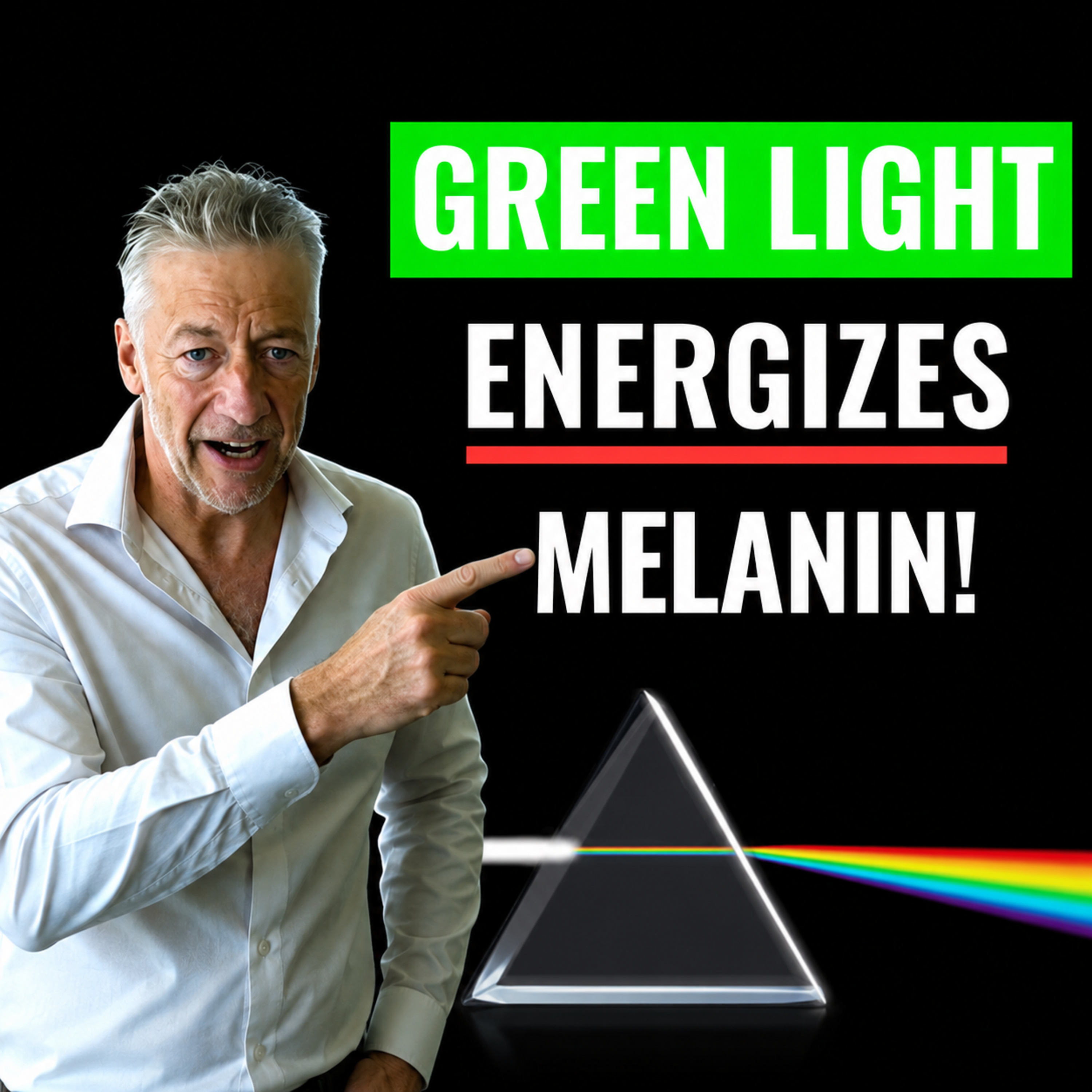
PhD Thomas Seager Explains Green Light Benefits | Melanin, Skin Health, Wound Healing, Hair Growth & Photobiomodulation | Cold Exposure & Mitochondrial Health
What's This About?
What if green light is an overlooked tool for skin health, wound healing, melanin, and hair growth?
In this episode of the Fitness Wisdom Podcast, I sit down with PhD Thomas Seager to explore the fascinating relationship between light, mitochondria, melanin, cold exposure, and human health.
We dive into the emerging science of green light therapy at 532nm and its potential applications for skin health, wound healing, hyperpigmentation, wrinkles, scars, migraines, and hair growth.
Thomas also explains how cold exposure influences mitochondrial function and internal light production, why shady forest environments expose us to unique combinations of green and near-infrared light, and why our ancestors may have evolved alongside very different light environments than the modern indoor world provides.
We also explore forest bathing, firelight, photobiomodulation, UV light, infrared light, melanin, mitochondrial energy production, and practical ways to create healthier light environments in modern life.
If you're interested in green light therapy, melanin, skin health, hair growth, photobiomodulation, mitochondria, cold exposure, and natural light, this episode is for you.
⏱️ Chapters
00:00 Green Light Benefits & Cold Exposure
00:06 Cold Exposure & Mitochondria
01:05 Mitochondria & Internal Light
02:07 Cold Exposure & Biophotons
03:22 UVB, Vitamin D & Light
04:25 Cold Exposure & Vitamin D
08:13 Photobiomodulation & Light Therapy
09:29 Shady Forest Light Benefits
11:14 Green Light & Near-Infrared
12:49 Forest Bathing & Immunity
14:19 Light & Wound Healing
15:24 Red & Green Light for Skin
16:43 Green Light & Hair Growth
18:34 Green Light & Melanin
20:05 Light & Cellular Biophysics
23:26 Light & Mitochondrial Energy
27:56 Natural Light Biohacks
35:40 Forest Light & Health
37:30 Firelight & Health
44:24 Green Light & Migraines
46:24 Green Light & Wound Healing
48:31 Green Light & Hyperpigmentation
50:16 Green Light & Fat Loss
54:11 Green Light Therapy Dose & Duration
56:56 Natural Light in Cities
58:36 Cold, Light & Human Evolution
01:00:12 Cold Water & Brown Fat
01:02:23 Green Light for Hair & Skin
-
👉 Find All Green Light Devices Here at a Discount with promo code: MOBILITY ✅
-
🌞 Join the Fitness Wisdom Podcast Community HERE:
- ➡️ Access Ad Free episodes of the show
- Transform Your Body & Health
- Connect with a like minded Tribe ⚔️
- Submit your questions to the Guests of the show!
- Exclusive member Blogs
- Health Optimization Protocols + Programs ✅
👉 I look forward to seeing you in there‼️
.
⤵️ Show Sponsors:
.
👉 Best 3 in 1 Blue Light Blocking Glasses Use code: MOBILITYFITNESS for Discount ✅ HERE
.
🦷 Favourite Mastic Gum Use code: MOBILITYFITNESS for Discount ✅ HERE
.
🫀 Elonga HRV Use promo code: MOBILITYFITNESS for Discount ✅ HERE
.
🧠 Vagus Nerve Stimulator: Use code: MOBILITYFITNESS for Discount ✅ HERE
.
👉 Find my favorite Blue Light Free Tablet ‼️ at a Discount HERE using promo code: MOBILITYFITNESS at checkout ✅
.
⚡ Best Grounding Mats & Sheets🔋 at a massive Discount
.
⬇️ Find & Connect with Thomas Seager:
Website
.
🌞 Find & Connect with me 👉 HERE
👉🏽 For Discounts & Offers: HERE
.
*None of the content / statements in this Podcast are Medical or Personal Advice & is not intended to cure, treat, prevent or diagnose any medical condition. All my videos are for Educational & Research purposes only. If you decide to try anything discussed in this video, you agree to do so at your own risk & responsibility*
This is the Fitness Wisdom podcast.
Professor Thomas Seger, welcome back to the Fitness Wisdom Podcast. It's always such an honor and a pleasure to talk with you. Thanks for having me back, this is great. You know, last time we had a very enlightening discussion on all things cold and the science of cold and cold thermogenesis. So I highly recommend people go and listen to that episode because it actually didn't get the amount of reach that it deserved back in the day. And I feel like it is slightly a bit of a censored topic. I feel like, you know, when you search online on YouTube might be true, maybe not.
But I just feel like the topic of I spots needs to get more awareness because it's so, so important for our health. It's not just something if you feel like doing doing it, but I just feel like it's something mandatory to actually do. But today we're actually going to be focusing more on light. And this audience loves all things biophysics and rhythm, quantum biology. And we talk a lot on the show about red and infrared light and the benefits of UV light as well. But we've never talked about the benefits of shady forest or Forest Green light.
So maybe do you want to enlighten us on this subject? Like what's the difference between red and infrared light versus green light for our health? There are two things that we got to talk about. The first is the connection between cold and light. And this is new. This isn't even in my uncommon cold book. This is something that I've been learning about the last 18 months. So we'll talk about that and then we'll talk about what is happening at the leading edge of photobiomodulation. So first, the connection.
Your mitochondria make sunlight inside your body. Most people say that's crap, that doesn't make any sense. You know, the sun is 93,000,000 miles away. How could my mitochondria possibly be making sunlight? But after you think about it for a second, they go, oh, in retrospect it should be obvious. You know that when you get into the cold, the mitochondria in your brown fat are making heat to defend your core body temperature. And everybody except the wackos that still think that adult human beings have no brown fat and it's just a rodent thing.
Except for those idiots, most of them went to medical school. Everybody understands that brown fat produces heat via non shivering thermogenesis when you're in the cold. Now, heat is just a word that we use for a certain part of the radiation spectrum. We might use the word yellow and we know that that corresponds to about 590 or whatever the heck it is. Nanometers. We might say blue and we know that's about 460 nanometers, or however it works out. We have different words for the wavelengths of different parts of the light spectrum, and heat is the word that we use for that.
Far infrared, thousands of nanometers in wavelength. Your mitochondria are producing far infrared light. These people go, yeah, OK, that's no big deal. Well, they don't just produce the far infrared, they produce light across the entire spectrum, including UVB and UVA. So when your mitochondria are engaged in cold thermogenesis, they're not producing ATP. All of that energy goes into producing light, and the light is spread across the entire spectrum, not just the far infrared. Some of that UVB light will intersect the precursor to vitamin D, which is lipophilic.
That means it resides, it's a form of cholesterol that resides in your fat cells. And when that little UVB photon intersects that precursor to vitamin D, it will convert its chemical form from something called pro vitamin D to pre vitamin D. That is then further metabolized into vitamin D, some of which will show up in your bloodstream. And people say that can't possibly be true until a group of Polish scientists studied women with multiple sclerosis. Vitamin D is not just a vitamin, it is a hormone.
Almost every single cell in your body has a vitamin D receptor. It is that important to every single function and in particular the immune system. Multiple sclerosis is an autoimmune disorder, and every single autoimmune disorder is associated with or originates in disorders of vitamin D. And so science have been watching the relationship between vitamin D and multiple sclerosis very closely. Ms. patients have always benefited from cold exposure. The heat is very hard on multiple sclerosis, but heat extraction improves their symptoms and may slow the progression of the disease.
So these Polish researchers say, hey, let's put these women with Ms. through cryotherapy and we will monitor their blood serum levels of vitamin D. No changes in diet, no changes in sunshine, no tanning beds, just 10 sessions of cryo chamber. Their vitamin D levels went up a significant amount. They also compare that to women who don't have Ms. They got an increase in their vitamin D, but the researchers say, hey, it was a small sample size. It was only 8%. It wasn't statistically significant. In the Mississippi patients, they did get that statistically significant boost.
One of my customers, she lives in Florida, she's got Miss Florida's very hot. She said, you know what, she read the article. I'm going to give it a try for myself. I'm going to monitor my vitamin D levels. She was on a vitamin D supplement that had been prescribed by her physician. She took her vitamin D levels up almost 3 times to like 160, which is too high and her physician who had 0 curiosity about what she had changed said you got to stop taking your supplement. The supplement got her up to around 45.
Now, supplements are not the same as sunlight or that endogenous vitamin D. But if you're, I don't know, on the verge of rickets, you can use a supplement to prevent an acute symptomatic problem. But I'm with Jack Cruz on this one. If your body can make it, you don't really need to take it. The supplements are a Band-Aid to get you to the lifestyle change that you really need. Her lifestyle change was ice baths. That ice bath generated UVB light inside her body that boosted her vitamin D levels to unheard of territory.
Her physician said quit taking your supplement and of course she feels great. What we have now is the clinical evidence of the end point in the bloodstream as well as the mechanism. This is a biophysical mechanism that explains the relationship between cold therapy and that clinical endpoint. This evidence is now very strong. Although if you ask, I don't know, AI ChatGPT, they'll say, well, you know, Seeger wrote some speculative articles on Morosco, but nobody really believes any of that stuff.
You should buy some drugs. Of course, that's that. GPT says because these AI engines are popularity contests, they are trained to speak like people talk to one another on Reddit and they will scour all of the Reddit posts. They have a licensing agreement with Reddit and they will speak to you like Reddit trolls will speak to you. With the one caveat that they always want to please you. They always want to tell you what they think you want to hear so they can keep you come back and clicking on them.
The relationship between cold and light is much closer and anyone has given it credit for. There are a few people who have have been doing the pointing in the right direction, even if they haven't been doing the clinical trials. Jack Cruz, Alexis Cowen, They've had very good intuitions, but then when you get actual patient data in a random sort of controlled study, you have to admit that their intuitions are leading the research. We should be looking at the relationship between cold and light much more closely than we have in the past.
So I started doing that. And that brings me to the second part, which is this leading edge of photobiomodulation. I know that your audience has already been educated on sunlight, on melanin as a critical chromophore and its capacity to act as a semiconductor that will convert the energy of light to energy inside your cells. This is wonderful, and it's also an oversimplification. People online who are paying attention have learned how important sunlight is, and they've learned how important darkness is.
So you have some people going so far as to to tape over the the little monitor power light indicator on their smoke alarms because they're trying to get into absolute darkness. I don't buy into it. I went down to Peru in the middle of the rainforest. We had no electricity. I spent a week, but moonlight is a lot brighter than I thought and I had no time. No problem walking around at night under the Half Moon. Darkness and sunshine are very important. What is not getting enough attention are two other light environments, the wood fire, and I hope we get to talk about that.
And the forest aid is probably more essential to human well-being than even sunlight. I'm going to try and explain why. What if your healthy habits and routines are quietly sabotaging your health and actually creating more stress on your nervous system? The truth is, your body is constantly giving you feedback, but most people are not paying attention to it. One of the best ways to really understand what's happening inside of your body is through heart rate variability, also known as HRV. The problem is, many HRV devices just give you a single number, a high score, or a low score without telling you what's actually driving the results.
This is why I use a longer HRV measuring device. Elonga doesn't just measure your HRV. It analyzes the components behind that number, giving you real insight into the balance between stress and recovery and really helps you understand what state your nervous system is actually in. In just a few minutes every morning, Elonga gives you objective feedback on how your sleep training habits and lifestyle choices are influencing your body. HRV is one of the most unbiased ways to see how your daily decisions are influencing your nervous system.
It shows you whether the things that you're doing are truly supporting your health or creating more stress than you realize. Instead of guessing, you can measure, learn, and make smarter decisions about your health, performance, and recovery. So if you want to find my favorite HRV measuring device, head over to the description and make sure to use the promo code MOBILITY FITNESS at checkout to get a nice discount on your entire order. Human beings were not meant to lie out on the beach all day. No matter what you hear about the UV light and the melanin and the semiconductor, you know when that UV index, like it does in in Phoenix, spikes up to 9 or 10.
You are not supposed to be wandering the beach or the desert sun tanning yourself all day. You're supposed to be under the shade tree. The lions of the Semana know this. The cattle in the field know this. Even the cats and dogs know this. In the shade, UVB exposure drops, but not to zero. You get the UVB that is scattered by all of your roundings coming in under the canopy of the tree. And so Jack Cruz just did a an Instagram live post from his pool. It reminded me of, you know, doing my ice bath lectures or something.
And he was talking about how do you build a solar callus in a newborn baby, which is a wonderful topic. He says start them off in the shade because they will get some UVB light under the canopy that is scattered from around them and they will get green and they will get red near near infrared. There are two wavelengths of light that dominate the shady forest, and the first one is about 540 nanometers, maybe 550. It's in the green spectrum. That should be no surprise. The leaves and the canopy are all green.
The second one is the red near infrared, just beyond the visible spectrum. The trees and the forest are loaded with near infrared light and they're about 7:30 to 700 and 70. And here's the amazing things. Melanin, which is the pigment in your skin that makes it dark and protects your skin from UV damage, does not just respond to ultraviolet rays of light. It has a very broad absorption spectrum and that includes 530 nanometer green and 730 nanometer red. To energize your melanin without the risks of UV over exposure, you need shady forest light.
So I had to go look this up. Andreas, I said to myself, if shady forest light is so essential, don't you think we would find something in the library talking about the benefits of shady forest light for for skin or for health? There are two lines of research here. The first is forest bathing. Forest bathing is getting more attention online because I won't shut up about it. I keep talking about of the studies in Japan where people will spend a few hours in the forest. They'll get an immune system boost, of course.
It will reduce anxiety levels. It will improve mood. Dean Hall cured his cancer using forest bathing. He cured his leukemia by swimming in the cold water for three weeks straight. But he still had lymphoma, and his doctor insisted on chemotherapy, Dean says. You know, give me a couple of months, Doc, and if and if, if I haven't cured it myself, then, you know, I'll come back. Maybe we'll do some chemo. He just went up into the woods and he did two days a week. He would spend one overnight in the woods in Oregon.
It cured him, his lymphoma, because forest bathing will boost the immune system. Everybody thinks it's because of a chemical called fight insides. And these are released by the coniferous forest. It's true. If you isolate the fight inside from the tree and you just use it in the lab in isolation, you get an immune system boost in animal models, and I think there's some human trials. The fighting sides are great, but not all forests release fighting sides. You might say it's the bird's song. You might say it's the, I don't know, the nature or The Walking or something.
All those things are also true. It is the light environment of the shady forest that promotes these health benefits. And here's how we know. There have been studies in the hospitals. They're not on the forest, but perhaps a patient has a window. And we know that patient rooms with windows are always healthier than patient rooms without them. But the view outside the window also makes a difference. If you have an urban landscape, it's better than nothing at all. But if you have a view of trees, those patients heal faster and have shorter hospital stays.
There was a dentist office. They painted a mural of the forest on the wall. And the patients reported lower pain scores, less need for medication, and better, more cooperative behaviors. In autistic children. The anxiety levels went down, the pain scores went down, The success of the dental operations went up because it was easier for the dentist. There are no fighting sides. Coming off a Bureau in a wall is the light environment. That is the benefit. The other reason that we know this is there are good studies in animal models where they wound a poor rat and then they test the different wavelengths of light that will promote skin healing.
Almost everybody knows that red light is good for your skin. The wavelengths that red light uses, 66880, these are the ones that anything longer than the 880 is going to penetrate well past the skin and it won't energize your skin cells. But the 660 will stay in the dermis and people get good results. They get some hair growth, they get some healing, they get some production of inflammation or faster healing of sunburn. That's great. They're not the right wavelengths. Those wavelengths target CCO, which is an important chromophore in the mitochondria, and that's great.
But for skin, the better chromophore is melanin, and you need 530 nanometer green and 730 nanometer red to target the melanin. So there's a study where they injure the skin of these rats and then they compare different wavelengths. Guess which wavelength works best? It is green. Green promotes skin healing faster than red does. And so I've come up with this. They call it the the skin light. This is a torch, just a little, you know, LED thing. And it's got two of these green. And then it also has three of the 730 nanometer red.
You can see how they're just on the edge of the visible spectrum. And you use this to spot treat sections of your skin. I tested it myself. I sent pictures to a skin care wound nurse and she's like, this is amazing. I have been getting now testimonies from the people who have been using this skin light to heal from surgery. So one woman who used it inside her mouth to speed the healing of oral surgery that she had people using it to heal the incision if they have a knee replacement. We're getting fantastic results.
This is the light of the forest on your skin that your body is tuned to, that very few people are bothering to talk about. They're talking about sunlight, they're talking about darkness, and they're not talking about shade and wood fire. So I should let you react because there's a third line of evidence about how beneficial the green is, but I've only been talking about melanin, the chromophores in the skin, so far. Most people focus on nutrition and exercise when it comes to health, and that's cool.
But if you're sitting under artificial lights all day, that's quietly sabotaging your health. That's not going to get you very far. As an educator, podcaster and fitness professional, I care about recovery as much as I do performance. The biggest secret to recovery isn't supplements, it's light. The light that hits your eyes is literally the instruction manual for your body. It says your sleep, energy metabolism and your hormones. The problem is the modern indoor lighting is sending that signal at the wrong times of the day, from morning to midnight, so your body never gets the message the day's over.
Now, if you already own a pair of blue light blocking glasses, hear me on this. Not all blue light blockers are equal. Viva Rays use a three in one light balancing system. Magnetic day, sunset orange and nighttime red lenses you swap to actually match the time of day. So you get energized in blue in the morning without the eye strain and protect your sleep at night. One pair dials you in for the entire day. That's the difference between just blocking light and actually syncing with it. Since wearing Viva Rays blue light blocking glasses, my sleep is deeper, my recovery is fantastic, and most importantly, my energy and cognitive function are through the roof.
If you're ready to experience the difference for yourself, head over to vivarays.com forward slash Mobility Fitness and make sure to use my code Mobility Fitness at checkout to get a nice discount on your entire order. The link will be in the description as well as in the pinned comments. Huge thank you to VRAS for sponsoring the show. Yeah, that was fantastic breakdown. I just want to comment on your cold part first before I talk about the green and everything that you said that was absolutely accurate for people who don't understand that nature doesn't make mistakes.
And when your body is placed in the cold naturally, like in the past, before we had technology and before we had housing, you would your body would need to be able to get sunlight somehow. So it just happens to be so that your mitochondria literally are the sunshine for your body. And that's basically creating the full spectrum of light that you're actually talking about. So it's absolutely fascinating. This is not like some woo woo information. This is a fact. People can go and look it up. And also for the for the green, Yeah, that's, that's absolutely incredible.
I mean, it doesn't get talked about enough. And we will dive into more of the benefits as well. And all of your anecdotal evidence that you've accumulated since actually starting to promote it yourself and talking about it. It's such an underrated subject. And I've always known that sitting on green surfaces, you know, grass or under trees, I always knew that it reflected the red and the infrared. That's the only part which I heard about. No one ever talked about the the green. So for me, the first time when I saw it on your Twitter on your ex and you started talking about the green and how it energizes melanin and all this kind of stuff, it literally blew my mind.
So do you want to maybe dive a bit deeper though for me? Explain to me when you say energize melanin, what do you mean? It's difficult to explain the movement of the electrons inside the cell. I'm getting this from Doctor Ahmed Amush, who is on my podcast. And I asked him the same question. He said, oh, no, no, no. You know, the melanin will take light and will create electrons inside the cell. And I said, OK, where do those electrons go? Well, they energize the they power the cell. Now this is a this description lacks specifics.
When you're a solar cell, for example, a photovoltaic cell absorbs photons. We know where the electrons go, these semiconductors, the electricity excites an electron, and then it's captured and it travels out a wire. The human body doesn't have wires. And yet we respond, of course, to electrons. I'll give you an example. When you are grounded, you get electrons from the earth. This is another thing that, you know, everybody on Twitter who follows you or me or Jack or Alexis, they all understand this.
But other people like electrons from the earth. That's crazy talk. And yet the, the science on grounding is so robust, so easy to reproduce that you're in denial if you're ignoring the electrons that are produced when melanin is energized by the sun. They don't go through a wire. And so we need to really decode what's happening in the the cell better. But the grounding electrons and the melanin electrons likely have similar effects. And this is, I'm going to speculate a little bit. Here's what I know about grounding.
You correct the mitochondrial membrane potential. Mitochondria, their job is to move electrons. When you make, for example, ATP, it's a process called respiration. You have carbon and you have hydrogen. It's either in the fats or in the glucose, and it needs to donate electrons to oxygen to produce carbon dioxide in water, which you then breathe out. This is how the mitochondria get the energy to make the ATP. To move those electrons, they must have a membrane potential. This is a voltage across a semi permeable membrane.
When that voltage gets out of whack, the mitochondria can't do their job. It's like pushing against a resistor. The electrons from the earth correct that mitochondrial membrane potential and allow the mitochondria to make more ATP and fewer reactive oxygen species. One way to think about Ros is that they're the sparks that fly off the wires. When the wires aren't properly connected, those sparks are OK until they get to be too much, until the melatonin in the mitochondria cannot absorb them, cannot neutralize them by donating their own electrons.
So I'm going to speculate about the light and the melanin. The mitochondria depend upon this membrane potential to have the correct voltage, and my guess is that the light that is producing using the semiconductor effect of the melanin is producing electrons, is correcting either errors or disruptions in that voltage, or it is allowing the more rapid transfer of protons. Here's a misunderstanding. We think of the body as if it were a machine, and the Pharmaceutical industry depends upon that misconception as if you were a a car and you just need to swap out a water pump or something.
The surgeon would love to put a new knee in your body as if you, I don't know, had spare parts sitting on a shelf. It is the wrong metaphor. Your nervous system does not transmit electrons like the wires in a printed circuit board does. When the body moves charge, it more often moves it in the form of a proton. Now it can move it in calcium, it can move it in lithium, it can move it in potassium. But the proton is the smallest most dense body of charge of material. That is mass that can hold the charge and it's protons.
They get moved across these membranes. For every proton movement, there must be a corresponding electron movement. But electrons don't travel through wires in the body, and they could. They must be attached to something else. They must be attached to a material. And so I'm speculating that the electrons that the melanin produces from light allow a better, a more efficient and easier movement of the protons on which the mitochondria reli to move charge throughout the body. What are those protons?
They are the H plus ion. And you know from listening to Jack that if you add a neutron to one of those protons, you have doubled the mass, but you haven't done anything to the charge. And now the mitochondria must push the deuterium protons, the D plus, not the H plus. Sort of it's like pushing it uphill. You have a bigger load and the same charge. Of course the mitochondria have to work harder to get the same amount of work work done. When you're giving the mitochondria energy from light, you're allowing them to move this heavier load.
There are other ways to do it. The deuterium depleted water the Jack is talking about makes it easier on your mitochondria. The amazing thing is mitochondria can put up with a lot of abuse. They can put up with some of those non-native Emfs, they can put up with some toxins, they can put up with a little bit of blue light at night occasionally. As long as they get a break, as long as they get to recover, as long as they get some dark nights and some intermittent fasting, they get some good cold exposure, your mitochondria are going to be fine.
Unless you have cancer or or a mitochondrial disorder, you don't need to baby your mitochondria as much as you need to give them a break. They need to sleep. They need to go through mitophagia, mitobiogenesis. But they do respond well to hormetic stress. Remember that stress curve, a little bit of stress and you're healthier. Too much stress and it can kill you. It we don't mean to to keep all mitochondria free of stress all the time. That's part of the point of the cold plunge. UV light is both a stressor and stimulates an adaptive response.
The shade is easier on your skin than the UV. You need some UV and if you can't get it then you definitely need the cold and you need a lot of shade, way more than people have given it credit for. Modern life has created the problem our biology was never designed for. It keeps us stuck in a state of fight and flight. Your biology isn't designed to live there 24/7. The parasympathetic nervous system, which is your rest and digest state, is where your body can prioritize restoration, regeneration, and resilience.
That's why tools to optimize the parasympathetic state are an absolute game changer for nervous system optimization. Xenoel, a transcutaneous auricular vagus nerve stimulator, stimulates the vagus nerve through the ear, supporting the pathway involved in autonomic balance and regulating brain body connection. Whether I'm dealing with chronic stress, trying to optimize recovery, deepen my meditation, or simply counter the demands of modern life, Xeno Well gives me a practical way to help my nervous system transition out of a constant stress mode and back into a state of recovery.
Because true performance isn't always about pushing harder, it's about knowing how to switch into recovery mode. So if you wish to explore my favorite vagus nerve stimulator, head over to Xeno Well AI forward slash Mobility Fitness and make sure to use the promo code Mobility FITNESS at checkout to get nice on your entire order. Yes, and people need to just spend more time outdoors in general. And a lot of times I tell people that, you know, you don't need to sit in direct light to get the benefits of being outdoors.
You can just sit like under an umbrella or something, you know, if you don't have access to a forest or a tree and just be spend as much time outdoors as possible. If you can have your bare feet grounded, at least you're getting that reflection of the light from the grass, you know onto your body as well. So that's definitely benefiting you. So I guess it doesn't need to be maybe forest in order to actually get the benefits of the green. Hang on, you're in Cyprus? I'm in Phoenix, AZ. It's nice to say, you know you should be outdoors as much as you can, but my built environment in Phoenix is inhospitable.
It was 117° in the air in Phoenix, on the sidewalk. It's barely tolerable. I'm not going to take my shoes. I get third degree burns on the soles of my feet if I were to attempt this now. Maybe people just shouldn't live in Phoenix. Maybe we shouldn't build skyscrapers and apartment buildings in large university campuses. But I love my job. I love my role as a professor of civil engineering at Arizona State University. I can't get out into nature as much as I want to. And so instead, because I'm an engineer, I build these machines like ice baths or green lamps.
And these machines, they bring some of that nature, some of that forest light to me. And it makes living in an urban area like Phoenix where you do have to stay indoors. And a lot of people are. Vitamin D deficiency ironically makes it more tolerable and healthier. Yeah, it's important to, you know, biohack your health, especially if you're living somewhere where you can't get access to nature like you're talking about. Very, very important. So many people are in your situation and they always ask me all the time, what am I supposed to do if I can't get outside?
You know, I work all day. I waken, you know, work in an office the entire day and they go to work when it's dark and they come home when it's dark, you know, and you're still exposed to all of these different lights. So we have to find ways to mitigate this indefinitely. Technologies can be absolutely incredible, and that's why we've got you on today to enlighten us on this subject. So I'm really like grateful and happy that we're doing this. Do you want to maybe tell me though, the next part of the discussion which you were telling me about the green, you were saying that you were going to tell me about the benefits of the green as well, beyond the melanin, energizing the melanin, Obviously by doing so, that must come with a whole host of benefits for our health.
Well, let me tell you how I got into green light in the 1st place because I was really concerned about vitamin D, ice baths, UV light and Google must have figured this out. I I don't know, you know, Google is paying attention to everything that I say and I'm probably going to get ads for my own product after this, you know, podcast because meta or something to be like, Oh, this guy definitely wants to buy some of those migraine listening, right. So I'm, I'm doing my library searches on light and Google must have sent me a paper from Harvard University that was using green light.
It tested every color of the spectrum on Migraner. So these are people in active migraine. There's something called photophobia. When you have a migraine headache, typically you want to lock yourself in a dark room and wait until the migraine process resolves itself. For some people, it's ours. Any amount of light will make the pain worse. And so the Harvard researchers, they wanted to understand whether there was a relationship between the wavelength and the photophobia. They tested all the wavelengths, and every single one, including white light, made it worse, except for green.
Green improved pain scores in people with active migraine. The Harvard researchers don't know why, but University of Arizona has a research group that looks at headaches, and they picked up on it. They started doing clinical trials on green light for pain, migraine pain, fibromyalgia pain, and they got statistically significant improvements in the pain scores and a reduction in the frequency of migraines from people who would expose themselves through the eyes to green light every day. They replicated the wavelengths and the intensity of the Harvard study, and that meant that their research subjects had to lock themselves in a dark closet for 45 minutes a day and allow the green light to indirectly enter their eyes.
The people in the study thought it was a godsend because they were on medications, in many cases for migraines, but the medications interrupt the migraine process. They do not allow it to resolve, and so the energy crisis that precedes the migraine in the brain was never resolved by the migraine process. Sure enough, you get something called a medication overuse headache, which is a terrible term because the migraine is taking the medication that their their physician prescribed. The medication makes the frequency and severity of the migraines worse over time.
So of course they take more medication and of course their migraines get worse without medication. The green light improved their migraines and they didn't want to give the devices back to the researchers at the end of the study. So I took a a red light light box. This is a portable battery operated red light box. And I asked a friend if he could put a couple of wavelengths of green in there and he did. We came up with this device and we both thought, Oh my God, this is way too bright. This makes no sense.
It's far more intense than the Harvard study. It's going to give me a headache if I didn't have one, you know? Well, a woman I was dating at the time, she suffers from migraines and she saw this device and she said, give me that. And she put it right up against her face, closed her eyes and said, this feels really good. And that's the realization. The Harvard study and the University of Arizona studies, they intentionally blocked out all of her wavelengths. They would lock the subjects in a dark closet.
But Andreas, you know how to block the wavelengths. Shut your eyes, and when you have a bright green light that is shining through the eyelids, the eyelids will allow about 30% of that intensity through. You're still getting the benefit of the green, even though your eyes are closed and you've already shut out all the other wavelengths. It takes 5 to 10 minutes. People feel an immediate relaxation, and then 5 minutes later they'll take their their visual analog scale pain score headache. It might go from 8:00 to 2:00 or 7 to 0.
They don't need the medication. They feel complete relief from the pain. But curiously enough, the rest of the migraine often progresses, whether that's visual disturbances or Vertigo or or lethargy or whatever is going on. They don't have the pain, but they do have the migraine process. Of course, you can imagine the the reviews on the Migraine Lamp website. People are writing in and saying this is miraculous, but it's only about 80% of the people. There's a type of migraine that is associated with hormones at a certain point in a woman's cycle.
And for whatever reason, migraine can't seem to touch it. Post concussion headaches, sinus headaches, migraine headaches, we got you. Tension headaches, stress headaches, migraine takes care of it, but these hormonal headaches can't touch it. And so migraine offer, you know, try it for 30 days. If it doesn't work out, you can return it if yours is a type of headache that doesn't work. But for those that do no medications, they quit their trip tans. And this is a, people say game changer. Now this is like a miraculous product.
People have been waiting for this in some cases their entire lives. That's how I got into green light therapy and that's how I started thinking about the forest. Well, Harvard picked this up and they said here's what we want to do. Never mind pain, we want to do a study of psychotherapy. This is conventional talk therapy for people with general anxiety disorder. And we're going to create two groups. 1, the conventional fluorescent lit suburban strip mall psychotherapy office. The other same type of office setting but lit exclusively in green.
They got a statistically significant reduction in general anxiety disorder among those patients that were treated with the green light. Why? How? The neurologists do not understand the mechanism by which stimulating the optic nerve in green will interrupt pain signals in the brain. So instead we're going to we're going to make up a story. Where would our ancient ancestors have sought refuge from the predators that would otherwise eat them and their children? Andreas who wouldn't be in the grass, it wouldn't be in the water, not necessarily.
It would be in the trees. Now, there are predators that can be in the trees too. But the theory here, the story, the hypothesis is that there is something in our neurology, our whole nervous system that is calmed by the trees, that when we get that green light signal, there's something about us. As long as it's not deep, dark, pitch dark forest, as long as it's a shady forest in which we can see there's something about the human condition that says you have access to shelter, you have refuge. Whatever danger it is, you're going to be fine.
And perhaps that story is the explanation for why we're so comfortable in the shady green forests. Not the Hansel and Gretel like pitch dark Bavarian of forests of like the Lord and the Rings, you know. But we're talking about the shade trees in which we can navigate in between them and we still have a healthy, light environment. Wow, wow. And so when people are going in the forest then like because I personally notice that if I'm in the jungle or if I'm in the forest, depending, you know, where I'm traveling, I find it very cooling and very soothing on my skin.
Is it? Does it like have anti-inflammatory effects as well because of the green? There's good clinical data on inflammation and forest bathing. And the weird thing is it doesn't really take a lot. It's a few hours a week. You don't have to go camping. You know, Zach Bush was just on Joe Rogan and he said three days of camping will turn your biological clock back ten years. I'm paraphrasing, and I don't doubt it. We've all had the experience of being outdoors, sleeping outdoors and feeling as if everything was sort of right with the world.
But it don't. You have to go off grid for three days, you get 3 hours in the woods and it's going to help you tremendously. That's what the data is telling us. Zach is somewhat famous for saying something else, saw a clip that was circulating on Instagram. He's a medical doctor. I'm an engineer. And he said one of the things about the wood fire is when you were looking down and your eyes have to be down and you're letting the light of the fire come into your eyes. It impacts your mood, your psyche and your Physiology in a specific way.
I thought, huh, part of going outside for, you know, going off grid and camping for three days is always a fire. Is it really you know? Of the great outdoors or is it the experience that many people have, you know, had the benefit of whether was it summer camp or a bonfire event or something? Or is it the experience of sitting around the fire and gazing down in the way that Zach Bush says he has these tremendous neurological and physiological benefits. So I had to look up wood fire. Remember, there are four light environments that are essential for human health.
The sunshine, the darkness which people get, the shady forest light which has been neglected, and nobody is looking at what is characteristic of the wood fire that might promote health. There are two ions trapped in the wood that when they are on fire, they get excited and then the electrons jump up, they jump down and then they release light. This is the same principle by which fireworks work. You could put magnesium in a firework, you get white light. You put copper in a firework and I forget, maybe it's blue.
You put cobalt in a firework, you get a different color. I forget. But all the colors of the spectrum correspond to certain metals because they all have their specific spectrography. OK. In the wood there is sodium, and potassium is not a natural gas fire because, you know, we have them here in Phoenix, little natural gas fireplace, and they're sort of OK, but they don't look the same. They don't feel the same. You don't get the same sort of warm coziness off a natural gas fire that you do off the wood.
Potassium will release amber light at 590 nanometers. I'm sorry, that's sodium. Sodium will release amber light at 590 nanometers. Potassium will release red near infrared at 770 nanometers. It turns out in the typical species of wood, the potassium is much stronger than the sodium, but you don't see it as much. And This is why the fire looks mostly amber, like an orange color with a little bit of red in it, because that's what's visible to us. So I'm like, OK, those are the peeve wavelengths of the wood fire.
If Zach Bush is on to something about, you know, the the benefits of the wood fire, then there must be something that this light is there must be some chromophore inside the body that responds to to the 590 and the 770. Andreas 770 is the peak absorption for hemoglobin in your bloodstream. And we could say, well, that's just a coincidence. But I agree with you. Nature doesn't make mistakes. And so when the 770 is on your skin or entering through your eyes, it is absorbed by hemoglobin. If you go to the library and you ask the scientists who have published, well, what happens after the hemoglobin absorbs this boton in 770, they'll say, oh, nothing, nothing.
It's just released, as, you know, heat. It did. Nothing happens. I don't believe them. I think that they haven't asked the right question. I believe Zach Bush, who says that these neurological and physiological benefits are associated with the wood fire. And I think that the mechanism is the light. Yes, the far infrared spectrum, the warmth of the wood fire is kind of nice, but you can get that from the the propane. You can get that from, you know, the burner on your stove. That is not the the sort of active light ingredient.
I think it's the 770 that is hemoglobin and the 590, the chorus response to that peak in sodium 590 nanometer light will induce lipolysis. So this is the release, the shrinking of fat droplets inside the fat cell. They were released fat into the bloodstream. Now where it goes after that we don't really know, but imagine Andreas, that it's a cold night and you have a fire. The your back of course is cold and it's activated your brown fat. You're doing thermogenesis inside your body. That thermogenesis is fueled by lipids released from your white fat cells.
What would promote the release of lipids from your white fat cells? The 590 nanometer amber light coming from the wood fire. So I've talked a lot about green and the benefits of shade. I'm just getting started on talking about the benefits of wood fire. I got to get into the studies that Zach is citing about staring down at the wood fire, letting these wavelengths in through the eyes. I suspect they're also quite healthy on the skin. 590 doesn't penetrate very deep, but if a woman is got Cellulite, if there's a part of her body that she's not happy with, it's lost its tone.
The 590 will also support her collagen and perhaps after a cold plunge, when she's in cold thermogenesis, she could use a 590 light to do a little body sculpting on those parts where she feels like she could use some lipolysis. So I've also so invented what's called a basking lamp. I can't call it a tanning lamp because tanning lamps are so dangerous and stupid. They give you the UVB, but they don't give you the benefits of the near infrared, which helps prevent and heal the sunburn. The basking lamp has two modes and one is, you guessed it, forest light, and the other one is wood fire light.
Now you can't get the forest light without so also getting the wood fire. I don't want people to get UV in isolation without the near infrared. So if you're going to do the forest, you're getting all the wavelengths, you're getting UVB for vitamin D, you're getting UVA for the nitric oxide release. The vasodilation associated with that. You're even getting the Violet. Right on the edge of the spectrum is 380, which activates opsin 5. This is what tells your body the UV light is present. You're also getting, of course, the green and the 730 nanometer near infrared that's characteristic of the forest.
When you turn on the wood fire mode, you get the amber, the 590 associated with the sodium in the wood. You get 770 associated with the potassium for your hemoglobin. And then of course you get some of the other CCO targeting the 660 and the 830 is what I put in the basking lamp. It's not a tanning lamp. It will give you a tan, but it's not a tanning lamp because tanning lamps are terrible. It's for basking in and so Google has no idea what it is. You can look for it and Google won't let you find it.
But I put it in pre-order on the my greenlamp.com because it is now the most sophisticated, most complicated and best of the photobiomodulation devices available on the market. Every cheap Chinese manufacturer in Shenzhen will crank out a classic red light near infrared PBM, you know, CCO targeting thing and you get them very inexpensively off of Alibaba. When I wrote to those manufacturers that look, I want these wavelengths, you know, you got to have 730 in it. They, they wrote back to me in broken English and they said no, no professor 730 does nothing not good wavelength.
You do not want that one. Exactly what I needed to hear because as in January 2026, the scientists in Hong Kong specially made a hood that is supposed to go over your head to see whether they could stimulate hair growth. They. Actually saw that study. You saw that study, that's good because I was tweeting about it. They were hypothesizing that the 730 nanometer, remember this is the wavelength that corresponds with melanin absorption in the red near infrared. And their hypothesis was that that this wavelength of light would penetrate the right depth to where the stem cells in the hair follicles reside.
That if they could use the wavelength that goes to the correct depth and target those stem cells, they could promote hair growth. Guess what, Andreas? It worked. And so now this is the first hair growth hood that has the green, which is good for your skin and also promotes hair growth. 660 nanometer to penetrate to the dermis and stimulate the CCO in the mitochondria and the 730 that will reach the right depth of the hair follicle. There's nothing like this anywhere on the market. And it's because it takes a long time for science to to, to make its way into product development.
It took about 20 years for photobiomodulation devices to leave the lab and enter the marketplace. I don't want to wait 20 years. People are writing to me and saying, can I get this thing right now? So I ginned up, you know, a, a prototype. I asked China for these wavelengths that told me, don't do anything. And I've distributed them to test subjects. About 45 people have signed up, paid money and said that I am willing to test this hair growth hood. Please send me one. I can't wait until they tell me how it works.
Takes about six weeks. Imagine a tablet that doesn't blast artificial blue light into your eyes, disrupt your sleep, or sabotage your health, but actually use the sunlight to power the display. If you've been listening to this podcast, you already know how damaging constant artificial blue light can be on your circadian rhythm, your sleep, and your overall health. That's why I love my Paper 7 tablet by Harborino. It's definitely one of the most interesting devices I've used in a while. The Paper 7 tablet uses something called an RLC 3D display, which means there is no backlight and essentially no blue light.
Instead, it reflects ambient light just like paper. So the brighter your environment, the better the screen looks. And unlike E Ink devices, which are slow and stuck in black and white, this gives you full color, a smooth 60 Hertz refresh rate and the ability to run all of your favorite apps. It also comes with 8 gigabytes of RAM for smooth performance, a 7.8 inch display that's perfect for both reading and productivity. And at only 240 grams, it's easy to carry around anywhere. The battery life holds out really well too.
You're getting around 10 hours of active use and up to 12 days on standby, so you're not constantly thinking about charging it. For me personally, I like to use it a lot for writing, researching, and preparing for my podcasts. Basically all of my administrative work. And the best part is I can do all of that outdoors in natural light, so I can actually support my biology while I work instead of fighting against it. And because the screen gets brighter in brighter environments, it's incredibly easy on the eyes, even in direct sunlight.
I've also noticed that it naturally improves my nighttime habits because indoors, especially at night, the screen isn't overly bright or stimulating since it uses your environment to power the display. So it kind of guides you towards better sleep hygiene and healthier circadian rhythms without even trying. At the end of the day, technology isn't going anywhere, so the goal is to find tools that work with our biology, not against it. And this is definitely one of those devices. You definitely want to hurry up and grab yours today as they are extremely popular and run out of stock really fast.
The link will be in the description below along side with a 15% discount code. Wow, Wow. It's incredible. Yeah. I was actually going to ask you, does green light actually benefit hair growth as well? Maybe tell me a bit about the skin as well. Like what happened, You know, when green light strikes our skin. You talked about the energizing the melanin. Is it like helping get rid of wrinkles? Is it helping with scars, wound healing and all that good stuff? Correct in all respects. The relationship between green and melanin and the melanocytes that produce melanin, it's been around for a long time.
Then the green light is intense. You can use it to remove what people call hyperpigmentation. So this could be an age spot, and my grandmother used to call them liver spots. It's a area often shows up on the face or on the hands that is darker than than you want it to be. Sometimes it's a freckle. So this is a part, a patch of skin that has excess melanin. Melanin absorbs green and when you use these sort of low level LED sources of green, it energizes the melanin. When you use a green laser, particularly if it's pulsed at a picosecond frequency, you destroy the melanin.
The green is targeting the melanin, but just like that dose response curve where a little bit energizes it and too much destroys it. Green lasers have been used to remove this excess melanin in this hyperpigmentation for years, and there's great studies on this. So green lasers are in this sense treating the skin not to heal it, but to destroy the melanin inside it for cosmetic reasons. And there's nothing wrong with that. But the green in the low level, the LED levels, not the laser, energizes the melanin and promotes new skin cells underneath.
That is, the longer the wavelength, as a general rule of thumb, the further the light will penetrate. If you want to treat the skin and you're using the 660 or the 880, you're going right past it. Most of the energy of the red light is is going further into the skin, not at that epidermis dermal layer where new skin cells are generated. But the green light, to which melanin is very sensitive, will penetrate to the right depth millimeters where new skin cells were formed. So you can use it when you have a scrap patch or a scar or a scab.
Like, I don't know, I bump into things too much. And so I get scabs on my legs and I'll take the forest skin light and I'll treat the scab. And the rate of healing is accelerated by the light, but not too much, not more than there's a little pulse mechanism on it, which I don't think does me anything. I haven't tested it or compared it, so I'm saying not too much, just 20 minutes a day is the Max. When I've been doing 5 minutes a day on a skin lesion that seems to work really well. And if I'm trying to push the envelope I will use 10.
But I don't think it works any better. A lot of people in this space think if a little bit as good, a lot must be even better. And it is not the case. It doesn't take very long or very much of this narrow band wavelength green and near infrared light because it's intense coming out of the LED. Wow. Wow. Incredible. Yeah. And so you're saying it destroys the melanin? Is that because like, I don't know, because it's the chromophore, the melanin itself absorbs all frequencies of electromagnetic radiation, so therefore somehow the green, it doesn't like the green or how?
How does it happen? It it does like the green, it loves the green, it's very sensitive to the green. But too much green will destroy the molecular structure of the melanin. A little bit of green and it energizes the melanin because the melanin acts as a semiconductor and it will jump electrons up the thing, then be captured by the cell. But too much green destroys the bonds that constitute the melanin, and so it disappears and all those atoms have to be reabsorbed by the body. I'll give you another example of this.
UVB will stimulate melanocytes to produce new melanin and it takes a few days. So if you go to the tanning booth and you get UVB, you might come out and say, well, nothing really happened, where's my tan? The tan will show up in a couple of days. UVA will oxidize melanin and make it darker. This is not a good long term strategy. It will give you a tan, but this tan is like an emergency that your body is responding to. It's taking the melanin that's already in your skin and darkening it for you. And so you go into the UVA tanning lamp and you're like, oh, this is working great.
Look at me, I'm so tan. But if that bed doesn't have the UVB, the oxidized melanin is removed by the body. They're like, well, we don't want this stuff around. And the tan fades, which of course means you have to go back to the tanning booth again. And they keep you on the cycle of destroying your melanin and then oxidizing the new melanin that your body makes. There are some pale people. You're based upon their Fitzpatrick score, you know, the redheaded. And you say, well, you know, they can't make melanin.
And that's an oversimplification. There's something like 25 different forms of melanin in your body. There's no one molecule of melanin, but we can talk about it on a podcast as if there is. When the people with fair skin, and I'm related to a lot of people with fair skin, overexpose themselves to UVA, they are not getting the melanocyte stimulation, they're not getting the melanogenesis. They're only getting the oxidation of the little bit of melanin that they have. And you know, the UVA is much more abundant throughout the day than UVBUVB because it's a shorter wavelength is attenuated by the atmosphere.
The longer the path of the sunlight through the atmosphere, the less UVB. So dawn, no UVB. But UVA comes online when the sun is a little bit higher, UVB when the sun, not in Phoenix, maybe not in Cyprus in the summertime, but a lot of latitudes of my relatives live at the UVB is only present in the middle of the day and they're not exposing themselves to this healthy UVB dose that makes new melanin. They're only getting the UVA that will oxidize the melanin. So here's what I'm saying. This dose response relationship.
Different wavelengths target different chromophores, and they have different effects. Those wavelengths are available more or less depending upon where you are in the day and what your light environment is. And all of this, you know for the most part makes sense. But the extent that is the amount of dose also changes the body's response. You must match the dose, and that means the intensity and the duration of the exposure to the desired outcome. If it's too intense or too long, you will get these perverse results, not the beneficial result that you're looking for.
And it's very difficult for people who have a competitive mindset to tell them no, no, no, no, no more than 10 minutes. You're fine because the competitor in them is always thinking more must be better. It is not. You're looking for the sweet spot and you just like with ice baths, I'm not trying to send any records. I don't need to be in the ice bath for four hours, 2 to 4 minutes a day. Just about as long as it tells takes me to explain bio Photon guns or something and then I'm great. You do not want to overdose on anything, not in nature, and certainly not in the biohacking machines that make it so much easier to overdose than nature would allow you to.
Yeah, it's the consistency that wins, right? Like it's nature doesn't hurry but everything is always achieved so it's always takes his time. It's that consistency day after. Nature, it turns out, is very wasteful. There are a lot of wavelengths in the sun that don't do anything at all, you know? They're just not tuned to any of our chroma force. When I say nature is wasteful, you know, imagine the salmon. They swim upstream here in the United States. They go back to their spawning place and they spawn thousands of eggs and then they die.
What a waste. Of those thousands of eggs, how many actually grow up to be adult salmon? Maybe 2. Nature is wasteful and it can afford it, but machines cannot afford it. I got a battery in here and I cannot afford to put in wavelengths for which you have no chromophores or don't stimulate anything in your body. Because machines are expensive and sunlight is cheap. And so the reason that we go with these narrow band LED photobiomodulation devices is because we can't afford to hit you with everything.
And in some cases, like the migraners, we don't want to hit you with everything. Depending upon your condition, some of those wavelengths might be deleterious. There's some photobiomodulation devices that have blue light in them, and blue light is associated with certain skin and health benefits, but we get so much of it from everywhere all the time that there's no reason to buy another device to give you more blue light. So I don't put blue light in the basking lamp. Yeah, yeah, yeah, exactly. No, I've seen those.
And I'm pretty sure that there is also those response to red light therapy as well, because I know a lot of people just abuse them, you know, because they feel like more is better like you mentioned. And maybe people haven't necessarily noticed any adverse effects or side effects, but I noticed that I have very strong panels. I won't name names of the brands, but if I'm using them too long or if I'm sitting too close for a long period of time, I've noticed that it actually does cause some adverse effects to my skin.
And so, yeah, you need to be careful with these things, especially if they're powerful devices for sure. Correct. I agree. Just like you need to be careful with the sunlight. If you haven't built up a solar callus, you don't try and do it all at once. You Ty tree your exposure to the sun. So because it takes days to build this new melanin and the seasons work exactly like that, we're supposed to be outdoors in February, March, and then by April, those days are starting to get longer. It doesn't feel like summer, but we're starting to get more sunshine.
And that's when the UVB, for most of the United States anyway, begins to come online and expose us gently so we can build the solar callus that will take us into June. There's no shortcuts when it comes to nature. 100% you know, it was really enlightening what you said to me about the UVA and the UVB and about the UVB being more oxid. I mean, UVA being more oxidative and the UVB actually building the new melanin. I actually didn't know that. So thank you for that. It's I always love learning something new and I learned so much from you today as always.
And is there anything else that we didn't talk about before we close out the show that you want? To we've talked about so many different migraine products and thank you for allowing me to do that. We talked about grounding. We talked about how cold thermogenesis produces sunlight inside the body. And I think your audience is going to be receptive to many of these ideas. But one of the things that comes up and sometimes I disagree with Alexis Cowan about mitochondrial haplotypes. If I'm the type of person who is descendant from these Equatorial populations, should I really be getting cold now?
Alexis loves her cold. She doesn't go, it's super freezing, but she'll go in for 2025 minutes at about 50°. She has Morosco, she loves to post about it. And although there are different mitochondrial haplotypes, I'm going to tell you a story of our ancient ancestors. It's about 70,000 years ago there was an enormous volcanic eruption. Ash is spewed throughout the upper atmosphere and there was no such thing as a summer for years because the ash was blocking the sun. Now you can imagine what must have happened to the glaciers.
They grew. You can imagine what must have. There was no agriculture, but what must have happened to the plant life and the animals. It was a very difficult time for humankind and humanity was reduced to several thousand people. If you believe the fossil records, the oldest human fossils are found in East Africa and the Rift Valley. Now, I don't know if that's the case, but there are also glaciers in East Africa at the Ecuador. There are four modern glaciers in the mountains on the equator in East Africa right now.
Our ancient ancestors had Physiology that would somehow survive this volcanic eruption in the ensuing Ice Age because they made heat and light inside their body. They forged in the water because the ground was either frozen or denuded because the light conditions were so bad. They made light inside their body because that water was cold. We are all descendants of people who were built for cold water. And this is the the last part. I know that I'm I'm storytelling here, but don't think that cold has no benefits for you because your grandfather was warm all the time at the equator.
That is not the case. One of the things that I was gratified to hear Jack say in his Instagram Live is that he was thinking about cooling the pool that he has in Ecuador because he gets a lot of sunshine. He's very happy with the Bitcoin environment and the politics, I'm sorry, in El Salvador. But one of the things he misses is cold water. And I don't want people to. We've been talking about light and light inside the body. I don't want people to think that cold water is just a nice to have. You said it at the beginning of the podcast.
Cold is essential for the health of the human body. I do it every day, and you don't have to have it every day to get that essential brown fat. The brown fat and the thyroid are in constant communication. The brown fat is highly innervated, which means it's activated by your nervous system and it's not a nice to have organ. It is essential internal organ. Most people don't have it and I don't want them to tell excuses to themselves about why they don't need it. They do. 1000% Thank you so much Professor Thomas, it was an absolute pleasure and I will make sure to put your links in the description below as well alongside with a discount code for the audience.
They'll be able to find the best eye spots in the world alongside with all of the green light devices that you mentioned like the would you call it like a helmet or what would you call it like a hood? You know the one for the. Hair. Yeah, the, the one for hair I, I call a hood and I say it's for men. And the reason I say that is because the LE DS in this hood are distributed so that they come down along the sideburns and will only energize dormant hair follicles and also active hair follicles. If you have no hair follicles, it's not going to grow hair, but if you do have hair follicles, it will.
Men need this additional coverage. Later I'll come out with a cap for women because women want robust, dense, thick hair as well, but they don't need it coming down along their sideburns like men do. It'd be funny if they started growing a beard. It's not going to happen and just because you get into the ice bath and boost your testosterone levels is not going to turn you into a man. Women need testosterone just like men do. All sex hormone synthesis originates in the mitochondria and the best way to stimulate MiTo Biogenesis is the cold plunge.
So I don't want to hear that women are afraid they're going to get a beard or something like that. It's not going to happen. They need a healthy light and temperature environment just like men do. Amazing, amazing, and I can't wait for my multi multi tissue green light torch as well to arrive. I'm excited to experiment with that and I'll give you some feedback when I try on some areas of my body, you know, and see and see what goes on. So thank you so much. I again, as I said, I'll put all your links so people can actually find you on Twitter as well and connect with you.
And please stay on the line when I end up, I will. If you guys enjoy the topics and guests I bring on the show, I would really appreciate if you left me a five star review on Spotify and subscribe to Fitness Wisdom Podcast on YouTube as well. This helps us spread the knowledge and wisdom with the world. Until next time.
 Apple Podcasts
 YouTube
 Spotify
 Castbox
 Castro
 Goodpods
 Moon FM
 Overcast
 Pocket Casts
 Podbean
 Podcast Addict
 Podcast Republic