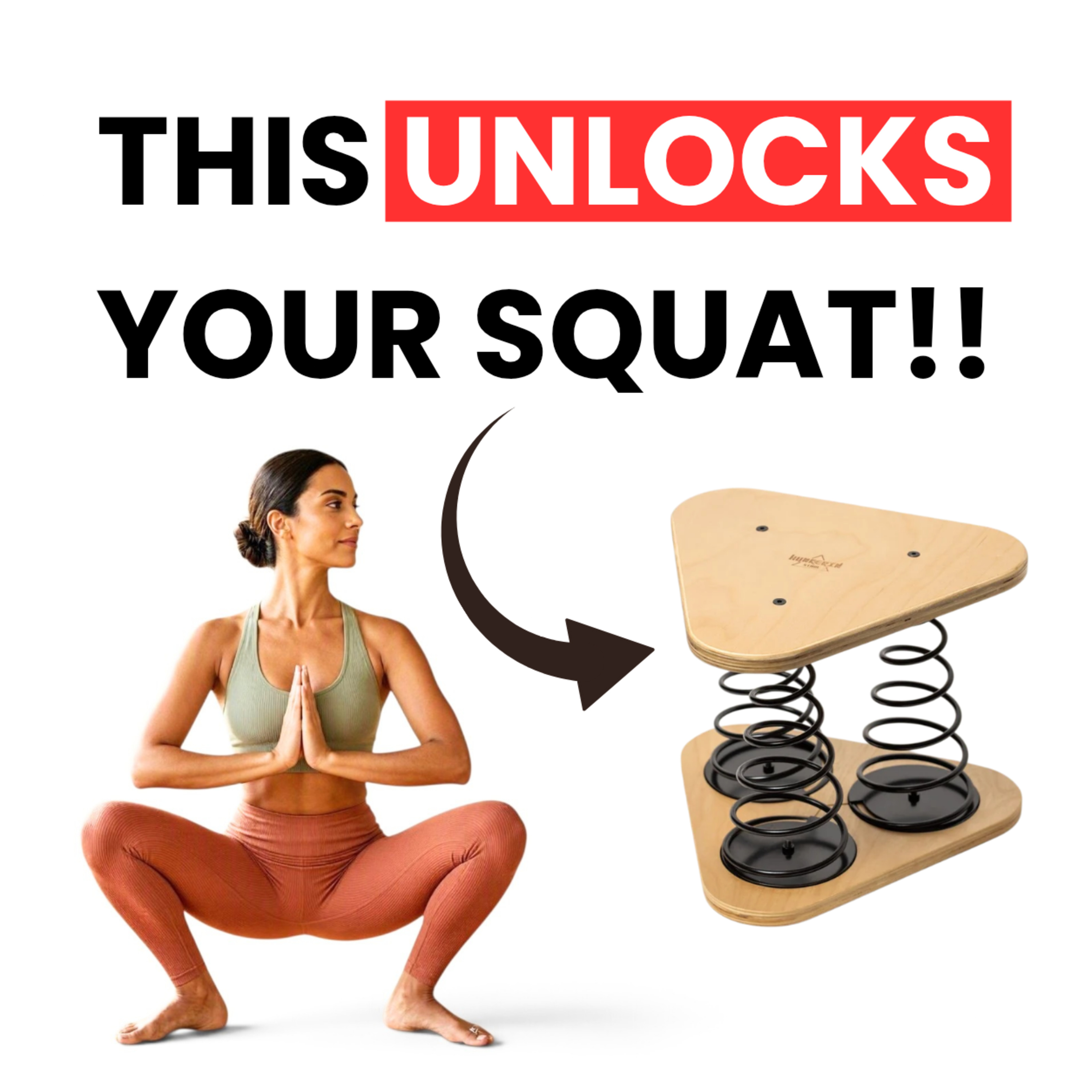
Sitting Sabotages Your Spine Health, Posture, Chakra Alignment, Mobility & Longevity | Malasana Pose & Deep Squat Explained | Hunkerin Stool with Kasey Jackson
What's This About?
What if sitting for hours every day is quietly affecting your spine health, mobility, posture, and longevity?
In this episode of the Fitness Wisdom Podcast, Andreas sits down with Kasey Jackson, inventor of the Hunkerin Stool, to explore why the human body may struggle with prolonged static sitting and why returning to more natural movement patterns could change how we use our bodies every day.
We discuss spine health, posture, mobility, active sitting, deep squatting, nervous system health, and the Malasana pose, along with the ancient practice of resting in a deep squat.
Kasey also explores the connection between posture, chakra alignment, energy flow, consciousness, chi, and prana.
You'll learn why the “next posture” may be the best posture, how prolonged sitting can affect movement quality, and how incorporating active movement and primal positions into daily life may support strength, mobility, and body awareness.
We also explore the story behind the Hunkerin Stool, inspired by an old milking stool on Kasey's grandfather's farm.
If you're interested in spine health, posture, mobility, longevity, deep squatting, Malasana, active sitting, ancestral movement, and natural health, this episode is for you.
🎯 Key Takeaway
Whether you approach it from a biomechanical perspective or through the traditional lens of chi, prana, and chakra alignment, the central idea is the same: changing how you position and move your body throughout the day may be more important than trying to find one “perfect” posture.
⏱️ Chapters
00:00 Sitting & Spine Health
04:07 Sitting & Mobility Problems
05:10 Sitting & Posture
07:17 Posture & Human Movement
09:35 The Next Posture
12:05 Active vs. Passive Sitting
14:17 Hunkerin Stool Explained
17:23 Deep Squatting Benefits
19:38 Malasana & Chakra Alignment
22:15 Posture & Energy Flow
24:07 Consciousness & Body Awareness
26:08 The Story Behind Hunkerin Stool
27:35 Hunkerin Stool Origins
30:39 Kasey's Spine Health Journey
31:08 Squatting & Longevity
32:18 Movement & Mobility
36:03 Mobility & Neural Pathways
39:24 Posture & Consciousness
40:18 Primal Postures
41:37 Hunkerin Stool
-
👉 Find the Hunkerin Stool HERE ✅ at a Discount with my promo link
-
🌞 Join the Fitness Wisdom Podcast Community HERE:
- ➡️ Access Ad Free episodes of the show
- Transform Your Body & Health
- Connect with a like minded Tribe ⚔️
- Submit your questions to the Guests of the show!
- Exclusive member Blogs
- Health Optimization Protocols + Programs ✅
👉 I look forward to seeing you in there‼️
.
⤵️ Show Sponsors:
.
👉 Best 3 in 1 Blue Light Blocking Glasses Use code: MOBILITYFITNESS for Discount ✅ HERE
.
🦷 Favourite Mastic Gum Use code: MOBILITYFITNESS for Discount ✅ HERE
.
🫀 Elonga HRV Use promo code: MOBILITYFITNESS for Discount ✅ HERE
.
🧠 Vagus Nerve Stimulator: Use code: MOBILITYFITNESS for Discount ✅ HERE
.
👉 Find my favorite Blue Light Free Tablet ‼️ at a Discount HERE using promo code: MOBILITYFITNESS at checkout ✅
.
⚡ Best Grounding Mats & Sheets🔋 at a massive Discount
.
⬇️ Find & Connect with Kasey Jackson:
Website
IG
.
🌞 Find & Connect with me 👉 HERE
👉🏽 For Discounts & Offers: HERE
.
*None of the content / statements in this Podcast are Medical or Personal Advice & is not intended to cure, treat, prevent or diagnose any medical condition. All my videos are for Educational & Research purposes only. If you decide to try anything discussed in this video, you agree to do so at your own risk & responsibility*
This is the Fitness Wisdom podcast.
Casey Jackson, founder and inventor of the Hunker install. Welcome to the Fitness Wisdom Podcast. My pleasure, thanks for having me on today. We're going to talk about something very, very important today, which is actually relating to the human resting position. And so let's let people figure that one out. But first, let's start off our conversation with what do you think that people are doing in their everyday life which is actually sabotaging their health and is probably considered as bad, if not worse than smoking?
So First off, and foremost, as a society, we sit too much. We spend way too many hours of the day sitting and not, not that sitting, it is the worst thing that was possible for us. Obviously we can sit. The problem is if when we sit for extended periods of time passively in a static 90° position, our bodies were never meant to sit for extended periods of time. And so I've I've I've come up with a solution for that. And so let's maybe dive into, do you think that the issue is like the sitting itself or how we actually sit?
A lot of people will wake up in the morning and they'll sit in their car and drive to work. Then they walk a short amount of time and then they'll go sit in an office chair for 8 hours a day. Then they drive home and they're sitting and then they go home and sit. So I just think as a society, in a Western society where we have so much comfort, that comfort is slowly killing us because we're not being able to move our bodies and we're losing our mobility and there's there's a lot of adverse health risks if we don't use our body the way it's been attended and designed since we were hunter gatherers.
I love that, I love that. And so you mentioned like it alters our mobility. I want us to dive into the consequences of actually prolonged sitting. What are some things that you notice, you know, in your life, you know, surrounded by people who complain to you all the time about their backs or whatever? What are some consequences of sitting that you're aware of or that you that you've heard for anecdotally? Well, one of the things when we, when we sit as a human, our pelvis will do a posterior pelvic tilt where our pelvis twists up and, and we kind of get a, we lose, we lose that lower curve in our lumbar spine.
And so when we lose that curve, that lower curvature in our lumbar spine, because our pelvis posteriorly tilt, it puts a sheer force on our lower back. And anybody who's ever had any discs problems or anything like that, quite often, they'll what they'll stand up and their back will ache after they've sat, after they've been sitting for an extended periods of time because the way the pelvis is aligned. So the pelvis is the base or the foundation of the spine. And so if the pelvis isn't isn't in the right position, it will then slowly adversely affect the human spine.
And so it's just not a matter of sitting, it's the way we sit and the length of time that we sit that will slowly start to irritate our spine. And then not only does it irritate our spine when we're sitting, our glutes are deactivated. The glutes are the biggest and strongest muscles of our, of our anatomy. And the glutes are the, are the muscles that drive the engine, if you will. Any athletic person that's ever ran or jumped, a lot of their power and speed and explosiveness is generated from their glutes.
So as we sit all day, our glutes slowly loosen up and atrophy. And there's a lot of other problems when we sit on our glutes all day and they're not able to fire in the right sequence. And then it causes other problems with your, your, your mobility and your flexibility. So those are just two little things. The way our pelvis is when we're sitting and our glutes are shut off. And those are just the beginning of the downfall. Downfall that slowly breaks down the rest of the tower or our body. I love that I I like to call it a flat bomb syndrome.
We also have a term here in the United States, we call it a secretary. But where there where your butt actually just flattens down? Because if we, if we, if we're our bodies are a reflection of what we do. If we sit all day, our bodies are going to and our fascia and everything is going to conform to that movement, you know, And so sitting slowly over the years will degenerate your body. And the term I use quite often as sitting is the new smoking. And that was coined from a big medical hospital called the Mayo Clinic here in the United States.
They're big advocate for trying to move and stay active and healthy, for prolonging the the the better quality of your life. Wow, You touched on many great points earlier about like people's bio mechanics being altered. Like what are some consequences of that? You know, when people's bio mechanics are messed up due to the fact that now that their muscles are not firing correctly or that maybe they're becoming stiff in some areas, what what's that going to result in later on in life? So one of the things I found out when on this journey of the hunkering stool is when we bend at our waist or we hinge at our hips, that Moat that the pressure then of that movement is transferred into our glutes and to our hips and to our upper hamstrings.
So any athletic endeavor will require some sort of a hip hinge. And when your glutes are no longer strong or able to absorb that tension of that of that movement pattern. And if we're sitting all day, we lose some of that natural hip hinge pattern and then it then, then once again, that will it starts to irritate the spine if we continually to bend over. And oftentimes you'll hear people like, Oh, I just bent over and my back went out. And that's, and it's not necessarily that their back went out.
It's just that they've lost the ability to do a simple hip hinge and function properly where, you know, when we were once hunters and gatherers or or manual laborers that spent all day in the field toiling underneath, you know, harsh conditions to be able to provide for our family, We've lost these basic human functional patterns. And so so once the hips aren't working right because the pelvis is out of whack and the glutes are deactivated or atrophied, then it will start to breakdown the rest of the bio mechanic chain.
What if your healthy habits and routines are quietly sabotaging your health and actually creating more stress on your nervous system? The truth is, your body is constantly giving you feedback, but most people are not paying attention to it. One of the best ways to really understand what's happening inside of your body is through heart rate variability, also known as HRV. The problem is, many HRV devices just give you a single number, a high score, or a low score without telling you what's actually driving the results.
This is why I use a longer HRV measuring device. A Longer doesn't just measure your HRV, it analyzes the components behind that number, giving you real insight into the balance between stress and recovery, and really helps you understand what state your nervous system is actually in, in just a few minutes every morning. A Longer gives you objective feedback on how your sleep training habits and lifestyle choices are influencing your body. HRV is one of the most unbiased ways to see how your daily decisions are influencing your nervous system.
It shows you whether the things that you're doing are truly supporting your health or creating more stress than you realize. Instead of guessing, you can measure. Learn and make smarter decisions about your health, performance, and recovery. So if you want to find my favorite HRV measuring device, head over to the description and make sure to use the promo code MOBILITY FITNESS at checkout to get a nice discount on your entire order. So you're basically saying that the chair is trying to mimic a functional pattern, but it fails miserably.
And in in fact, because of that, now it's causing us a whole host of issues because, you know, in the pursuit of us trying to find comfort, like you mentioned at the beginning, we are also creating this function at the same time because even though discomfort is uncomfortable, like temporarily, that actually keeps us more resilient and healthy for the long run. But you know, those are the things which are killing us over time, the things which are actually making us comfortable for the prolonged period and allow us to stay in a static position.
So what's that? What's that actually doing to our posture, in our mobility when we are sitting for a long periods of time? Well, so going back to the pelvis, going into it to a posterior pelvic tilt, we've lost, we've now washed that curvature in our lower spine. And then if we're sitting all day long and we're looking at a screen, I'm going to then lose, I'm going to lose the curvature of my spine, then round with my upper shoulders to bend over whether I'm scrolling on my phone. And now I, I don't like to say this, but I think as a species, we're slowly de evolving.
We're no longer like survival of the fittest, like we're de evolving as a species. Like, and I and I don't want to be, you know, condescending or, or belittle the human species. But when I've been out and about, like at an airport and I see young people who spend all day long on a tablet or a screen and people will start to get lines in their heads from their headphones and they'll they're, they'll their bodies, their upper bodies have curved over and even though they're standing up straight, they still have lost their curvature of their spine.
They're no longer able to activate their their lower body in a an explosive for primal way. And then they're hunched over at their backs and they look like they're old people, but they're teenagers. And I just said, Mike, no, you've got to maintain. We got it. And then and the best posture. This is really cool. I love this. I've just stumbled upon this. The best posture is the next posture. I love that. So if we're sitting passively in a static 90° position for an extended periods of time, our bodies going to conform to that modality.
And if we're moving, so I sit on the floor or I sit on a hunkering stool, or then I'll go and rest on my hunkering stool on my knees in a Japanese seiza position. So I'm constantly moving. So the bet the next posture is the best posture is the next posture. And so if you sit for an extended period of time on the floor, your butt's going to fall asleep. You're going to, if you don't have a big cushion of a couch or a nice sofa, your glutes are going to slowly go numb and my legs will go numb. So I constantly am having to move from one position to a next position.
And so I'm moving, I'm moving, I'm moving, and movement is medicine. That's absolutely right, 100%. And So what happens then to do you know anything about the nervous system state? Does does chronic sitting like influence our nervous system in any in any way? Does it keep us locked in a state of fighting flight? I don't. I don't know for sure if I can go into that aspect of it, like whether or not how much sitting in the nervous system affects the nervous system. One of the things that I can talk about is often times we call our calf muscles a second heart.
Our calves when we are running and jumping and moving, pump the blood back up up into our heart. And so if we're passively sitting, our body and our, and our sorry, our blood is going to pull in the lower extremities of our body. And that can be very problematic with people getting diabetes because they're, they're not getting the, the blood isn't moving the nutrients right and all the rest of it. So sitting has a lot more problems than it does solutions. Yeah. And also what you mentioned there about the blood flow, what's very important to mention for people is that when you're when you're not moving the blood as efficiently, obviously you're not as oxygenating your brain as efficiently either, because obviously the blood is carrying the oxygen around our body.
And when the brain is not getting the oxygen, we start to get brain fog. And then we start to make also bad choices because you know, that screens in general, the blue light from the screens and also the types of apps on the screens, those are keeping us addicted to the screens, a bit like a casino. And they're specifically designed in that way to keep us wired to the devices. This is by design. This is not by accident because they know what they're doing. It's literally an MK Ultra program without drugs.
It's using electromagnetic frequencies. And so it's crazy because the sitting and the tech use seems to go hand in hand. So it's like, OK, at least if you're sitting in a more, let's say. Natural position. Yeah, in a natural or authoritative position, meaning you are in your power or you're in a ready state. You can have more conscious awareness about what you're doing with your tech and with your screen, so you're not as hooked into it. But I find that when you're more slouched over and you get lost almost like into the abyss of the screen, it feels like you're just being pulled in.
It feels like your entire soul is being like sucked into the screen along with your posture, along with your like, sitting and everything. Do you want to tell me maybe the difference between active versus passive sitting? Perfect. That's, that's really fun to switch into that. So when I'm resting, I call it active rest on my hunkering stool. And so I'm going to kind of nerd out a little bit into this for those that are listening or, or or watching, I'm going to try to explain it and paint the picture visually.
So I rest on us on a slow on a on a small stool about 1011 inches off the floor and I'm able to keep 75% of my body weight on my feet. And that's a whole nother topic I could go into about how if our feet aren't working properly, how that then we will throw off the rest of the bio mechanic chain as we move up the the human body. But nevertheless. So I'm keeping 75% of my weight on my feet and then I'm using 3 conical compression springs on my hunkering stool to absorb the the next 25% of my body weight.
So now I'm hovering over my stool basically in a malasana pose, which is the term from a yoga tradition which in the West we call a deep squat, where my hips are below my knees. And when I'm down in that position, even though I'm using the stool to absorb my weight, I have to engage my core. My hips are activated, my legs are still engaged because I'm still bent down and and squatting in a in a deep squat. And so I'm a have to do little teeny micro adjustments. Why I'm on my stool or I'll fall off the back because there's no to support the my back when I'm on a stool, I'll slip off the back of the stool.
So all day long or however long I'm on this hunkering stool for my body's having to make little micro adjustments in order to keep me from falling off the stool. And, and in essence, I'm doing a small core workout by resting on a hunkering stool. Whereas if I was sitting passively. So once again, active rest, I'm moving my body to try to balance on a three wobbly springs. And so now if I'm passively sitting on a chair, my glutes are deactivated completely, my cord is not engaged, and then my my pelvic floor will soften and weaken and, and, and and there'll be other adverse problems from sitting all day that the hunkering still addresses with these little big maybe micro movements.
Most people focus on nutrition and exercise when it comes to health, and that's cool. But if you're sitting under artificial lights all day, that's quietly sabotaging your health. That's not going to get you very far. As an educator, podcaster, and fitness professional, I care about recovery as much as I do performance. The biggest secret to recovery isn't supplements, It's light. The light that hits your eyes is literally the instruction manual for your body. It says you sleep, energy metabolism and your hormones.
The problem is the modern indoor lighting is sending that signal at the wrong times of the day from morning to midnight. So your body never gets the message the day is over. Now if you already own a pair of blue light blocking glasses, hear me on this. Not all blue light blockers are equal. Viva rays use a three in one light balancing system. Magnetic day, sunset orange and nighttime red lenses you swap to actually match the time of day. So you get energized in blue in the morning without the eye strain and protect your sleep at night.
One pair dials you in for the entire day. That's the difference between just blocking light and actually syncing with it. Since wearing Viva Rays Blue light blocking glasses, my sleep is deeper, my recovery is fantastic, and most importantly, my energy and cognitive function are through the roof. If you're ready to experience the difference for yourself, head over to vivarays.com/mobility Fitness and make sure to use my code Mobility Fitness at checkout to get nice discounted on your entire order.
The link will be in the description as well as in the pinned comments. Huge thank you to VRAS for sponsoring the show. Are you able to show the audience the the stool? Are you able to show it for? Us real quick to the camera. I've got one right here. Amazing. Back. Amazing. Amazing. So here we go. Nice. I love it. I love it. Here is one of my personal hunkering stools that I've that I've modified. I've distressed it and I keep it here close to my gym. And so these three conical compression springs I'm talking about right here, they move really easy and still as my body comes down, depending on how much I weigh, I weigh 300 pounds, 130 kilos.
And so I the springs they, they compress inside of each other. So this has been heavy people can use this and lighter people can use it because what's now up here, I don't know if it's I can barely move these top of the springs that these coils are so strong and tight. And so here it's really easy. And so then I can move and articulate my body in 300 degrees, 365°. This will bend around and move once again, I, I have to, I have to do little movements so I don't slide off the back of the stool. And then when I was saying that when I'm resting on it, 75% of the weight are now on my feet and then 25, let's get it so I can bend it here.
So now, just because my, my butt's going to be right here. And as I bend down, this is going to absorb my body weight so I can still be flat. And then that comes down and absorbs my weight. And so there's nothing else like this. There's, there's only one, there's only one hunker in stool. And the design of the three conical compression springs is like our body, it's constantly moving and articulating. And so it's been a, it's been a wild journey to develop this tool that has so many different uses for it.
And it's been a fun project. I love it. Yeah, I use it every single day since you sent it to me. It's it's amazing. And you sent me the one with the cushion that goes on the top. And it feels fantastic because I can see around it for hours doing my work and change the positions like you mentioned, like put my knees on the floor and kind of like rest my bum on it as well. Like, or sit in a squat. And you know, I'll use my phone or like I'll read a book or do different things like this. And it just feels amazing because as you mentioned, I feel like I'm in a ready state, like an animal is in nature.
And I feel the issue with modern world and the way that we have designed our living in a way that everything is comfortable. It makes us so dissociated from our environment that if a threat came after us, we would just be eaten alive. Well, and going back to the Malasana. Pose and this is where it gets kind of a little interesting. And so didn't kind of stumbled upon this in my journey here with the hunker. And stool is resting in a deep squat. And I'm going to use the term amalasana pose in yoga.
And that is one of a primal movements of being ready. If you jumped, if you jump, you're going to come down and do a squat and jump back out. And so if you're on the ground and there's a threat, if you're sitting or if you're laying down on the ground, you can't get back up. And so you're saying this ready state. So if I'm, if I'm down on a hunkering stool with these springs, I can toil my body and and spring up and get and be able to move and and if there's an attack or something, come around the corner.
And so you are not just passively. And then I didn't, I didn't realize all of this, but I believe that we are eternal beings that we have a soul that that has always been and and will never and will never and will never be destroyed. It's always been energy could never be created. Sorry, energies. Never. I'm missing it. The energy's never tree. It's never created or destroyed something. Well, I can't. I've totally butchered that. I apologize. That's totally correct. OK, thank you. So I believe that we we have an internal soul and inside of our bodies, and I like to term avatars, we have a soul that care and then our avatar carries us through this mortal realm and inside of our bodies and especially going up through our spinal column in the Eastern traditions, they call these energy center chakras.
And once you start resting in a deep squat, AKA the Malasana pose, and our pelvis is in a neutral position, we can start to activate and open up our root chakra and that is the base chakra at the bottom of our spine. And so as I've been working on my hunkering stool, I have maybe accidentally started to awaken and tune my chakras all the way up outside of my crown chakra. Because once again, if I'm, if I'm sitting vertically on my hunker and still in a deep squat, my whole spine is awakened and opened up to my crown.
And doctor, Doctor Joe Dispenza, are you familiar with Doctor Joe Dispenza? He has a book called Becoming Supernatural. And in that book he has different meditations to help awaken and align our chakras. And in that one is where you go. And I, I do it on my hunkering stool. So I'm in a deep squat Malasana pose, and I'm able to reach down to my perineum, which is at the base of our spine. It's the muscle that controls urine flow. And I'm able to flex or contract that perineum as I breathe deep. And once again, I'm resting in a deep squat so I can breathe deep down into my lower belly and I go breathe deep down to my lower belly.
And if I'm sitting and I'm just bent over at my waist like this, don't have access to open up my body, my lower body, and breathe deep into my lower rib cage. So I breathe deep into my lower rib cage, grab that energy, if you will. And I breathe and I pull it up and in and, and channel that energy all the way up out into my heart chakra, through my heart chakra, out to my crown chakra. And I have been developing a very strong powerful movement of my energy and my life essence and, and awakening all sorts of different powerful energy centers that are in my lower 3 chakras.
So that you have your root chakra, your soul, your, your, your sacral chakra, where all of our sexual energies carried at, and then to our solar plexus and into our heart chakra. And if we can get to the place where we are opening our heart and running at A, at A, at A, at a energy level of, of love and gratitude and getting out of these bottom 3 chakras, it's transformative on a whole nother plane of living here in this mortal realm. And so accidentally, by resting in a deep squat, I've, I've awakened the sleeping dragon of energy that now I channel or I transmute towards my targets.
And that was, that's a little out there, but it's something, there's something to these chakras. And going back to Doctor Joe Dispenza, he's a much more qualified author than I am. So I'm just kind of borrowing from what he's already established and and implementing it into my own personal practice. Yeah, and honestly, what you're saying is not out there at all. People who actually understand the physics of consciousness, it actually makes total sense because there is no difference between the physical reality and also the metaphysical because it's all one.
The experience that you're experiencing now is the same experience that you would experience even if you were not here because your reality, the how you feel, the emotions that you feel is a reflection of your soul. So when you're happy, you're in living in alignment, you know, with your highest state with your highest. Now, how does the physical body align with the energy fields? The structure of the body is literally designed to anchor those energy fields like you talked about when those structures are misaligned.
Think of your body as an antenna. You know this, right? So if your body is an antenna, then therefore, if you bend OR alter the antenna, you, you know, you know, harsh 90° bends in the antenna, it's not going to pick up a signal because you're literally distorted the antenna now it's not going to pick up the signal anymore. So in order for us to be in tune with the divine or to embody our highest self or the highest expression of who we want to be in our life, we have to align our bodies literally physically.
This is why they say, like, if you take care of your physical vessel, it's so much easier to expand your spiritual growth or to, you know, increase your consciousness. But if your physical vessel is not healthy, it's going to be exponentially harder to do that because it literally is the anchor for for our soul like you're talking about. I love that when you're talking about the and I was just thinking of sitting and our literal, our antenna instead of being straight is kicked, it's kicked at the 90°.
That's just what sub that hit me when you're talking about that. So one of the things too is that with these human bodies, so we have a consciousness and we have a human body and inside of this human body is an ego. And our ego isn't. We used to think that our ego was something that was bad or something that we needed to try to overcome or all of the rest of it. No, our ego is here as our ultimate teacher. And so we get we, when we come into this mortal realm, we get a download of a syllabus or a curriculum, which happens to be our ego.
And so by gaining dominion over my avatar, over my natural man and, and working to try to transcend or work with my ego and then connect to my higher self is been a journey that I've been, that I've been pursuing and, and a spiritual awakening, I would call it, that I've been doing in my, in my life. And one of the opening passageways was getting down and feeling and finding that root chakra, which is the root. And then from the root, you can obviously build up the rest of the tree. And so by gaining dominion or learning to how to handle our body, like to overcome our vices, our addictions, we can then transfer that into our, our mental aspect of our life.
We, we, we're once again, like if it's somethings uncomfortable, like going to the gym is uncomfortable. And then, but once you're used to being comfortable in an uncomfortable situation, you can apply that into the next aspects of your life mentally and then potentially all the way up to spiritually to try to connect with our true divine self, which then I believe is part of the of God, the creator. And, and so here we go. Here we go. It's a beautiful journey that we're on. And once again, if we can awaken these energy chakras and use our bodies, then we can use that energy to do all sorts of other beautiful things here.
Why we have this chance to be here on this earth. Modern life has created the problem our biology was never designed for. It keeps us stuck in a state of fighting flight. Your biology isn't designed to live there 24/7. The parasympathetic nervous system, which is your rest and digest state, is where your body can prioritize restoration, regeneration, and resilience. That's why tools to optimize the parasympathetic state are an absolute game changer for nervous system optimization. Xeno Well, a transcutaneous auricular vagus nerve stimulator, stimulates the vagus nerve through the ear, supporting the pathway involved in autonomic balance and regulating brain body connection.
Whether I'm dealing with chronic stress, trying to optimize recovery, deepen my meditation, or simply counter the demands of modern life, Xeno Well gives me a practical way to help my nervous system transition out of a constant stress mode and back into a state of recovery. Because true performance isn't always about pushing harder. It's about knowing how to switch into recovery mode. So if you wish to explore my favorite vagus nerve stimulator, head over to Zeno Well dot AI forward slash mobility fitness and make sure to use the promo code mobility FITNESS at checkout to get nice discount on your entire order.
1000% I absolutely agree with you. I'd love to hear your story about how hunker install came to be. And first of all, before we dive into that, though, the word hunkering down, is that like an American saying, like squatting down? So it's very interesting. So really quick hunker. It's mostly like from the South. The word hunker originally comes from an Old Norse word hookah to squat. So I have a lot of Scandinavian ancestry, even though I'm here in the United States and I, and I love, I love the Viking warrior spirit.
I also love the samurai spirit as well. And so I, I combine a lot of my personal practices with the samurai spirit. I'm a I've been a martial artist my whole life and so I'm a black belt in jiu jitsu. They've now called it Brazilian jiu Jitsu, but Jiu jitsu originated in Japan. And so whatever we want to call it, Brazilian jiu Jitsu or jiu jitsu, you learn how to work with your bodies and do all sorts of fun stuff. So Duca is the word hunker in is it came to the word hunker in. And so when I found out the term hunker and stool, I didn't even know where the word originated from.
I just liked it. And then I like to hunker down, like to get after my to go to work. And so it's been a it was a good, it was a good marketing term to come up with a hunker and stool and and then get after it and hunker down. So that's a quick story on that. I love that. And So what was what inspired your journey to actually invent the hunker and stool? Did it, did it hit you like a lightning when you were in bed or what was the thing that actually? Your inspiration for this? So really quick back story is I was an American football player then in the early thousands mixed martial arts started.
So I left American football to go to go fight in cages and and then while I was doing that, I became a builder. I would build homes and then also after in and out of those times, I was also doing a strongman competitions where I was competing lifting giant heavy stones and and dead lifting cars and doing all sorts of crazy stuff. And so to to make a Long story short, I lived a very rough and rowdy life and over those years literally broke my brat back. I've I've herniated and bulged most the discs in my lumbar spine and my thoracic spine and even all of the way up into my cervical spine.
I've been dealing with bullish and herniated discs and it's, it's to put the body through that much toil. And I've been in multiple car accidents that don't help your spine when you get rammed in by it by, by a car at a high velocity of speed. And so during my martial arts journey, I started to do a little bit of yoga And in the yoga I found the Malasana pose that deep squat. And also I've had different chiropractors and other people along my journey would say, Hey, if you can rest in a deep squat, it's very, it's very helpful for your spine and, and your, and your lower back and all the rest of that.
And so, but I, like I said, I, I weigh 100, 35 kilos, £300. I've lost, I've lost weight. Now I'm trying to, I'm trying to get down to 125 kilos is my goal right now as I'm getting older. I, I turned 50 this year and I'm going to do and I'm turning, I'm going to have a, a 50 year old prime. I'll never be the same prime that I was when I was a young wild heathen, but I'm I'm now able to run and jump. I do a lot of rope flow and then I go to rope and so I'm doing I'm getting my body moving. So anyways, I'm such a big strong guy and stiff that I could barely, barely get down into a deep squat.
It is extremely uncomfortable. My ankles would scream, my knees would ache, and my hips felt like they were stiff like concrete. And so my grandpa, when I was a kid, I'd go to his farm and he'd have me milk cows on a milking stool. And so I was like, hold on a second, a milking stool would support me down in this deep squat. So that was my aha moment was my grandpa's milking stool. And it was very interesting. And so then it took me, it took me years to come up with this 3 conical compression springs.
And then I had to figure out a way to keep the springs from coming out to make it sturdy. And so my background is being a home home builder and my dad is an engineer. For years we figured out a way to come up with this hunkering stool. So in essence, I sell modified milking stools to help us with our mobility and help us decompress our spines. Wow. Well, I love that story. It's actually like, really, really awesome. Yeah. I mean, there's so many benefits when it comes to just sitting in the ultimate human position, right.
It's just one of those human positions, like you said, like we have lost our one of the human functions, which is so essential for us, which is getting up and down. And one thing which we didn't talk about actually was about longevity and the importance of getting up and down as we ate. Maybe like tell people like you know how important it actually is to see in a deep squat every day because of this. Well, so right now there's multiple studies out there that correlate grip strength and the thickness of our thigh muscles to longevity, meaning that if we have strong thighs and strong hands, that means we've been active and we're still moving our bodies, which will help us have a longer and better quality of life as we get older.
So there's the term if you use it or lose it. And motion is lotion. And so when we sit static, our fascia, our skeletal structure, everything will start to conform to that, to that, to that environment that we put ourselves into. And so if you're sitting all day and old people will then have to use a Walker or something to pull themselves up out of that, out of that chair. And then their legs, their glutes have atrophied by sitting in the chair for however many odd years. And then they'll try to take a step.
They've lost their balance. They've lost that ability to support themselves or catch themselves down. They fall, break a hip, get pneumonia and off to the next realm they go. And so I just saw this today. When you're older, you need to start moving and lifting weights or by the time you're in your 70s, you're going to pay somebody to lift you up. And so this hunkering stool, I use these springs now if I'm, if I'm stiff or sore, I'll use the coil to come down and bounce out of the hole in, in lifting weights, we call it like coming out of the hole in a deep in a squat.
And so I'll use the rebound of the springs to bounce up out of the out of the hole. And so the springs give us a little advantage to get up and we just have to keep moving. We just have to keep moving. And then you're going to go and walk your dog or you're going to go out and garden. And these are the things that the societies that have long people that live and have high qualities of life. These are the societies that people are moving and they they rest on the floor. They have to get up off of the floor.
And the floor is a great place to learn your body. And, and one of the basic moves in jiu jitsu is we call it a technical stand up. And it's a way to move our bodies so that we can get up off of the floor and protect ourselves and use our momentum so that if somebody's coming to push us back down, we can get back up. And so it's just keep moving and grooving and, and when if we if we don't use it, we lose it. That's honestly the only way I could say that. Stefan, what I really love about the hunkering tool is that it keeps you, as you mentioned, in this active and ready state.
And the fact that basically you are training the squat, the ability to squat down and get up and down like efficiently. Because again, you said, as you mentioned, you're not like just resting. You're basically active in that position. So your muscles are actually being recruited and for people who are having issues with getting into a deep squat who are having hip mobility issues or knee mobility or ankle mobility issues, one of the best way to train your actual mobility is to spend in the active range of motion.
Because that's actually when your but where your brain unlocks greater range of motion because when you force your body to do something, it rejects it like very, very quickly. That's why I don't advocate for passive stretching for people. I always tell them to do dynamic stretching or to move their body with control in and out of positions. But what I love about the hunkering stool is that it keeps you active. So that means that there is strength involved in the position so that now the brain understands that what you're doing is safe.
So it grants you access to greater ranges of motion. And something which I'll have to tell people all the time is that mobility is not gained. It's granted by your nervous system. So think of it as something that you need the key to the lock. And the key is the strength or the reassurance to your brain and your nervous system of what you're doing is safe. So you can grant you access to greater ranges of motion. And then once you can control that, it gives your access to more. So all the mobility, all the strength, everything that we can ever desire is already within our system.
It's just there is a neurological block to acquiring more strength or acquiring more mobility. And the more we practice those fundamental positions, but not passively, but actively like you're doing on the hunker install. It allows you to spend so many hours there while doing all of your work that you can be doing that you normally do on a chair, but you would do it on the stool instead. So you're not only sitting down comfortably in an active ready state position with keeping your brain clear and sharp, but it's also allowing you to improve your mobility and your fitness at the same time.
So it's kind of like getting like a mini workout in. And you definitely do feel your legs working. You know, after when I get up after a while, I feel like they're burning slightly, you know, especially when you're not used to it. And that's what you said about moving around, why it's so beneficial because it kind of helps, you know, get rid of that little bit like burning sensation that you might get on the quad. Well, it's so funny you say that. So I have a young family and I've watched with the development of my hunkering stool, my little kids learn how to army crawl.
Then they'll get up to a crawl and then they'll start to walk and then they'll fall down and then we'll get back up. But one of the things that's been very interesting for me to see is as they're learning how to walk and or. As they'll drop down instantly into a deep squat to play with their toys and they pop up instantly without any hindrance or effort. It's seamlessly they get up out of this deep squat position. And so our body going back to the nervous system innately understands and is aware of this deep squat.
And so the hunkering stool is just giving us access back into a position our body is already aware of knows how to do it. But we've lost that connect that mind body connection going back to the your neural pathways and your your nervous system. We've lost that connection to be able to get down there comfortably. One of the things like when I started lifting heavy weights, I had to convince my nervous system to allow my body to hold on to that weight or it crushed me. And so I wired my nervous system to accept heavy weights.
Well, our nervous system is already wired. We know how to do a deep squat. We've just forgot the motor and the neural pathways to get down into this ancient primal position. And so the hunkering still going back to the key in the lock is the, is the, is the primal movement pattern of a deep squat. And then if you can maintain a deep squat, then you're going to be able to get up and down off the floor. You're going to be able to one of my, one of my customers is an older gentleman and he's like, I haven't been able to cut my toenails.
I can now rest on the conquering stool and cut my toenails. And it's like as I haven't got to that stage of my life where I've lost the ability to bend over and touch my toes. And so this hunkering stool gave this older gentleman access back down to the ability to bend down and touch his toes. And, and it's a simple task. It's a mindless task. But as we age and we start to lose these different levels of mobility, the hunkering stool can help people regain that. And it's been, man, it's some of some of the customer reviews and comments I give back literally will, will make me emotional because I never had any.
I can never fathom that the hunkering stool could help people get off their pain medications, help this gentleman cut his toenails and and still be able to move and and be an active participant in his life instead of a passive spectator. I love that what I love that be an active participant in your life than just a passive spectator. Everybody knows about vitamin C, but have you ever heard about vitamin G? I'm talking about grounding. We know that oxygen is important for our survival, but what if I told you that grounding is just as foundational for our health?
Your body is literally a battery and needs to be recharged every single day. Modern life, depleted fatigue, insomnia, brain fog, and restlessness. These all sound like a charge deficiency to me. You see, grounding is it's not optional, it's foundational. This is why I make sure to get my bare feet on the ground every single day and to ensure that I stay grounded 24/7 like our ancestors did. I use my favorite grounding sheet as I sleep to keep me connected to the earth at all times. Check out my favorite grounding mats and sheets that I use on a daily basis by heading over to the description below and make sure to use the promo code attached to get a massive discount on your entire order.
Exactly. That's what it does to you. When you sit down, you're literally. It's almost like it's the same thing as scrolling your phone. So for example, when you scroll your phone, you are you are not staring, it's mindless gaze. So your eyes are just like loose, they're not focused on something. But when you're watching a bird in the sky, your eye is locked onto the bird and your head is, and your eyes are following the bird, right? So your, your whole body is engaged. But what's happening with the phone, your brain is just switches off because it's not actually locked onto anything, because it's trying to lock onto something, but you're constantly scrolling and scrolling.
And so this is what actually keeps us, you know, hooked in this state. And the same thing with sitting, just passively sitting down. It dissociates us. It actually just makes us like, OK, like, I can just like, fall asleep here. Like, you know, it's just so comfortable that you can just dissociate from life. But as you're mentioning, sitting in this primal position that human body is designed to do. And what I love about the hunkering stool is because it can be integrated into your daily life in such a simple and effective manner, Whether you're working out and you want to use it for, like, you know, doing shoulder press or whatever, or doing a lot pull down.
Or you can just, you know, read the book or scroll your phone or whatever you want to do. At least you're doing it in a more healthy way, which is not massaging your health and not disrupting your biology because as we mentioned, the posture is also driving the flow of the blood of the lymphatic system. If those are not moving well and they're stagnated, that's when this is begins to manifest in the body. And it's what we do consistently on a daily basis, which actually has the biggest impact in our life.
We know this, right, because we eat on a daily basis. Like food has a massive influence on our health. So the type of food that we eat can influence, you know, the quality of the body that we produce because we're made-up, were made-up of the nutrition that we eat literally. So the same thing with our the quality of our movement is kind of like a movement snack is like the quality of your ability to move, you know, So adding the primal movements back in, like you mentioned, ancestral necessary movements, it's actually not an optional thing because most people think, oh, well, why would I need to, you know, get up and down or sit in a deep squat?
Well, I'm sure that you want to maybe bend over and tie your shoes or you want to pick up something heavy from the floor without hurting your back. So there is a use case. It's just that people need to see the relatability for the incredible stool that we talked about today. I will make sure to put the link in the description below as well as the pinned comment. And if people use the promo code mobility fitness at checkout, you can get a nice discount on your entire order. I highly recommend it.
It's something that's really going to transform the way that you move your body. And thank you so much, Casey. And where can people find you and connect with? You. So I am. I am just at hunkering HUNKERINI cut off the G so it's hunker and stool. My websites hunker and stool. My social media is hunker and stool. And then just really quick, we are just about ready to launch a hunker and stool Junior for lighter people and younger people so that if they are resting or watching or playing on a on a gaming device or scrolling on their phone, that now they can have a proper posture.
So I can't wait to see how the hunkers still Junior goes and that keep an eye out for that that's coming. And so it's just been a fun, fun journey. Thank you so much for letting me have this opportunity to share my story and discuss my hunker. And still, it's been a huge blessing for me and my family. And and just thank you so much for your support. And what a what a beautiful day to talk to a guy and Cyprus. Brother, I love it. Thank you so much for all of your wisdom. Yet you're truly having like a massive impact on the world and you're doing a great service to humanity for sure, because you're solving a real like big problem that people are facing and you're solving a lot of issues indirectly by just taking people back to what they're supposed to actually do.
And that one question which I have about the junior hunker and stool, is it kind of like going to be the same height, you know, softer spring? So it's a smaller height with less tension on on the springs. So it's true it's a smaller it's a smaller area and a smaller height and less tension on the springs. So it will be help out. You know, people from around 75 to 100 lbs up to 200 lbs would be, would, would be. I can sit on the little one as well, but I wouldn't, I wouldn't necessarily advise people at my statute to do that.
So get a big one, yeah. Why I asked that was because I was thinking for people who already own a hunkering tool or or for people who are very mobile already, maybe they want maybe a deeper one or something that actually challenges their sitting even more. Someone who is already very fit for example, maybe they want to sit in a bit more of an even more active position, so if the spring are softer, maybe they would challenge their sitting. Well, that's why I asked the question. Yes. So it's, it's a, it's a junior for people that are smaller or, you know, lighter, lighter in weight, but it's also something for like people who are already able to rest in a deep squat or who can get down in that position.
So they can still, so they can maintain that position longer and be like you said, it's a deeper and harder position than the current OG version, I call it. Fantastic. Fantastic, brother. Thank you so much for your time and please stay on the line when I end the call. Yes, Sir. Thank you so much. If. You guys enjoy the topics and guests I bring on the show. I would really appreciate it if you left me a five star review on Spotify and subscribe to Fitness Wisdom Podcast on YouTube as well. This helps to spread the knowledge and wisdom with the world.
Until next time.
 Apple Podcasts
 YouTube
 Spotify
 Castbox
 Castro
 Goodpods
 Moon FM
 Overcast
 Pocket Casts
 Podbean
 Podcast Addict
 Podcast Republic