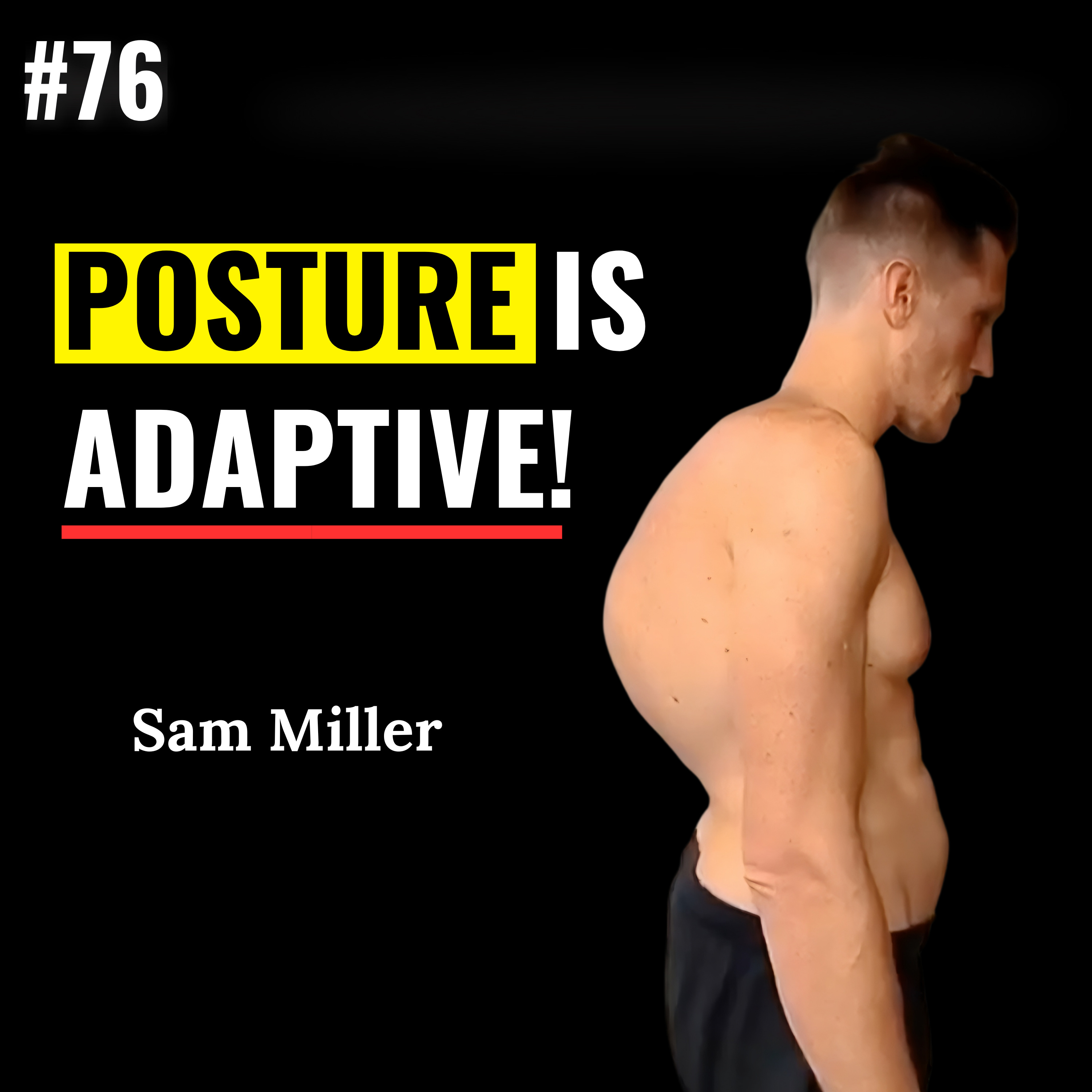
How to Fix Your Posture, Scoliosis & Kyphosis Explained | Fascia, Breath & Nervous System Regulation | Posture Dojo with Sam Miller
What's This About?
Posture, scoliosis, kyphosis, fascia, breath, and nervous system regulation — in this episode of the Fitness Wisdom Podcast, I sit down with Sam Miller (Posture Dojo) to explain posture from a foundational, systems-based perspective.
We explore why posture is not something to force or “fix” with exercises alone, but an adaptive response shaped by the nervous system, fascia, breath, pressure regulation, vision, and environment. Sam shares his personal journey with kyphoscoliosis and how understanding fascial tensegrity, reflexive patterns, and nervous system safety led to lasting postural change.
This episode reframes posture as a living system — and shows how breathwork, awareness, and exploratory movement can reduce pain, improve alignment, and create sustainable change without rigid correction.
🎯 Ideal for anyone dealing with chronic pain, postural asymmetries, scoliosis, kyphosis, or tension that won’t resolve.
---
⏱️ Chapters:
00:00 Understanding Trauma, Reflexes & the Fascial System
01:26 Postural Misalignments, Scoliosis & Kyphosis Explained
04:20 Sam’s Healing Journey with Kyphoscoliosis
07:00 How the Body Adapts for Survival
10:11 Fascia as a System of Reflex and Response
12:53 Fascial Tensegrity & Body Mechanics
15:41 Learning to Listen to the Body’s Signals
24:05 Understanding Tension Lines & Compensation Patterns
31:31 The Interconnectedness of Body Systems
34:36 Nervous System Regulation & Posture
43:25 Breath, Diaphragm & Pressure Regulation
49:50 Why Play Is Essential for Movement & Learning
54:07 Proprioception, Nature & Environmental Inputs
57:15 Slowing Down to Improve Postural Awareness
01:02:45 Taking Ownership of Health & Movement
01:04:47 Vision, Balance & Nervous System Input
01:08:47 Fascial Training Principles Explained
01:14:00 Integrating Breath & Movement for Healing
01:19:40 Rethinking Posture from a Systems Perspective
01:25:43 Practical Tips to Start Improving Posture Today
---
🔥 12 - Week Body Transformation Program: Specifically designed to get you into the Best Shape of your life!
You'll get:
- Personalized Nutrition
- Training Program
- Lifestyle Optimization Advice
- Step-by-step guidance & support to transform your body from the inside-out ✅️ Start your Journey Today
---
‼️Join my Free Fitness Wisdom Podcast Telegram Community HERE: I look forward to seeing you in there!🤗
---
📥 Join my Newsletter for FREE Educational & Empowering 🧠 content straight to your inbox: FIND IT HERE
---
⬇️ Find & Connect with Sam Miller:
📲 IG: https://www.instagram.com/the_flowwolf/
▶️ https://www.youtube.com/@SamFlowwolF
🔖 https://www.skool.com/the-posture-dojo-6655/about
⬇️ Find & Connect with me Here:
https://www.bio.link/move_with_andreas
👉🏽 For Discounts & Offers: HERE
---
👇🏽 Find the SHILAJIT I use & recommend HERE ⚡
Use promo code: MOBILITYFITNESS for Discount ✅
.
➡️ For my favourite Blue Light Blocking Glasses, use promo code: MOBILITYFITNESS for 15% Discount ✅ HERE
.
💦 My favourite Magnesium Supplement HERE⚡Use promo code: MOBILITYFITNESS for Discount ✅
.
👉🏽 Find Best Red Light Therapy panels, Blue Light Blockers & Circadian friendly bulbs 🚨Use promo code: MOBILITYFITNESS ✅ for 40% OFF LIMITED TIME OFFER on your entire order HERE
---
*None of the content / statements in this Podcast are Medical or Personal Advice & is not intended to cure, treat, prevent or diagnose any medical condition. All my videos are for Educational & Research purposes only. If you decide to try anything discussed in this video, you agree to do so at your own risk & responsibility*
This is the fitness wisdom podcast Hello and welcome back to another exciting episode of the fitness wisdom podcast. Today we have a very special guest. We have some founder of. Posture Dojo So posturedojo.com It's a space where people can come and achieve inner standing. Learn about how to how to stand tall and confident pain fair. So thank you for coming on the show like fascia is is an absolute fascination of mine, you know, and energy and breath and pressure and all of the things that you actually teach.
But you overcame some serious postural misalignments with your body and you're also constantly working through it, right? You're constantly making discoveries with your body. Your body is literally like the laboratory and you're constantly working on that. And it's an absolutely incredible and your story is truly inspiring. But before we dive into your actual story, I would love to ask you what do you think the relationship between emotions, trauma, and the facile system is I. Think the relationship between trauma motion, fascia is it's a it's a memory system for a reflex and response strategy.
So during those traumatic events, our nervous system is helping us survive and I am extremely grateful. When I was in a near drowning accident my my nervous system responded the best way it could. And if that response isn't down regulated, that system is is constantly looking for efficiency, which means that it will just go down that same path that it's on. It's easier to cycle down a path that already knows than to create a new path. So I don't think the trauma itself is stored in the body. I think our response, our reflex to the trauma is patterned in our system.
And that is continued until we choose to do the work to repattern that. And that is meant like it's energetically costly to do that. It's far more efficient just to keep looping the old patterns. So, so for me, that's, that's kind of where that link is. Fascia is a expression of the systems underneath the fascia. I think the fascia is really the the surface layer of of what's happening on the nervous system level as well as pressure management in the body. I love the answer. That's that's fantastic.
And so basically why would someone get actually stuck in that compensatory state? You said that it's more energy efficient. Is that the only reason why the body would be stuck in that state? Or is there other reasons why the body wouldn't choose to revert back to a fully more functioning system, but would would be more desirable to us, but for the body is for some reason and it's keeping keeping the other sorts of structure in place, you know, as a as a form of safety. Yeah, I think there's some nuance to like in what form it it that compensation formed or that reflex formed, right.
Whether it's more of that parasympathetic fight or flight or maybe it's that dorsal bagel shutdown that that playing dead right? Just all systems shut down, freeze to protect itself right over over time. The motor controls are lost in that area of the body. If that's kind of not used in a very long time. But again, I that comes back to energy efficiency, which is why I think that that Trump's everything. It's it's all about energy efficiency. We're energetic beings and if we've survived through an energetically efficient strategy, we're going to keep doing that until we choose to invest our energy and something consciously for the long term.
Delay gratification because the short term immediate cost savings of energy are are there and we're just going to keep doing that. That's, that's, you know, when you look at how most of us operate as humans in the in the in financial world, in education, where there's all there always this natural inclination to conserve energy instead of investing it into this, you know, delayed gratification. Yeah, basically putting in the work and taking that ownership basically, you know, because for some, for some of us in life, we're, we're born and we have, you know, better situations.
And for other, it's not so advantageous and other people have to work harder, right, than some other people. But those people who don't have to work so hard in some areas may have to work harder in other areas. So everyone will have their, you know, their personal struggles. So again, it's always taking that personal ownership and responsibility and acknowledging your, your weakness or your areas where you need to work on and, and just taking action every single day because as you, what you say is that your body is literally molding and adapting to what you do on a daily basis, right?
Yes. And and I think what you mentioned there about, you know, taking ownership is what what we've lost in today's world where we have everything outside of us that can support us and we we outsource authority. We outsource knowledge to the modern conventional medical systems. We expect they know everything. If they're not telling us it, then we don't trust that information. That's kind of the paradigm that we've, we've kind of been slowly letting go over the last couple decades. I've seen, you know, personally as well as around me, because when you truly do take ownership, you start realizing all of the, the, the information that is constantly being transmitted to and from your body.
And when you listen, you start communicating with this, with these sensations. You start realizing that you start noticing where there are interruptions in your system. And these sensations are guiding you out of those interruptions, out of those compensations. When you're listening, when you're, when you start seeing that that pressure isn't just happening to you. Pressure is your it's what you've created in your body, your nervous system, responding to your environment when you grew up or different situations that you went through.
This is something you've been creating consciously and subconsciously, but when you take ownership that that is all your creation, you start realizing that that's all in your ability to recreate and remodel. Guys, if you haven't already, smash that subscribe button and the like button. Now back to the show. That's amazing. So before we dive into pressure, let's dive into your personal story first. I'd love to hear how everything started for you with your own personal journey, your posture and everything because I have digged your page a little bit, but maybe it's nice to share with the audience as well, like your your whole journey from start to your current situation.
Sure, sure. Yeah. And I'll, I'll kind of give the give the high level view here. You know, I had AI was diagnosed with a very severe 85° kyphoscoliosis, so a kyphosis forward neck as well as the lateral curve scoliosis. At about 18, I went to, you know, the doctor and then the orthopedic surgeon and the surgeon's job I thought was to tell me what everything, anything I could do. But really, you know, his job was to say whether I was eligible for surgery or not because of the severity of the curve, because I was still functional.
He said, you know, it's too risky of a surgery for you. You're not a candidate for it, which is pretty. That's when it's sung in. You know, he was like, hey, so you just got to live with it. You just got to manage it. And that's when it sunk in that, you know, I'm going to live with this for my life. And, you know, that's pretty hard to to take. I lived with it for, you know, about 15 years until I was about 33 years old. And the compression, the collapse had started choking me out from the inside.
And I spent eight months trying to figure it out what was happening to me. I didn't even connect it to the posture because I just didn't understand the consequences of what was happening in my body. And that that kind of began me on the journey to, to unravel. But to go back to the, to where it came from. When I look back and I and I think about it, it's, I think it was a combination of a perfect storm of issues that compromised my ideal structure and the reason why 80% of scoliosis cases aren't diagnosed or they're diagnosed as idiopathic.
So idios of unknown pathic origin. So 80% of scoliosis are of unknown origin. They don't connect where it came from. After many years helping people and going through my and looking at it like I, I've seen a lot of commonalities between people who have scoliosis and it comes from anywhere. There's an infinite number of ways that people can get their posture compromised. But very often I notice it comes from sometimes an ankle, a broken, a sprained ankle, a broken toe, some type of foot injury early on in those preteen or child childhood years that just kind of set a rippling of, of of of compensations up the spine.
I had both of those. Then I had around 13, I had a near drowning accident where I got my ankle slipknoted in a, in a rope in a flooded river. And I was trapped in trying to struggle to get to my to my ankle in a, in a flooded river. And that that created a a bit of choking, you know, drowning trauma in, in my diaphragm as well as twisting and talking trying to get to my ankle, ankle in that struggle. Obviously a very traumatic event for the system, which I believe created a lot of, you know, dorsal vagal shut down around my mid spine in the, in the months kind of after that, you know, I had a torn groin.
It was just, I just, and then I was over the PC with poor postural habits, not knowing how to rehabilitate that type of injury. So my lower body had been, you know, compromised. And then I'm just poor postural habits hunched over on the computer setting in, you know, my curves in a very structural way. So I have a structural kyphoscoliosis, which means that the curves are part of the structure as opposed to a functional scoliosis where there's still movement in the spine, but it's mostly from lifestyle.
The curve is like just not a movable adaptation where mine was more of a rigid adaptation. So it was really just a perfect storm of of physical, mental lifestyle things that had happened to me. And it's allowed me to kind of empathize with a lot of people's stories about sometimes it is more psychological, dysfunctional family environments growing up, collapse of support from the feminine or the masculine, parental figures, different injuries, depression, literally the physical expression of a broken heart.
You'll start seeing that kind of leftward concave collapse in the thoracic. So it can come from anywhere. And that's how I got into the situation I'm at. And so it's been a process of undoing those, you know, those 1520 years where I just lived with it and just accepted these compensations as who I am before realizing how much I can actually do, how much I can remodel. How much that that posture, that spinal curve was just an expression of what was happening underneath. And that when I go under the hood, I'm able to relax, let go, train and remodel.
Wow, that's insane. So basically, I think that people won't even believe that you were not like born with this kind of a structure in your body, right? It's just something that you actually developed because of all of this traumatic events and experiences that you had in your life and that literally just accumulated in your body over time. And your body just literally just found the most efficient compensation strategy to keep you going on a daily basis because our body is constantly wanting us to survive, right?
That is the name of the game, you know, As for human being is to survive and survive long enough to reproduce. And then you can pass on your genes and it's going to do anything in order for you to keep on going, whether it feels comfortable to us or not even and if it's undesirable. And so your body just fell into these compensation patterns because you had your, your ankle injuries, you had this very traumatic experience, you know, with the the diving accident. And so I can imagine that in that situation with the diving accident, that your body, you were probably trying to, you know, try and get yourself, you know, coil yourself and try and get yourself like probably rounded and forward.
And your body just went into that, as you said, that shut down that dorsal, that Free State, and your tissue was literally molded in that state as a compensation response. But after that event, because you didn't know how to rehabilitate that and how to let go of the trauma. Maybe you know, it, maybe you, you hid it somewhere in the back of your mind and, and it was sort of like still kept, you know, your tissues in that state because your body still thought that, OK, we got to stay like this so this doesn't happen again to us.
And then now, so many years later, now you're, as you said, you're unraveling, you're opening up. If you're going deeper, it's not just physical work, it's psychological, spiritual, it's it's on such a deeper level because we understand the influence of our mind on our tissue tension and our nervous system state right influences as massively. Absolutely. Yeah, Yeah, it's very well put. And I would add a nuance there that, you know, during that, during that, that struggle towards my ankle against the current, you know, the, there I, what I remember that time, most of the pain was around my hip because my other leg was kind of being pulled by the current.
So I had that sprain in that hip. And so I imagine, you know, when you get a sprained ankle or, or a hip injury, you start walking with a limp. And if you walk with that limp for a while and you don't rehabilitate it and you know, through that section and then you're sitting and you're standing with that compensation, that unhealed, unrehabilitated pattern, you're, you're cementing that in there. And I think that was actually kind of what led to that compromise when I was sitting. And then, you know, as I'm on the computer, I remember, OK, something's going on my back, but I just ignored it.
I ignored the work. My body was saying, hey, with there's work to do. There's some, there's sort of like things, things are happening. But when, you know, we're in those teenage years, we sometimes, you know, we miss, we miss the signs, we miss the signals, we make mistakes and we avoid the work that needs to be done. And so, you know, the longer we avoid the work, the longer it can take to, to undo, undo that. But it is still very possible. And I believe at any age it's possible. And not only that, you know, we should only do it if it works, which I, I hear a lot.
Oh, is this going to work for me? Is this going to work for me? It's like there's there's an understanding that you must have here that this isn't optional. This is something that everyone can do, everyone can access, and you should do it. If you don't, it's only going to get hotter and harder. Imagine spiking your blood sugar without eating cake. Elevating course is all your stress hormone without being stressed and suppressing your body's most powerful sleep. Antioxidant and regeneration hormone, which is your melatonin.
This is why I make sure to wear my yellow daytime blue light blocking glasses every time where I spend time in indoors, under artificial lights and in front of screens to protect my eyes from oxidative stress and my entire body. And if I'm going to be exposed to artificial blue light, especially after sunset, I'm going to wear my red lens blue light blocking glasses to support my melatonin production and release. So if you want to protect your energy levels, sleep, and biology from artificial blue light, head over to the description and you will find all of the links with a massive discount on my favorite blue light blocking glasses.
It's a bit like breathing or breath work, right? Like it might work for some. And it might work for others, but at the same time, it's still going to benefit you. Whether you feel the the difference or not, it's still worth investing the time. The same thing with sunlight. You may not feel the benefits instantly, but if you accumulate good habits in your daily life, you know, and you do them every single day over over time, it has this accumulative effect. So it's always worth investing your time and effort into things which are going to benefit your overall health and well-being.
And you know, a lot of people don't actually realize the interconnectedness of the body. You know, when something happens to their ankle, they're not going to think that it's going to impact their shoulder or their neck or their, or give them like migraines and stuff like that. So maybe do you want to explain to the audience the interconnectedness of the human body through the fascio system and actually the role of the fascio system in our overall well-being? Sure. You know what a what a multi dimensional aspect of the human body, right?
The one I think that's most relevant for us here. I guess I would start by saying I, I see the fascia as the brain itself. I think, you know, someone took a scalpel and said, oh, here's the brain, here's the fascia. I see it as a continuous extension of the brain. It's, it's the part of the brain that that walks, that helps us walk around and, and stay standing. The, the part that's very interesting to me is how we're going from this classical biomechanical view of pulleys and levers into tensegrity.
And tensegrity is my, you know, word of the decade for any person in a human body to understand tensegrity being tensional integrity. So our fascia is a continuous tension network, which helps us stand up. It allows our bones to be suspended in the air with, again, energy efficiency. We're not using muscles to stand up. That would be very costly, very expensive for us to stand up if we were to use muscles. So the tension in the fascia is working together with the compression struts of the bones and naturally allow us to sit to float in as we stand essentially, which is beautiful to like what a beautiful miraculous creation and concept to understand once you get it.
And then all of a sudden, when you think of a broken ankle that suddenly makes sense of like, oops, OK, you get a, you get a compromised injury lower down. Maybe you start, maybe you start firing muscles because you've got that sprained ankle for a couple months. And so you start, you start teaching that left left hip to be doing all the work and taking all your weight and then you just don't rehabilitate that. You just take that with you for 10/20/30 years. What's that going to do to that, that neutral continuous tension network?
Well, it's going to shift how weight and force and safety and trust is experienced in your system when you're, when you're going through daily life. So for me, that's that's probably the most relevant aspect of fascia, even though, you know, there's a lot of a lot of rabbit holes to go go through. And I think to to to bring in one other layer to fascia around that sensegrity part. Is that it it's our way to listen to the body. And so if we've been leaning into those areas and we're starting to get sensation in that area.
Our mind is constantly pinging like a radar, our entire facial system and wherever there's interruption, wherever there's lower conductivity because it is piezoelectric, it's it's electrical in nature. It's got a layer of, of structured water on it. That's essentially, you know, a big part of how we're like this battery antenna aspect of the human experience. So when we have interruptions, compressions, compensations, we're getting that information and the facial system is communicating that to us at lightspeed and we can learn how to listen to that, how to interact with that.
And I believe it's also where that intuitive aspect of of movement comes from when people speak, oh, just listen to your body. Just listen, you know, just go with the flow in your body. Believe it is a major aspect of where that intuition comes from is the, is the intelligent nature of the fascia because it's it's, it has all the information, it's in every part of the body and it'll tell you where we're, where we're strong, where we're weak. When you listen to that, that's that's what I believe we also call intuition.
So it's sort of like a relayer of information. You know, you get the proprioceptive input, input from the environment. You also get the signals going from your brain throughout the entire body. So you have that feedback loop right from your environment and also from your brain about the environment. You're sensing the environment. So it's acting sort of like an antenna, which is tuning you to your internal environment. As you said, it's touching everything inside of your body, but you're also acting sort of like a, an antenna and a sensor to pick up the information from outside of your body to create signals of safety or threats.
And so it can adjust its positions or its tension accordingly based on the environment, right? So it's absolutely cool because I think it's really important for people to understand that, you know, that the Faso system is sort of like a sheet that is a continuous sheet that if you pull it on one position, it's going to impact the entire sheet. So if you pull one corner of the sheet on a bed, it's not going to make a nice and smooth bed, right? It's going to impact the entire sheet and that's basically the entire body.
I do believe that the Faso system does have a little bit of slack, but I don't think it's that much because, you know, in in daily life especially that because we've got so much compensation because we're always stuck in fight and flight. We have this constant tissue tension all around our body or in specific areas of our body. And that's going to create, you know, sort of like a knot or an adhesion or something. And then it's going to create a structural compensation in other areas of the body where it's sort of like unrelated, but it's, it's basically all related to that.
Would you agree on that? Yeah, so this year I've been my, my videos have been getting a lot of attention because I'm actually applying some of the concepts that you just you just mentioned there, which is this tensile nature of fascia. It's not contracting like muscle. And when people saw me kind of adjusting my, my, my spine by, by twisting my arms, they're like, well, you can't, you know, that's, that's impossible to, to, to manipulate your spine like that through muscular force. That's like impossible because in the, in surgeries, they need like big, they need leveraged tools to be able to manipulate that.
And So what they're not understanding is that I'm tapping into the, into the talking of the fascia, which is like when you, when you're, when you're clenching your fist and twisting your fist and you're starting to ring your mouth fascial webbing out and you're providing a counter twist on the other side of your body. You're actually generating a force of torque of torsion in the body. The, the, the, the tensile strength of fascia is things like 50 times more than muscles, so it's not going to rupture and break like a muscle does.
We go to the gym and we lift weights. Basha is actually much more incredibly strong and it's, and I'm, I'm not generating the corrective force through contraction of it. I'm generating correction of it through the torsion of it. Do you want to talk a little bit? Because. These these Sorry. Go ahead, I interrupted you. Yeah, these these malfascial, the, the malfacial webbing has particular, let's say trains of, of, of, of force factors. So they, you know, they're just like when you put up a tent and you, you bring those cables and you place them strategically around the tent, you know, in, in six different areas in the body.
They're, they're wrapped and they're enveloped in a spiraling nature throughout, you know, starting from the, from the toes all the way up over the head into the, into the tone, into the skull, and those all wrapped together and, and create this, these particular lines of tension. And so I think by, by just understanding this concept, it gives people the, IT gives people an eye, a, a, a skill and awareness that they can apply in their, in their own movements. And it's definitely been a big part of like kind of where where I've been going on my journey.
Based on my research, this is the best shilajit in the world. Here's why you need to know about Shilajit. Shilajit is a herba mineral substance made from the decomposition of plants and bacteria. This process taking place over thousands of years. It's harvested from the Altai and the Himalayan mountains. Think of it as a hyper concentrated plant matter that is made by a modern nature over thousands of years. In many cultures and traditions, it's known as the destroyer of weakness. Let me tell you why.
Shilajit is loaded with ionic minerals which are the most biocompatible with our human body. It also has a very high concentration of folvic acid. This folvic acid allows those minerals to get into the cell and do their work. Minerals are absolutely essential for all processes of the body from having good energy levels, enhanced cognitive function, hormone optimization and so much more. You name it. This is why I use shilajit on a daily basis because it works on a foundational level, on a mitochondrial level and we know that we need healthy mitochondria in order to produce cellular energy.
Something very important to mention is the quality of shilajit. The one I use has been tested for heavy metals and impurities, ensuring the highest quality shilajit. So if you want to experience this incredible ancient substance and find the one that I use on a daily basis, head over to the description. Below and use the promo code attached to get a discount on your entire order. I definitely want to ask you about training for fascia instead of training for just your muscles. But I would just want to ask you a little bit first about the intelligent divine design within the human body itself.
Because you were mentioning there about spirals. And I'm very passionate about sacred geometry and looking at nature in general and just observing some patterns that repeats over and over and over. And just when you look at everything outside of you, you realize that everything outside of you is also inside of you. It's sort of like the entire universe is within you, really. And it's just like a fractal. And do you think that the human body is built like this by design so that we can actually tune to our environment easier?
And modern living distorts that sacred geometry within our body and therefore creates disease. I think when you look at nature, you'll see beautiful geometric formations and when you look at the human body, you find those same beautiful geometric formations. And I think at the core of those, our energy efficiency. When you look at nature, there's simplicity in its design, there's beauty and and most importantly, there's always efficiency. There's nothing kind of wasted. Everything is just beautifully aligned with this natural efficiency.
And so I think as as part of nature, that's of course makes it makes a lot of sense. One of the patterns that that's been most interesting to me is when you actually look at how structured water is, is creating the body actually having a mouse pad like that, but that hexagonal nature of structured structured water. And I realized like, OK, there's actually layers of this. So it's layer on layer on layer. It's not just a 2D. And that's oftentimes how beautiful. Like the reason why geometry gets so, so fascinating is because it crosses dimensions.
When we see a wave like this, we forget that that's actually a spiral if you look at it from the other way, right? So when you look at this in a 3D perspective and you see that that is the film, the filmy layer on top of our fascia that's creating the electrical conductivity of our body. And this nature of, you know, we're, we're starting to realize the thoughts aren't really created. We're tapping into this cloud of, of information. And that to me is really interesting because it appears to be that, that, that, that layer between the, the, the outside and the inside, that's where that, that that is.
And I and I think in terms of identifying patterns, you may notice or may remember, there's a Alex Gray painting which shows this kind of infinite hexagonal with eyes in it. This, this kind of omnipresent consciousness looks very similar to that right there. That that structured water, that easy water layer on the, on the, on the fascial membrane that, that we're constantly engaging with the, with the outside world with. So I think that's a really important, really interesting layer. I, I'm just going to put that out there.
I don't have too much kind of more beyond that, but I just want to kind of put that out there. Oh no, that's perfect. I love I love your elaboration there. And Alex Gray's paintings are, you know, incredible. Like every time I just look at them, I'm having a psychedelic experience without without taking any psychedelics. It's just that you just see there is something unifying as all some greater consciousness where a lot of fractals and patterns, when we stare at them and look at them, it feels that they're so familiar to us because they actually exist within us, within our, you know, within our body, within our cells, These just these repeating patterns.
And then we are sort of, if we tap into our true nature as human beings, if we move our body as we are intended to, if we dissociate ourselves from modern living and reconnect back to nature, we restore sort of this divine intelligence that exists within the human body, which is this what our body is designed to do, to move well, to have a a great expression and to to, to feel amazing really. But modern living, I would assume, would distort these natural patterns and fragments. I mean these. Shapes, Yeah, yeah, I think a, a byproduct of, of, of modern living and, you know, the prominent economic model being capitalism is that innately in, in offering a product or service, you know, there's a demand that needs to be created.
And so we have to kind of interrupt a perhaps a already natural, already coherent system and say, hey, something's missing. Here's a, here's a product, service or solution to, to, to fix that. So an inherent part of that, of that system is, is, is interrupting that, that natural completeness and wholeness. And I, I think, you know, when I went through the, the modern medical system at like, you know, early 2000s, it, it was very specialized. So that's why you know, when it, when I ended up at the, in the orthopaedic surgeon's office, that was their, that was the, the approach to my, my condition.
Whereas I am seeing that the, the system is moving towards more of a psychosomatic approach. So a more holistic approach of looking at, OK, what, what will all of these potential factors. We now have the emerging research around fashion, how how important that is in, in in terms of posture, the nervous system, how we're breathing, how that regulates the entire system. So we, we now like the system is now forced to take a step back and, and realize, OK, this hyper specialization has limited how effective they can actually be to, to address things at the root cause instead of how they mostly address it, which is OK, The spine is curved and just like a, a business with KPI's, right, key performance indicators, I need to reduce this curve.
The patient. I can't rely on any compliance or any growth or any discipline or any lifestyle changes. I can't rely on any of that. How can I force a result, a measurable change in the curvature of the spine? Well, we're going to brace it or we're going to, we're going to cut in there and we're going to, we're going to wrench it and then we're going to put metal bars so it stays in place. What's what's going on in the nervous system? What's going on in the fascia, in the tissue doesn't matter. My goal is to reduce that curve because that's measurable and that that's, that's a result.
That's a scientifically proven result. Oh, and any other person who thinks that there's that you can fix this without this, by the way, that's woo woo. That's alternative that like you can't fix scoliosis was such a common comment when I first started kind of sharing like the stuff I'm doing. Like I'm not claiming that you're gonna get the exact same result of a surgical intervention depending on your situation. There's so many variables about how severe it is, how long it's been going structural verse functional, but just trying to say, listen, I'm just going to do what I can do.
I don't know, like I'm figuring it out, like I don't know the limit of what I can do, but I'm going to maximize everything I can do because I appreciate my body. I love my body. I want to invest in my body for the long term. I'm playing a long term game. I want to enjoy life. I want all terrain agility. I want to go snowboarding and hiking and, and, and work in the garden, the farm, like I want to be able to do stuff in my body. And so I'm going to do any, anything I can. And just like getting comments from people who say you can't fix scoliosis.
Why are you telling people you can feel like it's changed over the last couple years? But when I first started, we had this parroted institutionalized brainwashed reflex to anything, any approach outside of the the system. What's that? Agent Smith, you know, like in the Agent Smith, everybody. Yeah.
But basically, yeah, everybody is looking at the body as sort of like a fixed structure, you know, like something that cannot be changed, but the body is adaptable. What you mention all the time is that it's constantly adapting to certain situations. I would love for you to go into the different systems which are underneath posture, because a lot of people just assume that posture is just what it is. But you are a living proof that posture can be changed at any moment at any will. And I say all the time to people that there is no really such thing as bad posture.
Your body is just doing what it can based on the situation that it's given, right? And so also as well, like doctors, when they look at the human body, what you mentioned there about trying to force change, they're not looking at those underlying systems of posture. And so therefore they assume that there's something fundamentally wrong with the structure when in reality, they're not looking at what's governing that structure, right? So maybe let's get into the diff all the different systems which are influencing posture because this is a very empowering conversation.
Absolutely, absolutely. And the, the first layer of, of posture is, is the nervous system. And we've, we've talked a little bit about that, but ultimately our nervous system is, are how we're responding and reflexing to the environment, to experiences that were happening to thoughts that we're continuing to, to repeat. I think we're, we're governing our, our nervous system, which does a lot of stuff autonomically. But that nervous system is the first layer. If we've experienced things, traumas, emotions that we have not updated the program, our nervous system will be like stuck in gear over revving.
And when the nervous system is in that state, we, it is very resistant to start changing tissue and changing, changing programs in the body, changing the way that we experience safety and trust through these these parts of our body that we need to. So the first step if someone, if you're doing door frame stretches and chin talks and all these things you're seeing, but you're not addressing that that nervous system level that that coherent state, that safety, trust, assurance and calm. If that isn't there, a lot of this work is going to snap back the next day or when you go to sleep.
A lot of people find they just go back to their old, old ways, their old, old posture, even if they do work during the day. Nervous system is the first level. The next level is pressure, how we're regulating pressure in the body. We are fluid filled, right? We, we breathe air and we don't breathe it through the face. We breathe it by the diaphragm sucking air through our face like like a syringe, right, creating negative pressure in the in the chest. Our air comes into our lungs and in our lungs.
It's then transferred into our blood and experienced as pressure. So in our lungs, it really goes from breath and air into fluid. So really when we're belly breathing, we're really kind of like belly pressurizing, right? We're more of a hydraulic system, a fluid hydraulic system as opposed to some airy breathy system. So our diaphragm being, you know, one of the main diaphragms, but we have a lot, we have a bunch all over the body that are giving us information about how pressure is being regulated in the body.
Now think about this fascial tensigrity layer, which is the third element and we'll, we'll get to that, how that kind of sits on top of these other systems. But the diaphragm is regulating pressure inside of this tensegrity system. And if our diaphragm is dysfunctional in some way, maybe it was a near drowning accident where you had a choking or, or you know, that type of experience. Maybe you had that postural habit where you've really compressed your your lower back and you're only using the front of your diaphragm.
Maybe you've been, you know, chest breathing or or belly breathing out the front and your posterior chain is is quite compressed. Think about what that does in a, in a tensegrity system, you've, you've really kind of been breathing wonky and your, and your posture is going to get wonky because of that. And so understanding how we pressurize ourselves, how we pressurize our core is extremely important when it comes to posture, right? That was something that I overlooked for years and you know, building my core with a 85° curve in my spine was quite a different process, you know, and, and we got sold, you know, those 10 minute ABS in an AB crunches and all this kind of weird core stuff that never doesn't really address the pressurization issue.
So it's really a core pressure, not, not core muscles that I'm that I'm talking about here. And so pressure, regulating pressure throughout the system is that next fundamental part of, of posture and the way that we're regulating that, that that pressure is going to shape the fascial layer, the tensegrity structure of the body. So even this mild fascial release where you know you're rolling on the balls, maybe you're doing the the twisting fascial maneuvers that's coming at it from the outside in approach and that's where most likely you're gonna go to sleep and wake back up where you started.
So there's a sequence to this. There are layers to this and the nervous system coherence, it's pressure regulation, and then it's myofascial tensegrity. And there's a couple new words in there for people. But I believe if you're dealing with a compromised posture, scoliosis, kyphosis, this is what a doctor should be telling us. Like, isn't this like, like, why, why, why has it taken me years of internal exploration and of research to have gotten here? How did that happen? Like, why me? I'm not a, I'm not a formally trained medical professional, right?
Like, how, how, like, how has it taken me so long? Why has no one told me this? Why was this information hidden? Why was this? Why is this not like common knowledge? How did that happen? It just blows my mind. Muscle cramps, eye twitching, headaches, agitation and stress. Those are all signs that I have magnesium deficiency. I can always tell when I haven't taken my magnesium. You see, magnesium is an absolutely essential mineral and is required in over 600 biochemical reactions across the body.
I'm pretty sure we've all experienced that calf cramp in the middle of the night and that is most likely due to a mineral or magnesium deficiency. And the reason why most individuals are deficient in magnesium these days is because stress depletes magnesium. And tell me a single person in this world who is in stress right now, whether that is physical or psychological stress. Magnesium is something that I'm very religious about taking every single evening before I go to bed because I don't only want to sleep 8 hours, I want to have a deep and restorative sleep.
I know that when I've taken my magnesium, I wake up feeling relaxed and refreshed. So if you want to discover the magnesium that I use on a daily basis, you want to make sure that you head over to the description below and use the. Promo code attached to get discount on your entire order. Yeah, all of these systems of the body are sort of like disconnected, right? No one is teaching them as A1 unified coherent system like you talked about there like all of these different layers. Everybody likes to talk about the nervous system as separate from the lymphatic system as separate from the cardiovascular system.
No one is talking about all of the interconnectedness of the human body. And I guess what it takes is this will and desire to learn and taking ownership as you did of your health and this self respect and self love to constantly keep on working on yourself and diving deeper and deeper and deeper to try and understand the roots of of that specific system, which was what you had said that where posture arises from all of these different systems, starting from the nervous system state is influencing all of the other systems, you know, going going outward like you mentioned.
But I guess it can also start the other way as well. I can assume that, for example, if you hurt yourself, you know, physically, you know, when you're, I don't know, on your Achilles tendon, and then that can alter your blood flow in your cough. And then that can maybe, you know, take more energy away from your brain and then that can make you more depressed. And, you know, also your neurotransmitters. I, I guess it can have these multiple different paths and ways, but it's, it's definitely true that the nervous system massively influences tissue tension, as you mentioned.
And one thing which I learned which I didn't know that you actually just mentioned there was about the, the pressurizing of the, of the system and the blood and how basically the oxygen sorts of is like pressurized into the blood. And it just makes sense to me that because I, I'm learning all the time about biophysics more and more compared to biochemistry because the biochemical model is very slow, but biophysics is happening more at the speed of light and maybe even even faster, right at the quantum, at the quantum level, especially when we're looking at quantum biology and we understand and how photons and biophotons.
And then you've got energy that is communicating throughout the body through the phaso system, through exclusion zone water, which is basically like connected everywhere through the phaso system. It makes sense to me that wow, like actually oxygen is acting as this molecule which is creating movement within our cells, within our mitochondria, within energy generation of the system. So you just literally. Blew my mind there because I was just like connecting some dots there as you were talking and I just thought it was absolutely incredible.
I just love learning new things and I know a lot of things and I don't, I very rarely learn something new. So I really appreciate you sharing that. And also also these multiple different layers. I think it's very important for people to understand that if they actually want to fix their posture or become more aware of their posture, as you mentioned, there is a method to the madness. You got to start off by addressing the foundation, which is your nervous system, really your nervous system state.
Yeah, and I'll give I'll give everyone the key to do this right, Because we if you're just new to this like nervous system, how do I what do I, how do I do that? What do I do pressure? How do I do that integrity? What it like what, what can I actually do? Like how can I apply this? The key is your diaphragm. It's your diaphragm. You're what every breath you're taking. The, the, the, the choice you make with how you use your diaphragm is choosing is setting the rhythm of your nervous system. So like whether you want to up regulate or down regulate, you know, there's there's some viral kind of breathing techniques.
Obviously slower exhales calms your nervous system. Our eyes and our breath are the fastest ways to change the state of the nervous system, right? We've known that. So the diaphragm allows us to regulate the nervous system, increase coherence between what we're thinking, what we're feeling, connecting that mind body experience, entering into that, into that ventral connective state. We're open, we're safe, we're calm, we trust in our bodies, allowing for change, allowing being open to new ideas of movement, new neural pathways.
We're actually allowed to be in a constructive mode there. Then we've got then we've got pressure and, and, and the diaphragm, obviously the way it the way it's leveraging itself against the rib cage, there is, is and what we're contracting and what we're allowing, we can stop playing with pressure in the body. But one thing that that begins to really bring this all together is when we understand that the diaphragm is 30% fascia and the central tendon is a big part of that. And then we understand that it makes up, I believe it's about 6:00, it's part of 6 myofascial chains in the body.
So there's, you know, 8/10/12 different chains of, of, of these myofascial lines that people have are mapping out and identifying that force travels through the body, that our structure, our posture travels through the body when we're, when we're in movement and we realize the diaphragm is a giant central piece to many of those, many of those cables, many of those lines, we realize every time we're breathing, we're getting information from our entire fascial tensegrity map through our diaphragm, if you're listening right.
So the diaphragm, nervous system pressure and fascial tensegrity, it's the, it's the, it's the link between all of them. It's our way in to begin to to become a creator, a regulator of all of these elements of our posture. Wow, so basically you're saying that through the diaphragm, through the breath, you can manipulate your fascial through these fascia lines throughout the body. So through conscious awareness and control, you can literally just by sitting down and doing nothing or laying down, you can breathe into your diaphragm, you can breathe deep into your belly and you can literally change the tension in those myofascia lines.
And you're going to feel, if you're aware of your body, feel the tension sorts of changing. And I guess this becomes increasingly important when you are doing exercise right? You see a power lifters are very aware of the importance of breath because they are lifting extreme loads and they understand that if you are deflated, like if you are, let's say you go into a squat or a deadlift and you're descending in either movement, you have to have a full belly, you have to expand, you need to create pressure so you have efficiency throughout the entire movement.
So you don't have to lift with your joints and your muscles, but rather than with the entire tensegrity system. But if you're deflated like a balloon, that's basically like all slack. Basically there is slack in these lines. You know the lines are loose so efficiency doesn't exist and now there is basically more exhaustion really in the system. Am I understanding this correct? For sure, for sure. And when you think about, you know, let's go back to that broken ink, all right? So we have that compensation.
We've got those really strong neural pathways through that compensation, which is efficient, but it's not, it's not healthy because that compression where we're firing muscle, what muscles are doing work which they should not be doing, we should be effortless in our posture. That's what we're we're investing effort now to do so. And even though the brain is only like 2% of our body weight, it required, it takes up like 20% of the calories that we expend throughout the day. So it's to change a pathway from an efficient, you know, compensation.
I think it's 30 five times more metabolic brain neural energy to change it and create a new path. So I really began this journey of like, through force and trying to, you know, like hang and, and generate just like really using force physical musculature to, to really force change in the body. And I've, I've, since then, I've, I've realized it's so much more neural. It's so much more starting in the mind and connecting with those sensations that that are being fed to us constantly through the breath and pressure and doing the doing that intentional attention into the area that we'd like to develop that new path, which requires 35 times more energy than just going through the same old pathway.
So it's it's, it is intentional, attentional work, but that's where the work is. It's it and and the the shape will follow the the the surface level stuff will follow, but it begins there. We've probably heard about red light therapy before and all the incredible benefits that it has to offer, but unfortunately, not all panels on the market are created equally and This is why I only use and trust the ones that have put in the description below. They have the highest quality panels on the market from build quality, a aesthetics and functionality.
So if you want a massive 40% discount on my favorite red light therapy panels, head to in the description below and make sure to use the promo code attached to get a massive 40% discount. Sam, I want to be respectful of your time. Do you have more time on your hands? Yeah, yeah, we're good. OK, great. I just wanted to ask because I have many more questions. So. So basically, yeah. Have you ever heard some people say that to learn a new skill it takes approximately 400 reps? But if you actually that play, you use a form of play to learn a new skill, it takes something like 10 reps, something insanely low.
And so it just actually shows you the importance of play. What? How important do you think plays in our life, even as adults? Absolutely, yeah. Because I mean the, a lot of the energetic cost of building these new pathways is you've got to, you've got to explore and so and then you've got to repeat. So it's it, you've got to enjoy the process because you're going to be doing it a lot. If you don't enjoy it, you're going to be like, no, I'd rather just take the energetically efficient route and sit on the couch right now.
You have to enjoy it. And so play, you know, gives us that that pursuit dopamine in a good way. Play opens the mind, makes us more receptive. We're also, you know, spontaneously building there. And I would add on play and dance because I, I think you were leaning into before about a question about how, how we train faster. I think you were going there, right? And, and so faster response to, to rhythm and recoil and bounce, right? Those are aspects that you'll find in play and you'll find them in dance.
You won't find them too much in a gym these days. That's true. Like maybe on the treadmill, you get some rhythm, but you don't get a lot of lot of play and spontaneity in there. So when I look at restoring function athletically, and I believe we should all look at ourselves as athletes, I believe it comes down to looking at ways that we can bounce and hop and recoil in unpredictable ways, but inside a safe environment. And play does exactly that. If we're at war, we don't have time to retrain, but if we're playing and we're going in slow with curiosity and exploration, we've identified a a game that is just challenging enough that gives us an objective and immediate feedback, right, But isn't too difficult or too boring.
We've created the conditions for flow. So playing and flow is the greatest way to to re educate and re establish systems and and the pathways that we need to to create a more conductive, conducive flowing, energetically flowing posture. I think what's very important there, what you mentioned indirectly is not not forcing the process like kind of like welcoming the process in a playful manner, in a way which doesn't feel too threatening to the nervous system. For me, this relates to when I do my workouts outdoors.
Well, basically all of my workouts are outdoors because I understand the importance of training in nature and grounded to the earth and being under sunlight. And I just feel 1000 times better doing them outdoors. But I'm sure you can relate to the fact that an outdoor environment will make your entire being respond very differently because the terrain is different, especially if you're barefoot and, and you just don't have so many tools. So you have to become the tool with your body, right? And basically where I was going with this was that when I train pull ups, for example, if I do without a band unassisted, it usually puts my body more in a fight and flight state.
It's more compensatory. Like meaning even though my repetitions may appear good on the outside, they maybe don't feel as good as if I would do them with a band. And then I feel like I enjoy the process more. It feels more playful to me if I have more assistance. And I really enjoy the feeling of the muscle contraction and I feel like I'm, I'm really, you know, engaging and activating and then lengthening the tissues in that full range of motion compared to doing it when I'm loading my nervous system more unassisted.
Right. Making it, you know, you're putting it, yeah, you're challenging it too much. And it's, it's, it's not at that level where it can adapt and respond for sure. A big part of my process as well is removing the ego of, you know, showing off what I'm trying to do. And sometimes it's going to a super assisted, super basic form of the movement and, and spending time right there and listening right there and, and understanding what's happening at that. Like that primitive part of the movement before I start even trying to do the full thing.
Like really breaking it down to OK, where does where, where is my pathway online and where does it start deviating from an ideal path here. Where do my, where do, where does my natural strength start going into my compensations? Those, those things that are creating my curved spine, as opposed to what would that feel like? And what would that look like if I had more of a aligned spine in this, in this part of my body? What would that feel like? Where would that activation feel like? And sometimes that's just going an inch off the ground and, and, and that's where it's at.
And that's where my work is done. And then I would, I would add to that in nature, you'll find a lot of a lot of things to do right. And one of my favorite ways to, you know, as an example of this is if you find a tree with a good root system, walking slowly on those roots, yet you get that mild fascial release through the, through the different knots and the bumps as you're kind of like moving your feet, you're training your feet, which the ankles are extremely proprioceptive, highly sensory organs.
We, our nervous system gets so much information here. And if we're feeling unsafe in a certain part of our foot, certain angle, not we're not able to distribute pressure evenly throughout the foot, maybe we are left back of the heel like mine, you know, didn't feel safe carrying pressure up through my body. So just applying pressure ever so gently in that area on a, on the root of a tree, allow, you know, it sends ripples of, of corrects and corrections and adjustments up my body when I'm listening and breathing incoherence and, and just paying attention ultimately is paying attention to the small little stuff that's going on.
And, and that's when you get those dramatic shifts in the posture. It's not always those big grand movements. It's just paying attention to those little details of, OK, why, why, why when I move pressure and weight onto that left part of the heel, you know, my body starts twisting. Why does it, why is it doing that? Well, it's because it's protecting itself from, you know, a painful event or injury or myofascial line that's that's not comfortable in it doesn't feel safe. And so well, OK, well, how can I just gently move in it?
How can I just bite off a piece of that, of that energy and and just kind of reprocess that and say, OK, you know, hey, it is safe here. OK, I do have some I can put a little bit of weight here. I can put a little bit of trust in this position and those those things can just happen walking around on some tree roots. Starting to climb, you know, climb on the tree, like even before a pull up for me, I'm, you know, pull ups for me or there's a lot going on. So when I can just go to a tree and just kind of like put a little bit of weight on and realize, OK, which part of me is is creating this strength.
There's so much, so much healing opportunities that can come by slowing down, drop in the ego, going to the basics, zoning in, listening to the sensation and and being there. Just be there, listen. And your system is an energetic system that wants coherence. It wants to be to flow more energy and it will tell you how to move. That's that. That's that intuition. I guess what's so hard for people is to actually like slow down and really TuneIn and listen to their body. And I kind of understand that because life in general, modern life is just constantly throwing stimulus at us from all the things, all the things that we're consuming, whether that is like through our eyes, through our mouth, through our ears, basically all the forms of consumption is very, very stimulating.
And I just find that everybody's so distracted these days. And we're, we're seeking dopamine externally rather than, you know, gaining that natural dopamine, that reward by doing something hard. And I feel like doing hard things is so important for our mental health because that can remodel the way that our nervous system is understanding the environment, right? Because a lot of people don't have any hard things in their life. They may just go to the office and then from the office to the car, from the car back home and then on the couch.
And then the cycle repeats. And then therefore your, your body just thinks that daily life is a massive stressor instead of having these intentional peaks of stress, very harsh stress where you are putting your body like under this controlled environment, like sort of like a laboratory where you are training your nervous system and your body to get used to bigger demands and accept that pressure, that new pressure and load where it can actually adapt. And then therefore daily life can become more relaxing and less stressful.
And then the nervous system can now can start to regulate itself. It can start to shift more into a parasite sympathetic state on a daily basis. And something that I love to do what you mentioned there about the importance of the, the feet and the proprioception and the, and the adjustment in the fascial system. I like to stand on nail boards every single day. And I find that so powerful in, in adjusting my nervous system state because at the beginning I feel like my heartbeat is elevating so much, you know, But then after a while, if I stay on the nail boards long enough and I really control my breath and I nasal breath and diaphragmatically breathe, I'm now all of a sudden calming down my heart rate.
And I find that the pain on the feet completely stops. So I feel like I'm not standing on nails anymore. And what some crazy stuff begins to happen in my facial system. I feel that my body starts to shift from side to side like almost like a snake pattern. So my spine is like going like this and like without me consciously controlling it. It's absolutely wild. I've got my eyes wide open. I'm not even like meditating or something, and my body is just doing this. Do you think that my body is actually just readjusting itself based on the tension that it's receiving from the nails in the feet?
Or do you think that because I've gone more into parasympathetic state, my body has an opportunity to find a new attention states? What's your thoughts on that? Yeah, I mean, I, I guess I, I, I've done, I think I've done it once or twice the nail board, but I do a lot of barefoot walking on, you know, sharper rocks. And I get that similar, similar kind of experience where it's a, it's a, you're not just pinging the radar, you're like blasting the radar of your, of your tensegrity system. And, and because that is, I'd say one of the primary areas where your nervous system is choosing your posture when you're getting information through that, you know, that redlining kind of state, I think you're getting, you're just increasing your attention into that and your body's naturally adjusting to that.
I guess I've had a, an experience when I'm, I'm doing some of these very slow, deep realignments. I've had some quite vibratory moments where I feel like I'm, you know, dizzy on the edge of consciousness, literally. And from what I've what I've understood, it's, it's partly the vestibular system is recalibrating. There's an incoherence of, of how, how you know where, where, where is up, where is down. There's this moment where there's a, a recalibration that's happening. So I think it may land into that.
Yeah, I'd say that's where that is. I did want to refer to what you were talking about before, which was where most people, you know, have an easier life, but it ends up being hard on them. I think a, a worthy story to remember here is, you know, if, if you have 6 hours to cut down a tree, it's best to spend like four of those hours sharpening your axe. And I think that's what most people are, are, are stuck in the loop of doing, which is, you know, they're hacking at life with a very dull axe. And when you invest this energy into the infrastructure of how you're in engaging with the environment, how you're creating the environment around you, it's an extremely beneficial thing to do.
And I think what that's what we're witnessing. We're like, I see the I see this, this awakening of the, of this wisdom happened across the, across the Internet right now. And I think the people who are who are ready to to accept that responsibility ultimately are all waking up to it. And they're, they're starting to realize, OK, this is part of a disciplined approach to, to engaging with this, with this reality. That's amazing. So basically what you're saying there that we don't need to live life like victims, you know, things happening to us, but we can get to decide how we experience life.
And that all comes down to, again, ownership, responsibility, you know, taking a reflection within and look, looking within and understanding, OK, what do we need to work on? Understanding our values, What do we appreciate and expect in life? And then therefore taking action steps to go closer and closer to those, to the way that we want our life to be based on our values. And I feel like if we live life in alignment with our values, we're going to be more happy. We're going to have more purpose that is inevitably going to influence our nervous system state, right?
Because you know, we know that everything is influencing our nervous system state. Our state of like health internally is influencing our nervous system state. So the food that we put inside, inside our body, like whether we have inflammation or not, whether we have lymphatic stagnation or not, whether we are hydrated or not. And then our mental state like our spiritual state, whether we are aware of that we have a spiritual state or not, it's all impacting our our nervous system state. Our nervous system is sort of like this all-encompassing antenna, which is receiving the information from the entire body.
And it's sort of like the, the processing center and the, and the, the place where it's giving the, the final decision. This is what's going to happen based on the situation that we're in. So we have to alter all of these different inputs that we're giving it so that it can give us something so we can show it that, hey, what we're doing is is good and it's making us feel good. So therefore it can give us signals of safety. You mentioned previously when you we're talking about pressure and nervous system safety, you also talked about the eyes.
So how would training the eyes or using the eyes look like to create safety for the nervous system? Sure. So just like the feet when we're, you know, when we're exploring different angles on the tree roots, that's a reason why, you know, there's such important kind of organs, receivers of information for our posture. Same with the eyes. And so the other way in, by looking around left, right, up, down the, you know, figure eights, we're, we're establishing visual confirmation of safety, which is an important piece of this.
But then on a deeper layer, which I've actually been exploring with, with Daz from fit to move, you know, he came into the posture Dojo. I do weekly sessions with other experts because I'm, I love this stuff. I want to bring in other people who are exploring and he kind of led me to a the ability to ping the tensegrity system through the eyes. So the eyes, you know, have an oculomotor nerve which plug in to the brainstem and the, the dura layer of fascia along the whole spinal cord. So the same way when we adjust our posture by, you know, on a slant board and we, we challenge our system to reflex to that new, new angle, we can ping it from the, from the eyes as well.
And when we're listening and we move those eyes, we can actually create intentional attention into a very deep layer of the spinal cord, which I've been been exploring. So when you know you're going into these deeper connection sessions, the way that the way that you're looking, you can explore that and start feeling responses throughout the a very deep layer of the spinal cord. So I think that's why it's part of it. It's just a major information receiver and therefore that's why we're able, why it's part of regulating the nervous system cuz if we establish safety here, it'll be confirm to the nervous system.
Yeah, it's a huge information receiver as you mentioned, it's giving so much information about the environment. So it's that proprioceptive input rights, like our proprioception organs, our vestibular system, our basically all our five senses are giving that information. The better they those five senses work, the better it can feed the information to the brain, the easier time it has to understand about its environment. And that's why stimulus creates safety but lack of stimulus, because daily life is sort of devoid of stimulus, right?
It's devoid of like sensory input in a way. So we're getting so much, yeah, we're getting narrow vision. We're not getting any real physical sensory input, you know, through like skin and like feeling weird things with our body and the environment. We're not feeling a change in temperature, we're not feeling a change of terrain under our feet. We're not feeling all these different things. And therefore we are basically lacking of this information. And our no wonder our nervous system state is just constantly stuck in fight and flight just because it can't understand its environment.
So as a compensation for that, it would rather just either go into this Free State, you know, the shutdown state where you feel like you have no energy. You want to like lay down, you want to do nothing. You just want to, you want to hideaway from the world or you're just going to be just very uptight and very stiff and your movements are going to feel very rigid and not very, very natural. There was one other thing I wanted to mention there, but I lost my train of thought. Oh, yeah. It was about the the fascia training.
Do you want to talk a little bit how fascia training actually looks like? What are you doing today, like in this day and age to actually train your fascia system? And do you also want to explain to the audience your myofascia sky punch? Sure, A. 100% So you know, all, all training is, is fascia, fascia training in in a sense, because fascia is the brain and it's everywhere in the body. So everything is training fast. I guess what, what I'm leaning into and, and how I train it is I prioritize movements that are generating flow in the body.
I mean, that's why, you know, my account is the flow wolf, because I believe flow is, is health, flow is life. Wherever there's flow in the body of energy, we are, we're alive. And wherever there's not, there's problems and there's things we need to pay attention to. And the the fascial training techniques I've found are some of the most precise when it comes to removing compensations, removing tensions, the most relevant for me to actually change and and remodel my posture. It's also the most malleable part of our body as well.
When we're repetitive and consistent and rhythmic in the new patterns that we're building, it remodels a lot faster. It's it's Davis's law. It's a law that the the tissues will remodel. We've got these myofibroblasts that go in and lay down collagen fibers to support whatever your postural strategy is. If you're going to sit over the computer all day and hunch over, Buddy will say the fibroblasts will say, OK, let's lay down some cables, let's make this more efficient. And that happens over weeks, weeks and months.
And then there's then there's wolf's law, which is kind of funny for the flow wolf. But wolf's law is where the bones adapt as well. And you know, there's new layers of of bone that are laid over on top. And obviously that's a, a slower process. That's why we're talking years as they adapt, but nothing is permanent in the body. And that's the point of that. And that's where, you know, you start getting some, you'll start seeing bones kind of get bow legged, depending on how people are, are interacting with gravity, how people are transforming load and and force through their body.
So when I'm training fascia, I'm aligning fascia and I'm hydrating it because it is the the fluid transport layer in our body. And when we, when we get a compensation, let's say, you know, a very common one, the forward neck, the tech neck, we've got, we've got parts of us that shut down. Sometimes our glutes shut down because we're sitting. And so our lower back goes to our lower back. QLS go to work. Our hamstrings get a little tight because they, they, when we stand up and they're part of our, our bracing posture.
So what's happened here is, yeah, we've got stiff, stiff, tight areas, but that tightness is actually dehydration. That's an area where the flow of that, of that easy water has not has not been happening there. There's tension compression. We haven't got that fluid flow there. So fascial hydration through through recoil, through through bounce. I love training it that way because it's like like a dry dish sponge, you know, and maybe you've got half of the sponges is, is dry and the other part is wet.
How would you, how would you transfer water to the dry pot while you would squeeze it? And eventually that water transfers. So that concept of fascial rehydration into stiff tie areas has has, you know, really taken some of the stuff I'm doing to another level as we're understanding how intricately connected the breath can regulate the the tension in the system. By placing attention on the areas of fascia, we can actually generate infrared heat just like the red light that you've got going on. We can generate infrared heat in that area and help that sticky, stiff dried glue turn into its optimal, you know, hyaluronic acid, golden honey state, right?
So through movement, through intentional awareness, which is like an electrical awakening in that part of the body, we're able to, to rehydrate, reintroduce flow into that area. And, and then, and then, you know, so those things, these things I'm applying to, like whatever I, I'm being intuitively guided towards. When I walk into the gym, I'm listening to my body. I'm saying what, what does my body need today? Does it need calm? Does it, you know, do I want to work on a weakness? Do I want to weed out some, some weaknesses that I have?
Do I want to, do I want to kind of release tension? Is there excess tension somewhere? Do I need to release something? And so I'll follow those, those rabbit holes and use these different tools and skills to, to, to, to remodel that. And so I've learned from everywhere I've been through, you know, through method where which is like a rotational breathing method. I've been through, you know, animal flow and I've done yoga, I've done functional patterns, I've done calisthenics and rings and I've done, bro, I've done everything like, you know, this, like I've, it's been such an important thing and, and I take what works and, and I apply it.
And so there's actually a technique from a, a guy who trained with Wim Hof, who we went to the, the mountains of Columbia up to the glaciers and did some, some glacial emotions. And yeah, he introduced me this idea of like, like sending waves of, of tension up the body. So kind of like squeezing your body, like kind of ringing your body from the bottom up in the outside in through the arms. And then there was a, the T3 raises. I was getting like AT3 raise where you're kind of you're, you're leaning forward about 45° and you're kind of bringing that up.
And I noticed I was getting some really nice alignments and releases in the, in the upper back doing that. And then it was listening to listen. Oh, another thing I that I discovered in my process, which was starting from my curve, when people have a compromised prostate scoliosis, a lot of people hide it. And so that's really where we have that compensation problems that happen is because we're hiding that curve. We're not naturally going with where that curve may be. And so, you know, because I'll hold myself up much higher than my spine would, would make me, but I've, I'm, I'm doing that as effortlessly as I can.
But in training, I've made it very intentional to go into my curve. So I, I'm honest with myself where I'm at. I'm not trying to keep my spine super like my body posture super straight when my spine is curved because I'm, I'm just going to strengthen my compensations. And that's like when I'm doing pull ups and I'm trying to be straight and doing a pull up, I'm cementing in my compensation unless I allow that, that honesty, right? So yeah, yeah, it seems like you get that because that's a really key piece because I went into that and I had I had to wait.
And then I'm, you know, I'm in that contralateral stance and I'm, I'm starting to kind of grip the RIP the hands in, in a posing direction. So you can imagine kind of the thumbs going in in opposite directions, realizing that, you know, the edge of my mouth fascial wetsuit is, you know, it's it's all around. All the way through the fingers, so the, the position of the fingers, the wrist, and then starting to generate tension and torque through this so that there's a twist, a torsional element here.
It's not just contracting and, and pulling or something like that. There's a there's that talking element that's happening essentially, you know, like, like, like ringing those bed sheets at opposite ends and forcing rehydration here, forcing movement here as that that pressure from my feet up and the hands in come through and I move through it. And so I, I kind of come face to face with the restrictions that are in my compensations. And when I get to that point, the way that I'm breathing, the way that I'm managing pressure internally can help me overcome that.
It can help me expand through that as opposed to kind of going around it and all that's my limitation. That is what it is through that, through that intentional pressurization, through that forcing of, of torsioning movement through that area. I'm really forcing that area to, to get on board with a new program and, and when that's kind of done with presence and the, and the timing of that internal pressure with that talking of the the of the myofascial lines, that's when I've been able to demonstrate audibly with full sound because I get miked up for that area of my spine.
We get, you know, some people call them cavitations. You know, the severity of my spine allows me to show quite a dramatic spinal adjustment. Like you're, you're seeing the entire spinal column change position. They're being released from a, a tighter compensatory cage. Essentially, I, I breakthrough the shell, which has kind of held me in that hyperchyphonic position and, and it's intense. It's an intense feeling. It doesn't, it doesn't hurt. I don't perceive things as pain. I I perceive them as sensation.
And, and, and it's very intense as you can tell by the, the breathing that happens during those, those videos. But I feel like it's a internal chiropractic adjustment that's, that's happening. It's more of a release. It's not something that, you know, just do this and you'll fix your posture. I see it as helping release tight compensatory parts, especially in the upper thoracic. And this concept is, yeah, it's, it's gone super viral this year. It's something that I apply in other, in other ways and other parts.
And I think it's kind of part of a, part of a more, let's say, you know, frontier methodology that I'm developing. And so I'll, I'll get more kind of methodical with it as I go. But for now, I'm working with a licensed kinesiologist from Canada who is also tapped into the to The Who arrived at the same truths around the nervous system, the pressure regulation and the monofascial tensegrity. She she arrived to the same place when it comes to treating her patients with posture. And we're currently developing a a system that is going to be the, you know, the default way to approach posture.
And I'd like to, you know, I'm very excited to present this to the world very soon, but we're going to make a, we're going to make a real statement here because there's a lot of options out there, but I don't think any of them cover what we've talked about and approach it the way we do. So I'm extremely excited about this and we're really going to take this to a level where the institutions will have to, you know, respond or react to do something because it's it's, it's so clearly how this stuff is.
Done. Oh yeah, it's absolutely incredible. And for anybody who hasn't actually seen it, I highly recommend they go to the flow Wolf on Instagram and check it out. Like your this movement that the myofascial sky punch that you're actually doing and it's absolutely insane what you see going on there with your body. It's like literally, yeah, an intentional sort of programming, like a reprogramming of your tissues really through by listening to your body and adjusting and not necessarily forcing, but more going.
Through. The motion, the specific path and allowing your muscles to recalibrate every single time. And I can assume that every single time that you do this, do you feel like it changes? It's not the same, yeah. I do. And if I do it too much without allowing time for reintegration and also combining it with other, you know, I'd say like postural strengthening, let's say more congruent postural strengthening, it feels a bit of a collapse. It feels like, you know, I'm letting go because I'm ultimately breaking the shell of compensation.
And that means that you're going to go into the original collapse if you're not building those new foundations, which are foundations built on parts of your body that should be part of a activated posture that, yes, do require effort. You know, 1-2, three percent of of intention of intention, right? It's a continuous tension network. We need tension somewhere, but when we have it in areas that are designed to do that, that's when we're we're we're going to be flowing as opposed to those those, you know, compensation.
So yeah, definitely feel changes and it does feel like collapse if you're not combining it with other things like replacing it with a, a newer, better program. It is more of a release than a than a builder I would say. And so, yeah, when you're doing it as well, what I see there, there is a lot of strength involved. It's not sort of like a passive motion that you're doing because I'm I'm not. The biggest components of passive stretching are more into dynamic and active stretching because of the idea of moving the body through full range of motion, going to the end range of motion while holding strength and tension to create nervous system safety in that range.
And therefore coming out of that range. So that when you do like, you know, go away from your mobility session or your dynamic stretching movement session, you don't just lose all the gains that you have, you have actually made. Because when you're actually forcing your body to do something, either you're like going too hard or you're actually not putting any intention behind it at all. But you're just falling into a specific posture or position that is very easily just going to go back to your body's just going to revert back to its previous safety pattern, right?
Yes, yeah, 100% agree with that. The, you know, the passive stretching has been shown to make tissue more flaccid, like an old rubber band. And that's where the active, the neurally, the brain active aspect of this is important to actually integrate that. And I think that's when eyes start coming into it. So like, you know, moving the head by keeping the eyes in the same place, getting those around. We're really, we're not just kind of doing 11 vector, one line of of alignment. And then OK, now my posture has changed like no, like we're 360°, you know, 3D bodies here.
So we need to be comfortable in multiple dimension in dynamic, dynamic challenges that arise because as soon as, you know, we're off kilter or on uneven ground, we don't have that that same safety in that path trained into there. So integrating it in that 360 holistic senses is definitely part of that. So after, after release like that, it is about, OK, how am I, how am I breathing? How am I standing? Can I maintain this as I, as I shift weight into different parts of my feet when I'm looking around with my eyes, you know, am I able to maintain that In some of the videos?
I also smell some Rosemary, especially on my, on my cave side, which I want to activate a bit more. Rosemary increases the, the, the memory factor to it. So there's also that. But yeah, it does need to be reintegrated. Cool. And so by closing out our episode today, is there any practical tips that people can implement right away into their life that you know, that you feel can make a big difference? Sure. I would say, you know, if someone's going to work out on their body, sharpen your axe, spend a few minutes to, to connect with your nervous system.
That's the highest ROI thing I could say because you're going to spend, you're going to invest so much effort in all these workouts and all this stuff to do. Just spend a, a few minutes to create a intention to spend your a tension on the nervous system. And you can do that through your breath, closing your eyes, going within just a few minutes here and say, hey, what's up? I'm here, I'm here. What's what's happening here? What's, what's, what's going on right now? Where, where is the tension? Where is there, where is there not tension?
Where is there weakness? Where is their strength? What's what's happening? Just listen, listen, begin that conversation at that nervous system level. I think if, if people are doing that and, and, and listening me, you know, listening and combosing, which is like responding, right? Like listen to it. Do do like you, you'll, you're, it'll, it'll tell you, oh, go to that machine or go to that area. Go, go. Do you know this type of movement? It'll tell you what to do if you're, if you're listening.
So I would suggest that go in, set that intention to to connect, listen and and respond and create that safety and trust where it needs to and and and go have fun and play and dance. I love that. That's so true actually, because when I do animal type of movement, primal movement on the ground and I start exploring and moving and playing with my body, I start to understand that my body wants to go here and it wants to go there and I'm not necessarily determining the direction that my body wants to go.
Of course, I understand some fundamental principles of movement and where my body, you know, can go and its limitations. But there are some specific places and positions that my body just feels like it's craving. Like, for example, like, you know, doing some extreme Kozak squat side lunge to open up my hips and then, you know, turning and doing that into like a scorpion flip. And then like, you know, turning around and doing some crab reach or, you know, some things like this to sort of do this holistic, all-encompassing movement where it feels like you're, you're giving your body literally like a full body therapy from the inside.
I, I think I see sort of like someone giving you a massage without going to a massage. You're, you're massaging yourself in a way. And, and especially like when you use your body and your hands and your feet and you're moving your body in so many different directions. There's so much proprioception going on, so much feeding of information that is creating this sense of safety. And also when we are close to the ground, which I love, it also creates another sense of safety because as children, we grew from the ground on all our force.
And when we move on all our force, we're giving more information to our brain instead of just by operating from our feet. So that's creating another layer of safety. So all of these things that we talked about on the entire episode, the eyes, the proprioceptive input, the psychological aspect, the mindset, the spiritual aspect, the the fluid flow, the importance of movement of energy and fluids in the body, all of these things, they give feedback to the nervous system on how it should change tissue tension and then therefore posture in our daily life.
And so basically what Sam said in this entire episode is that posture is not random. It is determined and it's up to you to take responsibility and action every single day through your acts, habits and behaviors, and even in your mindset to actually achieve the body of your goals and your dreams, but also to transform the life the way you want to live it, to live it in alignment with your values. So thank you so much, Sam. This was an absolutely enlightening conversation. I loved it so much you as you could tell that this is one of my one of my favorite discussions as well because I'm a movement specialist and I'm, you know, I'm very passionate about the facial system and I understand about the interconnectedness of the human body with all, all the other systems.
So it's always so cool to learn something new and thank you for sharing your wisdom with us today. So where can people find you, connect with you and work with you if they wish to do so? Sure thing. Yeah, Thank you for having me on. The best way to find me would be on Instagram at theflowwoof as well as if you want to jump straight into our community where we have protocols as well as weekly sessions. I think we need to be around other people on this journey as much as possible. Our nervous systems Co regulate when we're around other people who are playing, exploring, we naturally sync up and and get in that same rhythm.
So, so join us for the the weekly sessions and that will you can get to that by going to posturedojo.com. Amazing. Sam, thank you so much. I would love to do it again in the future. And don't leave the call. Right on. You guys enjoy the topics and guests I bring on the show. I would really appreciate it if you left me a five star review on Spotify and also subscribe to Fitness Wisdom Podcast on YouTube as well as this helps us spread the knowledge and wisdom with the world. Until next time.
 Apple Podcasts
 YouTube
 Spotify
 Castbox
 Castro
 Goodpods
 Moon FM
 Overcast
 Pocket Casts
 Podbean
 Podcast Addict
 Podcast Republic