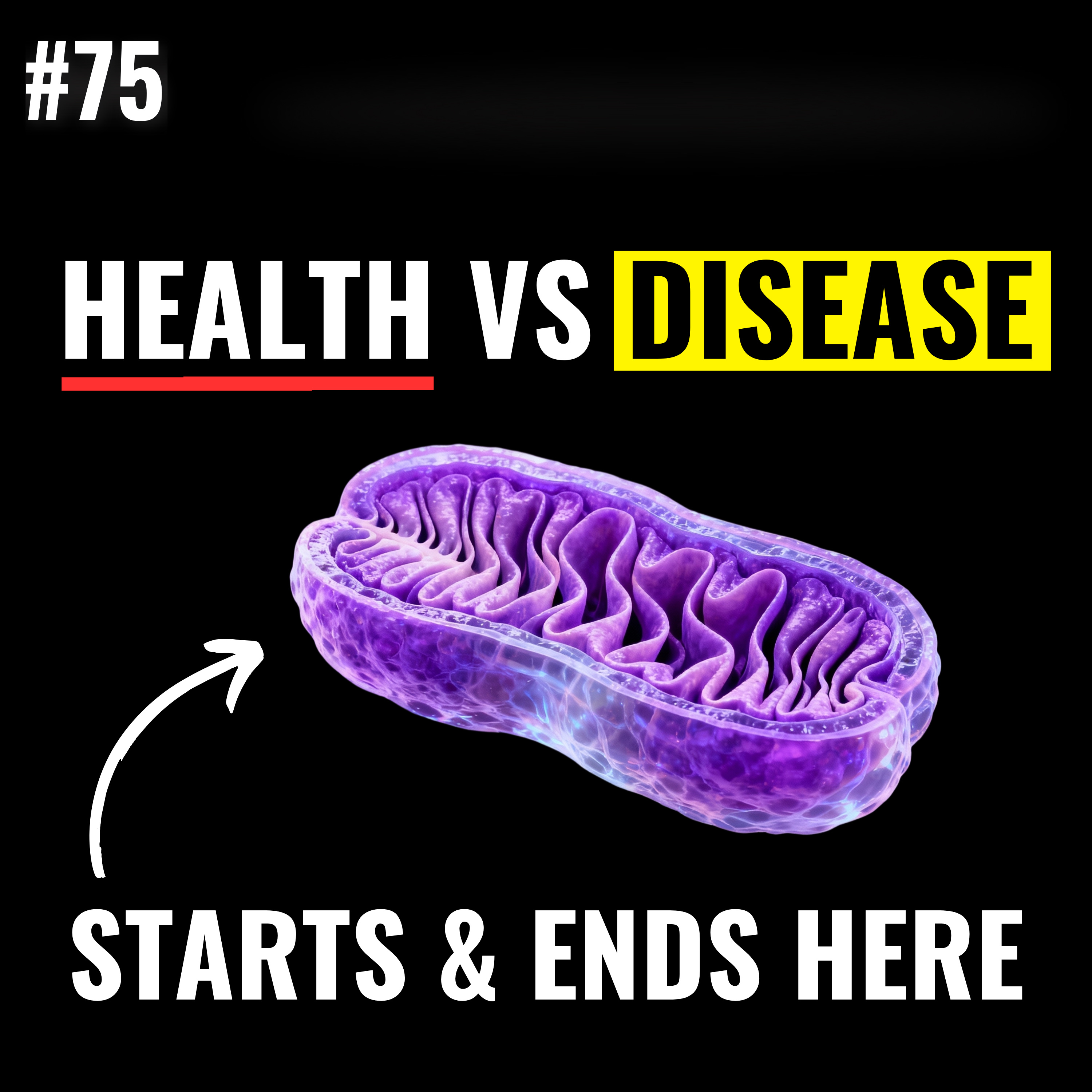
Modern Disease Explained: Mitochondria, Autoimmunity, Chronic Stress, Light Exposure, Nervous System Regulation & Foundational Health | Ryan Mitchel Brown
What's This About?
Modern disease, autoimmunity, mitochondrial dysfunction, chronic stress, and environmental health — in this episode, Ryan and Andreas break down why chronic illness is so common in today’s world.
We explore how symptoms are often the body’s intelligent response to modern stressors like artificial light, technology, nervous system overload, and lifestyle mismatch — not random dysfunction. Ryan shares his personal autoimmune journey and explains why healing often begins with simplicity, environmental awareness, and restoring mitochondrial and nervous system health.
This episode reframes health through a foundational, systems-based lens — focusing on light, stress regulation, environment, and balance as the true pillars of healing in the modern world.
🎯 Ideal for anyone dealing with chronic symptoms, autoimmunity, fatigue, or confusion around modern health advice.
🧠 What You’ll Learn
• Why modern disease is often the body trying to create safety
• Autoimmunity explained through stress, environment, and history
• The foundational role of mitochondria in health and energy
• How modern technology and artificial light impact biology
• Why simplicity often outperforms complex health protocols
• The importance of nervous system regulation in healing
• How joy, balance, and environment influence long-term health
---
🔥 12 - Week Body Transformation Program: Specifically designed to get you into the Best Shape of your life!
You'll get:
- Personalized Nutrition
- Training Program
- Lifestyle Optimization Advice
- Step-by-step guidance & support to transform your body from the inside-out ✅️ Start your Journey Today
---
‼️Join my Free Fitness Wisdom Podcast Telegram Community HERE: I look forward to seeing you in there!🤗
---
📥 Join my Newsletter for FREE Educational & Empowering 🧠 content straight to your inbox: FIND IT HERE
---
⬇️ Find & Connect with Ryan Mitchel Brown:
📲 IG: https://www.instagram.com/ryanmitchelbrown/
▶️ https://www.youtube.com/@RyanMitchelBrown
🔖 https://substack.com/@ryanmitchelbrown
⬇️ Find & Connect with me Here:
https://www.bio.link/move_with_andreas
👉🏽 For Discounts & Offers: HERE
---
⏱️ Chapters:
00:00 Disease, Symptoms & Modern Health Confusion
02:28 Disease as the Body’s Adaptive Response
03:13 Ryan’s Personal Autoimmune Journey
07:21 Mitochondria, Energy Production & Health
13:09 Nature as the Foundation of Human Biology
19:14 The Interconnectedness of Health & Disease
31:05 Mitochondrial Function & Chronic Illness
34:02 Environmental Stressors & Mitochondrial Damage
37:30 The Hidden Cost of Modern Convenience
41:16 Light Exposure, Technology & Biology
44:37 Grounding, Nutrition & Mitochondrial Support
46:58 Nervous System Regulation & Healing
50:40 Simplicity, Joy & Balance in Health
---
👇🏽 Find the SHILAJIT I use & recommend HERE ⚡
Use promo code: MOBILITYFITNESS for Discount ✅
.
➡️ For my favourite Blue Light Blocking Glasses, use promo code: MOBILITYFITNESS for 15% Discount ✅ HERE
.
💦 My favorite Magnesium Supplement HERE⚡Use promo code: MOBILITYFITNESS for Discount ✅
.
👉🏽 Find Best Red Light Therapy panels, Blue Light Blockers & Circadian friendly bulbs 🚨Use promo code: MOBILITYFITNESS ✅ for 40% OFF LIMITED TIME OFFER on your entire order HERE
---
*None of the content / statements in this Podcast are Medical or Personal Advice & is not intended to cure, treat, prevent or diagnose any medical condition. All my videos are for Educational & Research purposes only. If you decide to try anything discussed in this video, you agree to do so at your own risk & responsibility*
This is the Fitness Wisdom podcast.
Sit and reflect and just hang out and be in the moment and things like that. And I think it's a super undervalued aspect of health that I've been having a lot of discussions with people like we, we interviewed Jack Schroeder last night and the conversation kept going back to this idea of
everything is our body's response to stimulus. And so when we view disease like insulin resistance or, or diabetes, is is probably a good example, but obesity is another one. It's not so much that our body is failing, it's our body responding and trying to save itself. So it's all about our body trying to create safety. And so some, some of my views of modern disease revolve around this idea of our bodies simply just trying to respond to stimulus we were not built to thrive in. And so our bodies playing this massive catch up game, particularly in the last 30 years with the advent of very modern LED lighting in the last like 20-30 years.
And our biology just does not have this scapegoat. Whereas before, prior to the industrial revolution, right, we had all this time to adjust to new stimulus, even relatively at the advent of agriculture like 10,012 thousand years ago. You know, you have these hundreds of years to develop, you know, seed hybridization, for example, like when you look at corn from the year 1500 to the year 2000, so different. And just think of how much hybridization that corn had to take from whenever we started doing agriculture here in the Americas thousands of years ago from then to 1500 just to get corn this big.
And then how fast we've taken it from 1500 and now is just such a dramatic exponential change. And I think a lot about this with AI and how AI is integrating right now and everybody's just now in the mainstream media, in mainstream science, they're just now addressing the issue with social media and its impact on developing minds or, or even like cell phone technology. There was a good 60 Minutes article about a week or two ago that was talking about like the dangers of, of technology on, on developing brains.
And they were focusing on I think maybe maybe some of the wrong things, which is the content itself, which of course that's an issue. But I feel like we're just dancing around these very obvious issues with technology and we're just trying to scapegoat areas around it to continue the use. So we'll blame social media and we'll say, oh, you have to be X number of age to have a social media account now in the case of Australia and their new laws. But we're going to ignore the fact that this iPhone 17 or whatever, whatever the crap it is, has like 50% more blue light output on it than, you know, the previous iPhone generations.
And so there's just all these very obvious things that I think once you escape the Matrix mentally become apparent to you. And you don't even even need to understand like jargon to get it. I think once you get out of the Matrix, it's just super obvious the way the world is meant to function. And I think disease and disease management or even overcoming chronic conditions like we talk about all the time, become so much more simplified, if that makes sense. All right. Ryan, thank you for coming on the show.
Your intro was absolutely incredible and mind blowing. So the the audience obviously knows this is going to be like a mind blowing conversation, right? What everything that you said there was really, really on point. And, you know, sitting in stillness, as you said, like is so, so important, you know, to reflect on our reality and what's going on in our immediate environment. Because in this, in this day and age, we're all the time bombarded with us, all this information, like you're saying, and we're so overloaded and our body just is so over stimulated.
Our bodies stuck constantly in this fight and flight state. But I would really love for you to share your personal journey of how you overcame like 2 very serious, like autoimmune conditions that you were diagnosed with over the years. How do you think that you got there in the 1st place? And maybe just share your or your journey with the audience. Yeah. And I think it's a really good question because the answer to it is relatively simple once you have a wider world view of how biology functions in space and in a natural environment versus in a modern environment in which we find ourselves.
But the story is complex in that the way that someone gets to a disease state usually is a long, tethered, arduous process. And I think what it speaks to is how amazing the human body really is and how much stress it can put up with before a disease state actually starts. Don't quote me on this stat, I'd have to double check it. But I believe you can operate up to, like, nearly 70% mitochondrial dysfunction before certain symptoms would present themselves. So when we're faced with this question of like, yeah, So when we're faced with this question of, like, what is our vitality really at?
You can have someone functioning at, you know, 50% capacity and still feel like they're healthy. And I think this is the case often when you see someone get a virus or they have a catalytic moment that leads into a major disease. And I think one that's really prominent right now and just modern side is, is dysautonomia. And that's sort of an array of symptomatic conditions like POTS, IST things like that. But I always try to get people to understand, and this is where I think my learning really began, is that nothing happens for no reason and nothing happens randomly.
And so for me, when I began reflecting on my own condition, when I realized it wasn't just simply, oh, I have carpal tunnel in my hand. And for people that are listening, I was diagnosed with something called TSHCS, small fiber neuropathy and Hashimoto's thyroiditis. People may be more familiar with Hashimoto thyroiditis as an autoimmune condition than TSHTA small fiber neuropathy. It's a little bit more specific. But fundamentally the thing people I want people to take away from an autoimmune diagnosis is that diagnosis is only the beginning.
That diagnosis is the end stop of the problem, not the not the actual like domino that fell in the beginning. And so frankly, when I hear someone has an autoimmune disease, it doesn't tell me that much other than maybe what tissue is affected and what array of symptoms are actually going on, but it doesn't tell you why. One thing I learned really importantly from a mentor of mine, Doctor Terry Walls, who is an IT array of medical professional at University of Iowa and has her own healing journey from multiple sclerosis, is that two people can have the same condition for multiple different reasons.
And so when I first realized I was sort of in trouble in 2019, I was 23 years old, I was living in Los Angeles, CA, and I already knew intuitively that I had done something that led me to where I was with this condition. Guys, if you haven't already smashed that subscribe button and the like button, now back to the show. I don't have a familial history of autoimmune disease. I don't really have a familial history of many chronic diseases in general. So immediately that, that aspect of it, which I think a lot of people when they get diagnosed, they'll be like, well, my aunt has fibromyalgia or my aunt has rheumatoid arthritis, or my mom had this and my dad had that.
And they, they immediately allocate that as to a genetic predisposition, which don't get me wrong, all these things play roles, but because I didn't have that, I could immediately take myself out of that box. So I think that automatically gave me a better step forward than most people that might be diagnosed with an autoimmune condition. But I think an important part of my story that all also led me to being a little bit more skeptical of a conventional model of symptom management was I 10 years previously when I was or not ten years.
I guess at that time it was like 5 or 6 years previously. When I was 1819, I had an eating disorder and I was 88 lbs for about a year and a half. I was under £100 for about two years and I never felt the same after. After that my body was just not the same. Even though I, I went through weight restoration and I, I did therapy and, and treatment and, and gained weight back, my body did not bounce back. I sort of felt like an 80 year old stuck in a 20 year old's body and it was like that for five years.
So I suffered from chronic fatigue, especially from about ages 19 to 23. I just didn't have a name to put for it. But I was one of those guys that would like I needed to go to bed by 8:00 PM at night, which is not a normal occurrence at 23 years old. So I already knew there were problems sort of presenting, but I didn't know what to do about them. I was sort of stuck in this model of, oh, I'm really into, I was really into fitness, I was really into exercise. And so I, you know, I was in the gym, I was doing the sort of standard bodybuilding sort of macros.
So like, you know, 400 gram carbs a day. And I always thought like my energy was lack of carbohydrates because I was working too hard or whatever. And so I just would eat more and more and more and it just did not touch it. And if anything, it made it worse. And so it really wasn't until I started developing tingling in my left hand and then that tingling turned into burning and numbness and all this stuff. And that spread to my whole body in about a span of a month that I realized like, holy crap, I'm like up craps Creek right now and I'm in a serious problem.
And so what's funny about my story is 80% of autoimmune disease is diagnosed in women. And so women really get the runaround when it comes to diagnostics because I did an interview with the Wall Street Journal for small fiber neuropathy in the year 2020, which didn't get a lot of attention because COVID was going on during that time. And so I think it got kind of brushed under the rug. But you can literally look up like small fiber neuropathy, Wall Street Journal and you'll find the article that I was interviewed for.
I don't know if my interview actually made it to the final article, but it was interesting because during this interview, the the journalist was basically telling me that if I had been a woman with the same symptom analysis and I'd gone through diagnostics, that I would have just been diagnosed with fibromyalgia and they never would have given me like a more definitive answer. And So what I learned later on is that 50% of people with fibromyalgia actually have small fiber neuropathy of some kind.
And that's actually like the damage that's that's done. It's not sort of this umbrella term. Now, that being said, you can have small fiber neuropathy for 10,000 freaking reasons. So that isn't a root cause. And so I got really frustrated early on going to specialists and just sort of hearing the same story over and over again. And I think what made me skeptical of this being my forever was the fact that I was so young and I wasn't willing to just medicate myself. Maybe somebody who's in their 60s or 70s who's lived a full life and now they have this condition.
I think those types of people tend to be a little bit more accepting to like, oh, well, I'm old now. And this is just what happens when you get old. You get diseases and blah, blah, blah. But I was 23 and I was like, this is just not right. And so I couldn't tell you what about what about it made me skeptical other than I think just because of all the things I knew that were wrong with eating disorder treatment. I, I just like hated that system. I think I just was already skeptical sort of innately from my previous experience going through the medical system with an eating disorder.
So I think that just kind of made me a little bit simple. But actually what happened was for a while until I, I got a more definitive diagnosis, stumbled upon a Ted talk from Doctor Terry Walls because I thought I had Ms. at the time because I had all the symptoms. And so I was going down the Ms. rabbit hole and I found her Ted talk on and minding my mitochondria. And then I bought her book called Minding my Mitochondria. And that really led me into this other world view of autoimmune disease as a mitochondrial dysfunction first problem.
And so that's sort of where I started looking at shifting my focus from the disease itself to what in the energy process is breaking down. And I think in a really simplified form, you could probably dumb down most disease to a problem with energy in and energy out. And so you've definitely heard this sort of analogy before, and I've probably said it 10,000 times, but it's when you observe the known universe and you observe what goes on, everything is just an energy game. Can you make energy or can you not make energy?
When you don't make energy, you get disease and you die. And it's similar to the way stars form, right? That's like the famous Jack Cruz analogy of like what happens when a star begins to die? It gets bigger because it needs to basically get hotter to burn a more dense fuel. And the further it goes, eventually hits an endpoint and can't do it. Same thing happens to us. So our body's always trying to fix itself constantly. And that's goes back to our first discussion at the beginning of how it's amazing how far we can, you know, mess things up before something really Brooks and we notice it.
But our body is always trying to make energy, whether it's through glycolysis or through the Krebs cycle and do the electron transport chain. And it's really about understanding, I think those processes to get better that actually makes the difference for somebody with a very complex chronic condition than it is about trying to focus on the minute individual modalities of like, should you do red light therapy? Should you do a mold detox? If you're exposed to mold? Should should you look at heavy metals?
And for me, I got really confused because once I got into the functional space, I had multiple of these problems. So I had mercury issues, I had mold issues because I live in an apartment with mold, which was not helpful. I had that eating disorder history which complicated things. I have really bad MTH of our variations that make my methylation and detox pathways messed up. I have choline pathway deficiencies as well. And so I was getting all this information like you said earlier, just like information overload.
And I was trying to grasp at straws for help, but everyone was so focused on individual pathways in the functional space that I still wasn't getting better. I spent probably upwards of $20,000 of not even my own money. Like I couldn't work. So like, my parents were like spotting me this money and I love him to death for it. And I'll never be able to pay him back. But I still wasn't getting better. And so it wasn't until I started working with my, I'll call him my official mentor, Ryan Carter or Livitae on, on Instagram that he really sort of opened my eyes to this 50,000 foot view of disease.
And then as opposed to doing what most functional practitioners do, which is try to hone in on like hyper specific things, He really likes to start as a generalist out here and then come in. Because to me, I think to help somebody, it's about understanding the person as a whole, their history, the way they think, the way they learn, the way they handle stress, all that type of stuff. I think you have to get to know someone to help someone. And that's, and that's really where the conventional model fails full on.
And I think that's where many people in functional functional medicine fail as well, is they don't get to understand the person. They, they give someone a protocol. And I think that those can be valuable, but they're only contextualized within your knowledge of somebody. And so when I work with someone, and I'm sure this is a similar way when when you work with people as well, you really try to understand the whole of that person, not just the pathology of symptoms and labs and organic acid tests.
And you know, whatever gut Biome disruptions, it's, it's about all that stuff. Because I actually look at things like people will say like, oh, your gut microbiomes, root cause or whatever, you have like really bad bacteria, Lactobacillus ratios, blah, blah, blah. Well, how did you get there? So you're still not even at the root cause. You're at like the secondary thing. So like I look at things like SIBO or Candida or all this stuff as like secondary complications. And then the third complication is the disease symptom itself.
So it's one of those things where like, I think you can almost take it infinitely backwards. And so when people ask me, I'll get messages all the time. What did you do for neuropathy? I hate that question, but I understand why someone's asking that and it's because they're not ready. They're not, they're not in the mindset yet to take it way out here. They're still stuck it like right here. And so it's a complicated question because I can guarantee that the reason they have X condition is not the same reason is why I have X condition.
And they have to understand that first before they can tackle it, if that makes sense. Imagine spiking your blood sugar without eating cake, elevating courses, all your stress hormone without being stressed, and suppressing your body's most powerful sleep. Antioxidant and regeneration hormone, which is your melatonin. This is why I make sure to wear my yellow daytime blue light blocking glasses every time where I spend time indoors, under artificial lights and in front of screens to protect my eyes from oxidative stress and my entire body.
And if I'm going to be exposed to artificial blue light, especially after sunset, I'm going to wear my red lens blue light blocking glasses to support my melatonin production and release. So if you want to protect your energy levels, sleep and biology from artificial blue light, head over to the description and you will find all of the links with a massive discount on my favorite blue light blocking glasses. Oh yeah, absolutely. Thank you for sharing your personal journey and story. That was super inspiring.
And I feel like your message is a message of hope to a lot of people because a lot of people are, you know, are just feeling stuck out there and they just feel that there's no hope for them out there. They've done everything, they've tried everything. They keep on going from one doctor to the next. They keep on looking for solutions, but one thing that they're not doing, they're not addressing the foundation. Basically what you're saying, no matter who you are, like there is this general foundation that applies to everybody, you know, to all living things pretty much.
And if you address that foundation, then you can start to narrow down to the specificity, you know, to the different issues that someone has, whether that's gut health or joint issues or whatever. Whatever it is, for sure, you can fix that eventually, you know, when you can narrow in on that. But if you're not addressing the energy management of the system like you mentioned, then basically the body is not going to have the energy to channel it there where you are aiming to fix the actual problem and then therefore get rid of the symptoms.
Because at the end of the day, we know that symptoms are just screaming for our brain for attention. So it's telling us, hey, pay attention here. But then doesn't mean that the problem is actually there. It could just be manifesting at your weakest link, as I like to call it, because everyone in their body has some weak link somewhere, whether that is because of childhood trauma or because of, you know, of your bad mother's habits before you were born or something like this. It could be even like through your own personal habits in your own lifetime that maybe has made your right knee more vulnerable for for example.
And then when you develop some autumn new type of condition, then eventually you have like a swollen knee and a knee pain there for no apparent reason. But there is obviously a reason why it's manifesting in that place. But as you mentioned there, the most important thing really is restoring energy within the system. And once we have that energy, then it can start to process and deal with things. But again, like the body is doing, as you said, everything that it can, that the best it can within the situation that it's in.
So for example like. Like if the best that it can do is inflamed you more to try and survive, that's what it's going to do, you know? And then eventually when you give it the, when you create a different environment where it feels like it doesn't need to inflamed you anymore, then the inflammation will begin to go down and then a lot of the symptoms will begin to disappear and so on. So my next very important question that I have for you is where do you think health starts in the human body? That's a big question.
It's funny because there's that old like Hippocrates saying that's it, like all health starts in the gutter, all disease begins in the gut. You know, I feel like I'm, I'm sort of always ruminating on that question. I don't know if I have a definitive answer, but I do think all disease starts at mismatch. And So what I mean by that is disease starts when the system is receiving inputs that are not contributing to how throughout hundreds of millions of years, this mitochondrial relationship with eukaryotic cells has tried to become incoherence with its environment.
And so I think disease starts at the lack of coherence. And that's a really kind of woo woo hippie saying. I feel like that word coherence, but I think it's super important because. Not really, there's no. It's just communication that's. Yeah, yeah. What I mean by it is I think there's a lot of I feel, I feel like it's so easy to get lost in the sauce of mechanism. And I feel like this is where conventional science really fails in a sense with the scientific method because they're looking at 1 hyper specific mechanism at a time in a controlled laboratory setting.
And they're looking at, And that's The thing is like, I don't know how you make a better testing system, at least right now, because to get direct data like that is kind of true, You got to kind of look at 1 variable at a time. But unfortunately in the scheme of health, nothing is singularly affecting itself at any one time by itself. It's always interdisciplinary meaning like everything effects everything all the time. And so I think until they realize that truthfully, in a conventional setting, you're not going to help anyone in a really meaningful way.
So yeah, I think disease really begins or dis ease, like everyone likes to say, begins at the lack of coherence. And that can mean like 10 million things, you know what I mean? I don't normally, I actually really don't believe often times it's it's one thing. I think it's you have these multiple dominoes that all sort of are in a web and they all fall together into eventually one line and then that line is the disease. So you have all these like you have almost like set up dominoes in different, different paths that all lead to one path at the end.
But people will ask me all the time will like why did I get rheumatoid arthritis and why did you get Hashimoto's? I don't know why that is, and I don't know if it matters to know why. I don't know if we'll ever know why per SE. I think it has to do with so many different variables all at once. Like you have like these preconceived areas of weakness already, and so that Domino's going to fall before another domino for somebody else. That's probably what it is. But that's why I think truthfully, it's like the first focus.
Like you mentioned foundations. I think everything initially is about mastering foundational pillars of health and then honing in on specific discrepancies. So you can say one pillar, I've sort of narrowed it down to like these like 4 pillars. That would be, it's a little bit different. I, I make one pillar nature and nature encompasses a lot of things to me. Nature encompasses like circadian biology. It also encompasses magnetism. It also encompasses nutrition. So I kind of like lump a bunch of things into nature cuz I feel like nature is like the foundation of health, you know what I mean?
And then outside of that, we can get into things like the nervous system and then we can get into things like maybe movement and fascial health and hydration and things like that. So I feel like you could probably almost, to be honest, if you really wanted to mega simplify everything, you could put everything into just one pillar. And that pillar is nature. And then within nature, there's all the other subsets that are required for optimal biology. And so that's why I think actually like getting better is about creating health more than it is about battling a disease, you know what I mean?
And I actually think that the worst thing anyone can do, I got a comment the other day, the worst thing anyone can do is feel like you're fighting yourself. Because if you're trying to fight your biology, biology to win, then you're always going to lose. Because truthfully, like I said earlier, it's your body responding. So I think healing is more about listening than anything else. Based on my research, this is the best shilajit in the world. Here's why you need to know about Shilajit. Shilajit is a herba mineral substance made from the decomposition of plants and bacteria.
This process taking place over thousands of years. It's harvested from the Altai and the Himalayan mountains. Think of it as a hyper concentrated plant matter that is made by a Mother Nature over thousands of years. In many cultures and traditions, it's known as the destroyer of weakness. Let me tell you why. Chilajit is loaded with ionic minerals which are the most biocompatible with our human body. It also has a very high concentration of folvic acid. This folvic acid allows those minerals to get into the cell and do their work.
Minerals are absolutely essential for all processes of the body from having good energy levels, enhanced cognitive function, hormone optimization and so much more. You name it. This is why I use Chilajit on a daily basis because it works on a foundational level, on a mitochondrial level, and we we know that we need healthy mitochondria in order to produce cellular energy. Something very important to mention is the quality of shilajit. The one I use has been tested for heavy metals and impurities, ensuring the highest quality shilajit.
So if you want to experience this incredible ancient substance and find the one that I use on a daily basis, head over to the description below and use the promo code attached to get a discount on your entire order. Yeah. Oh yeah, absolutely. So basically what you're saying is that we need nature in order to push disease as far away as possible. That's basically what you're saying. Pretty much, yeah. I mean, there's a lot of intricacies to it, but I think without getting like too lost in the sauce, I think nature's everything, you know what I mean?
I, I just think like, if, if everyone could just start with spending as much time as they reasonably have in nature and get away from the city or whatever every weekend, like during the spring summer months when like things are abundant, I think you would feel better almost regardless of what's going on. Like I had a client the other day tell me like how much better they felt literally just sitting outside doing nothing else. And I was like, you got to listen to that because that's an important message to your body right now.
Like that's an important sign that that is where you're meant to be. And so I think we've just, I think really the biggest, I think really the biggest contributor to disease in modern society is our lack of our ability to listen to our body. Frankly, I think, I think we just like, I mean, you, you probably know this coming from a fitness background, like we're like the only animal on the planet that by the time we get into the world and we have to like make our own decisions and pay taxes. We have to look up what to eat, how to eat.
We need to look up how to sleep. We need to look up how to move. Like we have no intuition at all. And what's funny is like when you look at a baby or a toddler, they're doing all these sorts of crazy things inherently, like they're squatting to sit down, like they're doing all these crazy bio mechanics that are just intuitive to being a human. And then like we lose it through programming growing up. And so I feel like my goal is to like get to, it's sort of similar to Picasso's goal of like wanting to paint like a child.
It's like, how do I get to the intuition of a child because they're so smart without even knowing what the hell they're doing? And so I think, honestly, one of the best things any of us could do is observe. Observe your pets. What do they do when they go outside? You know, they sunbathe for a little bit, then they go sit in the shade. We're the only animal that has to ask, how many minutes do I need to sit in the sun? What a silly question, if you really think about it, you know? And so I think a lot of it's observing the way you ask questions, the way you think, and then questioning.
Does that really make sense? You know what I mean? Oh yeah, absolutely. What do you think the role are of mitochondria in health? How important are the mitochondria for our overall health and well-being? I think mitochondria define us as eukaryotic organisms, so multicellular organisms. So it is the defining feature of you and me, and it defines multicellular life in general. And what's amazing about it is they give us a deeper informative understanding of how to view health and disease because mitochondria play this critical role in bioenergetics via the use of oxygen primarily.
And I mean, they are the energy. I mean, they, they are the energy factory, but they are the sensor and the antenna of our lives. If you imagine sort of like I was kind of let people have this analogy of like a cat's whiskers, the cats whiskers sort of like give them sense of like their environment a little bit. That's like our mitochondria for everything. It's sensing light, it's sensing temperature, it's sensing interaction with other people's vibes. You know, it's it's sense sound frequency, It's sensing things that you don't even see, hear, smell with your 6th senses.
Like it's, it's so integral and honestly we are we're barely stretching the surface of understanding on any of these things. Like even with things like bio photon emissions where our cells literally emit light and maybe communicating with one another through light. We now know that, for instance, our gut bacteria. I think this is the work of Sabine Hazen, who's a gastroenterologist who studies the gut microbiome in conjunction with long COVID. Specifically. She found that like they put, I believe they there was a study where they put bifida bacterium in a cell culture over here and they started putting like some sort of acid on it to kill it.
And what they found is in this other cell culture completely like in a different part of the room and a different thing, it was like sending signals of distress to the other bacterium. So how do you do that? Like through telepathy. So maybe telepathy is really by a photon emission. And so I know there's some sites that have been coming outside. There's like different. Yeah. And there's like these other things where like our brain can communicate without actually sending like a direct electrical chemical signal to one another and the neurons.
And so maybe that's by a photon emission. And so there's, there's, there's all this area of study that's so we have so much to learn still, But I, I really think that they're pretty much everything. I at the end of the day, I think they're sort of dictating our environment for US. One thing that I find fascinating about mitochondria, I think my favorite fact about mitochondria is maybe one of the most boring ones, but it's the reason why we get it from our mom and not our dad or both of them. And it's because, and this is where you can get into things like, is it God?
Is it, is it natural selection? Like what is it? I don't know. Maybe it's both, maybe it's none, I don't know. But the reason we get it from our mom primarily is because during insemination or whatever, the sperm just gets so damaged on the way to fertilizing the egg that nature's naturally selected the mom to pass down the mitochondria. Because by the time you get there, you're so messed up. The sperm's mitochondria are just so broken just through the journey that nature's like, Nah, you're, you get it all from your mom.
So thank your mom right now because you are the way you are because because of your grandma and her development with your mom and utero, and then your mom passing that to you. So you're almost a direct reflection of your mom and your grandmother in many ways. And so that's why I think like if you're like when you, when you do a family history and an intake call, I'm really focused on learning about the lives of the patient's mother and the patient's grandmother. And not just their like physical life and what diseases they may be acquired, but also like, yes, what were their trauma like?
Were they abused? Like did they have an alcoholic husband or father or whatever? Like those are all important, pertinent information to have because that that definitely dictates mitochondrial development. And the other thing that's fascinating about mitochondria, So I'm just kind of going off is they work together like an Ant, like in an Ant hill. So like in an Ant hill, if there's a sick Ant, it'll selectively go and die for the betterment of the Society of the ants. And cells do that too through apoptosis.
And so I think in a lot of ways, we can look at certain diseases like cancer as inappropriate cell death responses. So we're getting all these incorrect signals. And so that's what I mean. Like the reason the environment is so important is because if mitochondria are antennas and they're receiving signals, then the wrong signals at the wrong time in the wrong order, blah, blah, blah, blah, blah, create this cascade effect that actually makes it really hard in a conventional model to like trace upstream and find out what the problem is because nobody understands that in a conventional model.
But like when you go to your doctor and you say, oh, I'm experiencing these weird symptoms, they're not thinking, oh, like what in your environment maybe like screwing you up because we're missing all these foundational principles of circadian biology and all this. No, they literally just, they started the symptom and then they go forward. So that means they're missing probably 90% of the entire thing. So yeah, to answer the question, I think they're everything. Muscle cramps, eye twitching, headaches, agitation and stress.
Those are all signs that I have magnesium deficiency. I can always tell when I haven't taken my magnesium. You see, magnesium is an absolutely essential mineral and is required in over 600 biochemical reactions across the body. I'm pretty sure we've all experienced that cough cramp in the middle of the night and that is most likely due to a mineral or magnesium deficiency. And the reason why most individuals are deficient in magnesium these days is because stress depletes magnesium. And tell me a single person in this world who is in stress right now, whether that is physical or psychological stress.
Magnesium is something that I'm very religious about taking every single evening before I go to bed because I don't only want to sleep 8 hours, I want to have a deep and restorative sleep. I know that when I've taken my magnesium, I wake up feeling relaxed and refreshed. So if you want to discover the magnesium that I use on a daily basis, you want to make sure that you head over to the description below and use the promo code attached to get discount on your entire order. Well, that's a great answer, a great response.
So basically what you're saying is the environment actually is so important to the mitochondria because the mitochondria have such an important role within the human body and for our overall health and well-being and our energy and our vitality. And basically you just said there that because the world has evolved to such a non-native level, so everything our in our environment right now, evolution that's occurring, technological evolution that's occurring around us is so foreign and so weird to our biology that it can't understand it, that it's trying to figure out what to do with these signals.
And that is causing sorts of cellular incoherence and distress within the system. So it can't keep up with its own fundamental biological process is that it needs to do on a daily basis because the input from the outside is so much. It's sort of like blasting a really loud music and then like scrambling the music. So you can't really hear which song it is. And you're you just feel absolutely distressed and your your nervous system is all the time on the edge, even though you don't feel, let's say, stressed.
But it's you're all the time under this micro stress, which is constantly basically breaking your body down over time. Is that correct? Yeah, another way that I just thought of explaining it to is it sort of like picture your mitochondria as taking down notes on a chalkboard. It's writing down all this information from the inputs that it's getting in till I do a mathematical equation to give you the right output. Well, then somebody comes along and just puts a nail and scrapes on the chalkboard and that signal is just so annoying and disruptive.
You no longer can write down like you lost thought, like you don't know where you're at. You don't know what to write down because a stupid guy is like chalkboarding with a nail. And so, yeah, it's exactly like that. I love that music analogy. I'm going to steal that from you because that's a good one. Yeah, I just, I just came out with that on the fly. So basically, let's give some real world examples to, let's give some real world examples to people of what things actually damage mitochondria.
What things do you know or that you're aware of are harmful to mitochondria? Because I think it's so important for people to be aware of their daily acts, habits and behaviors where they're aware, whether they are aware of them or not, so that they can start taking ownership and control over their mitochondrial health. Yeah. And it's funny because I'm going to sound like a broken record because I think the biggest ones are are the most obvious and yet the most the most difficult to give up because we're so addicted to it at the same time.
But I think light and technology are probably the most pervasive issues that modern people have. And when I think of developing humans, So Gen. Gen. Z to some extent, but Gen. alpha and Gen. beta especially, that's the new generation right now who are babies. I think they are so more screwed than I was growing up in the late 90s, early 2000s, and definitely more screwed than my parents were growing up in the 60s, seventies, and 10 times more screwed than my grandparents growing up in the 20s and 30s.
As far as like the amount of stimulus that your body now has to deal with, because we can talk about food and seed oils and process ultra junk all day long. The thing about most of those things, minus maybe seed oils, because that seems to be like something that the modern world has yet to grasp, but everyone knows processed food is bad for you. Everyone's known that since forever. It's probably worse. I mean, it's way worse in 2025 than it was in maybe like 1970 or whatever because of the amount of light dyes and other chemicals that they add.
But at the same time, it's like no one like, you know, you could, you could have a six year old tell you that they know what's bad, you know what I mean? But I think to grasp that these things that steal our dopamine and steal our like steal everything, steal our attention from the moment I think these things and the light that comes off these things and the signals these things emit are 10,000 billion trillion gazillion Googleplex times worse than all that food junk and soda or whatever combined.
Because I mean, we just, we love it too much. I think truly the enemy of today is convenience. We're fighting convenience now. And so gosh, you know, I was talking to a client the other day about Amazon. Dude, I could get, I was re upping on a few supplements I was taking, right? I got it the same freaking day I ordered it online from Amazon. How freaking crazy is that? And yet I hate. That that's crazy. Because they have this monopolized, you know, sector on the and they, you know, destroy small business and all this stuff.
But it's like I'm fighting that convenience factor. I should go to the farmers market, but it's like I can get it right now. I don't have to drive anywhere. I can order all the food to my house. You don't have to leave if you have a if you have a work from home job, you literally don't ever have to leave your house if you don't have to. And I know people that don't, they work from home. They order all their groceries, they order all the food. They never go to a movie theater to watch a movie with family or friends because they can stream it right here.
And I think truly that's probably the most damaging thing to all of us from a psychological to a physical level. And it it goes beyond the biochemical and the bio energetic. It goes into the very psyche of what it means to be a human. And you know, and I think AI is just sort of like that next thing where it's like, I'm not going to be someone that completely bashes AI and think like, oh, we should never, we should be completely analog, blah, blah, blah, because there is always a cost benefit ratio.
But the problem with humans, frankly, is we don't learn from history and we take things to the NTH level before we realize, uh oh, that's a problem. And then we're trying to walk back 10 steps when now we can only walk back one because we've just ruined things so much. And so. Oh yeah. Truth. Truthfully, I think to answer your question, I think like the most invasive toxins are convenience, but it's also like what that encompasses, which is like spending all our time on our phones, spending all our time, you know, on the screens.
I mean, and then it starts from a young age. Like my mom was a school teacher for 40 years and the last 10 years of her teaching, they really incentivized hybrid learning, which means 50% of your school day is on an iPad. And she taught first graders, so 6 7 year olds and she knew how messed up that is partially because I I've been telling her all this stuff, but she kind of knew. Like in the last 10 years she's been getting more and more 6-7 years. She's never had more 6 year olds with anxiety, with mental health disorders, with childhood defiance disorders, with ADHD, all these psychiatric diagnosis.
And it's not just because we're catching them earlier, you know, it's because there's more of them and it's because we're destroying our kids development from the beginning. Whereas you take an adult that got their first iPhone in 2007 and they're 2526, thirty years old, they've already gone through key developmental phases in developing myelin around their brain and neurons and things like that and melanin in their in their brain stem. Now we're just setting up kids to destroy that before it even fully forms.
And so who knows what the next 30 years are going to look at for those children that are growing up in a modern world. Forget about climate change, forget about like all the toxic crap in our water, in the air and all this stuff that's bad too. But just think about what you're putting your kid in front of just because you don't want to babysit them for 20 minutes. So I think those are probably the worst thing. So like key things you can do about that that are actionable. A lot of simple things for your computers.
You can download a program for free called F dot LUXF lux and that allows you to change some of the factory settings on your computer to down regulate the amount of blue light coming off of your screen. Iris is another one that you can download and you can check that with a spectrometer. It does a really good job of like actually narrowing the wavelengths into a more red spectrum, which is the missing wavelength and most of modern lighting. Other thing you can do with your phones is you can put shortcuts in your phone.
Oh, wait, where's my camera at? So there's blue. Sorry, I'm making out with my fiance on that photo. But you can make it red and you can actually check the Spectra of that light on your phone. And it does a really good job of taking that blue light all the way down. And so the danger of of modern LED lighting isn't so much that the wavelengths in them are particularly bad, it's the fact that they're isolated. So yes, the fact that an LED light is a predominant blue-green spectrum. When you look at the full spectrum of the light that we evolved under the sun, which is a full spectrum, which contains blue-green light as well, but it also has red infrared, the whole infrared spectrum has the UVAUVBUV spectrum.
It has, you know, all of the things that we can't see as well. That's what's really damaging. So like I think really simple things people can do for that is just switch to good old incandescent lights that have a much more broad spectrum in the infrared in a little bit of the UV. That helps a lot. Taking light breaks throughout the day is massive. You know, every hour go outside for 5 minutes, something like that. Make sure you see sunrise because that's like the ultimate time keeper for all your you're circadian clock jeans, which one of them is literally called clock, which I find hilarious.
You also have BMALL 1. You also have purr and cry such funny names for like some of these jeans. But I think like, I think a simple rule of thumb is like, do what the sun does when the sun is out, be outside when the sun is down, turn all the lights off as best or switch to it. Incandescents get red bulbs. I have this something called a sky portal right here next to me that is a flicker free light. And I can change the Spectra to white. I can change it all the way to orange because we're kind of in the morning here.
I'm kind of in between like orange and and white a little bit. But you can also change the the flux or the brightness. So like full on daytime would be here and then you can change it down. So at night time you can have an orange and then have a really nice sort of soft Spectra. I think that's probably the the best lighting right here. I probably should have done this when I started, but like you right now, you're sitting with your red light on in the background because it's later evening for you.
And so you're trying to mitigate that melatonin down regulation and you're still creating a little bit because of the luxe of the light, but you're wearing some blue blockers that'll help with some of that dimness as well. But but I think like simple actions you can do see sunrise, take light breaks throughout the day to make sure you're getting that natural light in your eye to make sure that your brain is sending the signals to the rest of your body that, hey, it is the time that it is. Because when you look at your phone first thing in the morning, it basically shocks your system into, holy crap, it's noon, we need to catch up.
So cortisol goes like this, melatonin goes like shoots down. And then the problem is that night, even if you're using incandescent lights, it's better. But if you're walking around and you have all these bright overhead lights on like all these modern home has, your body still thinks it's in the middle of the day. So it's not going to up regulate its natural melatonin cycle to put you to sleep and act as an antioxidant and have your body go into deep sleep and do all that repair and restoration and detox your brain.
So I think like actually mastering your light environment is probably the most proactive thing anyone can do to build a strong foundation for mitochondrial health. And then probably secondarily to that as a problem with these would be like improving your electromagnetism. So like turning off your Wi-Fi at night, things like that. And the reason like non-native Emfs can be so damaging is a lot of things. I think the one of the big ones is it it creates A hypoxic environment. So imagine like throwing a steak in the microwave.
When you heat up a steak in the microwave, it gets drier. And that's literally what happens to your mitochondria. It basically makes your mitochondria vibrate really quickly and they're dissipating heat and they're basically drying themselves out to. That's like a super simplified example, but yeah, it's similar to light where it's like you're getting wavelengths that don't exist in nature and your body's trying to deal with that and it can't. So if you're in a house all day that has all these inappropriate signals from like your Wi-Fi and your smart TV and the electrical outlets in your walls, you're basically just like sitting in a microwave all day.
And so get outside and touch your bare feet to the ground up. Takes some free electrons, you know, through through grounding and the natural magnetic fields of the earth like the Schumann's resonance. And I think that can be a very good low, low effort modality just like touch dirt with your bare skin. And then as far as food goes, I'm going to keep it simple because it's going to look different for depending on the problems that you have and sort of gut dysbiosis particularly and things like that.
But I take an approach of like, if you can start with like a basic seasonal paradigm of eating like what is growing in your innate environment, like what's at the farmers market and just eat those types of Whole Foods as your predominant intake. I think people will feel like quite a bit better, especially for like generic populations that are dealing with predominantly metabolic disorders, you know, hypertension, high blood sugar, obesity, just being overweight. I think if you literally just like focus on whole seasonal foods, you'll get so much further ahead than like worrying about the intricacies of like, what is my macro today and like what are like blah, blah, blah.
Because like if you're eating seasonally and you're eating like nose to tail, all that stuff, you're getting all the micronutrients, you're getting all the cofactors for all these important functions to the Krebs cycle and the electron transport chain. So kind of like the way I view food as food, as cofactors, light and grounding and things like that are going to be charged. They're charging the system, but you need cofactors to shove it through. And then I think we're nervous system comes in play is that we just live in this world where everything is measured by how productive you are.
And so we never have time to actually relax. And so just because you end your day with plopping on the couch and trying to veg out doesn't mean your nervous system is relaxing. I think as I said at the beginning podcast, the best thing you can, the best thing you can try and learn. And there's no perfect way to do this. It's kind of individual, but the best thing you can try and learn. And by the way, I actually still suck at this is something that I probably have the most room to grow in is being still and being in the moment.
Like I think if you can be bored, you've like mastered. You've like mastered that sort of nervous system regulation. Like how Like it's like, honestly, if I go outside and I sit in a chair and I'm sunbathing, it's hard to just sit there and do nothing. So one of my goals for like this next year is to like be, be better at doing nothing, you know what I mean? And it's a real struggle. Like that's, that's honestly my biggest, my biggest issue is being able to do nothing. So basically all of the things that you mentioned there was that, you know, we are we're needing to avoid all of the non-native signals from our environment, the blue light, the non-native BMF's, all the junk food, basically all of these things are non-native signals to our mitochondria.
Because again, going back to the mitochondria, like you mentioned that there are these environmental signals, these quants and sensors that are picking up everything from the environment and then we're doing everything more pro native. So things where we have evolved with over thousands of years, which is sunlight, grounding, real food, eating basically what's in season and moving our bodies in the environment, being barefoot and all this and automatically all of these things, they tune our nervous system to the natural environment.
But then when we are doing all of the non-native things, then basically our nervous system is freaking out because it doesn't have something familiar to anchor with. And this is like basically how we create safety by doing the familiar things, but not the things that aren't necessarily familiar in our modern world, but what's familiar to our biology for thousands and thousands of years, which is programmed in our DNA. Most people don't actually understand this, that you need to do things, that it doesn't matter what you think.
You need to do the things that your body thinks is right for. Exactly. When you actually do them. Yeah. You realize that. OK, when I'm becoming more in tune with my environment, it gives you this, the feedback signal. This feels good. So therefore you should do more of what makes you feel good. Obviously when you do something that makes you feel like crap, you shouldn't do it anymore. Yeah. And, and to kind of add like a cherry on top of that, it's sort of like because you and I are a human animal, there are certain things that human animals just similar to like, similar to like having a cat or a dog, you like, they need certain types.
They eat certain foods, you know, I mean, like cats, a carnivore, for example. So you're not going to feed it lettuce, you know what I mean? It's similar. It's like you have to view yourself as an animal. And I'm not saying that that's like dumbing us down to like a rat or something. Like, I think the human body is crazy and our brains are, you know, impossible to explain, But if you don't be yourself like that, then you're then you don't, you're not, you don't have like the setup for like making the right decisions.
And so like, everything I think about is like, what would I, as a human animal that's evolved on this planet, do in space? You know, what would I eat? How would I move? What are my bio mechanics, like structures for things like that? And so I think once you view it like that, everything else becomes a little bit easier to understand. The one caveat I wanted to add, yes, because I think a lot of people can get overwhelmed by a lot of the things that we talked about and we kind of just scratched the surface in a lot of ways.
But, you know, I think health anxiety and worrying about being perfect is just as bad as all those non-native things that I mentioned. And so there's a level of, you know, when I, when I observe people that really live happy, healthy lives that don't know anything about the things we're talking about. But they just seem to like they can smoke and drink and they die at 100 years old in their bed, you know, after a nap and they have no diseases. The thing that I think is really different between people like that and maybe people that are really health anxious and do all the right things but still remain sick is they they're happy.
You know, I think, I think happiness and gratitude are like are also a vitamin. And so part of the healing journey is about enjoying is about trying to find joy in the journey as well. It's not about being an anal butt wad who has to do 10,000 things a day to think they're healing. You know what I mean? Part of healing is also just, you know, finding peace and finding joy in like the little things, you know, like sitting in the sun or like hanging out with a friend or whatever. And so, you know, there's a, there's a, there's a balance to it that I think there's no one way to master, you know, and I'm still working on things myself in that respect.
But I think it's like, you know, learn all you can, apply what you are able to and let go of the rest. I think a lot of nervous system regulation as far as like, like practicing nervous system regulation is actually all about letting go. And you can do multiple things to to do that. But ultimately that's what you're trying to do is like let go of tension, let go of stress. Now you can achieve that through breath work and Mal fascia release and and somatic practices like tapping and you can do a bunch of different things and you got to find what vibes with you, but ultimately you're just trying to let go.
I I've been trying to do that a lot more as far as like recognize that I'm only here on this planet one time unless Confucius and all of them were right. In that case, I'm very excited for my next life. But as far as I'm, I know, this is the only life I got. You know, while I agree, we should all try to live our healthiest that we can because there's nothing better than a great health span. At the same time, you don't want to wake up one day and realize I'm 80 years old and because I was so anal about what I ate or the light that I was trying to block and all the stuff that I didn't experience life also, you know what I mean?
Like I didn't go hang out with friends because they they stayed up too late. So I'm not going to hang out with them. There's a balance to that. Like don't do that all every freaking weekend and you get blasted drunk or whatever. But you know, sometimes doing the wrong thing is the right thing. Sometimes going to a concert late at night is the right thing to do for your health because the experience brings you happiness and happiness is part of vitality. So. So there's a balance to it. It's funny too, because you said, you said something earlier where you said like do more of what makes you feel good.
I agree with that to an extent. But it's like, you know, I'm sure doing cocaine would make me feel awesome, but that's not a really good thing to lean on, you know what I mean? So it's like it's, it's like, it's sort of like these intuitions. It's like, you know, scrolling on my phone, like the dopamine rush makes me feel like, you know, sometimes. But it's like, that doesn't mean it's good. So we got yeah, yeah. So we have to, we have to learn to measure like what's actually hijacking our biology and what's actually giving us restoration and vitality, you know what I mean?
Because it's it's a distinct difference. And you really got to learn to listen to your body to understand what that is for you. You know what I mean? So I think that's what's actually tricky. I think the trickiest part for anyone's journey to heal is learning to listen because you can absorb all the information in the world, but if you don't know how to listen to your body, you'll have no way of applying that knowledge. You know, some of the smartest people I know are the sickest people. They're smart as hell and they do not know what to do because they don't know how to extrapolate what they've learned because they haven't learned to listen.
And so sometimes the sounds, the sounds bad. And so I don't want anyone to quote me on this, but sometimes working with someone that isn't the most book smart is the best because they have no preconceived knowledge of what they're learning. And they have a better in tunement to how they feel because they just they're not lost in the sauce of academics. You know what I mean? It's it's actually wild. Like, yeah, I think some of the people that have gone through these journeys, some of the people that become the sickest or some of the smartest people, like, for example, people that have anorexia know more about nutrition than anyone on the planet.
But they're also, that's also what's destroyed them. So it's sort of like, and that's where let it letting go comes in, right go. You got to let go of control sometimes to find the right answer. It's a weird, it's a weird paradigm because. Yes, it's beautifully said, but you know that it comes into the energetic aspect, you know, because what you mentioned there about letting go and then going to the concert and enjoying yourself and having that really good vibe. You know that that different feeling within your system is I think, very, very important for these for your body to experience these new experiences.
And I feel like it goes so, so much deeper that when we look at health, we tend to think of health, you know, as just something physical, but it's, it's more like spiritual as well. Spiritual health is impacting or, you know, energetic health, whatever you want to call it. Like what the stuff that you can't see, your bio field, all the stuff, the ether that's impacting you on a very big level that you don't even know. It's it's basically on the subconscious level where all our habits and behaviors are stored.
And because everything literally is there, it keeps coming back to us or through different life events until we learn our lesson and we overcome that. And I love basically what you said about, you know, just sitting in the stillness because that is the only way we're able to process and understand that what we're doing in our daily life. Is it taking us forward or is it like hindering our growth on every level? It doesn't have to be only about health. It can be, you know, like anything really. Yeah, so true man.
And that's why they call it a journey because it does not have a destination. You just keep going. And that's the thing, man, it's like, you know, I'm still every, every day is an opportunity to learn. It's an opportunity to be better. And sometimes the best step forward is taking 2 steps back, you know? And so that's why I think listening, it's probably the most important thing, even though it's funny because I say that and it's probably the skill that I have the largest growth to still have on, but it is definitely the most important thing.
So I appreciate this conversation. It's been like a ton of fun because I think I, I think it's. Like a lot of people like Ryan. It's great. Yeah, it's great. It's great to have podcasts where like you dive into mechanism and we did a little bit. But like when you dive into mechanism and you're talking about like Tom C and melanin and you're, I think that's fun. And I think for like the like, for people that just want to learn, learn, I think it can be great and it helps like practitioners have better understanding and make better decisions for their for their clients.
But I think like some of the and I think you'll talk anyone that's gotten better like you ask them what they do today. They they've realized that simplification is almost like the pays the biggest dividends, you know what I mean? I think we tend to, I think we want to over complicate things on purpose and I don't think there's a necessity to do that all the time. Yes, yes, I love it. Simplicity is the key. I love it. Any last words of wisdom before we close out the show? Ryan, thank you so much.
I think what I would say is that if you're struggling or you know someone that's struggling and maybe they don't know what direction to take, maybe the best first step is just sitting down for a moment, turning off all the social media, not necessarily unfollowing everybody, but deleting Instagram. Stop taking in information and instead reflecting on, OK, how do I feel? And trying to sort of reverse engineer the steps that got you to where you were. Because like I said at the very beginning of the podcast, nothing happens for no reason.
And so if you're thinking like, man, one day I randomly just got autoimmune disease, I think you need to, the first thing that person needs to do is sit down and think, you know what, no, that's not true. What about my environment? What about my history? Put the cards on the table to give me this hand. And I think that's probably the most pertinent thing anyone could do in the beginning is really reflect on that and just sort of like sit and feel themselves themselves in space. I think that's probably the first step.
So I want to leave people with that. If you haven't done that, definitely give it a try. Oh, that's wonderful. Really great advice for sure. So where can people find you, Ryan, connect with you and work with you if they wish to do so? For sure. I think the best place to find me would be Instagram or Facebook at Ryan Mitchell Brown. Mitchell's spelled with 1L because my parents don't know how to spell. And you can find me on YouTube as well. I have a school group that's a private community that I host with my friend Chris or at Mitopoppy on Instagram who's a masters in nutrition.
And there we kind of post a lot of more in depth resources for people and try to give people a little more, a little more individual help at an affordable price. Because I understand like working one-on-one with everyone isn't always feasible financially, especially in the climate we're in right now. So we want to give as much information that's individual to you as possible for like an affordable price. But I would say those three places are probably the best to find me. If you can find me on Instagram, why you can find all that other stuff.
Awesome Ryan, thank you so much for doing this. I would love to do it again in the future. For sure, we definitely should. We'll pick one topic and we'll just go in. I love it, I love it. You guys enjoy the topics and guests I bring on the show. I would really appreciate it if you left me a five star review on Spotify and also subscribe to fitness wisdom podcast on YouTube as well as this helps to spread the knowledge and wisdom with the world. Until next time, this is the Fitness Wisdom Podcast.
 Apple Podcasts
 YouTube
 Spotify
 Castbox
 Castro
 Goodpods
 Moon FM
 Overcast
 Pocket Casts
 Podbean
 Podcast Addict
 Podcast Republic