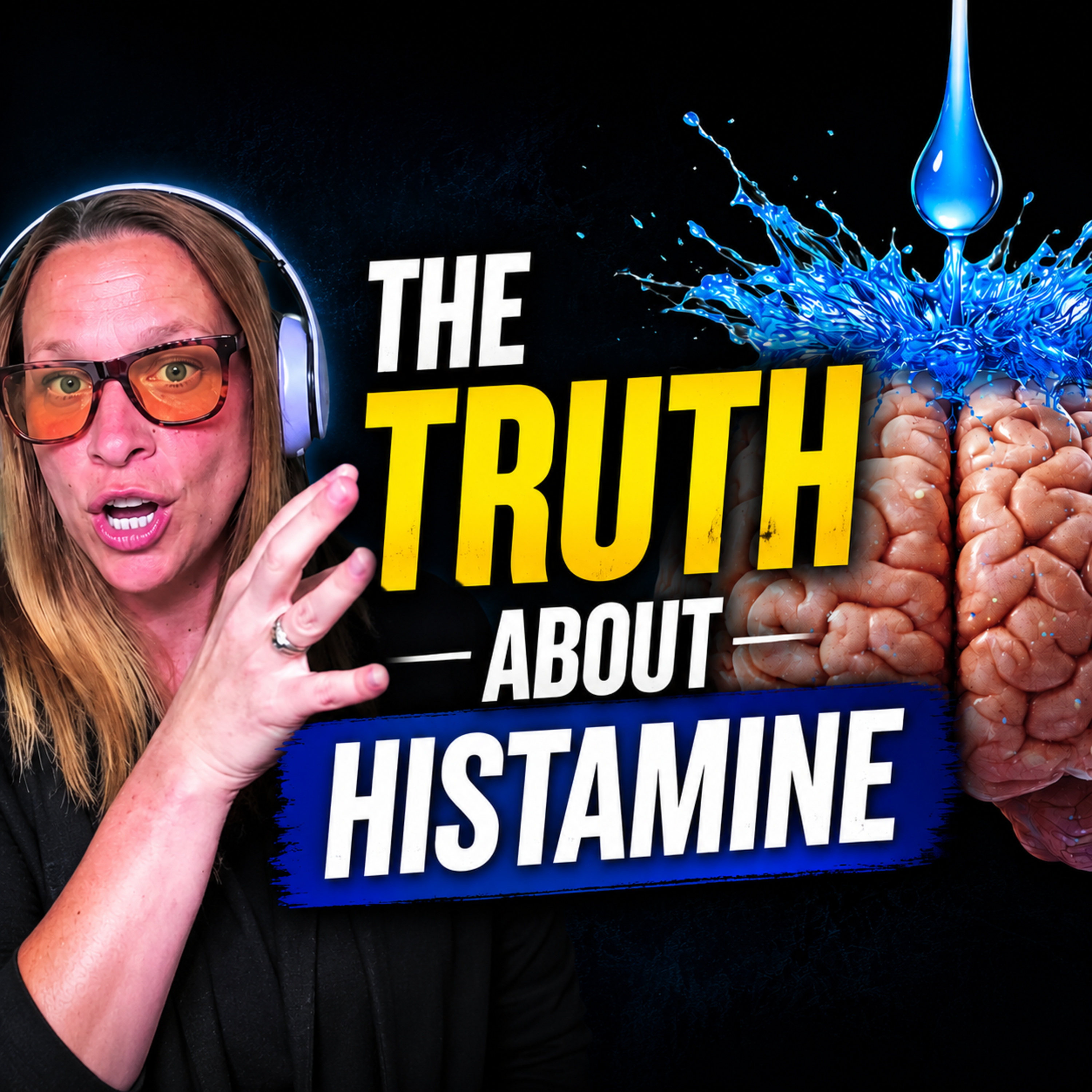
Carrie Bennett Explains HISTAMINE Symptoms & Hydration: How Blue Light & nn-EMFs Cause Cellular Dehydration, MCAS, Seasonal Allergies | Circadian Rhythm & Structured Water
What's This About?
Could dehydration be one of the hidden drivers behind histamine symptoms, MCAS, seasonal allergies, inflammation, and histamine intolerance?
In this episode, Carrie Bennett explains the connection between histamine, hydration, circadian rhythms, blue light exposure, mitochondrial function, and immune health.
We explore why histamine may act as a protective response to stress, dehydration, poor sleep, and environmental factors, and how cellular hydration, minerals, sunlight, and metabolic health influence histamine regulation.
If you struggle with seasonal allergies, MCAS, chronic inflammation, histamine intolerance, fatigue, or dehydration, this conversation offers a completely different perspective on the root causes of these symptoms.
🧠 What You'll Learn
• Histamine's role beyond allergies
• The connection between dehydration and histamine symptoms
• MCAS and histamine intolerance explained
• Why histamine acts as a water-regulating molecule
• Circadian rhythms and immune system regulation
• How blue light impacts hydration and histamine responses
• The relationship between stress and histamine release
• Endogenous water and cellular hydration
• Minerals, electrolytes, and hydration explained
• Practical strategies to improve hydration naturally
🎯 Final Takeaway
Histamine may be less of a problem and more of a protective response.
By supporting hydration, mitochondrial function, circadian rhythm, sleep, and metabolic health, you may address many of the underlying factors contributing to histamine-related symptoms.
⏱️ Chapters
00:00 Histamine Symptoms Explained
01:03 Histamine, Hydration & Dehydration
08:11 Circadian Rhythms & Histamine Regulation
13:08 Blue Light, EMFs & Histamine Symptoms
20:51 Breathing, Hydration & Histamine
24:52 Water Quality & Cellular Hydration
26:49 Natural Antihistamines Explained
28:38 Histamine Intolerance & Hydration
30:32 Dehydration, Inflammation & Health
34:24 Taking Ownership of Your Health
36:42 Metabolic Flexibility & Hydration
38:20 Practical Hydration Strategies
44:19 Electrolytes vs Ocean Minerals
-
🌞 Join the Fitness Wisdom Podcast Community HERE:
- ➡️ Get access to Ad Free episodes of the show
- Connect with a like minded Tribe ⚔️
- Submit your burning desired questions to the Guests of the show!
- Exclusive member Blogs
- Get my Health Optimization Protocols + Programs ✅
👉 I look forward to seeing you in there‼️
.
⬇️ Find & Connect with Carrie Bennett:
.
🌞 Find & Connect with me 👉 HERE
👉🏽 For Discounts & Offers: HERE
.
👉 Find my favorite Blue Light Free Tablet ‼️ at a Discount HERE using promo code MOBILITYFITNESS at checkout ✅️
.
👉 Best 3 in 1 Blue Light Blocking Glasses Use promo code: MOBILITYFITNESS for Discount ✅ HERE
.
👉 Find the Methylene Blue 💙 that I use HERE:
Use promo code: MOBILITYFITNESS for 15% Discount ✅ *Consult your Doctor before trying this, especially if you are taking SSRI's or other medications*
.
⚡ Find the Best Grounding Mats & Sheets🔋 at a massive Discount using promo code: MOBILITYFITNESS at checkout HERE
.
🧬 Find the SHILAJIT I use & recommend HERE ⚡Use promo code: MOBILITYFITNESS for Discount ✅
.
*None of the content / statements in this Podcast are Medical or Personal Advice & is not intended to cure, treat, prevent or diagnose any medical condition. All my videos are for Educational & Research purposes only. If you decide to try anything discussed in this video, you agree to do so at your own risk & responsibility*
This is the fitness Wisdom podcast.
Do you have itchy eyes, runny nose or itchy throat? Well, we have Carrie Bennett back on the line today and she's going to talk about histamine and the connection to hydration, circadian rhythms, blue light, non-native BMS and all of that good stuff. So I'm very excited for this conversation because Carrie made a post a while back on Instagram and she was talking about about how histamine is tied to the hydration inside of the body. And that really blew my mind, right? Because there, there is a common belief that histamine is because of, you know, allergies.
And, and that may be the case. Yes, of course, that may trigger histamine reaction or response. But you brought something else to, you know, to my awareness and I that was absolutely fascinating. So I want to welcome you back on the show. And for anybody who is interested to listen to our previous conversations, I have made a dedicated playlist on YouTube, which is the Carrie Bennett playlist. You'll find it under the playlist section on Fitness Wisdom Podcast, so you can see all our past conversations in there.
So thank you for coming back on Carrie. Thanks for having me Andreas. It's been so fun to chat with you all these times, so I'm excited to talk about histamine today. Amazing, amazing. Me too. And so let's start off from the very basic what is histamine? Sure. So histamine is actually a neurotransmitter, but it's a chemical that's produced in the body and it's produced in a couple of different ways. Number one, it it's basically it's the body's threat perception chemical. So if the body perceives a threat, it will, the parts of the immune system can do something called degranulate in their vast cells and pretty cystamine.
So there's these immune cells that can make histamine. And so that's useful. It's like a first line signal. So for me it, you know, I liken it to if there's an immediate intruder, I'm going to push the alarm button so that I can signal the authorities, I can signal the fire department, whatever is needed, right, to come and help me with damage control. And so that's what the immune system does. They all of a sudden they, they say, oh, oh, look, that looks threatening, that appears threatening. Let's dump a bunch of histamine there and let's just send out a signal, a warning signal, an alarm.
And so that's great and all. And I and I believe that serves a purpose, right? Because we, we do have immune cells that can come in and, and say, Oh yeah, that is threatening. And we don't, we don't have to send in the, the long term crew. We can just take care of this on our own. But it it it came to my attention that histamine isn't just triggered when it perceives like an outside threat or even an internally produced toxin. And it's it appears as though histamine also is triggered in response to something called chronic unintentional dehydration.
And this was brought to my attention by reading the work of an Iranian researcher whose name is Doctor Batman Gilege. He wrote many books on this topic, things like you're not sick, you're thirsty. The body's many cries for water, water and salt. And his experience as a physician. He was a physician in an Iranian prison, I believe it was during the Iranian revolution, right? And so he was, he was thrown in prison, but they knew he was a physician. And so they would bring prisoners to him who were dealing with all sorts of issues, including things like chronic pain conditions.
And because he wasn't capable of prescribing, he said, well, let me give these prisoners water and see if water will help their pain, their peptic ulcer, their allergies. And sure enough, he realized he would if he gave them enough water that the pain would start to subside. And he thought, listen, could this be placebo effect? Like is there a mechanism to this? Like what is going on? Because he saw it time and time again. He even saw it with pain related to angina, right heart attack. And so once he would, he, he was so dedicated to this kind of observational, like real time research that even though he was going to get let out of prison early, he wanted to stay in for his full term because he had already had all these data sets and things that were like, and he was curating his brain.
So he, he completed his full prison sentence. And once he got out, he then decided to really research the mechanism, like why and how is it possible that all of these people who I've quote UN quote treated with water, why did they're in conditions improve and sometimes literally their pain went away completely. And so he started to dig into the fact that the molecule that we call histamine that we think is just triggered because of an allergen or a threat. It's actually also what he termed an OSMO regulator, meaning a water regulator in the body.
And if the body senses dehydration, it literally teaches histamine can be released to make capillaries more leaky in a certain area of the body where you need the water to go and less leaky in other areas of the body, Kind of shutting off hydration to the less essential organs and funneling it to places like the heart and the brain. And he thought, well, this is fascinating. So literally, we could just have histamine triggered at a low to moderate to even high level simply because of dehydration alone.
And with that, he kind of dove down a lot of biochemical mechanisms that we could talk about. But it was a clinical hypothesis of mine, since you know how much I love water and learning about water. My thought is, well, what if these individuals who are coming to me are chronically unintentionally dehydrated? And that's why they're expressing some of these symptoms? And what would hydration mean through the lens of shutting down this histamine signal so that their food sensitivities go down or go away so that their inflammatory conditions go away?
So that they're, I've, I've had people with like eczema since childbirth, psoriasis for 30 years go away when they treat it through the lens of histamine and dehydration. And so that's just been a fun clinical thing for me to to work with. Your blue light blockers, they're a scum. No, seriously, use this RGB test on the screen to see if your red lens blue light blocking glasses actually work. If you can see any of the green or blue light on the screen, that means your blue light blocking glasses are not protecting your melatonin.
Most people know about the harms of artificial blue light, and so people go and buy blue light blocking glasses thinking they're all blue light blocking glasses are created equally. Unfortunately, they're not. And I'm specifically referring to the red lens blue light blocking glasses for the evening because the biggest game changers anyone can do for their health is to block artificial blue light, especially after sunset. You see, if your Redlands blue light blocking glasses allow blue and green light through your eyes will still be picking up that signal.
So your brain will basically think that it's still daytime. We know that sunlight is important, but the absence of artificial blue light and blue light in general after sunset is a biological necessity. And a good pair of blue light blocking glasses in this modern world filled with artificial blue light is an absolute non negotiable. So if you want to experience better sleep, mood and energy levels, you need to be optimizing your circadian rhythms and that is by respecting the light and dark cycles.
This is why I use and trust Viva arrays. There are three in one. Blue light blocking glasses give you full time protection from artificial blue light. You basically get 3 pairs of blue light blocking glasses for the price of 1. So if you wish to explore the blue light blocking glasses which I just talked about, head over to the description below and make sure to use the promo code attached to get a nice discount on your entire order. Wow, wow, what a mind blowing like breakdown. That was fantastic.
I'm sure you've already like boost people's minds. I mean blown people's minds. So basically you just mentioned there throughout this entire part that you just said that all of these symptoms that people associate with different issues like which are unrelated or they seem unrelated to histamine, right? But clearly they are related. And so if anyone is actually relating to this information, you need to like pay attention to how is your hydration. And we are going to get into practical tips towards the end of the episode as well to enlighten the audience, educate them how they can actually focus on their their hydration.
So what is the actual common belief around histamine? Why is histamine actually an issue? Or is it like something that just goes haywire and that's why we start to manifest symptoms? Like what is the common belief around histamine? Histamine is simply that it's an environmental trigger or they're they have people have food sensitivities and so therefore the immune system is going to make a lot of histamine and then you're going to get diagnosis such as histamine intolerance, mast cell syndromes and things like that.
And so, and so, I mean, those things are real, right? We, but there's, there's two underlying things that I think are very, very low hanging fruits when it comes to histamine. And, and this is not one of them. I mean, certainly if you know you have an environmental trigger or you know you have a food trigger, I would recommend people avoid it until they kind of work on what I call their total histamine burden and their bodies hyper reactivity. And so for me, the histamine burden is number 1. You have to address hydration, you have to address circadian rhythms because histamine has a circadian regulation to it.
And you have to address non-native Emfs, OK. And the non-native Emfs and the hydration, those actually go hand in hand. And so those are things that people don't even think of when it comes to histamine levels. And then the other aspect of it is I've had people who have had debilitating histamine issues, food sensitivities, eating, you know, only for safe foods, who only worked on it through the lens of nervous system regulation and teaching their body that it's safe and their food sensitivities went away.
And so these are not things that we think of when it comes to the conversation with histamine that I think are even more important, like in my opinion, way more important than just a low histamine diet. And and they're fairly simple things for people to address. So it's not really about fearing the histamine response, really of thinking that there's something faulty with the human body, but rather why is it sort of overreacting, causing all of these symptoms? As you and me both know that when the body is giving us symptoms, it's a sign for change, right?
It's a request that you do something different. It means that whatever you're doing in your life right now is not serving you. And it's asking you to do like something that's better for it, right? To be in alignment with nature most of the time. And This is why you mentioned all of these different things. They're like circadian rhythms. Do you want to dive a little bit deeper into the circadian cycle and where the histamine fits into the circadian rhythms? Yeah, one of the main places that people actually notice histamine and sometimes this will happen is if they have a wake up call really early in the morning, meaning like they get this desire to wake up at 3:00 AM, three AM, 3:00 AM.
I'm doing my light hygiene, My room is dark, my room is cold, my EMF's are low. But you could actually have histamine dysregulation there because of some aspect of circadian dysregulation. Histamine is a it, it does help with wakefulness in the morning. You know, these are these kind of, it's almost like what I say adaptogenic in a way, like it can drive wakefulness at a certain time of day and then it can be an immune provider or an immune support at another time of the day. But from a circadian perspective, it is supposed to enhance the wakefulness of cortisol, but it's not meant to get released at 3:00 AM.
It's meant to get released later on into the sleep cycle. And we're just about to wake up. So I've seen people with this regulated circadian rhythms have that 3:00 AM wake up time and not knowing why. And we absolutely worked on histamine, we worked on circadian rhythm and we worked on hydration. And that can put that played a big impact in that. The other aspect that I've seen from a circadian perspective that a lot of parents might be able to resonate with is my kid was doing, they were sick, we kept them home from school, they were doing fine all day, but now it's like 7:00 at night and their fever just spiked like crazy.
Well, that's another circadian aspect of immune regulation, right? So the body is using things like histamine, not just histamine, but things like histamine to help the body to clear whatever the body is trying to clear. I believe illness is body clearing some sort of damage or toxicity from the body. And so those are absolutely things that you can observe from a circadian perspective with histamine. And when you get the circadian signaling stronger, you'll have circadian release at appropriate times, just on a normal 24 hour basis, like closer to what it's supposed to drive wakefulness.
And then you'll absolutely still be able to spike it as needed to clear toxicity from the body. And so you'll still see that aspect of it, but you won't be hyper reactive and hyper responsive to things like we are these days. You know, there's the body is perceiving threats in many, many ways. And the solution for me has not been what the genes that regulate your body's histamine clearance, for example, because that's a rabbit hole that I went down about 15 years ago with clients. And certainly people have found support with things like DAO, which is an enzyme that helps to clear histamine from the gut.
But that's not the long term solution. That is a temporary support while you're dealing with these other really foundational aspects of histamine regulation. I think what you mentioned there, what was really fascinating was about where people like experience these symptoms of sickness after a certain time in a day. Like it's so true that, you know, not most of the times. I think we've all experienced this before, that when we're being sick, we're fine throughout the day. And then when the night comes, we really feel like crap, you know, in the nose starts shrining and everything and it's just so incredible.
It just shows you that wow, like cortisol and histamine are they're kind of like working together, right? Like cortisol like shuts down the inflammatory process. And that in that way, I'm just like, oh, I love coffee, I love cortisol. Keep it coming. You know, like when I. Blue light. No, no, no. Don't do that. Right? Don't do that. You know, like when you're feeling like crap, you just feel like cortisol is amazing because but then as you said, it's the body's healing like response and healing ability.
And another thing which crazy, which I have personal experience is if I've eaten my meals too late, not even too far past sunset, but even just one hour like past sunset, that I might wake up in the night and I may sneeze at a specific time in the night. And this has happened like consecutively, like consistently that I've noticed the pattern that every time when I eat past a certain time, I will sneeze at a specific time in the morning and that will wake me up. And that's really, really crazy to acknowledge and to realize like, wow, like the circadian mechanism is so tight to not only like the light that we're exposed to, but also the time of day that we're eating.
And you know, and now like, let's move into the light aspect a little bit. Tell me a little bit how blue light and non-native EMF's like messes up with histamine. Yeah, You know, I haven't dove into blue light as much just besides the disruption of the circadian rhythm. So I haven't specifically to blue light and histamine, but the non-native Emfs hypothesis was has probably been out for at least five years now. Then you know, as a clinician, I'm always like, OK, this is interesting. Like what can I do?
What, what can we observe clinically from this, this research? And my take away on that is non-native Emfs in general are just a noise stressor. So what can stress the body? What types of toxins or things can we react to? Well, certainly I could react to a physical substance. So a food that my body feels is threatening, pollen that my body feels is threatening, right? I can, I can absolutely respond to a physical substance. But what a lot of people don't realize is that we're continually picking up the frequency information in our environment and the baseline frequency information in all of our environments these days unless we take steps to mitigate it, is non-native electromagnetic fields, the wireless radiation coming from every device, the cell phone towers, the smart tech that we have, then also The Dirty electricity running through our walls.
And these frequencies to my body, they are either noise or chaos. They, my body does not perceive these as a coherent signal with information that I know what to do with. And so because I'm kind of in this continuous state of frequency chaos or frequency noise, my body again is in a threat, is in kind of a low level threat response state. So my mitochondria understand that because my mitochondria actually have dysfunction when it comes to exposure to excessive non-native BMF, they become dysfunctional.
But in general, my immune system and my nervous system are just on high alert. So I am more likely to dump a bunch of histamine at something that is not threatening to my body. It's just my body can't hear the coherent signals, so it assumes threat. It goes a step further into this conversation with the connection between hydration and histamine because mitochondria are are our primary intracellular hydrators. They make water at step four of the mitochondrial electron transport chain. So now if they are unable to make that water because they're becoming dysfunctional due to non-native EMF's, this is also where blue light comes into play.
We know that blue light can directly impair mitochondrial function. And so if my mitochondria are dysfunctional because of the EMF's and the blue light and they're not making a cellular intracellular hydration, then therefore I'm not, I'm going to get that histamine signal louder as well because my body says, oh, wait, we have dehydration at the cellular level. Because of that, we're going to have to signal this histamine just to make sure we get water going to the essential cells. If I'm and then this the, the, the whole histamine picture here too is I can have dehydration inside the cell, in the space between the cells and in the bloodstream.
And so from a clinical perspective, I want to address it from all three layers in order to make sure that that histamine burden can lower. Imagine a tablet that doesn't blast artificial blue light into your eyes, disrupt your sleep, or sabotage your health, but actually use the sunlight to power the display. If you've been listening to this podcast, you already know how damaging constant artificial blue light can be on your circadian rhythm, your sleep, and your overall health. That's why I love my Paper 7 tablet by Harborino.
It's definitely one of the most interesting devices I've used in a while. The Paper 7 tablet uses something called an RLCD display, which means there is no backlight and essentially no blue light. Instead, it reflects ambient light just like paper. So the brighter your environment, the better the screen looks. And unlike E Ink devices, which are slow and stuck in black and white, this gives you full color, a smooth 60 Hertz refresh rate, and the ability to run all of your favorite apps. It also comes with 8 gigabytes of RAM for smooth performance.
A 7.8 inch display that's perfect for both reading and productivity and at only 240 grams it's easy to carry around anywhere the battery life holds up really well too you're getting around 10 hours of active use and up to 12 days on standby so you're not constantly thinking about charging it. For me personally, I like to use it a lot for writing, researching, and preparing for my podcasts, basically all of my administrative work. And the best part is I can do all of that outdoors in natural lights so I can actually actually support my biology while I work instead of fighting against it.
And because the screen gets brighter in brighter environments, it's incredibly easy on the eyes, even in direct sunlight. I've also noticed that it naturally improves my nighttime habits because indoors, especially at night, the screen isn't overly bright or stimulating since it uses your environment to the power of the display, so it kind of guides you towards better sleep hygiene and healthier circadian rhythms without even trying. At the end of the day, technology isn't going anywhere, so the goal is to find tools that work with our biology, not against it, and this is definitely one of those devices.
You definitely want to hurry up and grab yours today as they are extremely popular and run out of stock really fast. The link will be in the description below alongside with the 15% discount code. Yes, and those 3 layers have different approaches of you know right, dehydrating. It's not as simple as just drinking tap. Water for example. Yeah, please, please, please don't do that. I mean, if that's all you have, I've actually seen acutely if that's all you have, that can shut down the pain signal.
But there's better ways to go about it long term. Yes, yes, absolutely. Because again, you're probably adding more like intoxicants in your body rather than benefiting yourself long term. So you mentioned so many things there like the blue light, the non-native Emfs, the stressors. Is there any other things which cause this unintentional dehydration which we haven't talked about yet? I also believe that you have lack of infrared light because one of the ways that the body sense, there's a couple of ways you can sense dehydration.
And specifically in the bloodstream, the body senses how hydrated it is or dehydrated it is based on blood flow. And so the blood has red blood cells and any, any biological thing traveling through the blood, right, can have this Halo of charge. But the red blood cells in specific have a Halo of negative charge around them called their Zeta potential. And as these red blood cells are moving through the bloodstream, that moving charge develops a magnetic field. And that magnetic field is sensed by the the walls of the arteries and the blood vessels themselves to decide how narrow should we be or how wide should we be in order to optimize blood flow.
And so if that system gets disrupted and they'll talk about the ways it can get disrupted then and the blood isn't flowing as well as we want it to, that right there can trigger, can trigger this histamine response. And so then you have to ask yourself, well, what will deplete? What will, what will disrupt that? Well, Doctor Stephanie Seneff has shown that glyphosate can absolutely impair the function of the enzyme that to control how wide and how narrow the blood is, the blood vessels are. So that's one thing.
Another thing would be, I would say lack of earthing and grounding, because we know through earthing and grounding we're able to pull earths charge into our blood vessels to reestablish that negative charge. So when blood isn't flowing, well, sometimes it's because the red blood cells are clumped together. And when they're clumped together, they're not flowing efficiently through the muscles. And so that means that now you have to re establish those negative, that negative charge and they'll they'll repel away from each other and become their little independent charged rafts that float through the bloodstream.
And then lastly is the infrared light, like I said earlier, and that's because infrared is the light frequency that's absorbed by the water that lines the blood vessels. And that will help the blood vessels maintain a negative charge on their lining as well. And so you've got negatively charged blood cells, you've got a negatively charged lining and they're repelling away from each other as the blood moves. And at that repelling force creates A vortex, a very self-sustaining, beautiful flowing system in the body.
Body. If that's disrupted, you can imagine that that the body will get the sense of threat and the sense that it needs to do something with water regulation. Wow. Wow. Absolutely mind blowing. That was amazing. So, yeah, you, you mentioned so many good things there. And we are truly bioelectric beings, right? We are governed by greater forces than just biochemistry. Our biochemistry is simply the red blood cell, you know, Right. But the biophysics, what is pushing, what is guiding, you know, the red blood cell to go to to do its thing and to get the oxygen where it needs to go inside the body.
You know, we just tend to think that things just happen randomly and because we have a pump somewhere in the center of our bodies pushing things around. But no, it's actually things are moving just by themselves. And then the heart is sort of vortexing the blood, restructuring the blood, like everything is becoming re energized, right. You have this like coherence center in the center of our body. It's not like by accident. Everything is is by design. So it's, it's so cool, like everything that you just mentioned there and the connection between histamine and how everything like decoherence itself is a threat response to the system and that how can that can lead to histamine issues.
So even if you are not exposed to all of the foods, which are, you know, high histamine foods, or even if you don't have pollen in your environment and you may be experiencing histamine like symptoms, this could be something to consider your nervous system state, for example, or your membrane potential, you know, charge because of, you know, your, your grounding, lack of grounding, all of these things is influencing your overall immune system response and how you're, how you're feeling like in symptom wise, because I guess that's the most relatable thing for people, right?
How, how do they feel on the outside? People don't really need to, or they don't care so much what's happening on the inside when they're not feeling good. All they want to feel is just feel better, right? So people just want to, they're like, OK, just tell me what to do. What am I supposed to do? We're going to tell you guys, OK? We're already giving you like a couple of tips already. So so do you want to tell me a bit about how breathing, mouth breathing is a problem for hydration? Yeah, absolutely.
This is another low hanging fruit when it comes to breathing. We are designed to essentially we are, we're expelling water all the time to the breath. It's one of the main ways we actually lose hydration, right? It's through our breath, that water vapor. So most people think that all we do is is get rid of carbon dioxide, but the water vapor itself. And we will lose less of that water vapor when we breathe through the nose versus when we breathe through the mouth. And anyone has experienced this, like if you've slept because maybe you were stuffed up and then you wake up, your mouth is dry as heck because your body is just, you know, that dryness, right?
You can't keep up with the moisture that the membranes need when you're breathing through your mouth. And so being a chronic mouth breather, but even just mouth breathing at night, that is enough for you to wake up in a chronically unintentionally dehydrated state. And unfortunately, the vast majority of us wake up and we make us cup of coffee and we drink that cup of coffee, which is also a dehydrating diuretic that flushes more water from the body. And that just sets up this vicious cycle. I have a really interesting anecdote if you're, if you want to hear about this whole dehydration aspect.
And it's from me personally, because as I was diving into Bob, I think, I think God works in funny ways. Because as I was diving into Doctor Bob Mangalich's work, I've never experienced allergies before in my life, right? I don't have histamine intolerance, no allergies. But I had to do a flight, I had to fly from Michigan to the West Coast to the West Coast to give a talk and back in what basically one day, right? So a lot of time on an airplane, a lot of time in airports, so garbage light, lots of non A to VMS.
And then at altitude it's even, we know it's dehydrating because we're at altitude when we're flying and all of the wireless radiation that's in planes. And I didn't have enough time. Normally when I travel, I like to be able to earth and ground and, you know, get into nature and go through all my rehydration strategies and things like that. But I just didn't have that time. And so I was when I left Michigan, I distinctly remember looking at my car, car. I was parked in the driveway as we were packing up to go to the airport.
And I remember going like this on the hood of my car and swiping it. And there was just a thick layer of pollen. My car is black and this thick layer of pollen on the hood of my car. No, but no allergy symptoms, nothing, right? Like obviously we were in high pollen season at the time. So I fly, I come back and all of a sudden, as soon as I land the itchy watery eyes and I start sneezing, I have that, that really clear, you know, mucus, that post nasal drip that just won't go away. And I thought to myself, I must be chronically unintentionally dehydrated.
So let me see what I can do to get rid of these histamine based symptoms solely not going, not turning to an antihistamine, not turning to even natural antihistamines. Let me just go purely to hydrating. And at the and at the time, I really knew I wanted to hydrate my blood. And so I took a product called Quinton isotonic, which is a mineral that mimics or it's a, it's a, it's a, it's a ocean based minerals fluid that mimics the exact ratios of minerals and fluids as my blood. And so it came in these 10 vile little little ampules.
And so I took one ampule on empty stomach and then then I took another and I added up trying to get as many ampules into my system as I could because I knew that that was a great way to nourish and hydrate the blood fast. After three days, I'd gone through an entire box, which was 30 ampules. That's a lot of ampules in, in three days. But my histamine symptoms were gone completely. And it wasn't because the pollen was gone, right? The pollen was still on the car. It's everything was like it was before.
But I just knew that my histamine symptoms came from dehydration. And you know, I mean, so it's, it's a fun thing to be able to share with people because they don't realize that it could be a simple thing like adding in the appropriate hydration into your blood. When people think about energy, sleep. And hormones, I think in terms of fats and carbs. But your metabolism doesn't run on macros. Minerals are the foundation for your metabolism, and a healthy and well functioning metabolism starts from your mitochondria.
Every single biological process inside your body requires minerals. When your body is lacking the minerals to run your cellular metabolism, guess how that is going to show up in your body? I'll let you figure that one out. One of my favorite ways to ensure that I get all the minerals that I need on a daily basis is through Shilajit, A herbal mineral substance which is made from the decomposition of plants and bacteria. This process taking place over thousands of years. It is primarily harvested from the Altai and the Himalayan mountains, some of the most pristine locations on the planet.
The beautiful thing about shilajit, it comes with high concentrations of fulvic acid. This molecule actually drives the minerals into the cells where they can do their work. So basically the minerals come in the most bioavailable form for your body to be able to use. Unlike most supplements which become expensive urine, this one actually does something without the hype. It's not man made, it's produced by Mother Nature herself. Now something very important to mention is the quality of shilajit. Not all shilajit on the market is created equally.
The one that I use has been tested for heavy metals and impurities, ensuring that you are getting the highest quality shilajit. So if you want to explore the shilajit that I use on a daily basis, make sure that you visit the description below and make sure to use the promo code attached for a nice discount on your entire order. Yeah, and everything in our modern world right now is. Really dehydrating us. If you think about the modern way of living that everyone's living their life. I mean, people are drinking, I'm everyone's aware that they need to drink water, right?
But I guess the quality of the water matters. So I guess people have been searching for higher quality waters, drinking from glass instead of plastic, you know, maybe filtering their water, but maybe they haven't gone the extra mile into re mineralizing the water, restructuring their water, you know, maybe simple things like this, which are very, very important because if you miss, if you miss that step, you know, after the reverse osmosis, it can be like quite detrimental. I feel like, you know, because of stripping the minerals like out of your body and your bones.
But as well as, you know, losing, you know, becoming also dehydrated and never feeling like fully like, you know, like you've quenched your thirst pretty much. Because I remember at the beginning when I bought like a reverse osmosis, like countertop filter, I started drinking the water and I didn't like re mineralize it first. And I just felt like, OK, it felt great at the beginning, but then after very, very shortly after, I noticed that I had this desire to drink all the time. And that's because I was literally flushing out all of my minerals.
And it felt very sharp, like on the tongue, you know, when you strip out all the all this, all the stuff from the water. Yeah. So is there like tell me a little bit about issues associated with taking or if you, if you are aware of any issues associated with taking antihistamines in general, like are there like any symptoms about chronically taking these things like and like what's your thoughts on this topic? Yeah. You know, I haven't looked into that because I typically by the time clients get to me, they know that that's not the route that they want to be on.
And if if they had been prescribed that with, with a physician, they worked with a physician or a medical practitioner to not take those anymore. I often times work with people who want to try or who are in the process of trying natural antihistamines like quercetin, like nettle tea, You know, I think those can serve a purpose. They can serve a purpose as you're getting the body to understand why it's producing so much histamine in the 1st place. And so I don't, I don't poo poo those, but I also don't find those to be the long term ultimate solution because you have to ask yourself, why am, why is my body producing this in the 1st place?
And that's where you really want to address the Emfs, the lighting environment, the dehydration in the blood, the nervous system. Those for me, are the foundations. Yeah. So where it happens in the 1st place where it gets like triggered from, but those natural antihistamines that you mentioned like are they all working like in a similar manner or are they working through different pathways? Yeah, I don't know. I just don't know. I just, again, I don't really recommend that people just come to me saying, yeah, I feel better on them.
And then my job is to say, OK, let's do the things from this other unique perspective on histamine to see, do you even need those anymore? And as you saw in that one Instagram post that you, you know, I think that triggered this whole conversation in the 1st place. That was a community member of mine and she had some pretty significant allergy symptoms that she said, look, I just figured out how I can take this water, these ocean based minerals and have them especially in the morning and allergy symptoms completely gone.
Histamine symptoms completely gone. Wow, wow, that's amazing. OK, so let's move into some practical tips then. If you feel that we've covered everything, have we, have we covered everything as it relates to histamine? I mean, have we left anything behind? Let me just give people a little bit more on this mechanism I really want to hammer at home in terms of when this I especially believe you're going to hear. My first thing that I want people to address is blood hydration because picture what happens on this vicious cycle that can occur that can really increase the total histamine burden in the body when the blood is even mildly dehydrated.
Let me put it this way. The blood delivers hydration to the cells, right? It'll deliver oxygen, nutrients, but it also delivers hydration to the cells. Now, yes, I said that the cell is mostly hydrated by the mitochondria. I truly believe that. But there are also, there is also evidence that the water from the blood gets to the space between the cells and then gets into the cells themselves, right? That's great. Now that happens because the the blood vessels branch to these tiny little capillaries and every cell in the body has access access to a capillary and has access into the space in between the capillary and the cell called the interstitial environment.
The interstitial space. This interstitial space should be full of a fluid and is where a lot of the immune system lives. And So what happens here is if this is a cell of a non essential organ where the body says, OK, yeah, you're chronically dehydrated, but this cell is not deserving of our attention right now. That capillary walls off and you can imagine what happens to the water. The capillary is no longer leaking water into the interstitial space. That dehydrated space is where the lymphatic system also lives.
So not only through dehydration in this space right here do you have you all of a sudden have a concentration? Maybe your cell was dumping some toxins. Now you got a concentration of these toxins. The immune system is going crazy saying toxin, toxin, threat, threat, threat. Histamine is increasing because of that. And you do not have the lymphatic capability because of the dehydration in that area. So you can see how this becomes a pretty vicious cycle and how then it ties to things like, well, I got sluggish lymph.
Well, yes, you do. But you know what it, what's causing that? Could it be this chronic unintentional dehydration that's causing the sluggish lymph and causing your lymph and causing your body then to have symptoms of it? And you know, I mean, I, I do, I see it all the time. We need to address things from this perspective. Hydrate the blood. That space gets hydrated. Tend to the mitochondria, the cell gets hydrated. They'll also have hydration that goes into this interstitial space and those work together to help to remediate this.
Yes, that was actually one of my questions, but you already answered it perfectly about the lymphatic system and how that's related to the bloodstream because it's the lymphatic system in the bloodstream are pretty watch one system. It just all kind of like loops and goes back in and just goes like this, you know, and through the kidneys and the filtration and all that good stuff. And, and would that make sense then for people who have histamine issues, would they potentially experience cold hands and feet because of this, let's say, vasoconstriction?
Absolutely. If your blood is not hydrated, you're not able to move it as efficiently. Also, if your blood isn't hydrated and you're not able to run all of your metabolic processes because your body really goes into this, OK, this is a threat mode. Well over time because people are not like saying, well, I'm not, you know, they're still drinking some water. The body is still putting making some fluids and things like that. So it's just really low level dehydration that doesn't always get noticed.
And because of that people go for extended period of time. At this state we're talking months, years. At this kind of low level threat state, the thyroid gland will certainly be impacted by it because the thyroid says, well, why are we going to run high metabolic features or a high metabolism or the correct metabolism for all these different organ systems if we're unable to deliver the key nutrients and clear the waste from them? So metabolic function shuts down. And so you do get symptoms of hypothyroidism.
Absolutely. You get symptoms of auto doctor Bob Mongolage also tied this to autoimmune conditions because what he found was when a certain tissue or cells are have this excessive histamine, the body starts to turn on histamine and other you know aspects of water regulation including something called vasopressin which is also been called anti diuretic hormone. And so when you have elevated vasopressin, but also this histamine elevated, the body starts to elevate corticotropin releasing hormone. And that's a, this is a stress pathway, right?
You can get it, you can produce it in a non stressful way, corticotropin releasing hormone to basically make cortisol in the adrenal glands, which is a very healthy thing to do during the start of the day. But if you're continually producing this corticotropin, as you alluded to earlier, the body doesn't want to feel pain. But what happens over time is that pathway produces what are called inflammatory cytokines and that starts to create tissue destruction. So let's say that's happening in your thyroid, your thyroid gland, because your body says, yeah, you're really dehydrated, you know, and you have this, this stress loop happening.
All of a sudden. The thyroid then is as you're producing that it those, those interleukins and those, those inflammatory cytokines at tissue destruction in the thyroid gland. The thyroid says, OK, well we can't have these dysfunctional proteins and things inside of the thyroid itself. Let's kick them to the outside of the thyroid, thyroid and hope that we can clear them with the immune system and the lymphatic system. But when the immune system is over activated and the lymphatic system is sluggish that they say, well, we got a lot of stuff here.
We got to call more help, call more help. You're going to call that an autoimmune disease because you're going to say, oh, the body is fighting the thyroid is is destroying the thyroid gland, right? It's because a lot of this has to do with the tissue destruction loop that needs to be broken through the lens of hydration and be able to deliver the nutrients to the cell, deliver the hydration to the cell and interest social space and be able to clear the waste accordingly. Everybody knows about vitamin C, but have you ever heard about vitamin G?
I'm talking about grounding. We know that oxygen is important for our survival, but what if I told you that grounding is just as foundational for our health? Your body is literally a battery and needs to be recharged every single day. Modern life, depleted fatigue, insomnia, brain fog and restlessness. These all sound like a charge deficiency to me. You see, grounding is not optional, it's foundational. This is what I make sure to get my bare feet on the ground every single day and to ensure that I stay grounded 24/7 like our ancestors did.
I use my favorite grounding sheet as I sleep. To keep me connected to the earth. At all times, check out my favorite grounding mats and sheets that I use on a daily basis by heading over to the description below. And make sure to use the promo code attached to get a massive discount on your entire order. Yes. So everything that's happening to the bodies by design, again, so people can really understand, we need to hammer this message home as much as possible because it's important for you to not be a victim and to take like ownership and responsibility over your own health.
Because it's so easy to be like, oh, I have this, I have that, like I'm destined to have this because my parents had this or you know, it's in my family and stuff like that. But at the end of the day, it's, you know, you can change so much of what your body is doing from day-to-day, you know, through your daily acts, habits and behaviors and through your epigenetic expression. We know this like how we can literally influence our mitochondrial like genes like so, so easily from what we do every single day.
So it's so important and many, many great things you mentioned there about a thyroid, the metabolism like truly like mind blowing. And also the fact that you know, if it causes this like anti diuretic effect, I can imagine that it would cause a lot of swelling in the body as well because of this alongside this inflammatory response. So that would make you feel more puffy and fat. So even though you may not be fat, you may feel like you are fat because you're accumulating all of this water under your skin.
So for example, if you can't see your veins or your, you know, like you can't see your body, you just look you, you can't see your knuckles. Yeah, yeah, your, your rings don't come off. Yeah. Exactly, exactly. So all these things that these are like common symptoms that people don't really like pay attention to. But this is all again tied to the, you know, everything that you just mentioned, the kidney health, the hydration. 1 interesting fact though, I want to share with you is because I, I want to get your thoughts on this because right now I'm drinking less water more than ever.
And not like intentionally, but unintentionally because I try to listen to my body's like thirst. Because I've learned over the years that if you drink too much, like, you know, when your body doesn't need it, you just all right, yeah, diluting your minerals. And then I just my energy levels, I tend to suck. I just noticed over the time. So intuitively, I have now just been listening to my body more and more. And since last year or when I came off the carnivore diet like originally and I introduced carbs, I noticed that I'm not as thirsty anymore and like I can, I'm barely like drinking water.
I drink more in the morning and very little towards the evening automatically just by design. Do you know like why this is happening? You're metabolically flexible, OK, So in individuals who have an optimized hydration lifestyle, so you are maintaining that exclusion zone water that gelled water all throughout the body. Your, your light environment is supporting mitochondrial water production. Your EMF environment is supporting mitochondrial water production. You're likely earthing and ground a bunch.
So #1 your fluid loss, even though you may be sweating, your fluid loss is going to be less than people who do not have that optimized environment. And add to it the fact that, like I said, your mitochondria have the ability. I've, you know, this, don't put this clip on social media because, well, maybe, maybe you want to, but I find people who they jump into carnivore or keto because they want to like become these really great fat burners and lose fat. But you can become metabolically inflected flexible in than from burning carbs.
So when you're truly able to hydrate from within, it's because your body can choose to burn the carbohydrates you gave it and make water or burn the fat that you have stored or the fat that you ate and make water. And when you're truly metabolically flexible like that, you, we have fat on our bodies. Our body at any time it needs it can pull fat from storage, funnel it into the mitochondria and the mitochondria can make this beautiful metabolic water for us. And so you are way less susceptible to the dehydrated frustration when you have that metabolic flexibility built in.
But I do find enough people that get to the point where their body actually becomes less metabolically flexible because they've stuck to one or let's say they haven't been seasonal, seasonal and intentional with their nutrition. And so there's a mismatch in the signals that their body is receiving. Wow, wow, that was amazing. Thank you for that. Like I've never heard anybody say that before. So that that's really cool to hear. And so I guess that would relate to leptin as well, since with that energy availability, because if the body thinks that you've got 0 body fat because leptin is not working well, right, then you're just primarily like going to rely on external sources or carbs.
So you're going to be more of a carb burner, right? And so then you're going to be constantly hungry, seeking for that fuel from the outside. So again, optimizing those circadian rhythms, the timing of the, of the eating and everything like this. Let's get into the practical tips then for people for optimal hydration. You're already mentioned a ton, even this metabolic flexibility, for example, that was a, that was a fantastic tip. So eating seasonally, you know, and locally and I guess outside, do you want to maybe enlighten the audience or some practical tips that they can start hydrating straight away?
Sure, sure. So if you believe that you have histamine issues, I you typically you cannot rely just on thirst. Usually thirst has been down regulated in a lot of individuals because of the fact that we've been exposed to tap water as our primary source of hydration and the body and doctor Bob Manglich had this hypothesis as well. The body starts to down regulate the thirst mechanism. If the body says, well, every time I I tell you you're thirsty, yeah, I get water, but I get fluoride and they get pharmaceuticals and I get some heavy metals in there as well.
So it, it's an in route for toxicity. And so the body says, wait a second, like, let's maybe not do that because we're now adding toxins to a body that's already burdened, that's already threatened. You likely have a very accurate thirst mechanism because of the quality of the water that you drink. Your body will say, yeah, let's put some, some more of that into the system. And, you know, doubt your body's ever craving tap water. So #1 be aware of the water that you're drinking. And I do think clients need to start their day off with hydration.
And it's not typically just, it's not a plain glass of water like you alluded to. Now, I do have a therapeutic strategy for having clients use something like just distilled water as a cleanse, as a flushing, as a pulling a way to kind of get stuff out of the body. But that has to be very strategic and therapeutic. And instead for long term hydration, we have to, like I said before, nourish our blood. And there's no reason our blood isn't just plain water. There's a reason our blood mimics the mineral ratios of the ocean, just in a more diluted form.
And so we essentially have ocean inside of us. And the one of the primary things I started with when it came to this whole hypothesis that Doctor Bob Mogulage laid out was, well, I've been working with Quinton Isotonic for quite some time. Let me play around with that. And the reason Quinton Isotonic really attracted me was because Doctor Renee Quinton, he actually used Quinton Isotonic as it as a blood replacement in animals, in soldiers when he didn't have access to like literally give people who are bleeding out, give it, give him access to blood to essentially keep their system full with the correct amount, the correct volume of blood.
He gave Kington Isotonic and it was very successful. Yeah, it probably can't do this, this particular research nowadays, but he did take an animal, a dog, and pulled the the the fluid from the dog's blood and replaced it with Canton Isotonic. And the dog was perfectly fine and in fact very healthy afterwards. And so I thought, I thought, wow, this is really cool. And then I went back to, well, you know, anytime I've been in the hospital because of an injury situation or an accident, whatever it might have been, they automatically started an IV in me.
Well, what was in that IV? Turns out it's the, it's a mineral ratio of a specific amount of sodium chloride, right? Salt. So they're not just hydrating you with pure water, they're hydrating you with diluted salt. Quintana Isotonic has I think a more balanced mineral blend than an IV at the hospital. And so that's one thing I encourage clients to do is start your day off and play around with this Quinton isotonic, meaning start with one ampule, see how you feel, maybe 2 ampules on an empty stomach, kind of like what I did when I was in my acute acute histamine phase.
And so I've had clients who have had to build up to oh, 50 milliliters or more of that isotonic. You can get liter bottles, it's cheaper, but you 50 milliliters or more throughout the course of of a couple weeks to start to really get a hand handle on this. So that's one thing you can do, but it's not just the Quinton isotonic. You also want to drink high quality water. And so that's where you want to make sure your water is at the very minimum filtered and re mineralized. If you can structure it as well, that's great.
But for the individuals who make the most progress, they add in more ocean based minerals first thing in the morning. And that's what that Instagram post was talking about. Basically this individual took so really large quantity, I would say probably the equivalent of about 20 oz or so of warm to hot water in the morning and added in a significant amount of sea salt into it to dissolve it to make it a fairly salty solution. This is also been called adding Soleil into your water. This is an 8 more more of a ancient tradition where you take a sea salt and you basically create a little solution where you Max out sea salt that's dissolved in water and have a little jar of it and that's very, very salty water.
Well, what this individual did was she took probably about two teaspoons of it and added it into her water and drank that first thing in the morning and then did the hydration. Some Quinton throughout the day did water throughout the day has been mitigating EMS. She already had a very good circadian rhythm and the addition of that blood nourishment, that water that gets absorbed very quickly, plus this, the minerals that was able to, over the course of a short period of time tell her body that it doesn't have to have a histamine burden that's elevated due to dehydration alone.
And so then her body can respond appropriately. Like if I was experiencing a toxin in my environment or something that was truly threatening. I want my body to be able to produce histamine, I just don't want it to produce it all the time when it's not under threat. The official community of the Fitness Wisdom Podcast is over on patreon.com/fitness Wisdom Podcast. This is a space where you can get to connect with a like minded community and tribe. Get ad free episodes of the show. Submit your questions, guests and topics that you would like to see on the show.
Read my latest health optimization protocols and blogs. Get my guided workouts and mobility routines and the good discount on my group and one-on-one coaching programs. The link is in the. Description below I look forward to connecting with you Yes yes wow, fantastic tips. And so something I've experienced with taking electrolytes for example, I always feel like more thirsty and almost like counterproductive, even though they are sold for like hydration online. I feel like unfortunately, you know, if anybody is watching any sponsors, you know who want to sponsor me for electrolytes.
I can't really promote you guys because I just feel like they're a scam unfortunately. And so you know, there is like what you mentioned these more full spectrum ocean blend minerals, right? What's the difference? Do you want to explain to the audience the difference between those two and why electrolytes, just plain electrolytes, are not the same thing? Sure. Well, the number one, typically with electrolyte powders, you're only going to get the four electrolyte minerals, magnesium, calcium, sodium, potassium, right?
So that's what you're going to get right there. Usually chloride could be added to some of them. Some of them add bicarbonate right there. There's a couple of things that sometimes get added. The isotonic is at least 70 plus minerals, including those electrolyte minerals plus all the trace minerals that our body requires. So it's a really, I would say it's a whole completionment. The other issue is that Quinton makes 2 forms of this confuses people. They make a form that's called isotonic and they make a form called hypertonic.
Hypertonic is 3.3 times the concentration. So I'll put it, I'll put it this way. Isotonic is 0.9 is what they call it, right? They're like, why 0.9? Well, that's the, that's essentially the mineral percentage of the mineral ratio of, of sodium of salt that you need in the blood. And so that one perfectly mimics the blood. The other one is more concentrated. It's much, much saltier. You have more concentrated minerals. They recommend that more concentrated one if you've just gone through a sauna session or you've done a workout where you sweated a lot or your body is in need of that type of sweat replenant because sweat is very salty or losing a lot of electrolytes.
So the vast majority of electrolyte powders are designed in my opinion post sweat session, not just for regular hydration because the body cannot use that type of sodium concentration and effectively hydrate the blood unless you are actually have been depleting that through your sweat. And so having a very diluted version of that, such as in canes on isotonic is highly beneficial because it is what mimics the ratios in the blood. Yeah. Thank you for clarifying that. And as well to mention that what I've noticed with electrolytes is that they put, for example, 1g of like sodium in there and then everything else is like significantly less, significantly less.
And I just feel like that doesn't like feel like it makes sense, you know? And I've tried these more broad ocean based minerals myself, full spectrum and it just feels so nice and like soft, you know, it's not like making me feel so thirsty afterwards. So I just feel like electrolytes, especially flavored ones, they're specifically designed to make you drink more of them. So you keep on buying like more and more, right? But the ones that, and also the ones that you mentioned as well, they're more like what I would call like medicinal, right?
So is this something that you would recommend people that they have all the time or is it only in extreme circumstances? I think I use Quinton therapeutically often times I do. I figured out that strategy simply because that is a costly supplement, right? And if I don't want my clients to have to be on anything they don't need to be on. So I encourage clients to get that leader bottle of the Quinton and then they can start to start to dose themselves accordingly. And the reason I think that this is a, an interesting way for them to be able to experiment is that the body has a mechanism when it has too many minerals and that that'll tell you, oh, that's enough, right?
And it's called loose stools, right? At most people have probably taken too much magnesium or something like that, right? And so when you get too many, when you have too many minerals, the body doesn't pull that into the bloodstream. The body sends that into the colon. And the colon is another area where you could absorb hydration and minerals. But if the body doesn't need it, but the body doesn't need those minerals, the hydration stays in the colon and you get diarrhea. And so I have had clients say, OK, dose it, but just be aware of loose stools and if you get loose stools back off a little bit and maybe stay at that dose that doesn't cause the loose stools and see how you feel on that for a few days.
And, and I've had clients build up to a certain amount, get loose stools back down, be there for a little while, get loose stools back down. And then they go to what they call a happy and a maintenance dose that they use because it's cost effective for them, which is about 10 to 30 milliliters a day. But I even have clients. I personally don't take it daily anymore because I do. The body does beautifully with just a great glass of structured remineralized filtered water at the start of the day and then adding in the corrective minerals and things to my water throughout the rest of the day.
I don't need that isotonic unless I I do a sweat session or something like that. Amazing, amazing. So if anybody has any like Constipation, you know what to do. It's true though, I've had many people cure their Constipation with that and that plus the correct morning light signaling so that the body makes serotonin, which is a bowel motility stimulant. Wow, it's powerful. It's powerful. You know, it's so true. Like for example, I drink my coffee in the morning always after going in the sea 1st and after having breakfast, I'm going to have my coffee around 8:00 AM or something like that.
And even after coffee, I may not get the urge to go to the bathroom. But as soon as the sunlight hits my belly, which I try to expose myself as soon as I can in the day, I notice whoa, like I get the signal to go to the bathroom. Like boom, just like that. It's it's not so like it's so crazy. And on the on days when it's like really chemtrailing in the sky, I don't get the signal as fast. So it really like impacts your body like, like wild. But it's very different, you know, when you feel the heat on your stomach, I guess.
OK, it depends where you live on the planet. I live in Cyprus. So, you know, I'm very fortunate for where I live. Well, Carrie, like, I really enjoyed this conversation, like always. And thank you so much for coming on. I'm sure the audience has gotten like, so much value from this conversation. So where can people like find you, connect with you, and work with you? Sure. So my, you know, my fun teaching hubs are on Instagram at Carrie D Wellness and on YouTube Carrie B Wellness. And then I have a lovely private community.
I was just chatting with you behind the scenes about this. Really what I have found these days is that people have information overload, but they're lacking the community to help them process the information and use it. So I've got this beautiful private community at we do 3 1/2 hours every week of live Q&A's. We do these, these little mini challenges together. So for example, the month of May, we're trying to spend 100 hours outdoors and see what happens and like help each other out, what that looks like, symptoms before, what we feel like afterwards.
And so it's through community that I have found to be the best way to really help support people with the information overload we have these days. So you can find out information about that at my website whichiscaribbeewellness.com. Amazing, amazing. I will make sure to put your links in the description below as well. And if you guys enjoyed the episode, please smash the like button. This helps to get this, you know this knowledge and wisdom out there in front of more eyes and more people. And if you are listening on Spotify, hit that follow button as well for more incredible conversations like this.
Thank you so much, Carrie. And of course, I'd love to do it again in the future. Likewise, thank you for having me. If you guys enjoy the topics and guests I bring on the. Show I would really appreciate if you left me a five star review on Spotify and subscribe to Fitness Wisdom podcast on YouTube as well. This helps to spread the knowledge and wisdom with the world. Until next time.
 Apple Podcasts
 YouTube
 Spotify
 Castbox
 Castro
 Goodpods
 Moon FM
 Overcast
 Pocket Casts
 Podbean
 Podcast Addict
 Podcast Republic