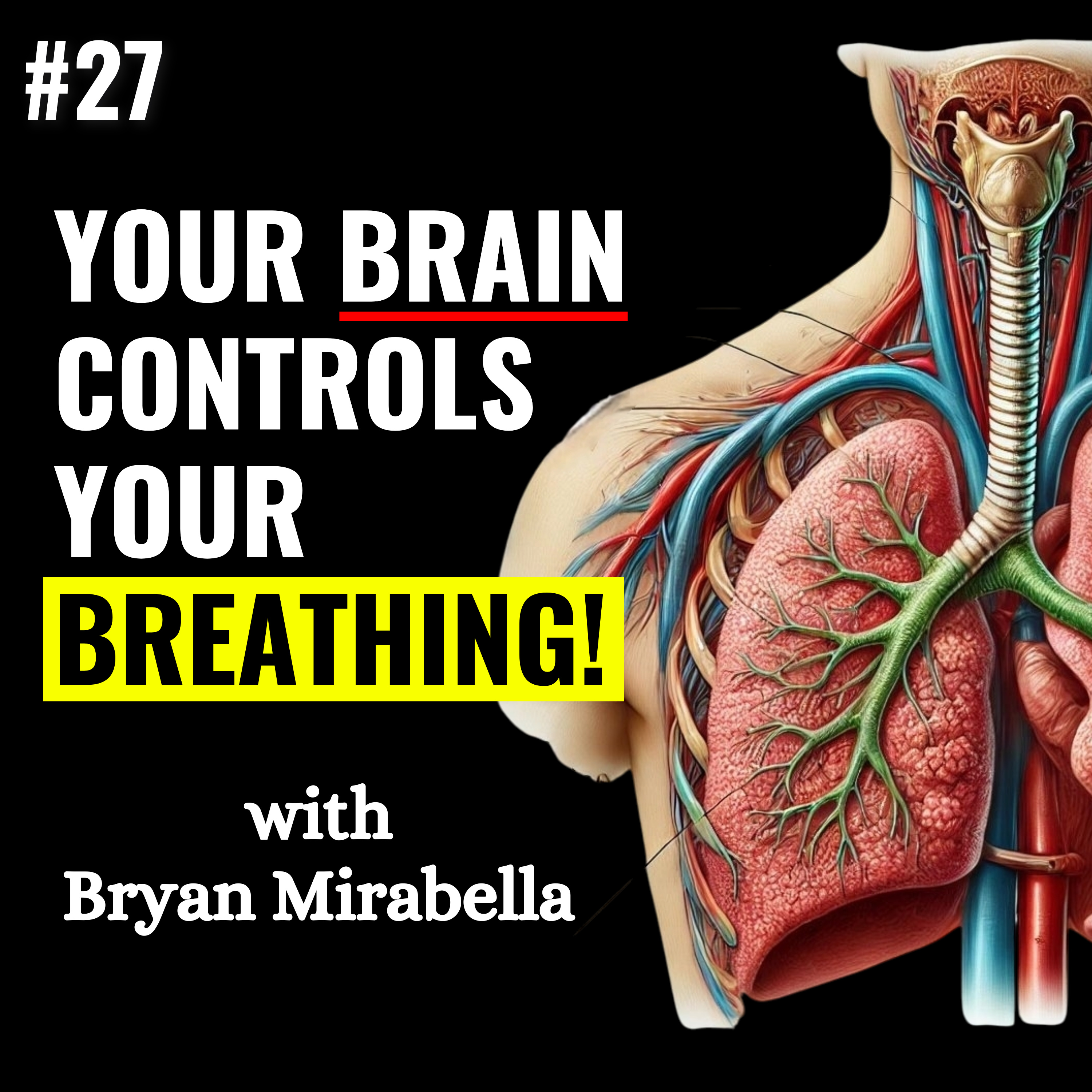
Breathwork Expert 💥 Explains How the Brain Controls our Breathing for Detoxification, Nervous System Regulation, Digestion, Performance, Health & Overall Wellbeing! Oxygen Advantage Master Instructor
What's This About?
👇🏽 Learn about the Power of the Breath 🫁 from a Brain Perspective 🧠 for Detoxification, Nervous System Regulation, Performance & Overall Well-being‼️with Breathwork Wizard Bryan Mirabella, Human Performance Specialist, Nervous System Specialist & Oxygen Advantage Master Instructor 💥🧬
Eliminate Stagnation & Stiffness, Restore your Mobility & Function, Improve Blood Flow and take Care of your Fascial System with my New Dynamic Stretching Routine Program! Only for limited time, you can get it at a 50% OFF ✅ with the code: GET50 at checkout 👇🏽https://www.mobility-fitness.com/dynamic-stretching-routine
Definitely SAVE & SHARE this episode with a friend, this knowledge is extremely important & potentially life changing!✅
👇🏽 In this Episode of the Fitness Wisdom Podcast we discussed:🎙️
• Why is breathing important?
• Mouth Breathing vs Nasal Breathing
• The importance of CO²
• Why is over breathing bad?
• Benefits of Breathing correctly
• Breathing from a Brain Perspective
• Sensory Cortex controls Breathing
• Evolution Brain Activation
• Breathing & Lymphatic System Connection
• Fascia + Breath Relationship
• Why is breath holding so powerful?
• Breath Holding during training
• Nervous System controlling our breathing or breathing controlling our Nervous System?
• Nervous System Regulation through the breath
• Breathing for Performance!
• No such thing as overtraining but under recovering!
👇🏽 You can find me on my other platforms as well, as work with me1-on-1 Online World-Wide 🌎
📲 Instagram: www.instagram.com/andreas_david_christou
🎙️ Podcast IG: www.instagram.com/fitnesswisdompodcast
🌐 Website: www.mobility-fitness.com
▶️ Youtube.com/@movementspecialistandreas
🐦 Twitter: x.com/movementandreas
Find & Connect with Bryan Mirabella💎
📲 Instagram: https://www.instagram.com/breath_verse/
🌐 LINKTREE: https://linktr.ee/bryanmirabella
👉🏽 Find the Best UV + Red Light Therapy panels, Blue Light Blocking Glasses & Circadian friendly light bulbs 🚨Use promo code: MOBILITYFITNESS ✅ for 20-30% OFF your entire order 👇🏽
https://www.emr-tek.com?snowball=MOBILITYFITNESS
👇🏽 Here is the Methylene Blue I use 🌀🧠
merakimedicinal.com/MOBILITYFITNESS
Use promo code: MOBILITYFITNESS to get 15% Discount on all products ✅🧠
👇🏽 Find the SHILAJIT I use & recommend below ⚡
https://mountaindrop.com/order/?ref=5873
Use promo code: MOBILITYFITNESS for Discount on your entire order ✅🧠
👉🏽 Join my Mobility Workout Library Members 🔱
🫴🏽 Learn how to Flow 🌊
🔓 Unlock your Mobility + Strength & Functionality from the comfort of your own Home, no equipment required!
✅ Step by Step instructions on how to perform the Movements & Flows from Beginner to Advanced 💥
🔆 All Fitness Levels welcome 💪🏽🔥
🔍 Find the Mobility Workout Library at:
👇🏽
www.mobility-fitness.com/mobility-workout-library 🌐
I have been coaching individuals World-Wide 🌎 for many years now, helping people transform their physiques but also to transform their health from the inside out through a Holistic Approach.
I teach people Holistic Movement Practices, Gym Workout Programming, Nutrition & Lifestyle Optimization practices for optimal and sustainable results 🏆
Work with me 1-on-1 ✅ and let's Transform your Body from the inside out! 💎 Contact me for details
👇🏽
https://www.mobility-fitness.com/product-page/gym-workout-plan
*None of the content / statements in this Podcast are Medical or Personal Advice & is not intended to cure, treat, prevent or diagnose any medical conditions. All my videos are for Educational & Research purposes only. If you decide to try anything discussed in this video, you agree to do so at your own risk & responsibility*
This is the fitness wisdom podcast methylene blue, an incredibly powerful substance that has an affinity for the mitochondria, discovered in 1876 at first as a textile dye, it didn't take long before it was noticed for its unusual biological effects. Here is a list of all the things that methylene blue is known for. My personal favorites it is effects that it has on the mitochondria. Methylene blue acts as a redox agent. What this means is that it has the ability to grab onto electrons, donate and transfer them anywhere where energy is required in the body.
And we know that most Neolithic diseases these days are due to a lack of cellular energy, ATP. The more electrons we can get through successfully along the electron transport chain in the mitochondria, the more deuterium depleted water we can make as well as the end of energy production, which is ATP. The energy that we need to power all our cellular processes come from electrons, so it only makes sense. The more we take care of our mitochondria and our energy production, the more energy we have for our overall health, well-being and vitality.
If you wish to explore the methylene blue that I use, head over to maragimedicinal.com/mobility Fitness and use the promo code Mobility Fitness at checkout for 15% of your entire order. Hello everyone, welcome back to another exciting episode of the Fitness Wisdom Podcast. Today I'm going to be talking with Brian Mirabella. He's a human performance specialist, nervous system specialist, and an Oxygen Advantage master instructor. We're going to be talking about the power of the breath today and there is nothing that the breath doesn't impact when it comes to our health, well-being, detoxification and overall performance.
So this is going to be a great. Discussion. Do you practice call thermogenesis? I take cold showers, but I will not immerse myself in cold more than like one to three minutes. Yep, that's still. Very beneficial, right? Because I don't think that doing it more is necessarily better, but maybe we can talk about this as well. I believe in our conversation today because I think that, yeah, like different types of stressors, you know, that we think that many times with overstressing the system or putting more stress on the system is better, right?
Like more is better. But in reality, it doesn't always go that way, does it? Well, in in my experience with what I do now through Lois Laney's work, if according to her right. So this is my approach now in life. If I don't know the blueprint of the cranial nerves of that particular individual, then I have no idea whether or not they can regulate pressure properly. So if they have an underperforming nervous system and they use stressors, it doesn't mean anything. You can feel good from it, but it doesn't mean it's helping you because you do not shift into a parasympathetic state.
By acting, you're activating your sympathetic nervous system. That's complete and total bullshit, no? That's true. I totally agree with you. I wanted to invite you on because you are a breath work wizard, right? And you have been. I've heard you say that before, but you truly are. I mean, I know that you know your stuff and because I really resonate with everything that you share on your social media channels. And yeah, you're coming at it from also a brain perspective as well. So recently you have been training, you know, more in this area, right?
Because you have, you are already an, what do you call it, Oxygen advantage master instructor. But then now recently you have been doing this other course that you have finished, right? This Eva course, evolution brain training. Maybe you can tell us the differences between the two and like why it's so important to marry the two worlds together. Sure, thank you. And yeah, you're right. I want to thank everybody for being on here and watching us. I want to thank you for inviting me. It's really, I feel really honored.
And you know, I, when I say I'm a breath wizard, I really mean that in a humble way because I'm not touting myself as better than anybody. I'm a breath wizard because of what I've done with my own Physiology. And even though I've helped hundreds and hundreds of people, it started with me. I was the worst person I have ever assessed. No one has been worse than me. And it started seven years ago. Seven years ago this past October was when I met Lois and I took a course here in New York City from movement and it was a four day course and it was with Doctor Emily Slykel of EBA Fitness.
She's the foot, the foot doctor and the fascia foot doctor. And she's a brain specialist too. So on day three in the afternoon, she goes, OK, we're about to bring out a woman. You're going to love her and she's going to talk to us about breathing. And I went, I literally remember going, oh, man, I came here from movement. Yeah. And I've been a personal trainer in New York City for 34 years. And they wanted to talk to me about breathing. And I was like, I don't care. Like, well, I don't need to know about breathing.
I'm an athlete. So Lois came out and she started saying things. And I was like, oh, oh, oh, yeah, that's me. Oh, I, I suffer from that. Oh, that's my struggle. And then she just hooked me and it was within 20 minutes. Next thing I knew when she asked somebody to come up to demonstrate, I had my hand way up in the air. And she, now I'm really paraphrasing everything because I wouldn't say for anybody else to go do this, but she took AQ tip with white flour oil on it and she stuck it in my face, in my nose.
And she couldn't, she could barely get the Q-tip in my nose. That's how compressed and underperforming my nasal Contra work that they were so coagulated and compressed that I couldn't breathe. So it was like I was breathing through a straw. And a lot of people tell me, Brian, it feels like I'm breathing through a straw. So as an anoxic so oh wait. So she happened to be staying in New York for a week and that following week she was giving a certification. So I paid $1800 and I went again the next week and I got certified, but the information was all about brain health and nerve health, and I knew nothing about that.
I knew nothing about breathing or nerve health. So I was just dumbfounded for three days. I was like, Oh my God, what's going on here? Your brain was fried. Yeah, completely. And so I, I learned from her from afar. She had a, a year long program that she was doing the following year, but it was very expensive and I couldn't do it. And then COVID happened. Then the scam demic happened. So I, she didn't do it for four years and then she released it. And last year I, I joined the program and I was with her for an entire year and there were five different modules.
So I went out to Phoenix from New York City, which the program itself wasn't inexpensive, and then I had to fly and pay for lodging for five times last year. So it cost me a fortune, plus all the tools I had to buy. But I really dove deep on it because all I care about is healing me. And if I can heal me, then I have the wisdom and the knowledge to listen to other people. Not tell them I can heal them, but listen to them and then give them feedback on what I experienced because I came from the worst.
Lois even agreed. So when we started back in January last year, I was still struggling with sleep, like really, really badly. And I've been now an Oxygen Advantage master instructor for six years. I got certified by Patrick after Lois because once I learned about breathing, it was like all the sudden it was coming to me. There was Patrick, then there was Doctor Belizda. So I did those courses and but something still rang true to me about Lois's work. So when I entered the program and she started teaching us about the cranial nerves, and she's like, look, there's a lot of beautiful stuff out there.
But if you're not looking at the brain stem, then all of the science is invalid because you can't test people's breathing mechanics without testing how their brain is functioning. And last January, I was at about 30%. So in November, in our last module, she asked everybody if you could guess where your nervous system was when you started and where you're finishing, what would you say? And there were seven other people in the course. And this is in her house, too. It's beautiful. So everyone was saying, I think I was about 40.
Now I'm about 48, so I said I was the 5th person to go and I go. I think I was probably about 30% and now I'm at about 60. And she said I agree because I've been doing the work. Andreas, I'm a wrestler by trade and I have no ability not to do what I'm supposed to do. I can't. I can't not do something. When I set my mind to something, I'm dedicated beyond belief. So I've been doing, I call them evolution brain activations. She just calls them brain activations. But I think they're evolutionary in their I see.
So I call them Ebas and the 13 exercises that I give out every time I post because I keep doing it and doing it and doing it because they're going to be work. They're going to work forever. So I keep trying to get as many people on this, and these 13 exercises are what I do every single day. So I'm giving away the information for free because it's been so powerful for me that I want other people to have it. Now, if they want to learn more, they can join my platform, which is dirt cheap. And if people want to train with me, of course you could train with me.
But I'm giving away information and people get upset. They're like, oh, you want my e-mail? Yeah, it's part of it. But but you're still getting something for free. You don't have to read my emails if you don't want to. And plus you're going to get information you've never heard before. And it's going to, it's going to revolutionize your life because when you strengthen the sensory cortex, you improve all bodily systems because you're an electromagnetic being. You're not a physical being. So the energy in your etheric system, you're naughties matters more than anything else.
So we can improve the energy of the nervous system and the central nervous system are the cranial nerves. You know, there's a lot of science online. When I started with her, I said Glowis everywhere I read cranial nerves. They say that the peripheral nervous system, she said, yeah, right. She's against in your brain stem. It's in your brain, it's central. Just because they branch out doesn't mean it's peripheral. It's stupid. There's a lot of bad neurology information out there and she's been doing this for 40 years.
She's a legend. I mean, I mean, the brain, I mean, the nervous system is basically just an extension of like, yeah, like the spinal cord, right? Everything comes from the center. It originates in the center. Even though we call it different parts, it's all just one system, right? If you run all the way from the surfaces all the way to the internal component where it comes from, it's like 1 big root which governs all the little smaller roots, so it makes sense. Yeah. So there's 12 cranial nerves and each one of them has a pair.
So if you have 24 cranial nerves and 23 of them are at 100%, but only one is at 50, guess how fast your brain can function? Well, only. As fast as your slowest 1. Yes, that's right. So it doesn't matter. You have to know what your brain, how your cranial nerves are functioning if you want to really. Now, I did get better when I did. I love Oxygen Advantage. I'm still teaching it. However, I have to teach it from a different perspective. So in a way, we say there's 3 dimensions of breathing, biochemical, biomechanical, psychophysiological.
Well that's true, but there's something that governs those 3 dimensions and that's the bioelectrics and those are your cranial nerves. And there's they have 93 functional possibilities and within 93 functional possibilities are one septillion possibilities for change. I'll give you 1 little example. She showed us a video back in September and she had just done this 8 days prior and it was a mommy group. So the mommy says, Lois, all the things you're saying, my little girl is one year and eight months old, and she can't walk and she can't talk.
So Lois goes, do you live close by? She said, yeah, She said, bring her over for lunch. So the husband brought her over. Andreas. Lois worked on her for 16 minutes, and the mom was sitting down. She's holding the baby's hands. The baby was facing the father. And the baby took off running, not even a step. She ran across the living room. And then she started going, ah, la, la, la. So one of the our group members goes, Lois, how did you know that was going to happen? She goes, I don't know what's going to happen, She said.
I'm always an amazement. I'm in wonder of the brain. She goes, but I know what the possibilities are because they're designed by God. They're set in stone, but they're organized by me. So every way of organizing the brain is unique and there's nobody else on the planet doing it unless you've learned from her. There's nobody else that's teaching her method besides the people that learn from her. Nobody else does the method like her. So she had this girl walking and and talking because she switched on her brain by tracing with AQ tip on her fingers playing.
All right, so it's like that feedback loop, you know, like talk communicating to the brain from a externally basically. Because you're a sensory organ, you're not a, you're not a motor program. You're you manifest from your sensory, you manifest motor programs and everyone's training motor. And as an OA instructor, I got to be a better breather, but it didn't help my sleep and it didn't really help me feeling even still anxious at times because I wrestled for 30 years and I power lifted after I stopped wrestling.
So I wrestled and I had AI gave myself scoliosis. Every wrestler has scoliosis. It's impossible not to because you're twisted and you're bent over. And then I power lifted and I used to squat 600 lbs and I pressed my scoliosis into into infamy and I destroyed my nervous system. You know, I post videos all the time of these people doing these really cool lifts. And I love it. I love watching it. But they're going to pay for it later. They are going to pay for it later because the human body can adapt, but it can't adapt to not have dysfunction happen when you're pushing your limits no matter.
Now I work with a lot of Olympic athletes and that's what I'm helping them to do is recover. But I'm also getting these athletes not to kill themselves. I'm teaching them not to go to their their limits in practice because that's not what happens in a in an event. If you're in an event, you should be able to do the event. It takes one time, maybe not in a lot like a a long football game or a hockey game, even though I have great success with footballers and hockey players. But if you're like a swimmer, because I have an Olympian swimmer right now and if you go all out, you should be fine after that one event of going all out is nothing.
It's actually fun. It shouldn't be hard. And, and now I posted this last week, he did a test run at 2000 meters of elevation and they made him swim 12 laps and he had to go in under 59 seconds on every lap and he was averaging 56. And this is only the first five weeks of practice back in in the pool. And his coach said, how do you feel? And he goes, I think I could win another two. And he was the only one that tested in front of the whole group. And they were teasing them all. Aren't you nervous?
And he's like, you know, normally I would be nervous to do it. He's like, but I was so calm, Brian. I was so calm. I was so confident in what you've taught me that I felt like I could do another two. So the coach goes, yeah, you probably didn't go hard in the first couple because they said go all out every single lap. So I said, were you going all out? He said absolutely. So he's only 2 1/2 seconds off his personal best record and he's only been swimming for five weeks and he's at elevation. I see him tomorrow and he's back down at sea level.
I'm really excited because we're training for the South African National Championships on April 8th and this kids going to be world champion. But you know what, Andreas, forget about his performance. He's a beautiful human being. He shines, his aura is huge and he because he's working on his nervous system, he's changing from the inside out and it's not about competing, it's not about being number one. It's about doing what you love and being happy at what you do. Yeah, it's about about presence, right?
Like the more aware you are about your no problem, the more aware you are about yourself. Like the more you work on yourself, you know, to improve yourself, the more you know, the better human being you can be because that affects literally every single aspect of your life. So what you are teaching and preaching is not just making people better athletes, but they can just enjoy their lives to the fullest, right? Because they can be more present, because the brains demand the breathing, it's influencing every single other aspect of your life, right.
So maybe you could give us a, a couple of examples of, of these brain activations. What do they look like? You know, and and maybe maybe some tips for people to implement right away into their life, for example, if you are happy to share. Yeah, beautiful. Let me reach right here. I didn't think about this. So the most important aspect of breathing is cranial nerve #1 your olfactory nerve. It's primal and it goes to your brain, not to your brain stem, but it goes directly through the limbic center.
So if you can't breathe, you can't organize your life. You can't even organize your thoughts. And people tell, I have CEOs, I don't know how they make it through the day. They don't know how they make it through the day. I know they. Don't they tell me all the time? Like I'm, I'm really I, I run on fumes sometimes, you know, It's crazy. So #1 all you have to do is go out and get an old bass inhaler or a neti stick, and it's got essential oils in it, but it's also shaped like a tube, and the inner part of your nose is the tube.
So cranial nerve #5 the trigeminal controls the nostrils. So breathing happens as the air is entering your nose, but in essence, the air doesn't really even enter your nose. We say feel the air coming inside your nose, but that's not true. I've done I sit for hours and I breathe and the air doesn't move through you. It initiates from inside of your nose because you're in a fishbowl. You just don't know it. And the atmosphere is the water and the water, the air is in my nose already. I'm not pulling it inside.
There's just pressure. I'm just exchanging pressure. So when you breathe, you initiate the air from inside of your nostrils. And if you can do that, you can breathe in very slowly. And when you breathe in very slowly, you maximize nitric oxide potential, which brings more oxygen to your lungs, which increases alveolar blood flow throughout the OR alveolar ventilation because you're getting more blood flow to the entire lung. But people say breathe in more air to get oxygen in your lungs, and that's not true.
It doesn't work like that. You need blood to the entire surface of the lung because the oxygen is in the blood, it gets absorbed by the blood when you inhale. When you inhale, you don't get oxygen to your muscles. It gets absorbed into your blood cells. When you exhale, the oxygen is extracted and then delivered to the tissues. So it's on the exhale that matters most. So when you breathe, when you use this, and this is in my free tool if people comment EBA, all you have to do is stick this in your nose and just practice same site nasal breathing.
So the first thing we do is we switch on the right hemisphere of the brain. Now it doesn't have to be right and left. I'm just doing it like this because it's my right, so single side nostril breathing wakes up the same hemisphere. So people go, well if I block my right nostril and I breathe through my left, I'm activating my right brain. No cranial nerves. That's why there's a pair of them left and right. Everything on the face is same side brain.
So when I put this in my left nostril and I breathe out of my right side, I'm waking up my right hemisphere. As I wake up my right right hemisphere, I'm also waking up all the cortexes of my brain. And I'm switching on all 12 cranial nerves in order. So right away I'm setting my brain up to feel safe and calm so it can organize. And then we open it up and we take the smells and we use smell to make the limbic center, the amygdala relax. Like say relax, but down regulate or regulate. Forget down regulate.
It's regulation. There's no down regulation. There's really even no up regulation. It's just sympathetic, parasympathetic. It's not up down, it's regulation. So after we use smell, now we're alive, we can smell, our brain is working. And then we use smell. And then we use pressure breathing. So I'm sure you know of deep sandbag therapy. So I can, I can do deep sandbag therapy without a deep without lying down. When you're lying down, first of all, you're not breathing correctly because you're on your back and blood is pooling horizontally and your diaphragm is pressing up against your lungs and so is the organs.
So you're not in the right anatomical position. I'm not saying it it doesn't work. I'm sure it has benefit, but I don't need to do it because I could do it just like this. So I take this, I put it in my nose. Now, most people can only do this, but I've gotten to the point where my nose is so open that I can put it all the way inside my face because that's how large your airway's supposed to be. Your airway's supposed to be this large. It's like a much. What? Like a magic trick. Yes, but most people can only do this, but it needs to be all the way in.
If you can't get it all the way in, that's how compressed your airway is. And then the third exercise is we learn to breathe through pressure. Pressure creates turbulence. Turbulence produces nitric oxide. So the goal is to produce nitric oxide because it's a vasodilator and it binds with oxygen and it brings more oxygen to the alveoli, but then it doesn't die right away. It takes carbon dioxide out. It's even more efficient. It brings oxygen in and then it forms a molecule called carbox, carboxy, carboxyhemoglobin, something like that, Carbox carbon, oxyhemoglobin, whatever.
And then it takes more of the the waste, the toxic gas that's been trapped in your blood out of your system. So those three exercises, just go get an inhaler, practice single side nostril breathing three to five times, then open it three to five times, take a breath and then practice breathing through pressure three to five times. And that's all you need. And you could do that every single hour. Now don't you can you can single sign nostril breathe forever, but don't breathe forever with smell because the brain stops hearing the signal.
It only needs a signal. It's like it's like homeopathy. The pollution has very little of what the activation is. It's mostly water. So we don't need to, we don't need to do a lot of duration, but we do benefit more from frequency. So if I did 3/3 of each, that's only 9 every hour. That would be better than sitting there for an hour and doing it wouldn't work that way. So and so and so by us, by us doing it, there's one more thing. OK, go ahead. Go ahead. You have to have it. I was right there and I forgot.
You have to have a stick in between your forefront teeth because your trigeminal nerve controls the the beginning of breathing. It controls your nostrils and it controls your lips and your teeth. And most people are going to have non conscious behaviors pop up and their teeth might touch. And if your teeth touch, if your enamel touches even a millimeter, cranial nerve five wakes up. And if it's underperforming, which it is on most people because we've been hit in the face, it's going to steal energy from all of the other nerves.
So you neutralize cranial nerve five with the stick and you stabilize your vagus nerve so your tongue is on the roof of your mouth and then you do your breathing exercises. And that's how we do it. And that takes, I don't know, 5 or 6 minutes to do. And just from those, just from those three exercises on a daily basis, you will automatically start to breathe better, you'll breathe lower. You don't even have to train breathing. You have to get your nose working. You have to get your own stem. You have to get your brain stem functioning.
Your, that means your nose will work and then your body will restore breathing. That's why I'm a restorative breathing coach. I don't teach breath work. I will never teach holotropic breathing. I will never teach hyperventilation. Never. Because it's not correct. Now the the people who did holotropic breathing were monks. And in the book Bliss of Inner Fire, written by Lama Yoshi, he said the monks have to be initiated for two to three years before they do holotropic breathing. They have to master the art of breathing perfectly at rest.
No one's breathing perfectly at rest. And then they're going and they're doing these vitality motions where they're hyperventilating and they're screaming and crying and they're like, Oh my God, I remember that. You know, my mom beat me when I was 5. So what you're, you're actually reliving the trauma. It didn't correct it because you didn't correct the energy in the brain stem. You're just reliving the trauma and you can actually get worse from it because they never talk about the people afterwards.
They interview them after the session, but they never interviewed them after. And I, I've helped, I don't know at least 50 people who for who used to do Wim Hof. I've helped nurse them back to health because they're all adrenalized. You can't do a vasoconstrictive energy exercise and not be adrenalized. You're well then you're not supposed to be stimulated. Maybe let's go back to the brain activation before I move forward to what you just said at the end. But basically by doing these brain activation exercises, you are helping to regulate the brain stem and thereby helping to assist the breathe, the breathing mechanics.
The sensory cortex specifically. So that's like altering, altering the breath basically through the brain, but instead of trying to just manipulate just the breath by doing different breathing exercises to try and magically regulate ourselves, but we're actually using specific exercises which are going right to the layer above the breathing, which is controlling the breathing basically. The sensory cortex cleans the motor. Motor influences sensory, but it can't clean programs. Sensory cleans the programs and restores them.
Because every single one of us was born breathing perfectly. Unless maybe you were like me because my mom smoked all through pregnancy, so maybe I was never born breathing perfectly. It's possible. So we're restoring what your brain already knows how to do. I don't breathe anymore. I don't. I mean I I do breath holds and stuff but I won't sit and practice mechanics because it's already restoring itself on me. Yes, yes. So what I was one of my questions that I asked for you was for later on, but I'll bring it up now was do you think that the breath, the breath is controlling the nervous system or the nervous system is controlling the breath?
Which one came first? Yeah, well, it's a feedback loop, but the nervous system is controlling the breath. Right. So that's that's why you're going that one layer above because you're seeing through the fact that, OK, you're doing all the breath, the breathing exercise before you were aware about the brain activation exercises, you were doing all the stuff, but it wasn't helping you to the level now, which is basically, as you said, restoring the function back to the natural breathing, the autonomic, the automatic function of what the body should be doing.
Rather, because we think of, you know, I find that if you are trying to control your breath too much, your nervous system is not regulated, right? Because your breath should be happening. Ultimately, it should be something that you're not thinking about really. But the moment that you need to start thinking about breathing, oh, I haven't breathed in a while, or you feel like you're all of a sudden needing to take a massive inhale because you feel like you're starved of air or oxygen, then clearly the nervous system is not working as it should, right?
Yes, like Doctor Huberman will say, oh, the physiological sigh is normal. I don't do it. Maybe, maybe at night if I'm slowing down and my breath starts to get slow, there might be that reflexive inhale sometimes. But actually when I inhale like that, my I won't go. It'll inhale very generally and it'll stretch myalveoli. But the the physiological side and they're like, oh, people can get out of stress that way. No, you're actually prolonging the sympathetic stress. You're not getting out of stress.
You're actually continuing the process of needing to do that physiological side. It shouldn't happen. It should only happen once in a while. And that's when you're really at rest. You might be totally at rest and all of a sudden you're like, and you feel nice little inhale because your body says that you need a little bit more oxygen. But it should only happen once in a while, not every 5 minutes. Yeah, that's ridiculous. And this is a neuroscientist who says they know breathing. They don't know breathing.
Yeah, it's different to know theory versus application. I've learned that in my field as well. You can learn all the things in the world in the textbooks, but if you don't actually see what works in, in a clinical setting or like you know, in a, in a gym or you know, on your clients or you're on yourself, you know, if you don't test it on yourself, you can't just put it out there and say that it's fact. So like there is so much science out there that is so outdated and doesn't make sense because it's just not based on fundamentals, right?
It's based on some theories, but it's not based on fundamentals. So I would like to ask you then, just for the audience really, I know most of these questions, but I, I feel like it's super important for the audience to know like the difference between mouth breathing and nose breathing and why which one is more superior and why we should know about it. Sure. Yeah, it's a great question because people still don't know. People still breathe with their mouth open. I think 95% of the world is still unaware.
You know, it's people who live on Instagram who might know this stuff because they're, they're seeking out the information, then it pops up on their for you page. But there's, there's no question that you're never supposed to breathe through your mouth. It's just that's it. End of story. Never breathe through your mouth unless you're eating or talking. And when you're eating, you're not supposed to breathe through your mouth either. You're supposed to take one mouthful, chew it 30 times, inhale through your nose while you're chewing.
Then your your cranial nerves, your glossopharyngeal nerve says close down the airway. The trigeminal nerve moves the food to the back of the throat, to the back of the tongue where the vagus nerve sensor is, and then the glossopharyngeal initiates the swallow. The vagus nerve sensor says I feel safe. I can close my airway and open my throat so I can swallow. So again, it's all a process of the cranial nerves. Now, if the mouth is open, you're fostering the habit of that bad habit. And now your cranial nerves aren't getting as much energy because you're losing oxygen.
Well, you're losing carbon dioxide by breathing through your mouth. So as soon as your mouth opens, your brain experiences autonomic distress. As soon as your mouth opens, there's going to be a, a degradation in your, in your performance. Of course, people say, well, what about marathon runners? Well, doesn't mean they're in actually good shape. I mean, this is crazy to look at somebody like dad who's running a 4 minute mile and say, well, they might not be in good shape. Well, they might not be because they're stressing their body.
They're they're good at stressing their bodies. That's all that means. Like Wimov did a marathon in the in the cold. Well, he's good at stressing his body. Well, he looks like death. He looks terrible because he's adrenalized, because he hyperventilates all the time and God forbid something happens to him. There's been a recent event, a legend in the field. One of my friends, Steve Cotter, passed away recently from a heart attack. Steve was a Steve was a beautiful man. He he was very good to me and, and I felt very hurt when I heard this because Steve took breathing with me and he wouldn't totally adopt what I was teaching.
But I wasn't teaching the brain stuff then. He still believed in Wimhoff and he thought that both had places. Now Steve has been in fitness his whole life, but he killed himself his whole life doing all these feats of strength, constantly working hard, constantly working hard, constantly working hard. And any did jiu jitsu, constantly working hard, constantly working hard. And I know you're breathing through your mouth, you know, And then a seemingly healthy person all of a sudden has a heart attack.
It's it's terrible. Now, people might get mad at me for saying that because people will love Steve and they'll say, oh, you can't say things like that. Well, I don't know the answer to that, but I have other episodes. I had a client whose father was 72, and he would be in the basement with a Peloton bike, and he would do a Peloton race workout every every morning before breakfast. And then he would come up and his wife would make him breakfast. She'd have breakfast ready for him. Well, one morning he didn't come upstairs, and she went down after an hour and she found him lying on his back in a pool of blood.
And they didn't know what happened. They're like, oh, he must have fallen. Well, you know how he fell. He got off the bike because he was, he wanted to be #1 he, he would only go into the 40 year old categories. So he wanted to be #1 and you know, when he was on his bike, he wasn't breathing through his nose. He was huffing and puffing day in and day out and day in and day out. And when he got up off the bike, his blood pressure dropped because he had removed so much carbon dioxide that the oxygen dropped below 50%.
And when it drops below 50%, you can black out. That's what sleep apnea is at night. So he blacked out. He fell in his head. He fell into a coma for three months, and then he died. And people need to know this. They need to be aware of these things. When you're exercising, don't kill yourself. You don't have to exercise to the point where you're feeling dead. That's ridiculous. Now I did that for 30 years, so I feel like I'm speaking from experience. You don't have to believe me, but I know what happened to me of wrestlers train harder than you can possibly imagine.
And I did it for a long time. And eight years ago when I had my first acupuncturist, she listened to my in 5 minutes, Andreas, she might have heard this story, but for your listeners. So I had a high level acupuncturist. She she was Polish. She'd been doing it for 30 years and she listened to my pulse. She looked at my tongue and she said, Brian, guys like you have a heart attack in your 60s and die now. That was not good bedside Madam.
But I was like, what? Look at me again, ego related. Looking at my body. I was like, look at me, I'm the picture of health. And she said, can you sleep? And I was like, I don't sleep. I go, I don't need to sleep. I'm like, I got tons of energy. She's like, no, you're adrenalized, you're burning up from the inside out. Your organs are already failing. And I was like, what? But I listened to her because actually wrestlers sometimes like to be talked to very strong. It motivates us. So because of her, she saved my life.
It was actually, so that was like 8 1/2 years ago, so before I met Lois and Patrick. So that woman actually saved my life because I went down the route of saying, OK, I'm going to reverse this. I have, she said you have Raynaud's disease because my hands would be blue on the table and when I would go in the cold, I would be just dying my feet in my hands. So my circulation was gone and I've improved all of it. I, I could be out in the cold now in just a little jacket. I go and I do it on purpose and my hands don't get cold.
I don't wear a hat because like an animal, I can regulate my Airways very open, so I'm able to regulate my body temperature through my airway because that's how you're designed. Animals don't have to worry. Oh my God, it's getting cold. They're adaptable. If you have a resilient nervous system and your cranial nerves are functioning at a high level, then you're resilient to stress and you don't need to. You don't need to be putting yourself under stress. You put yourself in the ready state like an animal, and then you're ready and you're adaptable to the environment.
That potentially means stress is coming. Do I fight or do I flight? But when we're exercising, we're getting ourselves into the fright response, and we're keeping ourselves there because we think it's good for us and it's not. So basically what you're saying is that the mouth breathing aspect is putting us automatically in a sympathetic fighting flight state whether we are at rest or in exercise. Any way in exercises we automatically go into sympathetically driven state depending on the level of intensity for every individual.
But yeah, what you're saying is that we want to be staying predominantly in a parasympathetic state, which is through our nasal breathing. And if we are nasal breathing and our nervous system is regulated, we're able to stay calm. And that is what we call the ready state. And then the in that, in that ready state, we're able then to respond to that, you know, that threat or the other stressor, whether that is imaginary or real. But if we breathe through our mouth the whole time, we are just all the time in this sympathetically driven, running away from the threat all the time.
And we are just not hard. We are burning away all our resources, right, all our energy. So I can assume that if we are burning away all our energy, which is what our mitochondria is making, they don't, The body does not have the energy to be able to detoxify, to regenerate, to heal, or to do any of its fundamental pros or even to build muscle, you know, So you need the energy to be able to do all of those things. I just tried to tie all together so people can understand that you know what, how it all relates to your daily life pretty much.
That was excellent, Andres. Thank you. I try so. So I was going to ask you the next question that I had was what are the negative effects of over breathing? Because you mentioned about hyperventilation and these Wim Hof breathing techniques. I used to do those in the past because I used to when I learned about it and I didn't do it because I learned about some benefits. I did it because I wanted to try and see what it's all about. And I, and I did it and the first time I did it just a simple 30 breaths and then the breath holds at the end.
And I just found a big benefit in the feeling that it made my brain feel more clear, right for the rest of the day. But I never did it like 3 rounds times the 30 breaths or I didn't do it maybe even every day. I just did it when I felt like. Do you think there is a situation where it can be like useful like this? Or do you think it just shouldn't be used at all? I'm going to say it shouldn't be used at all because if you're in the ready state, you're going to feel like that all day. You mean good?
You don't have to do a breath activation to make yourself feel good. If your brain stem is functioning well and your breathing is restored, then you're going to be feeling good all the time. So there's no it's complete. I think it's completely unnecessary. Now, when you hyperventilate, the most important blood marker for your blood gases is your E CO2 end END title, TIDAL CO2. That's how much carbon dioxide is left at the end of a passive XL. Now, there's only one way to measure it. You have to put a capnography machine on, or you have to have a very expensive machine like Lois.
She put a cannula in my nose and then she turned me away from the machine and she had me breathe. And she said, you're an OA instructor. What, what are your, what are good carbon dioxide levels? And I said, well, medical textbooks say that 32 to 37 millimeters of mercury pressure is, is where you're supposed to be, which is average. And I and she said, what do you think? I said no. And she said, so tell me. I said, well, 32 to 35 is is bad, 35 to 37 is average, 37 to 40 would be good and 40 to 44 would be excellent.
So in a way, when we do, our breath holds, we say, oh, we're getting our carbon dioxide, our eco 2 up into the 40s and that's good. But we needed to stay there. So I have been practicing away for five years. This is last January, so it had been five years. I got on Lois's machine. She tested me, I told her that. She said what do you think you're at? And I went 38.5 and she took a snapshot of the screen and I was at 35mm. So at rest after training, and I'm very religious in my training, five years of religious training, my Eco 2 levels were only at 35, which is just right around bad.
So five years of training my motor programs did not make me a better breather. It improved some aspects of my Physiology. It helped me to have more open nose. It helped me to learn how to diaphragmatically breathing. It helped me slow down my breathing, but it didn't change my nervous system because my nervous system was already depleted and you can't replenish your nervous system just through breathing alone. You need that sensory information. Then if you like I, I train athletes, so I do motor programs.
I absolutely do use breathing exercises as useful tools to make them better breathers. But first they're they're doing the the evolution brain activations. So that swimmer wakes up in the morning and he's doing it on a vibration plate, all 13 exercises. And then within an hour before bed he's doing it horizontal because he's a horizontal athlete. So the first thing he did for the 1st 8 weeks was practice that and now we work together twice a week and we're doing motor programs. So before I see him he does his sensory stuff and when I see him I only train his motor programs.
So I'm helping him to become a better breather but from the brain stem and then we train motor. Excellent, really good. So what, what other benefits would breathing have beyond the, the gas exchange, the fact that we're receiving and taking out, you know, air from our lungs? What are the benefits does breathing come with? You know, because we, we tend to think of breathing just as, oh, I just breathe to get oxygen or air in, right. But it has so many more functions than that. Could. Could you tell the audience what are the benefits you get by just breathing correctly?
Yeah, another great question that I know you know the answer to. So the neurological drive to breathe is to breathe out. It's to remove waste. If you think about your eliminative organs, you have two kidneys, they're pretty big. You have two lungs, they're massive, and you have skin, which is the largest organ of your body. And all of those 3 organs are eliminative organs. So the organs that control elimination are in more abundance. The ones that actually take in what we need to ingest food, water and all that stuff are the smaller ones and they're more redundant because ideally I believe that humans initially millions of years ago were Bertharian.
We, we definitely didn't start on the planet by consuming stuff. We were breathing and we learned and adapted to consume things. But I won't go that deep. So help helping out. Where were we about? We were just talking about the benefits of breathing beyond the just beyond the breath, beyond just taking the air in and out. Right. So if you lose 10 lbs, seven of those pounds come out as a gas from your lungs. Now your kidneys are your eliminated organs, and they pull the lymphatic system. The lymphatic system takes the cellular waste because the cell poops and the cell poops into the lymphatic system.
So that lymphatic system has been renamed and they call it the interstitium, which became an organ in 2017. And in the interstitium you have interstitial spaces. So if you have a cell around the cell is the interstitial space. So the cell's going to poop into that space and it's also going to pull water and sugar into that from that space. So you have everything in this viscous, think of jello, your body, inside your body, it's like jello. And that jello is fascia is lymph and it's interstitium.
It's all this connective tissue. And it, it should be, it should be acquiescing. But like, like jello would like like that, right? And that's how it would move because it's resilient. But when it gets overburdened with acids, it becomes rigid. And now the cell can't find the sugars anymore. It can't find the water because there's acids in the interstitial space that suffocate the cell. So now the cell can't get its oxygen. Now the the blood, the blood is cleansed through the lungs. Like, I know I love Doctor Perry.
I've done his in his workshop here in New York City six years ago. I did lymph mojo, but I don't agree with his assessment because he's looking at a textbook assessment that says you filter lymph through your your viscous, your veinous blood. It's not true. Your kidneys are filtering your lymphatic system. That's what they're for. And Doctor Morris in Florida, who's been doing this for 40 years, is going off Arnold Eric's information, Bernard Jensen's information, Doctor Professor Hilton Hotima's information, the information that was around in the in the late 1800s, that's been suppressed, that was written about in books, and those books are no longer available, right?
We have textbooks telling us that this is what happens and it's not true. It's a part of it. But the kidneys are eliminating the lymphatic waste and the lungs are eliminating the blood waste. It just makes sense that there would be two. And the skin is eliminating as well. It makes sense there would be more elimination channels because we're ingesting things in life we need to eliminate so the interstitial space doesn't get bogged down so the cell can receive oxygen. So I look at the body on that level too, because as you know, I work with Magdalena White, a raw coconut girl, and she's been a Doctor Moore's trained specialist for 10 years.
And starting on Monday, when I get my herbs from her, I'm going to start going on a much, much deeper cleanse. I'm going to go high, high fruit. Maybe when I'm when I'm feeling too much, I'm going to eat salads or I'll use avocados, but I'm going to continue to clean out the acids from my body because I want to continue to breathe better. I still have some subluxations in my spine. And if I can clean out the acids and I could get more oxygen into those faces, I'm going to become a better breather.
But what's going to happen is I'm going to decompress because that's what's happening to me right now. There's another great thing about the work. I've been seeing the same chiropractor for 12 years and he said to me, Brian, what you've done with your spine this year is remarkable. Your spine has gotten more free in this year than it did in the previous 11. Because I'm decompressing from the inside out. I'm charging my sensory cortex everyday. I'm electrifying myself. More electricity means more oxygen to the prefrontal cortex.
The prefrontal cortex is getting the oxygen. The hypothalamus gland is orchestrating all the bodily functions. So now my body's re like recapitulating itself, it's reorganizing itself, and my spine is starting to lengthen and I'm removing my scoliosis. My goal, my goal used to be enlightenment. And then I realized that that's spiritual ego. I learned that that's more of a spiritual ego because I when I read Autobiography of Yogi, I wanted to, I wanted to go and live in India and do all that stuff.
But that's not really it. You have to learn to be the participant and the observer. Was what Buddha said you? Before enlightenment, chop would carry water. After enlightenment, chop would carry water. Nobody's going to wipe your own ass for you. You have to do it yourself. So instead of being that kind of seeker, now I have it in a more left brain way of thinking. So my goal is to have a fully free functional spine. And if I can achieve a fully free functional spine, then I'm going to have that kundalini awakening.
But it's going to be more of a safe awakening because I've been in this process for a long period of time. And it's not going to be a spontaneous awakening. It's going to be something that I'm actually controlling. And my chiropractor and I talk about this all the time because I'm going to control that because I'm able to actually release subluxations in my spine sometimes on my vibe plate. And he's like, that's what Bruce Lee did. Bruce Lee would stand there and he would go and he would lengthen his spine.
He would unlock his spine, then he'd be ready. That's what Tai Chi masters do. They all have 3 functional spines. That's how they connect to the earth. That's how you become grounded. That's how you channel the energy. So the energy doesn't have to be overwhelming, it can actually be utilized because it's bet. There's an ancient Chinese proverb it's better to be a warrior in a garden than a gardener in a war. Because the warrior is ready. He's calm and he might not even talk all day long. He's calm, but if he attacked in an instant, he would be a lion.
That's what we're talking about. And people, it's going to take time for this to shift because the younger population, they want to go, go, go. They want output, output, output. So, you know, I just hope people can can grasp that way of thinking because it's important. Yeah, So important. Yeah. It's so important to understand that, you know, if you're all the time in that fight and flight state, eventually you hit a wall, right, And you go into this shutdown state where this is where a lot of people are facing right now.
They're going, they're going so hard. They're using all the stimulants. They they're stimulating their body from so many different directions. And what you just said previously is that the breath is not only impacted just like from the breathing, but it's just impacted from so many different areas of your life, right? Different stimuluses are different, like your food, your sleep, your relationships, your environment, all of these things are influencing the way that you breathe. And then because you know, the breath and the nervous system have this loop, this connection, you're, you're just all the time dysregulating your nervous system as well through the different acts that you're doing through your life.
So breathing is not simply about breathing. Breathing is, is almost like, how would you say it? It tells you about your life the way that you breathe tells you about your life rather than the other way around. Like so it's better to be, it's understandable that when you do something really difficult that yeah, you might be like a little bit out of breath, for example, because you're going in a sympathetic state, but you shouldn't be finding yourself in that state all the time. It just means that you are constantly frying yourself as you said, adrenalize your all the time running on stress hormones which is rubbing that precious life force energy from our vitality really.
And that's what ages us, isn't it? Absolutely, Yeah, I mean, again, brilliant explanation. You know, we're we're humans, so we like to do sports. So the people that are doing the sports they're going to be at, they're going to be crossing the red line. Think of yourself like a car and on the RPM dial, there's a red line. That red line is there for a reason. If the car engine is revved past the red line for a long period of time, the engine is going to stop, right? So we can challenge the red line.
Like I get my athletes challenge the red line, but don't cross it. There's never a reason to cross it. And and people yell at me all the time and you're not going to get strong. You can't get strong. You got to cross the red line. I'm like, no you don't. If you. Do you have to, you have to take double the amount of time to recover from crossing that breadbox? And who does that? Because nobody's focusing on recovery. And that's what I'm really big on. My whole, my whole modality is actually recovery because I work with athletes and they've got to work hard.
I'm not going to take anything away from them. I don't tell them not to work hard, but I'm trying to get their nervous system prepared for them so they can work hard and then they can recover as best as they can so they don't hit the wall. And that they can do the sport they love for as long as they want. And that they don't have a heart attack in their 50s and 60s. Yeah, and something that I teach my clients as well and that I implement in my own training is that I never trained past the point where I need to open my mouth.
I just set this rule for myself that for example, when I do sprinting, I just Sprint as long as I feel like I can keep my mouth shut so that when I get to the point where I need to open my mouth, I just stop and I continue walking. And I just basically as you said like not down regulate, but regulate my my breathing. So I come back to baseline. So I feel like I'm restoring this balance like fluid, you know, in and out motion. And when I've done something hard, it feels like the nervous system in a way works even better for me when I haven't pushed over that red line.
But when I have gone over that threshold, it feels almost how it feels impossible. I don't know when it's going to get better, right? It's this feeling of unknowing. And that's very scary. But when you push yourself to the point where, and that's actually a beautiful thing because it's almost like a safety system by your nervous system, right? Isn't it like a like a safety catch that push yourself to the point where you can keep your mouth closed, but then that won't rob you of the energy because you haven't gone so far that you're you're burning your system out?
Tell me what animal does that? None, none, none. The cheetah will. They'll give up the race. They're like, I'm done. And they're not exhausted. They're like, OK, I'm done. And then the average cheetah hunt takes a cheetah 30 minutes to recover from 30 minutes. They don't, they don't go, oh, I'm on Tabata timer, I have to go again in 15 seconds like it's the stupidest thing in the world. Yeah, Yeah, exactly. Yeah, I mean, and by the way that they are living their life as well, they are teaching us something that the environment that they are living in, the food they are consuming, the temperature and the fact that they don't wear shoes, they're grounded to the earth.
All of this is regulating our nervous system. So that top down connection that we're talking about and that's allowing them to be in that ready state to be able to go to that all out effort, you know, and because they're constantly moving, they are not sitting, they're not stagnant either in the joints and the fascia. So they're able to be in that ready state to run away. Whereas human beings, for example, if we're sitting down like, like now I when I get up, I'm going to feel a little bit stiff, you know, on my hips and my knees and I'm going to do a little bit of mobility work, some movement, then I'm going to feel good again.
But right now, I know I'm feeling a little bit stagnant. But I know if I was in a squat during this interview, it would be a totally different thing. When I would get up from the squat, I would feel like nothing would be aching and I would be in that ready state. So again, the animals are teaching us the constant movement, a little bit of resting, but more like this gentle type of movement goes a long way compared to battering yourself and smashing yourself with the training all the time thinking that you're improving when in reality, like, no, you're just overtraining yourself.
But you believe that there's no such thing as overtraining. But it's more like under recovering, right?
Yeah, because if you're smart in the process, then you can train whenever you feel like it. So short bursts are better. So like you just said, if you did that all out Sprint and you got to the point where right before you need to open your mouth, you stopped. Well, for me, I you can take as long as you want to recover. You don't have to go. I'm only going to do it. I'm going to recover in one minute. So coaches, coaches don't know how to train the nervous system. They only know how to brutalize athletes.
And I'm sorry, I've been, I was a coach for 18 years. I was a wrestling coach for 18 years. And I trained children and I pushed the children because I was trying to make them tough. And now I realize, oh man, I could have been much better as a coach. But you know, in the ancient Russian, Russian martial arts systema, they practice like that. They'll do a set all out, and then they'll take 5 minutes before the next one. They'll fully recover their CNS. They won't go there because that's what the animals do.
You don't have to. You're not getting in better shape because you're taking less time in between each set. You're just pushing your nervous system further and further and it gets numb so you can't feel it. And most athletes, How many athletes make it to the top? Very few. There's a reason for that. Yeah. And what you say retired athletes too? You're so crazy. Yeah, I have a retired hockey player who's another beautiful man. And he's like, man, I wish I knew this back then. He's like, God, I'm like, yeah, but would you have listened?
And he's like, maybe not. And I'm like, I wouldn't have either. Yeah, yeah. I wouldn't have either, but but we have to change that paradigm because like I said during that seminar when she said, oh, they're going to talk about breathing and I was like, but we got to change this paradigm. And I'm, I'm trying to change the paradigm by showing what a 55 year old not can do what a 55 year old has the ability to be able to do because they live in a ready state not to show off like so sprinting, right?
So before my shoulder started hurting, that's a whole nother story because that came out from the Ebas. I'm decompressing and there's injuries removing themselves from my body and it it's not pleasant. So back in, in early September, I was on the beach with my son and my son used to be a track *. And we ran in the deep sand. We did 100 meters and I ran, I ran a 17.2 in the deep sand, but I wasn't breathing. I ran 100 meters in 17 seconds in the deep sand. That's pretty awesome. So when this shoulder's almost better, it's taking me six months, so I'm going to start training again when the weather gets nicer as spring comes and I've run 240 meters on a track without breathing.
But that was before the brain stuff. So I also realized that that wasn't good for me, but I was doing it on ego. Now I'm going to do it to the point where I'm always going to listen to my body, like you just said, because I was pushing myself. Now I'm going to progressively use that stress and that's called hormesis. So what you were mentioning, hormesis is adaptable stress. So if I'm challenging the red line, my body can recover from it because I didn't go past it but didn't use that much energy.
And that's what I'm going to do. And we'll see how far I get. I'm not going to kill myself but see how far I can run on on a non breath hold and then how fast I can run breathing in 100 meters because I'm not interested in running distance because I also believe that's stress. So I want I like short births. Yes, so. Like a lion, like a cheetah, I want to be able to run quick because that's more important than being able to run long, yes. That is true. Exactly. And so what's the benefit of like holding your breath during the the Sprint?
Is it the fact that you are conditioning your body to more CO2? So you are becoming better at tolerating the CO2 levels in your blood and therefore your lactate levels as well? You're you're getting used to that lactate threshold. So you're getting comfortable familiarizing yourself with that feeling of of build up or what is the mechanism behind this? Well, that is the the theory, and there is science to support that theory. But it's only a theory because like me, even though I was able to do those things, when I had my glossopharyngeal nerve tested, I wasn't, I couldn't even sense the test.
I failed the test because I wasn't regulating pressure. So my willpower enabled me to run 240 meters without breathing. So we could say that I was tolerant to the build up of CO2 and that I was able to buffer blood. I was able to buffer the lactate as it came on, but I wasn't doing it efficiently because my glossopharyngeal nerve was underperforming. So first I need to know if my glossopharyngeal nerve has the ability to regulate pressure, because pressure is the balance between carbon dioxide and oxygen.
That's the theory part. So first it has to come from do I have a high functioning glossopharyngeal nerve? Because if I do, then I have a high functioning vagus nerve because it's the nerve beforehand that needs to be functioning well for the nerve above it to be functioning well. So like everyone's putting on these vagus nerve sensors now. Now it's going to work a little bit, but if the if #9 isn't regulating pressure, you could wear that device all day long and it'll never be as effective because the nerve before 10 has to be working well.
And if 9 isn't working well, maybe 8 isn't working well. And that was my problem is why I wasn't healing as fast as why I couldn't sleep because I've been hitting the head countless times in wrestling practice. You're banging heads all the time. So I've been getting micro concussions for 30 years, banging my head, banging my head. I've been choked, I've done jiu jitsu, I've done judo, I've tapped out. That's a near death experience. That near death experience is imprinting trauma into your brain stem.
You know, I, I squatted, I dead lifted, I compressed my spine, all of that in and destroyed my ability to regulate pressure. So first we have to be able to regulate pressure. And then the theory would be as I'm running, I breathe out and I take a normal breath out. What my normal breath out is, is your functional reserve capacity, and that means above homeostasis. So once you breathe out and you stop your breath and you go, carbon dioxide is going to start to rise. So think of it like a seesaw. This is oxygen, this is carbon dioxide.
And as you start to your Sprint and carbon dioxide starts to increase, whether it's the whether it increases fast or slow, is your ability to regulate that build up of pressure, which is lactate. And that has to do with #9 So as I'm running, because I got good at it, it was going to, it was going to only go up very, very slowly because my body is adaptable to the build up of lactate. So your body learns to buffer the acids. So if you think about a cup running over as the acids get to the top, which is death, the body's trying to buffer it, buffer it, buffer it.
Because it's doing everything to keep you alive. It's doing everything to keep the acids from going into the interstitial spaces. Once the acids corrode the interstitial spaces, they suffocate all the other cells. And that's where heart attacks happen. That's where cancer happens, diabetes, arthritis, It's all because of acidosis. So now it would be pretty cool because before I get on the track, I'm going to wake up my brain. I'm going to do salt, lemon and vinegar at the track. I'm going to do some of my brain activations, and then I'm going to go run because my body, my brain, my sensory cortex will be in the position to regulate pressure.
And now I have more of a feeling inside. I'll do exactly what you do, and I'll make sure that I'm only going to train progressively and adaptively. And I'm going to listen to the feelings of my body that I never ever did before as an athlete. That's what my swimmer is doing. That's why I, I, I believe this band's going to be a world champion this year. I think he's going to, he's going to blow the field away. There's, there's another really cool thing. Swimmers, when they're getting to the wall, they all look up to see where the wall is so they can flip turn.
But one of the brain activations is a simple thing called convergence, which is cranial nerve 4. So if you can't converge on a target, if you can't catch a target, you're going to be like, and people will be like, oh, they can't care or they drop the ball because they can't see the ball, they can't converge on the target. So he's now noticing that when he gets to the wall, he's already got a sense of where the wall is and he doesn't have to lift his head anymore. So I said, how many seconds would that take off you?
He's like probably like maybe a maybe less than a 10th. I'm like, yeah, but less than 1/10 on 8 flip turns is almost a second. He's like, so he's now almost at his best time at 2000 meters of elevation and he's he's going to set records. He's going to set records. It's going to be tremendous. And it takes four months. It takes four months for one neurological cycle. So if you're doing things like this, you have to do it every single day for four months. And you cannot miss, not even one day where you got to start over because neurology, one neurological cycle is 120 days.
And science tells us that it takes 120 days to mature a new red blood cells. So that's how you're regenerating. So I'm not only teaching athletes to recover, to be high performers, to have less anxiety, but I'm teaching them to regenerate as their tax, taxing their body, They're regenerating in the process. So there is a regeneration factor because that's what the animals are doing. They're not taxing themselves. They're going and sitting down and they're regenerating. So what the cheetah does is the cheetah runs and then when he stops, he's standing up and he's like, that's not hyperventilating, that's panting, that's removing the excess acids, the gas, the lactate.
So then the cheetah sits down. There's a great page called Cheetah Enthusiast on Instagram and I follow animal pages and I watch them. So the cheetah sits down. Then it lies down and it's tongue is open and all of a sudden the mouth closes and now the cheetah is back into regulation and now it's self regulated itself. It intuitively knew how to get rid of the increase of gas and then it got back to nose breathing. And when it goes on its run, this is what it does. It's in the weeds. It sees the antelope, it picks up the pole and it moves and the antelope moves.
It sees and the cheetah goes. So it's ready to be sympathetic. It doesn't. It doesn't have to go. If it, if it does that, if it excites its nervous system, the animals are going to run away, right? So it's in the ready state and it's waiting. And then it can be sympathetically dominant. And when it's sympathetically dominant, the mouth does not open, not not even a little bit. The the tongue is up, the teeth are a millimeter apart and it's regulating pressure through the nose. And that's how it it can get from zero to 60 in four seconds because it has that ability to have their carburetor working properly, right?
And that's what I want to be. I'm a cheetah and I'm teaching athletes to be like cheetahs. Yeah. And when you are in this parasympathetic state or more this regulated state, you are not tense, right? Which I find this is a super essential part of being an athlete that if you want to be responsive or not not reactive, but you have to be able to respond to your environment. You're, you need to be soft and supple and you need to be able to adapt to that environment and, and then just go for it when you actually know that you can go.
But although other than that, like when you look at MMA fighters, for example, the best ones are the ones who are able to just be as fluid as possible and to just at the last second in a way, like as David Weck shows, you know, through his methodologies and his hands, you clench your face at the last second. It's like, that's how you're able to make a weeping motion with your body without being like super braced and, you know, tight. Yeah, yes, David's great with that stuff and I have another good example.
So when Matthew did his test run last week, when he had to go all out for 12 laps, he got up on the platform and he was the only one testing in front of the whole team. And he said to me, normally I would be very anxious and scared. And he said, but I got on the block and I was just relaxed as could be because I knew that I could breathe well and I felt very confident in my in my ability. So I wasn't nervous at all. And I'm like, that's what you're supposed to be in the Olympics. When you're on the block, you're completely ready.
You're not relaxed, but you're ready. But you're not. You're not excited to the point that it inhibits your performance. So I said, Matthew, you're going to you. This is going to change. I said you're just going to change your whole life. Your whole life is going to change.
Absolutely. And so like the breathing massively impacts the fascia then, doesn't it? Because the nervous system influences the muscles and the muscles are obviously the fascia wrapped around the muscles. So I guess if the muscles get tight, then the fascia is going to be influenced also isn't it's going to become more rigid. But if it's, isn't that how it works? Or do you know more information about the breath and fascia connection? Well, breathing is body wide. It's not through your nose and with your diaphragm.
That's a mechanistic reductionist approach. I used to call my Instagram channel Tensegrol breathing. But my son said, dad, it might be cutting edge, but no one's going to remember you. He's like, you got to change it. So Tensegrol breathing is if, if you have a goldfish in a, in a fishbowl, a clear fishbowl, and you look down at the fish, you'll see the whole body of the fish breathe. The entire body breathes. Well, a human being should do that too. But because we have so much density and so much pressure, we're not acquiescing the tissues of the fascia properly.
And that can slow the piezoelectric, the mecanotransduction. I, I once had an argument with Natty Aguilar. He commented on mecanotransduction and I wrote about cranial nerves and he just outright was nasty. Like he's just always nasty even though he's got a lot of amazing information. He's adrenalized because he's a mouth breather and he's always nasty. It's it's unnecessary, unnecessary to be mean to each other in this, in this field. It's so, it's so silly. Like I see like, you know, people going back and forth in the fitness industry, bashing bodybuilders, bashing functional training, bashing work method, but bashing everyone.
I'm thinking like we should all be just extracting from every single training discipline and modality what's useful and then applying it to our life. And if the if something is not useful to us, does it mean that it's not valuable? Yeah, why can't? It's so stupid to say. Why can't we all just get along? Why can't we all come to an agreement where we're like, hey, that part is really good. Maybe I wasn't thinking of it like that because I'm a wet method coach. I'm a go to coach. I've done all of them.
And when I started learning go to David dropped me as a friend. He didn't like it. And you know, we, we don't talk anymore. And I, I stayed it. I used to stay in his house. I've been out to San Diego like 6 times and I stayed with him every time I stayed. I. See, but he's also adrenalized, right? He's always and I love him. He loves his nicotine. Yeah, and you know, that's a neurotoxin. I mean, these people are. I'm about to put out a a video on on nicotine. It's a neurotoxin. Caffeine is a neurotoxin.
It's going to corrupt your breathing. I don't care if it makes you feel good. You could snort cocaine. You're going to feel good snorting cocaine.
It's stupid, and I don't mean to say like that, but I get angry at it because they're putting out really false information. That's a lot of people are going to go down that road and they're going to hurt their nervous systems. But first of all, they're not supposed to be stimulated. You're supposed to be a warrior in a garden. A garden is beautiful. You're supposed to be parasympathetic. You're never supposed to even be sympathetic. Never. Your entire life. You should never experience a sympathetic response because sympathetic is fight or flight.
It's get away or fight for your life. So that means it's not supposed to. You're not supposed to live in that situation. It's never supposed to be activated, but we do it. That's why if we want to exercise, it's got to be progressive. It's got to be adaptable. We can't go too far. It is good for us. We were hunters and gatherers, and even before that we were frugal wars. We weren't killing animals. We were picking fruits off trees and we were eating live fruit. We weren't desiccating the animal.
We weren't eating rotten meats, you know, all of that. So yeah, we we touched on a lot. It's pretty awesome. This is this has been a great talk. You are a wealth of knowledge. Everything I say you repeat back verbatim verbatim with your own beautiful way of describing, which is great. You're you're very connected. I can see it. You have a great aura around you and I and I really thank you for this. It's been an awesome, awesome talk. Thank you so much and I really appreciate it and thank you so much for your time and taking the opportunity like to to join me today.
I can people find you, connect with you and work with you if they want to reach out to you. Thank you for asking. Well my Instagram channel is breath under score verse. My website is Quantum Fitness, which I started our company in 2017, so I was ahead of the curve. So it's quantumfitness.org. My link tree has everything, My website has everything. And those are really the only two places I have a YouTube channel, but I haven't posted on YouTube in like 2 years. So it's under Brian Mirabella, but that's it.
People can DM me. I talk to everybody. I respond to every single my, my wife thinks I'm crazy sometimes because some people, you know, ask me weird things or they attack me or whatever. But I respond to everybody because my passion is to educate people, but not to make them believe something, just to offer them information that they then discern for themselves. And and then I'm just, I'm just sharing what I, what I believe, what I've done with myself, and if it rings true for you, great. And if not, great.
You enjoy all these awesome conversations that I'm having with the guests. I would really appreciate if you left me a five star review on Spotify and you also followed me also on on YouTube as well because that helps to get the message out there and spread this awesome knowledge and wisdom. I hope that you have an awesome morning slash evening wherever you are in the world. And until next time. This is the Fitness Wisdom podcast.
 Apple Podcasts
 YouTube
 Spotify
 Castbox
 Castro
 Goodpods
 Moon FM
 Overcast
 Pocket Casts
 Podbean
 Podcast Addict
 Podcast Republic