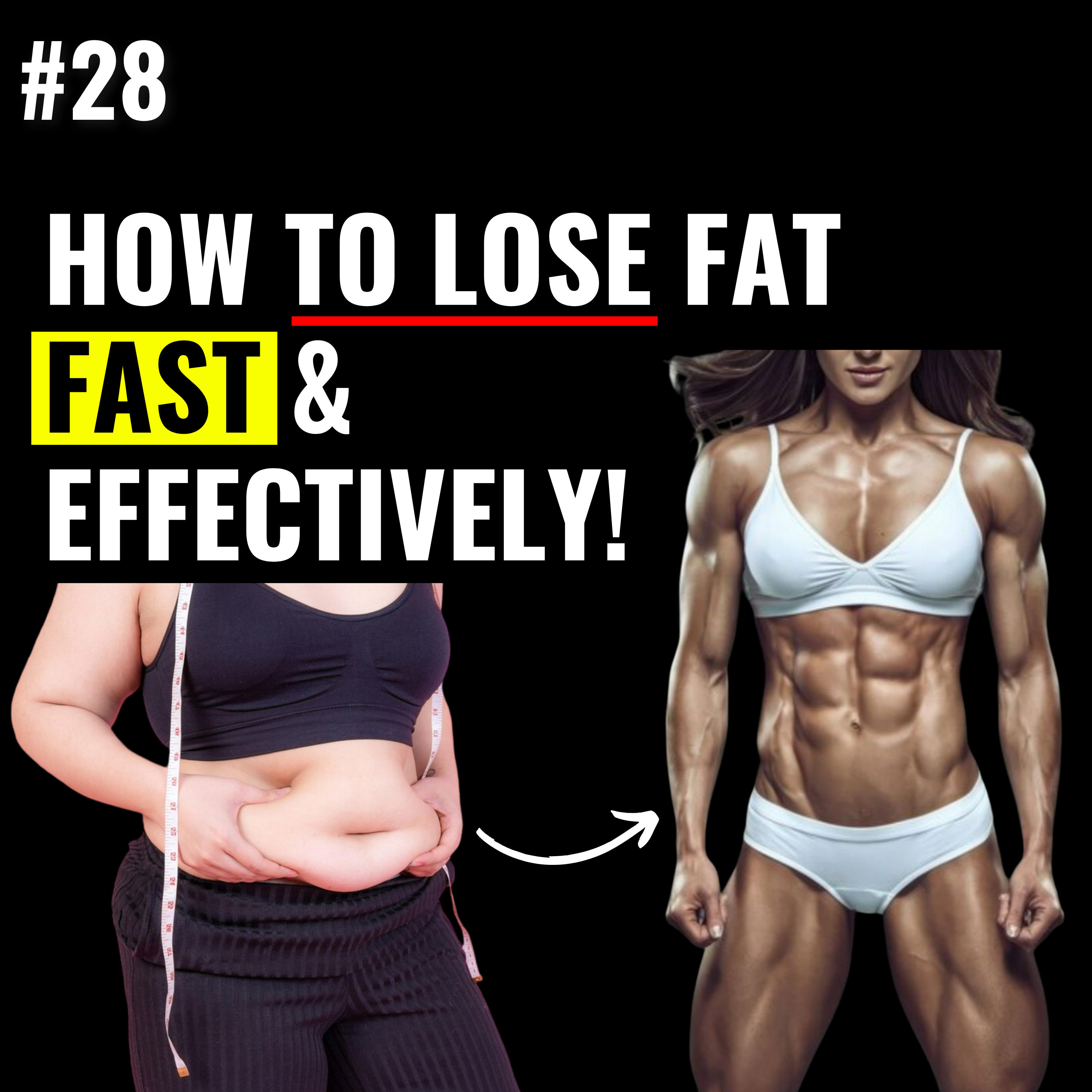
How to Lose Fat Fast! & Effectively and Keep it OFF | Best Diet & Type of Exercise for Fat Loss | Weight loss Strategies & Tools | TDEE Explained | Get rid of stubborn Belly Fat | Importance of MUSCLE
What's This About?
👇🏽 How to Lose Fat 🔥 Fast & Effectively, Most importantly how to keep it OFF ‼️ In this episode we cover the fundamental & foundational principles of Fat Loss, ways to accelerate fat loss, practical tools to implement right away, as well as all the things that are inhibiting/slowing down your ability to lose fat & keep it off!
This is the Ultimate Fat Loss Episode, so Definitely SAVE & SHARE this episode with a friend, this knowledge is extremely important & potentially life changing!✅
Eliminate Stagnation & Stiffness, Restore your Mobility & Function, Improve Blood Flow and take Care of your Fascial System with my New Dynamic Stretching Routine Program! Only for limited time, you can get it at a 50% OFF ✅ with the code: GET50 at checkout 👇🏽https://www.mobility-fitness.com/dynamic-stretching-routine
Definitely SAVE & SHARE this episode with a friend, this knowledge is extremely important & potentially life changing!✅
👇🏽 In this Episode of the Fitness Wisdom Podcast we discussed:🎙️
• Environmental Toxins and Pollutants are making you Fat and keeping you fat!
• Blue Light & nn-EMFs slow down your Fat Loss
• Understanding Fundamental & foundational principles of fat loss (BMR, TDEE, NEAT, DIT, EAT)
• 3 most important things when it's comes to Diet
• Understanding your current situation, body composition and where to go from there
• Muscle a key player in metabolic health, metabolic flexibility, glucose regulation & Fat Loss
• Best way to exercise to lose fat consistently!
• The importance of Nervous System Regulation & Fat Loss
• Role of Circadian Rhythm & Hormones in Fat Loss (Cortisol, Leptin, Melatonin...)
• The importance of Movement
• How to breathe for Fat Loss
• Other strategies and tools that increase our TDEE
👇🏽 You can find me on my other platforms as well, as work with me1-on-1 Online World-Wide 🌎
📲 Instagram: www.instagram.com/andreas_david_christou
🎙️ Podcast IG: www.instagram.com/fitnesswisdompodcast
🌐 Website: www.mobility-fitness.com
▶️ Youtube.com/@movementspecialistandreas
🐦 Twitter: x.com/movementandreas
Find & Connect with Tiina Haikola 💎
📲 Instagram: https://www.instagram.com/tinamaaria/
🌐 LINKTREE: https://bio.link/tinamaaria
👉🏽 Find the Best UV + Red Light Therapy panels, Blue Light Blocking Glasses & Circadian friendly light bulbs 🚨Use promo code: MOBILITYFITNESS ✅ for 20-30% OFF your entire order 👇🏽
https://www.emr-tek.com?snowball=MOBILITYFITNESS
👇🏽 Here is the Methylene Blue I use 🌀🧠
merakimedicinal.com/MOBILITYFITNESS
Use promo code: MOBILITYFITNESS to get 15% Discount on all products ✅🧠
👇🏽 Find the SHILAJIT I use & recommend below ⚡
https://mountaindrop.com/order/?ref=5873
Use promo code: MOBILITYFITNESS for Discount on your entire order ✅🧠
Get yourself a personalised Nutrition, Training & Lifestyle Optimization Plan designed for Your Body & Goals! Work with us 1-on-1 ✅ and let's Transform your Body from the inside out! 💎 The Link is Below👇🏽
https://www.mobility-fitness.com/workout
I have been coaching individuals World-Wide 🌎 for many years now, helping people transform their physiques but also to transform their health from the inside out through a Holistic Approach.
I teach people Holistic Movement Practices, Gym Workout Programming, Nutrition & Lifestyle Optimization practices for optimal and sustainable results 🏆
Work with me 1-on-1 ✅ and let's Transform your Body from the inside out! 💎 Contact me for details
👇🏽
https://www.mobility-fitness.com/product-page/gym-workout-plan
*None of the content / statements in this Podcast are Medical or Personal Advice & is not intended to cure, treat, prevent or diagnose any medical conditions. All my videos are for Educational & Research purposes only. If you decide to try anything discussed in this video, you agree to do so at your own risk & responsibility*
This is the fitness wisdom podcast.
If there was one substance that could increase your energy levels, optimize mitochondrial function, boost ATP production, help to optimize your hormones, re mineralize the body with ionic minerals, boost cognitive function, assist detoxification and support your gut health via the microbiome. This substance is shilajit, known as the destroyer of weakness. Shilajit is a herbal mineral substance made from the decomposition of plants and Syria, this process taking place over thousands of years. It is harvested from high altitude locations, primarily the Altai and Himalayan mountains.
And what makes Shilajit so unique is that it's made by Mother Nature herself. I call it nature's methylene blue. That's all Shilajit that you find on the market is created equally. This is why I only use and trust Mountain Drop Shilajit. They have an extremely high quality shilajit product that has been rigorously tested for heavy metals and impurities. Grab yourself some Shilajit, the destroyer of weakness today and head over to mountaindrop.com. Use the promo code MOBILITY FITNESS at checkout for a nice discount as well.
Hello and welcome back to another episode of the Fitness Wisdom Podcast. Today we're going to be talking about how to lose fat fast and effectively and most importantly, how to keep it off. Today I'm joined by my beautiful wife, Tina High Cola. Welcome guys, it will be so exciting to talk all things fat loss related today. Awesome to have you on board. And I can honestly say that she is a true expert when it comes to followers. You can just simply look at her Instagram page or any of her social media channels.
Or if you have ever met her in person, you can see that she's probably the most jacked female that you have ever met. And she has not achieved this by stressing her body or using anabolic steroids. She's done this in the way that supports her body most optimally and her mitochondrial function. And this is what we're going to teach you guys today, how Tina achieved this level of jackness and also what we have been teaching clients as well over the years to achieve the results that they have gotten as well.
So we're going to start off this conversation today talking about how environmental pollutants and toxins are making us fat and also keeping us fat. And maybe you could tell people what are environmental pollutants and toxins? Like, what are these things that are making us fat? Well, in the common day, I feel that environmental pollutants are everywhere. So we are getting them from our personal care products. We are getting them from the skies these days. And it's honestly anything like we are eating from plastics.
We know that there are some endocrine disrupting chemicals in there. So I think a lot of synthetic chemicals which are made by the man, we get them in our foods, we get them from the soil these days. So I don't think those are things that we can totally avoid, but there are many, many things that we can do to make our environment better for our body and why we would think about those factors contributing to the fat lost. But loss. I think simply to say, it is just so important to help our body to keep its detox pathways open, to keep our system functioning as it's supposed to, so that our body doesn't have those excess stressors from our environment which it has to deal with.
And it can keep its metabolic processes functioning as we desire when we do want to lose fat, because we want to make it easy for our body. Yeah, absolutely. And the all the, the only thing that the body cares about really is survival, right. So it makes sense that the body will want to gain fat or not necessarily gain fat, but to store those environmental toxins and pollutants, if it cannot efficiently detoxify them or if they are coming in in excess in the body, like meaning it cannot keep up with the detoxification, it has to store them somewhere, right?
And the body does not want to store them in our vital organs. It doesn't want to store them in the brain. It doesn't want to store them in the heart or the, you know, like the kidneys, the liver, it want to, it wants to keep those organs functioning well. So the safest place for the body to store these environmental toxins and pollutants is our fat tissue, right? So it's not actually that the body is necessarily producing fat, but even if we are in a calorie deficit, let's say, even without like changing your diet or your exercise, this could be a contributing factor why you may be gaining fat.
And you don't seem to understand why you're gaining fat even if you're eating less and you're exercising as well, and which we will get into later on in this conversation. Do you have anything to add to this? And I think also some of that perceived fat gaining would be also some fluid dynamics as well. So often when we are store storing a lot of fluids in the body that can be perceived as excess fat in the body. But of course, those things we cannot different differentiate so well if we are not really, really experienced with our physique.
But I think it's important to note that also when our lymphatic flow is disrupted, our fluid dynamics will be a little bit off as well. So that could be one thing that could be happening sometimes if if individuals are feeling like they are gaining weight for no reason, really, yeah. Yeah. So one thing which I actually forgot, thank you for reminding me, is that, you know, the solution to pollution is dilution. So the body would prefer to dilute something that's toxic rather than keep something extremely toxic going around in the bloodstream.
And so it's diluting that through fluids and through fat tissue, right, Distributing it throughout the body in ways where it can dilute it. So it's not so toxic to the organs until the body sees that our body and the lymphatic system and the detox pathways have room to be able to manage for more toxicity. So it's not going to start detoxifying until we stop the intoxication, right? Because so one really big factor when it comes to detoxification is to stop the intoxification in the 1st place. So the intox, right?
So we want to make sure that we're detoxing more than when intoxing and maybe we can give people some practical tools that we use in our life to make sure that we are minimizing all of these environmental toxins and pollutants. And then we will get into how blue light and non-native electromagnetic fields are also contributing to us having a difficult time with with fat loss and also fat gain. So what, what things do you think that people can start or remove from their lives? Because it's more about removal right, Rather than adding things into their life?
Absolutely. And as with any stressors, actually, I like to think that a distance is our friend. So anything that is closer to my body, I like to think that OK, I want to keep that quite clean and I want to keep it supporting my system rather than fighting against it. So four years ago, long, long time ago, I haven't put a lot of chemicals on my body. I don't use all kind of perfumes and deodorants, all these sorts of things. Shampoos I use natural so any really personal self. Care. Toothpaste 100%, very very important.
Anything that comes in the contact with the skin, I think it's good to pay attention to. So what are we putting on our skin will end up in our body. And yeah, that's the number one thing. And another thing which I find very, very important is like inhaled products. So for example, OK, I touched upon the perfumes, but then there are so many different things that we use in our household. Not only that, but laundry detergent. This is huge because we wear our clothes on our skin. Whatever remnants there is left from the laundry will be ending up in our system.
And actually, this is funny and maybe something to pay attention to. We don't consider those things before we actually pack off a little because when we stop using certain things like let's say the laundry detergent, which are really, really marsh chemicals, then we start smelling them even on other people. I, I actually quite struggle with that because there is isn't there like a thing with the brain that it when it perceives the threat in a way like let's say the perfume or something, it starts ignoring it.
Well, if we over sensitize, yeah, if we over sensitize the system. So if we're exposed to March to something, let's say you, you love essential oils and you sniff them all the time. If you do that all the time, your body's going to get used to that smell and you're not going to smell it anymore unless you use an excessive amount. And this is what is actually happening to most individuals who are using these toxic personal care products, perfumes, deodorants, detergent, all this stuff that they're using in their house, stuff that you you used to mop your floor with, for example, basically anything that is a chemical.
And this like, you know, and it's not meant to be ingested or you can't eat it is most of the times toxic for you, right, If you can't eat it. So I would only put something on my body that I could pretty much ingest. And yeah. And so that I think it's super important to knowledge and be aware that where did we come from as human beings, We didn't used to use any kind of toxic chemicals. We only used whatever came from nature. And nature is the most biocompatible thing with our biology, wouldn't you say?
100% One notion I did want to mention there is that essential oils I use in my personal care routines and I don't count those as toxic chemicals because they actually come from nature. However, I do feel that they are more like medicine, so we need to be clever with those kinds of things as well. Oh yeah, I was just giving that as as an example for the for the smell aspect. But yeah, just like with anything, even with a perfume, like a toxic perfume, for example, you can put it on and you know, after a while you get used to it.
And then after you're putting excessive amounts so that you can smell it, but then the other people around you are choking because you don't actually acknowledge like how much perfume you're using. But anyway, we shouldn't go too much on around down this rabbit hole. We want to provide you more with practical tools and tips on how to be able to transform this aspect of your life. So I think let's let's tell people that what can they add in there instead? Because I think that we acknowledge that now what we've, based on what we have just discussed, that we want to be removing all the things which are toxic in our life, right?
Anything that you wouldn't ingest, you probably shouldn't be using on your body. And yeah, and also the cleaning products in your house and also the scented candles. Anything that smells, which is artificial, is not natural, is not useful and good for us. So what would we add instead for people to implement? Yeah. And of course we are not telling anybody what to do and where to do. These are just things that we have found useful in our own life and in our own health journey. So personally, I love to use different oils from nature like coconut oil, tallow and these sorts of things.
I don't use a lot of skin care products. But to be honest, like I think we can make a separate podcast episode for for this topic, you know, about the chemicals and all that. But one important thing, I think a lot of people are physically active. So for deodorants you use something like salt. I just use a salt deodorant and it works perfectly fine. And you know, it's natural for the human body to smell a little bit, right? It would be completely weird if your body doesn't smell at all. So yeah, this is maybe like a hard concept for people to wrap their head around, especially when it comes to women as well, because they are more maybe conscious about what the way they look and the way that they smell.
And I totally understand that. And I totally get that guys are too. But I think ladies are even more conscious on that aspect. But yeah, you just need to acknowledge that the cleaner you are, like internally, the less you smell externally and also the more open your pores are in your armpits also the more easy it is for your body to sweat. So it's not going to hold on to as many toxins, which is not going to make your body smell as much. And the whole point of the everything that we're saying is that when we stop the intoxicification in the body, then the body can start to release a lot of those toxins that is holding on to the fat tissue, which has been stored in the fat tissue and in the lymphatic system.
And now you will start to lose an excessive amount of weight depending on your level of toxicity. Of course, even without changing your diet or your exercise or your other lifestyle habits, it's just a no brainer that you need to start from something that is a is a low hanging fruit. And this just simply doesn't take any effort just by simply reducing or eliminating some products from your life and swapping them for more natural products. Non-native Emfs and blue light. Yeah. So this is of course a little bit of a controversial topic for people who don't understand circadian rhythms and quantum biology.
But basically what non-native electromagnetic fields are and also artificial blue light, well artificial blue light is also a non-native electromagnetic field. So we can get that clear from the beginning. But basically these two things, they are stressing our system, right. They are activating our sympathetic nervous system. Now when we are in a sympathetically during state, we are basically going to produce or release glucose into our system. And that's not necessarily from the food that we eat, but rather through gluconeogenesis.
If the body does not have fuel already stored somewhere in the terms of glucose and that's going to raise our blood glucose, right? And then this is not good because then that's also going to raise our insulin. And we know that when insulin is constantly high, it's extremely hard for us to lose body fat. But that doesn't mean that you can't lose body fat if you are all the time in a sympathetically driven state. I think both of us, we have managed to achieve that over the years and many of our clients as well who are very high achievers.
Many people can be in a sympathetically driven state a lot of the time and still lose weight very, very fast, especially if you are in a calorie deficit, which we will get into later on in the conversation. But if you are in a calorie maintenance or surplus, my God like artificial blue light and non-native EMS is an absolute no no for you because it will increase the fat mass on the body so quickly because the body is now in distressed state. And think about if you're running away from a threat, do you think that your body actually cares about losing body or utilizing body as a fuel?
No, all it cares about is survival in that moment in time. So I think it's extremely important for for us to be in a parasympathetic state as much as we can if we actually want to lose body fat, because that is how we enter ketosis. Ketosis is a metabolic state. It is not a diet. Do you want to say something? One notion I did want to say when you mentioned that even chronically stressed individuals will experience weight loss. But actually in my experience, this is with my clients and this is also with myself, that in the most stressed states in my life, it's been really hard to actually acquire that lean and toned body.
So even and if we are losing weight in that state, it doesn't mean that we are just simply losing fat. So it's a very important notion to make for ourselves as well. That or for anybody listening that when the weight is dropping, where is the where is it dropping from? Because it's actually very easy to be in this catabolic state when we are chronically stressed and that eats away our other tissues which we don't want to get into. So the whole purpose of weight loss journey or fat loss journey is the fat loss.
So we actually want to maintain the most amount of lean tissue we can, the most amount of mineral tissue we can in the body while we are losing the fat. And This is why parasympathetic beet oxidation is the way to go. So entering that ketosis more often in the day, throughout the day, being in the most more parasympathetic state, as much as we can. And actually, when is there a reason to be in the sympathetic state? In the regular life, there is no state, no, no situation really, because we are not actually running away from the threat.
So we can be alert in the parasympathetic state. That's totally possible. We don't need to be in that overly stressed state. Yeah, absolutely. No, extremely well said for sure. I mean, I think that it's so crucial for all of our bodily functions in general, for our detoxification, our healing, regeneration and our fat loss for everything to work optimally, our digestion and, and sleep those and hormones, all of these things can only really work and function adequately and properly and optimally when we are in a parasympathetic state, which is our rest and digest state.
But if we are constantly having running away from an imaginary tiger, because in this modern world, right, it's more psychological rather than it's physical. And and then you know, if you add on top of that physical stressor as well, you can easily reach burnout, which we have hit that point over the years as well. And we have had to learn all of this. And This is why we are able to share this knowledge and wisdom with you guys because we've gone through this with our own personal health and also many of our clients have as well.
And we have been able to assist many people over the years to get into more of a parasympathetically driven or parasympathetically optimized state or learning how to shift the nervous system state so it's more regulated, right? Because The thing is that then it's not bad to be in a sympathetically dominant state or sympathetic state. You just want to be in it for a short period of time. For example, when you work out, of course, you want to be in a sympathetic state. That's what keeps you alert.
That's what keeps you, gives you the ability to be able to push and to progress and to make change. But then after, when the stressor is over, you want to be able to, you know, come very quickly back into parasympathetic state to initiate the healing response, the inflammation that you need to to heal the tissues and to regenerate the body. Absolutely. And this is crucial because stress in the short bouts, it's very, very healthy even for our pathos journey. But if we have to stay there chronically, that's where we end up having the issues.
And also I think it's important to tie this topic because I'm not sure if the audience is familiar. Why do we think that the non-native Emfs and the blue light cause us in that being in that parasympathetic state. So I think it's just maybe without going into too much detail, it's important to understand that the non-native Emfs, they influence our cellular. Yeah, it's non, non-native as it says it in the name like because it's non-native to our biology and our planet, then our body perceives it as a threat.
And when it perceives something as a threat, because the crazy thing about non-native electromagnetic fields and artificial blue light, they are, they are like waves, invisible waves. That's how your Wi-Fi works, right? But that's non-native electromagnetic field. Your Wi-Fi, your microwave cell towers, your cell phone, your laptop, anything that runs on electricity and these wireless especially is going to produce non-native electromagnetic fields. And there are many things like such as the electric fields from your plugs, your, your wired devices, all of these, these are producing magnetic and electric fields, which are also harmful for our biology.
Because what basically what happens is when we induce the cell danger response or there are stress response in our system, we get a, an influx of calcium into the cells. And that's primarily the way that this is actually, you know, putting us into this constant. Perpetual cycle of sympathetically driven state because calcium initiates contraction in the body. Cellular and muscle contraction. So you actually need calcium to be able to contract your muscles, but excess calcium release constantly in the cell is going to deplete minerals such as magnesium, which is essential for relaxation, right?
And then what happens if we're constantly stuck in a sympathetic driven state and then our muscles are tight and then that's feeding into the whole cycle and if we're not able to enter back into the parasympathetic state again? Bringing this back to fat loss, remember that you cannot lose fat or it slows down your fat loss tremendously if you are constantly in a sympathetically driven state. So we're going to talk about strategies later on in this podcast of how to enter into a parasympathetic state.
One other thing which I wanted to add in here because I do think that it's important and I think it's something to pay attention to because actually often the blue lid gadgets, they start actually manipulating our behaviour as well. So this is one reason why I often see people actually failing even following a plan with diet, because if our we become really impulsive, if we are spending too much time in this kind of like very narrow depth of field sort of a way, so we are looking at our screens all the time, then we become impulsive when it comes to food, for example, we might misinterpret our bodies triggers in a way that we want to just like eat more and it's going to be harder to stick to the planet.
So this is something that I'm totally seeing in my clients, but also in myself that it's becomes actually really hard to stick to a plan which was easy to begin with. And if I'm living now, it's my personal experience. So if I'm living in line with the nature I have 0 struggles and I can actually like I can get owned by a very very low caloric diet without feeling any low energy or anything like this. Or agitation. Or agitation or frustration and any disturbances in the sleep. But then when I start using a lot of tech, I really feel the consequence.
And then it's really hard to actually to stick to a plan as well. So I think this is just something to pay attention to because I know that a lot of people don't don't know how these things influence their biology because they are so common thing every day what we do. So we don't have a comparison. So we are lacking that control from our life. And every time when we do experience a stressor, it's depleting our energy levels by again going into that gluconeogenesis. And then the stress itself, because the body is under stress, why it's going into gluconeogenesis is because it actually needs that glucose.
Because remember, in a time of stress, the body needs glucose as a fuel. And so that is anaerobic metabolism. And so basically when we are in a parasympathetic state that is aerobic metabolism, which means that we are using oxygen and we are doing performing fatty acid oxidation. But when we are in a sympathetically dream state, we are mainly using glucose. And because we are so stressed, our body is needing that extra energy to be able to, you know, not to be able to survive basically, right? So This is why we don't want to be wasting our energy, especially if we're in a calorie deficit, because then that will create us to have binges and to want to like eat everything in front of us.
But I think now we should move on to the to the next topic, which is now the foundations and the fundamental principles in understanding our total daily energy expenditure. Well, let's start off by saying this. There are many individuals in the health and fitness space who believe that calories don't matter, which kind of makes sense in a way. I totally get their perspective. And they only say that the the type of food that you eat matters. So the quality of the food or the timing of the food matters, but all of the things matter.
You can't just pay attention to your your, the timing of the food that you eat or only just the quality of your food. You have to make sure that you're eating right, you're eating the right amount of food, and you're also eating at the right timing. Would you like to say something? Absolutely. I think color calories are fundamental and we have to make a little separation here because aiming for fat loss is not the same as aiming for health. So for example, a lot of very troubles, yes. So a lot of principles out there promote not looking into the calories, but we can still gain a tremendous amount of health.
If we are paying attention to our circadian habits. We are going to feel better. It's not guaranteed that we are going to lose fat even if we are on an elimination diet. We may feel better, but it's not guaranteed that we are going to lose fat. So actually what does play the most significant role is the caloric amount. So are we in a maintenance deficit or surplus? And often times all those tools that we, I kind of like, that's the one, you know, if we are paying attention to our circadian habits, we are going to eat less food most often.
And if we are on an elimination diet such as carnivore diet, we are going to eat less certain foods. So not necessarily less energy. OK, now that I got step on that diet, I think I need to elaborate a little. So even if we are totally not eating carbohydrates, we will be losing a lot of fluids from the body. But that doesn't mean equate to fat loss. So that might just be that that weight loss that we are experiencing might be the fluids or for or for some reason we are on a caloric deficit which is often not going to happen on those type of diets and.
I would just like to say, I would just like to contribute to this by saying that a lot of the fat loss that we and weight loss that we do experience at the beginning by not changing necessarily our caloric intake or just by simply swapping it to, you know, healthier circadian rhythms and also eliminating these environmental toxins and pollutants from our life. We are going to experience so much water loss from our body fluid retention that we had under our skin that we thought was fat tissue that will make us feel like, wow, I lost all this body fat.
But in reality, no, you just lost a ton of water weight and a lot of inflammation from your body, but you didn't necessarily lose so much body fat. You may lose somebody fat because you are shifting into a parasympathetic state. And if you are have been an extremely long time stuck in a sympathetically driven state, and all of a sudden you are giving the body all the right environmental tools to shift into a parasympathetic state, you may even experience fat loss without going into a calorie deficit because finally your body's machinery is starting to work properly again.
Absolutely. And another factor which happens in the beginning of weight loss is that the cough mass also goes down. And in some cases that can be pretty significant because if we are, let's say we are just going on an elimination diet, we are not eating as much fibrous foods and all that. And the amount of things that we can store inside of our intestines is so much that that could also contribute to the weight loss in the beginning and often when we are coming to that depleted point in our fat loss journey, which is kind of like the initial phases.
What do you mean by the places? Well, when we have lost a lot of fluids with the cryogen that we have been losing from ours. So the glycogen stores are getting low. Yes, yes, absolutely. Sorry. In simple terms, yes. And often that's the point where we actually need to keep going because of course there are strategies to implement on the way just such as repeats and all these sorts of things. But that is when we must keep going if we want to actually keep losing that fat mass on from the body. So often we come to the point that we're like, well, I already lost like 1-2 kilos, so I'm quite happy now.
So maybe I will just go back to my regular diet. But actually nothing fundamental happened yet. So I think it's important to also. Yeah, Yeah. So basically when we get to that point, like the whole idea is to never really go back to your previous diet. The whole idea is a is a lifestyle change in general, right. And we need to, this is something that we will get into just in a in a couple of moments. But I think let's first talk about total daily energy expenditure, what this actually is and what contributes to our total daily energy expenditure since the amount of food that we are eating matters, right?
Think about this for a second. Do you think a granny needs as much food as an athlete? No. Right, Because they have total different coloric demands. The one has completely different body compositions, so they're one. One of them is using and expanding way more energy throughout the day and another one is not. And This is why the granny will not need as much food as the athlete does who is young and full of muscle. So understanding this, this makes us understand that, OK, how are we able to increase our total daily energy expenditure, which is how much energy are we using in total?
All right. And what actually contributes to our total daily energy expenditure? So there are 4 main things that contributes to our or five, yeah, 4, four to five main things that contribute to our total daily energy expenditure. The biggest one being our basic or resting metabolic rate. This is how much energy we are burning at rest without doing anything. And one of the biggest determinants of this like changing this is how much muscle we have on our frame. So even if you are someone pretty short or even a woman who is like pretty doesn't weigh much in weight, you can still significantly increase your resting metabolic rate by increasing the amount of muscle that you have.
Now, for ladies, it's pretty hard to build muscle, right? So we would say that do not be afraid to build muscle, especially if you're trying to lose fat and make it sustainable. Now this is the key, right? Fat loss is supposed to be a sustainable thing. It's not meant to be something that you do for a short period of time and then you quit because of course you are going to rebound and you're going to gain all the way back and maybe even more, right? Because you haven't addressed the root cause of the problem, which is your low metabolic rate in the 1st place.
So your total daily energy expenditure was low to begin with. You went on a low calorie diet and now you went back to your diet that you were eating before. And now your total daily energy expenditure is maybe even less because maybe you changed some of your habits and behaviors because you've been feeling tired and you didn't have the energy. And now you're in this perpetual cycle of going on these low calorie diets lower and lower and lower and constantly burning yourself out trying to lose weight without addressing the root cause of the problem, which is your resting metabolic rate, which is contributing to your total daily energy expenditure.
But I will just tell you all the other things that contribute to the to your total daily energy expenditure as well, which is your non exercise activity thermogenesis, which is basically your movement that you do throughout the day. The more you move throughout the day, even just fidgeting like I am now just moving my arms or tapping your feet and just simply breathing, smiling, whatever is going to burn more energy. So the more active you are throughout the day, the more energy you are taking away or the more calories you are burning throughout the entire day.
So it's going to add to your total daily energy expenditure, meaning that if you are aiming to lose body fat and you are burning more energy that you are taking in, that's going to allow you to lose body fat way, way easier. And the next thing is the diet induced thermogenesis. So some foods are are going to expend way more energy from digestion compared to others. So things that are high in fiber and especially high protein diet is going to expend way more energy compared to eating more carbohydrates or fat.
So This is why another reason why we should be focusing on eating 1g per pound of ideal body weight, not only because it preserves muscle mass and allows us to gain muscle mass at that level, but also because it creates satiety and it also increases our diet induced thermogenesis. Now and the last one is the exercise aerobic thermogenesis. So basically when we are exercising and we have more muscle mass, that's also going to increase our energy expenditure even more, our total daily energy expenditure that we have covered the foundation of fundamental principles to understand of the total daily energy expenditure.
Now we can move into things that actually contribute to our, you know, increasing our basin metabolic rate, but also like how to lose fat fast and effectively. And what are the biggest needle movers actually? And you did mention about the base on metabolic rate, how it is so fundamental for our total energy expenditure for the day. And so it would only make sense that we want to get that as high as we can. And how can we get that high is by acquiring more of more of that muscle mass. And you mentioned before how we don't want to end up in this loop of dieting, which I think is very important to understand that we won't don't want to keep revisiting that and maybe do the dieting in a bad way and lose a bunch of muscle mass at the same time.
And then go back to something that we thought was the normal way of doing. And now we even have a lower basal metabolic rate, and then we end up digging that hole deeper. And that's not really the goal to do So that's why aiming to build that muscle is the most sustainable way because everybody wants to be lean. But how are you going to be lean if you don't have enough muscle mass to begin with? Like you once said, what's the next place to go is like the bone. So that's all. Yeah. So. So desire it.
No, absolutely. And since we're on this topic, it's probably appropriate to talk about the best type of exercise to do for fat loss because when it comes to exercising, there are exercises or the type of exercise that preserves muscle mass and increases muscle mass. And there are activities which do not necessarily eat away muscle, but in some cases can eat muscle and contribute to fat loss. But it's not honestly not ideal when it comes to fat loss. And I think you already know the answer to this, to this topic or this question, right?
Maybe you could touch a little bit upon this. What do you think about strength training versus cardio for follows? Resistance training for sure, 100%. So cardio, I think it's not an issue if it's done correctly, but we cannot overdo cardio if we want to build muscle and if we want to lose fat, that's the that was the goal is to lose fat. And so resistance training, if that's the only way that we can train, I would just stick to that. And other than that, to be honest, like with endurance type of activities, I would be a little bit careful.
It's so easy to overdo this. And we need to remember that our body is always adapting to its environment and it's always seeking the most efficient way. So if we let's say we run a lot, I used to run a lot, we become efficient at running and. What does it? What does it mean to be efficient? Exactly. Being efficient at that sport is not carrying a lot of muscle mass because we need to be efficient in that sport. So and then again, like if we start lifting weights, what do we need to do? What does our body need to do?
It has to adapt. So it wants to grow that muscle so that it can be stronger. Not necessarily. It doesn't necessarily want to grow muscle if we start lifting weights, but we have to because remember it's about the efficiency. So it wants to build the strength. But in this way, we have to trick our body to understand that it has to build that muscle. So we want to in a way which is hypertrophic and it helps us build that muscle mass. Yeah. I think now it's important to talk about why it's important to carry more muscle on the frame, because it is an extremely highly metabolically active organ and compared to fat tissue, because it has way more mitochondria than than fat.
And basically our muscle can serve as a reservoir for glucose and so it can help to lower our circulating, but glucose are fasting but glucose levels. So it's a resistance training is a phenomenal way to be able to deplete the glycogen stores from the muscle and also create bigger glycogen storage. So it's like a book, it's like a reservoir which is soaking up all of the glucose. So if we do ingest, you know, high amounts of carbohydrates or if we do endure a lot of stress, we are we have somewhere to store a lot of that glucose which is circulating in our bloodstream as well, don't we?
100% So I would say that the first principle to do is the resistance training when we want to lose fat. Other things are kind of like a bonus, but one, the nice thing about resistance training is that of course that can be done in many ways, but it is the number one exercise which I think we can do in a way that we are more parasympathetic throughout our whole weekly training. So it doesn't put us, it temporarily puts us in that fight or flight state, but we can be way more soft with that approach.
So when we think about something like resist endurance sports, we are doing that sport for one hour or more often and that's really quite stressful for the body. So it requires so much more time from our body to actually come back to the baseline. And think about this for a second as well. That muscle, when you build muscle, since it's a highly metabolically active organ, you're going to be burning or utilizing way more energy at rest. So that again, This is why we're saying that it's essential and vital.
This is the root cause of the issue of you not being able to lose weight in the 1st place because your total daily energy expenditure is very low and you are consuming more energy than that. And This is why you're having a hard time in losing weight. And so This is why it's vital for us to build muscle compared to endurance type of training or cardiovascular type of training that is only going to utilize energy during the activity. And as soon as the activity is over, the amount of energy is not going to continue being expended.
And that is the not necessarily a downside, but it's like the limitation of endurance training. Everything has it's time and place. We just need to understand that some things are foundational, right? So building strength and muscle is absolutely foundational when it comes to us fixing the loop that we are trapped in when we are trying to lose body fat. Because the idea is eventually when we are, because we always have to diet. Let's be honest, we always have to diet to lose body fat. But the depth of which we need to diet will change over time, especially if we are having a bigger resting metabolic rate, and that is by increasing the amount of muscle mass that we are carrying on our body.
Right, absolutely. You're so right about that. And very important thing is that a lot of times we think that OK, exercise more and eat less is the way to go. But actually I would come to say that a lot of people overdo the exercise as well. So even if we are thinking about movement, people think that OK, I need to move like 10K plus steps every day and you know, keep going, keep going. While the movement is essential, we need to recognize like where are we overdoing it? Because actually we want to keep our body, like we mentioned earlier, we want to keep our body more in that parasympathetic state.
And overdoing any type of activity will be a stressor for our body, especially I think in this kind of like chronic exercise regimes, which I mean by chronic exercise is that even a low intensity exercise for prolonged periods of time all the time. So multiple times a week and then doing the resistance training and then maybe even the running and all that stuff. So it just has to come to a balance with that 100%. So I would more like to see people exercising a little bit less and eating a little bit less.
Exercising intentionally. So the type of if you're exercising, meaning when we say exercise, we mean heart intense exercise, which yields a meaningful change to your body, meaning that you're breaking down muscle in pursuit to build more muscle. Because remember when you exercise, you're not building muscle, you're breaking down tissue, right? All exercise is catabolic. You only recover and build outside of training if you are in a parasympathetic state, which is very important so. But what I did want to say is that rather than aiming to eat as much as possible and exercise as much as possible, sometimes it's more clever to eat less and exercise a little less and yield better results.
But 100% we must do the basic work. Yeah, because what happens if you have built this sort of lifestyle where you are constantly active to be able to lose body fat and all of a sudden one day you just wake up and say fuck it, I don't want to get out of the bed, I don't want to move today. And then this becomes a habit. And then all of a sudden your total daily energy expenditure is reduced because you are non exercise, you know, activity is basically reduced and then you are wondering why you gained weight.
Well, of course it always comes back down to our total daily energy expenditure. And This is why we are trying to explain to you guys that that the amount of energy that you consume and that the amount of energy that you are utilizing with your body absolutely matters when it comes to fat loss. We have implemented this with ourselves and with many, many clients over the years, and we've had tremendous success. So to say that calories don't matter is a very dangerous claim to make, especially if you want to see your 6 pack.
You can't lose a a pretty good amount of weight without tracking your calories by being more intuitive, but it is wise to get yourself a personalized diet plan. We can help you with that. Of course, we don't need to track your calories. We can track everything for you and just give you a ready made plan that you just need to follow and just make sure that it's personalized to your body and goals. OK, so now I think it would be great if we move into the second aspect. So we've talked about the amount of food or energy that we are expanding.
That's crucial, right? So now the second part is the food quality. So of course we are not one of those people. Like, you know, if it fits your macros, you can eat it. Yes, if it fits your macros and it's healthy, you can eat it. But we don't think that if it's junk food, you should be eating that, because that has some downstream consequences, right? Absolutely. Like like we said in the beginning, like we want to support our body system. So we want to put in good stuff. And this is number one because we don't want to put in like chemicals that our body is having a hard time to deal with and all kinds of processed foods.
That's number one. But also we need to think like why do we want to eat Whole Foods? And the real foods is because those are made by nature again, and they are not hyper palatable foods which you want to just keep ingesting. So actually we allow our bodies as society signals to work way better when we are eating real foods. So we get real flavors, real nutrients, and we also make sure that we can target our macro goals in that way without about going over our caloric. Yeah, absolutely. And when sorry, Yeah.
So basically when a food is kind of boring, right, you don't want to like overdo it. And that's absolutely crucial that you eat foods which are, you know, you see online all these recipes about these fancy recipes trying to alter the taste of food. When in reality we need to learn how to enjoy and appreciate the food as it is, as it came from nature. Of course, we sometimes we need to cook it or not, but we just need to learn that respect and we need to respect the seasonality as well. So when we say for example that eat in accordance that it fits into your energy intake in the day, you're going to see OK, when you go to the supermarket for example, and it's winter time, there's no fruits and vegetables available to you.
Maybe there is some squash available, maybe there is some zucchini available, maybe there is like I don't know what kind of maybe oranges available here in Cyprus, for example, in the winter time. Those foods you can probably implement into your diet because they are seasonal and local to you and if they fit your energy intake. So you've made the calculations and basically you need to calculate how much protein you need, how much carbohydrates and how many fats, but most importantly, how much protein do you actually need in your diet?
Because then that is the foundation when it comes to building a diet, right? We want to make sure that we're getting enough protein. And once we have covered those bases, then it's only the energy substrates which are left, which is the carbohydrates and the fats. With those you can play around with the ratios. Whatever you prefer, whether is to do more of a ketogenic style diet or you want to do a low carb or even high carb diet. As long as you are in a caloric deficit for your body and your total daily energy expenditure, you will lose fat even while eating carbohydrates, right?
So just because you are in a ketogenic style diet, if you are not in a calorie deficit, that doesn't mean that you're going to lose fat. Many people have this idea that there are some miracle diets out there and we just explained to you before why some of the reasons you may be experienced seeing this weight loss at the beginning even when you are not tracking your calories and you're eating more food than before. And contrary, contrary to the common belief, I have to say that some of my easiest diets dieting phases ever have been on a high carb state, so high carbs as possible.
And low color. And yeah, calorie deficit. Of course, calorie deficit always that has to play a role in the factors, but pumping my carbs higher has been easier for my body. So that has allowed my body to not go in this kind of like stress state and I could have just kept going. And yeah, so contrary to high fat diets, I I would struggle because the body likes to get that quick source of fuel, especially when we are long longer time in deficits. Yeah. And I think that since we are on this topic about stress management, we shouldn't necessarily use carbohydrates as a way to manage stress, but they are a tremendous tool in managing stress.
So meaning that it shouldn't be like our first resort, but there can be a quick fix in the moment to reducing our stress levels and our cortisol levels because insulin is the opposite of cortisol, right? So when insulin is present, it shuts down cortisol, which is going to help us go into that parasympathetic state. Now this shouldn't be our first resort, but you know, in some cases it's extremely useful and especially if you are an individual who is doing glycolytic type of activities such as resistance training such as sprinting.
Anything high intensity, anything anaerobic is going to utilize glucose. Now when you utilize glucose and you empty it from your muscle and your liver, how do you think your body restocks the glucose? Or rather, you need to think that the body always has to have a glucose reserve ready for in times of threat available in your muscle and in your liver. So if you're not ingesting any carbohydrates, you're doing a 0 carbohydrate diet and you are performing glycolytic type of activities, which is resistance training or sprinting, you are going to be running maybe into some issues by constantly being in a gluconeogenic state.
So meaning that your body is constantly trying to produce glucose for your muscle and your liver even though like you are not ingesting it because and that is the reason because you are not ingesting it. And that is extremely stressful on the body because remember, in what state does the body, you know, going to gluconeogenesis, that's a sympathetically driven state and we don't want to be stuck in that state all the time. We want to be there for short periods of time. This is why I think that long term ketogenic diets, especially for people and athletes who are doing glycolytic type of activities are not necessarily the best approach.
That's what we have found with ourselves and with our clients. But if you are a person who is very stress free, you are chilling all day, you're on the beach, you're enjoying your life and you don't have like many stressors in your life. You're not very often in a scene by the daily driven state. You can get away, I believe, with eating primarily a ketogenic style diet the majority of the time, right? I think you're right, absolutely. So it's always individual and that's why it's so dangerous to just go and try and find all the answer answers from social media because nuances matter there so much.
Context is everything. Exactly. And what I wanted to mention was because, you know, you said that we might need those carbs as a tool to keep our body in a in a less stressed state. So important notion here is that we want to still adhere to our meal timings and meal plan. The reason why I say this is because we don't want to end up in a loop where we are like just having to get that quick glue goes like right now right here, because then we just end up easily getting in this pinched loop as well.
So that's that's a little dangerous. So the body doesn't necessarily need it right away in most cases if we have our Chrygogen stores in check in the liver. Not only that, but it's all about as well building metabolic flexibility. So the the key is that if you are able to be in a parasympathetic state, remember what we said that ketosis is not a diet is a metabolic state, right. So if it's a metabolic state, that means that you need to support the body to get into ketosis. One of those ways is through diet, but other ways is by being predominantly in a parasympathetically, you know, in a parasympathetic state.
So if you are not in a parasympathetic state, well then you are not in ketosis and then your body is going to be creating those hunger signals that you want to binge and you want to eat everything in front of you. So you want to be implementing things in your diet. You have correct meal timings which we are now going to go into. So why is it so important for us to eat at the correct times of the day? For multiple reasons, but that's definitely a circadian signal for our body. So if we eat at the appropriate times of the day our that's another signal.
Of course we have the light environment, but it signals our body what time of the day it is. And why it is so important is because we are built to function in this type of 24 hour cycle. So we have our brain perceives the environment and then we do physiological reactions accordingly, Yeah. So. So yeah, basically like our bodies, our mitochondria in our body is a quantum sensor to the environment. And what this means is that it's taking all of the inputs from the environment, the type of light we are exposed to, the temperature, the magnetic field, like the season.
It knows all of these things based on the external environmental cues. And based on that, it knows what type of hormones it should release at what time of the day. And eating breakfast, for example, is incredible because it helps to shut down that cortisol, especially that we don't want to be dragging that cortisol on throughout the morning because it's going to steal energy away from the rest of the vital hormones that we want to be producing throughout the day, right? And so we want to be shutting it down.
And also we don't want to be eating after sunset for the reason being that when we fast like naturally nature's rhythm. So when as soon as the last light disappears off the horizon, we basically are able now to release melatonin and we are able to stay insulin sensitive, which is vital for our melatonin and our leptin to be able to work appropriately. And we know that leptin is basically our master hormone when it comes to appetite regulation. So if leptin is able to bind to the brain in the night because glucose is not elevated, because insulin is not present, because we haven't eaten like so late, Plus probably your last meal of the day shouldn't include carbohydrates.
That's what I do anyway. Like of course you can consume, but I would rather not just to make sure that, OK, now my body is going to enter a keto ketogenic style state, a keto ketogenic state when I'm going to fall, you know, into sleep. And I'm going to go into that deep repair and regeneration. Because we can't go really into deep repair and regeneration if our melatonin is not released at the appropriate time, if we're not blocking the blue light. Because remember, blue light stimulates symbiotic nervous system.
So that means is all high melatonin low? When melatonin is low, we can't sleep. When melatonin is low, we can't regenerate, we can't heal, we can't thrive, we can't detoxify, we can't clean up, we cannot be in ketosis, we cannot lose body fat as efficiently, which means we wake up the next day with more cravings. So leads us into this binge cycle. So This is why it's so important for us to be at the correct times of the day when it comes to fat loss. Would you like to add something to that? Yeah, I think it's going to create a lot of confusion now because you said the no carbs in the evening.
So again, context matters. So for us that works the best. So the highest amount of carbs come in the morning and the daytime. And actually typically the dinner for me and for you right now as well is keto style dinner. So there are basically no, no carbs there. But what matters more is the total of the day. So because we ate our carbs in the daytime, then we can do that. But for somebody who start there themselves for the day and now are hearing that maybe carbs another good thing in the evening, well, maybe in that person for that day, it is a good thing.
So we have to always think about the context here. So. So yeah. Yeah, I think then if they do have to eat, let's say they eat one meal a day and they fast the whole day, which we don't necessarily recommend for your stress hormones. Probably like the, you know, eating all the carbs you are going to eat some carbs, then you should do it like pretty early in the evening so that your body has time to digest those and you and put away those carbohydrates into your muscle and into into your fat tissue depending on if you have exceeded your caloric intake or not.
But moving on to the next topic, which would be like the importance of nervous system regulation. I think we have covered this quite a lot in this conversation, but is there anything that we missed when it comes to the importance of nervous system regulation for fat loss? Breathing. Yeah. So yeah, that breathing is fantastic. But I meant I meant that like, why do we need to regulate our nervous system to be able to assist our body to lose body fat? But I think we we touched upon that quite well.
I think we touched upon. That so then let's move into like how we should actually breathe to assist our body to get into, you know, a fat loss state. Do you want to start? I just think nasal breathing is fundamental. So again here I want to think about supporting the whole body and the whole Physiology. I don't and and that's going to assist the fat loss. So and of course the better we can oxygenate our tissues, the better we are. Like we said earlier, fat oxidization happens in the oxygen rich environment.
So, so I think nasal breathing is the number one it's. Yeah, it's absolutely key, right? Because not only are you, when you nasal breathe, you are retaining more carbon dioxide, which is allowing the release of the oxygen from the red blood cell to be able to answer the tissues. Just because you are breathing doesn't mean that you are absorbing oxygen or releasing oxygen into the system. So if you are a mouth breather and you are exhaling more air than you are breathing in, you are off gassing way too much carbon dioxide from your system.
And this is an issue because then even though you are breathing, your brain is sensing that you are lacking the oxygen which is creating this vicious cycle for you to breathe faster and more gasping for air. So in reality, you want to train yourself to be able to breathe through your nose as much as you can, because remember that anaerobic metabolism uses glucose as a fuel, which means sympathetically driven state, which means fight and flight. Presence of oxygen in the tissues means parasympathetic state means ketosis means easier fat loss.
So the more we understand this, that ketosis and fat loss is a metabolic state, the easier it is for us to know that being in a parasympathetic state is one of the most important parts about, you know, for gaining, I mean, sorry for losing fat and being able to keep this consistent. And so now I would like to lead into the last part of our conversation, which is like some last final tools and tips which can increase people's total daily energy expenditure. We already talked about the importance of movement, the importance of how to breathe, the importance of what type of diet to eat for total daily energy expenditure, the importance for building muscle, for increasing your total daily energy expenditure.
One very good thing or two very great things which I have found very beneficial is sauna and also cold exposure. And those two things, they are fantastic because they increase your metabolic rate because they are stressors, right? So anything that is a stressor is going to deplete a lot of your energy. But the the good thing is about those stressors is that there is a lot of benefits that come with them, especially if you do cold exposure in the sea or in a living body of water like a river or a lake, because you're also getting grounded, which is also supporting your parasympathetic activity.
And yeah, do you want to add something to this? I would want to add also that, yeah, like you said they are stressors. So for example for Sona, we don't want to use that as a fathos tool. Like we don't want that to be the primary way because then we end up especially we are overdoing exercise, we are overdoing life, we are overdoing all these different. Tools we are burning through minerals. Yeah, we are burning through minerals and honestly like that type of approach is going to eventually end up in a burnout at of some level.
Yeah, I think, I think that you know. I I just wanted to say that wonderful tool but not to over. Abuse. Oh, yeah, I wasn't saying that you should use it as of course, like your primary, as we said, it's like a contributor to your total daily energy expenditure, but it's a very small contributor, right? So if it's a small contributor, that means that you should be aiming, putting your attention and your focus more on building muscle and changing your body composition. And then you can add these extra tools into your life.
If you have your nervous system regulated, then in that case, I think they can be fantastic tools. What would you say? You said it perfectly. And those are anyway like health tools, health optimization tools when our nervous system is resilient enough to, you know, take or. Tolerate them. Yes, tolerate. Yeah, because there is a lot of talk also. Are they good? Are they not good? But I think they are wonderful tools. It's just a matter of where is our body at and what has our body been going through?
So what can we tolerate right now? So I think in an optimal state we should all be able to tolerate those things, but we cannot necessarily always do so. We need to understand where we are at. Yeah. And also apart from the increased energy expenditure that you get from those activities like cold exposure and sauna, you are going to get a ton of other benefits as well. So even if they are stressful like for example, like Sona, if you don't do it too long, it can put you really in a parasympathetic state can be so relaxing for you, especially if it's infrared sauna because it's penetrating your tissues.
We love to use red light therapy every single day. We will link to all of the things that we use in the description show notes below as well for you guys to check out that amazing discounts and but remember that all of these other things that we said at the end, their Sona and the cold exposure, they have mitochondrial benefits as well and detoxification benefits. So even though like they may be such stressful in some way, they are absolutely incredible when used in the right context and by the right individual.
And I would tie it all together, to be honest, that fat loss is a mitochondrial thing. So striving for that mitochondrial health is going to be foundational. So. So yeah. So if you want to look like Tina, you better, you better take care of your, your mitochondria and your mitochondrial health. Because honestly, she eats an insane amount of energy and she's totally jacked, right? But her body mass isn't even that much. She doesn't even weigh that. How, how many kilos are you right now? Around 59 I. Think so?
Imagine she's 59 kilos, which is not that heavy, but it's pretty heavy for how she looks like, right? And that's because the way that the weight is distributed on her body is in her muscle. And one very important thing to say is that fat mass looks way bigger. 1K of fat mass compared to 1K of muscle. So ladies, don't be afraid to build muscle guys, build that muscle. If you want to increase your resting metabolic rate and most importantly, if you are in need of an exercise plan and a nutrition plan, please do reach out to us.
Do not hesitate to contact us. We will be more than happy to help you towards your goals and ambitions. And thank you so much for listening to this conversation. I we really, really appreciate it. If you enjoy this conversation, we would really appreciate if you saved and shared it with a friend and also gave us a five star review on Spotify. This helps us share this awesome knowledge and wisdom with the world. And also subscribe to our YouTube channel as well, which is under my name, which is movement specialist Andreas.
Subscribe on there and give it a like and we look forward to seeing you on the next one. This is the Fitness Wisdom podcast.
 Apple Podcasts
 YouTube
 Spotify
 Castbox
 Castro
 Goodpods
 Moon FM
 Overcast
 Pocket Casts
 Podbean
 Podcast Addict
 Podcast Republic