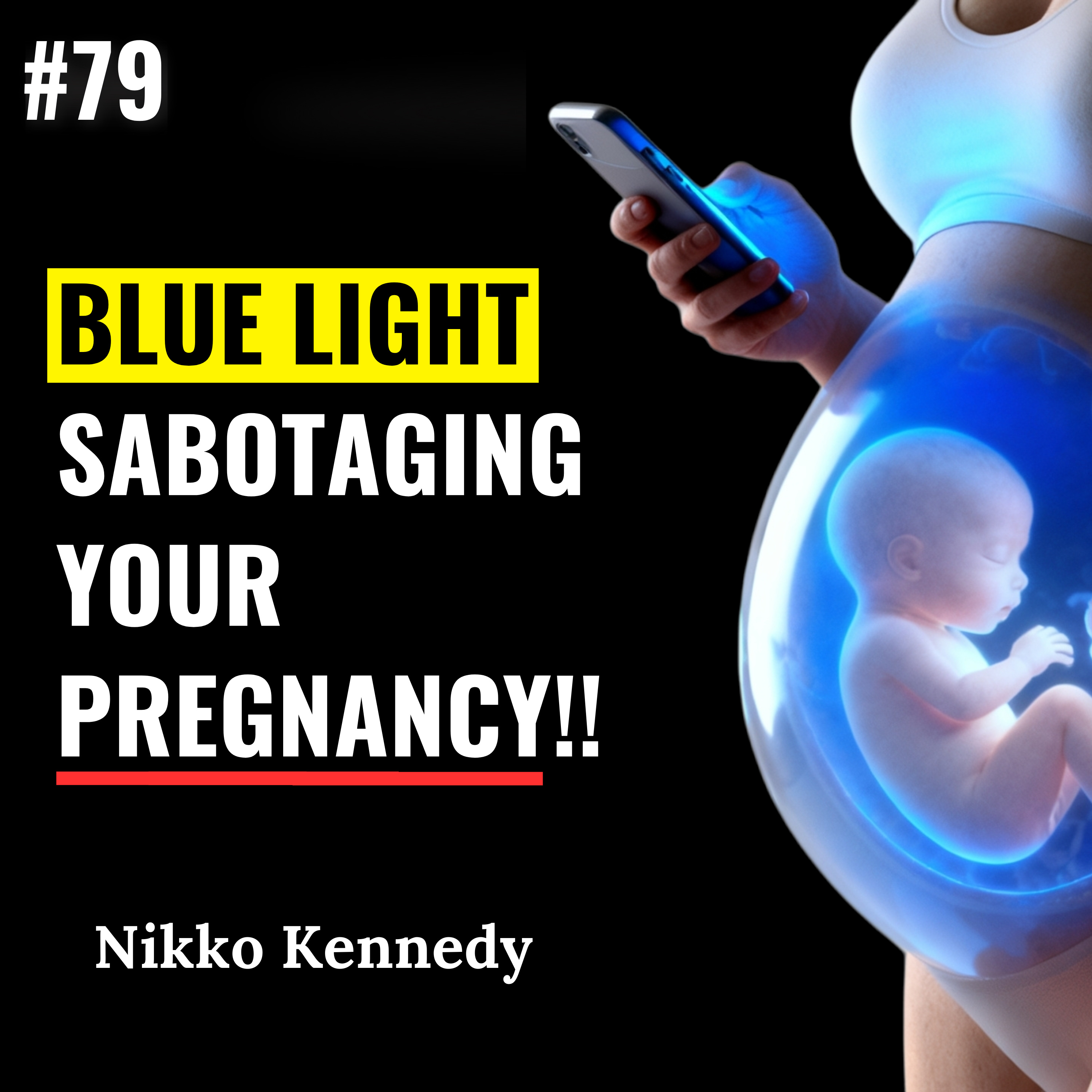
Blue Light Is Sabotaging Your Pregnancy: Circadian Rhythm Disruption, Fertility, Hormones, Birth Outcomes & Postpartum Health | Circadian Birth & Home Birth with Nikko Kennedy
What's This About?
Blue light may be disrupting your circadian rhythm, fertility, pregnancy, and postpartum recovery! In this episode of the Fitness Wisdom Podcast, I am joined by Nikko Kennedy to explore how blue light exposure and circadian disruption affect hormones, birth outcomes, and maternal health.
Nikko breaks down the roles of melatonin, cortisol, and hormonal timing in reproductive health, and how simple changes to lighting, daily rhythms, and postpartum support can dramatically improve pregnancy, labor, and recovery. This episode offers practical, biology-aligned strategies for protecting maternal and infant health in a modern world.
🎯 Ideal for expectant mothers, parents, birth workers, and anyone interested in fertility, pregnancy, and circadian health.
🧠 What You’ll Learn:
- Why circadian rhythm health is critical for pregnancy and birth
- How artificial blue light disrupts fertility and postpartum recovery
- The role of melatonin and cortisol in labor and maternal health
- How maternal circadian rhythms influence infant development
- Practical lighting and lifestyle strategies during pregnancy
- The impact of modern birth practices on natural rhythms
- Why postpartum care is essential for long-term maternal health
- How community support improves recovery and resilience
🔔 Follow for more episodes on circadian rhythm, fertility, pregnancy, postpartum health, and holistic wellness
---
⏱️ Chapters:
00:00 The Importance of Circadian Health
01:09 Issues with Conventional Medical Birth
03:53 Melatonin’s Role in Reproductive Health
07:41 Practical Steps to Improve Circadian Alignment
13:53 Artificial Light & Hormonal Disruption
17:18 Cortisol, Stress & Labor Outcomes
20:30 Nikko’s Journey Into Birth & Circadian Health
26:26 Melatonin’s Role in Childbirth
38:09 Postpartum Care: The Missing Piece
43:40 Advocating for Change in Birth Practices
---
🔥 12 - Week Body Transformation Program: Specifically designed to get you into the Best Shape of your life!
You'll get:
- Personalized Nutrition
- Training Program
- Lifestyle Optimization Advice
- Step-by-step guidance & support to transform your body from the inside-out ✅️ Start your Journey Today
---
📥 Join my Newsletter for FREE Educational & Empowering 🧠 content straight to your inbox: FIND IT HERE
---
⬇️ Find & Connect with Nikko Kennedy:
🌐 https://www.nikkokennedy.com/
📲 IG: https://www.instagram.com/brighterdays.darkernights
🔖 https://substack.com/@nikkokennedy
⬇️ Find & Connect with me Here:
https://www.bio.link/move_with_andreas
👉🏽 For Discounts & Offers: HERE
---
👉 All Natural Non-Toxic Skin Care 🍦 Use promo code: MOBILITYFITNESS for 15% OFF your entire order ✅️
.
🧬 Find the SHILAJIT I use & recommend HERE ⚡Use promo code: MOBILITYFITNESS for Discount ✅
.
➡️ For my favourite Blue Light Blocking Glasses, use promo code: MOBILITYFITNESS for 15% Discount ✅ HERE
.
💦 My favourite Magnesium Supplement HERE⚡Use promo code: MOBILITYFITNESS for Discount ✅
.
👉🏽 Find Best Red Light Therapy panels, Blue Light Blockers & Circadian friendly bulbs 🚨Use promo code: MOBILITYFITNESS ✅ for 40% OFF LIMITED TIME OFFER on your entire order HERE
---
*None of the content / statements in this Podcast are Medical or Personal Advice & is not intended to cure, treat, prevent or diagnose any medical condition. All my videos are for Educational & Research purposes only. If you decide to try anything discussed in this video, you agree to do so at your own risk & responsibility*
This is the Fitness Wisdom podcast.
Do you want to be healthy? I'm talking mitochondria level healthy. Do you want healthy babies? Do you want your babies, babies to be healthy? This is such an important topic. And we've got Nicole Kennedy, AKA Brighter Days and Darker Nights to talk about circadian birth and fertility today on the show. So welcome to the show, Nicole. Thank you for being here. Thank you. I'm excited to chat with you today. This is such a big topic and there's so much to say, so much actionable advice and ideas to Mull around.
If you're thinking about having a baby, then you'll want to listen in all the way through and bring your partner, have them listen to this and then you'll be on your way to having a much smoother pregnancy. Birth, postpartum, happy Mama, happy baby, not just healthy. So let's go. I love it. Thank you. Thank you for that. So before we actually get into your story, because I would be really interested to hear you how you actually go into all of this and you went down the rabbit hole of circadian birth specifically, let's address the elephant in the room, which is of course, this question is not to shame or guilt any mothers or parents who have already given birth, but what kind of issues are you seeing with conventional medical birth in the conventional system that as it is, right?
Now, well, you'll get no support whatsoever with stabilizing your circadian rhythm, even though circadian health is associated with pretty much every major common complication and also possibly some of the less common complications. But looking at gestational diabetes, preeclampsia, preterm birth, small for gestational age, all of these issues that many, many women face and that a lot of times will end them in being labeled high risk, being marked for induction, and then having a lot of interventions in their birth.
The birth suite itself is highly disruptive of the exact hormonal flows that are needed for physical logical birth to take place. So a lot of women, they go into labor, they're laboring at home, and then it's time to transfer. They go into the hospital. Suddenly bright lights and strangers everywhere, tests, poking, prodding, all of this stuff. And then labor stalls. So then the answer is to augment with pitocin. We'll talk all about the exact mechanisms that circadian health can improve the labor and birth process if you want.
But then it just goes on because then baby is being born, Bright flashlights shone in their eyes. So a lot of babies are very first set up like 8 hours, 12 hours off from the actual solar time of day. So then sleep is a difficult thing. Postpartum recovery, getting babies to latch and breastfeed, all of that milk is a huge circadian component. Getting the breast milk, having the mom, a strong circadian rhythm is passed on via the breast milk. But so many women have such a hard time breastfeeding for similar hormonal reasons and it just goes on and on and on to the point that you can look at dementia diagnosis and tie that all the way back to circadian disruption that that person experienced in the womb.
So it's setting babies out for either a lifetime of healthy circadian rhythms or that's a lifetime of unless you do serious work, you know, for everyone who was born and in this system, which is most people were kind of in a multi generational experiment, right, that most people have had circadian disruption from the time they were in the will and then going forward. So it's a really big deal that isn't really talked about yet, but you are starting to see more and more people picking up the thread.
I'm working pretty much every day to get the knowledge of this out because the changes are really simple. It wouldn't take all that much really to drastically lay the foundation for stronger circadian rhythms and then from that stronger rest at night and all of the things that you're familiar with, with circadian rhythms, it's just the most important in that baby time because you know the little embryos and development and everything is happening under the timing regulation of the circadian rhythm.
So it's really important for it to be optimized through that time. It's the highest impact time of life to you do this kind of work. Thank you for that breakdown. So basically what I understood from what you said there is that the time basically before the baby is born, the duration while the baby is basically brewing in the mother's belly. And also when you go to the hospital or if you decide to give a home birth or whatever. But most of the times we're talking now about the conventional medical birthright.
So in a hospital, you're saying that it's very all of this, you know, because of modern life in general, everyone's living sort of out of alignment with the true cycles of nature. And this is causing a lot of the issues that you you mentioned there at the beginning. And then as well, the last second bombardment from all the artificial lights and all the pressure and everything in the hospital, creating potentially a life, a lifetime of trauma for the mother and for the baby as well, which is absolutely insane.
So I think This is why it's so important for people to, you know, become more aware and educated about this. This show is in general about empowerment. It's not meant to discourage any mothers who have already be given birth, but if you're thinking about having a second baby, like how can you do things better, right? And a lot of this knowledge which we're going to be sharing today, you can apply it to yourself and to your child, even if it's born and it's going to improve simply every single aspect of the life.
And so this is not like some stuff that has benefits only before or during birth or, or, you know, right when it's born the baby, but it has a lifetime benefits really. And this is something you know how This is why it's so powerful, this type of work, which Nico is actually sharing, is that you can always take back ownership and control over your health. And it's and every single day you get a new reset pretty much right. That's right. So such a wonderful way to be working. Yeah. And I wanted to clarify, when we're looking at circadian disruption and all the all these things, we're seeing associations in the literature, right.
But when you look at like what's actually caused, it's that not feeling good because circadian disruption, when you look at correcting circadian rhythms, the one thing that we're allowed to say is actually causal and not correlative. The correlative data is really, really strong. But the one thing causative that you can say when you stabilize and strengthen your circadian rhythms is you'll get better rest and you'll be more alert during the day. And that is a complication, you know, that is like maybe not a complication.
That's a complaint. Like pregnancy makes moms tired, motherhood makes moms tired. So a lot of the tiredness that we pin on our children or being moms is actually just from the poor lighting environment and other choices that we didn't realize we're actually upsetting the circadian rhythm and making it so we can't wind down properly at night and we don't rest. So it's really great that the immediate benefit is one that's so visceral that affects us every single day. So if you're like, I don't care about, you know, prevent about like reducing my risk for gestational diabetes.
Like I've never, I didn't even get diagnosed with gestational diabetes, but then I am really, really tired. Like, well, rest better and then have better energy in the morning. Show up more the woman you want to be for your children. That is an immediate visceral benefit that happens even just in a weekend of change, regardless of all the other health associations that are associated with having stronger circadian health over time. Guys, if you haven't already, smash that subscribe button and the like button.
Now back to the show percent. And so let's get into the details then of it. What are people, mothers and fathers? What what are they doing before pregnancy, during pregnancy and after pregnancy which is actually an issue which is causing themselves harm and therefore harm to the baby as well? So when looking at the main circadian hormones, just the very basic scratching the surface, we're looking at melatonin cortisol rhythms. So melatonin is actually a reproductive hormone and no one talks about it that way, but it's absolutely associated with when you look at puberty.
So children have really, really high levels of melatonin. When puberty begins is the same moment that melatonin begins to decline in the overall peak that happens in early childhood starts to climb. That's when puberty, everybody happens, right? It's deeply associated with puberty. And then across the reproductive lifespan, it's declining, declining, declining. When it reaches a certain low threshold, that's when menopause hits. And that is part of all of the circadian disruption I believe is contributing to early menopause.
And so I work with a lot of women who are reaching that perimenopause phase, and they're like, wait, I didn't have babies or I still wanted to have another baby, and my cycle's all over the place. And so you see, calcification of the pineal gland reduces the body's ability to release melatonin at night. And there's also different types of, you know, sources of melatonin, all these different melatonin metabolites. Like I said, we're just I'm going to try to keep it a little bit high level for anyone who's totally new to this concept.
Go as deep as you. Want then going on to the OK, great. Well anyways, when we get to the end of life and melatonin, pineal melatonin becomes negligible in the release, that's when senility hits in that dementia which is also starting to happen earlier than it used to. So we see this circadian disruption happening from excess artificial light and lack of natural daylight. Basically that staying indoors all day long, seeing artificial light before seeing any kind of natural light and then using artificial light deep into the night.
Waking up, using artificial light to get to the bathroom, having a snack, opening the fridge, being blasted with that light, light streaming in the windows from outside, going for a drive and the headlights blasting you in the face. Just everywhere we go, we're getting signals that are our body interprets as it is the middle of the day and we need cortisol to be high because it's time to get to work. And so we have this heightened, heightened stress response where we constantly feel like we're late because our, we're getting 1 signal to our brains, whereas our sleep pressure, our bodies like what?
I've been up for 10 hours already. I should, you know, your body feels the tiredness, but the hormones are saying no, go, go, go, go, go, go, go. And that driving force of cortisol that makes it so that melatonin can't flow is really, really challenging, especially because when cortisol is really, really high, a lot of the other sex hormones can't flow. Not only melatonin gets suppressed, but also a lot of the other sex hormones. So that's a whole issue. So we have the anxiety issue highly tied in with cortisol from all of these lights.
And then also the lack of melatonin, melatonin being a huge scavenger of free radicals. So when you look at infertility, we see that's associated with oxidative stress, absolutely for men and for women. So when we have melatonin having been suppressed, especially the further away from the equator you live, the more of a melatonin type biology your body is expecting to have based on when you step outside. What's the temperature? If it's cold, then that is going to give your body a signal that influences the circadian rhythm and rearranges the whole biology.
But then if you just spend all your time inside, like we do so much to just insulate ourselves from these signals naturally that are meant to be coming in. Another really big issue is the light and UV and temperature is all coming right here at the neck. Is that where the thyroid is a huge time keeper for the body. So the thyroid is also highly in, you know, it's really important for the thyroid to be correct for reproductive to happen, for reproduction to happen, for pregnancy to flow naturally, for for postpartum not to be a disaster.
The thyroid has to be keeping time. But if we're just constantly bundling up and shielding and putting on like SPF, you know, a lot of women are like, you know, putting SPF over their whole head because they've been told wrinkles and like, what would you rather have wrinkles or would you rather feel good? You know, like all of these cultural things coming in where we've been told to fear the sun. And so there's the the balance of if you're avoiding the sun, that means you're not working outside, that means you're working inside.
If you're avoiding the sun, then naturally you have just excess artificial light that's giving your body kooky signals is really the main, main one. We could get into other factors, but that's the biggest one. That's the easiest to tame because it's literally when sunset happens, just like turn off your overhead lights. Like eventually you can swap it all out, but you can try it even without buying any new equipment. Just just try when the sun goes down, turning off the lights and see how it feels at bedtime.
Have candlelit dinner. Like that's romantic. And if you already have children, children love a candlelit dinner. They will think it's the greatest thing ever for you to set that up for them. Or candlelit breakfast for those of us who are having to get up before the sun instead of turning on all the lights and really getting into touch with the way things feel. Because when you turn on the lights and you and you feel your pupils constrict, I do that, you know, there's like constricting and it hurts and you're like, like, that's your body having a stress reaction that you should listen to.
And if you instead start with low lights and slowly work up to the light, because that's what the sun does. The, the light of nature is constantly in motion. You have the sun and the moon and they're in constant flow. Like you never have static light in nature. And that's what those signals, those those signals make the body do physiological compensations that are actually really, really healthy. And where a lot of people are just kind of stuck in one mode. They're in a Choo Choo train of like work and cortisol work and cortisol check the clock and move in time.
And then that is where they just get burned out. And when you're too burned out, your body is like, no, like having babies is not on the table. I have other things to to prioritize. Your skin is not just a barrier, it's a living organ. Anything that you put on it gets absorbed into your lymphatic system and your bloodstream. You see, skin health is a reflection of your internal health. This is why I make sure to only use non-toxic skin care products. This is why I love fat skin and non-toxic all natural skin care brand made to work with your skin, not against every ingredient has a purpose to nourish, protect and support your skin the way that nature intended.
My personal 2 favorites are the Copper Peptide Salve and Quantum Blue solar powered skin care. Tricopper peptides are known for the skin repair and renewal properties, while Methylene Blue is known for its very potent antioxidant and protective properties against oxidative stress. So if you want to check out the all natural non-toxic skin care that I love to use on a daily basis, go to the description below and use the promo code ATTACK. To get a nice discount on your entire order. You said many great things.
They're basically people are doing the opposite of what your username is on on Instagram and also on sub stack. They're doing a dark darker days and brighter nights pretty much. And that's literally like you're becoming like a nocturnal animal. You know, you're you're literally just flipping the switch and you're living like an like another animal or another species really. And and that's really just messing up your entire biology and that of your child as well. I don't think parents actually understand, especially mothers like how much their circadian rhythm influencers, their the circadian rhythm of their child as well, you know, in the womb and you know, what kind of consequences that may have later down the line.
You can maybe get more into that for us as well. So another thing that you mentioned there that was really good about the menopause. One question I may have for that is do you think that's because there are the rate of aging is increased due to the exposure to artificial blue light? Is that the reason why or do you think that like, I don't know, like does biology think that the Organism is going to die earlier so therefore menopause comes faster? What's your thoughts? It could be, that's really interesting.
It's usually also associated with other comorbidities, comorbidities and you can look at all of these other things that are also connected to circadian disruption. So what I was mentioning are like, you know, the infertility, pregnancy complications, all of that. But you could also look at, you know, regular type 2 diabetes, not gestational diabetes and try those correlations there. So we see women who are just kind of stack making up health problems over time. That is like a baseline. If you like any whatever, whatever your health issue is that you're upset about that's making you feel like life is not as good as it could be, search that plus redox or that plus oxidative stress or that plus circadian rhythm and see what comes up in pub Med.
And it's like, whoa, there are thousands of studies. And if you if your doctor hasn't told you about it, like sometimes I'm like they're bordering on negligent. Like at very least they should have Pam about it, even if they don't have time to talk to you. Like if they can give you a pamphlet this big for your prescription medication, they can give you a pamphlet this big. That's like, hey, these light bulbs that you're using shouldn't be used at night. If you don't use this artificial light at night, then you'll have melatonin flowing and your body will actually be able to process all the oxidative stress from all the work that you did all day.
And then you'll sleep better and you'll wake up and you won't feel like crap because even if you don't go to the bed, even if you don't change anything about your sleep, just changing the environment you sleep in, even if you don't sleep any extra hours. In fact, when you stabilize and strengthen your circadian rhythm, you might actually find you need less sleep and still wake up happier and have more energy across the day. Because a lot of people are actually needing all of this extra sleep because they're just crashing into it.
And, and yeah, they're not actually getting deep restorative sleep that can actually happen really fast. Like if we have the ability to have really fast regenerative sleep, which for moms is so important because there's no way a mom is ever, especially a new mom, going to sleep 8 hours straight, like her baby would die. Her baby needs to be taken care of at least every two hours in that initial newborn state. That's not some kind of mismatch. That's just that moms need to know how to do polyphasic sleep in an environment that allows it so that they can actually wake up for their baby, be happy, take care of their baby, and then fall back asleep easily and not be sitting there like staring at the ceiling waiting for two hours for their melatonin to turn back on.
Wow. So yeah, it's just by design basically. Nature is so intelligent. It's absolutely incredible. This is blowing my mind that I'm sure the audience is loving it as well. Another thing that you mentioned previously about the cortisol as well, what came to mind was that I was just thinking how easy it is like cortisol for that hormone to, you know, for us to trigger that hormone compared to all the other important hormones as well. I'm not saying that cortisol is not important. I'm just saying that it's so easy to trigger that specific hormone compared to all the other hormones that we have in our body that we want taking place when and they're not taking place because court, court is always taking over.
Would you say that cortisol is more of a like a survival hormone? Is that why you know it's all the time triggered? Cortisol is the wake up hormone. So I think of cortisol is like when you wake up in the morning and you really need to go pee and you need to like run up and race the bathroom. Like that should be like one of the most stressful things that we go through because, you know, it's normal. Cortisol rises in the morning. That's a good thing. There's nothing wrong with cortisol being high in the morning and feeling eager to get to your day.
The problem with cortisol is they call it cortisol slopes. So it should rise in the morning and then it should decline across the rest of the day. But what happens is if we're still getting that morning light signal that this instead of being a steep slope, it goes like this. And so when we're talking about excess cortisol, the only case cortisol excess is like this direction is an anxiety like anxieties associated with a really high cortisol spike. And so. It's low because even if you have a steep slope, it's so high that it just doesn't have time to get low enough.
That's anxiety. But most issues like this is really tied in with immune and autoimmune conditions. Is this the slope instead of being steep, is like this because we have all this artificial light and social stress and every other thing telling cortisol not to go down in the evening. So it's the volume of cortisol, not necessarily like a really High Peak. Does that kind of make sense about like what's cortisol and what's it displacing? If it's not going down, then the other ones can't come up. Imagine spiking your blood sugar without eating cake, elevating cortisol, your stress hormone without being stressed, and suppressing your body's most powerful sleep.
Antioxidant and regeneration hormone, which is your melatonin. This is why I make sure to wear my yellow daytime blue light blocking glass every time where I spend time indoors under artificial lights and in front of screens to protect my eyes from oxidative stress and my entire body. And if I'm going to be exposed to artificial blue light, especially after sunset, I'm going to wear my red lens blue light blocking glasses to support my melatonin production and release. So if you want to protect your energy levels, sleep, and biology from artificial blue light, head over to the description and you will find all of the links with a massive discount on my favorite.
Blue light blocking glasses, Yes, that makes absolute sense. That's a little bit like insulin really. You know, many times we think that insulin spikes are an issue when in reality, like it's more about if we the duration of insulin and blood sugar is elevated for prolonged periods of time, that's more of a greater issue compared to just a rapid, you know, spike and a drop back down. You know, if we have that constant elevation, that's when we have more of that oxidative stress and that damage occurring in the system.
And exactly what you're saying there, there are consequences to keeping things elevated all the time in the body when they're supposed to ebb and low and they're supposed to go up and down naturally and have this sort of a rhythm. I think. I don't think people actually understand how important and how foundational circadian rhythms are and our relationship with light in general. Because everyone knows about exercise, everyone knows about nutrition, people know that they need to get outside. People know that they need to sleep well, but they don't actually understand there is a fundamental order to these things.
So that actually means that you need to lay the foundation before you actually start stressing your body out more. And we're going to get onto, you know, a lot of the practical steps in this episode. And I want you to dive into what a circadian birth can look like, you know, in contrast to the conventional medical birth. But before we dive into that though, I would love to hear your story if you, if you want to dive into that. Sure. I my story is that I, when I learned about childbirth and what all the things were going wrong with it, I wanted to make a difference there.
And so I was like, went to school and I thought I was going to become an OBGYN because they're the ones who handle birth. And I was like, I'm going to be the good one. That doesn't force everyone into surgery and when they want it, that doesn't like leave them feeling uncared for, that doesn't have so many clients that they're racing from one room to the next to the next to the next. And then when I was going to school for that and I learned more about it and I realized that I did not want that training and that that was not actually the support that that families needed that was missing.
I'm like, OK, so we have the surgical support. That's great. But what families really need is something different. So first I thought it would be midwifery and until I found out that the midwives are all regulated by the OBGYN's. So I was like, well, that's just a pipeline to there. And then I found doula, which is a non medical role. And I was like, that support is what families are really, really truly missing. So I ended up pivoting my college experience into understanding science literature and getting ready to do science writing because I was like, there's all of this information about physiological birth, about biology, about health, all these things that is bottlenecked by the institutions because they're dealing with such high volume, they don't really have time to process all, all of the awesome research that's coming out.
So I'm like, and individuals are not getting informed by their practitioners because the practitioners don't have enough time. It's like everyone has passed off. Like it's not my job, it's not my job, it's not my job. So then families are left navigating pretty much on their own. And every practitioner when they come to them is just saying, I can give you this OP, I can give you this treatment or this treatment. Which one do you want? And they don't really, no one's really giving them that holistic picture of what is health and what is their lifestyle and what do they truly want with their birth.
So combining science writing and like the deep knowledge of like what is good experimental design and what's not good experimental design and how to translate really complex topics into things that everyday people who don't have that background can understand. Plus, what is the actual social support that women need to be able to have a good birth? That's kind of my trip. And circadian health got all wrapped up into it because I was, when I was going to school, it was in the time when, like, online classes start to become a possibility.
And I became a mom. And so I was taking classes online and I was working online and I was doing a job that was East Coast from Pacific. So every single morning, logging onto the computer, 4:30 AM, no matter, you know, in the summertime, the sun's kind of starting to come up here. But in the winter time, that's many hours before sunrise. And my immune system went haywire and it was very uncomfortable. My husband put the flux screen filter software flux on my computer and it would automatically with sunrise and sunset dim the screen and make it orange.
And it was totally transformative. And so the next, you know, after that, just that we didn't change anything else. It was just he just changed the light on my screen. But I was spending so much time on it because I'm driven. I want to do the best job I can. So I'm like, I'm going to be the best one at the company. I'm going to show up on time and be the best person. I'm going to get straight A's in all my classes. I'm going to make home cooked meals for my daughter every single day. You know, like I want to do everything well, and that is a totally natural thing.
That's, that's great. And that's, you know, what I do now. I still have that same mindset, but like, now you see me and I'm outside even though it's icy outside because I know that I need this light in my eyes at this time of day. It's before 9:00 AM where I am. So I don't usually do podcast at this time, but you know, we have this global scenario and I really wanted to chat with you. So I made an exception, but I'm still outside here because I've learned that it's so important and it was amazing.
So like the outside and all of that. I always like knew that it was important and that I loved it. But it was really getting the artificial light tamed. That was my first stepping stone into it that I was able to look back. I wasn't even trying to heal anything. My husband put it on there. He was, he saw it and was like, oh, you know, you need this. And it was for me, I was just like, oh, this is just another like health fad. This is like trying a new diet or something, you know, like it was very casual.
But then the next year I was like, hey, yeah, that was a really mild allergy year. Cool. And then the next year I was like, oh, another, you know, like, do I even have allergies anymore? And then not to mention once that kind of helped fix some of my other like dopamine, like the computer addiction kind of helped break that cycle. I ended up quitting the job and realizing I couldn't I couldn't keep working for corporate. And so then I went independent and had a decade of entrepreneurship that is still going.
Eventually I fully pivoted into health and Wellness and started publishing on sub Stack and made a huge pivot in my life. And you know, there's lots of other side routes there. But the main thing was that I wanted to, I wanted to help moms and babies have a better time. And then eventually was, you know, was working towards that in so many different ways. And then eventually when I did all the circadian healing and put the pieces together there in birth, it's so amazing what a big difference it makes.
And when you look at like melatonin, this hormone we've been talking about is what makes the uterus sensitive to oxytocin. So everyone who's in birth knows about oxytocin and knows that you know about the synthetic oxytocin that they use to augment labor, but they don't realize melatonin is what primes the uterus to be sensitive to that in the 1st place. And that in a non circadian disrupted population and labor onsets almost always going to be at night. Babies can be born anytime, but when does when do the contractions usually start?
Usually around peak melatonin because it makes the contraction stronger. But not only that, but melatonin is a pain regulator. So with a high a mom who has a high melatonin, she has stronger contractions that feel less painful. Like that's huge. It's so important. And so when you look at the lighting and the birth suite, I'm like, this is negligent that they still have white LE DS in the earth suite. And like, no wonder moms are having such painful contractions and stalled labor like all the time.
So many women have the need for their need for their labor to be augmented because no one's turning the lights off for them properly or the lights are off, but they flip them on. So you talked about cortisol earlier and ask a question. I wanted to share something with everyone about that, which is that the reason that cortisol can be flipped so easily is that when the light comes through the SCN, it flips cortisol through a nervous pathway through the nervous system, which is very, very fast. But for melatonin to come up, it's going through the hormonal pathway.
So a whole threshold has to be reached across the the body. And so it can take two to three hours for the melatonin to actually come up and be fully released. Whereas the cortisol like one single flash of light can turn that on. So they've actually stalled women's contractions by shining a green light in their eyes. This is documented. And if you shine a green light in a woman's eyes, then her contractions are going to stop and slow down. And if you look at the spectrometer of the lights that are in the birth suite, what kind of lights are they?
And they have that green spectrum in there. So it's it's just really, really wild that we're so technologically like advanced and we but then there's this mountain of research that is just not being implemented do. You think that's due to ignorance or unawareness? Like what? What do you? Why do you think that this is the case? Everyone's so busy, everyone's so busy, no one has time. OBGYN's might be seeing, you know, 1000 or more women per year. There worked the bone in these big hospitals. Midwives like a really wise experience.
Home birth midwife is not going to take more than six clients per month and ideally even fewer. But the way that everything is run and then all of the circadian disruption too, it's really upsetting to the brain and to like the ability to regenerate and have clear thought and, and think through things and there's a huge amount of trauma. And then there's another problem of that families in the US around the world industrialize are coming in with more and more and more of these comorbidities and lack of health and nutrition.
And so people who work in birth have seen horrible things go down, which is then embedded in their nervous system where so when you look at data like the higher the clinical load, the more stressed and the more quick to jump to intervention a provider is going to be because they have seen things go badly and they feel like they have more control. And then the other thing with that light in the birth suite is that so this was a really, really cool study that that was done where they were testing the different lighting conditions for the birth suite.
They had a regular white, white lit room. They had an amber room, they had a red room. And in this particular study, they not only looked at the families, but they also looked at the providers. So in the bright white room, everyone's like, what are the things that they say? They're like, I feel bright, like a busy bee. I feel like I need to watch the clock. I feel like something could go wrong, right. Because we have the the cortisol being like a high alertness. The cortisol, yeah. So they're alert, which means that they're watching the clock in the Amber room.
Everyone's like, I feel safe and supported, including the practitioners, including the midwives who are in the study. They're like, oh, you know, I feel mellow and calm, right? If the midwife feels mellow and calm, she can share her nervous system with the woman who's birthing, right? Then the woman's feeling more mellow and calm. In the red lit, red lit room, everyone felt a heavy pressure. They didn't walk around. Even the providers started crawling around on the floor with the women. So like that, you know, like you think of the OB, he walks in, right.
They have the red lit room. The midwife is crawling around on the floor and like they described over his move as like sinewy, like a snake. And if, I mean, obviously I don't know if you have, you know, anyone who's given birth, like have kids, but it's like belly dancing, right? Like the woman has to just move her spine and wriggle around and make like the vortex kind of movements to bring the baby down through. And so that is not only were the women doing that, but the providers were doing that with them.
And so that is like, you know, anyone who's had a home birth, they're like, Oh yeah, we had like our Himalayan salt lamp and our candles and like we're all down on the floor together. We're all in it together, right? And that's what the red light a lot of midwives talk about is cave. Like when they come in, they're like trying to make a cave for their for their clients. And that's just so different than like a white light come in, check in. Like what's the timing of the contractions? Like here's the machine and it's beeping and like it's this much time and you've been dilated for this long.
And right. All of that stuff is like not helping a woman get into the subconscious state she needs to be in for the birth to be able to, to just happen naturally. So instead they're having to do with their rational mind on which isn't really the way that birth works. It's very instinctual, very non verbal. I know a lot of women who have said that they got the epidural not because they couldn't handle the pain, but they couldn't handle the pain without vocalizing. And they were too embarrassed to vocalize in front of all these strangers.
So like, I just got the epidural to be quiet. And like, that's why the doctors give the epidural too, because you have like woman after woman after woman in various states of Labor. And so if they're all making all of these like animal noises and stuff, then it's it makes the whole thing, it's like a din, right? And what only in a very rare scenario would two women be giving birth and sharing the space. I have heard of it. It does happen, but very, very rare. Usually when you're giving birth, you're the queen, you're the center of attention.
Everyone who's there is someone that you know very, very well, right? If you think of like hundreds of years ago, the idea of a stranger walking into the room or the idea of competing with another woman who's giving birth for the attention of the people that you're working with. There's there's so many issues, social and circadian with the with the idea of like going to a center and, and, and birthing. Yeah in yeah, in a hospital. So most home births, you know, for women who don't have comorbidities like these serious health complications, the the statistics are all really good.
Like it's, it's you're, you have fewer complications and equally good outcomes. So there's, you know, kind of just a matter of drawing people's attention to it, making women demand it. There's work with the, the insurance companies, there's work with the hospitals and the protocols and getting them to actually look at the other literature. So they're every, every institution has a review board. So I've talked with people on the inside and they're like, oh, yeah, it's, it's, there's just a committee.
And then we go and everyone talks about what we think we should spend our budget on and this and that. And so the people who are on those committees, whoever, you know, if you're here listening to this podcast, then grab this stuff, this information, and bring it to your committee because it is possible. There's a lot of people who are like, no, no, the system does what it's meant to do and we can't change it. I don't think that's necessarily the case. And there are people who that's what makes them feel safe.
And so like shifting the whole thing just to be a little bit more harmonious, like changing the, the tint of the lights in the room, right? Like, sure, it's an upfront investment, but how much less stress, how much, how much fewer complications, how much greater satisfaction of the people going through there, right? Like there's lots and lots of benefits from even if you look at the cost analysis, if you look at the social analysis, yeah. So there's a lot of room for change and improvement in all of this.
And the the the research is there. It's it's right for the reading and the sharing and it's very, very clear cut about a lot of these things. So yeah, that I'm excited because I feel like there's starting to be like kind of a pickup in the momentum of everyone starting to catch on to this and feel it and experience it. And then once you experience that, you don't want to go back, whether you're a provider who's seen it go well for a mom who has had one versus the other kind of experience. Like for me personally, my home births have been very straightforward, you know, 12 hours, just easy.
One birth that I did in the hospital, 49 hours. And it's like, so for me, it's like so clear in my body. I know exactly the difference that it's made for me. And also being a doula and talking with so many women about their experiences and the different things that they've been through, what they want, what their hopes and dreams are. They, you know, for the most part, they want to have a good birth experience. And the idea of just healthy mom, healthy baby, that's one thing. But there's a lot more to it than than that.
We have a whole, you know, we're all very dynamic beings and babies are also very dynamic. So I think about that like, what's the first thing that a baby experiences when it's born? Based on my research, this is the best Shilajit in the world. Here's why you need to know about Shilajit. Shilajit is a herbal mineral substance made from the decomposition of plants and bacteria. This process taking place over thousands of years, it's harvested from the Altai and the Himalayan Mountains Inc of it as a hyper concentrated plant matter that is made by Mother Nature over thousands of years.
In many cultures and traditions, it's known as the destroyer of weakness. Let me tell you why. Jilajit is loaded with ionic minerals which are the most biocompatible with our human body. It also has a very high concentration of folvic acid. This folvic acid allows those minerals to get into the cell and do their work. Minerals are absolutely essential for all processes of the body, from having good energy levels and cognitive function, hormone optimization, and so much more, you name it. This is why I use shilajit on a daily basis because it works on a foundational level, on a mitochondrial level, and we know that we need healthy mitochondria in order to produce cellular energy.
Something very important to mention is the quality of shilajit. The one I use has been tested for heavy metals and impurities, ensuring the highest quality shilajit. So if you want to experience this incredible ancient substance and find the one that I use on a daily basis, head over to the description below and use the promo code attached to get a discount on your entire order. It's so important. I think it's like. More important. Yeah, I think it's one of the most important things, like not bright lights and stripped away from the mother and wiped down and maybe shoved in another room and separated and all these things.
I just feel like a lot of these practices are just. A lack of trust in the human body, really. You know, I feel like humanity has lost this faith that the body is intuitively strong and resilient and is actually designed to do this. Like when we look at other animals in nature, they just go and give birth and then no one is assisting them. They just do it. And it just happens, you know, whereas we are probably the only animal on the planet where we feel like we need to control every single aspect of the process.
And of course, there could be, you know, some marksides to this whole thing, you know, about making money from people and all this kind of stuff. Of course, you and me both know a lot about this. But let's not try and go down this rabbit hole today because we're trying to focus on like actionable steps here and educating the masses mainly, mainly the parents and the mothers and the fathers. And you know what they can do. You mentioned so many great things there previously and I wanted to dive into those.
But I'm wondering how much time do you have today? I set aside an hour for our conversation, so I think. Okay, so only 15 minutes left. To wrap up, yeah. Okay, okay, so I need to be very selective with my questions then. Right. You can come back another day. I do have another meeting after this. So yeah, I've been doing a lot of interviews lately because I have the energy for it. I took off almost all of last year because, and this is something that is practical here, we need time off for moms in the first trimester.
First trimester sleep is so important. First trimester is so exhausting. So last year this time of year I was pregnant. So I pause all my podcast recordings to you, give time to my baby in time for me to rest, be away from all of the public eye and go through the birthing portal. So my baby was born this spring and then so I've slowly been coming into it and now he is just amazing. He's such a healthy baby. We had a beautiful birth. It was very straightforward and simple and he's so wonderful and now I'm able to get out there and I did take time off after he was born.
The more babies that I've had, I have five children, the more babies that I've had, the more I focus on postpartum and the less I actually focus on birth planning because birth is really the least of it. Once you have your baby, that postpartum time, like if you have a great birth but no postpartum support, you can end up traumatized and having a horrible time adjusting to motherhood. You have a terrible birth but amazing postpartum support. You can have a wonderful time adjusting to postpartum.
That reintegration, the initiation of postpartum, you go through your trial of Labor and then you go deep into your subconscious in the dream space with your baby, taking care of them, staying in bed. Having a full traditional postpartum lion is very, very important. It's much easier for your organs and everything to to heal. You bond with your baby. Breastfeeding initiates, you go on a nice dark, you know, room, staying warm. I've written a lot about this. A proper postpartum lion is a really, really big deal.
I think one of the most important things for moms to do to build that community and then you come out and then you can be recognized with your new baby, with your mom, no matter how many children you've had that postpartum. I mean, if anything, it just becomes more important. But anyway, so now you know, my baby is great and I'm feeling really good. And it was, it's so different compared with the early on, earlier pregnancies that I had before I knew about all of this, that there was a lot of stress, There was not a lot of support.
I did. I, I knew about some of these things, but not all of them. It just makes such a huge difference. And I talk with women who come through and they like taking my courses and they're like, like all of my babies, you know, we have a blood incompatibility. So all my babies have needed to go under the bilirubin lights. That's the number one reason babies are separated from moms or free hospitalized in the Nicky after birth is to go get jaundice treatment. And their treatment is light. Like the babies are born light deficient and they don't get light in the beginning.
So then they go through this whole jaundice, which is actually an oxidative stress issues. So I have a course about this. They write like, does this work for ABO? I'm like, yeah. And she's like, OK, she been one of these moms. She binged my course over the weekend. This was so impressive. And then she just did the steps for postpartum. She didn't do it. She was like kind of doing a little bit of stuff while she was pregnant, but she really wasn't that aware. But when she was like, oh, this could help me not have jaundice, All my babies have needed to go under the lights and I don't want that this time.
So she did the postpartum steps and her baby never developed the jaundice and and her doctor never wanted to put them under the lights and she got to just take them home and have a normal postpartum experience. She was so grateful. She's a wonderful member of my community and nice. But like these changes can really happen super, super quick and make every like it's very subtle, but it just can make the hugest difference there. So you can go ahead and ask me some questions, but I'm really glad to be getting out there and sharing all of this now and so motivated because it's so impactful when I hear stories like that of women who have had a hard time and then they're like, I'm really actually enjoying my second pregnancy so much more than my first is another testimonial that I get that is just like so heartwarming to me because having babies should be a joyous experience.
It's one of the most exciting things that we ever have the honor of doing on in our time here. So for it to go well and be in tune with all of the the nature and everything, there's also that epigenetic print imprint of helping a baby be aligned to the location that it's in is also really, really cool. That also I was kind of alluding to that happening through the thyroid, which is what's picking up a lot of these nature signals, either the light and dark, you know, the light and dark and the hot and cold and UV versus no UV.
All of that through the thyroid. Actually those thyroid hormones are part of what gives the epigenetic imprints. So we can see people that are second generation, like moving from the equator to Alaska, the second generation actually have a much easier time than the initial set of migrants because of this epigenetic fingerprinting. So if we can actually make that happen a little bit more, like there are very large scale impacts beyond just, you know, avoiding the the bilirubin lights, which is great in itself, but it there's it's also a sign of being in tune.
Wow. OK. You have some more questions for me. That no, I love. That I love. That it will be OK too? No. No, no, no, that was absolutely fantastic. You know, I have like so many more questions to ask you. So we definitely, most definitely need to arrange a Part 2 really, really soon. So thank you so much for coming on today. I want to be respectful of your time. Of course, I know that it's, you know, been an hour since we arranged it now. So I just don't want to hold you on any longer. But thank you so much for like doing this episode with me.
And, you know, I really, really enjoyed all the information that you shared and everything was so, so important what you said there. And it's so important to educate the mass, the masses about this and to bring the awareness. So I really appreciate your work and for carrying this torch, you know, because not many individuals are, you know, tackling it from this perspective. And it's so, so important. And as you said, the steps are so simple but so impactful. They can have such a dramatic difference on the outcomes.
And on the next episode, we will be going more into how to do a more circadian aligned birth. So everybody, stay tuned for Part 2. And Nicole Kennedy, thank you for coming on. Where can people find you, connect with you, and work with you? Just head over to my website, itsjustnicokennedy.com com it's Nikko Kennedy spelled normal way. So from there you can go if you need the 1 to 1 support. If you're a practitioner who needs to integrate this into your work, I have mentorship. If you want to go into my sub SEC.
I also have parent practitioners there. And all of that is just through the website. It's a hub for everything. My social media to brighter days, darker nights. Yeah, I'm I'm around, but searching for my name, going to my website. That's the easiest way to end up in the right place. Amazing. Thank you so much, Nicole. I'll let's do it again really, really soon. OK, sounds good. I'm up for it. If you guys enjoy the topics and guests I bring on the show, I would really appreciate if you left me a five star review on Spotify and subscribe to Fitness Wisdom Podcast on YouTube as well.
This helps to spread the knowledge and wisdom with the world. Until next time.
 Apple Podcasts
 YouTube
 Spotify
 Castbox
 Castro
 Goodpods
 Moon FM
 Overcast
 Pocket Casts
 Podbean
 Podcast Addict
 Podcast Republic