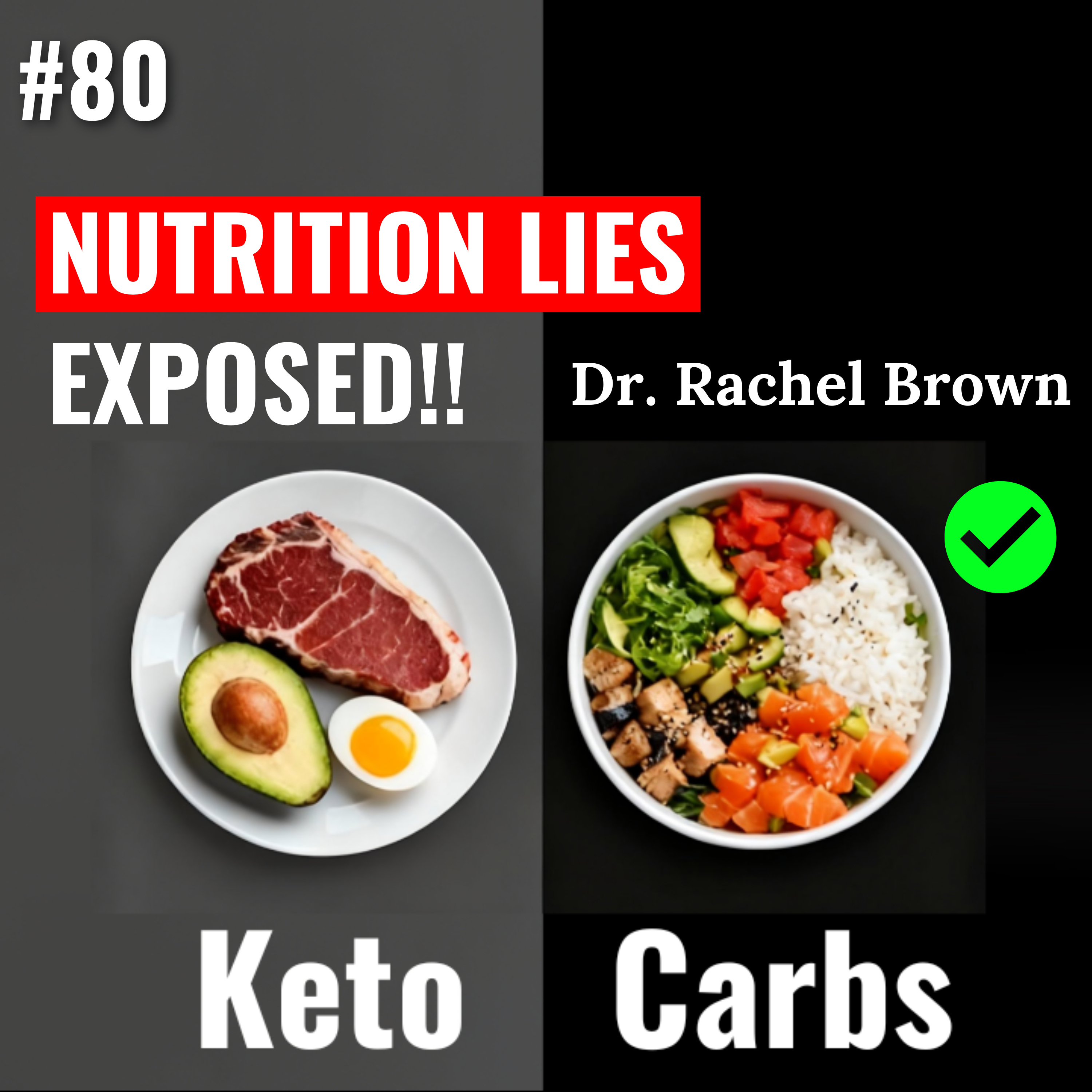
Blue Light, Carbs & Nutrition Lies Exposed: Keto, Carnivore, Metabolic Health, Blood Glucose Regulation, Nervous System, Gut Health & Sustainable Diet Strategies & Nutrition Myths | Dr. Rachel Brown
What's This About?
Nutrition myths are everywhere — carbs make you fat, keto is king, carnivore is ultimate… but is it really that simple?! In this episode of the Fitness Wisdom Podcast, Dr. Rachel Brown and Andreas break down the science behind carbs, restrictive diets, and metabolic health, exposing common misconceptions and oversimplified advice.
We explore the consequences of long-term low-carb or carnivore diets, why carbohydrates are critical for nervous system function, fat loss, and overall well-being, and how gut health, fiber, stress hormones, and environmental factors like blue light influence metabolism. Dr. Rachel shares practical strategies for diet transitions, mental health support, and creating a flexible, sustainable approach to eating.
🎯 Ideal for anyone tired of nutrition dogma and looking to fuel energy, resilience, and long-term health with nuance and strategy.
🔔 Follow for more episodes on nutrition myths, carbs, keto, carnivore, metabolic health, gut health, and sustainable eating
---
⏱️ Chapters:
00:00 The Authority of Credentials in Health
01:48 Personal Dietary Journeys: Carnivore vs Plant-Based
04:44 Health Impacts of Long-Term Diets
07:16 Transitioning from Carnivore: New Insights
10:26 The Role of Carbohydrates in Health
12:51 Stress and Dietary Choices
15:57 Gut Health and Dietary Fiber
18:34 Mast Cell Activation Syndrome and Diet
21:44 Detoxification and Dietary Choices
24:27 Fasting and Its Implications
29:48 Fasting, Nutrition & Metabolism
32:16 Blood Glucose & Carbohydrate Reintroduction
34:12 Blue Light and Metabolic Health
37:28 Environmental Impacts on Metabolism
40:31 Diet Nuances: Carbs, Ketosis, Mental Health
44:29 Age Reversal and Dietary Changes
49:09 Energy, Motivation & Exercise
53:13 Transitioning Keto to Balanced Diet
01:06:00 Final Thoughts: Natural Eating & Mindset
---
🔥 12 - Week Body Transformation Program: Specifically designed to get you into the Best Shape of your life!
You'll get:
- Personalized Nutrition
- Training Program
- Lifestyle Optimization Advice
- Step-by-step guidance & support to transform your body from the inside-out ✅️ Start your Journey Today
---
📥 Join my Newsletter for FREE Educational & Empowering 🧠 content straight to your inbox: FIND IT HERE
---
⬇️ Find & Connect with Dr Rachel Brown:
🌐 https://drrachelsbrown.com/
📲 IG: https://www.instagram.com/drrachelsarahbrown
🔖 https://www.youtube.com/@DrRachelSarah
⬇️ Find & Connect with me Here:
https://www.bio.link/move_with_andreas
👉🏽 For Discounts & Offers: HERE
---
⚡ Find the Best Grounding Mats & Sheets🔋 at a massive Discount using promo code: MOBILITYFITNESS at checkout HERE
.
👉 All Natural Non-Toxic Skin Care 🍦 Use promo code: MOBILITYFITNESS for 15% OFF your entire order ✅️
.
🧬 Find the SHILAJIT I use & recommend HERE ⚡Use promo code: MOBILITYFITNESS for Discount ✅
.
➡️ For my favourite Blue Light Blocking Glasses, use promo code: MOBILITYFITNESS for 15% Discount ✅ HERE
.
💦 My favourite Magnesium Supplement HERE⚡Use promo code: MOBILITYFITNESS for Discount ✅
---
*None of the content / statements in this Podcast are Medical or Personal Advice & is not intended to cure, treat, prevent or diagnose any medical condition. All my videos are for Educational & Research purposes only. If you decide to try anything discussed in this video, you agree to do so at your own risk & responsibility*
This is the Fitness Wisdom podcast.
You've been lied to about nutrition, you've been sold half truths and social media is definitely not helping. All of this black and white blanket statements carbs are making you fat and insulin resistant are a huge problem and I welcome. Everybody today to keep an open mind for our conversation because I feel like we need to have more of these nuanced conversations, you know, in the right context because everything is just getting totally out of hands on social media and many people are being misled and their health is actually being impacted because of this.
And so I've got Doctor Rachel Brown on the line today, and we're going to be diving into her personal journey and what has happened to her with her transition and experimentation with different diets. And so welcome to the show, Doctor Rachel. Thank you for being here. Thank you for having me. So I reached out to you on social media because I noticed. That you know you were a long time carnivore, right? How many years were you doing carnivore diet? Oh gosh, six years long time. That's quite long.
Wow. And did you, were you quite strict or did you like have any times where you would eat, you know, vegetables or or other things like that? No. If there's one thing about me, it's that when I dedicate myself to doing something, I really go all in. And so that can be both a blessing and a curse as I live and learn and repeatedly seem to learn. So no, I was, I would say I was strict carnivore for five years. And then in the last year, because I was aware I was encountering some health difficulties, I started supplementing with medicinal mushrooms, which wouldn't technically be carnivores.
So and I still had a bit of coffee here and there, although lots of carnivores do so. But otherwise I was carnivore. Yeah, that, that's awesome and crazy at the same time how you managed to do it for so long, because I I did it only. For a short. Period of time when I I tell you my full journey, right? I started many years ago when I met my partner Tina. She was plant based her entire life and I decided to try what her lifestyle was all about. So I did a plant based type for five years. Once I started gaining a lot of weight and started all my teeth started feeling really loose and my hair was like falling out almost.
Then we both decided hey, not because of me but also because she was encountering some health issues as well like autoimmune type of symptoms and why don't we actually try and eat some steak. Anyway we had our first steak for the first time and it was like a light bulb went off in my brain and it felt like this was the thing that was missing, right? It just felt life was 1000 times better. So anyway, once we converted over to started eating meat, both of us, even though for her as well it was her entire life, you know, basically being plant based, started going more lower carb and keto.
Because when you get into the space of eating more meat, you just hear this repetitive statements all the time that carbs are bad for you, like plants are trying to kill you, sugar is bad for you. You keep hearing all these statements because specifically because the keto and the carnivore community is so strong behind eating meat in general. So you never hear like a really nuanced perspective. I think the person who has it the most right, honestly, like from listening to hundreds of different doctors and people on the Internet, I believe, is Doctor Paul Saladino.
Of course, I feel like some things he misses in terms of the seasonal perspective, but overall, I think he's the most on the right track with that as well. With us, Doctor Shawn O'Mara isn't that bad too, because he actually acknowledges that fermented foods are important, you know, for your gut health. Of course it doesn't advocate people eating other types of carbs, but at least he tells carnivores that hey, maybe you should try and incorporate fermented vegetables, you know, into your diet. So anyway, I went full circle, you know, from plant based to animal based to keto to carnivore for only a couple of months and I encountered all kind of different issues after the first month of doing it again, my hair was like started to thin.
I said I felt super fatigued, super weak. I couldn't like sleep through the night like fully. I was getting like cramps. You know, my performance was sucking in the gym. I was basically never sore from training, but I also felt like I was never really recovering either. So it was kind of like this really weird state that I was in. And then as soon as I added carbs back in my diet, like literally I feel like I gained my life back. My hair started growing back, my skin got more soft like it was some really weird things.
So I would love to hear what kind of symptoms did you experience by actually doing it such a long period of time? Yeah. So I might just briefly mention I've been plant based in the past as well, but a long time ago and that I'd only did that for about 18 months and it was probably 2000 and nine 2010 and I gained weight myself. My health suffered doing that. So really thin nails, body composition, it wasn't good. So lost muscle, gained fat and was hungry all the time. So anyway, when I, when I started doing carnivore, I noticed lots of benefits initially.
So I, I had a real difficulty with some of the transition symptoms with, you know, like die off from the microbiome. And I suspect that's why I benefited initially because I probably had some, some gut biosis to begin with. That carnivore helped with I, I had benefits in terms of a really clear sense of satiety. I could go long periods of time between meals, wouldn't feel hungry. There were, there were a few other health issues like, gosh, it's so long ago now. I'm trying to think back for years.
So this is something that's been a huge learning piece for me just really in the last two or three months. So it's still learning loads after having been in the low carb community for over a dip, well over a decade longer than that. But I dipped in and out. But I'd been labeling myself as a sugar addict for years and in retrospect and having gone through the transition I've gone through just in the last two months, I don't think I was right in doing so. So that's been a really big learning piece for me.
I'm sorry I forgotten what you have. It was just so much to. Guys, if you haven't already smashed that subscribe button and the like button, now back to the show. Oh. So much to talk about. Although no, that was fantastic what you were saying there. And let's definitely go back to the sugar addict part that you said there. So I want you to explain to me what you meant, but I what my original question was about your symptoms. What kind of symptoms did you did you see arise because of doing carnivore or do you believe came from doing carnivore for so long?
Yeah, so I, it was a difficult 1. So I ended up doing it for so long because I didn't have any really severe symptoms or difficulties, although I did run into a few like occasional gut type symptoms after probably around year 4 or five. It's hard to think exactly when. However, I started carnivore in 2019 and in 2022 I developed mast cell activation syndrome, which I've never experienced before in my life. And I, I know based on some testing that I've done and more knowledge that I've developed after having to navigate my way out of these symptoms.
I now believe that that was likely due to my lifestyle and particularly car carnivore. Because I did serial gut microbiome testing in 20/23/24 and 25 and I had quite severe dysbiosis and I'd lost a lot of my short chain fatty acid producing and gut bacteria, particularly for butyrate in my case. But I also ended up with C diff overgrowth and um, I think a hemorrhagic form of E coli as well on one of those tests at one point in time because I've depleted my butrate producing bacteria so much by not having polyphenols and plant based compounds in my diet for me personally.
And what was the trigger for you to make this transition in the 1st place? I mean, you only did this two months ago, right? You just started. So what was the one thing that said to you? You decided one day. OK, that's it. I'm gonna I'm gonna try something different. What was the trigger? Oh, I'm probably learning more about leptin if I'm honest. So I, I've come through the quantum biology collective training and I'm board certified now and applied quantum biology and just being around people and be aware of their views.
And I know a lot of my colleagues and in that sort of scene don't aren't necessarily supportive of long term ketogenic or carnivore approaches to diet. But learning about leptin really changed my views and I realized in actual fact that I've had low thyroid symptoms and low leptin for quite a number of years, probably. In fact, I think predating carnivore, to be fair. So I've been ketogenic for 10 solid years and I've run into difficulties with that. That's shown up as menstrual irregularities for me.
And in retrospect, just monitoring some of my, so I checked my heart rate variability and something that I wasn't expecting is actually that my heart rate variability has improved significant frequently since adding carbohydrate back into my diet. So I think I've been running on stress hormones for a long time. So that's a big, big learning piece for me. Imagine spiking your blood sugar without eating cake, elevating cortisol, your stress hormone, without being stressed, and suppressing your body's most powerful sleep.
Antioxidant and regeneration hormone, which is your melatonin. This is why I make sure to wear my yellow daytime blue light blocking glasses every time when I spend time indoors under artificial lights and in front of screens to protect my eyes from oxidative distress and my entire body. And if I'm going to be exposed to artificial blue light, especially after sunset, I'm going to wear my red lens blue light blocking glasses to support my melatonin production and release. So if you want to protect your energy levels, sleep and biology from artificial blue light, head over to the description and you will find all of the links with a massive discount on my favorite blue light blocking glasses.
So many great things that you mentioned there and so many things that are very. Relatable to a lot of people, I believe, who have been doing these types of diets for long periods of time. This is why I think it's so important to have these long form nuanced conversations. And I don't want anybody to get the idea that we are bashing carnivores or keto or whatever because I believe, and I'm sure you believe too, that there is a time and place for certain things. Just like, you know, I believe that actually abstaining from protein altogether and doing more of a plant based approach, I feel like also has a time and place.
I've come full circle to that, to be honest, by trying the sugar diet this past summer in 2025, by just doing like just fruits, only fruits and honey throughout the entire day to accelerate fat loss, eating the same amount of calories as I would on a balanced macro day with just the same amount of energy. It just insanely increases metabolic rate. It's absolutely wild due to the absence of protein. And I just kind of feel like it makes you think. And then I've been reading some research lately that they've been doing on mice and they've been finding that actually losing restriction actually increases the lifespan by something like 45%.
And obviously leucine is the one is the amino acid which stimulates muscle protein synthesis. Of course, if you're trying to build muscle, maybe you don't want to be, you know, abstaining from losing. But, you know, I'm, I'm very aware and conscious about my body. I don't want to lose muscle either. Training is one of the greatest ways for people to actually retain muscle. It's one of the biggest signals you can give to your brain. So even if you actually don't eat adequate amounts of food, if you train hard enough, your body will actually hold on to the tissue because you're literally giving that signal to your brain, you know, that it's important.
So yeah, I'm just saying that there are different diets and different things you can do and approaches at different stages in life for specific reasons, whether that is for fat loss or muscle gain or for immune system regulation or for detox. And I think that's what's very important for people to understand that you don't actually need to do something forever for the rest of your life. You know, you can experiment with like low carb days, some days of the weekend, you can do higher carb days other days of the weekend.
You can just see how it makes you feel and find what works best for you. And I just kind of feel like like a lot of the problems arise because of social media. Would you agree? Yes, I, I, I've certainly been influenced by social media. Some, some really big present presence is on there and I so it makes me worry about just, you know, other people who don't necessarily have the medical knowledge context of everything. It's easy to get caught in an echo chamber. Yes, yeah. I think it's this confirmation bias as well.
Like when you do something and you're in a group where everyone is supporting the idea of doing something, even though it doesn't serve your highest purpose or your health, you still keep on doing it anyway because people are saying do it harder, do it better, do it longer, when in reality it may not actually be like that. And you mentioned something very important before about your stress hormones, you know, like being stressed. Do you think that that was due to the absence of carbohydrates from your diet?
I, I do know because although I didn't, I didn't feel particularly stressed, I have to say. And I, I think stress can be a really difficult thing to get a handle on or get a clear grip of if you, you know, like, so I, my, my job's stressful and demanding and has been for years. Lots of people have extremely stressful lives, but you continue to function. And I didn't feel stressed, but I did some testing, you know, like hair tissue mineral analysis that showed I was in sympathetic dominance. And then my heart rate variability wasn't all that great.
And, and I was quite surprised. But it was really interesting about the minerals. And I know better now having learned a few things over the last few months. But yes, certainly my, my stress levels have come down since introducing carbohydrates again. And luckily I didn't have hair loss, but I know a lot of people who have had that in the context of restricting for so long. And I do I, I agree with you in terms of I think carnivore and keto can be great tools in certain situations and circumstances, But a lot of the focus tends to be on short term, more immediate benefits.
And I think there's a lack of discussion around longer term health outcomes and health optimization and nuance from, you know, like different. Yeah. And and what works for one person doesn't necessarily work for the next. Oh yeah, absolutely. And a lot of things and claims that are being made about, for example, fat specifically not being problematic in big doses. Now I've come to the realization that it actually can be problematic, especially if you're very stressed. I feel like it can be actually quite serious for your health, overdoing fats in general.
I never was against fat and I'm still not against fat. I think that context is everything and it all depends on the individual who you're working with, right? But now that I look at the world and that I've experienced all these different types of diets. And also Tina also experienced something which she hasn't shared with anybody online, but she developed like some like fatty deposits under her skin on her hands and, you know, different areas of her body which were cholesterol accumulation. And, and this was really interesting because that started accelerating rapidly when we transitioned from more of a ketogenic to more of a carnivore diet.
And so it just shows you that is it actually like the best thing to do, like a really like high fat diet, like all the time? And is it like the best thing for you, especially if you are stressed? Because how do you actually know? I'm not saying that it's the contributor to heart disease at all, because I feel like the type of fat matters that you consume and everything, everything so much your stress, but I just in general feel like people don't need, they shouldn't be reliant like so much on fats.
You know, it should be more of a you as a substrate that is used for hormone optimization, just enough to keep your hormones in check and your skin elasticity and so on. But it shouldn't be abused. And I feel like the primary energy substrates should be actually coming from carbohydrate sources because what you mentioned there about the stress. And I encountered that too, and also teen as well, and many other people who have transitioned off carnivore keto dyes. Long term, it's true that the absence of carbohydrates itself is actually a very stressful state for the body because in order for your body to enter ketosis, it has to undergo a bit of stress to get there.
And like that's like undeniable. And there are actually some individuals who do follow carnivore or keto diets for long periods of time and they actually can't get into ketosis. Their body, their blood sugar is high and then their ketone levels are low. And that is just like simply a sign that the body is like trying to compensate by trying to, you know, you breakdown basically the excess protein that you're eating and converting it into sugar. And basically what you experienced there with the HRV going, you know, higher after you quit.
And now coming to eating carbohydrates makes total sense because heart rate variability is basically like tells you about how healthy your heart is, sorry, how healthy your heart is and how fast it can flex back to baseline really or to like homeostasis after you have encountered a stress. So instead of you being stuck in this like moderate chronic stress, which actually kills us extremely fast, it's not the high stress that kills us, it's that moderate chronic stress that kills us and causes all our problems.
When we actually come back down to baseline and be, you know, lower, that's actually when our body can heal, regenerate, detoxify, you know, be in that parasympathetic state. But if we're all the time just stuck there because of abstaining from carbohydrates, of course, there are many other ways you can regulate your nervous system, regulate stress and come down. But now in a modern world that we're living in from so many stimuli, from light, non-native electromagnetic fields, just so much information coming at us in one day compared to 100 years ago, our body now has to deal with substantially more information.
And so naturally it's going to be more stress. So therefore, insulin is kind of like our savior in this situation where it's able to blunt, blunt the cortisol responses, be able to shut down cortisol, and then we're able to be a little bit more parasympathetic for a while. And then if we're able to to calm ourselves down after we've had a carb meal, we're then able to sustain that parasympathetic activity. But if we go back to of course, our all our normal habits that trigger stress, of course, we're just going to feel like we need carbs all the time to shut it down.
That's why carbs shouldn't be actually used as the primary way to lower stress. But it's a, it's a phenomenal way for really stressed individuals to not burnout really. And I feel like if you're already going towards burnout and you're following, following a keto carnivore diet and drinking lots of coffee, I tell you for a fact that, you know, you're really running on fumes and it's, it gets really, really dangerous. And that's when your thyroid starts to get problems. That's where your hair starts thinning.
That's where your sleep starts sucking. You mentioned about your gut there. And I was wondering like, what kind of symptoms did you actually feel like, you know, internally, externally with your body? What kind? How did you know that you had an issue with your? Well, as far as gut symptoms go, I didn't, I didn't really have any major symptoms apart from very occasional diarrhea. But when I say that I just mean just very occasional and not all that much. So you know, the kind of stuff that you would just think maybe you've eaten something that's been slightly off or and then it doesn't persist.
The main difficulties I ran into was from the mast cell activation syndrome. So at its worst in 2022 when it started, my whole face blew up. So I had major angioedema. I had rashes that were started out on my neck and then spread kind of around my face, particularly around my eyes. I had severe sensitivity for artificial fragrance, fragrances and smells that I just never had had previously. My skin was so hyper reactive, so if I got a slight scratch, it would swell up. So like major sensitivity reactions.
And luckily, I mean, there's so many other symptoms that can go with my cell activation, you know, even included like memory sort of brain fog, mental health type symptoms. I didn't have any of that luckily, but I did in years subsequent to that develop nerve pain. So I ended up with quite, quite significant pain across both of my hands to the point where I couldn't. If I clenched my fist it would hurt and if I put my hand in certain positions it would hurt and then down the whole of my left thigh, I had the same nerve pain and a bit in my feet and I managed, I managed to get rid of that eventually.
But more recently I've been having another, a bit of another flare and that's been more sort of skin symptoms just around you get have a huge density of mast cells just underneath your eyes. And that's come up again recently. But I think that's been because I've been exposed to some A1 dairy which stimulates mast cells. So that's the current thing, but I ended up basically with a mycotoxin issue in 20 kind of 2022. And I think that's because I, I wasn't able to detox from the mycotoxins that are within the food chain adequately when I was carnivore because I didn't have the fiber to be able to clear out the gut.
And then there's you get, enter, enter hepatic recirculation of toxins that then expose these environmental toxins to your immune system and your mast cells are more likely to react and you know, so on and so forth. There's been a lot involved. Everybody knows about vitamin C, but have you ever heard about vitamin G? I'm talking about grounding. We know that oxygen is important for our survival, but what if I told you that grounding is just as foundational for our health? Your body is literally a battery and needs to be recharged every single day.
Modern life, depleted fatigue, insomnia, brain fog, and restlessness. These all sound like a charge deficiency to me. You see, grounding is not optional, it's foundational. This is why I make sure to get my bare feet on the ground every single day and to ensure that I stay grounded 24/7 like our ancestors did, I use my favorite grounding sheet. As I sleep. To keep me connected to the earth at all times, check out my favorite grounding mats and sheets that I use on a daily basis by heading over to the description below.
And make sure to use the promo code attached to get a massive discount on your entire order. Oh, that's crazy. So all of this just because your gut was basically out of whack and then because of the body wasn't getting enough. I think we, it's important to re emphasize this, what you just said there, you're basically saying that due to the absence of not eating specific fibers, polyphenols and vegetables, your body was not able to detoxify and get rid of. You know, because I've heard this in university as well, because I study nutrition sciences and they always told us that, you know, when you eat things like broccoli, things like cauliflower, things like, you know, what do you call them now?
Is it non soluble fiber? Yeah, that's right. Non soluble fiber. Basically it's able to buy into things and it acts like this mucus layer and it wipes everything out. Am I understanding this correctly? Yeah, yeah. So I call it insoluble fiber, but I think, I think both types of fiber are important. And something that I heard repeatedly and, and I still here to this day in the low carbs scene is that you don't need any fiber on keto or carnivore because your betahydroxybutyrate, your ketone bodies that you're producing will feed butyrate to your colon.
And, and I, I just don't know that I buy that or where where they get that evidence from, but that's something that you hear repeatedly. I think there is some butter rates if you consume high enough fats, but it's not the same as the endogenously produced. And the cool thing is about the microbiome, what I love. I've done many interviews with many incredible people on the show talking about the importance of gut health and the microbiome. And they have illuminated to me how basically, yeah, every single microbe has a specific function and they are producing certain compounds or peptides or vitamins.
And you know, these kind of things where basically just from by consuming fibers really and polyphenols, things from, you know, plants and herbal teas and spices and all these types of things, your body's actually able to put these into your bloodstream and you have them readily available. But if you basically don't consume fiber on a daily basis, your body, I mean, you just notice that you don't go to the toilet as often when you consume, when you don't consume vegetables. Did you have this issue as well?
Were you a bit slower to the bathroom? Yeah, yeah, yeah, yeah. And eventually it kind of, I wouldn't say I was anxious, but I was focused on it because I was thinking this just, I just don't like, and I know I've got these mycotoxins on board and I need to be detoxing them and yes, and doing saunas, but, but I also need to be detoxing through my gut as well. And then microplastics, that's a whole other issue. But I worry a lot about all the microplastics these days and our bodies ability to just keep on top of everything that we need to detox from.
Yeah, going to the bathroom is is absolutely huge. I had the same issues towards the end of my carnivore journey, I guess because you know, when I, when I was doing my carnivore journey, I was abroad in Costa Rica and I came back to Cyprus where I'm originally originally from. And I had a quite stressful time over there because I was doing the carnivore diet when I was in Costa Rica. So I didn't really get to enjoy any of the amazing fruits and I really regret that. So next time when I go back there, I'm definitely eating all the fruits.
I'm going fruitarian for a while and then. Make up for it. Yeah, yeah, exactly. I just feel like, you know, for short periods of time, it's not really a big deal. It's like a detox, right? You know, people, cultures around the world have done juice fasts and fruit fasts for thousands of years. You know, I think that just for one week, eating just purely fruits can be absolutely incredible, like for your body. I don't see anything wrong with that, especially if you're getting like, you know, because the fruits contain the fiber, the vitamins, the minerals, the structured water, which is the most biocompatible the human body.
And it's got, yeah, the fiber is everything that you need. So in a way, it's like an incredible cleanse. Of course, it's not something that you should do for prolonged periods of time. That's where we get into these dogmatic views. And we think that you need to only living foods. And what do you call, what do you call a living food? You know, I mean, everything has biophotons in it. And actually, meat has probably more biophotons than an actual fruit and vegetable. It's more energy dense naturally, It contains more calories.
Therefore it should contain more Energy Information. That's just another way that people should probably start looking at it. But I don't remember what I was saying to you before I we went down a rabbit hole. Think I was telling you something about the gut, the microbiome. Oh, yeah. And I was able to go to the bathroom. And then when I started incorporating vegetables again, I could go normally. And I know, I know myself that I used to go like every single day before and it doesn't feel right. And you don't go and your, your brain starts to become more foggy.
You literally have brain fog and you feel like you can't think clearly. And honestly, the best ideas for me always come on the toilet. I don't know about you, I. Don't know if that's the male thing I could. Because you know, I always think of it like this, that when your body gets rid of a lot of toxins and waste, it doesn't need to be in your body. It's sort of like cleanses all the crap out from your brain as well, like all the bad ideas because you know how the bacteria and the parasites, they actually control your brain.
So actually like some of the bacteria in your gut now for real now, like some bacteria in your gut do influence your mood and your psychology and how you feel whether you're happy or depressed or you're focused or you're all of your immune system, everything. And so your body composition, like all of these things are governed by just the microbes in our gut. And so you can imagine that what's going to happen if you actually can't go to the bathroom or if your micro Biome is disrupted for some reason or you have dyspiosis or, or something like this.
So I think it's, I don't think it's, we can't overstate this enough for people to, you know, consume enough fiber because I feel like, OK, I'm not, I don't feel like you need to consume so much soluble fiber, but that's great too for different reasons. I just feel like more insoluble fiber is actually more beneficial for people for that bowel movement and for that boot rate, actually production. I think it's, it's super duper important. Have you done fasting before? And what's your experience with fasting?
What's your thoughts with fasting? What's your stance right now? I haven't done major fasting, so I think the longest fast I've ever done would be a 24 hour fast. And thankfully I listened to my body and didn't do any longer than that. I do, you know, I, I think fasting can be a nice tool in certain situations. But when I, when I became serious about going keto, I, I worked with somebody who's quite well known in the space and they got me to start intermittent fasting, which I've never done before, but I, I basically did everything wrong.
So I was advised to skip breakfast and then have a short eating window, so not eat until midday. And I was probably doing a coffee in the morning in that fasted state to get through. So I mean, talk about really pushing up your cortisol levels. And when I might, I remember that because when I went carnivore, it was much, much easier to do that. That's what I did notice. So I'd done, I'd done that intermittent fasting first, like eating window from lunchtime until afternoon. And when I went carnivore, it was so much easier to do that like it, it felt almost effortless.
And I continued to do that intermittent fasting pattern for quite a, quite some time before I knew any better. And so now I make sure I eat breakfast, not because the cereal industry says that it's important, but more for my leptin levels, more for turning off cortisol and letting my body know that it's safe and it's fueled. So my, I've been through that whole fasting experience and I just, I just wasn't somebody who would have been able to fast for long periods of time because I just felt so hungry trying to do that.
Yeah, yeah, yeah, exactly. And the intermittent fasting is kind of like an easy way to kind of get into it, right? Especially if you drink coffee. It's a fantastic way to blunt your hunger. I always find that when I drink coffee, like mid morning, if I'm feeling hungry, it's always shuts down my my hunger really. And I feel like I can keep going. It's a it's a great tool, but I think if you abuse it then it becomes problematic if you start stacking multiple coffees. In addition, with the, with the fasting, it can really like raise your cortisol and cause all kinds of issues because most people are honestly, even if they are not doing keto carnivore diet, if they're eating a regular diet, standard American diet or whatever, and they're drinking a lot of coffee.
A lot of people are just very court is all driven and they're on this yo-yo like the entire day, right? They're spiking their blood sugar and then it's dropping too low and then they want to eat something again and they're constantly snacking throughout the day. I feel like there is a lot of structure missing from the nutrition space in general, like a bit more practical ways and realistic ways to approaching nutrition. And I feel like why carnivore and keto work so well, it's because it's so simple and so easy to follow.
Just eat meat and just eat like one meal a day, for example, in the night time. It's just so easy to follow, you know? And then that way you can have a huge steak at night and just get all of the calories that your body needs. But that doesn't mean that your body's thriving because the entire day you would literally just dragging yourself and dragging your metabolism. And then you refuel at night, which is the wrong time to have a massive meal really for your circadian rhythms. And then you do the whole process again.
And then did you have any issues with your sleep, by the way? No, not. Not generally.
Not generally, although I've gotten into phototherapy patches which have improved my sleep in terms of I dream a lot more these days than I used to when I was key to our carnivore. But generally I slept pretty well on those on those diets. I know, I know, some people do run into difficulty. Your skin is not just a barrier, it's a living organ. Anything that you put on it gets absorbed into your lymphatic system and your bloodstream. You see, skin health is a reflection of your internal health. This is why I make sure to only use non-toxic skin care products.
This is why I love fat skin and non-toxic all natural skin care brand. Made to work with your skin, not against it ingredient has a purpose to nourish, protect and support your skin the way that nature intended. My personal 2 favorites are the Copper Peptide salve and Quantum Blue solar powered skin care. Tricopper peptides are known for the skin repair and renewal properties while methylene blue is known for its very potent antioxidant and protective properties against oxidative stress. So if you want to check out the all natural, non-toxic skin care that I love to use on a daily basis, go to the description below and use the promo code attached to get a a nice discount on your entire.
Order OK, so you talked about fasting and So what do you think? Tell me a little bit about your blood glucose. How did you used to measure it before when you were carnivore keto and do you measure it now at all? No, actually, that's one thing I don't do. I'm not a big tracker. I used to measure ketone levels occasionally, just out of interest, but not, and very occasional blood glucose, but not. I didn't do serial testing, so I don't actually know what happened with that. I wouldn't be surprised if it had ended up going a bit higher.
I certainly haven't checked an HBA 1C in in quite a few years. So yeah, sorry I don't have data from that, I'm not sure. No problem at all. I'm just interested, you know, because I, I hear from so many people also that I've interviewed on the show as well. They tell me that, you know, their blood sugar drops after they reintroduce carbs. And that makes absolute sense to me because you know, when your body is not stressed all the time by and not having carbs and then you give carbs from the outside, your body does not need to produce them from the inside because your body always needs carbs in some tissues.
You know, there needs to be glucose available for in times of threats. I think that's what a lot of people don't understand is that when you deplete, let's say your muscles are different in your liver, it has to replenish that because and then to actually replenish it, it has to, if you don't eat carbs, it has to stop producing, it has to make gluconeogenesis, right? And so you're going to produce more glucose all the time. And if you're a person who is constantly depleted in your tissues and if you're an athlete, you're more likely to actually have a higher blood glucose chronically because your body is trying to constantly pump and create glucose, especially if you do anaerobic type of activities.
I think a lot of people don't realize that metabolism is not only governed by the nutrition that you eat. Do you want to tell us about what other things influence metabolism? Yeah. So the big thing that comes to mind is blue light if people are worried about insulin resistance and elevated blood glucose and diabetes risk. So I think something that doesn't get spoken about enough is just the impact particularly artificial blue light can have on our our blood glucose. So essentially many people these days are blue light toxic.
We're not spending enough time outdoors. We're on screens all the time. People aren't using filters on their screens and it's a very blue dominant screen. And obviously maybe not obvious to some people, but we have photoreceptors in our eyes that take in all of this information and we're designed to be taking in full spectrum natural light information. But instead we're getting bombarded with blue dominant screens and then all of the energy efficient indoor light bulbs that are flickering, the LEDs that are also very blue light dominant but deplete, deplete our cellular energy is the best way that I can say it.
So it impacts on our mitochondria and it impacts on quite a number of different things in the body. But certainly blue light toxicity can increase the risk of diabetes. And so people, if they're worried about their blood glucose, which it would be wise to pay attention to how much time they're spending on screens and around very blue dominant lighting environments. Yeah, very underrated and under appreciated topic really, because blue light is everywhere these days and that's where why I'm wearing my blue light booking glasses because I have a screen in front of me, right And we see the lighting in my house is all red.
So when it starts to go dark, everything will be like red in here, right? So I'm trying to optimize my environment as much as I can because I'm aware of that, but because I also want to protect my circadian rhythms. It's not only about the the blood sugar. I think many people don't realize, well, people of the show who listen to this show actually know, know a lot about circadian rhythms and quantum biology. But we are hoping to reach way more people beyond everybody who is currently listening, you know, with this message that we are sharing today, 'cause I feel like the discussion around nutrition is just so black and white and it's not nuanced at all.
And it's just only focusing on nutrition, especially when we think about, you know, blood sugar regulation and diabetes and so on, and metabolic issues. We don't realize how our environment actually influences greatly. And I actually did a crazy experiment in the summertime where every single weekend I would replace my lunchtime meal, which I would normally have, which would be normally six eggs and quite a lot of fruits, maybe 1 to 2 kilos of watermelon. And so I replaced, that's my standard lunch.
And then in the summertime, and then basically, instead of eating the eggs and whatever, I went to the beach that day specifically, I spent the whole day on the beach. And I would replace it with ice creams and marshmallows and things like this. And, and when I did that and the crazy thing, what happened, I exceeded the amount of calories that I needed for the day because I ate my normal meals around this specific meal. And I actually lost weight every single weekend that I did that, every single time when I did that.
I'm not telling people that you should go out and do this, but I, I advocated to the fact that I was outside the entire day on the beach, grounded with my bare feet, eating my marshmallows and my ice cream, enjoying life and I. I just feel like the environment has such a wild effect on your metabolic health that it's unimaginable until you actually witness it for yourself. Most people don't believe that you, you know that that's the case. But this is a crazy experiment that I run with myself because everything that I tell my clients to do, I always try on myself first.
I'm like, sort of like the Guinea pig. And I always want to see, you know what's useful because I want to give people food freedom. I don't want people to be stuck in this way of eating where you're feel like this is bad, this is good. No, it's never like that. Of course there are some things which are artificial and they have colorings and process. Of course, those you should avoid. I always try to buy good ice creams and good marshmallows, but in general, like I just feel like people need to realize there is no such thing as bad or good.
It's just context dependent on what situation is it bad and in what situation is it good. In some situations, consuming carbohydrates, yes can add fuel to the fire, but that does not mean that they created the fire in the 1st place. This is what we're trying to tell you guys. It's like if we are blaming, it's like saying that, you know, you know, saturated fat causes heart disease in what context? You know, yes, it may in specific context, but not in all content. You know, it just depends on the individual really.
And it's very it takes self experimentation, I feel, and it's very brave of you that you like took the leap of faith to transition into something different. And I feel that the I invite people to to do this with themselves as well, to be a bit more, you know, just have a little bit more fun with your way of eating and just experiment, add and remove things from your diet, see how you feel. Increase your food, decrease your food. Play around with these different ways of doing if you've been stuck for a long periods of time because as Einstein says, you know, doing the same thing over and over and expecting different results is insanity, Right?
Yeah. Agreed. Yeah, You know, I a really interesting, a really interesting experiment would be, you know, if you made everybody just go to the beach and ground all the time, how many of those people, have you followed them up over quite a number of years would end up developing heart disease? I suspect not very many because they'll be restoring their redox potential and their cellular biology just by being in contact with the the air surface and the free electrons that are available there and being grounded and put into a parasympathetic nervous system state and lowering course.
All, all of it. And, and obviously the full spectrum sunlight and the infrared and all the melatonin all our mitochondria will be producing as a major antioxidant. There's so many different benefits to to this being outside and in nature. I think that's why a lot of people get mad when Jack Cruz says you can eat like whatever you want as long as you're outside. And I literally took that statement that he he made, right? And I tried it for myself and he was, he was damn right. Like it's just insane.
This guy, he's like on another level. He's coming on the show, by the way, in a couple of days. So everybody stay tuned for that. Oh my God, It's going to be explosive, but it's going to be fantastic too. You know, I owe him a public apology, by the way, because back in the day on Twitter, we had a bit of a Twitter war. You know, we were arguing that was back when I was carnivore and he was mentioning like he was mentioning this article that that he posts about all the time. How blue light contributes to diabetes manifestation and he was saying how not a single word of.
Food. Was mentioned in this paper and my reply to him was because I've heard him on podcast say you can eat whatever you want as long as you're outside. I said to him that I still wouldn't tell people to eat carbs even if they were outside. And so, you know, I was just that very dogmatic, you know, way of thinking. And he actually blocked me, like, on all social media platforms. I actually like, very grateful that I'm having him on the show and hopefully we can restore our relationship. But yeah, I've come a long way since then.
And I feel like many other individuals have as well. Like yourself. When you understand how impactful your environment is on your overall health and well-being, it can literally mitigate a lot of the damages that occur from eating crappy food. Or if you use your technology outside, it's uncomparable to using your tech inside. Do you feel the same? Yeah. Oh yeah, absolutely. I'm sure my neighbors think that I'm a bit crazy, but I'm quite often outside no matter what the weather with my feet and the grass and my laptop out there.
And yeah, I've still got Wi-Fi, which which isn't perfect, but just getting outside, I love nothing more than just to do some work outside if I've got that option and it's not absolutely raining to the point it's impossible. Based on my research, this is the best shilajit in the world. Here's why you need to know about Shilajit. Shilajit is a herbal mineral substance made from the decomposition of plants and bacteria. This pro taking place over thousands of years. It's harvested from the Altai and the Himalayan mountains.
Think of it as a hyper concentrated plant matter that is made by a Mother Nature over thousands of years. In many cultures and traditions, it's known as the destroyer of weakness. Let me tell you why. Jilajit is loaded with ionic minerals which are the most biocompatible with our human body. It also has a very high concentration of folic acid. This folic acid allows those minerals to get into the cell and do their work. Minerals are absolutely essential for all processes of the body. I'm having good energy levels, enhanced cognitive function, hormone optimization and so much more.
You name it. This is why I use shilajit on a daily basis because it works on a foundational level, on a mitochondrial level, and we know that we need healthy mitochondria in order to produce cellular energy. Something very important to mention is the quality of shilajit. The one I use has been tested for heavy metals and impurities, ensuring the highest quality shilajit. So if you want to experience this incredible ancient substance and find the one that I use on a daily basis, head over to the.
Description below and use the promo code attached to get a discount on your entire order. Yeah, I think that what you mentioned previously about the parasympathetic activity being in contact with the earth and regulating your nervous system while you are outdoors, you're getting the full spectrum light in your eyes. Even if you're in the shade, your body is getting that lux. The light intensity is significantly greater outdoors which is able to calm your body down and restore the timing inside of your body.
So the timing is not lost because the number one or there's multiple wavelengths which are lost indoors. But I think the biggest issue is like the lack of red and infrared, which is, you know, so, so important for our exclusion zone water and our blood flow and all of this stuff. And when we don't actually end up cellular melatonin that you mentioned and when we don't get it, it just, you know, your body just tightens up indoors. It becomes more dehydrated, like the fascio system becomes more dehydrated and your tissues.
So you become like more injury prone, like, you know, you're more achy on your joints and in your muscles. But when you do it outdoors, like for myself, and I'm sure it's the same for you, you feel like your body is way more at ease, way more relaxed. Yeah, 100%. Oh gosh, there's so many things I've been thinking of while you were talking there. One thing I wanted to mention which I wasn't expecting, although I now understand the possible mechanisms as to why is I've had age reversal effect since I added carbohydrates back in.
So I'm so I'm in my mid 40s and I really noticed in the last kind of year or two more visible signs of aging, particularly in my neck. And it was, it was just getting progressively worse. And I've been in contact with a couple of other people that we both know messaging back and forth about this. But I've had very clear age reversal effects since I completely changed my diet a couple of months ago and added a lot more carbohydrate back in. And I think I know now that that probably related to just having been in ketosis for too long.
Again, not saying that ketosis isn't a useful tool, but I think for me personally, I just was too dogmatic about it and stayed there for too long. And I probably ended up using using up some of my own collagen to convert into glucosis fuel via the process of gluconeogenesis. It could be that it could have been the cortisol effect as well. But it's just been a really interesting observation from my perspective. I noticed that in many people who have anorexia where their skin starts to become very sort of like it gets weakened, like the structures like literally, you know, are breaking down because the body is trying to get energy from just anywhere because there isn't any fat left on the body.
So it's trying to breakdown whatever it has, even muscle. So it's a very common symptom. I feel like it's very similar really. Like when your body is constantly running on gluconeogenesis, it's going to use up, you know, some of it's going to create muscle wasting and protein, protein wasting. There was something I wanted to say to you, but I forgot. I lost my train of thought. Oh yeah. Do you think that a lot of the skin issues on the neck as well is also related to the thyroid health too? Could be I'm trying to think what would the mechanism of that be direct?
I mean, leptin, leptin and thyroid work together and that's responsible for the, I'll tell you that the leptin is responsible for skin elasticity and the hormones in general. And if your hormones are in generally tanked in one way or another, another, the skin elasticity, it doesn't really take place like that. Regeneration doesn't take place because leptin tells our body that we have how much energy do we have available. If it thinks that we don't have energy available, if it doesn't tell the brain how much fat reserves we have on our body, it tells our brain, hey, we've got 0 body fat tomorrow.
You need to be starving. Make sure that you eat everything possible to make sure that we get that leptin. This is why carb refeeds actually are able to help reset leptin and increase leptin levels which help to increase the satiety as well, which is absolutely mind blowing. And some other cool things about eating carbohydrates. It also helps the conversion of the thyroid hormone as well. So it actually improves, you know, it doesn't, you don't have to overburden your thyroid by having to produce more thyroid, you know, hormone really, you can produce less and it's going to be like way more beneficial because you see a lot in carnivores and keto people that their, their thyroid hormones are like really, really high.
And that's like, for me, an indication that the thyroid is working super hard to just try and keep you going because of so much cortisol. Did you check your thyroid levels at all before and after? Umm, I only checked them once and it was a few years ago now and I, I haven't been able to find the results, but I did send them to a friend who knows about all of this at the time. And I remember her saying those numbers don't look that great. Umm. But at the time we were having that conversation, I just wasn't ready to hear it because I was feeling OK as far as I was concerned.
And we had this interesting conversation, her and I, because she was basically asking if I had any thyroid symptoms. And I'd I'd had the menstrual irregularities for so long that I didn't even think about that. I just kind of assumed that was just part of me and nothing abnormal. But I had developed dry skin probably a couple of years into carnivore and that that has since resolved as well. And so that would have been due to the thyroid being low. Basically it's. Crazy. It's crazy. Any any changes with your weight?
Have you noticed any improvements in your weight before versus after? Again, I don't measure. I don't measure that either, but I just feel better is what I will say. And so I haven't gained weight since reintroducing carbs. I've obviously been lowering my fats because you don't want to have high fat, high carb and that was a bit of a transition having been keto and carnivore for so long because you just get very used to eating a large amount of fat. Yes, I've been accused of not having eaten enough fat by quite a few people, which is crazy.
But anyway. But the one thing that I have noticed is I just over time, I just lost my motivation to exercise and I've had so much more energy and just motivation to get back into exercising. And it hasn't been from thinking about having to comp compensate for eating carbohydrate again. It's just been more of AI want to move my body and work out, which is really, really nice again. So that's been one plus as well. Nice, that's inspiring for people to hear. I do want to dive into some solutions as well towards the end, so people don't think that, you know, we're just being, you know, yapping on here, you know, like just just telling about all the issues related by doing, you know, these diets.
But again, as we're saying, we're not trying to force you or convince you to do anything. You just need to, you know, use your own mind, take what's useful from this conversation and just apply for yourself, you know, if you want to experiment. Because I just kind of feel like, you know, if you're stuck in a way of doing which is not serving you at the moment, if you're frustrated with your weight or your energy levels, or you just feel like something is not working for you, then obviously you need to try something different, right?
It means what you're currently doing isn't supporting your biology. So I think what was very important that you said there about the energy and having the desire to work out. Again, so many people don't realize that lack of motivation to go and exercise is not a real thing. It's if you have cellular energy, so much cellular energy in your body where you feel like you're buzzing from the inside. You actually want to exercise, you actually want to move your body. You feel the desire to actually go and do something.
And that's the, as a human being, this is how we should feel. And I feel like it's been normalized for human beings in general to just accept a suboptimal state of being in just, you know, whoever you are in the world, no matter what, how you live. We've just been conditioned that, hey, you know, it's just normal. When you get older, you just get more tired. Even if you're in your 30s, you it's normal because you've been working, you know, you're. So you have to have the discipline and the motivation to go and work out.
I do agree that obviously having some structure and organizing your workouts in your calendar and going and showing up even if you feel like crap is a really good idea because you don't have to go and give 1000% of yourself. You can still do 50% and that's better than doing 0%. That's my personal opinion because you most often feel 1000 times better afterwards than not doing it at all. Because actually when you do move your body and exercise, it makes you feel really good and then it gives you that feeling of optimism.
It's sort of like a reset for your brain. You can forget about things in your life for a while. It's sort of like a blank canvas. And then when you come back home, you just feel more excited and you're more committed and easier to stick to your, to your path. Do you want to talk about your book a little bit? Because I know that you have written an e-book, right? And in that e-book, you talk about the newest perspective about all of this that we just discussed today. Do you want to just tell people what it's about?
Yeah, sure. So I published a paper, a paper book in 2022 and that was all about the connections between metabolic health and mental health. I'm, I'm still involved and there's a lot of research going on, although the focus is on ketogenic diets and for mental health. And I've personally witnessed people have amazing transformations implementing ketogenic diet for their mental health. And however, I've also seen people who didn't respond well, who've done things perfectly, or people who've initially done really well who then go on to relapse or experience difficulties later on.
And so just my own health journey and learning particularly about leptin has really opened my eyes to think about about longer health, a longer term health outcomes and health optimization. So I very much view keto as a tool now that people could do cyclically or have carb refeed days if that's what they need to do, if keto suits them really well and works for them. However, there's a lot of research showing that suicide victims, for example, have low leptin levels. People with depression can have low leptin levels.
There's even a published study showing that people with schizophrenia, a cohort of them have low leptin levels. And so I do worry about the, the nuance of being very dogmatic and saying that somebody has to be in ketosis the whole time long term, because ultimately what can end up happening is for some people, they can end up driving their leptin levels too low. And there is a sweet spot for leptin. And it often seems to be females who notice this more than males. And it's because females need a slightly higher range of leptin than males can get away with.
So I wonder if sometimes males just don't notice it as much as females. But I, I worry. So, you know, I've got, I've got certain people in mind now who have been using keto for their mental health, who haven't been seeing an awful lot of progress. And I, I really wonder about them and their leptin levels now and whether they need to have a completely different approach, more of a, a bioenergetic approach, even in terms of optimizing mitochondrial function in other ways and using more of a carbohydrate based approach.
So I think there's a huge, a huge amount of nuance involved, but the guide that I published really just wanted to pull all the links together about why leptin is so important for mental health. But it also interacts with our gut microbiome and the signaling between the gut and the thyroid. And like we've, we've known for a long time that if you're hypothyroid, that increases your risk of depression and anxiety and, and all other mental health disorders. And so and so does stress, so running on high cortisol levels.
And so this is all interconnected. And I just wanted to bring awareness to people of a slightly different way of either transitioning out of keto or using more of a cyclical approach for keto of keto has worked fairly well for people or for people if it worked well initially, but then the the results haven't been sustained. Just what would be ways to navigate out of that and what what ways could they do their own and of one test? Because I think it's very bio individual and I think there needs to be nuance around what carbohydrates certain people can tolerate.
It all depends on the gut microbiome and I don't think there's a 11 size fits all, so I just wanted people to have that information to know that there might be a different way of still using keto but in a more nuanced fashion than what currently gets talked about. Muscle cramps, eye twitching, headaches, agitation and stress. Those are all signs that I have magnesium deficiency. I can always tell when I haven't taken my magnesium. You see, magnesium is an absolutely essential mineral and is required in over 600 biochemical reactions across the body.
I'm pretty sure we've all experienced that cough cramp in the middle of the night and that is most likely due to a mineral or magnesium deficiency. And the reason why most individuals are deficient in magnesium these days is because stress depletes magnesium. And tell me a single person in this world who is in stress right now, whether that is physical or psychological stress. Magnesium is something that I'm very religious about taking every single evening before I go to bed because I don't only want to sleep 8 hours, I want to have a deep and restorative sleep.
I know that when I've taken my magnesium, I wake up feeling relaxed and refreshed. So if you want to discover the magnesium that I use on a daily basis, you want to make sure that you head over to the description below and use the promo code attached to get discount on your entire order. I think that's very useful actually, because I do believe that if you do cyclical ketosis, it can be kind of okay. You know, especially you could even do intermittent ketosis where you're doing like, you know, two days on, one day off.
I feel like something like that would be significantly healthier than running it all the time. Just, you know, because of the stress levels that we talked about, you're able to, you know, regulate your body. I do feel like that could be a quite a good approach for fat loss if you're watching your caloric intake as well. I feel like that could be a really effective way of depleting your glycogen stores and tapping into your body fat faster definitely can be a very useful tool. And what you mentioned there about the mental health is super important as well.
I think that when people realize that ketosis and fasting has benefits, what happens is or what tends to happen, people grab something and they think the more you do something, the better, the better it is. But what if I told you that actually the body gets into mild ketosis every single evening? If you adhere to circadian principles, you don't eat your dinner too late and you eat carbohydrates during the day. Obviously if you, you know, ovary energy in general, if you're eating, eating in a calorie surplus, your blood sugar is going to naturally be more high.
This is just a normal fact, a normal phenomenon. You eat more energy than your body needs. Obviously there's going to be more floating substrate around and you're going to accumulate more body fat. But if you're eating calorie maintenance or calorie deficit, then you're most definitely going to be entering into mild ketosis in the night. And that is that perfect ratio that yinning young with the daytime, right? So you've got the night time to repair, heal, regenerate, detoxify. Your body can clean itself up and go into that deep repair.
And in the daytime, you don't necessarily need to be pumping them stress hormones out. You know from the morning and driving your cortisol straight from the morning, right? You can just go smooth throughout the day. There's literally no reason for you to be running on the stress hormones all the time. And do you want to describe to people how running on stress hormones feels like so they can identify it? Well, if I was talking about my personal experience, it felt pretty good and I might even say addictive in a way.
So for me, I felt very mentally sharp, productive, apart from the exercise side of things. And I wasn't really, I didn't have an awareness acutely anyway that that I was stressed. But I suppose stress can come in all shapes and forms for for people. So it could be feeling a bit on edge, having a slight bit of anxiety or mood, just not being mood being a bit suboptimal to normal all the way through to, you know, having major physical health issues. You know, there's there's almost a non exhaustive list when it comes to the impact that stress on the body and I don't know if you had something specific in mind.
No, no, I wasn't trying to dig some information. I was just wanted to hear like your experience. I can tell you also a little bit about my experience with the with the carnivore diet that I had in terms of the cortisol that I noticed elevation. I was very anxious and I'm not an anxious person at all actually. And I just felt like, OK, anxiety to me is not something in the brain. It's a physiological symptom, a physiological byproduct of an imbalanced nervous system state slash lack of cellular energy.
That's my view on or what I believe is, you know, anxiety or depression. And so when I was feeling these symptoms, it felt like my chest was sort of like squeezed and it felt like I just couldn't breathe. My autonomic nervous system wasn't like relaxing, like my lungs were not. I was not able to inhale deeply. And it felt like no matter how much relaxed breathing I did, because I'm very aware about the breath and the nasal breathing and the slow exhaling and all that stuff. I was doing all the things with the breath, but my body was just not listening to me.
My autonomic nervous system was like, you know, we're sticking, sticking in fight and flight no matter what. And it was just, it was just crazy. And yeah, that was one of one of the major symptoms that I noticed. And just in general, kind of like this low grade fatigue throughout the entire day that I had sharp mental focus that what you just said there in the morning time towards the afternoon, I was just totally gone. My brain was like a total Mashed potato. So yeah, if anybody, if anybody can relate to that, I just highly recommend that you try and just eat a banana or something and just see how you feel.
Because honestly, when I had my introduced my first carbohydrates back, I felt this immediate ease in my body felt like I wanted to go to bed where many people and carnivores say see, like it's not good for you because it makes you want to fall asleep. But it was actually that my nervous system finally was like, thank God, thank you for giving me the carbs. And then and then all of a sudden, yeah, I was just able to, you know, relax and come back to baseline. It took a while for my nervous system to get a bit more regulated.
I would say around a week. But after I incorporated them back, it was it was just night and day. I felt I was a better person to everybody around me because I wasn't, you know, you know, start depriving my cells because of the carbs. I feel like I went, you know, too much about my own things. Do you want to like share maybe to the audience some practical tips and tools? Now, if someone is thinking after our discussion today and they've heard us and they're think they're really thinking now, OK, how do I transition from keto carnivore to incorporating more carbs?
What kind of useful tips can you give people so they don't immediately blame the carbs for gaining weight on the scale or, you know, and things like this? Yeah. So I think, I think there's a whole variation in terms of quality of carbs. So you definitely want whole food, local and seasonal. That would be the ultimate goal there. Can I think depending on the state of somebody's microbiome, there can be some nuance around whether somebody tolerate sugars better than starches and about the fructose to glucose ratios that are in certain foods.
Because of some people can have fructose malabsorption that then leads to bloating and GI symptoms if they, they don't have enough glucose at the same time. So I, I how I did it was I think the first carb I had was some local honey, although that absolutely floored me. And because I think I had physiological insulin resistance from not having had carbs for so long. And it took a few days to kind of get that insulin signaling back again and not feel horrendously tired after introducing carb. But probably, I think probably fruit, local fruits or root vegetables would be more starchy options.
But you probably want to pick one or the other and, and just have a small amount to begin with and just see how you feel with it. And then decide how much in terms of how many grams of carb roughly that you want to introduce. I would usually say to do it at lunchtime if possible, just when you're a bit more, you're likely to be more insulin sensitive. And if people are really worried about blood glucose going up and you can't have some funny blood glucose responses if you've been no carb for a long, long time and then you suddenly shove a whole load of carbohydrate in there, they can go for a walk or do a bit of exercise, time it around a workout.
There's all sorts of different strategies. But absolutely, getting outdoors, getting natural spectrum light, Don't sit in front of our computer screen, a computer screen eating junk carbohydrate. If that's the first, if that's the first time you're going to be introducing carbs again, you know, there's all different ways, but that would not be the way that I would suggest somebody do it. All really, really great tips there, like 100%. And I think it's important to mention that, yeah, when you are starting out because you may be slightly insulin resistant, like a physiological insulin resistance due to the body wanting to maintain stable blood sugar levels.
If people haven't thought about that, then you know, your body obviously is going to be a little bit more resistance when you actually do incorporate the carbohydrates. And then therefore you may have higher than normal like blood sugar levels, they may not come down as fast and you may feel a bit funny like Doctor Rachel mentioned there. And so yeah, it's important that you start off slowly and do what you mentioned about the circadian way of eating, eating towards the lunchtime specifically and keep your breakfast and and dinner more like carb free at the beginning.
I prefer to all of my carbohydrates in the morning and the lunchtime and in the evening it's just more like lower carb. That's just because that goes in alignment with the circadian principles as well. I just kind of feel like your body can go into that. If you care about ketosis, it can go into that, you know, a little bit deeper ketosis if your last meal of the day is more lower carb. But at the end of the day, what matters most is the quantity of the food that you're eating. So if you're overeating food, you know, your body has a way harder time getting into ketosis and fatty acid oxidation in general, depending on the type of food that you eat.
So everybody needs to keep that in mind and just start off slow. I think those were some really, really useful tips. Is there anything, Doctor Rachel, that we didn't talk about today that you wanted to address before we closeout the show? The only other tip I would say that I'm really a big fan of is eating outside while grounded. Because I think if you've had any digestive issues, then actually just plugging yourself into the natural Circuit of the earth and supporting your nervous system response to going into parasympathetic rest and digest as you eat that.
That can be a game changer as well. So I just wanted to mention that. Yeah. The only other thing I'll just circle back to was just about the sugar addiction thing that I labeled myself with for years. In retrospect, what I've realized is that I only had what I thought were, well, basically carb cravings when I was actually restricting my food overall. So I I in my teens and my 20s I would say I restricted a lot and for years I thought I was an emotional eater and then I did keto and then I did carnivore and just had no food noise.
So then I labeled myself as a sugar addict because I had great satiety on low carb and didn't have any cravings for carbohydrate foods. But since I've been able to reintroduce them again, I haven't had any compulsive issues around food or cravings. And I've come to realize now that I think all of the cravings that were coming were in sort of years gone by when I was actually not getting enough calories in or I was restricting too much so that my body was actually just crying out for carbohydrate at those times.
That's been my learning and it's been a, it's been a huge learning piece for me. So I'm probably all over the Internet referring to myself as a carbohydrate addict. Yeah, I need to take that all back now. So it's just not true, I've since discovered. You know, so many people actually transition to keto carnivore because it's just a way easier way to restrict your way of eating or abstain from eating certain foods. Because a lot of people actually do go to that way of eating, not necessarily because of health issues, but because they want to lose weight right rapidly and they want to sustain it for the long term.
Because as we know with anything, sustainability and consistency, consistency is the key, obviously, if you want to sustain a certain physique or appearance in your health status in general. And so I just kind of feel like because it's so easy to actually do that type of diet, that's the reason why people transition there. And because when you cut the carbs out, your body loses all the water, which is associated with the carbs. You lose the, the glycogen literally in your muscles. So you you basically become more depleted.
So you lose so much weight at the beginning, it makes you feel good, right? But then over time, as your body gets stressed out and if you listen to a lot of the carnivore people, they say to eat as much meat as you want, it doesn't really matter. Well, actually I can tell you for a fact that if you overeat calories, even if by eating steak, you can still get fat. Like I actually started gaining weight on a carnivore diet because I was eating might be 3500 to 4000 calories, but it was just purely just meats and eggs and butter and stuff like that and nothing else.
And so yeah, I started gaining weight. But as soon as I transitioned to a more, you know, carbohydrate rich diet, I reduced my calories as well. And you know, I just started losing weight like straight away. So it, it really matters as well the quantity of the food. You can't just eat as much as you want just because you're eating a certain way of doing. Anyway, Doctor Rachel, this was an absolutely fantastic discussion. Thank you for coming on the show. I really appreciate it. Any last words of wisdom for the audience?
Oh gosh, no, I don't know that I do have just my philosophy these days is just the more natural the better. Get as much time in nature as you can and and go for Whole Foods, natural seasonal options. Actually, I think mine's that's a huge 1. So just having gratitude and counting your blessings, that's that's a really big one as well. That's so important and very underrated. If people want to reach out to you and work with you and find you, where do they do that? Yeah, so I'm on Instagram. That's probably where I'm most active.
Just Doctor Rachel, Sarah Brown and if people want to sign up for my newsletter, I e-mail out quite frequently about all these kind of things and and keep people up to date with my learning. But there's links to my profile there they can they can go to. Nice, Awesome. Thank you so much, Doctor Rachel. I love to do it again in the future. Well, thank you. It's been a pleasure. If you guys enjoy the topics and guests I bring on the show, I would really appreciate if you left me a five star review on Spotify and subscribe to Fitness Wisdom Podcast on YouTube as well.
This helps us spread the knowledge and wisdom with the world. Until next time.
 Apple Podcasts
 YouTube
 Spotify
 Castbox
 Castro
 Goodpods
 Moon FM
 Overcast
 Pocket Casts
 Podbean
 Podcast Addict
 Podcast Republic