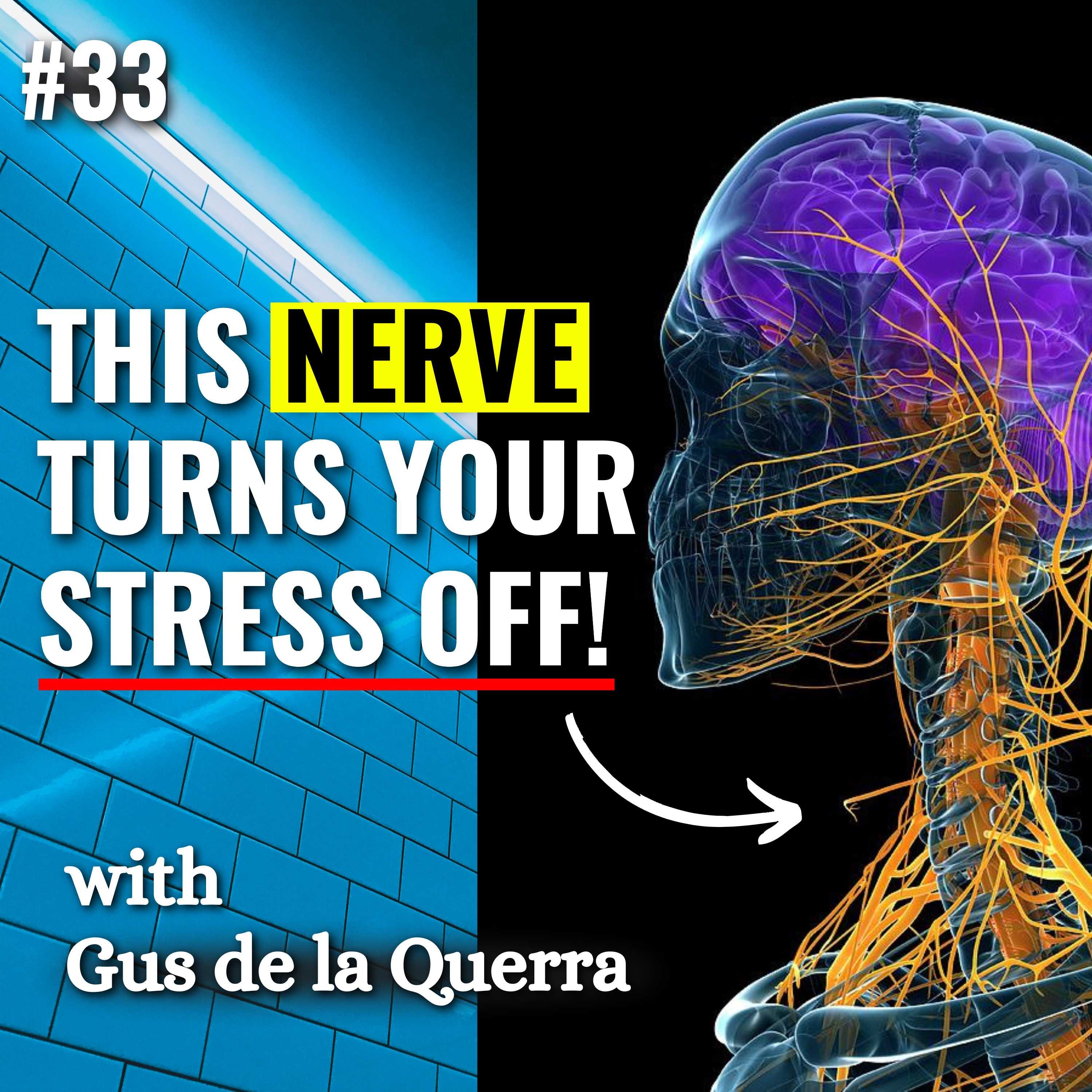
Vagus Nerve Expert explains the Vagus role in Stress Management, Chronic Pain & Inflammation💥Vagus Nerve Exercises, Vagus Nerve Reset, Vagus Nerve Stimulation, Vagus Nerve Breathing, Gus de la Querra
What's This About?
👇🏽 Discover the Healing Power of the Vagus Nerve for Stress Management, Chronic Pain relief, Inflammation and Nervous System Regulation with my guest Gus De La Querra Structural Soft tissue Therapist specializing in the Vagus Nerve & Lymphatic System! 💥
Definitely SAVE & SHARE this episode with a friend, this knowledge is extremely important & potentially life changing!✅
🔱 Eliminate Stagnation & Stiffness, Restore your Mobility & Function, Improve Blood Flow and take Care of your Fascial System with our Dynamic Stretching Routine Program! Only for limited time, you can get it at a 50% OFF ✅ with the code: GET50 at checkout 👇🏽https://www.mobility-fitness.com/dynamic-stretching-routine
👇🏽 In this Episode of the Fitness Wisdom Podcast we discussed:🎙️
• The different types of stress• What is the Vagus Nerve?• Why it's crucial to understand it's function!• How do we know if our Vagus nerve is not functioning correctly?• Chronic Inflammation• How the vagus nerve helps with Stress• Vagus nerve & Pain• Causes of Vagus nerve dysregulation• Gut Health & Vagus Nerve• Ways to stimulate the vagus nerve• Why is Nasal Breathing important?• How does diet effect vagal tone?!• Eyes and the vagus nerve• Vagus Nerve & Movement
👇🏽 You can find me on my other platforms as well, as work with me1-on-1 Online World-Wide 🌎
📲 Instagram: https://www.instagram.com/andreas_david_christou/
🎙️ Podcast IG: https://www.instagram.com/fitnesswisdompodcast/
🌐 Website: https://www.mobility-fitness.com/
▶️ https://Youtube.com/@fitnesswisdompodcast/
🐦 Twitter: https://x.com/movementandreas/
👇🏽 Find & Connect with Gus de la Querra: 💎📲 Instagram: https://www.instagram.com/thebodyrewired/🌐 Website: https://www.thebodyrewired.com/about-gus
👉🏽 Find the Best UV + Red Light Therapy panels, Blue Light Blocking Glasses & Circadian friendly light bulbs 🚨Use promo code: MOBILITYFITNESS ✅ for 20-30% OFF your entire order 👇🏽
https://www.emr-tek.com?snowball=MOBILITYFITNESS
👇🏽 Here is the Methylene Blue I use 🌀🧠
merakimedicinal.com/MOBILITYFITNESS
Use promo code: MOBILITYFITNESS to get 15% Discount on all products ✅🧠
👇🏽 Find the SHILAJIT I use & recommend below ⚡
https://mountaindrop.com/order/?ref=5873
Use promo code: MOBILITYFITNESS for Discount on your entire order ✅🧠
Get yourself a personalised Nutrition, Training & Lifestyle Optimization Plan designed for Your Body & Goals! Work with us 1-on-1 ✅ and let's Transform your Body & Health from the inside-out! 💎 The Link is Below👇🏽
https://www.mobility-fitness.com/product-page/1-on-1-online-coaching
*None of the content / statements in this Podcast are Medical or Personal Advice & is not intended to cure, treat, prevent or diagnose any medical conditions. All my videos are for Educational & Research purposes only. If you decide to try anything discussed in this video, you agree to do so at your own risk & responsibility*
This is the fitness wisdom. Podcast Hello and welcome back to another episode of the Fitness Wisdom Podcast. Today I'm joined by Gus de la Cuera, a structural soft tissue therapist, and he specializes in the nervous system and also in the lymphatic system. And he utilizes a holistic approach when it comes to treating the body. And we're going to be discussing about the power of the vagus nerve today. And the reason why it's so important to talk talk about this nerve is because in this modern day, we are faced with so much stress.
And we know that stress is a massive contributor when it comes to most modern day diseases. And it's absolutely essential for us to learn ways that we are able to control our stress levels, so manage our stress levels and that we can so that we can become more resilient and so that we can be thriving. And This is why it's so critically important to understand the vagus nerve, the role of the vagus nerve, ways to activate the vagus nerve, and what causes vagus nerve dysfunction. So welcome to the show, Gus.
Thank you Andrea. It's lovely to to be here. Thank you for having me the. Pleasure is mine, so I think go. Ahead. That's fine. I hope I can give you some insights today that you that you find helpful. So yeah, let's let's go for it. I'm sure the audience is going to find a lot of value in this conversation because I feel like everyone is dealing with stress to some degree in their life. I don't know a single individual who is over 18 who is not, you know, facing stress these days, because these days stress is coming from all different directions, whether that is visible or invisible.
And I believe the dangers of the modern world is the invisible stressors that we are facing, such as the, you know, the artificial blue light from the screens, the electromagnetic fields, the micro plastics, you know, different like different forms of radiation that we are maybe not aware of the electric fields. And it's more due to our modern day living. So I think it's critically important to know how can we manage our nervous system state since that dictates so many of our bodily functions. And if we are not in a parasympathetic state, you know, the majority of the time our body is not thriving.
So maybe we can start off this conversation by you explaining the different forms of stress and maybe which ones are good forms of stress and maybe which ones are not so great forms of stress. Sure. You know, as, as you know the most, the most common, you know, stresses are stress that we experience with work and you know, life and, and relationships, etcetera and, and things that that happened to us in life that creates these these stress responses. And we all, and we all know them and all, we all experience them then you know, but stress, you know, as you've spoken as well, stress is a stress is a good thing.
We need, we need stress. We need little bouts of stress. If you, if you've read about the Poly vagal theory where Stephen Porter's talk about the different levels of stress and, and the fact that our nervous system needs stress in order to build resilience. It's like, it's like a muscle. So your vagus nerve as well, your vagus nerve is like a muscle. You can, you can exercise your vagus. And if you can do things for your vagus and if to make it stronger, to make it more resilient and the more resilient we are, the better we can, we can handle stress.
So, so we can put ourselves in, in stressful situations if the situation is safe, which is a good thing. So, you know, so taking cold water, taking cold water plunges, you know, it's a safe environment. So you can do that, You know, playing sports, doing exercise, those are, there's all stresses to the, to the nervous system, but they're good stresses because they're in a controlled environment and you're not going to feel like you're overwhelmed. You know, it's a situation that you can get out of, which is very important for safety.
And so it's really important to build those kind of stresses into your your into your nervous system to make it to make it stronger, to make it more resilient. When you look at the vagus, nobody use something like like your heart rate variability, your HIV to measure your vagal tone. Your heart rate variability is a space of it's a time difference between each heartbeat. And that should vary. So your heart shouldn't be like a metronome. Yeah. And, and so the higher, the higher the variability over a period of time, over a minute or two minutes or however long you want to measure it, The higher the variability, the more we know, the more resilient the nervous system is.
And that's an indication of your vagal tone. So, so definitely when you have low HIV, it basically means your, your nervous system is not that resilient. And that's normally linked to physiological issues and, and sort of health related problems. So definitely, yes, we get, we get the bad stress, but we need the good stress in a controlled environment to build the muscle of the nervous system for sure. Great overview. So then, now let's move into then like what actually is the vagus nerve? Because even for many people, they have probably never heard what the vagus nerve is.
I guess they can get a bit of an idea that it is a nerve. You know, it's one of the cranial nerves of the body, but maybe you could explain what it is and what its role is in the its function in the body. Sure. Methylene blue, an incredibly powerful substance that has an affinity for the mitochondria. Discovered in 1876, at first as a text dye, it didn't take long before it was noticed for its unusual biological effects. Here is a list of all the things that methylene blue is known for. My personal favorites it is effects that it has on the mitochondria.
Methylene blue acts as a redox agent. What this means is that it has the ability to grab onto electrons, donate and transfer them anywhere where energy is required in the body. And we know that most Neolithic diseases these days are due to a lack of cellular energy. ATP, the more electrons we can get through successfully along the electron transport chain in the mitochondria, the more deuterium depleted water we can make as well as the end of energy production, which is ATP. The energy that we need to power all our cellular processes come from electrons, so it only makes sense.
The more we take care of our mitochondria and our energy production, the more energy we have for our overall health, well-being and vitality. If you wish to explore the methylene blue that I use, head over to maragimedicinal.com/mobility Fitness and use the promo code Mobility Fitness at checkout for 15% of your entire order. You've mentioned your vagus nerves, one of your cranial nerves, cranial nerve 10, they're all numbered and vagus stands for wandering or meandering. And, and So what it does it, it describes what the what the nerves doing it, it leaves the brain stem.
So it leaves the brain out of the brain stem and follows down either side of your neck before it dives into your thoracic area and then go down to your organs. So it's the longest cranial nerve and it and it winds itself all around your organs except and then your vagus nerve is basically mostly a sensory nerve. So it tells the brain what's going on in the rest of the body. So 80 to 90% of those vaginal fibers coming down and going to the rest of the body is like an octopus with tentacles and it and it and it senses and it senses the information and send it up to the brain and then the brain decide what it needs to do with that information.
And so, and so the, the first thing that people don't realize is you have a branch in either side coming down. So that's the one side of it. The other thing that people don't often realize is the fact that the vagus nerve in the brain in the brain stem actually originate or feedback into two separate areas. So you have your dorsal vagus, which is in the back of the brain stem and your ventral vagus, which is more to the front. And the ventral vagus seems to be your vagus of safety where you want to hang out.
The the ventral vagus, the dorsal vagal part that is the back that's in the back of the brain stem is more of the primitive part of our original nervous. So when that gets activated, we get sort of primitive responses like instead of fight or flood, you're going to get freeze and faint. Where you we've all seen this, this sort of, you know, mice when they when they get a fright and they lie in the back and then, you know, paws up and they and they and they play dead. So that's what happens basically when you all rabbit and headlights, you know, when you shine the headlights and rabbit just freeze.
So that's basically the the dorsal Vegas kicking in. So for us in real life, it's not a good scenario to be in because your dorsal Vegas activity, when it's when it's prolonged, can lead to to organ issues, can lead to health, health issues. So we want to be in this ventral Vegas state. And the big thing about the ventral Vegas state is actually social engagement. So you know, which we've had a problem, see, with a pandemic a few years ago where people had a lack of social engagement and anybody who was on the on the border of being mentally OK or not OK, they tend to be.
Then when we had the whole, you know, lockdown, we, a lot of people went not OK, because they went into that, into the dorsal phrase due to lack of social, social engagement. So, so the vagus nerve plays a part in all of that. And the other big part as well is that your vagus nerve, the part of the brain that the vagus nerve feeds into, it's called your insular cortex and your insular cortex in the brain deals with all your bodily functions. It also deals your memory as well. So it's, it also deals with the fact how you respond to the world in relation to how you've experienced the world before.
It receives all your sent information in the same part of the brain. So the vagus nerve feeds into the and then the brain has to put all the information from the Vegas nerve together with all your memories and old things has gone on in there, et cetera, et cetera, and make a decision of what needs to happen next. So it's a very intricate part. And, and, and so from my angle with the body work, because that's where I come from and that's why that's how I treat people with Vegas related issues is from hands on work.
When you, when you try and get too, too hard, too deep, too painful with body work, you miss the insular cortex. Those signals of, of, of painful body work will go to a different part of the brain called your motor cortex. So the brain will experience a pain from your touch and it will then it has to do it, then it has to deal with the pain. It won't really care where it's coming from. It needs to deal with that. With that pain. There's fire alarm going off. But when you have gentle body work, that's not a threat.
Once again, not a threat to the nervous system because everything about the Vegas never is about safety. When you when your body work, it's not a threat to that person's nervous system. It goes to the insular cortex and start activating all these emotional and vagal symptoms etcetera. So it's nervous complex. It's simple, but it's complex. Yeah. And I think that thank you for that breakdown. That was fantastic. I think why this is so crucial for people to understand this because you can come at the vagus nerves from so many different routes.
So what you were basically saying there about the social engagement and then also about the dorsal state going into the shutdown and freeze, I think it's so important for people to understand what depression actually is. Or, you know, because I feel anxiety and depression are physiological states. They're not necessarily mental health conditions. So I feel like everything is first arising inside of the body biochemically or structurally or on a quantum level, and then that's affecting us, you know, emotionally and mentally.
A lot of people think, you know, dissociate the brain from the rest of the body, but all of the body is at 1 interconnected system. All systems of the body are communicating with each other. So if something is thrown off, like the brain is just simply the processing center and our rest of our organs or our system is what gives it the information. So if that is not receiving the information that it should from the environment, then we're going to give those signals to the brain that, as you said, that we are not going to be in a safe state.
So when the brain doesn't feel safe, it does two things. It either makes us want to run away or fight or shut down and freeze. And so I think it's so important that we actually understand how are we able to influence these different areas of the nervous system through our daily acts, habits and behaviors, and how much control and power we have over influencing our Physiology just by what we do every single day. And so for example, what brought to my mind when you talked about the anatomy about the dorsal and the ventral.
So when you said that the dorsal is at the back of the brain, it made me think that there's our posture. For example, if we are like this, crouched over, does that affect? Does that put us? Into a dorsal state automatically. What do you think? If there was one substance that could increase your energy levels, optimize mitochondrial function, boost ATP production, help to optimize your hormones, re mineralize the body with ionic minerals, boost cognitive function, assist detoxification and support your gut health via the microbiome.
This substance is Sheila Jit, known as the destroyer of weakness. Sheila Jit is a herbal mineral substance made from the decomposition of plants and bacteria. This process taking place over thousands of years. It is harvested from high altitude locations, primarily the Altai and Himalayan mountains. And what makes Shilajit so unique is that it's made by Mother Nature herself. I call it nature's methylene blue. That's all Shilajit that you find on the market is created equally. This is why I only use and trust Mountain Drop Shilajit.
They have an extremely high quality shilajit product that has been rigorously tested for heavy metals and impurities. Grab yourself some Shilajit, the destroyer of weakness today and head over to Mountain Drop. Com Use the promo code Mobility FITNESS at checkout for a nice discount as well. Has the ability to, when you have say neck related issues of compression around the neck and then there is a possibility that you will affect the nerves at the back of the neck, affect blood flow, which will then affect you know, what happens in the brain.
Yeah. The other thing as well, the other thing is all with posture that often goes together with posture is emotions as well. So you won't find a very positive person being all slumped forward and low down when they walk in that positive, you know, positive people are out there. People are always, you know, not quite sure which way to use, but people are always negative and they're always down here. So your posture can go with your personality as well, which brings the emotional part with in that sense.
But yes, you can, you can have issues through the thoracic area. You can have compression through this area because that's where the vagus nerve hangs out. Your vagus nerve goes to your heart, goes to your diaphragm, runs past the diaphragm into the organs. So lack of movement posture forward can block the vagus around the visceral around the organs. But definitely you know, E2, the C2 root ganglion is where a lot of things happen in the back of the neck. Your C2 root nerve ganglion is where is where your vagus nerve hooks into as well.
Your two nerves that control your tongue, your glossopharyngeal nerve and your and your hyperglossal nerve that involve heavily in tongue function. The vagus nerves involve in tongue function as well. Those two nerves are involved with your tongue function. Also accept the C2 to the C2 ganglion, your vision, your Oculus stuff also accept the C2. So yes, So what happens to the neck and any compression or lack of flow? And then obviously, like you say, when your head goes forward and pushes forward, that kind of thing, it's going to strict lymphatic flow and your lymph is responsible for keeping those neural areas clear and healthy and get Toxus away from area.
So if your lymphatic system is starting to clog around this neck area, then it'll knock onto those nerves and possibly their function. But obviously the other important thing is, is a brain drains into your into your neck. So all your cerebral spinal fluid, a large percentage of your cerebral spinal fluid actually drains into your sinuses via via, you know, the, the, the sort of optic, sorry, blank of the nerve name, the smelling nerve, you know, the olfactory nerve. So so your brain drains wire the olfactory pathway into your sinuses.
So it's really important for this area to be clear. So when you start stagnating the area and come down the whole time, you're going to have a nervous system reacting to that for sure. Yeah, because also it makes sense that for example, if our lymphatic system becomes stagnated, then our our nervous system becomes irritated and inflamed because the tissues around cannot get rid of that metabolic waste. So if we are because of the lack of movement and the posture, it's like because movement itself moves fluids, right.
But then if we are in a specific posture that we are not breathing, we are not moving and we are, you know, staying there in it for long periods of time. That just shows us how detrimental it is actually to do a lot of sitting jobs where we are staring at the screen fixated for a long period of time. When we are not moving and we are not diaphragmatically breathing, we are not moving those fluids around. So basically what Goose is saying is that all systems of the body are intertwined. And if you don't move, then obviously your lymphatics don't move, your blood doesn't move.
And then the nerves get, you know, triggered. And then that's what can result in pain, which isn't unrelated to a physical injury, but just arises somewhere in the body just because there is a lack of oxygen already, there is too much metabolic waste or whatsoever, and it gets irritated. So I guess it would be really good if we tell people how come they tell if they have vagus nerve dysfunction? What are some symptoms that they may be experiencing that they don't know about? Well, if we look at the things that the vagus nerve is heavily controlled by, the first thing that's going to go if you have vagus nerve issues, it's digestion.
Your vagus nerve is, is your regulator of your digestive processes. In fact, when you have the fight and flight response, the first thing your body will shut down is your digestive process because it takes up between 10:15. Twenty, 25% of our daily energy comes from our digestive processes. So when you need to run away from danger, your body needs that energy to make you run faster and jump and jump behind it. So, so it's going to shut your digestion down. So the first thing that's going to start happening when you have a vagus nerve issue and, and stress related stuff is your digestion is going to go.
And we all know that we all get nervous, we feel it in the gut. We, you know, you might have to go to the toilet, you know, depending if you're writing exams or go for a test, you know, you feel it, you feel it there. So, so your digestion is a first that's going to go. And, and unfortunately with digestion, it has a knock on effect after that, because as soon as your digestive system slows down, you're going to have, you know, low stomach acid. And then it just starts knocking on to what that's going to cause later on.
You can start having bacterial overgrowth in the gut because you have low stomach acid, because you have stress responses. So it's a knock on effect from the digestive point of view. You're also going to possibly have, you know, you can have things like high blood pressure, depending on your, on your amount of stress, you can have high blood pressure and high heart rate, or you can, if you're, if you're, if you're, if you're stressed and your, and your traumas carry is very big or carried on being carrying on for too long, You can go the opposite way.
So you can, your heart rate can slow down too low, your blood pressure can go too low. You can get POTS, you know you have POTS problems. So, so it can go either way that way. The other thing that your vagus nerve obviously is you're getting back to gut health is your vagus nerve is your data cable between your gut and between your brain. So what happens in the gut with your microbiome is going to affect your brain function. So you can have a vagus nerve problem that will affect your gut health and the, and the microbiome in the gut, which then will affect your mood, anxiety, etcetera.
So the vagus nerve is involved in your mood and anxiety via the gut, but also via the part of brain that I, that I've spoken about earlier on your insular cortex that it feeds into. So you're going to have those, those issues. And you know, most of the time when, when people think they're going to have anything stress related is going to be a Vegas problem because any stress, it's if it's if it's a feeling of not being safe type of stress, because we said there are two different types of stress, the good and the bad one.
So if it's a bad type of stress where you feel out of control, then it's going to knock your vagal tone. Your vagal tone is going to go down low and you're going to have all these health related issues. And because your vagus nerve is a data cable also from all your organs to your brain, you can start having issues with your liver, you can have starting issues with your kidneys, etcetera, etcetera, due to due to stress due to low vagal tones. It's a, it's a massive knock on effect. And the thing that people think, people always ask me, well, how can I heal my vagus nerve?
And I, and I normally say, you don't have to heal your vagus nerve. You have to heal you. Your vagus nerve is, is a mirror of what you're doing with yourself to yourself. And, and you know, if you kind to yourself and you look after yourself, your vagus nerve will thrive. If you don't look after yourself, your vagus nerve won't thrive. It's, it's really not, not, you know, it's not about how can I fucking I heal or fix my vagus nerve. It's, it's really you have to look at what you do, what you're doing in your environment and in your head, thoughts, emotions, etcetera, and the way you talk to yourself and think about yourself that will actually affect the vagus nerve then leading to the other issues.
Great, great. So then this is a really great explanation for people to understand that, you know, the different symptoms that they may be experiencing and that maybe they can relate to that, You know, even if they're doing many things in their life, right, let's say from an exercise standpoint, nutrition and what so on. And but they are kind of experiencing some of these issues. Maybe this could be related to their vagus nerve. And so maybe we could talk about, you already said that stress is basically the thing that's going to disregulate the vagus nerve, right?
But could you pinpoint some specific things that you feel like are the biggest culprits when it comes to? You know, vagus nerve dysfunction or or it not operating correctly, what are some things that people are doing in their daily lives or they're exposed to that could be actually harming them and they don't realize? It sure you know, anything that's going to your vagus nerve is is a major regulator of your immune system and immune system responses. So So what you'll find is is with it's with chronic information and chronic health issues, the vagus nerve is going to be down there.
So it's really important, you know, if you've, as you've mentioned before as well, with toxins coming in from the outside, you know, exposure to light, exposure to to endocrine disruptors, those kind of things, that stuff, you put enough food, you know, all those kind of things is going to start affecting your vagus nerve from that, from that angle, obviously stress is 1. The other big one that I've got a big interest in is actually TMJ problems. And a lot of people don't know they have a jaw related or TMJ problem.
They experience it as something else. Yeah. But the important part is, is, is that your, is that your trigeminal nerve, which lines, you know, your head and aligns your sinuses, but your trigeminal nerve hooks onto each and every single one of your teeth. It is a nerve supplied to your teeth. And the trigeminal nerve hooks up to the vagus nerve in the brain stem, right. So anything that will start affecting your trigeminal nerve, IE around the face, around the mouth, inside the mouth is going to start affecting the vagus nerve.
So I do a lot of TMJ work on people, a lot of intraoral work to try and just get some tension release from from this area here because once again, it's a bit massive knock on effect. I've already spoken about the two nerves that that controls your, your tongue function that also accepted the vagus nerve and the brain stem. And on C2, you know, when you, when you have nose breathing, which is what we want, because with nose breathing, your tongue would sit against the roof of your mouth. When you have mouth breathing, your tongue will tighten up and it will start affecting the position of your highway bone.
And during the day, most people are nose breathers. No, I breathe through my nose. I'm fine. But when the sun goes down and people go to sleep, that's when the tooth comes out. So if you have tight tongue, you know, tight tongue muscles, because you actually actually by by nature a mouth breather, soon as you lie down, it's going to sink back and start affecting your, your, your, your, your, your breathing patterns and your, and your oxygen going in and that'll affect the vagus nerve. So if your body is starving from oxygen, it's going to affect your heart immediately.
It affects the vagus nerve because your vagus nerve regulates the heart rate as well. So TMJ issues is my big thing that I always go to or any TMJ work around the face. And that's often where stress go as well, you know, yes. And people can't grind their teeth. So, so those things and you know, as we've said, the minor problems that I get people in clinic now where the, where the, the root cause, I would say is actually a stress response and then creating everything else knock on after that and your TMJ, your mandible and the position of your mandible will dictate what your body is doing lower down.
It will detect dictate the position of your pal was the position of your head where your shoulders are. So so. Why do you think about this? Yeah. Which is? There's a few reasons for that. One of the biggest ones are the fact that you, the trigeminal nerve that hooks up to every single one of your tooth teeth is actually part of the body's proprioceptive system. So each teeth has got a ligament. Yeah. So each tooth has a ligament called the periodontal ligament. And that ligament feeds proprioceptive information back to the brain regarding your bite.
If you have. And the brain is always looking for safety, for stability. So if you have teeth that don't fit together properly, So the fact that you know not to bite harder because you're going to break your teeth or get or hurt yourself is down to those periodontal ligaments telling the brain this is the pressure on those teeth. Stop biting down because is going to break or something's going to snap. So, so the brain is always looking for that, for that, for that safety, for that, for that connectivity.
And, and when you have a bite that's not right, the brain can start looking for that bite and start changing your head position. Now your head weighs roughly the weight of a bowling ball and it's sitting on top of a broomstick and it's sitting to the front of the broomstick almost, you know, And so, and so as soon as you start tilting your head, everything below has to adjust because gravity dictates that so, so often when you have, so often when people have mandibles that are setbacks where there's compression in the TMJ, it can actually start collapsing your posture.
So we, so we find that as soon as you create vertical hide through the back of the mouth, vertical hide within the TMJ, you actually lift the structure up. So I have colleagues and, and, and dental friends who work that way. They have appliances that they make for people to create vertical height in the TMJ, which then straightens the structure up and there goes their spinal issues, you know, so it's, it's, it's a big thing. So for the brain, so, so the trigeminal nerve is one way of the position of the mandible and the, and the brain trying to find where they had trying to find safety in the bite.
And it'll try and do that by shifting your head and there goes everything below. So that's, that's one, that's one angle. It'll also push out your highway bone. So if you have have tight tongue muscles, because it looks up your highway bone, your highway bone holds your trachea and holds your airway open. When you have tight tongue muscles, you know, a lot of times people are tighter on the one side and the other side. For argument's sake, what that's going to do is pull your esophagus slightly off to the side.
Now the brain's main aim for your survival is to get oxygen in. So what's it going to do if your esophagus pull over? It'll shift their head over slightly to get that, that passage open and there goes the posture down below again. So really important area. So I always getting back to the Vegas. I always do TMJ work for anybody who's struggling with any, with any Vegas issues because and it's cranial nerves. You know, the other problem you have is that your vagus nerve, I spoke about it, the CT root nerve ganglion.
So the vagus nerve also connect to your, your accessory cranial nerve, cranial nerve 11. And your accessory cranial nerve is the nerve that's responsible for flexing your trapezius and controlling SEM's. So the muscles that that allow you to look side to side, the sternal mastoid muscles and you're upper trapezius, those are controlled by cranial nerve, right? They're affected by cranial function because they're stress related nerves. So if you think back when, when you know, if you're looking for danger or if you, you know, we were living in caves and we were hunting for food, like, you know, what's going to happen is you're going to be down here and what you're going to do is you're going to lift the head up, right?
You're going to lift the head, which is trapezius and you're going to look side to side, which is still not any mastoid. So those are primitive response nerves, cranial nerves. They built in for safety. If there's a bang behind you, what you're going to do, you're going to do this, right? He's trapezius. Yeah. It's a safety. It's a, it's a primitive response nerve. The first thing babies do when they when they, when they, when they start moving on on the ground is they will come up with a head, right?
That's trapezius. And then they will start looking side to side and that's SEMS. So those are primal survival muscles and those are controlled by cranial nerve and they hook up to your vagus nerve. So now people want to, you know, so when people say I stressed out, it goes, yeah, yes, it's going to go there because your vagus nerve is linked to that nerve controlling those muscles. So it's very interesting. It's very interesting. It's a whole body. Once again, it's a whole body system. So everything basically that what you're saying is that how basically our nervous system state and how our body deals with the stress like it's going to reflect or present itself in the body in different ways for different people, right.
So I guess for example, what we mentioned previously, I think was that, you know, the stress can be the leading cause to most issues, but stress is so context dependent for the individual, right? Because for example, a certain person may come in and they may have a very good stress, like book it like they have a really good resilience with their nervous system because they have allowed their body to adapt to stress. So they're exposed to stressors and then they recover from the stress. So they become badass, they become stronger.
But like if you're constantly chronically exposed to the stressor without the recovery period, which a lot of people don't understand that when you are exercising, for example, the recovery is equally as important as the workout, like as the stress. But if you don't have the recovery period. But most people also in their lives when they're exposed to traumatic events, you know, emotional psychological events at work or with their family, divorces and these kind of things, they don't see those things as something that they need to recover on.
They just continue living their life. And then their life before was already pretty stressful and then and that overflows their capacity, basically their stress capacity. And then that's what manifests itself in the body as different form of symptoms, whether that is gut issues, skin issues, because that's related to the gut as well, postural issues, pain, like, you know, all kinds of different things. And that is just simply from stress. And I just don't think people understand how so much the severity of chronic stress is on the body.
And I think This is why it's so important for you and me right here, right now to hammer home this message that you need to be aware what are the stressors in your life and start to minimize those and start to increase the activities in your life that take you out of stress. So things that put you more into a parasympathy. Except I once wrote a really great post maybe 1 1/2 year ago, and I told people to write down, write down the things in your life on a 24 hour basis. How many things that are you doing that are putting you in a sympathetic state?
And I wrote down the type of activities which lead to sympathetic activity. And then how many of the things are putting you in a partisan politics state and then put them on a piece of paper and see the percentage of each side. And if you have got more of the sympathetic stuff, well, it's time to add more of the parasympathetic and get rid of the sympathetic. But a lot of time what people do is when you tell them that, you know, you need to go and get a massage, you need to go to the impeach the relax.
You need to do this instead of removing the stressors, they just add in the relaxing stuff, but they don't remove the stressors. So they just overwhelm their body even more. So I think it's so important for people to understand that it's more about a removal of things from your life, not about what can I do additionally, like what's the next best food that I can eat or what's the next best supplement? What's the best red light to use? It's more about removing the blue light from your life, removing the stress from your life, removing all the dressers in the 1st place so you don't need so much of that good stuff, but then when you do have the good stuff, it's actually going to benefit you, isn't?
It absolutely. So it's a whole thing about these hacks, you know, so yes, the hacks are good because they can help you cope, but the hacks are not going to sort your problem out. You need to, you need to step back and you need to look at why do you need the hacks? You know, and, and that's a big thing. And then, you know, we look about look at cortisol, which is, which is the, you know, we see cortisol as a stress hormone. Cortisol actually is our friend cortisol. Cortisol is anti-inflammatory, you start off with and cortisol is what, what allows you to wake up in the morning and get out of bed, right?
Your melatonin starts going down in the morning and then your cortisol starts kicking in and wake you up. So if you didn't have cortisol, you wouldn't be alive really. Also, if you didn't have a lymphatic system, you'll be, you'll be dead with it. If your lymphatic system had to stop working, you'd be dead within 48 hours. That's how important it is. But, but so, so, so cortisol is, is, is actually anti-inflammatory by nature. And so it will help with anything it's trying. It's the body trying to help with, with with certain things, obviously.
But the problem with cortisol is when it, when it release, become chronic, then it becomes catabolic. So I start breaking things down and so you, so I can get people coming into my clinic with reoccurring injuries. They're always doing the hamstring or they're always having their Achilles tendon or, you know, or the Achilles tendon, you know, plantar fasciitis are hanging around for six months. If it's hanging out for that amount of time, then you have to look at what the immune system doing. Why isn't the immune system doing its job and shutting it down?
So, so cortisol can actually physically break tissue down. It becomes catabolic and break protein down reoccurring injuries, you know, especially in the same areas. You know, you have to look at what the immune system is doing and what your what your stress is doing. So, yeah, and I think, you know, for me originally when I started getting into the vague stuff as as you do, I'm probably saying for you as well as when you start looking at these things like my fatigues, Vegas, you, yes, I got injured because I want to share that with other people.
But you can't help but looking at yourself at this at the same time. And, and what do you, what are you doing to your own body and to your own mind, et cetera. And, and so a few years ago, then I started realizing, okay, so this is when my dorsal Vegas start kicking in. These are the signs that I'm, I'm, I'm sort of retracting myself from social stuff. I want to get away from people, you know, and I'm like, okay, is this actually my dorsal bag is kicking because my stress levels are getting too high.
So you, you really start, you know, and then I decided another big thing I think is the fact that setting boundaries and saying no and yes, I've always been somebody. So yes. OK, yeah, yeah, yeah, no, OK, it's good. Yeah, yes, we'll do it. And then I, and then I end up with the stress and the load, et cetera. So one of the biggest thing that I that I had to learn was to say no. And, and if you want to say no to things and set boundaries, you don't have to give a reason, right? Those are your decisions based on your experience in your life and what you and achieve.
So the biggest thing I think is, is, is saying no setting your boundaries and, and people pleasing. You know, I think those are the really big ones in in creating your own unnecessary stress by by doing those those things. And and it's not easy. You know, it's not easy saying no, it's an easy sitting boundaries. But it's something you have to decide, OK, It's either that or my health is gonna suffer. So you have to make that that decision, I think. I wonder why it's so built into our society that you know we want a people please so much, or why why we why it's so hard for us to say no.
I've all, I've had this difficulty as well the majority of my life and only recently in the last couple of years, I've gotten to a point where I've started to set boundaries, you know, with my relationships that did not serve my highest purpose. And I just felt like now that I have set those boundaries, I've got so much more energy and vitality for my health and my well-being because I'm not giving my energy away like an octopus in all these different places. And the relationships that I am in right now.
We all respect each other's energy. And it's not like, you know, take taking, you know, it's just more like we're all, when we are feeling like it's time to give them, we give, but then it's not somehow expected. And that is the beautiful thing when you have relationships that are in alignment and then that is also not zapping you from your vital life force energy. Because I don't think people understand like how much relationships actually take so much of your cellular energy. Like on a cellular level, it's not just energetic because energetic is physical, right?
Everything like on an emotional energetic level is manifesting itself on a biochemical level. And then that's affecting the way that our mitochondria are working and then our ATP production and therefore how much cellular energy we have. And This is why sometimes some people can make us feel really energized and good because they give us energy and some people can make us feel really drained and tired. So I'm just wondering why it's so ingrained, Like, because I don't know, in school, for example, they never taught us to be like people pleasers, you know?
But so I just don't know like why it's so? Prevalent, I guess, I guess I, I don't know. I guess the one side is that we all crave love and we all want to be loved. We all want to be liked. And, and so there's obviously one part of it. But like you say, yeah, nobody ever tells you not to do that, not to, not to do that too much and putting yourself lost the whole the whole time. So yeah, it's a very difficult one. It's a very difficult one. And a lot of times, you know, also we run a 95% subconscious.
So, so we're doing things based on what's happened to us before and, and, and and happened in the past. And so we also we sort of running on autopilot. But when you make these big decisions in turning a corner and taking different path, you're breaking away from the autopilot. You know, it's the whole thing of, you know, if you, if you don't create, you know, if you want change, you have to, you have to change. And so that's always the whole, the whole thing for me is I started learning to say no.
He started learning putting boundaries in and that made things. And it's actually quite a good big sense of freedom when you start doing that. It's like a big waist left on your shoulders. You know what, I'm not happy about that. I'm stopping that or I'm saying no to that. And it makes you feel good. It makes you feel yes, you know, let's go for this. So, so that's my biggest advice for people is to set boundaries, learn to say no and because that will lean then towards self love. Yes, self love.
Yeah, that's also important. Self respect, because when you align, your life respects. Yeah, because you know, when you respect yourself and you love yourself, you align. You start aligning the things, the habits and behaviors in your life towards the best interests for your health and your body. And then therefore that reflects to the people around you in your immediate environment, like how your internal health is doing is going to shine outwards. You're going to have more energy and enthusiasm to be better towards other people.
But if you are feeling inside, not so good and optimal. I know myself if I am not feeling good, I can't be good to others. Like I'm neither interested to give energy to other people when I'm not feeling good. The only thing that matters to me when I'm not feeling good is to feel better before I can start to do anything else. So I can totally understand for people who it's more subconscious how it can reflect more as a negative energy outwards as well. Like you know, when you're not thriving internally, but you can't blame them.
I mean, if you're suffering internally chronically and you're in pain, that also changes your like your brain chemistry as well. Who you are as a person, even that's not what they are intending to be. But that's the beautiful thing is that when you work with the body, you can transform the brain as well. So I think now it would be really good since we tapped into all of the things that we should be avoiding and saying no to now it would be really good to go into what things should we be doing? Maybe like you can give us some helpful tips, practical tips and tools that we can implement right away.
Maybe self self help tools that we can do every day or maybe a couple of times per week that we can activate the vagus nerve in order for our brain to feel safe so that we can live in a parasympathetic state and to thrive. I've been using red light therapy for many years now, but only since I started using EMR Tech red light therapy panels did I really start to notice the true benefits of red light therapy. I'm using EMR Tech's Fire Dragon Pro and the Inferno pro. I noticed better recovery from workouts, improved skin health, better energy levels, improved eye health, improved sleep quality, and pain reduction.
I can safely say based on my experience that EMR Tech has the highest quality panels on the market from build quality, functionality, and the aesthetics. Don't take my words for it. Grab yourself a panel from emrtech.com and use the promo code Mobility Fitness for a massive 30% discount. Actually, you do everything the opposite to what you don't want to do. So, you know, the easiest thing really is I think breathing when you, when you, when you breathe, when you take proper deep breaths and you're going to simulate the vagus nerve mostly when you breathe on the out breath, because when you breathe out naturally, your heart rate slows down slightly and it's the vagus nerves job to slow your heart rate down.
So, so breathing is one of the, one of the biggest things and that goes breathing goes for lymphatic flow as well. Your lymphatic system relies heavily on your breathing because the diaphragm creating suction and compression and in your vagus never allows in your breathing. The people I see in clinic when you when you lie on the couch and I and I observe the breathing, the people are highly stressed out. They have the shallow breathing. So you want to go after deep breathing and it doesn't have to be massive.
You know, there's a whole box breathing thing of breathing in for three seconds and you hold for three seconds breathing through your nose that is 3 seconds. Hold for three seconds and then maybe breathe out for about four or five seconds. Make the out breath slightly longer if you can and a hold for a slightly longer if you can, because it's during the out breath and the hold off the out breath that you actually stimulate the vagus. So, so breathing is one of the, is one of the easiest 1 ones. You know, we know that all the classics of of, you know, singing, humming, chanting, your Vegas never controls your vocal cords.
And so and so stimulating your vocal cords with singing, humming, you know, all the chanting, all those kind of things will stimulate the Vegas of automatically through that. And that's why sometimes when people stress out, they lose their voice, or their voice go croaky. So when they, when they stress out, it's because it's because the vagal tone goes down. So they lose the ability to control the vocal cords properly. So that's you and you and you feel that your, your voice is always straining or every now and then you lose your voice.
You have to pay attention to that because that means you need to stimulate the Vegas more. So singing, chanting, humming, all those singers stimulate the Vegas nerve. Cold stimulate the Vegas nerve as well. The Vegas have loved cold so you you don't have to go, you don't have to go in a massive ice bra for you. You don't necessarily, although it's good, you don't necessarily have to have an ice cold shower because some people it's like really scared of that. But you can just splash cold water in the mornings on your face, on your upper chest here.
That's where a lot of the vagal fibers hang out, right. So around here, just splash around cold water, cold water and that'll simulate your vagal nerve looking after your gut is going to look after your vagal nerve for sure. Because because the vagal, that's where the vagalism hangs out, your immune system hangs out there last proportionally the vagus nerve hangs out there. So you have, you have to look after your after your gut health, Omega-3. So making sure that you have enough of, of Omega 3 is really important as well because that helps.
It's also anti-inflammatory and it helps the vagus nerve. So things like that. But from, from the mental side as well as as you, you know, you can get deeper into things like the circadian rhythm when your circadian rhythm starts struggling when you're not in a good circadian rhythm. So when you sleep, when your sleep patterns are rubbish, so you can't don't sleep properly. That whole rhythm, it's all hormonal driven and it's, it's sort of catch 22 is driven by hormones, but it also affects your hormones.
So, but it affects your vagus nerve. It's going to make your nervous system nervous. Anything's going to make your nervous system nervous is going to, it's going to affect your vagus now. But anything that makes you feel good about yourself and anything, once again, the self love, those kind of things, all those things are going to stimulate the vagus nerve. So you have yourself. So you've mentioned earlier on having massages, you know, just going away somewhere, spending time in nature is a big thing.
Nature's nurture, you know, So, so getting out of nature, going to the seaside, looking at the sea has been shown gratitude is a big one. Showing gratitude being, being, you know, being happy that you can, instead of saying, I've got to wait for the trainer, the train is running late, right? Rather say, well, I actually get to wait for the, for the, for the train. So making it that you're actually happy to be there and happy to be alive. So, so gratitude, showing gratitude and different things. Those are those are really important things.
It's not always just about the physical, but it's, it's, you know, having to look after yourself mentally. Anything that you're going to do to put your physically and mentally in a safe place is going to stimulate the Vegas now. That's really, really great. Yeah, that's so important. I think the self talk, what we say to ourselves and how we we think about ourselves really reflects on the outside, how we present ourselves to the world. And then I mean, that really shows, you know, whether we are more introverted or extroverted, right?
And doesn't mean that we have to be 1 or the other. But you know, in certain situations, you know, if we feel that we need to be more extroverted like we are now on the podcast, we can be because we have the nervous system resilience and our body can switch into that social engagement state. Whereas if we are thinking, you know, more negatively ourselves, you know, again, we're zapping that energy, that internal energy from our system. So it's going to put our nervous system more into that fight and flight.
So it's going to be way more harder for us to relax and to be able to be natural and flowy in our conversation. So yes, definitely the mental state, I feel like it's a huge part and what people say about themselves I think is huge. And because inside is actually more important than what you say on the outside. Because so many times people, they say that, well, I don't speak badly, but they think negatively or badly internally. So it's very important to catch yourself when you are thinking these negative thoughts, if you can always replace those thoughts with something positive, that would be ideal.
That I do that very, very often. In fact, I find myself many times where I'm out and about, I find that maybe I'm judging somebody internally in my mind. And instantly when I do that, absolutely I think like, no, I'm not judging because if that was me, the other person, then how would I feel about that? Yeah. And then I tried to remove the judgement. Yeah, and everybody has, I tried to remind myself that everybody has their own story. So the way people act, the way people behave is due to their story, you know what, what what they've gone through.
So, so, yeah. So I, I've never been somebody to to judge people because I've always believed that we all have our own problems and, and, and people really do behave due to what's happened to them before, subconsciously or consciously. Once again, we get back to the inch of the cortex that deals with you, all your past memories, and have to judge what you're doing now in relation to that. So yeah, it's a whole thing of being triggered, isn't it? If somebody triggers you, it's normally you. It's normally, why can't you see past that?
You know, and just to get back to the insular cortex again, your insular cortex has to deal with your emotions, what you experience. If it's struggling to do that, if your insular cortex can't put a word or, or a response to trauma that you're experiencing your emotions, the brain still has to deal with those emotions. And so if the insular cortex can't deal with it, it throws it out somatically. So you're going to have things in the in the body, you know, backward lower back pain is classic, you know, stress stuff, neck pain, etcetera.
Knees, knees are big one for stress issues. You know, often the body throws, throws the knees. So, so yeah, if your brain struggled to deal with with stress and it can't quite cope with it, it throws it out somatically for sure. That's really Cortex. Really fascinating to know because I talked with one lady who she is like an emotional trauma therapist and she basically talks about how emotions are this like not necessarily an emotion that's created from our mind, but it's actually a very physical reaction.
It's a physical response and it's us as human beings that we have labeled those emotions are something that is more mental. But in reality, there is actually a very physical reaction, a response to a specific stressor or a trauma. So it's really cool that you explained it this way around as well about the brain, because that's one part of our conversation that we didn't get into about how if the brain doesn't process the emotion, but why? Why do you think would the brain not process the emotion in the 1st place?
What would be stopping the brain to process? That I guess it's, it could be the degree of trauma. And so you know, so if it's, if it's big right now, massive or if it's, if it's, if it's big, but continuous. So you get to a point where you just don't know your brain just don't know what to do next. It can't get out of it and, and then it throws it out. And, and so you have that and, and also with for every thought and emotion that you have, your body produce, produce a certain neuropeptide. They will travel through into your bloodstream.
I don't know if you read the book by Candace Perth, molecules of of emotion. Now she talks about about that and Joe Dispenza as well talk about the the neuropeptides. And so every time you have a thought or emotion, your, your brain physically release a neuropeptide which travel, which travels in your bloodstream to a specific part of the body. They like to congregate and around certain areas. And it's quite funny actually. The Western medicine and the Western scientists call it neuropeptides. And what they've done is they follow as soon as you have these thoughts and emotions in neuropeptides go in your bloodstream and they've, what they've found is they like to congregate along certain areas within the body.
And then So what they've found is, is that the areas along the spine with these neuropeptides start congregating is almost exactly and very similar to the chakra charts. Wow. So that's amazing to the Chinese medicine. The Eastern side already had a inkling of what that is, and the Western side comes with neuropeptides, and this is where they congregate and blah, blah, blah. So it's very interesting. But yeah, so, So what happens in the brain, and if the brain can't cope with things like that, then it's going to throw it out somatically.
So it'll throw it out into the rest of the body. We know that your tissue holds tension, obviously, due to stress. So you can stress about something and that's going to cause you to maybe, I don't know, you know, hold your neck a certain way or hold your arm a certain way or clench your jaw a certain way more on the one side because you're stressing out about certain things. So that that tissue in that area, wherever that might be holding your stress is going to be linked to that emotion that created those that stress to start off with.
And then and then from from a body work from a hands on point of view, a lot of times people have dealt with stress emotionally, but now it's stuck in the tissue. And so from a hands on point of view, what you know when we work with massage or any type of soft tissue work you do that that very gentle for the nervous system is as soon as you release that tissue, you will often then obviously get the release of that emotion because it was actually what in that movement pattern in that ingrained in that fascial line or you know or muscular system.
So. Yeah, and that's, I think what was very important that you said there and you also mentioned at the beginning is that it's so important that when you do this soft tissue therapy and like massage on yourself, like self myofascial release or even you go to a massage therapist that they understand that how to work with the nervous system rather than against it. Because I feel like there is a time and place, I, I believe for everything like, you know, going hard and also going slow, but I feel that going slower.
Definitely it is a, it is a way more powerful way to accessing the nervous system and communicating with the nervous system and getting longer term results that are not just going to immediately go away when you finish your treatment. I find this exact same thing when I'm doing mobility training with people. A lot of people have been doing flexibility training for many years and they stretch and stretch and stretch and they do passive stretching and they force their body into a stretch. Well, when you're forcing the body to do something, a lot of times it doesn't like it.
So what it does, it compensates for that. So it goes into a Free State. So for example, you're trying to stretch your hamstrings and you've got chronically tight hamstrings. You force into position, you get flexible for those 1015 minutes that you're doing it, but the next day again is tight all over again. But why? Why is that thing that you're doing not sticking? Why is it not sustainable? And this is what I teach my clients as well, is I teach them how can we neurologically, we get the access to be able to have a bigger range of motion that is actually going to stick, right?
And we do that by applying strength through full range of motion, meaning we have control over that range. And we only go to the point where the brain feels safe. And we have, we have load or external stress on the muscle in order to communicate with the brain that what we're doing is we're in control and we're safe. So slowly over time, we build our capacity into that range of motion which will eventually allow you to be more flexible even at rest. And that you don't need to all the time keep on doing stretching or mobility exercise to be flexible.
You don't need to warm up so much before you're training because now you're more supple, you're more ready. And that's what you are doing as well, right? You're helping people to be in a ready state. Exactly. So, So what Sam is you're doing, you're actually talking to the nervous system via movement and I talk to nervous system via my hands on work. And the nervous system is your, the nervous system is your friend, you know, So if you, if you think, you know, if, if the, if the treatment all the time is hard and hard and pain and pain and pain.
It's like sitting in a conversation where you've been shouting at shouted at the whole time and you haven't got a chance to speak. So that's what you're doing to the nervous system is you're shouting at it, shouting at it, punching it, you know, thinking you, you can create a change and the nemesis will go, OK, for now, I'll go with it. But you know, when, you know, in a day or two or three time, I'm going to go back to where I was because I didn't have a chance to say what I wanted to say. So from a hands on point of view, what, what I do as well, and which is one part of the, the Bowen technique that I, that I use for the soft tissue tech technique, which forms the basis of what I do is the fact that we leave the room.
So I do but of work on the client, give them nervous system information about certain things that are on certain areas. And then I leave the room. I leave the body in its own space. So there's no talking going on. I, I leave the room for about a minute or two or so and that kicks the body into a process that we call into reception. So your vagus nerve going down into the body, hooking to your organs, sensing what's going on, the process of the vagus and of doing that and then sending that information back to the brain.
That process is called interception. It's the body's ability to clock everything internally and then make a decision on that. So when I, when I do hands on work on my clients and I leave the room, I force the brain and the nervous system to go into a deeper interception rather than me standing there working the whole time, talking, talking, talking, talking to them. And the brain will do some of the things, but because there's too much going on it, it, it loses track, it loses focus. So what I would do is do very specific things, you know, and then I would leave the room and leave the brain to decide what I want to do with that.
And most of the time after this breaks, when I come back and check the area, it's totally changed. So, so the nervous system is your frame. We don't have to shout at it and, and force it to, to, to do things because it'll just go back to what it done before. So. I've noticed this with specific movement type of training that I do, you know, because I like to do more like holistic movement, not only a gym training. I like to do like, you know, animal flow, calisthenics, a bit more like primal movement where you're moving on all fours.
And that's incredible for your proprioception because you're receiving information from your hands, your feet, you know, gravity is pushing down, you're moving your body in this yogic style, you know, patterns. And when you're doing that, like it's quite hard on the body. And I find that some in some situations I'm having difficulties and some movements. So what I do is like when I get when I find that it's too difficult, I just stop and then I may rest. And then the next day when I go back, my body has all of a sudden unlocked it because it feels like it has had time to integrate in the night time when I'm going to bed.
Because sometimes I even feel during the bed, like when I'm in the bed that my body is switching in weird ways. It's really weird that the muscle fibers are sorts of like programming, like, you know, the nervous system and they mind muscle connection is sort of building with those new neural patterns and networks. Yeah. So it's really fascinating when you realize that actually your body just say you give it some stimulus, but then it requires that gap with nothingness to be able to integrate. And I feel like that's so important that what you said there is that a lot of people throw everything on their body and they expect it to change when in reality it's better to do like, slowly, slowly, you know, one thing at a time and really allow the body to integrate.
Of course, some things are synergistic with some therapies, for example, like adding like red light therapy in combination with your massage and stuff can be very synergistic. But if you're doing like a lot of stressors at the same time, it can be counterproductive as well. Well, Gus, this has been a really fascinating conversation. Thank you so much for today. Do you have any last words of wisdom that you like like to leave the audience with? No, no, I would, I would say, you know, be kind to yourself.
You know, life, life can be long. So there's no, it's a bit of, a bit of a long game. So be kind to yourself, do the best you can, set boundaries. Learn to say no, because when you can't yourself, you can't do the Vegas nerve. When you can't do the Vegas nerve, the vagus nerve will, will regulate your immune system will regulate all your, all your systems. So that's, that's the main, that's the main thing I would, I would say and, and, you know, learn, learn to love yourself. It'll change a lot of things.
That's beautiful. Thank you, Chris. So where can people find you, connect with you, and work with you? So my Instagram account is the body rewired at the body Rewired and my website is the body rewired.com and I have sort of an online Vegas little self help workshop that you can purchase there for $29.00 or £20 that you can purchase self help workshop. You have lifetime access to that for Vegas network. I have a lymphatic workshop there that you can purchase online, lifetime access for practitioners.
And then I run workshops all over the UK OK. And I'm possibly going to Canada in October and Iceland in February running lymphatics and Vegas workshops. But you can catch me at the Body Rewired Instagram or facebookor.com. Awesome, I would love to do this. Andrea, thank you for your thank you for your good work. Well, thank you so much for, you know, spreading this awesome message. I feel like we gave the audience so many incredible tools to be able to work with today. We empowered them with the knowledge and we gave them the practical tips and tools.
So now it's up to the audience to start implementing it into their life straight away so they they can be able to create change. So thank you so much. I would love to do it again in the future. Absolutely. Thank you very much. Thank you. Thanks a lot. We'll speak soon. This is the Fitness Wisdom podcast.
 Apple Podcasts
 YouTube
 Spotify
 Castbox
 Castro
 Goodpods
 Moon FM
 Overcast
 Pocket Casts
 Podbean
 Podcast Addict
 Podcast Republic