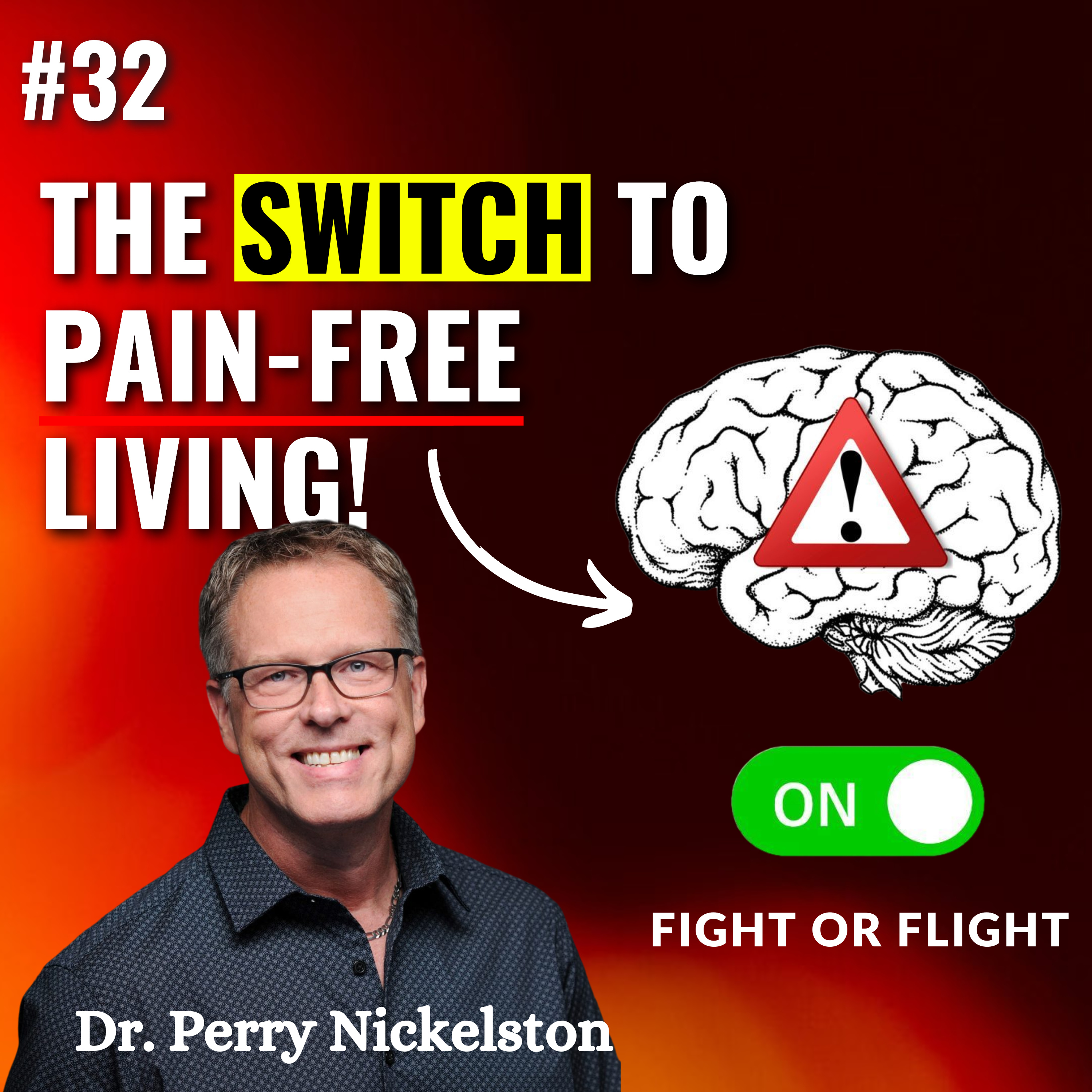
Dr. Perry Nickelston on Pain Free Living Techniques | Pain Science Explained | Chronic Pain Relief | Stop Chasing Pain | Big 6 Lymph Reset | Proprioception | Vagus Nerve | Holistic Health Tips
What's This About?
👇🏽 Dr. Perry Nickelston shares the Secret switch to PAIN FREE Living! 💥🧠 Explains the Science of Pain & enlightens us with Chronic Pain Relief strategies 🔑 Dr. Perry Nickelston empowers us with the anatomical locations of the Sympathetic & Parasympathetic nervous system! He provides us with simple and practical tools to turn the sympathetic nervous system off to allow healing, regeneration, detoxification & pain free living to occur 🤯
Definitely SAVE & SHARE this episode with a friend, this knowledge is extremely important & potentially life changing!✅
🔱 Eliminate Stagnation & Stiffness, Restore your Mobility & Function, Improve Blood Flow and take Care of your Fascial System with our Dynamic Stretching Routine Program! Only for limited time, you can get it at a 50% OFF ✅ with the code: GET50 at checkout 👇🏽https://www.mobility-fitness.com/dynamic-stretching-routine
👇🏽 In this Episode of the Fitness Wisdom Podcast we discussed:🎙️
• Understanding the Nervous System and it's different States• Polyvagal Theory• What things influence our Nervous System State• What happens when our Thoracic Spine is compromised?• Role of Nervous System on Blood Flow & Lymph Flow• Why is the Naval Region so important to understand?• Brain & Nervous System safety, Pain• Proprioception (Eyesight, Hearing, Taste, Smell, Touch)• What is Proprioception?• Important of Proprioception as it relates to Pain• Proprioception for Pain Management• Proprioception for Physical Performance & Motor Output• Influence of Lymphatic System on Pain• The Power of Stimulating the Vagus Nerve• The importance of Sensing our environment for Pain, Resilience, Body Awareness, Body Control...• Ways to cultivate Nervous System Resilience & Regulation
👇🏽 You can find me on my other platforms as well, as work with me1-on-1 Online World-Wide 🌎
📲 Instagram: https://www.instagram.com/andreas_david_christou/
🎙️ Podcast IG: https://www.instagram.com/fitnesswisdompodcast/
🌐 Website: https://www.mobility-fitness.com/
▶️ https://Youtube.com/@fitnesswisdompodcast/
🐦 Twitter: https://x.com/movementandreas/
👇🏽 Find & Connect with Dr. Perry Nickelston 💎🌐 Website: https://www.stopchasingpain.com/📲 Instagram: https://www.instagram.com/stopchasingpain/🐦 Twitter: https://x.com/stopchasingpain▶️ https://youtube.com/@stopchasingpain/
👉🏽 Find the Best UV + Red Light Therapy panels, Blue Light Blocking Glasses & Circadian friendly light bulbs 🚨Use promo code: MOBILITYFITNESS ✅ for 20-30% OFF your entire order 👇🏽
https://www.emr-tek.com?snowball=MOBILITYFITNESS
👇🏽 Here is the Methylene Blue I use 🌀🧠
merakimedicinal.com/MOBILITYFITNESS
Use promo code: MOBILITYFITNESS to get 15% Discount on all products ✅🧠
👇🏽 Find the SHILAJIT I use & recommend below ⚡
https://mountaindrop.com/order/?ref=5873
Use promo code: MOBILITYFITNESS for Discount on your entire order ✅🧠
Get yourself a personalised Nutrition, Training & Lifestyle Optimization Plan designed for Your Body & Goals! Work with us 1-on-1 ✅ and let's Transform your Body & Health from the inside-out! 💎 The Link is Below👇🏽
https://www.mobility-fitness.com/product-page/1-on-1-online-coaching
*None of the content / statements in this Podcast are Medical or Personal Advice & is not intended to cure, treat, prevent or diagnose any medical conditions. All my videos are for Educational & Research purposes only. If you decide to try anything discussed in this video, you agree to do so at your own risk & responsibility*
This is the Fitness Wisdom Podcast.
The Dynamic Stretching Routine is the ultimate program to help you eliminate stagnation and stiffness, helping you to restore fluidity and range of motion to your body. Some of the benefits you may notice by following this program. Reduce stiffness and tightness from your body. Improve blood flow. Improved passive and active range of motion, which is your mobility. Decrease your recovery time between workouts. Improve your body awareness and control and most importantly, to move better and more efficiently throughout life.
This program is for anyone looking to move better, recover faster, and feel confident in their ability to move their body. Join the Dynamic Stretching Routine program today and let's get flowing. Hello and welcome everyone back to another episode of the Fitness Wisdom Podcast. Today we have a returning guest, Doctor Perry Nicholson, also known as Stop Chasing Pain. We had him on episode #7 of the Fitness Wisdom Podcast where we discussed all about the the importance of the lymphatic system and how that relates to pain, swelling, and inflammation and how it's one of the most underrated systems of the body.
We also covered his own personal health journey at the beginning. So I highly recommend that you go and listen to that one before you dive in or after you finish this awesome episode. But on today's episode, we're going to be focusing on the nervous system, different states of the nervous system, what influences it and how that relates to chronic pain, you know, athleticism, motor output, proprioception. And we're going to give you guys some practical tools and tips as well that you can apply into your daily life to be able to, you know, transform your life straight away.
So welcome back to the show, Doctor Perry. It's a pleasure to have you. Thank you so much, my friend. It's wonderful to be back. Honored to be here for another episode. Thank you. Thank you, Doctor Perry. Well, you're such a wealth of knowledge and wisdom. I think that you are the foremost expert when it comes to, you know, to not chasing the pain. That's why your trademark is stop chasing pain. And I feel like that is one of the greatest message that you can give to people because most of the times where the pain is, that is not where the problem is.
And that's why I think it's so critically important for us to talk about the nervous system and different nervous system states today. So I would love for you if you give a basic overlay of what the nervous system is and the different states of the nervous system. And if you can weave in, there may be the Poly vagal theory as well. Sure, sure, I'd be happy to. If you actually care about your health, you want to stop putting and using toxic personal care products on your hair, skin, and in general your entire body.
Your skin is one of the largest organs of your body and absorbs pretty much anything that you put on it. The more aware you are about these topics, the better choices you can make for your health and well-being. This is why I only use blue hair wash on my hair. It comes with only six non-toxic, scientifically packed ingredients for hair health and potentially growth. It comes with none of the nasties and all of the good stuff that your scalp and hair needs to be healthy. Grab yourself some non-toxic and super effective hair wash and use the promo code Mobility FITNESS for a 15% discount as well.
Well, that's a deep rabbit hole right there, man. That's kind of like asking people what's the definition of pain? I'm like, how many years do you have? There's many of that. Yeah. Well, honestly, I could probably talk for a couple of years because I do love to talk. It's the thing about pain. Let me start off first talking about pain. You know, pain, it can mean so many things to so many people. And most often pain is equated with some form of punishment. And when you can just flip that definition of pain not being a punishment from your body, but as a very effective and sometimes really effective protective response because it's trying to keep something worse from happening to you by causing pain.
So maybe you'll stop doing something or maybe you'll actually start doing something differently. So that's like my definition of pain is it's, it's a protective output from the nervous system. It's hard to envision that and feel that when you're stuck in it and you've been hurting for so long. I get it because I was there 'cause you're in what I call the abyss or the quicksand of chronic pain, which is different than acute traumatic pain. And it's very important that I give that definition before we start talking about the nervous system, because the nervous system is going to respond different ways to what state of the pain you're in, like where you are along the journey that that's a really important thing for people to understand.
But pain is your, your body. And people say which part of the body? And my answer is yes, all of it requesting that you change something in your life because whatever is happening, it's is not working out well. And then people say, change what? Well, it could be a lot of different things, which can be overwhelming, which can actually make pain feel worse because you're just overwhelmed with so many options that you get paralyzed and you just don't know what to do next. But for me, the very first step in changing pain is doing what I already suggested, which is changing your definition of pain and your view of pain.
If you can flip the switch of punishment to protective, it's a different relationship with pain. And you're more so going to be asking your body. OK, I get it. Like you're trying to protect. Protect me from what? Yeah. Like and. And why so hard. So then the journey begins. It's it's like a if you name and blame body parts for hurting, you're gonna stay in chronic pain, quicksand. Yeah. You just can't get out of it. So let's talk about pain, right? First of all, pain is an output signal from the brain and nervous system.
It's not an input signal from tissues, even though it feels that way. So all this information comes up into the brain from everywhere in your body for your nervous system, what you see, what you smell, what you touch, what you taste, what you remember, what you think about the story you tell yourself about your pain will influence what the brain does with the output signal of pain. So all these things come into the brain. And then that's just information. That's just data, and it's trillions of bits of data.
Most of it you're not paying attention to because your autonomic nervous system, which we're going to talk about in a moment, is running in the background with the software. So you don't have to think about digesting food. It just happens, all right, So the stuff goes into the brain and then the brain has to decide, all right, there's a lot of stuff here, what do I do with it? And that's the output part. So there's this interpretation that has to happen in the brain. So every part of your brain wires and fires.
There's not one single part of your brain that's devoted to pain. It's kind of like all or nothing, right? You're either wet or you're not wet. It says no in between. So it just goes all over the place. And then the brain interprets the signals. And this is really important based on the prior signals that you got in your life and what you did the last time you got them. Like what did I do the last time I was in this situation? And did it hurt or not hurt? And if it hurt, guess what? It's probably going to hurt again because the brain remembers it never forgets anything.
And then it'll decide at that point if it should put out pain or not. Is it a big enough threat that Perry needs to be worried about this? So I got to hurt him so he's not going to do something stupid, right? Because the ultimate goal of your brain is for you to not be dead, because your brain doesn't work anymore when you're dead. So safety is at the top of the list and makes a huge difference in whether something hurts or not and for how long, Right. So then the signal goes out, and then it could be ouchy, it could be pain.
That's the reason why one person can have a stimulus and have pain. Another person can have the same stimulus and not have pain. You're like, that doesn't make any sense. Why not? Because it's not the stimulus. It's the individual response to the stimulus. Does that make sense? Yeah. So what I'm giving you right now. Yeah, I'm giving you right now a super power, and the superpower is holy cow. If stuff can come in and then this interprets it before it goes out, maybe I can change what happens in this space before it goes out.
Yeah, which means you can change pain based on how you think and based on how you choose to think about pain. So pain is that output signal. OK, so that's your nervous system, right? Is going to be. Yeah, your nervous system is really, really important, but it's not the only system that you have. You have other systems like the lymphatic system that we talked about prior. You have your blood flow vascular system and you have your immune system. So your nervous system will impact those systems, but it also works the other way.
Those systems will impact your nervous system. So that's the reason why when people had done the lymphatic work or tried to change lymphatics, they say, holy cow, like I feel more calm, I feel less pain, like I can move better. And I was just working left. And I'm like, first of all, you're never just working one thing, but when you influence the lymph, you influence your nervous system and vice versa. And then things start to feel better. OK, so now that we know that pain is an output signal, we can help train the brain to be better at doing what they call inhibiting pain, which means deciding whether you get it or not.
And your your nervous systems going to play a role in that. But you've got different parts of your nervous system right now. They're all important. Otherwise you wouldn't have all the different parts of your system. But here's the thing I want you to keep in mind. Even those parts are not separate, because guess who named all the different nervous systems? Humans. There's this system and this system and this system, and your body's like, I don't care what you call these things. You can give me 10 of them.
I'm still going to do the same thing. So the names don't matter. I just need you to know they all work together. Does that make sense? OK. Yes. So you've got, let's talk about the autonomic nervous system because that's going to be the biggest driver of people who have chronic pain, right? So your autonomic nervous system, pardon me, is the sympathetic nervous system. And many people have heard of that known as your fight or flight, You know, hang on for dear life. It's called hyper vigilance, hyper arousal.
You are switched on and you're not turning off and you've got your foot all the way on the gas pedal on your car to go as fast as you can either away from something. That's the flight part or the fight part, which says, OK, I'm not going to be able to run and escape, so I'm going to have to stand here and fight right now. You need that response because if you didn't have that response, you'd be dead kind of quick, right? So your nervous system says let's let's anticipate the worst here just in case something is not in our best interest.
Does that make sense? That's like preservation. And you're, this is really important. Your nervous system is automatically designed to look at everything in a negative light, not a positive light. Why? Well, because let's say you're walking in the woods, you know, in a strange place with one of your friends, and then you hear something rustling behind the bushes. So that's going to grab your attention and your sympathetics are automatically going to go up and you've got 2 choices. You can say, uh oh, there's something over there that I don't know what it is.
It might be be an animal that's going to have me for lunch. Your second choice is that's not an animal. That's just Bob who was late to the walk and then now he's showing up. Now your nervous system is going to say, you know what? I don't like my chances of it being Bob because if I'm wrong and it's the animal, I'm dead. So I'm going to look at this from a pessimistic negative perspective to say there's something there and it's going to kill me. And just in case, because if you get it right, well, you know, then then you live right.
But if you get it wrong, you're dead. Like you have only one chance to get it wrong. So the negative bias is built into human behavior. Anxiety is built into human behavior because you need to be anxious so you can move. All right. So knowing that, I'd tell people don't beat yourself up when you get anxious or when you are negative because that's just your program running to protect you. So there was a this guy named Robert Sapolsky. Some of you may have heard of Robert Sapolsky. He wrote the best book title ever created by man called Why Zebras Don't Get Ulcers.
And it was about stress. And the reason that zebras don't get ulcers is because they don't ruminate about what ifs, right? So they let stuff go. So if they're going to be eaten by a lion, they get away from the lion and then they shake it off and then boom, they're on to the next thing. Humans, first of all, one, they don't shake it off 2, they sit and they Stew about it all day long or for days at a time. And they keep themselves in fight or flight and then they make themselves sick. He said a quote that really stood out with you.
Your nervous system only cares about the next three seconds of your life. Think about that for a second. I'm going to say that again. I'm going to let, I want, I want this to sink in. And I heard that me, your nervous system only cares about the next three seconds of your life. Well, that makes a whole lot of sense because that's just survival, which means whatever it's doing in the moment it's in is a survival tactic. It's a protective tactic. It's not a punishment. One, you're not trying to make your life more difficult because if it makes your life more difficult, you die faster.
It just gets really, really, really good at keeping its foot on the gas pedal. So you stay in sympathetic mode. You are. You are supposed to go into sympathetics. But here's the rub. You're supposed to come out of it. And when you come out of it, then that brings you into the other side of the autonomic nervous system, which is called the parasympathetic nervous system. That's the one where you do what we call wine, dine, feed, breed. Now, that speaks for itself, but it means drink, eat, get together with people, talk, have sex, procreate, everybody's happy, right?
So that happens when you go into what's called a vagal response, vagus nerve. The vagus nerve is the most important nerve in your body to control what they call the inflammatory reflex, how well your body can handle and deal with inflammation. It's like a thermostat. Am I going to take it up? Am I going to take it down or does my thermostat get stuck? Does that make sense? OK, it's also the nerve that relaxes your whole body down and that nerve is a cranial nerve, which cranial just means head and skull.
It comes off the brain stem in the back. The brain stem is inside your skull underneath your brain, hence stem. Think about like a piece of cauliflower with a stem hanging on the bottom or broccoli like that, and those nerves come off and you've got 12 on the, you've got 12 on the right. So in actuality, you have a total of 24. The vagus nerve is cranial nerve #10 left vagus, right vagus. It comes some of the skull out of the skull, down your neck, down behind your sternum and to your abdomen, here to control a lot of your organ, what your organs do automatically digest stuff, you know, pooping, all sorts of stuff like that.
OK, so that's the vagus nerve. And I want you to think about the sympathetic, the parasympathetic, in two ways. Think of a seesaw on a playground. One goes up, the other one's down. One goes up, the other one goes down. And if you go up and you go down and you are with somebody really cool on the playground, you always each get to go up. And you like, this is fun, this is good, right? But sometimes you get on there and then one sinks down because somebody's too heavy, somebody's too light, or nobody's bouncing, and then you're stuck.
Yeah. So then you get what they call, I don't like the word dysfunctional at all. I like the word dysregulated. It's just it's not able to regulate itself. So it's stuck somewhere, right? And what you need to do is try to unstuck that, which is that my term for it. So the sympathetics, when you're stuck in that mode, it starts to break the body down over time because it's like putting, think about this way. If you put your foot on the gas pedal and you just keep doing that with your car, it's going to get you somewhere quick.
But what if you keep it on there for a couple of days, weeks or years? What do you think is going to happen to the car? It's going to wear out, burnout, right Now, how would you slow down the car? If you're in a car, you would take your foot off the gas, right? But that's the first step, which means you got to take yourself and try to remove yourself away from all these stressors in your life, which we'll get to. So that's a good thing. But what if you go on really, really super fast? Then you need to put your foot on what?
The brake, brake, brake. The brake is the parasympathetic nervous system that is the vagal system, the Poly bagel theory, the vagus nerve. So it's called a vagal brake, like the vagal brake is the term, because once the vagus nerve can engage, well, it'll put the brakes on the car. Put a brake on your sympathetic fight or flight so you can go. I'm going to chill out now. I can rest, heal and recover. But here's the rub. You can't and have your foot on the gas and on the brake at the same time because you're going to wear stuff out and you're not going to get anywhere.
And that's the same with your autonomics. You can't. You're either in one or the other. You cannot do both. And that's why people breakdown is because the parasympathetic nervous system is not the default mode for you. The default mode for you you is fight or flight. Why? Because this is my thing I tell people because it's hard to heal, recover and regenerate if you're dead. So those 3 seconds are just about survival. But in the world that we live in, there's no escape from that because everything is coming at you all the time from everywhere.
With so much sensory input, the sounds, the lights, the smells get on like TikTok for four hours. Your system is gone. You're toast. And then you mix the blue light into that thing and I don't know if you've been on social media yet, but people aren't really nice to each other that much. Then you get pulled into the threat response and you never get out of it. And here's the important thing that people need to understand. If you stay stuck in fight or flight, it is 99.999% impossible for you to heal, recover and regenerate and get out of pain and get well because you physiologically do not have.
This nervous system working well enough to do it and paint. So when you're in sympathetic dominance, it heightens everything. You become really reactive. That's the jumpy person, that's the PTSD. But that also when you're in that one of fight or flight, it changes blood flow everywhere. Blood flow, actually the pipes that control blood flow become smaller. They constrict. That's called vaso. Big fancy word is vasomotor tone. That means my fluid pipes of blood flow are not big and flowing well. They're smaller and tighter and they don't work as well.
So that increases blood pressure as well. Yeah, and you're going to get a lot of pain from that too, because you're going to decrease blood flow long term over time. And when you have decrease in blood flow, pain's going to show up. And you're also going to be more sensitive to stimulus. So things hurt more, More things pain hurts. You're also going to increase the activity of your immune system. Well, why would that happen? Well, if you're in fight or flight, your nervous system is anticipating that during this fight or flight, you will likely get hurt.
So it's going to increase the response to potential harm, right? Like a fight Or you may get hurt when you're running, which happens in every movie because everybody falls when they're running from the slasher, right? So it heightens that up. So listen, that those are good things, man. But if they stay up there too long, what happens? You get immune system depression. It actually gets inhibited because it's just, it says, man, I'm just tired. I can't do this anymore. I'm shy. And then and now you're more vulnerable to everything and you will absolutely change your breathing patterns when you're in fight or flight, which means you'll do one of two things most often.
You'll over breathe, which means you breathe too many times per minute. That's what it is, OK? And you're probably going to be breathing with your mouth gaping wide open at the same time because you're panicking. And then that is not going to work out well for you, OK? Or you're so panicked that you don't breathe, so you stop breathing a lot. And either one of those is going to set the stage for chronic pain. Because when you change your breathing, you change blood chemistry, which is the amount of oxygen and CO2 in your blood.
And you need those things because without oxygen, you're going to die quick. And without oxygen, stuff is going to hurt, right? Stuff is going to hurt. So the number one goal that I, I have when I work with people, is this, OK, I got to pull you out of fight or flight. The part that sucks kinda is when you're in constant pain, it keeps you in fight or flight because stuff hurts. You can't turn off. And then you're like, well, which one came first? Well, it's, it's a mixture of both, right? It's a mixture of both.
Now, this is important where I have to talk about acute pain to chronic pain. I know I'm, I'm still talking, but like I told you, I could talk for a couple years here. Now, let's say acute pain, right? Like something happens then life because you're supposed to have pain. You need pain. Let's say I twist my ankle and then I'm going to have pain in my ankle because I probably had some damage to the ankle and then everything's going to happen to try to fix that. It's going to swell up. It's going to try to spend more bloat flow there and it swells up because the immune system is trying to protect stuff and kill it, right?
That's the repair process. That's good. And that's going to hurt. That's good. That's what you want that right, That's a cute pain. And I absolutely, positively want you to go right to that ankle and start treating it right. So the thing I have to tell people is it says stop chasing pain. It doesn't say stop treating it. So when you have an acute thing, well man, you go right after that sucker because you're supposed to with anything you want. And but here's the rub, man, when you do that, it should get better and stay better.
That's the goal. Now, some, some people might not do anything and they do this wonderful habit where they ignore stuff until it's really, really, really bad. So the body is sending all these whispers to you slowly over time and you're like, ah, shut up until it screams and then you can't ignore it anymore. But let's say you treat that ankle and you're doing everything to the ankle man. And I got my rehab and I do all this stuff and this should be really, really good, right? But it's like 3 months later and you still have ankle pain.
Completely different animal. You've moved then to the next bucket, man. Not even close. Which means it's now become chronic. When it becomes chronic, it's never ever, ever going to respond to isolated treatment because it's expanded now to more of the body systems overall that are involved now. How do I know that going after it is not going to fix it? Well, it's been 3 months and it's not fixed. Like what more do you want to do to it, assuming that you diagnosed it? Like like if you miss a fracture or if I miss a tumor in there?
Well, then you have to get your right diagnosis to make sure you didn't miss something because of course it's going to hurt. So that's why it diagnosis it. But those are the people that are like, it should be good, man. They don't see anything on here. But I can't still can't move. So then you have to remember, wait a minute, that ankle is attached to all these other parts of the body as well that I should be looking at. And this is what I tell people. Let's say you get a twisted ankle, right? How well you recover from that injury depends on the state and function of your nervous system and all your body systems before you twisted your ankle.
So what were you like before you got hurt? Because what I'm going to tell you is this, If you were stuck in fight or flight for 10 years, you have poor lymph flow, you have poor blood flow, you don't breathe well and you eat like crap. You're going to struggle more than the person who doesn't because your systems only have have so much to work with and they can only do so much with the hand that they're dealt. And you get what you get, right? Because that makes sense. That's why for me, it's never an isolated injury problem.
No matter when it happens, I have to look at the entire individual. And we start with that nervous system. So I'm almost done. You've got your sympathetic system and you've got your parasympathetic system, and then you have another part of that subset called your enteric nervous system. Your enteric nervous system lives in your gut system here and that's that kind of like sixth sense gut feeling things. You just feel butterflies in here that tick off when something just doesn't feel right. Like I met this dude and I'm not getting a good feeling that's that's the enteric nervous system.
So all of them are working together and what they find is the enteric nervous system actually has more neurons in it than any other system in your body. Like that's the powerhouse that enteric nervous system. So you need to pay attention to that. And it's also, if you remember, that's where most of your lymphatics live, right? So that's kind of super important. So if your lymphatics are trash, your enteric nervous system is trash because they sit right next to each other. So all these sympathetics and parasympathetics and enterics worked enteric work together all the time in the background making stuff happen so you don't have to think about it, right?
And then that will communicate with the peripheral nervous system when peripheral just means the stuff outside, like stuff in the arms and the legs. And what's interesting, they consider the cranial nerves part of your peripheral nervous system. Like for me, I don't care what you call it, zippity, Doo, dah, whatever name you want, they're all together as one, whether it's autonomic or peripheral or the last one is central. It's called your central nervous system because it's what in the center, more central.
That's your spine. Yeah, and your brain here. But if you think about that, that looks just like a tree. You got, you got a trunk and you got branches and then you got leaves. So everything in nature has the same layout if you just stop long enough to see it. And then you have to look at all these different systems when you have chronic pain. The last thing I'll end with before you ask another question is, is that when you have chronic pain, you must absolutely now look the central nervous system, brain and spinal cord and the autonomic nervous system in order to get yourself well.
You cannot get well now by chasing the painful body part. It's way beyond. That's why. OK, I'm going to take a breath now. I've been using red light therapy for many years now, but only since I started using EMR Tech red light therapy panels did I really start to notice the true benefits of red light therapy. I'm using EMR Tech's fire dragon pro and the inferno pro. I noticed better recovery from workouts, improved skin health levels, improved eye health, improved sleep quality, and pain reduction.
I can safely say based on my experience that EMR Tech has the highest quality panels on the market from build quality, functionality, and the aesthetics. Don't take my words for it. Grab yourself a panel from emrtech.com and use the promo code Mobility Fitness for a massive 30% discount. That was a fantastic layout. Thank you so much, Doctor Perry. Well done. That was that was really, really great. And I think why this is so important for people to understand, especially who are in chronic pain.
Well, there's a lot of individuals these days who are stuck in chronic pain because there are so many things that are stimulating our sympathetic nervous system, which you mentioned quite a few during this whole discussion. You said the artificial blue light, you know, the dopamine, you know, from the devices. Also if our gut maybe microbiome as well is off, that can also to affect our immune system and our enteric nervous system like our lack of sleep and stress. So all of these things that are putting us in a state of fight and flight is inhibiting our ability to heal, repair and regenerate.
And because of the bodies saving all of its resources to keeping us alive, there is not enough energy and resource to go towards healing, repair, regeneration and detoxification and basically to thrive right? So thriving only occurs in a parasympathetic state. And I just, I had the discussion with one other guy on my podcast. He's a was a breathwork specialist and he was saying how we're supposed to spend the majority of our time and day in a parasympathetic state. And only in very few instances are we supposed to be in a sympathetically dominant state or sympathetic state.
And that is very, very true because if you think about it, if you spend, if you take the 24 hours and the majority of the hours in your day are more of in a sympathetic state, well, when does the healing and the regeneration and all the good stuff occur? It doesn't, right? This is what you're saying. So now I think what would be really good is if we talked about maybe if you have something that I missed, things that are actually influencing our nervous system states are beyond breathing and blue light and non-native EMS.
Well, there's a lot of things in our environment, but is there something that could potentially be putting us in this state that we are not aware of in the sympathetic state? Yeah, that's a good question. And I love all the points that that you make because I always kind of give this example for those that might be watching on can't people, will people be seeing a video of this or? They're absolutely yes. OK, so I tell this to my clients. Is that this bottle only hold so much water that's called the tolerance, its capacity or we can call this with, you know, as your allostatic load how much water can hold this.
And I want you to now think of the water as stress. You have the capability to tolerate and handle stress. So stress is not a bad word, just like inflammation is not a bad word. If you, if you didn't have inflammation, you would die sooner. It's just your capacity to tolerate the inflammation and how much you're getting. It's the same thing with stress. The way you become a very resilient hashtag beast mode monster human is to put yourself under stress, but then be able to heal and recover from the stress so you can tolerate more stress.
So that's, it's called resilience and you only get there through hardship. You're not gonna get there through comfort. That's why people make the biggest changes in their life through some type of pain and suffering that they sometimes, most often actually willingly don't ask for. But that's what survival is. Okay, so you can add to this with whatever you want, which means that you can put water in here or I can put kool-aid or orange juice. I don't care what you put in here. It's only going to hold the tolerance.
So now make that part of your life. And this is stacking up over your life. This is the job that you can't stand. This is the the yoohoos and pop tarts that you're eating for breakfast. This is your toxic relationship that you have maybe in a marriage or a relationship, or how about this one, the toxic relationship that you have with yourself because you hate yourself or you're ashamed of yourself or you're beating yourself up because you can't get out of pain. And then you start blaming stuff. That's a big one.
It all adds up. And then the breathing and then the breathing is, but look, it's still in the bottle, right? But eventually it's going to get really close to the top. And then one thing is going to happen. Like that's the time that hey man, all I did was go out and do my big run or I went to the gym and I had a great workout session. Well, guess what? Those are stressors. Those are also stressors, but that's a good stress. But for you, your tolerance level wasn't there. So you no longer have the capacity to tolerate that.
So this is the person says, and the next day I woke up is when I couldn't move and I had pain here and I had pain there and I got diagnosed with every autoimmune disease on the planet. And that's the answer to why. Why was I good yesterday and then today I'm not? Because this thing builds up over time and that's why you can't just rub a body part and have it go away. You have to look at all the different things that go into the bottle. But when you do it the right way and you get resilience, you know what?
You get a bigger bottle. Bigger. Bigger bottle. Yeah, like now, now I start off with this, then I got hold a gallon and then you're like bring it man. I got this right. So you have to work with your nervous system to calm it down. And what you need to understand is, is that everything you do in your life, whether you consider that good or bad, because you've already labeled it something that can stress you out. Because that's all subjective anyway. Like working out to me is good. Working out to somebody else is hell.
So it's all this interpretation. I'm back to it again, right? Even your therapeutic interventions are stressors. I would like to repeat that. Even your therapeutic interventions are also stressors, which means that you could be doing a lot of stuff to try to get yourself well, but you're doing too many things to a system that doesn't have the ability to put any more in the bottle. That's the person who overdoes therapy. And I know the person who overdoes the therapy because they're the type A person that has sympathetic dominance to begin with because they want to go monster mode on everything, which is a great trait.
Like that kind of person changes the world and they get things done, but every car has a limit before it breaks and that you have to break that pattern in order for you to heal and recover. So one thing I tell people is, is that watch how many things you're doing in your life to try to keep get you out of pain or keep you from getting in pain because you just may be overtraining yourself. Yes, I see that all the time in the gym. I get people work out six days a Week, 2 hours a day, and they're they're right on the verge of something or they're sick all the time and they have aches and pains and they just push through it.
That's going to come in and that's going to pull you into the deep part of the ocean with a cement block you're going under at some point, whether you want to or not. OK, So that's one of the biggest things that's elusive. Check the stuff in your life that you are checking off as good, because that's subjective. And then check your dose. They say the dose is the poison, which means, yeah, this is good to a point. But if I give you a little bit more than it's toxic. Yeah. All right, so that's for medicine.
One pill is great, 5 is not. It's the same thing with working out. When I teach people the big six lymph reset, I get it all the time. Hey, Doc, can I do that like five times a day? Yes, But no, I don't want you to do it five times a day because you don't need to do it five times a day because once a day is plenty. Yeah. Excuse going to overload the system right now. That's also why lymphatic flow and blood flow is so important, because when you have slow flow like that from sympathetic dominance, that actually keeps feeding the sympathetic dominance.
OK. Yeah, because you're starving tissues and that's going to freak them out because you're restricting. You're restricting what the cells need. The cells are saying, hey, you know, Perry, I need like, a lot of oxygen here, man, can you help me? Can you help me out? And then oxygen is only going to get to the cell through the blood anyway. So if you, if you don't have good blood flow, it's going to be really difficult to get oxygen there, right. So that is important too. So that's why I go after these flow routes because most people don't pay attention to them, but they don't, they only pay attention to blood flow and stuff around areas that they're trying to increase or decrease stuff through heat or ice or stem.
They're, they're isolating stuff. They're not looking at the full piping system underneath everything. And then that's when I started to think about this. I started to just look at the beautiful, miraculous layout of the human body of all these different systems. And I said to myself, OK, if I want to try to change these systems, it would be a really good idea for me to learn where these systems live in the body. Where is the anatomical, physiological region where these areas that are part of the sympathetics, enteric and parasympathetics live?
Because if I find out where they live and I can do stuff to where they live and change the blood flow and lymph flow and movement in motion and less tightness and tension and restriction around those areas, maybe those areas could work better, right? Because when you have a lot of tension in your body, it slows down everything like everything slows down because you're too tight, can't move well, can't breathe well, blood flow doesn't move well, lymph flow doesn't move well. You're a tight, rigid mess.
That's what fight or flight is like this man. Chill, like relax, but it's very hard to take yourself out of flight or fight or flight by using your mind to do it. That's the person who says I just I can't do like the therapy or I can't meditate. And I'm like, I know you can't because when you go from from fight or flight into meditation where it's total silence, that actually is very life threatening to a lot of people because it's too quiet, right? Because then you're like, OK, what's going on?
That's like driving with your foot on the gas and then all you do is put your, you slam on the brake, boom, you're going to crash. So that's where what happens is, is that you can't go from that immediate fight or flight for a lot of people to just sit down and have. 15 minutes of breathing and let's talk about your stress. They're gonna say no or they're gonna do it and they're gonna go. They're gonna get worse because the body just wants to flee away from that. So that's why you have to move in slow.
But then I'm like, okay, if I know where these things live, I'm going to do a lot of stuff to those areas with my hands or with exercise and motion. So let's talk about where these live. You want to talk about where these live because this is a change of life. Absolutely. So let's talk about the parasympathetic system. That's the wine, dine, feed, breed, chillax. You know everything's good. That's going to live in a couple of places. It lives in your sacrum, the bottom of your spine. You have what's called your sacrum slash tailbone and these nerves called S2S3S, sacrum 2, sacrum 3, sacrum 4.
They're the parasympathetics. They're going to really send a lot of signals down to your abdominal region, around your genitalia and your colon. The reason is, is because yeah, yeah, yeah, go ahead. I was going to ask you because I remember in the past, my partner Tina, she got some therapy by one body worker and she was, I believe, stuck in fight and flight, but I didn't understand what the body worker was doing and they were manipulating her tailbone. So is that maybe what they were going after?
That's exactly what they were doing. Because what will happen is, is that that S 2-3 and four, one of the biggest roles that it's going to play is it's going to relax the digestive system down so you can have a bowel movement like you can poop. Wow. Because it's virtually impossible for you to poop when you're in fight or flight. And that makes a lot of sense, right? Like, when are you going to stop and poop? When you're running from the tiger? You're not because you're dead. Yeah. So. So what happens is when you're stuck in fight or flight, digestion process slows down almost completely.
Right. And we'll get back to that when we talk about sympathetics. So when you work the sacrum like that, you automatically put your body into a hey, this is good, man. He's on the right spot. That's good. And then the other place that is in the cranial nerves on the brain stem. Yeah. All right. We, we said you had 12. Yeah. It's going to live in a couple of them. Cranial nerve #3 which controls the eyes. So that's why if you move your eyes a lot, you can calm the body down. And that's also one of the biggest reasons why a therapy called EMDR works so well.
If people heard of EMDR, it's moving your eyes in different positions to put you out of PTSD into a more relaxed state. So eyes are tied to relaxation and fight or flight. And what's interesting, up to 80% of your brain is devoted to vision, which means you see something and then the rest of your brain has to interpret, what the hell did I just see and what do I do next? So we're very visual creatures. Then you got cranial nerve number 7, and that's your facial nerve. And the facial nerve is the nerve that supplies your facial muscles so you can smile and socially interact with another human being.
That's why we're hardwired to read faces. So I can see from your eyes and your face if you're friendly or I have to be. I have to watch out for you. That's another reason why social engagement. Yeah, that's why social engagement is so such a part of therapeutic healing. And it's part of the Poly vagal theory of the Vegas term social interaction. So what happens if you don't have social interaction? You're going to be in fight or flight. And there was a lot of that happening when the pandemic hit.
Yeah. Right, so you can change a parasympathetic state by changing how you move your face. So you just, you just make you do freaky things with your face. Like I tell people, I mean, I want you to make the weirdest odd looking freaky faces you've ever seen before and just do it. And first of all, you're going to laugh because you're going to feel ridiculous. But then you're going to say, wow, I actually feel a little bit better. I know you do because it's just Physiology. You're just using those muscles.
And then if you can do it with another person you feel safe with and comfortable with, then it's going to be even better because you're both going to be on the 4 rolling, having a good time because how much fun it is. So using the facial muscles, right? But the facial nerve also supplies the taste to the thumb. So that's why you can put things on your taste and taste something going, this is really nice. I like this. I feel comfortable, feel nice. Then you've got, so it's #3 #7 then you got #9 is the glossopharyngeal nerve.
Glosso means tongue, pharyngeal means pharynx. So that's why singing works so well, because you're going to be using your tongue and you're gonna be using your pharynx, larynx here, all these noises. So I have a good idea. Make freaky faces and make freaky noises, right? And then you have #10 and #10 is your vagus nerve, cranial nerve #10 and that's the one everybody talks about #10 but you can really powerhouse Dr. the 379 and 10 together. So what I'm telling you is if you can do something for #3 which means move your eyes in different directions #7 make funny faces #9 make funny sounds, and #10 is the vagus nerve, you can get that quite well by just belly tapping as you do all those things.
OK? And then you tap and you slap your sacrum after that, because that's the other. So then what will happen is your parasympathetics will go, hey man, I hear you, I'm good, I'm coming, and then you can relax. Does that make sense? Do you have any questions on that before I move to sympathetic? Struggling with gut tissues Did you know that your circadian rhythms and the type of light you're exposed to massively influences your gut health and microbiome? The gut heals and repairs itself at night in the absence of blue light and in the presence of melatonin, another essential reason why you should be blocking and minimizing blue light after sunset.
Artificial blue light activates the sympathetic nervous system and keeps us stuck in fighting flight. We cannot heal and regenerate in a sympathetically dominant state. Artificial blue light has been known for contributing to gut dyspiosis. On the other hand, UV red and near infrared wavelengths of light have been shown to positively influence health and diversity of the gut microbiome. I will highlight in detail in the description what all the different wavelengths of light are doing to your gut.
A healthy gut in microbiome is essential for brain and mental health, energy levels, metabolism, digestion and absorption of foods, skin health, robust immune system response, inflammation, nervous system regulation, weight management, and so much more. This is why I make sure to get my belly and entire body out in the sun every single day as well as use my favorite red and UV therapy panels from emrtech.com. Check out the panels that I use on a daily basis to improve my overall health and well-being, and use the promo code mobility fitness at checkout for a massive 20% discount.
No, that was all really fantastic. I mean, those are all just really simple things that if we live in alignment with as we are supposed to be in, you know, in nature and we have the social interaction and engagement and we move in different ways in different environments, and we experience life as we're supposed to without this extra stress. We are activating those nerves without us even thinking about it. But now, because we're living in a modern world, which is constantly driving that sympathetic state, we're now needing to find strategies and ways, which you have just given us that we can just simply add in our life, which are super simple.
It doesn't take long at all. And people can just immediately start to feel better. That's, I mean, everything that you said is so true because I do a lot of those things automatically before you even mention them. Like for example, if I spent a lot of time on my computer afterwards, I find that all of a sudden I'm sticking my tongue out and I'm looking up at the ceiling like this. For some reason, it just makes me feel better and I do these weird things and or, or maybe I'll just shake off my arms and I'll, you know, twist the belt or something or jump up and down.
And it's almost like an animal which is getting away from a threat. You know, they're taking off that sympathetic activity now. And I'm just bringing myself back to baseline because I just know where my baseline is. Many individuals have been stuck in that fight and flight for so many years that they forget what good feels like, right? So they think that feeling bad is like they're normal. So they don't know what good feels like until they start to feel better. And then they realize, Oh my God, all this time I've been stuck in this state and I didn't even realize it.
So those were really fantastic tips. I think now you were going to move on to the the sympathetics, weren't you? Where those are located? Yeah, I'm so glad you brought those up because you're very in tune with your body and you, you have an innate sense of things. But so many people are today are detached from their body, living outside of it. Very often there's a lot of resentment towards the body or your pain or how you look. And I can tell you now that's not going to workout well for you and the healing and recovery department.
And the only time that they actually pay attention to their body is when they get the attention signal, which is pain, right? Because pain is the last thing you feel, not the first. This is unless it's acute, like if I hit you with a baseball bat, that's pretty simple. But you know, if it'll say I hit you with a baseball bat in your knee and it hurts, that's that's an easy 1:00. What if your knee starts hurting today? It didn't hurt yesterday. Your body was trying to use all these different solutions and strategies to prevent that knee from hurting for a long period of time until it ran out of options and the only option left was pain.
So, you know, you're deep layered in compensations. You're gonna have to peel back because it's probably not the knee. I mean, there might be damage at the the knee, but then you have to figure out why did that happen? And that's from the previous layers, you know, that came before. And when you're stuck in hypervisilance, fight or flight, you just become like a hot, inflamed sensory thing where sometimes you just don't notice differences in anything. So I always give people this example. A neuroscientist taught this to me once.
It really stood out. Think about going into a really bright room and it's a lot of stimulation and then somebody is standing behind you and then they turn on another light. In the really bright room, you're probably not going to notice that other light because there's so much light if you're over stimulated. OK, but now let's take it to where you're in a dark room and somebody turns on a light, you'll automatically see it because you're in that state. There's enough of a change in the stimulus. When you're when you're sympathetic, you're over stimulated.
It's very hard to notice differences in them, where in the body and when it's hard to notice differences, it's very hard for your brain to to move well. It really can't sense the difference in all the body parts. Does that make sense? And then you're more prone. First of all, you're going to get a lot tighter that way, but you're much more prone to an injury. And if you ever looked at really great athletes, they're not stiff. They almost look like they're fluid, like they're relaxed because you can, you can get over stiffness and that's not going to work out well.
So you've got your parasympathetics right there. You just learn ways to put your foot on your brake for you. And then let's talk about the gas, right? So the sympathetic system to me is the most important system because like I said before, it controls vasomotor tone. It controls the size of the pipes that move all the fluids in your body that you need in order to get everything that your cells need to recover. And also it controls the size of the pipes that are removing the waste from your body.
So you want good pipes like you really want pipe. If you're stuck in fight or flight, I'm going to tell you your pipes are trashed, right? That lives in one place right now. Part of it's going to live in your brain through what's called the HPA axis, that hypothalamic pituitary adrenal axis, like hypothalamus up here, pituitary gland up here, adrenal glands down below. So they're going to be a lot of this what like hormone response, right? But these are glands, glands, and because they're going to release out hormones, but glands also need nerve flow and they also need blood flow.
So you have to look at the nerves that go to the axis you follow. The only place they're coming from is your spine, man. That's it. All right, so you've got your cervical spine and you got 7 bones up there. Cervical 123-4567 and then you have a transition into your thoracic spine that's that big long one in the middle and that's T1 through T12. We've got 12 of them. And then your ribs, your rib cage wraps around that, right? And then you have your lumbars. Most often people have 5:00, but some people have extra ones.
There's different variants. And you got a lumbar 12345. Those are the ones that everybody herniates, right? And they get low back issues. And then you have your sacrum. And then at the bottom you have your coccyx bone, your actual tailbone, your sympathetics live between thoracic one, which is basically at the big giant hump above your shoulder blades in the middle of your back that you see sometimes the older ladies have, or people with poor posture where the heads forward and they're really round and they get a big giant hump, yeah, called Dowager's hump.
That's that C7 cervical, cervical 7's last T1 region. So the sympathetics live between thoracic 1 and lumbar 2T1L2. That's it. That's home. That's home base. That's the master breaker switch. And then what what happens is, is that all those nerves will send signals out to the nerves up in the neck, and they'll send them to nerves that are down in the lumbars called the lumbar plexus. And then they'll send those signals to the legs, like to your feet, your calf, stuff like that, right? But they all originate from thoracic 1 to lumbar 2.
That zone controls the fight or flight for your body. So if now I knew that, I'm like holy cow, that's like really big. Because a lot of people don't do anything for the thoracic spine because it very rarely hurts. Most people get pain wear when they have spine pain. Lumbar. Low backs, kind of top of the list. Low backs, a big one, and then the cervical spine and everybody treats there. And that's OK, you should, right? But what I'm trying to tell you is the low back and the neck are going to be beholden to the mid thoracics here.
And the thoracics are actually supposed to have the most mobility and motion of your entire spine because the simple reason is you have less movement per vertebra, but you have more vertebra you follow. So it's just by sheer quantity and it's supposed to have really nice amount of rotation. I think it's like 2°, maybe 3° rotation per segment. I don't. I don't really know. It's arbitrary to me. But they should rotate and of course they flex and extend. But when you look around in the world today, how many people actually rotate anything?
Yeah, like never only walking if they actually walk. Yeah, well, that's it. That's the actually is the important word there, because if they're walking, they're usually walking and doing what? Looking at their phone. Yeah. So their arms are here and they're not. Yeah, their arms are stuck here and they're hunched forward so they can see what they're doing. And it's really hard to see your screen and rotate at the same time. So you're not going to rotate. If anything, you've got a more like shuffle your body and you'll go more into what I call the human cashew nut position, which is flexion, like slumping like this.
OK. And so everything in that middle back gets decreased motion and gets tension and tightness. That's not going to work out well because running all along that area. OK. Or your sympathetic nervous system, this goes, it's called paraspinal because it's like running along your spine, right where the ribs are. So that's another reason why breathing is so important because you move ribs a lot. Yeah. Breathe. So just by getting better motion in your thoracic spine, particularly rotation and improving your breathing pattern works great.
And my other two favorite forms of treating that area are red light therapy on T, well, two, and then using vibration, particularly direct. It's called localized vibration therapy, LVT. So yeah, you can stand on a plate. I get this question all the time. Doctor, you like vibration. I love vibration of all different types. You can stand on a plate and you'll vibrate everything, but that's the whole point. You're vibrating everything. I need you to be specific. So I tell you to do localized vibration therapy to L from T1 to L2 with vibration balls, which is why I have that product.
It's one of the only products that I make because I like it so much. And then what it'll do is yeah, when you vibrate stuff, stuff moves, including the joints, but including the blood flow. But you're going to actually calm down. Here's the thing, you're going to calm down the fight or flight. So when you have, let's say this, you have pain in your leg, right? Well, there's a lot of things that can contribute to the pain, but I want to look at my fight or flight relaxation system first. So then I'm going to ask you, well, where does the nerve supply for the sympathetic system that controls blood flow, which will then control whether nerves hurt or not?
And in your leg. And then that's when you say my lumbar spine. And I'm like, yeah, but where does it start before that? Yeah. So you're still back to the same thing. So here's what I tell people. That's the person who treats the leg, leg, leg, leg, leg, leg, leg. And it's not getting better. And that's when you have to say, well, why the hell not, man? Like what? What's up? And then that's when you say, oh, I'm more than a leg. Yeah. And then that's when I said. And he said, what are the autonomics to the leg?
The parasympathetics and the L1L2 or the thoracics, because I want you to hit the whole thing. Then when you go and relax those, you change what everything that the leg is doing, right? And then you'll calm the whole body down. And when you calm the whole body down, guess what can ease up? Pain. Pain can ease up. And then when you calm, when you calm the whole body down and things relax and you improve your breathing and you change blood chemistry, you improve blood flow. Would you agree with that?
And then everything functions better with better blood flow. And but you're here's here thing and then I'm going to wait and see if you got a question is that you're going to improve blood flow to the body part that hurts for sure, but you're also going to improve blood flow to your brain. And when you improve blood flow to your. Brain, your brain functions better, which means what your brain will likely be more effective and efficient at now inhibiting pain for you because it has better blood flow.
That's kind of a big win right there, like a super one. And very what irritates me sometimes about the world is it, yes, we know the importance of the brain and we do brain science and we do neuroplasticity stuff and I love that. But people just go brain. And then there's people that have like a body part that hurts and they'll just go body part. I want people to always do both because The Dirty little secret is it's always both, whether you realize it or not. And then that's how you have to think when you have chronic pain.
You have to think bigger picture. You have to think what the ultimate goal of your body is, which is protection. And then you have to just step back and ask itself, OK, what kind of solutions are you trying to use here to help me get better? And where might you be stuck? And how can I give you better options and make this easier for you as opposed to blaming it? And your chances of finding an answer significantly increase. Now, it doesn't mean that everything is unicorns and rainbows and then pain always goes away.
But what I will contend is maybe you'll suffer less today than you did yesterday. You'll have less episodes of that. You'll have more episodes where you have a little bit more freedom of emotion and movement and more joy in your life. Because here's what I do know. If you have that poor blood flow and you have your fight or flight and you're not doing things to try to take it out of that, you will forever be in quicksand. Absolutely. So basically like what you're saying is that you know the cool things and tips that you just gave the strategies for people to turn off those sympathetics and they and activate the parasympathetics.
Basically what it's doing is helping to basically reset the body in a way to reorganize itself, relax the muscle tissue, you know, the musculoskeletal system, which controls a lot of the blood flow and the lymphatic system flow as well. And we know that the Fascio system as well is, is wrapped everywhere around the body, right? So if the muscles are tight, the fascio system is tight. Therefore our mobility is restricted. We're not able to move as well. We're not able to breathe as well. So going after the basically the foundation, the root of what you were just saying of these systems, the sympathetics and activating the parasympathetics as well is going to allow us to come into this more regulated state for to be able to initiate some healing, right.
So I think the next step that I would like us to move into would be how like proprioception plays into all of this. You kind of talked about proprioception quite a bit in giving a few of these examples with the vibration and the, and the eyes and the, and the touch and all this. But basically what I'm thinking about is how can we bring a sense of safety to the nervous system through our daily life acts and habits? Like, you know, that primal movement, for example, which is a course that you also teach is a way to influence, you know, the proprioceptive system to help our body is to feel a sense of safety, how to feel safe, you know, from its environment.
So how does that all work, if you could explain to us? Like how does the brain start to feel safe by receiving all of this information from the environment? That's a great question. Let's see how I can layer this. Let's kind of cover what proprioception means anyway. OK, so your body uses sensory systems to help Orient itself in the world, and there's the primary ways that it does it. One of the biggest ways is what I see. So I'm going to Orient myself to the world based on what I see or what I'm anticipating on seeing.
Does that make sense? So that's why it's very easy. It's very easy to trick the brain with what it thinks it sees and just think about magic or those magic eye things that holy hell, oh, there's the fish, right? So it's very easy to manipulate. Actually, I use the word manipulate because you can really do that with people. Yeah, Yeah. And there's nothing wrong with tricking the brain either, you know, like, because if I can trick the brain that you have less pain, that's good trick, right? And then the other one is your balance, like your best.
It's called your vestibular system or your inner ear. And then that system tells your body where you're going and which way is up. That's why you get disoriented if you spend in a circle. Yeah, yeah. You ever see those videos where they have somebody lean over and put their head on a bat and spin around and then run? That doesn't work out well. Or you get motion sickness on a, a boat because what happens is that your eyes don't match up with what the inner ear is sensing and then you get a mismatch and then that's a threat response and you can throw up.
So that's why people who have inner ear balance issues or vision issues with poor vision or not the same vision or they don't have good balance in the eye muscles. That's a lot of information coming into your brain that is not, that's not accurate if you will, or it mismatches. Wait, this doesn't match this. That's very threatening to a nervous system when it doesn't quite know where it's at. You follow that. That's why distributor issues and eye issues keep a lot of my clients stuck in fight or flight no matter what they do to get well, because nobody ever checked those systems.
And an easy way to check that one system is just try to stand on one leg for 20 seconds with your eyes open and see if you can do it and then switch to the other side. And then if you can do that, well, not many people can, by the way, and do it with no shoes on, then try to do it with eyes closed and then everything falls part. So you have eyes, then you have vestibular system. And I know this is like a roundabout way to get to the proprioception, but I have to do that because proprioception isn't the only thing that you're using here.
Proprioception is like what you sense with your body when you move joints, it can be touched like this. OK, so that's also feedback coming in. So that's a person. If you have good movement and mobility in your joints, all of them, but particularly that spine, that's a lot of good proprioceptive sensory input into an area. And same thing with why walking barefoot is so great, because you get a lot of good proprioceptive input into the bottom of the foot. And most people don't feel things in their feet because the feet are trapped in darkness and coffins called shoes and they're not exposed to the world.
So I'll tell people wearing shoes is like wearing gloves all day long. You're not going to really get a sense of what you're feeling. So that's why mobility work and joints work so well, because if if joints don't know where they are with your brain, they get a lot tighter. They get you get stiffer and you say why would you get stiff if your body has poor proprioception? Because the body doesn't know where things are. So they keep you safe. And a classic example of that is let me put you into a room that you've never been in before and I'll turn on the lights and you just walk because you know where you are now.
Let me put you in another room that you've never been in before and turn off the lights. How Well you're going to move. Yeah, not well. You're going to be be really slow, you're going to be really tense, you're going to be really tight. And that's what's happening with your body because you've turned the lights off around your joints. But it's not that's not the only place that you have proprioceptors. You have them inside the body too. They're around everything. They're around your fascia, they're around your lymph nodes, they're around your arteries and your veins and your cells.
It's called the extracellular matrix. They're around your organs. So that's why when you you can get great breathing and you get better movement in your organs or you just shake your body, you help that proprioceptive input into all these different areas. And then that's really great feedback for your nervous system. And that's the person that when you can see things more accurately or more efficiently, and you have good inner ear balance and you have good proprioception, your body will allow you to have much more freedom of movement when you move.
So it looks, it looks effortless, it looks efficient, it looks elegant. That's another reason why the big six lymph reset works so well is because when you slap these areas where the lymph node clusters are, they're located around the largest joints of the body that need proprioceptive input to allow you to move well. Yeah. So you're getting a lot of neural logical carryover from the big six that you didn't realize you were getting from doing the big six. So if I can improve proprioceptive awareness, then I can improve my ability to move better, but I can also improve my body's ability to inhibit pain and not make things hurt.
Because here's a really interesting thing. You know what pain does? It makes you aware of something. So one of the one of the fascinating theories in pain science is this. If there's an area of your body that has poor sensory input, poor proprioceptive input, they call that smudging and neuroscience, which means that your brain has a hard time seeing the fine line details of a drawing, kind of like drawing a beautiful Michelangelo arm, for instance. The brain knows exactly where everything is. But when you have poor input, you have what's called smudging.
That's it's like somebody if I drew the arm and crayon like it's just, I'm not sure what that is or how many fingers that I have or is that an elbow, Right. And so your brain doesn't know where your arm really is. And I find this quite fascinating. A strategy that your nervous system can use to help your brain know where your arm is, is to make it hurt. Because when it hurts, I know where my arm is all the time. What does that mean? That means if I can help that person get better proprioceptive input in through the area here, and you can get a lot of that through skin, I can help them with their pain.
That's why vibration balls work great, because they stimulate proprioceptor. So if my right arm hurt, I would hold a vibration ball in my right hand. Or that's a person that does really well when you put Kinesiology sports tape on them. Yeah, because the tape is constantly signaling to the brain because the tape is there. And then they say, wow, like I feel a lot better. And that's one, one of the biggest reasons is because the tape actually helps you more neurologically and what your brain senses from the tape than what the tape actually does to the issue.
Yes, exactly. That's fantastic. What a what a beautiful layout like you already just gave like so many great tools just from that. Like the way that we perceive the environment is literally, you know, how our body is decoding that information determines basically the state of our nervous system. And if our body is not able to perceive the inputs from the environment very well, then again, what you just just said, the body just cares about survival, right? So if if it feels it's under threat or if it's not receiving a lot of information, like let's say from the eyes or the ears or the, OR the sense on the skin, all these proprioceptive inputs, if the body is not receiving them or able to understand them very well, we are going to be stuck in that state of that sympathetic state.
And then we are going to be inhibiting healing and regeneration and repair. So it always literally comes back to that again, you know, the nervous system state influencing all the other systems of the body, but again, all the other systems also influencing the nervous system state. So it's this beautiful relationship and symbiosis that we have in the system. And the cool thing is about what you teach and preach is that you're teaching people that there is not one way to target that area that you are trying to treat.
You can target that area through 1000 different ways because all of it is interconnected and intertwined. So, for example, how the eyes are related to pain, no one would ever think how their mobility, they're restricted in their mobility would think, oh, it's because of my eyes, you know, But then as soon as they start doing eye exercises, maybe they wear barefoot shoes, maybe they are, you know, more connected with their environment and their body. Then all of a sudden they are out of pain and their body gives them great ranges of motion, access to greater ranges of motion, because it says, OK, now I feel safe.
So I'm going to give you more freedom of movement and ability to be more athletic and perform. And you see a lot of people actually athletes as well, who are very, very tight. And no matter how many mobility drills they do in flexibility exercises, it's not helping them. And that's just because it's always coming back to what you just said, you know, with the, the information that's coming in. And if that's inhibited or if we're not showing the, you know, what we're doing is safe, it's going to lock us up and freeze us because all the body cares about and the brain cares about, it's about survival, keeping us alive.
So thank you so much, Doc. This has been a really fascinating conversation. Is there any last words of wisdom you would like to leave the audience with before we end our our show? Wow, I can't believe I went pretty fast. Right. I think we hit the flow state and the matrix here. We really did. That was epic. Yeah, well, first of all, I just want to say how much I truly enjoy our conversations and the opportunity to come on and share some of my perspectives on things with your followers and your listeners and thank them for tuning in.
I hope they got some new perspectives on things, new views on things and had a little bit of fun to be nice. If I got to the crack of smile a little bit along the way, that's pretty nice. And the one thing I do share with everybody is that because I, I see a lot of people, by the time they reach me, been suffering for a long period of time. You know, I said before I call that the the quicksand or the abyss. And you just feel like you're all alone. And the harder you fight, the faster you sink sometimes like quicksand.
And it's easy to feel alone and you start to resent, like I said before, your body or you, you, you think it's turning against you. I want you to realize that it's not. I've been there. I know how it feels, but I say 2 phrases all the time. 1 is to realize that your body's always doing the best it can with what it has available to it to heal, recover, and regenerate. To protect you and heal you. It doesn't want to be in pain or suffer any more than you do, right? It's just using all these strategies as some type of possible solution to it.
And there is a way out of the quicksand. I promise you if you introduce that perspective that we talked about just now and looking at pain differently, you'll take your foot off of your fight or flight gas from there and just begin to implement a few of the stuff. Few things we talked about today, like even just throwing a vibration ball on your sacrum today, say I'm going to start there. First of all, you're going to love that one by the way. And then you know, build up from there. And the other one is this, you're one piece, you're a unit, You're not parts, they're not broken parts, they're not defective parts.
Everything is working together. So all these systems, I don't want you to think about them as separate anymore. So no system in your body's ever working by itself. No system ever gets injured by itself. It's it's all or nothing and it never heals by itself. Every cell is trying to help every other cell to carry the load. That's what it does. OK, so just remember that if you're having an issue trying to go after one area, just pick another one and see what happens. Explorer, have fun, trust in yourself, trust in your body, and you'll get one step closer remembering this final thing that health is not got some magical elixir destination like getting to Mount Everest.
Health is a direction, which means it's going to change. It's going to Serpentine, it's going to zigzag, you're going to have pitfalls, you'll fall off a Cliff, but you'll grab on, you'll get back on and you'll find another way up, but you keep going in that direction. Stay positive and I promise you, you'll get there. Beautiful message, Doctor Perry, thank you so much. Where can people find you and connect with you and maybe even come to your workshops? Yeah, very simple. Thank you. If you just type in Stop chasing pain, the thing that's on my shirt or those 3 words in any search engine, I'll pop up.
I've been doing this stuff a long, long time. And you'll, you'll probably say, Gee, this dude's all over the place. I'm like, yeah, I am. But I spend most of my time now on Instagram for sure. YouTube is another big format for me. My website will give you links to educational options for you of many different ways of what can be better for you for time, but also for cost effectiveness for you. But there's something for everyone when you want to dive into the stop chasing pain pool. So I appreciate the opportunity.
Thanks. Absolutely, and I would love to tell people as well that you know once they check out your things, they absolutely won't regret it. Like Doctor Perry breaks things down in at the most simplest and easy to understand the way for anybody to understand from any background level. You don't need to be in expert or a health healthcare professional to be able to understand the information that he's teaching and preaching. All you need to do is just give it an opportunity and try and see for yourself and and see the mojo that he's bringing.
So thank you so much, Doctor Terry. I would love to do this again in the future. You got it. Thank you my friend. You enjoy all these awesome conversations that I'm having with the guests. I would really appreciate if you left me a five star review on Spotify and you also followed me also on on YouTube as well because that helps to get the message out there and spread this awesome knowledge and wisdom. I hope that you have an awesome morning slash evening wherever you are in the world. And until next time, this is the Fitness Wisdom podcasts.
 Apple Podcasts
 YouTube
 Spotify
 Castbox
 Castro
 Goodpods
 Moon FM
 Overcast
 Pocket Casts
 Podbean
 Podcast Addict
 Podcast Republic