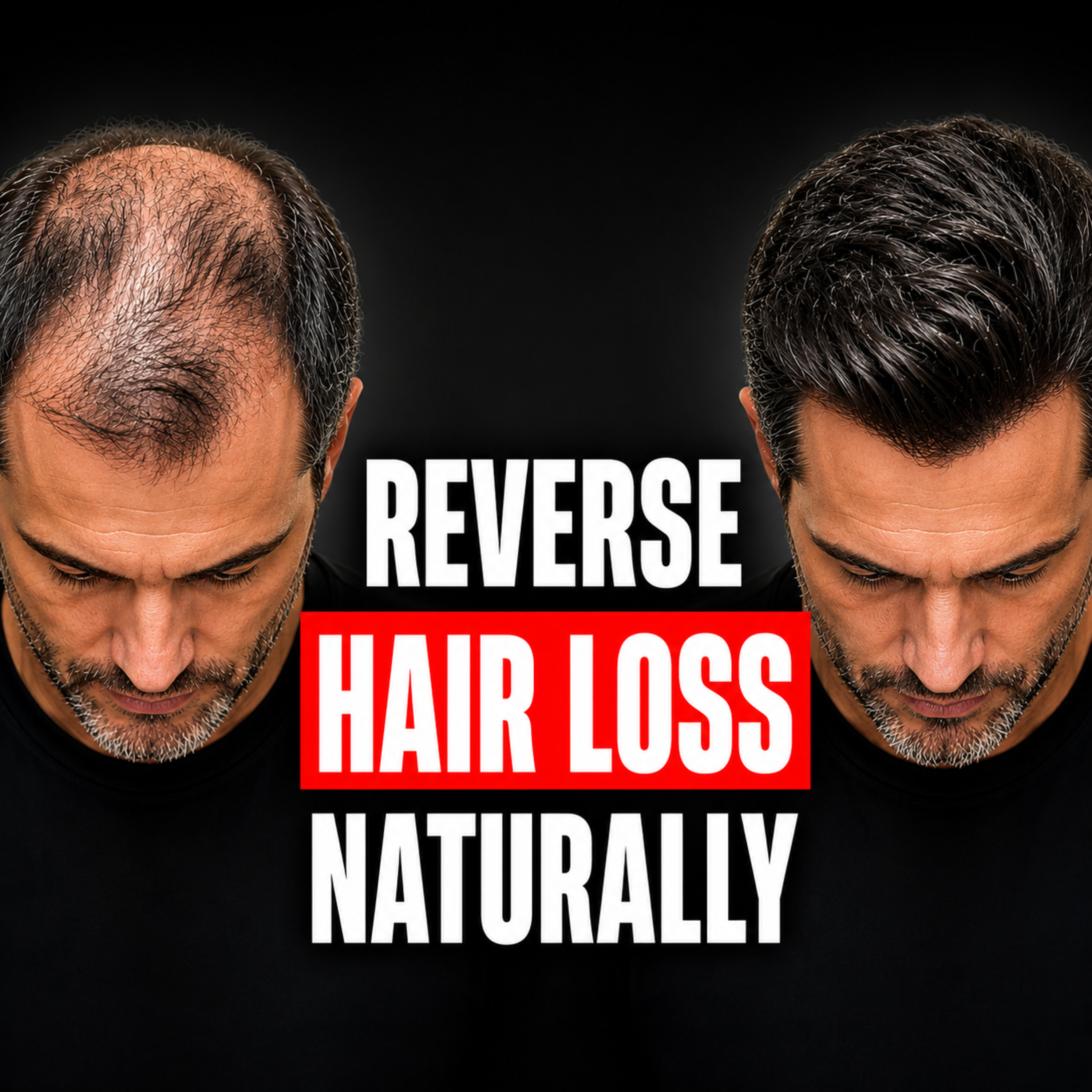
Reverse Hair Loss Naturally: Hair Growth, Gray Hair, Hair Thinning, Circadian Rhythm & Natural Remedies with Circadian Health Coach Jack Schroeder
What's This About?
Is Hair loss and premature gray hair all about genetics?!
In this episode, Jack Schroder explains how hair growth, hair thinning, gray hair, circulation, inflammation, oxidative stress, hormones, mitochondrial health, and circadian rhythms all influence healthy hair.
We explore the hair growth cycle, why blood flow and metabolic health matter for healthy follicles, and how stress, blue light, sunlight, dopamine, and lifestyle may impact hair loss and premature graying.
Whether you're experiencing hair thinning, hair loss, or gray hair, this episode offers practical, natural strategies to support healthier hair from the inside out.
🧠 What You'll Learn
• The hair growth cycle explained
• Common causes of hair loss and hair thinning
• Why circulation is essential for healthy hair
• Oxidative stress, inflammation, and hair health
• Circadian rhythm and healthy hair growth
• Dopamine, stress, and hair follicles
• Sunlight, blue light, and melanin production
• Natural strategies to support thicker, healthier hair
• Lifestyle habits that influence long-term hair health
• Practical ways to improve hair resilience naturally
🎯 Final Takeaway
Healthy hair reflects overall health.
Supporting circulation, stress resilience, circadian rhythm, mitochondrial function, and metabolic health may help create the conditions for stronger, healthier hair growth over time.
⏱️ Chapters
00:00 Hair Loss Causes Explained
01:42 Hair Growth Cycle Explained
04:46 Why Hair Turns Gray
11:20 Metabolism & Healthy Hair
14:21 Stress, Nervous System & Hair Loss
16:30 Thymus Health & Hair Growth
20:07 Inflammation & Hair Loss
23:30 Blood Flow & Hair Follicles
27:10 Dopamine & Healthy Hair
35:38 Aging, Oxidative Stress & Gray Hair
41:10 Natural Hair Growth Tips
46:38 Circadian Rhythm & Hair Health
51:05 Blue Light, Dopamine & Hair Loss
56:06 Diet, Lifestyle & Hair Health
01:06:19 Natural Hair Loss Solutions
-Show Sponsor 👉 Best 3 in 1 Blue Light Blocking Glasses Use code: MOBILITYFITNESS for Discount ✅ HERE
.
💦 Non-Toxic Hair Wash at a Discount with promo code: MOBILITYFITNESS ✅️ HERE
-
🌞 Join the Fitness Wisdom Podcast Community HERE:
- ➡️ Access Ad Free episodes of the show
- Connect with a like minded Tribe ⚔️
- Submit your questions to the Guests of the show!
- Exclusive member Blogs
- Health Optimization Protocols + Programs ✅
👉 I look forward to seeing you in there‼️
.
⬇️ Find & Connect with Jack Schroeder:
Website
Skool
.
🌞 Find & Connect with me 👉 HERE
👉🏽 For Discounts & Offers: HERE
.
👉 Find my favorite Blue Light Free Tablet ‼️ at a Discount HERE using promo code MOBILITYFITNESS at checkout ✅️
.
👉 Find the Methylene Blue 💙 that I use HERE:
Use promo code: MOBILITYFITNESS for 15% Discount ✅ *Consult your Doctor before trying this, especially if you are taking SSRI's or other medications*
.
⚡ Find the Best Grounding Mats & Sheets🔋 at a massive Discount using promo code: MOBILITYFITNESS at checkout HERE
.
👇🏽 Find the SHILAJIT I use & recommend HERE⚡
Use promo code: MOBILITYFITNESS for Discount on your entire order ✅
.
*None of the content / statements in this Podcast are Medical or Personal Advice & is not intended to cure, treat, prevent or diagnose any medical condition. All my videos are for Educational & Research purposes only. If you decide to try anything discussed in this video, you agree to do so at your own risk & responsibility*
This is the Fitness Wisdom podcast.
If you're experiencing hair loss, graying hair, or thinning hair, this episode is for you. Make sure you save it and share it with a friend today. We've got Jack Schroeder back on the line. Make sure that you listen to our previous episodes where we talked all about the connection between sunlight and hormones and that was an absolutely mind blowing conversation. We went really, really deep into the mechanism of action Bio photos, tons and so much more. So I'll leave that in the pinned comment below on YouTube, on Spotify.
You'll just have to search for it with his name or sunlight and hormones or something like that. And so Jack Schroeder is a nutritionist and also a health optimization coach. And today he's going to be enlightening us on the subject of hair loss, you know, graying hair, thinning hair. And I, I can safely say that in this modern world right now that we're living in like hair loss is literally inevitable. And it's happening at an earlier and earlier stage. I've noticed a clear pattern in many women and men.
I've, I've also suffered from this personally, when I was doing the carnivore diet. I think that had a massive contribution to a lot of my hair loss that I experienced. And as well when I did the vegan diet as well when I was vegan for, for five years. So many things can literally affect the growth of your hair. But I think some of the biggest culprits are the things that we're going to be talking about today, which people don't really think about. So thank you for coming to the show, Jack. It's a pleasure to have you back.
My absolute pleasure. I honestly, I think that's probably a great starting point around the carnival diet and hair loss. So I'd love to unpack all of that and just everything around hair loss. We'll obviously talk about light and all the things that we spoke about last time to a degree. But yeah, I do think the listeners could definitely refer to that podcast because we'll probably go a few layers deeper and add more more concepts into that. Absolutely, absolutely. And so yeah, I will, we will go into the hair loss aspect, but let's talk first about the the hair and body connection.
So for example, I think it's important for the audience, imagine that you're speaking to an audience now who doesn't know anything about circadian or quantum biology. So we can go as basic as possible, but then you can then go as deep as possible as well for the people who do understand. So starting off like really, really basic, do you understand about the nature of hair? Where does it come from, understanding its cycle and all of this? I think it's very important to understand the basics of hair in general, like what's actually meant to happen to hair, like the cycle of hair and all of this good stuff, before we dive into all of the symptoms that people are experiencing.
Yeah, absolutely. With hair. And I haven't dived deep into evolutionary biology, but obviously we have evolved to have less hair, but we seem to have kept it on our face, on our head, little bits on our bodies and obviously in our pubic region. And there's a few hypothesis around why that is. I don't think we really need to get into that specifically today, but we'll talk about how the hair, cuz you asked about cycles and all that, but basically what hair is, is that it's these cells that are essentially dead and they form this matrix from a bulb.
So it kind of like sprouts up essentially and comes through and obviously comes out of the epidermis, which is where the last layer of your skin, the stratum corneum, they come up and they go through this cycle. So there's two or three main cycles. There's the antigen phase, what you can kind of think of anabolic, you've got the calogen phase, which is catabolic and then you've got talogen phase, which is like this arresting phase or medium between the two. Now the antigen phase, that's probably the most important concept here because the antigen phase lasts the around 3 to 6 years.
So that's where on this heavy differentiation, we need a lot of nutrients and oxygen and blood flow going to this region to essentially allow for the hair follicle to grow, or the hair shaft, should I say. And then obviously we've got other things beyond that. The actual colour of it, which would be driven by the melanocytes, that lasts for three to six years. And then there's the catogen phase, which lasts for about, I believe it's two to three months more or less. The issue with hair loss is that these phases or these cycles become completely shifted in the sense that antigen phases last way shorter.
There's local inflammation, lack of circulation and blood flow going to this region that can be up, regulated up, regulated by certain things which we'll get into I'm sure later on down the path. And what essentially happens is that that antigen phase is shortened. The hair follicle is miniaturized so that there's, it's thinner, it's it's not as dense. And then what also happens is the catagen phase starts to increase. So we have this more catabolic effect and even the talagen phase, which is this resting phase where we have those cycles essentially out of balance where we're not growing as much hair as we should.
That's essentially the hair cycles. And then there's going to be a bunch of factors that actually innovate that. And I've already given a few away around how blood flow was absolutely fundamental for sending nutrients and oxygen to that tissue, which is already quite low in oxygen, much like the skin layer where it's only about 1%. Atmospheric oxygen saturation is roughly around 1%. So if that becomes even slightly compromised, that's where we start to see issues arise and that can send from many things which we'll get into it.
Most people chase energy, performance and good cognitive function through stimulants, but that only gets you so far and depletes your system over time as it doesn't address the foundation of cellular energy, which is your mitochondria. One of my favorite tools to boost cellular energy, mitochondrial function reduce inflammation, and is also a potent antioxidant that's methylene blue. Methylene blue is a fascinating molecule as it's able to grab onto electrons and donate them anywhere where they are required in the body, making it an awesome antioxidant and restores electron flow in the mitochondria resulting in more cellular energy ATP.
I love to use methylene blue, especially in times of high stress. It keeps my brain clear and energy sharp so I can perform my best no matter what life throws at me. So if you want to explore the methylene blue that I use, head over to the description below and make sure to use the promo code attached to get a nice discount on your entire. Order Yeah, that's exactly why I asked you this question, because if people actually understand the foundation of the hair cycle and its life, we can then start to understand what's actually happening to these different phases like you mentioned.
And I think it's really important for people to understand this and this kind of knowledge and wisdom. I feel like it should be very common, but it's, I feel like very suppressed on purpose. Not even suppressed. It's just kind of like, you know, it's just partitioned in a way that it's not out there for the public to understand. And you have done the deep dive and I really, really appreciate and respect that because I know that when you are interested in a topic, you always, you know, go to the research and you do your, you know, you do your due diligence to share the information.
So This is why we have you on today to enlighten us on this subject. And so then people. Yeah, can understand that already. From what you mentioned, it would make sense. OK. If you've got less of the growth phase and more of the catabolic phase. Well, it kind of makes sense. It's the same with the with the body, right? If you're breaking down more muscle than you're building, well, what's going to happen? You're going to you're going to lose muscle, right? It's kind of like a hole where you're you're digging a hole and you're never refilling the hole where it's kind of like the same thing.
And then I can assume that the hair is becoming more fragile, thinner, more weaker. So it's all kind of like connected to the foundational principle of these hair cycles. So let's get into first about the hair graying and then we'll get into the hair loss. So do you want to maybe discuss what's actually happening there? You talked already about the melanocytes and how that actually is what contributes to the hair color. And So what kind of things do you think that people are doing in their life today?
What's actually contributing to premature hair graying? And is hair graying like even a thing that is meant to happen to humans? I mean, like, is there a specific point in life where it's normal? Or is it like never really normal but it's just a sign of accelerated aging? Yeah, it's a great question. I think there's definitely some kind of genetic component to all of this that is going to arguably play a role where you see certain individuals that start to Gray and and certain ethnicities start to Gray.
So I think a prior example is I've got a good friend who's Lebanese and he's very dark pigmented skin and hair. And it seems that again, it could be related just to the color of his hair. We we call it like in Australia, salt and pepper, where like you start to see like the salt sort of popping out because there's all these Gray and white hairs that start to arise. But yeah, this obviously when people think of Gray hair, they think of, I think the generic thing that people think of is someone is stressed, like you are so stressed that your hair is graying.
And I think we can actually unpack that, that that there is definitely 100% some truth to that statement. Now, when it comes to hair graying, I think this is all going to tie together around hair loss as well. But I, I would almost say that hair graying, there's probably different levels of like the extremity of how a lack of blood flow at a certain time and scar tissue starts to occur and inflammation starts to rise. Where there may be a degree where hair loss occurs even prior to the, the hair graying.
But there's obviously circumstances where the hair graying starts prior to the hair loss. Now, if we think about if we reverse engineer what a melanocyte is, it is a cell obviously found in our skin, but also in the in the bulb of the the hair follicle itself. And what it does is it makes melanin, it does a bunch of other things on top of this. But we're looking predominantly here at melanin because that's going to provide EU melanin or phaeo melanin that is going to provide the color to the actual hair itself.
And you see that where U melanin may be slightly more of an orange tinge, you've got beautiful blonde hair there. So there's probably like a combination of you melanin and then a little bit of phaeo melanin. And probably the same case to me, whereas someone say from Africa or my, my friend that I've referenced, my Lebanese friend, he's probably higher amounts of you melanin. So how do we make melanin? Well, firstly, we need blood flow to deliver oxygen and nutrients for the cofactors to actually make it.
So tyrosine and phenylalanine are really important there. To actually convert the phenylalanine into tyrosine, we need something called BH-4, BH4IS recycled by something called NADPH, which I'll get into in a second, but that can be regulated or depleted, should I say, by oxidative stress. So there's that component there, and oxidative stress will actually oxidize the BH-4 needed to convert it. We have tyrosine. We need things like zinc and copper and oxygen to actually make melanin through melanogenesis.
When we do that, we we need some sort of light input that helps stimulate that. And that's where the whole POM C story comes in, where sunlight predominantly in the form of UVA and UVB is going to stimulate POM C to induce a melanogenesis or alpha MSH should I say, that will bind to its receptor, the melanocortin receptor to induce melanogenesis. Therefore, that starts to occur and we have a beautiful color of hair, whatever it is now when anything that I just mentioned is compromised. And even things beyond that like inflammation, oxidative stress, lack of oxygen to the tissue.
So this could even layer into things like vasodilation, hemoglobin and the ability of red blood cells to carry it. Even the negative charge in the exclusion zone on those capillaries, which are becoming very thin as I hit the scalp tension in the in the osteopotalis and frontalis muscles, which because there's a connective sheet here, the connective tissue, the fibrous sheet, it's called the Galaya. Galaya, something that essentially sits, if you feel like your head and you go like this, there's like the connective tissue that sits just below that.
If there's any tension or inflammation there, that can lead to degradation of the integrity of those melanocytes, stem cells and also for any stem cells in the hair follicle. So that's a few things and we can obviously go a bit more specific around it, but basically anything to what I just mentioned has the ability to compromise hair color as well as hair loss or hair growth, should I say. Everybody knows about vitamin C, but have you ever heard about vitamin G? I'm talking about grounding. We know that oxygen is important for our survival, but what if I told you that grounding is just as foundational for our health?
Your body is literally a battery and needs to be recharged every single day. Modern life, depleted fatigue, insomnia, brain fog, and restlessness. These all sound like a charge deficiency to me. You see, grounding is not optional, it's foundational. This is why I make sure to get my bare feet on the ground every single day and to ensure that I stay grounded 24/7 like our ancestors did. I use my favorite grounding sheet as I sleep to keep me connected to the earth at all times. Check out my favorite grounding mats and sheets that I use on a daily basis by heading over to the description below and make sure to use the promo code attached to get a massive discount on your entire order.
Wow, so many great points there. I think I'll need to re listen to that afterwards. I've got more, don't worry. No, that was, that was fantastic. Yeah. So a couple of things which I picked up there. What you said. So you mentioned scar tissue there. You mentioned inflammation, oxidative stress. You mentioned the the fascial layer underneath the skin. You mentioned blood flow oxygenation, so it seems that redox is really foundational to this story. It sounds. It sounds like redox is foundational to everything in the body, right?
Like redox, Redox potential. I think when many people hear the word metabolism, they automatically assume metabolism only relates to fat gain, fat loss, you know, weight maintenance. They don't, I think understand that you need actually metabolism to run everything in your body because like, you know, a healthy functioning metabolism is what governs the cycles. And I guess this is the beauty of circadian rhythm and circadian alignment is that the metabolism follows a certain rhythm, right? And I guess this is where we're going to get into all of the things which disrupt this or cause the the grain or the hair loss.
It's kind of like they are disrupting the cycles. I could, I would assume not only that that is just one little tiny aspect, but then again, as you mentioned, you've got all these inflammatory aspects to decrease blood flow. The decreased facial health or tension that we have. I have heard before that, you know, if you use a brush, for example, every day like 100 times on your head, like that's actually really, really beneficial for hair growth. That's probably tied to the fact that you're, you know, creating micro inflammation, maybe stimulating blood flow to the scalp, moving the the facial system under beneath, because you know, it's like right underneath the layer there and probably also maybe relaxing the the muscles or the tension because of that proprioceptive input.
So the nervous system feels safe. It's like when someone imagine someone never touches you, like, you know, in a loving way, you are foreign or you are lacking that kind of like inputs and that connection. So you're you don't have that connection with that area of your body. So you're that area of your body feels sort of unsafe. But if the more you stimulate by by touch sensation, temperature, all these kind of things, sunlight, you can restore safety. So it also goes to this discussion of, you know, nervous system safety versus nervous system like survival state.
How, how is that going to like, you know, influence your hair as well? If your body is constantly stuck in a state of fight and flight? Well, obviously it's going to probably direct resources towards more like survival. And hair is clearly not like something that you need for survival, right? So you can, you can notice this in people who are very stressed, people who do like marathon, like long distance running, for example, extremely stressful sports things which are kind of like modern day like situations.
They're not like they're like man made things. It's not something that we were biologically designed to do in the past. And if we did do them, they would be limited. They would be in like short durations. So do you want to dive into maybe like all of the things which are actually contributing to these things that you already mentioned previously? Yeah. And I think that's a great point around metabolism and energy in general, where we obviously have like a, a credit of energy that we can spend per day.
And you would definitely, most definitely argue that our hair is non essential relative to things like or organs like our heart and lungs and muscles and liver. So there's definitely that layer to it as well where if we're lacking the actual energy surplus to supply the because obviously stem cell turnover and differentiation of hair cells, especially in the antigen phase is incredibly energy demanding. Especially because of the fact that we need to actually rebuild the architecture of the blood vessels and deliver all the nutrients there to a place that's not particularly in a easy area.
Especially the top of your hair, which I imagine there's a connection there around why you lose that in comparison to say your beard versus your chest hair or your or your pubic hair, right? Yeah. So it's, it's a more vulnerable location anatomically for actual supplies and energy to get delivered there properly. So what was your question around like the the layers of it? It was about the causes, but before we dive into that, I, I just had another question which I think maybe it would be important to answer before we go into that.
It was about what do you think the relationship? Sorry, there's a fly on my face, the issues of living in in a warm country, but this is a blessing at the same time. So basically I was thinking about the connection between hair and Meridian lines and organs in the body. Do you know if the hair is connected to any specific organs? Is the hair like the growth and the hell the health of the hair and the scalp? Is it like a by product of a health like of a healthy functioning system internally? Of course I would assume yes, but like what's the connection between like different organs in the body and if those are is like the hair and indication that some organs are failing inside or not working optimally?
OK. So I think I have a feeling where you want me to go with this, which is going to be tied to the thymus gland. But before that, you mentioned meridians, which I think is interesting as well. There seems to be some research around acupuncture being beneficial to hair growth. And then there's research around how the meridians are tied in with the fascial networks. And one other thing that I will say here as well, on the energetic level, where obviously there can be a lot of tension stored in the frontalis muscle where the forehead is.
I would suspect that from like a chakra level, maybe the third eye could believe it could be could be compromised there. And that's going to be tied to intuition and spiritual energy and things of that nature. So I just wanted to add that there because I think it is really important to tie in these ancient, ancient medicine and ancient wisdom around these concepts. Yeah, like around hair. So I think the biggest thing is the there is a gene I'm blinking on the name. I think it's, I hope it's called Fox N1, which is related to the embryonic, embryonic embryonic development of the thymus gland, but also to hair and skin.
So there is this kind of, and you can kind of think of this where someone called Upward Bakery on X who is excellent, has mentioned this to me where or on his post where it almost seems like when we're born, we don't have hair and our thymus gland is small. And for those who don't know what a thymus gland is, it's heavily involved in T cell education. So for a healthy immune response and a clean one to occur where it's the perfect around it amount of immune activation or or the lack thereof, depending on the situation, the thymus gland is heavily involved.
It's it's one of our main lymphoid organs. So what? A good outline is that in hair growth or like as a baby, the thymus is small, hair growth is lacking. And then as we age, there's something that process called thymic involution, where certain hormones and cytokines and other mediators can essentially lead to a shrinkage of the thymus gland. And as we age, we're obviously losing our hair as well. So that's kind of the aging indicator there that that could be linked to it. Another layer that I found super interesting around this because we're going to get into DHT and the androgens and how obviously that's like the, the mainstream idea that DHT is the main driver of hair loss.
And look, I, I want to unpack that at some stage because there is truth to it, but they're like very much zooming in on just one particular aspect and not thinking about anything upstream or downstream of that. Now with the thymus gland, androgens actually induce thymic involution. So when you take a main medication for hair loss, in particular androgenic alopecia, that is going to be finasteride or duasteride, which inhibits the conversion of testosterone to DHTDHT is 4 to five times more potent than testosterone.
It's our main masculine hormone. It's truth be told that people think it's testosterone, but it's actually DHT. So there's probably a connection there as well where if there's issues in the thymus gland and there is already a shrinkage of it causing other issues down the line through immune activation and inflammation and so on. The the finasteride could actually be working in that regard to improve the thymus health. And therefore it could potentially be improving the hair health in general because of the connection around how hair loss is directly tied to it.
Inflammation, what can cause inflammation, immune activation, what causes immune activation? It could be certain nutrient deficiencies. But I think the most important thing here is that microbial issues can directly occur on the skin as well and alongside the gut. And when we think about what happens in the gut microbiome, that can directly influence the rest of the body, including our skin layer and our scalp. Wow, fantastic. Yeah. So that's really, really cool to understand. So then the immune system is a really big player than in the in the health of the hair in general.
So I can imagine if someone is immunocompromised or all the time triggering like an immune response in their body, they're actually going to like experience like hair loss or, or just like maybe, you know, premature or like graying of the hair. If someone is all the time, like, you know, constantly bombarding basically themselves with stressors in their life, obviously that's going to suppress your immune system and then that's probably going to shrink your your thymus, as you mentioned. Do you mind mentioning where the location of the thymus is in the body?
Well, it's right near the heart actually. So in the in the thoracic cavity. So this is where obviously on an energetic level as well, it could be related to emotional suppression in the heart chakra. And just one other thing around the immune system here whilst we're on this topic, is that the hair follicles are meant to be immune privileged. So they're meant to be somewhat protected from the immune system. And obviously when there's this upregulation of infection and inflammation and anything in between that can drive the pathology of hair loss or just damage to the integrity of the hair follicle itself.
That's where we start to see issues arise around the immune system becoming compromised or activating locally in that area, driving cytokine activity and therefore leading to things like fibrosis and poor blood flow and hypoxia and everything in between. That is right. Most people focus on nutrition and exercise when it comes to health, and that's cool. But if you're sitting under artificial lights all day, that's quietly sabotaging your health. That's not going to get you very far. As an educator, podcaster, and fitness professional, I care about recovery as much as I do performance.
The biggest secret to recovery isn't supplements, it's light. The light that hits your eyes is literally the instruction manual for your body. It says your sleep, energy metabolism, and your hormones. The problem is the modern indoor lighting is sending that signal at the wrong times of the day, from morning to midnight, so your body never gets the message the day's over. Now if you already own a pair of blue light blocking glasses, hear me on this. Not all blue light blockers are equal. Viv arrays use a three in one light balancing system, magnetic day, sunset orange and nighttime red lenses you swap to actually match the time of day.
So you get energized in blue in the morning without the eye strain and protect your sleep at night. One pair dials you in for the entire day. That's the difference between just blocking light and actually syncing with it. Since wearing Viva Rays Blue light blocking glasses, my sleep is deeper, my recovery is fantastic, and most importantly, my energy and cognitive function are through the roof. If you're ready to experience the difference for yourself, head over to vivarays.com/mobility Fitness and make sure to use my code Mobility Fitness at checkout to get a nice discount on your entire order.
The link will be in the description as well as in the pin comments. Huge thank you to VRAS for sponsoring the show. So that fibrosis is going to decrease the blood flow then, and then therefore they're going to get less oxygen, less nutrition. So then again, creating that kind of like that scar tissue like you were talking about layering down like some layer which is very, very hard for the body to break down. I guess then systemic enzymes would be actually quite powerful for this. Of course, I don't know how that would affect the hair, but I can imagine that systemically would benefit like all of your organs in your body when things are you know, your lymphatic system is able to flow well, your your blood is able to flow well.
I know that when I take systemic enzymes, my eyesight improves dramatically and of course like following an anti-inflammatory diet, eating like high amounts of DHAI personally noticed that my vision improves like massively. But I just wanted to put that out there that, you know, these systemic enzymes like things like bromelain, like in pineapple or syrup peptase, natto kinase, like all these things are like super, super powerful. Not only for that like getting rid of this fibrinogen and kind of like this scar tissue in the body, but it's also improving, I believe the the blood flow because of that as a by product.
So do you, do you want to maybe do you want to add something to this before I move on? Yeah, yeah, that's, that's great. So and I think this is where the second medication comes in, which is minoxidil, which acts on potassium channels to increase vasodilation as well. So there's like the second clue and this is the, the benefit around if you research a disease or a pathology related to a disease, you look into the medications that are used and essentially reverse engineer it and see what you can find.
That's, that's the trick. Now with the, the fibrosis piece, because I think that is really important and it's something that I've been taught by one of my mentors recently in quite deep detail, where the fibrosis can occur for multiple reasons. So I'll give you a few examples, Homocysteine's one of them where methylation issues, the homocysteine within itself can drive inflammation. Therefore like this plaque formation, calcification is a big one which I want to get into probably in a second actually cholesterol and dysregulation of lipids.
So this is sort of tying into the metabolic piece as well. And then the DHT story as well, when there is this inflammation, there's this positive kind of feedback loop where DHT increases something called TGF beta one and that is very pro fibrotic. So it will induce fibrosis kind of like as a protective mechanism. Now if we think about our first podcast where I spoke about how hormones are carriers of light, I want to almost layer onto that, that hormones are communications between tissues around redox states.
So I think that DHT in this case, and I want to ensure that we cover DHT as well around like why it's not actually bad, but DHT is acting locally in the hair, in the scalp or in the hair follicle to drive this pathology. And you almost can think, well, if it's being up regulated in that case, it's acting protectively. In terms of circling back what we said before, where if we only have a certain amount of energy credit that we spend for the day, while we're going to use it on hair, let's try and form this scar tissue and fibrosis for fibrotic tissue to essentially prevent it from happening.
So then we have more energy that we can utilize in other tissues. And another interesting point that I'll mention as well is that you said around the sympathetic nervous system and just stress in general that induces vasos constriction. So that's another really important point there where finasteride doesn't just act as a 5A reductase inhibitor. It actually inhibits the conversion of norepinephrine to epinephrine and epinephrine is obviously a very potent vas constrictor or it redirects blood flow, shall we say.
And then obviously that's chronically activated. That's where we start to get this dysfunction going on. So really important there. Now I just wanted to touch on because I found it really interesting that you said you started to notice your hair loss more. So when you took when you started a carnivore diet, I predict how long do you were you on a carnivore diet for? Like only four months. OK, interesting. I was my hypothesis around that is that calcification isn't really driven by calcium. It's driven by a lack of nutrients to support where calcium gets guided into bone and teeth where it needs to go.
Agree. Usually, yeah. So that's usually going to be related to the phosphorus in in animal meats where and then probably a lack of vitamin K2 in the diet, maybe a lack of magnesium. All of these are regulatory around ensuring calcification occurs in the tissues we don't want it and not in say the soft tissues in like our arteries or blood capillaries and so on, which actually increases the the fibrotic factors as well. Another just short connection here as well that that I'll make because I mentioned the third eye chakra before, but the pineal glands can also be calcified from this mechanism.
And we have to think, well, that that could be related to the tension in the scalp, but it also is related to melatonin and circadian regulation. And there's evidence or research that shows that cortisol, obviously there's this kind of seesaw effect with cortisol and melatonin. Cortisol induces the cartogen effect in hair cycle cycles as well. Or yeah, in in the hair cycle. So that within itself kind of ties to the stress piece. But then we've got more layers on top. Isn't it cool how it just all connects?
It's so cool. I mean everything is connected and everything makes sense. I think the more that people listen to my podcast in general, they understand that the body is like a body wide communication network system. You know, it's all it's everything is communicating with everything. So everything, if something is thrown off, then obviously, as we mentioned previously, the resources to things which are not that important are going to get, you know, like pushed back or just put on the, you know, the back stove there.
But I found it fascinating when you mentioned about the DHT and how like it would make sense that why bodybuilders experience hair loss as well, because if they're prioritizing on putting their resources towards building muscle, it would make sense that maybe the all the resources wouldn't be going towards hair growth. Would that be the case? Is that is that why they experience rapid hair loss, especially because they are using obviously exogenous compounds to enhance their, you know, musculoskeletal system?
It's a great question. I don't know the answer to that one, unfortunately. Yeah, to be honest, I I do see somebody builders who do go bold and that's probably related. I imagine it's more so related to the exogenous steroids, which is obviously going to play a really big role in terms of destroying hormone cycles in general. But yeah, I'm afraid I don't have an answer for you. There was some research around creatine causing hair loss, which was very much debunked early on because creatine was shown to raise DHT in one study and it was very terrible method methodology.
And therefore it just kind of got on health health Twitter and on Instagram, a lot of people sort of said, oh, OK, creatine, you know, bro, diet bodybuilding raises DHTDHT causes hair loss. But I think what's important around that is that DHT in the scalp is very different to DHT systemically. And this is where like the whole finasteride component, because there is something called post finasteride syndrome where people literally like penis, penis shrinkage, erectile issues, completely abolished or diminished libido, very feminine looking faces as opposed to like a very masculine looking face with like a emphasized jawline and just like the face of the man basically.
It's almost like they reverse in puberty a little bit. And I think like the other consideration around that is that when when me and you and basically every man on this planet was around 10 years old up until they were 18, we had extremely high levels of DHT systemically. And we weren't losing our hair by all means at that stage. We obviously had things like acne and pimples, which were more occurring and that plays a role with androgens. But the whole idea around DHT being a problem in the scalp or being a problem systemically is just like one of the most dangerous.
Well, finasteride is one of the most dangerous medications you can take in my opinion, purely because of that and because of what DHT actually does. And now I know I'm going on a bit of a tangent from your question, but I just wanted to emphasize like how important DHT actually is for a man to actually feel like a man because of its potency, the androgen receptor, but then its ability to actually form something called neurosteroids down the line, which raised dopamine, increase endorphins, increase GABA to give you like this almost like a masculine aura, help with things like libido and just like overall masculine presence, which I think is just like a huge component in just a dynamic of a relationship or just your ability to succeed in life.
Imagine a tablet that doesn't blast artificial blue light into your eyes, disrupt your sleep, or sabotage your health, but actually use the sunlight to power the display. If you've been listening to this podcast, you already know how damaging constant artificial blue light can be on your circadian rhythm, your sleep, and your overall health. That's why I love my Paper 7 tablet by Harborino. It's definitely one of the most interesting devices I've used in a while. The Paper 7 tablet uses something called an RLCD display, which means there is no backlight and essentially no blue light in Instead, it reflects ambient light just like paper, so the brighter your environment, the better the screen looks.
And unlike E Ink devices, which are slow and stuck in black and white, this gives you full color, a smooth 60 Hertz refresh rate and the ability to run all of your favorite apps. It also comes with 8 gigabytes of RAM for smooth performance, a 7.8 inch display that's perfect for both reading and productivity. And at only 240 grams, it's easy to carry around anywhere. The battery life holds out really well too. You're getting around 10 hours of active use and up to 12 days on standby, so you're not constantly thinking about charging it.
For me personally, I like to use it a lot for writing, researching, and preparing for my podcasts. Basically all of my administrative work. And the best part is I can do all of that outdoors in natural light, so I can actually support my biology while I work instead of fighting against it. And because the screen gets brighter in brighter environments, it's incredibly easy on the eyes, even in direct sunlight. I've also noticed that it naturally improves my nighttime habits because indoors, especially at night, the screen isn't overly bright or stimulating since it uses your environment, the power of the display, so it kind of guides you towards better sleep hygiene and healthier circadian rhythms without even trying.
At the end of the day, technology isn't going anywhere, so the goal is to find tools that work with our biology, not against it, and this is definitely one of those devices. You definitely want to hurry up and grab yours today as they are extremely popular and run out of stock really fast. The link will be in the description below alongside with the 15% discount code. Wow Wow. Since you brought up the word dopamine, let's bring my last question here because I feel like it fits quite nicely. Do you think there's a connection between dopamine depletion or constantly like, you know, spiking your dopamine artificially from artificial sources?
Do you think that that could contribute to hair loss as well? So one thing is that dopamine plays a role in inhibiting prolactin and it shows that prolactin induces the catagen phase as well. So that's the catabolic phase of hair. So there could be a link just directly because of that. And we have to think like how many people are having a dysregulated dopaminergic system from a lack of sunlight just over stimulation across artificial dopamine substances, whether it's pornography or or drugs, hyperpolatible foods, blue light, whatever it is, I imagine that there's probably some sort of piece in there that connects it mechanistically.
It makes sense to me that if prolactin's high dopamine's the inhibitory factor that lowers it in the pituitary gland. So maybe that also extends to the scalp as well and the hair follicle. But yeah, around like the hair loss stuff beyond that, I don't really know. But mechanistically it makes sense. And then I suppose the other layer to that is tyrosine is directly related to not only dopamine but also melanin. So if we are depleting our melanin reserves or dopamine reserves, we're shunting more tyrosine away from melanin or dopamine or just both, and we're just depleting it and our need for tyrosine potentially increases.
So it could be related to that as well. And that could contribute to the hair grain because, you know, as we can convert the dopamine into the melanin or it requires it in that pathway. I can imagine that can contribute to the grain as well if your body is not able to keep up with this, like, entire process. Would that be correct? Yeah. Yeah, exactly right. And then there's a whole component or the, the idea which I have posted about before, but it was more of a mechanistic claim as opposed to if it's true or not.
But that obviously grey hair means there's less melanin in, in the hair itself. Could that be reflective of someone lacking sunlight in their environment? We need to get more to the brain. One other layer to that is that calcification and fibrosis will actually block the infrared light into the brain as well, or infrared light. So if we have thicker amounts on the scalp, the hair loss, the the hair discoloration coupled with what is going on with the fibrosis, we're just trying to get infrared light into the brain, which is obviously our most mitochondrial dense and energy dense tissue where it's 2% of our body weight, but uses about 20% of our oxygen.
So maybe there's a connection there around that as well, but it's just purely hypothetical at this point. Yeah, I was actually thinking if there's a connection between like brain health in general and also like hair health, it will kind of like make sense in a way because, you know, your hair is literally right on top of your your brain, right. So I think it's just kind of like an area where people are very conscious about. And there are many things that people are doing in their lives which are like sabotaging literally their hair and they just don't even know it.
But I mean, it's, it's kind of like so obvious these days that you would experience something like this, because obviously everything in our life is destructive active to our health, especially if you take how modern life is given to you these days. If you live life like a modern human, I feel like the signs of aging, whether that is like skin aging or elasticity or hair and just feeling youthful is going to like decline massively or accelerate your, your aging. I'm seeing so many people online who are supposingly like circadian health people.
I mean, they are they, they share a lot of good information, but I'm also noticing accelerated aging in individuals, right. So it just kind of shows you is their lifestyle maybe are they using too much EMF's? Are they exposed to too much blue light? Are they doing the things which, you know, do do as I say, not as I do in a way, you know what I mean? So a lot of people are telling people what to do, but maybe they're not putting the practices into their own life or maybe they're just stressing too much.
Maybe this, you know, they maybe they have toxic relationships. Maybe there's like these other things that are going on behind the scenes which could, I can imagine, contribute. To the actual problem, but I feel like accelerated aging ties into this whole topic that we are discussing about today is that you're seeing people age who are 20 years old, they're looking like 3035 years old, you know what I mean? And so even 16 year olds these days are looking like they're they're 25 and eventually or they're having like premature puberty, for example, and then or they're not able to.
Yeah, all this kind of stuff. What's what's your thoughts on that? What do you think the connection between what's actually causing this accelerated aging? Yeah. So, and it's kind of funny because like if we consider men again, there is that component where they look aged, but then they kind of look young at the same time. In the sense of like this ties with to the DHT component where the the higher amount of androgen activity alongside just optimal health in general will drive a more masculine facial structure.
And the easiest thing to do is literally just look at what American footballs looked like in the 1980s compared to what they look like now, where they just look like men. You know, look at boxes like Mike Tyson when he was like 18 years old and you're like, holy shit, how is this guy 18 years old? Like he, he's obviously looks youthful, but then he has like the frame and the masculine, masculine energy of like a, of a man that who is, who has high androgens and overall decent health, I would have presumed.
And that's just like one example. And you can look at boxes now and you'll get the same sort of idea. So I think there's probably, I almost want to separate that to like youthfulness where youthfulness versus like actual masculinity in this case where the youthfulness is. Yeah, it definitely seems to fasten all speed up, which we're tie into the aging where we have wrinkles and just like more higher fine lines. And I think it's just even beyond that, beyond the hair loss and all that kind of stuff.
I think people just have this like, look, and it could be even like a electromagnetic vibration that you pick up on where someone just looks ill and they look old because of that. They look like they're aging faster than what they should, and it's maybe something that you intuitively can't truly pick up on. So did that answer your question? No, that was good. I was just wondering what do you think is causing this accelerated aging? Maybe maybe let's dive into, let's connect this to the actual like graying of the hair before we dive into more of the hair loss specifically, let's connect this like, you know, with the aging and also like the, you know, the graying hair.
What do you think is driving this? I think it's everything. I think it's every, well, let's use one word here. Let's just use stress because that is found from that statement that it's just so blatantly obvious that we kind of just like skimmed over it. But anything that causes stress either locally or systemically in the body has the ability to accelerate hair, hair graying or hair loss. And then we think, well what what is stress? It could be oxidative stress, environmental stress, or light stress.
Toxins would tie in with the environmental stress, but like toxin load, immune stress, metabolic or nutrient stress, psychological or psychosocial stress, anything that has the ability to shift the body's cellular state or biochemical state from how it's supposed to be running to slightly suboptimal. And even if it's just like say a 5% difference. And obviously we think about this whole energy credit that we have for the day that we we spend at energy spendings. If we have 5% less that obviously that 5% is going to go to the places that well, it probably plays a role in terms of distributing, distributing it everywhere.
As we said earlier, it's probably directly related to the hair and hair loss and things that come up on the skin. And then over time that will accumulate to 10% or 15% or 20%. So my answer to you is that I think it's everything that has the ability to induce stress and that's going to be very different for each individual. So you made some really great examples before. And I'd like to use my example of where we spoke about this prior to recording is that I was living on an island. It was very stressful in certain ways.
I obviously had very good EMF stress around the actual EMF's being low. Now maybe there's like a component around dirty electricity that I didn't actually measure, but in the general sense, like I was very connected to nature. But in saying that, I was socially isolated. I was very stressed trying to find a home. There was just like this disconnection where my stress bucket was filled with different stresses versus someone else who may be in a city, but they're well connected with their family and friends and friends and they can do.
Maybe they have that their passion that they're following. And it almost is like, well, the stress is there. Maybe just like EMF's and the lack of sunlight exposure or fucking chemtrails or whatever it is where it's still just going to be like, what threshold can our body handle until the stress becomes overflowing in that bucket and that's where we start to see issues arise. When people think about energy, sleep, and hormones, they think in terms of fats and carbs. But your metabolism doesn't run on macros.
Minerals are the foundation for your metabolism, and a healthy and well functioning metabolism starts from your mitochondria. Every single biological process inside your body requires minerals. When your body is lacking the minerals to run your cellular metabolism, guess how that is going to show up in your body? I'll let you figure that one out. One of my favorite ways to ensure that I get all the minerals that I need on a daily basis is through Shilajit, A herbal mineral substance which is made from the decomposition of plants and bacteria.
This process taking place over thousands of years. It is primarily harvested from the Altai and the Himalayan mountains, some of the most pristine locations on the planet. The beautiful thing about shilajit, it comes with high concentrations of folic acid. This molecule actually drives the minerals into the cells where they can do their work. So basically the minerals come in the most bioavailable form for your body to be able to use. Unlike most supplements which become expensive urine, this one actually does something without the hype.
It's not Man made is produced by Mother Nature herself. Now something very important to mention is the quality of shilajit. Not all shilajit on the market is created equally. The one that I use has been tested for heavy metals and impurities, ensuring that you are getting the highest quality shilajit. So if you want to explore the shilajit that I use on a daily basis, make sure that you visit the description below and make sure to use the promo code. Attached for a nice discount on your entire order yeah yeah, it's it's that simple.
But that's why, again, for so many people, they just kind of like don't want to pay attention to that because stress is this kind of thing, like it's an all-encompassing word that, you know, stress can't be beneficial in small doses, like hermetic stress. You know, it can make you stronger if you have the time to adapt to the stress. But if the stress is kind of like moderate but chronic, that's the one that actually kills you. And it's kind of happened in the background all of the time psychologically, you know, emotionally, your relationships, your environment, all of this kind of stuff.
Do you want to go though a little bit more specific? Like what are people doing in their day-to-day life which they are not conscious of or aware of, which is actually contributing to this stress? Yeah. So if we think about all the layers around this, let's just start with the psychological and psychosocial stress because I think that's important. So any stress in relationships or finances or working and you're not obviously it's inevitable that you're going to have some kind of stress, but we have to obviously explore interventions to support the ability to handle that stress, which would otherwise be known as resilience.
So yes, there's obviously many examples, but even just something as simple as doing 10 to 15 minutes of breath work or some myofascial release to release the tension and just doing some inner child work may be enough to really help handle that stress. And then there's things that would kind of be like slightly indirect to support something like that. And obviously all of these kind of ties in together really. But if we think biochemically, how can we support these things that people could be doing incorrectly would be if you're waking up checking your phone straight away, you have literally set up the day to dysregulate your dopaminergic system.
And we spoke about that previously in terms of what that could be doing. On top of that, if someone's not actually getting outside straight away, getting some grounding in, going for a walk, doing some lymphatic movements, whatever it is that is tied to their morning routine. That would also lead to compromisations in terms of layers from like a mitochondrial level, like a oxidative stress and redox level, some of the timing and signaling level in terms of like the circadian rhythm input. So there could be things like that.
It could be the way someone's eating, are they getting, It's not just like about are you eating a good diet, are you eating seasonally? Which I think is obviously great place to start. But I just think in this modern world where our food is not the same as what it was 50 years ago, let alone 200 years ago, we really want to ensure that we leverage micronutrients and actually probably track that a little bit and just see what we're missing. For example, if we tie back to the hair loss, the if we're lacking say K2, which is found in cheese or natto or fermented foods, we we might be inducing calcification and therefore that could be driving the hair loss eventually down the line.
It could be related to some someone who like lacks bile flow to actually absorb the vitamin K2 or there is clogged lymphatics where the fat soluble vitamins actually get transported through the body. So we kind of have all these layers they need to support that. But when it comes to say, other stresses, right, if we're looking at just like the mental stress side of things, right, from a nutrient standpoint, could be B6 or magnesium needed for GABA or balancing GABA and glutamate. It could be again, like the social isolation, which is really important because that within itself can shift to POMC cleavage.
Even if you're out in sunlight, you raise something called dinorphine, which has an inhibitory effect on POMSI and also shifts the the tone of it or the cleavage towards CRH and ACTH, which is more cortisol inducing as we said before. So that within itself is like a really big deal, right? So it'd be many things, hydration, even just the way you breathe, your fascia movement, your connection to nature, your connection to loved ones, all of these essentially compiled together to enable resilience to any stress in the modern world.
And I, I just think that we have to cover basically every single base now. It's come to the level where we have stresses coming at us left, right and center. We have to obviously do our best to mitigate them. We have to do our best to not be neurotic about it, but then we have to just cover all bases. And I think that's just like the level of what it is now. Whereas maybe 50 years ago, our parents could have drank alcohol and felt OK doing that and maybe eating a little bit shitter than usual and not worrying about the light stuff.
But now 2026 is a very different world in comparison to 1966. Yeah, no, 1000%. So basically what you said there really is like, OK, if you optimize your health in general, you're going to obviously optimize every single aspect of your biology, your hormones, your sleep, your recovery. Obviously that's going to help contribute to your hair health, hair growth, scalp health. Of course, we'll get into a bit more like practical tips a little bit later on as well. I definitely want to ask you, you know, what are some like big needle movers that you have noticed?
I think it was really good that you mentioned about the the symptoms associated or the side effects associated with taking these drugs for, you know, preventing like hair loss and promoting hair growth. Because many people think that that's the only option. And you just look online these days like there is just so much marketing, you know, for this kind of stuff. And there is also a lot of marketing for good stuff as well. But it just kind of feels like the good stuff is mainly targeting the biochemical aspects and there isn't enough knowledge and wisdom that's promoting the biophysical aspects of what is governing that biochemistry.
Do you want to maybe tell me a bit about how dopamine addiction dysregulates circadian rhythms? Because I can imagine circadian rhythms are very important when it comes to hair, hair health, hair health. Yeah. Yeah. Just quickly on that as well. You just made me think of something around the biophysics side of things as well, is that our fascia and our collagen networks are obviously like the highways of communication and shuttling energy and information throughout the body. So if we think of what fibrosis or scar tissue actually is, it is disorganized semiconductive networks where the communication is completely lost.
It's not hydrated properly, It's not formed properly in terms of like the Helix and the extracellular matrix that essentially accompanies that. So just wanted to layer that on top because I think that's a really important biophysical piece for for that specifically. Now your question was about dopamine again, what was it? Sorry, it was about dopamine addiction and the connection between circadian rhythm dysregulation. I know you made a post about this recently. I think that's that's quite a fascinating subject.
I feel like many people don't think about that. Yeah. So one, dopamine does a lot of things beyond just reward. Well, all the anticipation and drive to get that reward essentially. And one of the interesting points, well, one of them was related to prolactin. There seems to be like this inhibitory effect on melatonin as well, which would make sense if someone's partying and doing something like cocaine or whatever, or drinking coffee, like they're going to be highly alert and not want to go to sleep at all.
Don't ask me how I know that. Now when it comes to, so when it comes to what I was talking about specifically with dopamine in this case is from the post that I think you're referring to is that dopamine works in a part of the retina called the retinal pigment epithelium. So that sits behind the actual retina itself, which is where phototransduction actually occurs where light goes through our eyes to the back of our eyes and it gets converted into electrical current. And obviously there's things like DHA and vertinal or in the form of vitamin A is really important to this working that the nerves themselves and neurotransmission.
But there is a really important component in the photoreceptor outer segment. So that is like the outer region where there is constant light hitting it. And obviously this light is great, but we need that darkness and the right wavelengths to essentially support the turnover of healthy turnover of it. Because kind of think of it as a factory that you have a bunch of workers in there and they're all working very hard. And there's obviously a certain threshold where we need to replace the workers or something like that.
You can't just have them working 24/7. Otherwise you have an idea in terms of what that would end up like. So yes, dopamine plays a really fundamental role in driving something called phagocytosis of those retinal pigmental epithelium cells, which are really dense in mitochondria and melanin. So there's like kind of like a biophysical link there as well where there's obviously this high amount of energy needed to regulate this process. And what essentially happens is that we need morning sunlight and dopamine at the right pulse.
So this is tying into the whole artificial side of things in addiction to certain things that will deplete your dopamine or dysregulate the system that could compromise this. And what are the implications? So I should explain the process. But essentially phagocytosis is where the cells eat up the outer segments or the the parts around it and recycle it to allow for more photoreceptors. So you can kind of think of the analogy where the workers sign out and then new workers come in and then they're highly efficient and we can continue the process.
And down the line, that's obviously going to innovate, not just circadian entrainment, which is going to govern basically everything on a timing perspective for our body. But then at the same time, it's also going to govern things like vision as well and visual awareness. So you may see implications around visual loss as well or visual disturbances now, So tying in that if dopamine is fundamental to that process and there's certain receptors that are needed, if there's some sort of desensitization or depletion of dopamine due to everything that we mentioned earlier on when we spoke about dopamine, that can drive addiction and depletion of dopamine itself.
You could even be even just throwing other things out here. It could be also like can't eater infection in the gut where they release something called acetyl aldehyde, which reacts with dopamine to form something called cell solanol that damages dopaminergic neurons. So that's probably more so tied to reward centers, but there could be a potential link there. So it's not just related to addiction, but anything that disrupts the dopaminergic system. So what essentially happens is that that process becomes impacted.
Therefore visual disturbances can occur. And also tying in the circadian stuff, the timing and signaling of our tissues governed by the suprachiosmatic nucleus that picks up light signals from our eyes is going to be completely dysregulated. Obviously, if you just search circadian disruption and name a disease, you're probably going to find it. So this is a really big consideration there beyond just like people who are getting sufficient sunlight and doing all the right things. But if you're just sitting down on X rolling all fucking day or you know, dream scrolling on Instagram, looking at Reels or just like having that reinforcement in, that within itself can also be problematic and may cause issues relative to this.
The official community of the Fitness Wisdom Podcast is over on patreon.com/fitness Wisdom Podcast. This is a space where you can get to connect with a like minded community and tribe. Get ad free episodes of the show. Submit your questions, guests and topics that you would like to see on the show. Read my latest health optimization protocols and blogs. Get my guided workouts and mobility routines and the good discount on my group and one-on-one coaching programs. The link is in the description below.
I look forward to connecting with you. So you're basically saying that it's not sufficient to get the sunlight and block the blue light at night, but you have to also not constantly trigger your dopamine artificially? That's basically what you're saying. Yeah, and people will say that it's just the blue light and it's absolutely not. It's the the apps I think is smart enough or the developers, should I say are smart enough to think that people are using Twilight on their phone or probably mitigating this where there's other ways to reel you in, pun intended.
So yeah, definitely related to that where you can be doing all the right things around that. But then if you're on your phone for four hours a day and you're, and it might not even be that much, but you just are under the intention of using it and being sucked into the doom scrolling. And just like the attention span of like 5 seconds and continuing to scroll and scroll, you're just constantly seeking novelty. And whenever you're constantly seeking novelty, you have dysregulated dopamine just by default.
That's just neurochemistry. Yeah, well, there's something that I've clearly noticed personally that if I get sucked into, you know, scrolling, which it happens to the best of us, you know, it's like it's so, so powerful. You know, these platforms are really powerful. You go there to do a specific task, to make your post, to make your thread, to make your tweet or whatever. And all of a sudden you find yourself one hour later, you're still scrolling, you know, doing different things in there. My brain feels like a Mashed potato.
You know, I can't, like, think clearly afterwards. But if I go there on my laptop and I start writing A blog or something, I feel after is significantly different. Like, so how you use your actual devices, I can imagine can have a massive influence like on your brain health, your eye health, your hair health, for example, tying this all into the hair and your stress levels, for example, you know, if you've got some harmonious music playing in the background and you're in the flow state and you're writing a book on your laptop and you've got no distractions, no silly apps going on, but you still have the blue light from the screen.
I feel like that's way way less harmful compared to being sucked into. To this doom scrolling which it does for sure do something to your dopamine because you just it feels like almost impossible to stop unless you are this kind of person where you can set some boundaries or be more aware or realize oh whoa like what I'm doing right now really I should stop doing it because it's actually creating me a massive disservice to my entire biology. Yeah, absolutely, man. And I think it just takes a little bit of discomfort.
It's inevitable that you're going to feel discomfort because you've got to think of it like a drug because that's exactly what it is. It's probably the most potent drug that we have. It is super stimulating and nowadays your phone, as much as you want to try and block it from doing it, it is hearing everything you say. It is processing that. It is forming it into the perfect algorithm catered to you where you're just going to see something. The first post is going to drag, draw your attention in or do its absolute best, and then after that it's just slot machines where you'll get sucked in.
You'll get some good posts or, or reels or whatever you're looking at. And then there may be one that's like not as good. And then you hit here's another one. And then it's like, oh, it's, it's stimulating you because that's going to drive the phasic dopamine pulses, which is like kind of unexpected. And that gives you the, the more reinforcement and pleasure from doing so. And that's essentially what slot machines does where you're, you don't know what it's going to come. But then when you get one that reels you in a little bit, like, oh, maybe I'll insert more money into this and see how I go.
And then maybe you actually end up winning the jackpot or whatever. But yeah, it's definitely a really big component. And there's two parts of the, well, there's a part of the brain called your anterior cingulate cortex where it starts to atrophy. The, I think it's the white matter, which is like the, Oh no, it might be the grey matter, which is like the cell bodies of the neurons inside that region where it will start to atrophy when you are not forcing yourself to do things that you don't want to do.
And when you do the opposite of that, it will strengthen that. And that region's going to be directly connected to the prefrontal cortex, which is related to your limbic system. And that is directly tied in with the reward system as well. So you kind of see like this top down effect where if you embrace the discomfort, obviously you kind of think of someone who's a cigarette smoker, it's going to be very hard the first day for them to smoke, to not smoke a cigarette or have the cravings to do it.
The more that they kind of stay no to that, the easier it becomes. And obviously there's a connection around dopamine sensitivity, like the receptors and the release of it and the synthesis is coming back online. But you could also argue that there's certain regions of the brain that are strengthening to have the ability to not always fall into that trap. Yeah. And the same applies for scrolling as well. Yeah, really, really great points there. I was going to say that I'm a user of nicotine. I like to use Knick knack because it's kind of like a bit more of a kind of like healthier alternative.
Obviously I'm not recommending people that they should use nicotine, but I personally notice some benefits from using it. I like to get use it to get into a flow state. It really helps me lock in the zone. I find that it helps me stay away from distractions and I feel almost put off by dopaminergic type of stimulus. Yeah, it actually makes me do my work that I'm supposed to do and stay away from the stuff, which is quite interesting. I've also noticed that I'm not addicted to it at all. So for example, if I go a couple of days without it, it's not going to, I'm not going to feel any difference.
Like I just know I use it as a as a tool, just like I use coffee as a tool. I don't drink my coffee first thing in the morning. I drink it typically mid morning because I want to use it as a brain stimulus and it just puts me in that zone. It's also a good appetizer present as well. So I'm not just like constantly thinking about food, especially if I'm dicing. And so yeah, it's just that I think it has to do a lot with the health of the system. I think it's because like, I'm all the time outside.
I'm doing the majority of my work outside. I'm obeying the circadian rhythms, circadian alignment, and I'm not breaking nature's laws. And because I'm doing every aspect of my life kind of correct, I have some of these things which are considered as unhealthy, but I feel like they're adding more value to my life personally. And I just feel like addiction is not as easy on me versus someone who lives a more misaligned lifestyle. What's your thoughts? Yeah, I I don't mind nicotine at all. I personally don't like it just because I don't know the sensation it gives me in terms of like warming my body.
I don't like the feeling, but I have no issue with nicotine when it's used sensibly because and what what you said around how it makes you feel, I think there's definitely merit for that in it's pharmacology where it's acting to somewhat activate the vagus nerve. It's also activating dopamine and then it's working on the nicotinic receptors which are tied to acetylcholine. And then it's also doing some interesting stuff like neurogenesis, it induces that. It's also like an aromatase inhibitor, interestingly enough.
So it's I think in the right amounts. And then one other thing as well as obviously it can be really beneficial for those individuals who have spike protein found in their blood or maybe they're they've had COVID infection a bunch of times and they're still having like these long COVID like symptoms. Nicotine can be really beneficial. So I think the timing and the bio individuality is really important for that. And I will say this as well, nicotine versus cigarettes, very different ball game, kind of like caffeine versus coffee, where there's components in coffee, cacao and tobacco and they're called beta carbolines.
And this is kind of tying back into the pineal gland as well, where there's someone called Grimwood and also Bryce Hannah on X. You speak about this a lot, how these beta carbolines are somewhat made endogenously in a healthy pineal gland and they have like these kind of like, I think people gravitate towards these things because they have like a spiritual component to them. But basically tobacco also contains those as well. So it has like that kind of more of a kind of up uplifting feeling and sensation to it where you kind of feel a little bit deeply connected to it.
Same applies for coffee versus say if you have caffeine. So it's interesting to kind of consider that. And I think the other thing as well is like cigarette smoking now versus organic tobacco. Obviously it contains a bunch of other crap in it as well, like other toxins that get directly absorbed into your bloodstream. But I have no problem with nicotine. I just don't prefer it personally. I if I'm going to act or use something related to that, I'm more of a alpha GPC ginkgo combination sort of guy where it kind of acts in similar ways but just slightly different.
Yeah, yeah, yeah, exactly. It's very bio individual like you said. I mean, for many years, like I never used it before. I just heard the podcast with the doctor talking about it and all the different benefits that it has to offer and how it literally like helps to fix like almost everything. So it was kind of like a mind blowing episode and I decided to try it and yeah, it honestly does make me feel like I'm more in my power. Like I feel like I'm more of a man. Like it's really weird. It almost makes me feel like more masculine when I when I use it and I'm don't like use high doses.
I try to use a minimal dose because I understand minimal dose is the optimal dose. If you can get an effect, why would you go higher if you can get the benefit by, you know, having a lower dose? So I'm always trying to take as less as possible. The same with coffee. I only have one coffee a day and I use it strategically. So I think if you use the dosing matters as well and the timing that you use it. So of course, if you use like coffee in the afternoon or nicotine in the afternoon, it can probably disrupt your sleep.
I have heard many people say that they don't have dreams, for example, when they use nicotine or when they drink caffeine, but when they stop, all of a sudden they have very vivid dreams. For me, hasn't impacted my sleep at all. I just feel like it's, I'm reinforcing, I feel like my circadian rhythm because I'm doing it at the correct timing, because I feel like the timing is super, super important of when you use things like certain compounds, you know, it's like the same thing as if you're going to use, you know, hormones, peptides, all these kind of things.
If you're injecting them at times of the day where your biology would naturally not be producing them anyway, then I can, I can assume that it would throw off your circadian rhythm as well, right? Ah. Yeah, 100%. I think the timing and the sequencing of it and the bio individuality is really important there. And I think like a few examples is I'm not, I don't know like a ton of information around this, but I know that if you take growth hormones, say in the evening versus the morning, it has slightly different effects where if you take it in the evening, it's going to have more of a growth promoting effect.
Whereas in the morning it does something slightly different, but it obviously has similar effects. Another one would be taking melatonin or something like that, or taking even thyroxine T4, taking it in the evening versus the morning, you may require a lower dose because the conversion can sort of happen overnight in a certain way, which is interesting. So yeah, it's it's interesting to think about these things and the timing of it all. And I think like the dosage as well is really important and by individuality.
So I think in my case, right, I, I believe I am undiagnosed ADHD, like in terms of I've got it kind of down now where I can actually use it to my advantage. But something like coffee in excess or nicotine is going to, I tend to, if I'm not careful, I will tend to just like get sucked into it and then I'll end up having all of a sudden 3 coffees a day. And then I'm like, yeah, obviously a little bit scatterbrained to be honest with you. Where I think I'm productive, but then I'm like, it's this whole dopaminergic thing where you think you're really productive, but then like you're changing tabs or changing tasks every 5 minutes and you're not really doing deep work, but you're justifying it as like really hyper productive, but it's really hyper productive.
So I think, I think there's like that component as well in terms of what's your personality type, what works best for you. And then probably even another layer is single nuclear type polymorphism. So like your genetics as well, Do you have the ability, is there a compromisation in terms of metabolizing caffeine in the liver, which would be like the cytochrome 1A two or three A4 enzyme? Could it be related to right? Like if you have a COMT which breaks down dopamine and other catecholamines, is that slow or fast?
We have to kind of like think about those things where someone who has coffee will feel super overstimulated and will not like it versus someone who would just like keep them kind of like mellow, like a little bit focused and they're good and they can sleep really well versus the other one might not sleep well. So yeah, definitely have to consider the buying individuality of everyone really to consider what is going to be applicable for them or not. And that's kind of what I do in the school community where I'll look at all the labs and symptoms and their diet and where they live and essentially figure out what will work best for them in terms of their health goals.
Yeah, it was really important what you said there about what you experience versus what I experience. Personally, when I use stimulants like nicotine and caffeine, I just find that I'm not switching between tabs. I'm more locked in. But for you, it's like the exact opposite. So I if I'm not using those, I find that I'm more likely to switch between tabs. That's just kind of like my brain. I feel like my whole life, like especially when I was younger because I was like diagnosed, diagnosed as dyslexia.
I kind of feel like dyslexia is not really like a limitation. I feel like it's like a, a blessing if you know how to use it, you know, your mind is a bit more creative. So I'm not like so much of A logical thinker. So I'm just a bit more like, you know, in this more artistic style. And so I just, I'm do better with imaging and, and this kind of stuff. So my mind is a little bit like all over the place. But these kind of stimulants help me to lock into something if I have to perform a certain task and I have a very hard time to finish a specific task.
If I'm OK, it's not like that. I, I don't manage to do it without the stimulants. It's just that I noticed that I'm significantly more productive and more efficient at doing it. So I'm not kind of like wasting my time. But I mean, again, I feel like if you are living more in alignment with nature and I didn't have like so many stressors in my life, I feel like I could be more, you know, locked in again, I, you know, everybody's got some areas of their life that they need to work on, right? So it's also by individual.
100%, man, I think if someone thinks they're in 100% optimal health, I have a high suspicion that that's not true. There's always little things that you can work on and you're a human being. And I think that being word is powerful and important because you may be healthy one day, then the next day something could happen and you might not be. And I think it's like obviously layers to that where yourself and myself have come quite a long way. But I imagine it's probably a similar case to you where like there is things that I still need to work on, which is something that I will be excited to share probably within the next six months around doing some pretty intense biohacking on myself to come to the bar, get to the bottom of certain health issues that I sort of just lingering and restricting me from, say I'm at like 80% right now to get me to say 90 to 95% plus.
So yeah, that obviously comes with kind of like more layers and it probably isn't 100% necessary, but it's still stuff that can definitely this layers to healing in my opinion. So you're absolutely right. 1000% Before we finish out the show, I definitely want to make sure that we cover everything. Are you OK with time? Yeah, I'm good. I'm good for another 30 minutes. OK, all right, so let's let's try and hammer this home now like about finish it off with the with the hair topic. Is there anything about the hair, the hair growth, hair health, hair loss that we haven't talked about before we move into practical solutions?
Yeah, I don't, I don't really think so besides like specific interventions that people could use and I could just throw some out here. I won't go into too much detail mechanistically, things beyond the fundamentals would be say like scalp massages and even using things like Amy oil or MCT oil or magnesium chloride spray, which can play a really important role around inflammation or allowing for calcification to kind of like be minimized. Especially around if someone is using a is has a like they're showing with hard water, so like high calcified water and then also champagne and stuff forming like a soap scum.
I think it's called a scum soap. The magnesium could play a role there. But like the the scout massage is going to be beneficial for that. But then it's also going to be beneficial for blood flow, potentially reorganizing the collagen structure because it's constantly getting like manipulated. So it's turning like the piezo electricity back online in the collagen networks, allowing water to kind of like form there again, you mentioned a great one as well in terms of like brushing that that's a great one.
And also I'll layer onto that like micro needling or derma rolling where you you're using like an actual micro needle to induce micro inflammation. Therefore blood flow or the angiogenesis, the creation of new blood vessels could occur. So you kind of think if you're doing both of those things, you're, you're disrupting the extracellular matrix or the, the fibrosis to enable, to enable like blood vessels to actually get through it because it's very narrow and sorry, dense and disorganized that it can't actually work even though the body's trying.
So those are two really important ones. And I think the layer onto these peptides can be leveraged as well. So GHKCUB PC157, maybe even TB 500 because it plays a role around stem cells, but it's mostly related to the thymus gland, but it could be playing a role there as well. Minerals on point, nutrients on points, yeah. And then it would just be kind of more specific stuff depending on the individual. Let's just say there is tension, like for example, I get a little bit of a tight neck. So Speaking of stuff that I need to work on a bio mechanic system that I really want to hone in on this year as well.
And you could argue that the the tightness in my neck, there's a fascia band that runs up to the occipital muscle that could potentially be driving tension down kind of like a pulley system. The scalp becomes compromised. And then obviously that within itself can drive inflammation too chronically. So it could be specifics like that. But yeah, besides that, that's all I really wanted to mention. I think there's probably more layers. And that's why after researching this topic, I, I am going to do like a full course inside my school that touches on it, to be honest with you.
Because I think there's just like so much information that needs to be told and so much a nuance for each individual in terms of what they need to be doing beyond what I just mentioned. And that would tie into optimal health. But then there's be some specifics around it as well related to hair loss or hair growth, Sorry, hair loss or hair graying. So the reversal. So everything that you said pretty much throughout this entire discussion, really, even though it's like hair graying or hair loss, they're kind of like both interrelated.
Like they are almost like a couple, like they come almost like hand in hand. So all of the mechanisms of problematic like scalp or hair growth or hair maintenance or, you know, hair loss is all like you like, you know, 1 system. So I guess if you manage to take care of that system, you're also going to is it possible for people, for example, to reverse their hair loss? Is it possible for people to reverse their hair Gray? Yeah, it would. It really depends. I think if the scar tissue is really significant in terms of hair loss, then there there may be some reversal, but it's going to be very, very difficult depends on how early on you catch it.
So there is there is anecdotes online of it being reversed. So it definitely can happen. And and same applies for hair graying where there can be a minimization of it. So for example, my girlfriend, she has an autoimmune condition. It's a goiter. So hyperthyroidism, yeah, she's had it for like 10 years. The last year or so she's been doing great in terms of improving it. And what has come from the hyperthyroidism and even hypothyroidism does this as well. It can induce hair shedding and also hair graying.
But what we've noticed is that as she start to come back to homeostasis from a health standpoint, her hair shedding has definitely drops. So therefore you could argue on that early phase this quarter and hair growth is improving and it's it's looking healthier. There's still some things that we're working on, but it's, it's definitely improving. And then also the hair growing as well is, is slightly improved too. And I think it's just, again, it's probably going to take a little bit of time for most individuals to work on it.
But yeah, there is there is research out there and there's anecdotes that it can be reversed, but there may be a certain degree where someone who is like basically bold, it might be just too late. And it is what it is. And I don't recommend this is not medical advice but I just don't think taking a anti androgen or anti DHT medication just to save your fucking hair but then to destroy your masculine aura is a great idea in my opinion. Yeah, yeah, exactly. Like I've had this thought as well that, you know, like I, I would never be willing to take any of that kind of stuff.
So I'm just, This is why we're having having this discussion today, because I kind of feel like to give people natural solutions in a way that they can restore their biology internally. And again, highlighting the importance of the different organs and glands of the body, how those can have an indirect or even direct relationship to the actual hair, you know, the immune system, the blood flow, the oxygenation, how one breathes, like you said, the nervous system stays. So all really, really great points that you mentioned.
Is there anything? About light that people can do like shine like red and infrared light on their on their hair or UV. Is there something like this which could improve like the hair? Yeah. And one other thing that I didn't mention as well is just like mitochondrial function in general. So any nutrient bottlenecks or anything that can impact the ability to actually make energy in an efficient manner is going to cause issues as well. And that's why I suspect that things like biotin or B2 or iron deficiency like can lead to hair loss.
So just wanted to add that in there as well, because we haven't really spoken about mitochondria too much this episode. You see, in the previous one, we spoke about how anything that compromises oxygen leads to reductive stress and bottlenecks higher up. And therefore, like the the actual flow of energy throughout the body becomes compromised. And that's where disease states can occur as well. Around light to me. There's probably some research. To be honest I haven't really looked into it, but I I would suspect that mechanistically it makes perfect sense to get plenty of infrared light, plenty of UV lights on your head.
Try and wear a cap. We we obviously I got one on but like try and not wear one whenever you can. I think there's still the concept or idea around photo aging as well, especially for someone like myself who is in an environment where I'm in Indonesia. For one, I'm not Indonesian. I'm definitely not the skin colour of an Indonesian. So I need to keep that at the back of my head about let's just say just for the average individual of in Europe or America, I think you can definitely build up a solar callus and get light specifically on the scalp as much as you can.
And I think it would makes perfect sense from a biochemical and biophysical standpoint that it would allow for healthy, a more healthy regeneration of blood flow or the enabling blood flow having a role around regulating hormones and optimizing the mitochondria and everything else that sunlight actually does. It would be a huge benefit and it would just be a no brainer for levels beyond even hair growth but just for health in general. Really, really good. And one last thing I wanted to add there is that what's your thoughts on like topical caffeine or taurine or B3, for example, on the scalp, because I can assume those can help with the blood flow and and so on?
Yeah. Yeah, yeah, I think they're excellent actually. So there is. I think there's a brand of shampoo that's meant to be pretty great. I don't know the name of it, but you see it. BABALOO. Yeah, yeah. So topical melatonin has some good research. Topical caffeine has some great research. I found a paper earlier today that showed that black like so piperine in black pepper, curcumin from turmeric and capsaicin from Chile was compiled into like a topical oil and it was almost as effective as minoxidil.
So there's definitely natural interventions that could be leveraged and even things like Amy oil, black seed oil, which I mentioned before. But the only thing is with those oils, if it is because all of these pathologies or like all of the biochemistry that can occur. So for example, inflammation upregulates, DHTDHT, upregulates seed and production seed and reduction could feed into microbial overgrowth. Then the microbial overgrowth will induce inflammation and hypoxia, then fibrosis. So then like all of these kind of feed into one another.
But what could be? What was I going to say? Yeah, with the MCT oil and the other oils, you just kind of have to be a little bit mindful of that because you could be actually making matters worse. So again it comes to N = 1. A few other things I will say as well, this is some of them is topical like topical hibiscus seems to be OK as well. I've seen some research around that. And then it would just be certain herbs that may help up regulate stem cell pools. So things like ginseng or go to cola could be leveraged.
And I think just in general, having a high amounts of certain herbs from say Ayurveda or Persian medicine or Chinese medicine, I just think it's a no brainer to include some as well. And to be honest, like around what you said with the B3, you could literally just make your own spray. Like you get like some distilled water, open a few capsules of niacinamide, caffeine, Caffeine may be a little bit more challenging, but you know, to be honest, you could probably get like powdered forms. Just mix it together and you've got your own air solution, which is probably going to cost you say 1% of what they actually marketed as online.
So yeah, those are some things to definitely leverage. But caffeine and melatonin seem like they're they're pretty decent and it's found in that glue product. Yeah, awesome brother. Well, I really enjoyed this discussion. I'm sure the audience has gotten a lot of value out of this podcast today. So if you guys enjoyed it, make sure that you smash the like button and subscribe to the channel and I will make sure to link, as I said, like previous Jax episode in the pinned comments as well. So definitely go and listen to that because it is related.
Everything is foundational, you know, starting from the inside out, right? Many of us when we think about aesthetics, because hair is sort of like a cosmetic, you know, aesthetic thing that we see on the outside, we tend to think it's just surface level. But this discussion that we had today, obviously Jack is explaining to you guys that, you know, there are many things happening inside of the body. And if you are maybe not optimal there, you have some nutrient deficiencies, you have too much stress, you know, all this kind of stuff.
It's going to impact your hair obviously. And it has impacted me as well nutritionally and also from my stress I've experienced throughout the years. So you definitely need to, you know, get a hand on that. So thank you so much, Jack. And work on People find you, connect with you, and work with you. Yeah, thank you for having me is an awesome conversation. I love going very deep on a topic. So if you ever want to get me on for something else, I'd be happy to research it in depth beforehand. And.
Absolutely. With you, but yeah, the best place to find me so Instagram is Jack Schroeder under score, X is Jack under score Schroeder under score. It's kind of like similarities around what I post there but slightly different. Then jackschroeder.com is my website, but more importantly, if you want health coaching from me, I have done it in a more community form now where I you can join the community. There's like 2 coaching calls a week. There's a bunch of webinars and courses and blogs and protocols.
Which to be honest with you, as I said, I'm going to probably do like a hair loss, hair graying course inside the school because I just think it's necessary after doing all this research. And you can just post a health journal there with your lab work, your symptoms, your, your, your nutrients, your chronometer and everything in between relative to your bio individuality. And I'll be able to directly health coach you there and give you an actual protocol and be in communication in the journal or on live calls as well.
So that's where you can find me. That's where you can get deeper support from me as well. And yeah, I think that's everything. Yeah, that's the Instagrams, the next website school. Yeah, that's everything. So thank you. Awesome brother, awesome brother. Yeah, I will make sure it's a link all of your stuff in the description below so people can find you easily. So thank you so much. And of course, I would love to have you back on the show. And please stay on the line when I end the recording. Epic brag, thank you.
If you guys enjoy the topics and guests I bring on the show. I would really appreciate if you left me a five star review on Spotify and subscribe to Fitness Wisdom Podcast on YouTube as well. This helps us spread the knowledge and wisdom with the world. Until next time.
 Apple Podcasts
 YouTube
 Spotify
 Castbox
 Castro
 Goodpods
 Moon FM
 Overcast
 Pocket Casts
 Podbean
 Podcast Addict
 Podcast Republic