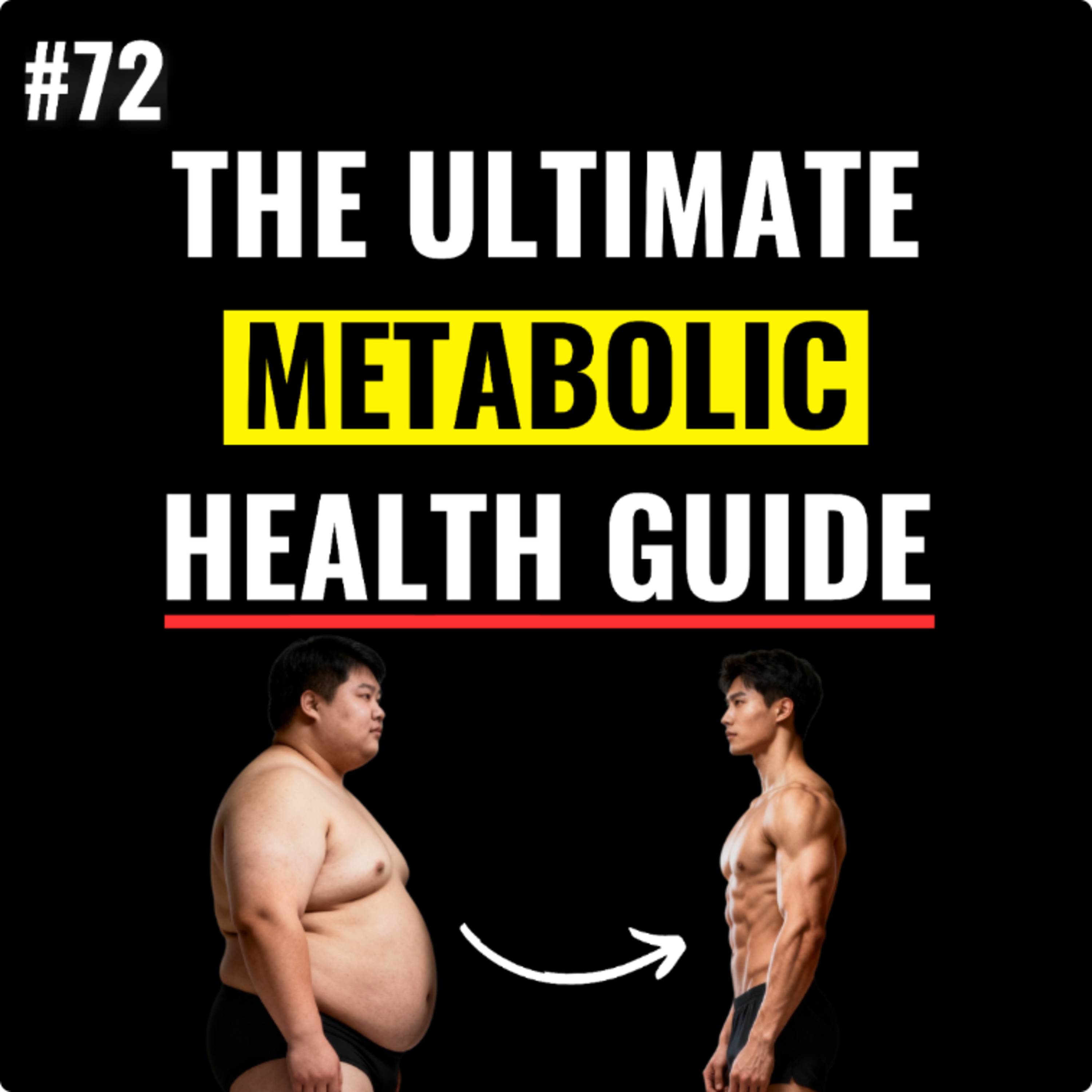
Metabolic Health & Insulin Sensitivity: Prevent Fat Gain, Blood Sugar Spikes, Low Energy, Weight Management, Glucose Control, Hormones, Stress, Circadian Health & Longevity | Fitness Wisdom Podcast
What's This About?
Metabolic Health & Insulin Sensitivity: Prevent Fat Gain, Blood Sugar Spikes & Low Energy
Protect your metabolism and avoid fat gain, energy crashes, and blood sugar spikes during overeating, stress, poor sleep, alcohol, and inactivity. We explain why weight gain isn’t just about calories — it’s about insulin sensitivity, metabolic health, glucose control, circadian rhythm, hormones, and stress.
Learn practical strategies to manage big meals, holidays, and social events without restriction, using movement, HIIT, resistance training, fasting, red light therapy, and circadian optimization.
This episode gives science-backed tools to improve metabolic health, regulate blood sugar, preserve energy, and prevent fat gain, so you can enjoy food without paying for it later.
🔔 Follow for more episodes on metabolic health, insulin sensitivity, fat loss, blood sugar regulation, energy, circadian health, hormones, stress, and longevity
✅SUBSCRIBE to Tiina's YouTube
---
🔥 12 - Week Body Transformation Program: Personalized Nutrition, Training & Lifestyle Optimization to transform your body from the inside-out ✅️ Start your Journey Today
---
‼️Join my Free Fitness Wisdom Podcast Telegram Community HERE: I look forward to seeing you in there!🤗
---
📥 Join my Newsletter for FREE Educational & Empowering 🧠 content straight to your inbox: FIND IT HERE
---
⬇️ Find & Connect with me Here:
https://www.bio.link/move_with_andreas
👉🏽 For Discounts, Offers and Freebies: HERE
---
⏱️ Chapters:
00:00 How to Avoid Fat Gain During the Holidays
00:30 Understanding Metabolic Health & Insulin Sensitivity
01:00 Preventing Weight Gain, Low Energy & Water Retention
02:44 How to Improve Metabolic Health & Insulin Sensitivity
03:54 Sunlight & Red Light Therapy for Glucose Regulation
05:47 How Red Light Therapy Reduces Blood Glucose
06:44 Glycogen Storage and Reserves Explained
08:50 Resistance Training & HIIT for Glycogen Depletion and Fat Loss
12:12 Stress Management for Insulin Sensitivity and Metabolic Health
17:17 Eating Mindfully for Improved Digestion, Blood Sugar, and Metabolism
17:45 Intermittent Fasting: Lowering Blood Glucose & Reducing Metabolic Crowding
22:50 Circadian Rhythm’s Role in Metabolic Health and Insulin Sensitivity
25:00 Fasting & Feasting Strategies
27:00 Sauna & Ice Baths to Improve Metabolism and Insulin Sensitivity
32:00 Factors Contributing to Poor Metabolic Health & Insulin Resistance
32:30 Sleep Loss & Chronic Stress Impacts on Metabolic Health
33:30 How Artificial Blue Light and Non-Native EMFs Affect Metabolism
36:50 Overeating & Metabolic Crowding Explained
37:50 Muscle’s Role in Blood Glucose Regulation, Insulin Sensitivity, and Metabolism
39:00 Best Exercises for Fat Loss
44:30 How Alcohol Impacts Fat Gain, Insulin Resistance, and Metabolism
49:00 Top Biohacks for Metabolic Health and Insulin Sensitivity
53:00 Free High-Intensity Interval Training
56:00 Grounding, Breathing, and Nervous System Regulation for Metabolism
---
👇🏽 Find the SHILAJIT I use & recommend HERE ⚡
Use promo code: MOBILITYFITNESS for Discount ✅
.
➡️ For my favourite Blue Light Blocking Glasses, use promo code: MOBILITYFITNESS for 15% Discount ✅ HERE
.
💦 My favorite Magnesium Supplement HERE⚡Use promo code: MOBILITYFITNESS for Discount ✅
.
👉🏽 Find Best Red Light Therapy panels, Blue Light Blockers & Circadian friendly bulbs 🚨Use promo code: MOBILITYFITNESS ✅ for 20-50% OFF your order HERE
---
*None of the content / statements in this Podcast are Medical or Personal Advice & is not intended to cure, treat, prevent or diagnose any medical condition. All my videos are for Educational & Research purposes only. If you decide to try anything discussed in this video, you agree to do so at your own risk & responsibility*
This is the Fitness Wisdom podcast How to not get fat. Experience sluggishness, low energy, and water retention this Christmas time. This is what we're going to be diving into in today's episode. We're going to be going over all of the things that you should and shouldn't do in order to feel great, no matter what the occasion. So this video is going to serve as a great guide for any occasion when you have social gatherings, you eat more food than you normally do, and you don't want to end up feeling like crap.
So you definitely want to send this episode to all of your friends and family members and definitely save it for next year's Christmas as well. So in order to lay the foundation for our discussion today, we first need to go over the importance of metabolic health and insulin sensitivity in general, as well as understanding glycogen reserves in the body. So what do we actually mean when we talk about metabolic health and insulin sensitivity? So metabolic health and insulin sensitivity is directly tied to how we feel on a daily basis, whether that is like good energy levels or good performance or good cognitive function or good hormonal function.
This is all intertwined in our body, right? And basically what we actually mean when we talk about metabolic health. So good metabolic health would refer to when we actually taking fuel from the food that we are eating and our body is able to process that fuel efficiently and actually metabolize it. When we talk about poor metabolic health is when our bodies literally resistant to the food that we're eating. And that can be due to many different factors which we will be addressing today as well in this episode.
But in general, we need to understand that if we have poor metabolic health, that means that the body is not able to utilize the fuel that we're putting inside our body, the food that we're eating. And it's just going to be creating havoc and chaos inside of our body. And then we're going to be feeling low energy. We're going to have water retention, we're going to have brain fog, lethargy, fatigue, and we're not going to be feeling good because when the cells are not able to use the fuel that's coming in, they literally think that they are starving in certain situations.
In some situations they may be over full, which we'll also be going into today. And that may be the reason why they're not able to accept the fuel. So that is basically what we mean when we talk about good metabolic health and poor metabolic health, just so we lay the foundation so everybody understands everything that we're going to be talking about today. And insulin sensitivity and insulin resistance all is all intertwined with metabolic health, right? So when we have good insulin sensitivity, that means our tissues are responsive to insulin.
That means the fuel can enter the cells efficiently and it can be metabolized. But when we have insulin resistance, that means the cells are not responding to the insulin and then therefore the fuel is not able to enter the cell and be metabolized. And now it's circulating in our bloodstream longer than it should and therefore it's going to result in fat gain and also elevate chronically elevated blood glucose and a whole host of other symptoms which are associated with that. So what are some ways that we can improve our metabolic health and insulin sensitivity?
Well, there are so many different ways we can do that right from sunlight, red light therapy, high intensity training, sprinting, resistance training in general, stress management, intermittent fasting, walking after a meal, contrast therapy, so hot and cold exposure, as well as sleep and circadian rhythms. So all of these factors are super important to actually understand because this actually gives you power over your own body so you don't feel a victim to the situations. We know that when we are in some certain type of events where we can't necessarily the control the amount of food that we're or the type of food that we're eating or the timing of the food and so on.
There are some ways to empower your body so that you have more control of how your body actually responds to the food that you're putting in. You see, this is what makes a difference between someone who responds well to food versus someone who doesn't respond well to food. And so we're aiming to actually empower you today, and we're going to be explaining to you about how all of these factors actually help your body to respond better to the food that you're going to be taking in. And now we're going to start off with the first one, which is sunlight and red light therapy.
So how does sunlight actually improve metabolic health and insulin sensitivity? So the primary mechanism of sunlight is that it improves our mitochondrial function and it it also comes with a host of other benefits. But also of course aligning ourselves with the natural light cycles improves our circuity and rhythms in general. So that means our cortisol rhythms and our melatonin rhythms and that all ties into the metabolic health. So sunlight is not really, we cannot pinpoint 1 mechanism only, but there are a host of things that improve our metabolic health.
And therefore we always feel better when we spend more time in alignment with the natural light, whether that is in winter or it is in summer. So it's actually foundational for our metabolic health. Guys, if you haven't already smashed that subscribe button and the like button. Now back to the show. Absolutely. And vitamin D as well is known for improving insulin sensitivity. So that means that you're basically your cells are going to be more responsive to the insulin elevation. You know, if you have a high carbohydrate meal, even high protein meal actually spikes insulin as well.
If you didn't know that. And do make sure that you stay until the end of the episode because that is where we're going to be sharing the practical tips of how to actually implement this into your day. So now we're just kind of going over the benefits of doing certain practices in order to actually help your body to respond to the feel better. But towards the end of the episode, we're going to be sharing with you like how to actually implement them in order for you to make it so much easier and more efficient for you.
So this is maybe something that you don't only want to consider doing in events around Christmas, but it's maybe some practices that you probably want to implement in your daily life in general because they are so powerful improving your metabolic health and insulin sensitivity. And we know that metabolic health and insulin sensitivity is a long term game. The longer you do these practices, the better your body becomes. And this is the beauty of it. So also there is some very interesting research around red light therapy in general, how just doing 15 minutes of red light therapy before a meal is able to reduce the glucose response by 30% post meal.
So it actually lowers blood glucose by 30% post meal, which is absolutely incredible. And that is just through the power of light. And we know that sunlight is 50% red and infrared light. So you basically get a red light therapy for free. But of course, if you can't get outside for whatever reason, which you, you probably can, But you know, everybody makes excuses. But if you can't, let's say you can always have a red light therapy panel in your home and you can use that before, you know, having a meal, you can always do it after your meal.
And that can massively improve mitochondrial function and then therefore allow the increase in ATP production and the utilization of fuel independent from insulin. So basically like indirect glucose update? OK. So now we're going to move on to the next factor. How can high intensity exercise then help our insulin sensitivity? Well, basically anytime we do any high intensity exercise, we're going to be shifting more into an anaerobic type of metabolism, which means we're going to be burning glucose primarily as a fuel.
And this is an incredible way in order to deplete the glycogen levels in our body. And why this is so important to actually understand is because this is what makes a difference between gaining body fat and not gaining the body fat. Of course, the total calories that we consume in the day is one of the most important factors, but the second most important factor is whether our glycogen reserves are depleted or over full or spilling over, let's say. OK, so glycogen reserves like in a in a normal individual, so in a sedentary individual, they can be between 350 to 500 grams of carbs.
So that means a person could store up to 500 grams of carbs in their body when they are a sedentary individual, trained individuals. So people who have a lot more muscle, muscle on their frame can eat up to 600 to 800 grams or can store up to 600 to 800 grams of carbohydrates in their body. So this is absolutely insane, right? So this just actually shows you the importance of having more muscle mass because now your glycogen reserve, your ability to eat more carbs increases without you gaining body fat.
Of course, again, never forgetting about the total caloric intake in general, because when we have a calorie deficit, meaning we're eating less calories than our bodies burning or we're burning more calories than we are taking in. We are never going to have fully stocked up glycogen reserves. Because if we are in a deficit, that means our body is going to be using some of that glycogen as a fuel. But when we're eating at a calorie maintenance or calorie surplus, like in many of these events like Christmas time or when we go out with friends or in, in times when we can't necessarily control how much we're eating in the day, most likely we are going to be at a calorie maintenance or calorie surplus in the amount of food that we're eating.
And so why am I talking about this in relation to the high intensity exercise? Because the high intensity exercise, what it does if you're an individual who doesn't have a very big glycogen reserve or storage in the body, you actually want to be reducing your glycogen load in your body. So reducing how much you have available in your muscles and in your liver. Because after when you do consume a meal which is high in carbohydrates or just a lot of calories in general, now your body is going to be more responsive and receptive to the fuel.
But when your glycogen reserves are fully topped up, basically there is more reason for your body now to store the excess fuel that you're eating into body fat because it doesn't even need to put it in the cells anymore because the cells are literally fully topped up. And they basically say to the body, hey, now I'm I'm going to create a normal physiological insulin resistance due to the fact that you are fully topped up with glycogen. I don't need any more right now in the cells. So what it's basically going to do, it's going to save that fuel for later and it's most likely going to store it as body fat.
But at the same time, it's going to create an elevation in blood glucose as well. So in order to prevent an elevation in blood glucose, meaning like chronically even when you are not consuming foods, we want to have like a little bit more depleted glycogen reserves, but we also want to focus on building muscle mass. And we want to be doing more like high intensity training because as I explained, like high intensity training is going to be anything that it makes your muscles really feel like they're burning.
So things like sprinting, things like resistance training, anything that is super hard, that feels like is burning your muscles is basically considered anaerobic. And that is basically when you're going to be depleting glycogen levels. And these are fantastic to do before events where you know there's going to be a lot of food the day before or even on the same day as well as after. You don't need to obviously do it immediately after a meal, right? You can't do it later on in the day or the next day.
And to start to treat the fuel that you're taking in more as a driver for exercise rather than using exercise as a form of punishment. So as we mentioned previously in our previous episode that we did about muscle being the organ of longevity. So we actually don't want to be using exercise as a punishment, but what we want to be using exercise as something that's going to improve every single area of our life, whether that is our strength, our capability, and our function overall, but as well as improving our metabolic health and our insulin sensitivity.
And basically, you know, when we do this high intensity exercises, it's going to be incredible for depleting our glycogen levels and allowing us to eat more food without that food spilling over into our body fat. And this is something very, very important for you to understand that if you have a bigger glycogen storage or bigger, bigger glycogen reserves because you have more muscle mass or because you have created a depletion in your body, now your body is going to be way more receptive. And it doesn't actually require insulin as much in order to drive that fuel into the cells because the cells are actually begging for that fuel.
You see, this is what makes the difference between someone who responds well to fuel versus someone who doesn't. Why does someone get fully bloated and get has like a lot of water retention and so on the next day versus someone who does not? Muscle cramps, eye twitching, headaches, agitation and stress. Those are all signs that I have magnesium deficiency. I can always tell when I haven't taken my magnesium. You see, magnesium is an absolutely essential mineral and is required in over 600 biochemical reactions across the body.
I'm pretty sure we've all experienced that cough cramp in the middle of the night and that is most likely due to a mineral or magnesium deficiency. And the reason why most individuals are deficient in magnesium these days is because stress depletes magnesium. And tell me a single person in this world who is in stress right now, whether that is physical or psychological stress. Magnesium is something that I'm very religious about taking every single evening before I go to bed because I don't only want to sleep 8 hours, I want to have a deep and restorative sleep.
I know that when I've taken my magnesium, I wake up feeling relaxed and refreshed. So if you want to discover the magnesium that I use on a daily basis, you want to make sure that you head over to the description below and use the promo code attached to get discount on your entire order. And that all ties into the stress management management as well because the way that you are explaining it there, it actually allows us to make this mindset shift instead of training being like a stressful situation for our mind or instead of us approaching it from like anxiousness, stress restriction and trying to burn calories, we are actually utilizing it as a tool or something that our body is capable in doing.
And we are fueling our body appropriately and then we are putting that fuel into use. So there is like a huge paradigm shift almost that it's happening. So this all ties into the stress management as well. So as you said, that resistance training is super important for our metabolic health, but that is a stressor. But when we are talking about stress management, that really ties into the chronic stress. So we don't want to be under stress all, all the time because that is actually going to be counterintuitive for our metabolic health.
But having those bursts of stress is equally important. But then coming back to the baseline, how does this stress management then tie into our metabolic health? Well, if we are under chronic stress all the time, our bodies all the time pumping that glucose into the bloodstream because we need that as a quick source of fuel to escape from any situation or survive in that situation. So stress management is equally important. And obviously when we are in holiday mode and all that, we are probably we have less mental stress in general and probably less physical stress as well.
But however, though we often create that stress ourselves. So whether that is true circadian disruptions or whether that is from mental space, because a lot of people do experience social anxiety in this kind of situation. So it's just so important to have those tools that we can use to manage our stress as well. Do you have anything to add into that? I wanted to share 1 fascinating fact about high intensity exercise and how actually, even though it's hard during the exercise, you would think that, you know, it causes more stress overall.
You know, in an individual who has a lot of stress, you would think it would actually promote more stress. But actually research suggests that people who do high intensity exercise and they're already stressed in life, it actually makes them deal with stress even better after the exercise is over. So actually their cortisol does not spike as much as it did before compared to doing the exercise. And I, I think I understand the mechanism of why this is. And I believe the reason is because when you have a stressful event such as exercise, high intensity training or sprinting, because sprinting, it literally is fight and flight, right?
It's literally running away from a threat or running to hunt your food is literally the most primal thing that we can do as human beings. You don't have to do sprinting. You can do resistance training is as long as you're going towards failure, your body still thinks that you're under threat, right? You're mimicking a hunting and gathering situation. That's basically what resistance training is. And so basically when you do this, the event is so stressful that your brain actually perceives it as very hard.
And then when the event is over, then it recognizes the event is over. But when you don't actually purposefully have these stressful events in your life and you all the time have these low grade stressors without any big meaningful intentional stressors that you have put on yourself, then your body perceives those low grade stressors as really big stressors. And you're stuck in this chronically mild, you know, stressful state, which is actually what kills you over time. Because we know that chronic stress is actually one of the biggest killers in the world, which is absolutely insane, right?
And so we want to find ways to actually help our body to deal and manage with the stress better. And that is basically what's called resilience. So making your body stronger in order to be able to tolerate more stress, but also showing it something more stressful in order to understand that daily life is actually not stressful. Another thing I wanted to add about stress in general is that it's so like effective at actually making you insulin resistant because actually your body doesn't care about any of your functions in the body or it cares cares about is running away and surviving the threat.
It is only when you are primarily in a parasympathetic state when your body is more insulin sensitive and more receptive to fuel. And This is why it's so important to wind down and take deep breaths and calm your body down before actually eating. Because if you don't do that, if you eat in a stressful state, your body is not going to digest the food efficiently and you're going to have a way, way harder time at metabolizing that fuel and putting it away into your cells. So your cells are naturally going to be more insulin resistant when you are actually under more stress.
So you need to find ways that are going to help you lower stress which will actually share towards the end of the episode. This is such an important fact that you are sharing there because actually always the meals should come with a peaceful mind and peaceful body. So I would always recommend people to find that space to eat in peace. So the eating shouldn't be something that just happens on the side. Of course, when we are socializing and all that. We should still drop in into our body and into our environment and really just try and calm our body before the meals.
That is so important and this ties into the next factor really nicely. So intermittent fasting or time restricted eating is really important when it comes to metabolic health. And why that is, is because when we have set mealtimes and we have time in between of those mealtimes, we allow our body to become sensitive to the fuel again. So we are not bombarding it with all the time with more and more fuel, but it allows our body to put the fuel into use and then we become hungry for the next meal again and then we can eat again.
And this is really the healthier way to do even when even if the meals are bigger, at least we allow that the body to time to get more sensitive to the fuel again in between of the meals. And This is why also intermittent fasting or time restricted eating has really been shown super, super beneficial for our metabolic health. And that can of course be done in multiple ways. This all ties into the circadian rhythms as well, so it is helpful to time restrict the eating windows in alignment with our surrogatian rhythms.
And of course to have the time in between of our meals to maybe not snack all the time in between of the meals, but really allow our body the time to just digest and rest. Based on my research, this is the best Shilajit in the world. Here's why you need to know about Shilajit. Shilajit is a herbal mineral substance made from the decomposition of plants and bacteria. This process taking place over thousands of years. It's harvested from the Altai and the Himalayan mountains. Think of it as a hyper concentrated plant matter that is made by a Mother Nature over thousands of years.
In many cultures and traditions, it's known as the destroyer of weakness. Let me tell you why. Jilajit is loaded with ionic minerals which are the most biocompatible with our human body. It also has a very high concentration of folvic acid. This folvic acid allows those minerals to get into the cell and do their work. Minerals are absolutely essential for all processes of the body, from having good energy levels and cognitive function, hormone optimization, and so much more, you name it. This is why I use shilajit on a daily basis because it works on a foundational level, on a mitochondrial level, and we know that we need healthy mitochondria in order to produce cellular energy.
Something very important to mention is the quality of shilajit. The one I use has been tested for heavy metals and impurities, ensuring the highest quality shilajit. So if you want to experience this incredible ancient substance and find the one that I use on a daily basis, head over to the description below and use the promo code attached to get a discount on your entire order. I think a great analogy to give for this is a fire fire. If you over you put too much wood on the fire, you're going to choke the fire.
So the fire is actually going to go out. If you don't put enough wood on the fire, the fire is also going to go out. And this is like a perfect reference to metabolism in general. So just imagine like, you know, creating a traffic jam in your cells. The traffic is not moving and so it's just accumulating there. It's causing a lot of havoc and stress on the That's basically what you're doing if you're snacking and constantly eating throughout the day. But if you have clear eating times, even if you're overeating food, your body is going to have a way easier time at metabolizing that fuel and putting it away.
Even if it's in body fat, your body is just going to be significantly healthier compared to snacking. That's why me and Tina were very strict about having only three meals a day and not eating in between of those meals. Because snacking is, in my opinion, only necessary if you genuinely, genuinely have depleted your body and you feel so low on energy that you actually need a snack. But if you're just snacking just because you're bored or just because you're just looking for something to do or you think that you're hungry, well, those hunger signals are probably not the most reliable hunger signals.
The the hunger signal should feel actually from your stomach. It should feel like a genuine hunger signal from your organs, not from your mind. If it's coming from your mind, it's most likely a fake hunger signal. So it's very important to have like these clear cut times for your meals, like Tina mentioned, you know, circadian timed meals, eating breakfast time within one hour of sunrise, eating lunch. We you know, in the in the midday when the sun is the highest and eating your last meal within the hour of sunset to the latest.
Because we know that eating food actually after sunset is we are more insulin resistant naturally because our body is not supposed to be consuming food in general. And so if we have to be consuming food after sunset, it definitely has to be way more lower carb and it has to be way smaller in general. But we want to be avoiding that altogether. We want to be eating our carbohydrates primarily the first half of the day. So for breakfast and lunchtime, when our bodies more insulin sensitive naturally and the sun is the highest, which improves insulin sensitivity, right?
And then we're going to be reducing our food intake towards the end of the day. And so if you want to do this like safely during the holiday season, if you want to become even more sensitive for the holiday season because you know you're going to be naturally overindulging on food. One really great strategy is that I don't actually promote this on the long term, but would be too fast from the evening time till the breakfast time and even skip your breakfast and just go straight into the lunchtime as your first meal of the day.
Because this way you have reduced the amount of calories that you have consumed in the day in general. Because now you have less hours to consume, you know, 2 meals and your body is now going to be more receptive to the fuel. Now this is not something that I'm an advocate of doing all the time, like intermittent fasting, skipping breakfast. But if you're if you know that you're going to be overdoing a certain meal, I think it's an incredible tool you can use to actually deplete your glycogen levels.
Because anytime, when you go prolonged periods of time without actually any calories in general, your body starts to deplete your glycogen stores before it taps into your body fat. So it's a really great way to make your cells more insulin sensitive before a big event. I let me tell you mentioned that the big meal would be launched. So to do this type of approach and having the big meal very late in the evening would also be a little bit counterproductive. So of course, when the meal times are built around family and friends and all that, it will be a little bit harder to set the times exactly.
But I think it will be helpful to shift the even the dinner time slightly earlier and then later to really allow our body to be sensitive to that fuel. And this all ties into the circadian alignment and sleep really nicely. So even on the holiday season, we want to adhere to our circadian rhythms and we want to adhere to a good sleep as much as we can. So therefore, of course not having those super big meals in the very late in the night is is a better idea because we can have a better insulin sensitivity.
And also we know that melatonin and insulin work opposite opposite to each other. So if we are digesting a big meal in the evening, we will less likely experience a good sleep on that night. Our really cool thing with intermittent fasting is that, you know, the the more you move your body and the more you exercise during intermittent fasting in general, obviously that's going to deplete your glycogen stores even faster. So a really great hack during intermittent fasting if you want to deplete your glycogen stores even more if you know you're going to be having a lot of carbs or a big, big amount of calories in general, is to go for, you know, a long walk before a meal as well, like in sunlight even better.
So all of these ways and even doing like ice baths and so on and these kind of things, these are absolutely incredible at elevating your heart rate and actually depleting your body of glycogen. And this is going to make you more insulin sensitive and basically make your cells more receptive to the fuel and you don't actually require insulin so much to drive the fuel into the cells. Also, there is a fine line there. So for highly stressed individuals, this is probably not the most optimal approach.
But if you're somebody who has a nice baseline and who is not so stressed all together, they can tolerate those things, those things better. Yes, yeah. Because we know that short bouts of stress, as we mentioned, are beneficial. But if someone is like very, very stressed and they're just in general under eating, and we know that most likely if a person is under eating chronically, they're probably not going to overeat during Christmas time, right? Because a lot of people are very manipulative with their diets.
If they have like some eating disorder or something like this, they are going to be very manipulative and controlling around how much they eat. So I guess our discussion is centered for around for people who are in general more likely to overindulge and overdo it like myself. Because you know, like I come from a background where I used to be overweight and obese as a child and I still have that in me somewhere. You know, like I just basically, I just feel like somehow my stretch receptors in my gut or something are not working.
And so I just feel like I can just eat so much food way more than my body actually needs. And I can do that all the time. And so I have to actually be very mindful, you know, of my meal, my portion sizing, but also ways to improve my metabolic health and insulin sensitivity. Let's be honest, that's for most people that is the situation because we as humans are really designed to eat, because we are designed for survival. And of course, evolutionarily, if you think about it, we would eat always when the food was available.
So I think we're just designing and fasting, feasting and fasting. Exactly. So I think we're just designed for that. So it will be the vast majority maybe I think, who can overdo food than under do food. No, I love what you mentioned there because this feasting and fasting concept is actually built in our biology. It's by design. So your ability to overeat is actually a good thing because that means that, you know, your body is now able to store a lot of that excess fuel that you're going to eat into body fat.
So you can actually survive a long period of fasting until the next time when you're going to get the fuel. The thing is that now we live in a world with abundant calories and, and abundant food available. And so now we're not doing the fasting so much. So we're doing only the overfeeding. And that is actually the problem. If we were actually adhering to long periods of fasting, meaning couple of days of fasting at the time and then overeating, I think that the majority of the population would be extremely healthy even with all of these excess calories.
Because as I mentioned, and as Tina mentioned before, like insulin sensitivity and metabolic health comes about when your body is actually more receptive and actually craving the fuel. You don't actually have that when you're overfeeding all the time and your body makes you insulin resistant by design in order to store the excess body fat. You made a nice mention about the putting wood to the fire. So that takes me to the contrast therapy. So especially in a lot of countries where Christmas is celebrated a lot there it's on the higher latitudes and we have the snow and we have the sauna and all that.
So contrast therapy is a really nice way to improve our metabolic health. And traditionally actually in those countries, it is often done the sauna and then swimming in a ice lake and all this. And this is a very phenomenal tool for improving our metabolic health because it makes our, again, it's like this short term stressor which makes our cells burn through fuel way more efficiently. Basically, sauna is like doing cardio, right? Without doing cardio, you just sit there and your heart rate elevates, you sweat more, you detoxify your body, which is incredible for your immune system.
So that's just beyond the benefits of metabolic health. You get so many incredible benefits by doing sauna. And then you combine that like with cold exposure, you know, ice therapy or whatever, you're going to elevate your heart rate again and you're also going to increase the amount of brown fat that you have in your body, which is incredible because that's loaded with mitochondria, which means that now you have more places for the fuel that you're eating to be metabolized, as we mentioned as well with muscle.
So the more muscle mass you have and the more brown fat you have, the more you can tolerate cold, but as well you can metabolize more fuel. So that means that you can actually eat more food without getting fat. So these practices, all of these things that we mentioned are absolutely, absolutely incredible for making your body more receptive to the energy that you're taking in. And you don't need to be a victim to gaining weight and feeling lethargic, low energy and experiencing all of these negative effects from, you know, Christmas times and any kind of events out with your friends.
It would be worth mentioning though, that one thing what I've noticed in the past is that cold exposure is something that people try to do in the middle of the winter without actually acclimatizing towards it. It's a little bit like going for a holiday in the summer and exposing ourselves to a really harsh sunlight without actually any kind of acclimatization period. So it could be that for a lot of people in the modern, modern people, the cold is not necessarily always approachable, you know, the Super cold ice, ice water.
But for those who have maybe practiced it and can utilize it it as a tool, that could be a very, very nice way to do it. I agree with you. It's like you know as they say that in the sun you build a solar colors right by being exposed to the sun all year round like we are doing right now. It's like winter is December here in Cyprus and we know that it's actually not that cold. Obviously that's why we're outside like, you know, we just just very little clothing, but we, the UV index is very, very low right now.
It's like UV 2. And so in the summertime here, it's like UV12, which is basically very, very high, but you know, that doesn't that rises gradually throughout the season and throughout the months, you know, leading up to the summertime, obviously it doesn't go from UV index two straight to UV index 12. So that means that, you know, you're going to build that solar colors and that means that your body is not going to burn so easily if you're actually outside every single day, no matter what the season is, because then your body actually acclimatizes to that environment.
And now we're exposed to a little bit of the cold air as well, which makes us more resilient and more, you know, capable. So I would call it like a cold colors, not like a solar colors, but cold colors. And you actually build this again by from the summertime going, you know, in the sea or in a lake or taking ice spots or whatever. And you build it up and you do it slowly over time, and eventually you're going all year round and it just feels normal to you. You've normalized. You know your body is not under shock because you've actually made it like a daily habit.
And the beautiful thing is when you do it in alignment with nature, as the days go on towards the winter, the sea gets cooler or the lake gets cooler, but it's always such a slight difference in the temperature that it's so possible for the body to adapt to it very nicely. But if you were to swim in the summer and then try to swim in the winter, that would be a big contrast. But acclimatizing with nature is really the way to do with us with anything. All right, so now we just covered all of the things which actually help improve metabolic health and insulin sensitivity.
So now we're going to be actually talking about all the things that make metabolic health worse and make you more insulin resistant and actually promote fat gain, water retention, low energy and lethargy. And these are all of the things that we want to be avoiding, right? No one, I think, wants to experience those things, even if you want to like enjoy a nice Christmas time or go out, you know, with your friends and overindulge. So let's talk about the things which actually make these things worse.
Not sleeping enough and surgeon and rhythms disruption. That's really on the top of my list because this is so foundational for our health and for our metabolism in general. So of course in the holiday times of people tend to skip sleep or maybe go to bed too late and all that. And then that can really increase our water retention, feeling slackies and all that in the daytime as well. And another factor would be stress. So we want to really give that stress in, as always. And we actually know that even just one night of bad sleep actually elevates our blood glucose because we are spiking our cortisol levels.
And then that's messing up with our insulin sensitivity and our metabolic health because it's going to be pumping out more glucose into our bloodstream from the liver because we have created more stress in our body, right? Because our body is now less resilient because we didn't sleep so well. And so now it's needing to create more cortisol to make us more alert and more awake than it actually needs to. Well, it actually needs to in that situation, but you know what I mean? When you actually skip the one night sleep and now you're going to be less receptive to the food that you're actually eating.
So you're naturally going to be more insulin resistant that day that you actually haven't slept well. So definitely focus on prioritizing your sleep and your circadian rhythms rhythms because these are absolutely foundational to mitochondrial health. And as we said that the more mitochondria you have and the more healthy your mitochondria are, the more you can process the fuel efficiently. And think about your night time or more melatonin as your repair and restoration. So that really helps to reset everything in the night time and then we can come to the new day again with a reset metabolism as well.
And another factor would be excess artificial blue light and non-native EMS. This is something that is still way overlooked in the modern life. But if we think about it, we are all the time under artificial blue light, even do it when we are indoors and these days even more because our indoor lighting is more lead heavy and no incandescent lights or fire lights like we used to have. So this is a problem because it's devoid of the infrared light, which is beneficial for our metabolism. But then we just get that high spike of blue light throughout the whole day and that releases cortisol and puts us in this stress state.
So too much of that and unbalanced with the natural light spectrum or infrared light that is a problem. Imagine spiking your blood sugar without eating cake, elevating cortisol, your stress hormone, without being stressed, and suppressing your body's most powerful sleep, antioxidant and regeneration hormone, which is your melatonin. This is why I make sure to wear my yellow daytime blue light blocking glasses every time when I spend time indoors, under artificial lights and in front of screens to protect my eyes from oxidative stress and my entire body.
And if I'm going to be exposed to artificial blue light, especially after sunset, I'm going to wear my red lens blue light blocking glasses to support my melatonin production and release. So if you want to protect your energy levels, sleep and biology from artificial blue light, head over to the description and you will find all of the links with a massive discount on my favorite blue light blocking glasses. Do you guys remember those times when Christmas used to be like all warm and cozy and it used to feel like more orange and red and glowy And now all of these like leads, you know, for the trees, even they're all white in color.
And this, this brutally cold white color, which makes it makes everything feel so clinical and pharmaceutical, you could say, and so devoid, you know, from, from the natural state that we, we have come from as human beings, you know, which is fire light and just being cozy around like infrared light in general. And I feel like that's one of the biggest issues that we have today because this is actually messing up, messing us up so much. And I actually talked to you at the beginning about the importance of red and infrared light and actually managing blood glucose, you know, glucose regulation, which is so, so powerful.
It's crazy. Even just by having like incandescent light bulbs in the house, which actually have the full spectrum of light and they have red and infrared as well. It actually helps to give the signal to the body to know, you know, how to function properly. But when it's only exposed to the blue light and also the non-native PMS from Wi-Fi, cell phones, cell towers, microwaves, all these things, all electronic devices, this creates an excessive Ros, excessive reactive oxygen species, excessive stress, excessive inflammation in the body.
When you have excessive inflammation, you naturally are more insulin resistant. And so again, you're not able to use the fuel, metabolize the fuel, put it away effectively you're it's going to result in more easily gaining body fat, especially if you're eating in a calorie surplus, overeating without earning it. What do we mean by that? So just basically over consuming calories and not putting that into use. That's simple as that. So there is like a limit for our body what it can take and then after that it starts storing the fuel into our fat stores.
So think of it as like a traffic jam. So if we put too much fuel into the system, it's just going to overflow and we are not going to feel at our best. SO overeating without really earning it, it's a problem. Yeah, and that's where the exercise piece comes in, as well as what we talked about at the beginning about the glycogen stores and reserves. If you have like a small glycogen store in reserve because you don't have much muscle mass, that means you can't eat as much food, you know, without gaining the body fat.
And obviously if you over spill, meaning think of your glycogen reserves like a bouquet and obviously like if you put too much water in the bucket, it's going to overflow, right? When it overflows, that means it gets stored into the body fat because it has nowhere to go. It's floating around in your bloodstream. Your body doesn't want to have chronically elevated blood glucose. So what it actually does, one of the compensation mechanisms is to put it away into the body fat for later use for the body, for when you have depleted the body or for when it's going to experience sometimes of.
Fasting, you know, naturally or something like this, then your body will be able to tap back into that body fat and start to mobilize that fat, you know, and use it as a fuel. But it's not going to do that if you're all the time fully stocked up with your glycogen reserves, you have low muscle mass, you're not exercising. Exercising and movement in general are absolutely incredible ways to use a lot of the glucose from your muscle and your liver. And then it's going to be create a bit of a deficit right in those areas of the body.
So now you're going to be like more receptive to the fuel. So again, like if you're not moving and if you're not exercising and if you're overeating at the same time, it's basically the perfect recipe for gaining body fat and gaining water in your body and feeling very uncomfortable. Also ties into individual responsibility really. So we should all aim to know our party better because a lot of times in the holidays as well, we compare to our food intake to another person in the family or in the friends or something.
And actually we can never compare ourselves to another. So how much he can eat, I cannot necessarily eat as much. And depending on what I was doing as well, if you are somebody who has a lot of entrance activities or something and it's just like soaking up a lot of food, those people can just eat so much more than the others. And seemingly it looks like we are eating the same amount of food, but the other one is gaining weight and the other one is not. So it's just really a matter of using these times to actually learn our body better, and next time around we can come back stronger and with more empowerment because we actually know how much our body can handle and what we can maybe do to feel a little bit better in the situation and all that.
Yeah, exactly. Like strategies before and after, how can we actually improve our body's ability to use the fuel, but also to increase, I think the most important in the long term to increase our glycogen reserve, the ability to store more glucose in our body by building more muscle. Like we mentioned in our previous episode, there are so many incredible benefits to having more muscle, right? You have a high metabolic crate, you have a bigger glycogen reserve. That means you're going to be burning more energy at rest and also while doing exercise, you're going to be able to eat more food without getting fat.
Like who doesn't eat? Want to eat more food, right? Everybody loves eating. I don't know anybody who doesn't like eating. And so I just feel like it's one of the greatest hacks that people can do is to learn how to, you know, resist the strain correctly and to build muscle mass in the long term and to use exercise as a, as a way to improve their overall health and well-being rather than a punishment and burning calories. Absolutely. So it can be a motivator for the next year around maybe this year, instead of going for a mature diet on January, maybe we can think like, OK, how can we build a sustainable workout plan to actually start building muscle this year?
Also, another thing is that I see all the time is when people are overindulged, then they feel guilty and then they go for a run afterwards. That's like literally the worst thing that you can do. And plus, I think the most waste of energy that you could have done with that fuel that you ate, because first of all, in running, you are not going to burn so much glycogen. Well, you are going to burn if you're fully stocked up, but your, your body favors more fatty acid oxidation during endurance activities.
And so the best thing you can actually do with the fuel that you actually is to do resistance training, put it to use in your muscles, because now your muscles are going to have a, a greater demand. So if you really deplete all of your glycogen stores in your body by doing a full body workout, let's say, or a sprinting session or something like this. Now your body is going to be able to mobilize a lot of that fuel and get it out of your blood stream, get it into the cells, put it into the use. And actually you've done something beneficial for yourself.
You know, you've, you've been, you're probably going to increase your strength if you did like a good strength training session and you're going to improve so many aspects of your health. And it doesn't feel like you are using the exercise as a form of a punishment for yourself, you know, because you feel bad, but rather use it as a if you, there are many big differences. Like when you go for a run, you're not going to feel the benefit of overeating. But when you actually do resistance training or yeah, or like explosive movement, you're going to notice that you are so much more powerful.
So like you want to do the things that actually make you feel more powerful and make you feel empowered because this is going to make you feel like, wow, Like all of the extra fuel that I ate actually benefited me in the gym, actually benefited my workout. It it allowed me to build more muscle and make me healthier in the long term rather than seeing it as something that you need to get rid of from your body as soon as possible because you feel like crap. And you know, temporarily you're not able to sit with that that feeling.
So another thing that comes to mind there is if you are not willing to do the things that we're saying right now, just don't overindulge in general. So you don't feel like crap in the in the 1st place. Because if your body is like not receptive and you're not willing to do all the things which are going to make you more insulin sensitive and more metabolically healthy, you have just have to learn your body like Tina said. And you just have to make sure that you don't overindulge so that your body has enough room so you don't create a traffic jam in your body to, you know, create this metabolic chaos.
A lot of people skip this glycogen part. So I'm I'm quite glad that you're explaining it like this because a lot of people actually want to burn fat when they are exercising. So this is like the first idea that comes to mind that now I need to just burn this fat from my body. But a lot of times actually we just have way, way more glycogen reserves in the body and therefore we have a lot more water retention in the body. And over time that's going to translate into fat stores. Yes. But actually if we think about exercise more like utilizing that glycogen that we have in the system and reducing that traffic jam, that is going to translate to better fatty acid oxidation as well.
But it just doesn't need to happen necessarily during the exercise. So we are not necessarily we don't need to go for one hour run or one hour cycle or something like this to actually be better fat utilizers as well. And there are some fascinating research around like fastest cardio versus doing cardio later in the day when you have already eaten your meals. And they have actually shown that people who are both in a calorie deficit. So let's take one group who is doing the fastest cardio and they are also in a calorie deficit.
And the group which is not doing the fastest cardio, but they're also in a calorie deficit. And they actually show that no matter which form way they actually did it, whether it was fasted or unfasted, they both resulted in the same amount of body fat loss. So that actually just shows you that it doesn't matter whether you're burning. Yes, they did actually show that you were burning more fat during the fastest state, but it didn't result in a greater fat loss in the body. So actually burning body fat does not equal losing fat.
That is a very important distinction to make. And I actually wrote a sub stock article on this on sub stock. So definitely go and check that out. And so, yeah, it's just so important to actually realize that you shouldn't be chasing burning fat, but you should just be aiming to create a bigger calorie deficit in your body if that's your goal in order to lose body fat. Alcohol. This is the big thing during holidays and actually drinking alcohol in conjunction with excess calories could be a really detrimental thing for our metabolic health.
Not only does the calories add up from alcohol as well, but actually we are causing further issues with the metabolism as well. So that doesn't necessarily mean that 0 alcohol all together for us it is quite a simple answer, 0 alcohol just because it just doesn't deliver much benefit. It just has the downside. So a lot of people just like to have the alcohol though, as a social thing. And I think that's kind of like understandable, but it doesn't justify binge drinking or it doesn't justify going or going overboard.
Because also we need to understand that if we give it like the little finger, it kind of like takes the whole hand. So a lot of times one glass of wine turns into one bottle of wine, that turns into two bottles of wine, then that turns into resolutions for January and all that. So it's just, I think another place where we need that individual responsibility. So to know, OK, what does my body tolerate? How much alcohol can I drink or can I drink at all? So I think it's a big difference to have one glass of wine in the middle of the day than have one bottle of wine in later in the day.
So individual responsibility, really. So basically when we over consume calories in general and we are combining that with alcohol, it can be a very dangerous game because we know that eating in excess makes us naturally more insulin resistant because our body is like, you know, fully stocked up, right? So it doesn't actually need the fuel. The cells are, you know, fully like they're trying to process the fuel. So if we're eating in excess, naturally, there's going to be a traffic jam in our cells.
And then if you add alcohol on top of that, it's going to make the whole process even harder for your body. We're not saying that you should eliminate alcohol altogether, but you just need to learn how to do it wisely. For us personally, we never drink alcohol because of how we feel in general the next day and the, and you know, it takes like a long time for your body to recover. The less you drink alcohol, the more sensitive you are to it. So even just one glass of something, it's, it's going to feel greatly just for even like one week afterwards, You know, it's going to take like a long time for your body to feel optimal.
And a lot of people I feel they don't know how good it's supposed to feel like. And so because their reference point is, you know, messed up, then they just are OK with feeling like crap all of the time. And then they go from feeling crap to feeling like shit, you know, because you know, when, when you are feeling good, then it's very easy to actually understand that, wow, this actually throws my entire energy off. It makes me, it doesn't make me feel good. And so why would I compromise, you know, one week after for just one day of drinking one glass of something?
Yeah, this is really important observation because we are building that baseline for ourselves. So how do we feel is really a result of our habits and acts and basically if we never do things differently. So let's think about that alcohol for example, if we are always used to having that alcohol on the times of celebration, we don't actually know what's causing us. Feeling lucky is feeling low energy, feeling water retention the next day, is it excess food or is it the excess alcohol? So I always encourage people to actually find out for themselves.
So do things differently. So next time maybe try and skip the alcohol parts, see how you feel. If that makes you feel better, well then maybe stick with that approach. But I just, I just think it's just so important to keep testing and seeing what works and really build that baseline. The healthier the baseline can be, the more we are kind of like a plank canvas. That's how I like to see it. So without any kind of additional substances, we are almost in that our natural state of being and then we add things on top of that.
We lose the touch to our real being. So how does it feel to be without any kind of stimulation or any kind of like alteration in our brain chemicals and all that? So, So I think it's important to take that responsibility with this topic as well. You've probably heard about red light therapy before and all the incredible benefits that it has to offer, but unfortunately, not all panels on the market are created equally and This is why I only use and trust the ones that I have put in the description below.
They have the highest quality panels on the market from Bill Quality, Aesthetic and functionality. So if you want a massive 40% discount on my favorite red light therapy panels, head to the description below and make sure to use the promo code attached to get a massive 40% discount. OK, so now on to the final part of our podcast, which is actually the practical tip. So all of these things that we mentioned at the beginning, how can we actually implement them into our lives to actually improve our metabolic health, insulin sensitivity, prevent weight gain, and actually how to feel good during and after the holidays.
So let's start. Surgeon and rhythms and solar habits. So getting up with the sunrise, trying to adhere to our meal times as much as possible, and getting outside in the natural light as much as possible during the day. And of course adhering to the darkness after sunset as well. This is important. Or even trying to use more of that incandescent light or fire light, more atmospheric light instead of blue light after sunset. Yeah, this is absolutely huge and we definitely want to be prior maximizing the sunlight during the day as we mentioned at the beginning for all of the benefits that it offers.
So, you know, even eating meals outside is a super powerful way at lowering blood glucose faster and improving, you know, the clearance of the fuel from the system. And so, yeah, so we want to use the sunlight as much as we can, red light therapy before and after meals and of course, sleep. Sleep is incredible for a stress management that's all tied in with our circadian rhythms and minimizing the blue light, most importantly after sunset because otherwise we can't have deep and restorative regenerative sleep if we don't if we have blue light after sunset.
So again, like Tina said, incandescent lights, red light bulbs, firelight, anything like this that is not going to, you know, stimulate your cortisol production. And as I mentioned a little bit, adhering to the meal times also very important because that sets the rhythm for our body as well and avoids knocking in between of the meals. So always knowing when our big meal is coming and trying to set things around that. So trying to have that time of not eating in between of our meals as well. Yeah, think about your eating sort of like solar eating.
So eating actually with the sun, eating when the sun is up and then not eating when the sun is done. Cold exposure and sauna. Before meals to improve insulin sensitivity and after meals to improve glucose clearance from the system. So I would say that at any time we can implement these tools during the days. It is a good way to do it. But if we want to optimize it, maybe we want to tie it around our bigger meals in the day and make it a social event as well. So it's going to be fun as well. Yeah, that's the cool thing about the sauna, right, That it can fit many people in at the same time, especially if it's a big sauna.
You can make it, you know, like a family event. And it can be a very joyous thing where everybody is improving their health at the same time. So it doesn't need to be just like some like a biohack, but it can be also like a, a social event and as well like cold exposure as well. It's like a, a nice thing to do together because it's you kind of sometimes need a little bit that's mental support, you know, when when you're getting into the cold. So it's kind of like a nice thing to do in it during the holiday season, but in general all of the time.
Absolutely. That's actually been some of our first times doing cold water immersion in Avondo in Finland during Christmas times. So it's fun with family. You go in the, you make a hole in the sea, in the ice in the sea and get in and can feel quite rough. But if you have the sauna at hand, that's just so fun. So much fun. Yeah, it's such a cool experience. And I think that those kind of things your, your brain always remembers because, you know, they're so threatening, but they're also like, so fun at the same time #3 alcohol.
Just be mindful about the alcohol and know where you are yourself. But late night drinking is probably not the best thing to do. And of course, yeah, just limit yourself as much as possible. Yeah, because as we as we mentioned that there is no amount which is necessarily beneficial for the human body. So if you have to do it, just make sure that you do it like during daylight hours, which is going to be the the your body is going to be the most receptive to fuel as we mentioned in general. And just watch your portion sizing, overall #4 movement and exercise.
So daily movement is important and even during holidays, that's something that I would adhere to. So getting more steps throughout the day all together, maybe going for walks before or after meals with your friends, with your family and having a morning mobility routine. So this is one thing that normally people get in because morning is that time that you normally have for yourself, at least you have half an hour or a little bit more depending on when other people wake up. And you can have 10 minutes, 20 minutes, thirty minutes mobility routine, which you can do every morning.
So then you know that at least you set yourself out to a nice day and you've got some of your movement in early in the day. So that would be for the moment. And then of course, resistance training, high intensity training, and basically even to make those workouts short just to get that fuel into use and really pump those muscles. And it can be fun as well because you can do routines with your body weight at home with your friends. And I will be dropping after this episode drops. I will have a high intensity training on my YouTube channel.
So you guys can come and join that. So there should be a link in the description. You can subscribe to my channel. So that's a fun way to add in some exercise during the Christmas time as well. Yeah, movement and exercise in general are absolutely incredible for metabolic health and insulin sensitivity because it promotes glute for to the surface of the cells and this actually allows glucose to enter the cells independent from insulin. And because, you know, GLUT 4, it seems like this one protein which is very sensitive to an energy deficit.
And so when you create a deficit in the body, whether that is through exercise or by eating less food in general or by fasting or by doing anything hard really, you're then these receptors come to the surface and then your body is able to utilize the fuel more efficiently. So it's a super powerful way to do it. And definitely subscribe to Tina's YouTube channel because on there she shares weekly movement and exercise workouts and she has many different playlists for different reasons, you know, stretching, mobility, like workout style, a lot of like body weight stuff.
So basically, you don't even need a gym to actually do this stuff. So this is the one of the most coolest things about her page is that, you know, she gives you practical tools and tips and movements in ways to move your body where you don't actually need equipment. And this actually sets you free. So there's actually no excuses why you shouldn't be getting any movement and exercising. We know that they're one of the best forms of human movement is walking. But if you don't want to leave your house, well, Tina's YouTube channel is perfect for that.
Additionally, I think it would be really important to mention to the audience that you have a primal core program. This is basically an like an abdominal based, a core based program. And so this is an absolutely incredible program, which is super effective at helping you develop a strong functional aesthetic core. And it's a great way also to deplete your glycogen levels as well. So not only are you going to build a really great 6 pack, but you're actually going to deplete your glycogen levels from your body, which is actually super good if you're, you know, going up to an event where you know you're going to be over overeating in general.
And the most important part not to over is about things but to educate yourself, empower yourself and learn your body more so that always gives you freedom for future times to come. One last thing that we forgot to talk about actually in the terms of the practical tips, it was actually about stress management and that is the one of the most important things for improving metabolic health and insulin sensitivity in general. So grounding super powerful, you know, getting outside bare feet on the ground as much as you can throughout the day.
You know, when you get your feet on grass or in a lake or you know, in in the sea, This is a super powerful way lowering cortisol and just in in general, putting you into a parasympathetic state where your body is able to digest and process food better and utilize the fuel that you're eating. But as well as learning how to breathe correctly. So breathing through your nose diaphragmatically breathing deep down into the belly rather than into your chest. Because we know that the way that we breathe can actually reinforce a certain nervous system state.
So if you breathe calm and relaxed and low breaths per minute, this is naturally going to put you into more parasympathetic state because this alters your brain waves. Your breath literally alters your brain waves. So if you actually want to down regulate, or regulate rather your nervous system, you actually want to breathe more calmly. If you want to excite your nervous system, you want to breathe more fast. So literally this is how it works. Your breathing controls your heart rate and your heart rate gives signals to your brain about the situation, about the environment.
And then there is this feedback loop mechanism which reinforces you either to breathe faster or to breathe slower. So breathing is one of the most powerful ways that you can tap into your nervous system state. And I'm a very big advocate of nasal breathing all the time, as much as you can, especially like when you are doing walks and stuff like that, but in when you're not exercising, because then when you do exercise, it's easier to nasal breathe if you've been practicing it outside of exercise.
And this also helps you do nasal breathing as well while you sleep because we know that, you know, sleeping with your mouth open is not ideal for, you know, getting the oxygen that you need. You're letting go or go of too much carbon dioxide and you're not getting the oxygen into the cells. And we know that the body metabolizes feel better when it's in a parasympathetic state, when it has oxygen available. And so then the all of the tissues are, are functioning properly. So guys, I hope that you really enjoyed this episode.
Make sure to share this with a friend and your family members and also save it for the next years or any events where you are facing a situation where you are, you know that you're going to be overindulging and overdoing energy in general in terms of calories. And so this is going to be a super powerful episode for you to really listen to and take the practical tools and tips that we share today and actually understand why you're doing them in order to empower and educate yourself to become more metabolically healthy, more flexible, and basically set you free.
So we wish you all a wonderful holiday season and Merry Christmas guys enjoy the topics and guests I bring on the show. I would really appreciate it if you left me a five star review on Spotify and also subscribe to fitness wisdom podcast on YouTube as well as this helps to spread the knowledge and wisdom with the world. Until next time, this is the Fitness Wisdom Podcast.
 Apple Podcasts
 YouTube
 Spotify
 Castbox
 Castro
 Goodpods
 Moon FM
 Overcast
 Pocket Casts
 Podbean
 Podcast Addict
 Podcast Republic