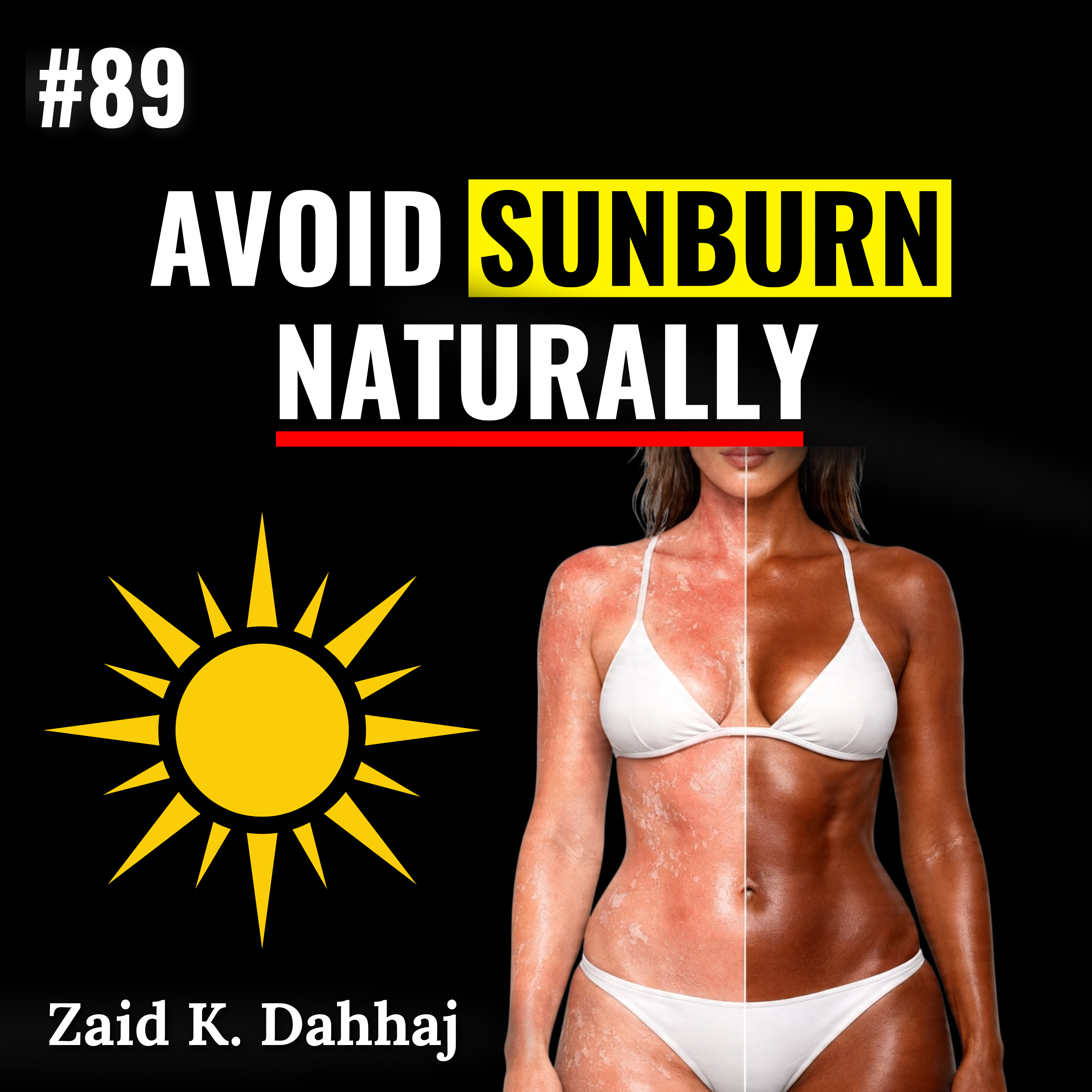
How to Avoid Sunburn Naturally | Healthy Tanning, Skin Health & Sunlight, Circadian Rhythm, Sunscreen vs Melanin, POMC, Red Light Therapy, Solar Callus, Blue Light & Skin Cancer with Zaid Dahhaj
What's This About?
How do you avoid sunburn naturally — without relying on sunscreen?
In this episode, Zaid Dahhaj explains how sunburn, skin health, and tanning are influenced by circadian rhythm, light exposure, diet, melanin and overall lifestyle — not just time in the sun.
We break down how blue light, poor sleep, and seed oils increase sun sensitivity, sunburn susceptibility & skin damage, and how to build a “solar callus” to improve resilience.
If you want to use sunlight to boost energy, skin health, and longevity, this episode gives you a practical, nature-based approach.
🌞 What You’ll Learn
• How to avoid sunburn naturally without sunscreen
• The role of melanin in skin protection
• Why circadian rhythm impacts tanning and skin health
• How blue light increases burn risk
• The truth about SPF and sunscreen
• How diet (seed oils) affects sun sensitivity
• How to safely build a “solar callus”
• The role of red & infrared light in skin repair
🎯 Final Takeaway
Sunburn isn’t just about UV exposure — it’s about your biology, lifestyle, and environment.
When aligned correctly, sunlight is the ultimate tool for health, not harm.
⏱ Chapters
00:00 Solar Awareness & Skin Health
00:48 Sunscreen vs Melanin
06:21 Sunburns & Skin Types Explained
12:46 Circadian Rhythm & Sun Exposure
18:32 Nutrition & Sun Tolerance
25:45 Circadian Health & Skin
28:18 Sleep, Recovery & Light
36:01 UV Light & Skin Effects
43:56 Building a Solar Callus
46:47 Nutrition for Skin Resilience
53:34 Natural Skincare Approaches
-
🌞 Join the Fitness Wisdom Podcast Community HERE:
- ➡️ Get access to Ad Free episodes of the show
- Connect with a like minded Tribe ⚔️
- Submit your burning desired questions to the Guests of the show!
- Exclusive member Blogs
- Get my Health Optimization Protocols + Programs ✅
👉 I look forward to seeing you in there‼️
.
⬇️ Find & Connect with Zaid Dahhaj:
🌐 Substack
📲 IG
.
Find & Connect with me 👉 HERE
👉🏽 For Discounts & Offers: HERE
.
👉 Find my favorite Blue Light Free Tablet ‼️ at a 15% Discount here, using promo code MOBILITYFITNESS at checkout ✅️ HERE
.
👉 Find the Methylene Blue 💙 that I use HERE:
Use promo code: MOBILITYFITNESS for 15% Discount ✅ *Consult your Doctor before trying this, especially if you are taking SSRI's or other medications*
.
⚡ Find the Best Grounding Mats & Sheets🔋 at a massive Discount using promo code: MOBILITYFITNESS at checkout HERE
.
🧬 Find the SHILAJIT I use & recommend HERE ⚡Use promo code: MOBILITYFITNESS for Discount ✅
.
🚨 My favourite Red Light Therapy Mat ⚡Use promo code: MOBILITYFITNESS for Discount 👉 HERE
.
👉 My favourite Blue Light Blocking Glasses, Use promo code: MOBILITYFITNESS for 15% Discount ✅ HERE
.
*None of the content / statements in this Podcast are Medical or Personal Advice & is not intended to cure, treat, prevent or diagnose any medical condition. All my videos are for Educational & Research purposes only. If you decide to try anything discussed in this video, you agree to do so at your own risk & responsibility*
This is the fitness wisdom podcast.
This is going to be the ultimate guide to learn how to not get burnt and also to build a healthy and vibrant looking tan. This is a solar awareness episode, so make sure that you save it and send it as far as you can because this knowledge and wisdom is about empowering you that your body is the ultimate machinery that is meant to be tied to the sun and also the environment. I feel like there is a lot of misunderstanding when it comes to, you know, getting burns and melanin and sunlight. And This is why myself and Zaid did a podcast previously on sunlight and skin cancer.
So definitely go and listen to that. It will be somewhere linked here. And so thank you for coming back on the show. Zaid the Hajj. It's an always a pleasure and an honor to have you and you are our global Heliotherapist. Thank you my friend, I appreciate the kind words. So we're going to start off with a bit of a controversial 1 Sunscreen versus melanin. Which one wins? Well, I would obviously say melanin because you know if you go into the different types of melanin, you melanin versus pheo melanin, there are different levels of photo protection, let's say.
But when we're looking at you melanin specifically, we're talking about dissipating UV light into heat at a rate of 99.9%. And so that's, you know, that's a a biological polymer that's circadian in nature, electromagnetic in nature, and that the body has evolved for over the course of however many hundreds of thousands or millions of years. And that also applies to other species as well as ubiquitous throughout nature. And so I just think we're we're foolish to think that we can outsmart nature.
And when I look around in the modern world, I just see a bunch of reductionists who think that they can actually do that, when in fact they're creating the conditions for 2nd and 3rd order consequences to manifest. Exactly. Just because, you know, they think that they are, they can somehow block the sun, they think that it doesn't come with consequences. And there are also many other consequences associated with not only with the sun blocking, but do you want to maybe tell the audience that you're aware of other consequences of applying something on your skin which is not actually to our planet?
It's something man made and and very foreign to our biology. So I think there may be two or three other issues that I find with SPF use. I mean #1 the most obvious one if you look through the literature is that SPF is designed to block UVB, which is the only wavelength range responsible for D3 conversion. And so SPF 15, the lowest level of, of SPF, as I've mentioned a lot locks at least 90% of UVB. If you go all the way up to that list, SPF 50, which most dermatologists recommend, it's about 98 to 99% blockage of UVB.
So just straight out the gate, that's a very, that's an inherent contradiction within the mainstream narrative. And that's why we don't want to use SPF because we're blocking ourselves from producing A hormone, vitamin D3 that is anti cancer, pro autophagy, pro apoptosis, pro DNA repair, so on and so forth. The next one I think is that, you know, when you some of these ingredients in in conventional sunscreens can actually get into the system so they can be absorbed by through the skin and they can become photocarcinogens when they interact with UV and light and heat as well.
And so that's something that we need to consider like we don't obviously want photocarcinogens within our system because that can increase the likelihood that we develop some sort of a skin cancer. There's also the issue of disrupting normal Ros, reactive oxygen species in RNS, reactive nitrogen species signaling. So Ros and RNS, RNS are fantastic signaling and hormatic molecules in the body that we need in balance. But what we find is that if you put sunscreen on chronically and that you know that sunscreen interacts with the full spectrum, it can actually interrupt those processes to where you get a runaway phenomenon with ROS&RNSROROS more specifically.
And that is what can create oxidative stress and that is actually a hallmark of oxidative damage over the long term. So it just doesn't make any sense from my perspective. Those are kind of the 2nd and 3rd order consequences we're talking about. And even outside of that, you're, you're manipulating the spectrum, you're blocking UVA and UVB with SPF. And that's a problem because we don't actually know the effect that manipulating the spectrum like that has on the skin barrier, especially considering that glue can penetrate that.
There are modern options that block infrared, which is mind blowing to us and our work and so we need to consider that again, we are pretty much in the dark when it comes to a lot of this stuff. Guys, if you haven't already, smash that subscribe button and the like button. Now back to the show. Yeah, that was a, that was a fantastic breakdown. And in addition, I would like to add there, you know, the fact that it may also enter the bloodstream and the lymphatic system, it is going to overwhelm your immune system as well.
So therefore, you know, you're going to impact your detoxification processes. And if people don't have a well flowing lymphatic system anyway, most people's lymphatic systems are stagnant these days. They have poofiness and swelling in their body, right? So if they're not taking care of their circadian rhythms, they're not doing lymphatic massage like doctor Perry Nicholson teaches. And you're loading your body or intoxicating your body. So if your body has to deal with more intoxicants rather than detoxing, well, it's all about that in versus out.
So if you're intoxing more than you're detoxing, obviously you're going to have more inflammation, more swelling. Your body stores fat as a protective response to toxins. So if you actually also don't want to get fat either, it's probably a good idea that you consider what you're actually putting on your skin. And we will be discussing on later in the episode some of your favorite things that you actually like to apply in your skin for skin health or even to create good skin health from within. You know, like eating your skin care, which is another great concept.
But anyway, everything that you just said there about the sunscreen, what why was so important was you basically highlighted the fact that your body has the most powerful inbuilt sunscreen, which does not actually disturb the light spectrum, allows you to receive all of the magnificence of the sun itself. And you still like protect yourself, protect yourself, right? Like, because again, I just now want to go into that a little bit when we think about sunscreen or sunburn, sorry, is sunburning inherently bad?
Yeah, So actually, right before we dive into that, I'm going to mention one more thing with SPF, and this is something I don't really talk about as often, but you're essentially creating the conditions for atrophic or dysfunctional skin by chronically using SPF because you're always blocking the hormetic stressors of UVA and UVB. And so you're not allowing your body to adapt in the way that it should. Your body is an adaptation machine at the end of the day. That's what evolutionary biology is all about, and circadian biology.
So again, people, I think they're protecting themselves, but they're actually putting themselves in a more dangerous position because it means they can't even handle the UV index of a 3A4A5 without burning. And so when we go into sunburns, I view sunburns as an acute injury from too much UV that also happens to confront the fact of, of the individual's lack of of melanin. And So what we're looking at somebody who is pushing their UV exposure capacity way too far according to what they're currently adopted for.
And so that's, that's something to always consider. It's the same thing as like, you know, injuring yourself when you're sprinting because you haven't warmed up properly or you haven't progressively overloaded yourself to that point. And it's, I, I love the parallels between exercise and sunbathing because they're almost like a perfect one to one. Now, is sunburn as dangerous as people make it out to be? I don't think there's been any study showing that, you know, sunburn is causal when it comes to any form of skin cancer, whether it be SECBCC, Melanoma.
And outside of that, I mean, there's some weird associations You have the association with a lower risk of death or mortality from Melanoma if you've had a large number of sunburns throughout your lifetime. But I think in general, the human body is an incredible, you know, incredibly sophisticated system that can heal from sunburns pretty quickly. But fundamentally, we don't want to get them because that just tells me that we're not approaching sunbathing in the correct fashion. Oh, I really love that.
That was a really good explanation there. And so I think it would be important to go into the different melanin types now and talk about the different types of skin because many people will hear this and think, oh, well, I have light skin, blue eyes. I shouldn't actually get in the sun, you know, because there is this idea that any kind of tanning or, you know, melanin production at all is a sign of skin damage. So maybe let's go into, you know, the different nuances how people should actually approach the sun based on the different skin types so they can actually understand that no, it's not that you should have avoid it where you should just know how to tackle it differently.
Yeah. So we're talking about the difference between you melanin and Theo melanin. So you melanin responsible for the blacks and brows in nature. That's the primary melanin that is found at darker skinned people. Highly protective again blocks 99% of UV and dissipates it as heat while using the the rest of the 1% systemically melanin is responsible if you look at mainstream sources, maybe around 20 to 40% of that UV can be dissipated into heat. And so that's I think one big reason why when a lighter skinned person initially gets into this work, I want them to be a lot more intentional because obviously they have more more room to burn from that perspective.
But what's interesting is that you know, what the science doesn't show and where we're more like forward thinking when we actually look at clients and how they respond to this work, is that lighter skinned people are still able to spend multiple hours in a high UV index environment if they put in the prep work and are circadian aligned. Which is incredible to know because that's something that most dermatologists think is not possible. They think that redheads are just destined to burn no matter what happens, no matter the context.
And they say that lighter skinned people can't develop a tan, which is fundamentally wrong. In fact, if you look through the literature on melanin itself, between a darker skinned person and lighter skinned person, the number of melanocytes or the skins or the cells that make melanin are pretty much constant throughout an individual regardless of skin tones. The the only difference is like, how much melanin does that melanocyte make? What's the context? Is the melanocyte disrupted from a circadian perspective or aligned?
And So what I want people to understand is that regardless of skin type, outside of really extreme circumstances like, you know, someone who might be albino, you are able to put yourself in a position where you can build more melanin, sunbathe correctly. And it all comes back to the the fundamentals that I'm sure we'll cover, which is the morning priming, the micro dosing UV initially, nighttime darkness, what do you eat, all that stuff. Imagine a tablet that doesn't blast artificial blue light into your eyes, disrupt your sleep, or sabotage your health, but actually use the sunlight to power the display.
If you've been listening to this podcast, you already know how damaging constant artificial blue light can be on your circadian rhythm, your sleep, and your overall health. That's why I love my Paper 7 tablet by Harborino. It's definitely one of the most interesting devices I've used in a while. The Paper 7 tablet uses something called an real CD display, which means there is no backlight and essentially no blue light. Instead, it reflects ambient light just like paper, So the brighter your environment, the better the screen looks.
And unlike E Ink devices, which are slow and stuck in black and white, this gives you full color, a smooth 60 Hertz refresh rate and the ability to run all of your favorite apps. It also comes with 8 gigabytes of RAM for smooth performance, a 7.8 inch display that's perfect for both reading and productivity, and at only 240 grams, it's easy to carry around anywhere. The battery life holds up really well too. You're getting around 10 hours of active use and up to 12 days on standby, so you're not constantly thinking about charging it.
For me personally, I like to use it a lot for writing, researching, and preparing for my podcasts, basically all of my administrative work. And the best part is I can do all of that outdoors in natural light, so I can actually support my biology while I work instead of fighting against it. And because the screen gets bright in brighter environments, it's incredibly easy on the eyes, even in direct sunlight. I've also noticed that it naturally improves my nighttime habits because indoors, especially at night, the screen isn't overly bright or stimulating since it uses your environment to power the display, so it kind of guides you towards better sleep hygiene and healthier circadian rhythms without even trying.
At the end of the day, technology isn't going anywhere, so the goal is to find tools that work with our biology, not against it, and this is definitely one of those devices. You definitely want to hurry up and grab yours today as they are extremely popular and run out of stock really fast. The link will be in the description below alongside with a 15% discount code. Yes, yes, that's so important, everything that you said there for people to actually understand that just because you have a different type of melanin doesn't mean that you need to avoid the sun altogether.
In fact, like I believe Doctor Jack Cruz mentioned on my episode that we did together, he was saying how like the reason why we have different types of melanin is because of the oxygen concentration, which I found that like absolutely mind blowing because on the equator, apparently we have more oxygen versus like higher up, we have less oxygen on the planet. And therefore that created the different, you know, types of melanin. But also, I guess the lack of solar exposure or UV made it so that nature could still receive as much of the benefit from that, you know, less intense UV light.
So you absorbed every single bit of it because if you're blue eyed and very light skin or redhead, you're designed to be able to soak it up like a sponge because you have so little available in your environment. So you actually are designed to get in the sun as much as possible. If you are like a redhead, just like as people on the equator, I mean, if you are dark or black skinned, like if you are not in the sun, you're making yourself a big disservice. And you see that when people migrate away from the equator to, you know, northern latitudes, you notice that those are the individuals who have the most, you know, issues with their body, right?
Because they are. They are not in connection with the sun because they are designed to be like a battery. There. The sunlight is their battery. Literally. So maybe now let's move into the importance of understanding sunlight, that sunlight is not like the same at all times of the day and also across all times of the year, because there is such a lack of solar awareness. And I hope that this episode reaches many individuals who know nothing about circadian and quantum biology, because this is supposed to give you the power to understand that your body is not faulty.
You just need to know how to work with your biology and your environment in unison. So maybe let's explain to the audience about sunlight across different times of the day and also throughout the year. Yeah. So we started Daybreak and look, there's going to be a massive variation with the timing considering where you are in the world, latitude, all that in, in season of course. But with with Daybreak, that's like where biological day begins. And so I always wake up at Daybreak because that's where you start to see that shift in blue and that's we start to see that that really intense red and infrared come into the atmosphere.
And so that is, again, I, I've mentioned this, it's the, the first domino you push to create systemic circadian alignment. And when you start to head more into the sunrise where you see a lot of the dark oranges, the Reds, the infrared, all that, you want to get as much of your skin exposed to that spectrum because it does some very fantastic things. And this ties into sunbathing. People think that sunbathing is all about the midday portion. Even even some of your, your most renowned photobiology experts kind of have this reductionist view of sunbathing.
Like we're only going to think about midday, but we need to understand that it's a circadian sequence. You have the morning time, you have the, the late morning, you head into the, the, the midday and then you have peak intensity. Then you have this like sort of crescendo all the way into the night and that you need to view it from one holistic framework. So the morning time is incredible. So you know, I'll be sunbathing with red and infrared on my skin. Red and infrared are going to stimulate collagen, elastin, hyaluronic acid in the skin.
Those are youthful skin and components that help with the quality of your skin, integrity of it. You're going to create your mechanic acid and filigrin, which are skin proteins that moisturize and protect the skin naturally. This is all just from the red and infrared spectrum. And then I think the most important thing just getting that that shift in blue and then the overall more full spectrum at that time is that you're going to create circadian alignment in the skin clocks. And as I've mentioned before, the the circadian clocks, wherever they are found in the body are responsible for function repair and regeneration of anybody part they're found in.
They quite literally control apoptosis. They control, you know, whether precancerous cells are able to escape things like apoptosis and autophagy. They control oxidative stress, everything across the board at including cancer risk, by the way. So once you set that right, then you put yourself in the best position to to get into UVA rise, which happens typically in about an hour after sunrise. And I still advocate for everyone to get as much of their skin exposed to that UVA because that's where we start to to see the first, the first step of Milano genesis.
Because UVA does have an influence on you producing melanin. That's where we start to see mitochondria getting primed even more so after sunrise. Because again, UVA is just so important for the system at large, you know, things like aromatic amino acids, nitric oxide, so forth. And then I think about an hour after UVA, you have UVB starting to come into the atmosphere. And that's where of course, you're going to produce vitamin D. But of course, you can see that this is a, a sequential process. And I think that's the most difficult part for people to understand in the modern world because they're they're #1 not taught any of the stuff.
Number 2, they have to go to an office to work. They have to take care of kids, they have to drop kids off at school. And so the question becomes, how do we fit all of this in to that modern context? And that's where it gets a lot, a lot more fun because you have to try to find ways of doing that. Yeah. After that, the the UVB comes in. That's where we start to get into more intense territory where people are more susceptible to burns because UVA and UVB increase in intensity at that time more towards solar noon.
And that's where you have to be a little bit more careful, especially if you're new to this work. But either way, you want to micro dose that UVA and UVB initially, You want to build up over time and you'll get to the point eventually where you can handle a lot more UVA and UVB even beyond what your your mainstream dermatologist says. And then you know, of course, you head into the evening time sunrise. That's where we go into dark mode once nightfall occurs. And you know that whole process from morning to midday to evening to night, that is fundamental to things like DNA repair, autophagy, apoptosis, all anti cancer defenses, metabolism, cardio, metabolic health, you name it across the board.
It's it's so fundamental. Wow, Incredible breakdown. Absolutely fantastic. Yeah. I mean, people don't realize that, you know, the UV is not out the entire day. You know, we've got this beautiful orchestra which is occurring in the light spectrum, which is was I just explained, you know, we, the rainbow ratio is changing throughout the entire day through the visible and invisible spectrum. And This is why it's so important for you to understand. And we were discussing in one of our previous podcasts on the sunlight and skin cancer, how I get so annoyed when I see people putting sunscreen on at sunrise.
You know, going for a swim in the sea when there's literally like no UV. Even if you are concerned even about the UV concept, like if you, if you understand it, you still don't understand it's not available at sunrise. So you're really doing yourself. With a huge disservice in your biology because you could actually just be building the beauty of your skin. And who says that UVA and UVB doesn't contribute to the beauty of your skin just because we have this idea that oh, it causes damage, yes. In what context?
In isolation that maybe, yeah. But like when we are combining in the full spectrum, is it actually or is it having this beautiful hermetic, you know, response and then eventually it's actually contributing to better and more youthful looking skin and vibrant looking skin. So maybe let's dive into did you want to jump in? Yeah. Just real quick, I want to make sure that I mentioned this because this study is so phenomenal. I think it's one-of-a-kind. If you look at the Journal of Investigative Dermatology in 1998, again, 1998 was a pretty long time ago.
They did this study back then. They preconditioned fibroblasts, which are the cells responsible for creating collagen and all sorts of other things. They precondition these fibroblasts, excuse me, to near infrared before they were exposed to isolated UVA and UVB. And what they found is that in isolated UVA and UVB models, those fibroblasts essentially are destroyed. The viability of those cells are, but when you precondition them over the course of one time, 2 * 3 times, you see a market increase in not only the cell viability, but also its ability to serve its function.
And So what you'll find is that this preconditioning is so powerful because it's not only instant, it it provides instant protection from UVA and UVB, which points the the whole hormatic concept, but it's also cumulative. I think that when they actually tested these fibroblasts preconditioning near infrared first and then doing isolated UVA UVB, they found that the protection I think ramped up all the way up to three days. So that gives US11 little idea of how incredible the body is from a circadian timing standpoint when it comes to red and infrared priming.
And people just don't understand that because most of dermatologies literature is based off of this isolated UV model, which is not how nature works. When people think about energy, sleep, and hormones, they think in terms of fats and carbs. But your metabolism doesn't run on macros. Minerals are the foundation for your metabolism, and a healthy and well functioning metabolism starts from your mitochondria. Every single biological process inside your body requires minerals. When your body is lacking the minerals to run your cellular metabolism, guess how that is going to show up in your body?
I'll let you figure that one out. One of my favorite ways to ensure that I get all the minerals that I need on a daily basis is through Shilajit, A herbal mineral substance which is made from the decomposition of plants and bacteria. This process taking place over thousands of years. It is primarily harvested from the Altai and the Himalayan mountains, some of the most pristine locations on the planet. The beautiful thing about shilajit, it comes with high concentrations of fulvic acid. This molecule actually drives the minerals into the cells where they can do their work.
So basically the minerals come in the most bioavailable form for your body to be able to use. Unlike most supplements which become expensive urine, this one actually does something without the hype. It's not mom made, it's produced by Mother Nature herself. Now something very important to mention is the quality of shilajit. Not all shilajit on the market is created equally. The one that I use has been tested for heavy metals and impurities, ensuring that you are getting the highest quality shilajit.
So if you want to explore the shilajit that I use on a daily basis, make sure that you visit the description below and make sure to use the promo code attached for a nice discount on your entire order. Yeah. And even though for example, we know that red and infrared light, for example, from red light therapy devices is beneficial, there is like, you know, a bit of a question in the back of my mind, you know, because we are isolating the wavelengths and just because we think something is good, does it actually also have also AU shaped curve?
You know, like for example, you don't get enough, it doesn't do anything. You get the optimal dose. It's like perfect. It gives you the response that you want. And if you go over, does it have a counter, you know, productive effect? I don't necessarily know. Do you know, do you know anything about this? I do think it follows AU shaped curve but to say that it causes damage after you get to that that that U-shaped curve point. I mean, I don't, I don't think so. I don't think the literature shows that, but I just think there's a reduction in benefit for lack of a better.
Yeah, it's probably like something that the mitochondria get over saturated or something like this. That's just my speculation, my my non scientific brain making some hypothesis, but it's not it's fun, you know, it's fun to, you know, speculate and have these different ideas. And then as you learn and dive deeper, you start to understand and put these pieces of the of the puzzle together. Right. Because we're constantly learning and new information is constantly coming out. But a lot of the stuff that we are talking about today is based on common sense.
I think that that is like the most important thing, you know, to understand that your, your body is not inherently flawed and it's up to you, the person listening to take ownership and responsibility over your own health. Because you, it's easy for us to say, Oh, the sun burnt me. No, you burnt yourself because you didn't actually understand about the relationship that you have with your environment. We've, we've totally disconnected ourselves from our environment, going from a closed box indoors that has no circulation in air, no natural lighting and no grounding.
And then all of a sudden we go to the natural environment, which is so rough and wild in a away, which makes a badass resilient human being if you were to live in a 24/7. And then we think that it's causing us harm because we are becoming. Such a yes. So so let's dive into the most common causes of of sunburn. So #1 lack of melanin production, I mean lack of that adaptation by the mere fact that most people spend upwards of 95% of their time indoors #2 I would say a big cause of, of burns. More so, both directly and indirectly is the advice that mainstream dermatology provides because of the fact that it ties into, you know, you're not allowing yourself to build melanin, but by blocking UVA and UVB, you're not being taught about this circadian timing involved with priming the skin.
Hormetic stress during the midday and then the night time recovery where DNA repair happens and all this beautiful stuff #3. I would say that this intermittent exposure also ties into the, the, the concept of burns. I mean, you don't want to be somebody who, you know, for four weeks. So you basically expose yourself to no sun and then the the next day you even when you're priming, even if you're priming and you're doing everything circadian aligned for that day. You don't want to be inconsistent with this work because that means that you're leaving room on the table for things like DNA repair and in that hormatic response to be broken.
So yeah, make sure as much as possible you you're priming consistently almost every day and then you're getting a little bit of UV every day and then you're you're following all the other principles. But that's also big contributor to burns because it's almost like a shock to the system. This in intermittent sun exposure is, is a real problem in my opinion, especially within circadian disruption. And then #4 I think that obviously the consumption of oxidized Omega 6 within the form of seed oils mostly is, is a problem because those fats get integrated into your cell membranes.
And then, you know, we, we have to talk about the interaction of different types of fat and UV light because I think that's a fascinating intersection. But it does leave you more prone to getting burned if you have these, if your cell membranes are made-up of these oxidized Omega sixes because you know it, it'll, it'll create things like lipid peroxidation, it'll create excess oxidative stress, which leads to oxidative damage. It'll increase local inflammation and systemic inflammation. And so those are all things we need to consider for sure.
Absolutely. Basically, you're frying yourself in the sun, you're becoming like a, a French fry, right? And you're putting, you're putting yourself outside, especially because if you're, if the majority of your diet is consistent of these of these oils and you're consuming, consuming them chronically, I don't think it's a big issue. From time to time you're, you know, you decide to have some fries, you know, one time on the weekend and the majority of the time you're eating saturated fats or Omega threes, you know, from fish.
I think that's going to be OK. But like, of course, I have heard anecdotal evidence from people saying that when I ate, you know, fries and then I went in the sun, they burnt way more easily. So it could have such a quick turnover, maybe due more to the inflammatory response from the meal rather than the fats being deposited in the skin right there. And then of course, this don't know how long this, you know, this process takes place. I can assume that it would take a little bit of time before you know your skin cells would adopt these these fats.
Yeah. And I think that is more readily apparent in lighter skin people because of course they have less leverage when they're new to this work. And so if you have any lingering chronic inflammation, especially within the skin barrier, then you know, the all the processes within the skin barrier are going to take a big hit. And then your your defenses are kind of almost down to where you can't experience a burden, get too much of that. Yeah. Let's dive a bit deeper into the importance of the circadian rhythm into skin health.
So of course we can't emphasize this enough. Like how important is it to let's say you are doing all the sunlight and all that good stuff and everything that you just said about the priming and getting in the UV and doing the sunset. But if someone is as exposed to artificial blue light after sunset, is it? Is it a problem? Yeah, it's definitely a problem because, you know, going back to this idea that we need everything in a, in a nice sequence, circadian line sequence, problems do occur. If we start to let's say we watch sunrise, we get a lot of UV light during the day and we sunbathe as correctly as we can.
But then once night comes around, you make it really bright and you just for some reason you're just not educated on the, the night time darkness or you just don't really think it's that big of a deal. It is a big deal because at the end of the day, when you look at the skin barrier, not only is it a circadian organ at at all three layers, but every skin cell within the skin barrier, We're talking about carotenocytes, you know, melanocytes, fibroblasts, as I've mentioned earlier, every skin cell is a circadian skin cell.
And so they follow a circadian, not only do they contain a circadian clock, but they also follow a circadian pattern. And so if you are, you know, if you make your nights as bright as possible while also within a more circadian line contacts, that can lead to problems with the function of things like melanocytes, which produce melanin. And you know, that's where things start to get really wonky, where you can produce pigmentation in uneven ways. You can develop things like melasma or hyper hypo pigmentation.
You can you can disrupt fibroblast activity from producing collagen in the right way. And that's where I think we start to see more negative outcomes over the long term. If you do it, you know, occasionally I don't think it's a big deal. But if you're doing it chronically, then that's where we we start to see an increased risk in these problems. And so whenever I see somebody with skin issues like that again, the melasma, vitiligo, hyperpigmentation, that for me is a big signal that the circadian, the circadian skin organ has been disrupted in, in very severe and chronic ways.
They can be fixed for the most part, but we do need to understand that your body's almost telling you that there's a big problem and that we need to address these things from first principles. And also with things like vitiligo and and hyperpigmentation, there are many other factors that that play a role, you know, for female Physiology like hormone disruption and and hormone just a hormonal influence takes it has a, has a big role to play in that. But either way, we need to understand that if you start messing around with that sequence, then you know problems start to occur.
Yeah. And that regeneration and healing is not going to take place in the night, right, Because that's when we heal and regenerate. It's again the sun being the stressor. When we go away from the stressor is like when we start to heal, repair and regenerate. Of course, that happens in the daytime as well. If we're, you know, spending our time outdoors, we're maybe in the shade getting that red and infrared light, you know, getting that cellular melatonin. So we're able to start repairing already within the daytime.
But then at night time is when that real deep healing and repair is occurring. And if we don't have that reset button for our body, you know, because people think that just sleep is just so they don't feel tired, but literally that's when your body is cleaning and regenerating itself. It's preserving your, your youth pretty much. And This is why sleep is so foundational to overall hormones, energy levels, performance, cognitive function, everything, everything that we, that we aspire for in life.
And so when that's like broken, then obviously you're going to wake up feeling like trash. And then you're most likely your habits and your choices are not going to be optimal either. And then you're going to go down this road of probably getting sunburns because you're not living in alignment with the light in dark cycles. And I think something important that you mentioned previously about the intermittent solar exposure, like something which I do every single day is get in the sun. Like no matter, no matter whether it's raining or shining or cloudy or cold or windy or really hot, I'm going to get in the sun every single day.
And I'm going to do it as much as I can. Now, of course, I do it responsibly, right? Again to going back to that common sense, but it's true that you know, I'm I'm from the my mother is from the UK, right? So I have very light skin and also my eyes are not like super, super brown. And so I should burn. I should supposed to burn easily, but I never wear any sunscreens and I'm just outside 365 days a year and I'm outside as much as I can. And especially in the winter time, I'm outside more than in the summertime because in the summertime it can get quite overwhelming.
Here in Cyprus, it gets up to 40 to 45°C, which is like Texas hot here. And so then I, you know, you want to go seek the shade because I could maybe handle maybe 2-3 hours like Max in, in peak UV. But then afterwards it feels like now I start to get more overwhelmed. But again, that just re emphasizing the importance of being outside no matter what the season is, no matter how uncomfortable it may feel, even if you feel like you're not getting benefits from the sun, what Zaidi is saying is that priming that's occurring whether you are feeling it or not feeling it, even with the chemtrails there, even with the clouds there, the benefit is still occurring, right?
You are still getting that red and that infrared, even though they're blocking the blue and the UV light with the chemtrails because they're shorter wavelengths, you're still going to get massive benefit. You're going to get that LAX, that light intensity, which you cannot replicate indoors with your even with your best circadian light bulb, you're not going to manage to replicate that. So just wanted to reemphasize the importance of getting your ass outside 365 days a year, going for a walk, just enjoying nature, getting barefoot on the ground as much as you can.
All of these things it just make you more human again. Plus, you will slowly build your melanin gradually and so that your body actually doesn't respond abruptly to the sun, remembering that the sun isn't the issue, you are the issue because you're not taking responsibility by getting yourself outside. So again, taking about that ownership and that responsibility. Do you have anything to add to that before we move on? Yeah, I think that was spot on. I think, you know, all animals, all diurnal animals that are meant to interface with the sun in, in its natural evolutionary context, always seek sun and seek shade.
There's always a fine balance. So a lot of this, you know, once you start to educate yourself on these basic principles, a lot of it just becomes intuition at the end of the day. And that intuition is very powerful. But I, I pulled up a picture of this 2019 study. I think it's called it's time to advance our understanding of circadian clocks and in cancer pathogenesis and all this other stuff. But basically, I wish I could show the picture right here. I'm actually going to release a sub stock article on this, but it basically talked about how circadian timing makes the difference as to whether UV light becomes a hormetic stressor or whether it becomes true distress or damage.
And so you know in this little infographic shows that genotoxic stress from UVR interacts with a cell. It shows how circadian clocks and circadian genes are fundamental to the repair process, AKA the hormetic process. And the. The thing people don't understand is that when you know, we, we have so many layered and redundant DNA repair processes, things like nucleotide base excision repair, you know, the, the byproducts of vitamin D3 production and then even deeper, deeper layers to that, that you are essentially restoring the cell to its healthy state.
If you have all of these circadian regulated DNA repair processes in check and in alignment. But if you don't have those processes in alignment like most people, then you start to get into the territory where you have genomic instability and that's where you can get into carcinogenesis. So there is an, an implication with UV and related in relation to the skin, skin cancer discussion. But again, most people ignore the context, especially modern dermatologist these days because there is new evidence based off of circadian clocks and how they work as to this major difference.
And really, if you look at it, it's no different than exercise. Like, you know, if you're doing Sprint work, of course you have to approach that with extreme care and caution until you develop the intuitive faculties to know what you're doing and have the experience. Otherwise you can really mess yourself up. I mean, you could rupture an ACL, you can rupture an NCL and, and so you need to approach this work correctly and give the respect that UV light deserves because it is a powerful external U stressor.
But again, it just depends on the context of the individual, whether it's an actual U stressor or whether it becomes a stressor. So it's this classic distinction between eustress and distress. Are you interested in smoother skin, better recovery from workouts, improved energy levels, and an overall feeling of vitality? Listen up. You've probably heard about the benefits of red and infrared light, and This is why I love to use my red light therapy mat every single day. And the reason why red and infrared light is so powerful for our health is because it targets the mitochondria, which is the foundation of cellular energy.
When our body is able to produce energy efficiently on a mitochondrial level, we have better energy levels, better cognitive function, better hormones, better sleep, basically every aspect of our life is improved. Red and infrared light is not something optional, it's foundational and it's something that we are meant to get in our lives every single day. Sunlight contains red and infrared light at all times of the year. Unfortunately. Fortunately, most people are not getting outside and This is why it is essential for red and infrared light to be supplemented back into our lives, because it's not something nice to do.
In my opinion, it's a biological necessity. Think of light as an instruction manual for your metabolism. Without that light, your body starts to fall apart. So if you want to check out the Red Light Therapy mat, which I love to use on a daily basis, head over to the description below and make sure to use the promo code. Attached for a nice discount on your entire order. Yes, yeah, I would say that another great analogy would be like sugar as well. People love to blame sugar and carbs for insulin resistance and glycation and all these and all the different issues.
And yes, chronically elevated glucose does indeed 'cause these problems, but consuming sugar or carbs doesn't necessarily contribute to chronically elevated glucose levels. And again, going back to the the context, people love to leave the context out of these conversations and not discuss in, in what situation, in what context is this occurring? And is that actually the truth? And also the fact that another idea that people have is if you consume sugar, it automatically means Warburg metabolism.
It's just not the case because Wurlberg metabolism is a programming which actually occurs within the cells and then the cells get stuck in growth mode and the fuel may add to the fire, but it may not be the starter of the fire, right? And I would say that circadian rhythm disruption most likely would be the starter of the fire, in addition to a bunch of other stressors, which causes DNA mutations and mitochondrial damage, which can therefore put you into this other mode, which is a survival like response for your body to keep on producing energy when your mitochondria are not there to actually produce the energy that your body needs.
So now let's move into the next question, which would be what's the problem with sunlight? I mean, sunglasses. I know that we talked about this last time when it comes to the eyes, but specifically when it comes to the skin, why is it a problem wearing sunglasses? Because there is no difference between the skin, brain and eyes. I mean, we've referred to this neuroactoderm is, is fundamental here because when you're, you're an embryo in your mother's womb, like the, the skin, brain and eyes are made of the same tissue fundamentally.
And So what does that point us to? That points us to the fact that the, you know, skin, brain and eyes is 1 circadian trio that needs to be in alignment and whatever you do to disrupt the one area of that trio, then you know others constant 2nd and 3rd order consequences manifest. So think of it like a stool. Like if you take one leg out of that three legged stool, you don't have a stool anymore. The thing falls down and it fails to become functional. So with the skin, again, you're like all of the antioxidant pathways, all of the mitochondria in the skin, all the options in the skin, every skin cell from the, the epidermis to the hypodermis and then the options in between every layer.
It's, it's a very complex system. But when you start to put sunglasses on and you interfere with that initial UV light signal, at least peripherally into the eyes, you know, that gets into the retinal hypothalamic tract, that gets into the, the SCN, which the master circadian clock. And then that fundamentally translates itself down to all the peripheral organs in the body, which, what's a peripheral or peripheral circadian clock? We're talking about the skin. And so that's, that's an important thing to consider.
And so this means that you know, you can, you can place yourself in a position by wearing sunglasses where your body thinks it's perpetually like an in perpetual darkness. And so the body's response is not going to be to activate melanocytes properly or to activate fibroblasts properly. It's, it's in fact going to have its defenses down, which means that you leave the, the room wide or the door wide open for burns. And so that's, that's just so fundamental to consider because we're looking at a complex system.
Whatever you do to introduce a reckless intervention into that system is going to create secondary consequences that that hurt people at the end of the day. Wow, Well, I'm wondering if it has the inverse relationship. For example, if you apply sunscreen on your skin, does it actually influence your eyes? Or is it so that, you know, the rest of your body primarily takes information from your eyes? Because, you know, we know that the master clock sits inside the brain behind the eyes. You know, pretty much they're taking instructions from the master clock.
But of course, as you mentioned, we've got all of these peripheral clocks. I did write a nice article on Sub Stack as well talking about how different peripheral clocks like in the gut specifically you can also impact your SCN as well. So it can have this like bi directional relationship. So it's a beautiful thing. There are multiple ways to influence your circadian rhythm, not just by yes, light being the primary zeitgeaver like the time giver, but then there are many many other like ways to sync the circadian rhythm as well.
I think one of them like was, was sound like, which was fascinating, the timing of your caffeine, like your microbiome, like there are so many like incredible ways. But of course, this discussion is centered primarily around the light topic because we have a very bad relationship when it comes to light because we've disconnected ourselves from the primary giver of life, which is the sun. And we have now just connected with the artificial source because it raises our dopamine and it makes us feel good and we think it's good that we have lighting to use in the evening.
And of course, it's a it's a blessing, but we need to know how to use it appropriately. Otherwise it can literally destroy our health. Because again, like if you're just living life as it's given to you right now and you're taking all the food that's available, all the lighting that's available, and you just live your life like a normal human being. Unfortunately, normal these days is not optimal. It's very far from optimal, right? So This is why we are seeing so many chronic diseases, conditions, metabolic disorders specifically.
We know that metabolic health is foundational to our overall health and well-being and how these lights and electromagnetic fields are influencing our biology. So throughout this entire discussion, we talked about the importance of getting sunrise for our skin, you know, for priming our skin, you know, getting as much light, you know, during the morning hours and getting that UV, you know, as it's as it's climbing, being outdoors every single day of the year. We talked about the Omega sixes, why it's important to actually avoid those.
We talked about the importance of circadian rhythm, circadian alignment, why that's important for that healing, regeneration, repair. Is there anything else that we didn't talk about which is important to discuss about building a solar callus which is going to make you, you know, able to tolerate the sun better? Yeah. Well, I have a good one. I mean, anybody who thinks that they can build a solar callus properly through tanning beds or booths is just fundamentally misguided because the, the circadian perspective on those is pretty shocking when you dig into it because you're, you know, with, with tanning beds, you have isolated UV primarily.
The new tanning beds have some introduction of red light, but it's nowhere near the, the spectral brilliance that the sun offers, nowhere near the power density and all that stuff. And and so with tanning beds, we're looking at, you know, a form of technology that is designed to actually create circadian disruption in and of itself. And that makes sense considering that people are not thinking about the time in which they're actually doing the timing that in. Because if you're doing it at 8:00 PMI can, I can rest assured say that you know, you are dramatically increasing your risk of DNA damage and increasing your risk of developing any, some form of, of skin cancer pathology.
Because again, your defenses are way down. Your body's expecting true night time darkness for repair. It's not expecting that hormetic signal at night time because you're inverting it in a sense. And then, you know, you also have other problems like you don't get the immune activation through tanning beds that you would with sunlight. You, if you think about how people use tanning beds, considering that tanning beds are mostly 95% UVA, 5% UVB, they're actually wearing goggles. And so you're actually wearing sunglasses, practically speaking, in an environment that only provides isolated UV, which is crazy because that, you know, it completely removes and divorces the circadian perspective.
You're disrupting that, that neuroactoderm trail between the eyes, brain and the skin. And again, it's just, it's, it's so it's kind of goofy how people think that we can replicate the sun's benefits through a tanning bed. And, and this is the only area where I actually like fall in accordance or believe. How should I phrase this? This is actually the only area where I I agree with the World Health Organization in their assessment that tanning beds are basically a class or a type 1 carcinogen because again, it's just isolated UV like it's it's nonsense.
Yeah, yeah, exactly. It's always when we're isolating wavelengths where just, you know, playing like we're playing God, right? It's it's the same idea as like, you know, just spraying chemtrails in the sky to block out, you know, the sun. Like it's absolutely ridiculous once you start doing these things that are many downstream consequences, not only to us, you know, human beings, but to animals. You look at nature like everything, like so many things are occurring on the planet and then eventually we don't even have nature to be able to get our resources from.
So is there anything else that's important for people to be aware in terms of building their solar colors? Should we maybe talk about how somebody who is light skinned, how should they, for example, how should their typical day look like? How should they approach the sun if they actually want to build a healthy tan so they could be resilient to the sun? So for very light skinned people, I almost treat them like I treat them like I would a, a newborn or a toddler. When it comes to the sunbathing discussion, not not mentally, but more so in how we approach the sunbathing work.
And so we're really going to place a lot of all emphasis on on priming in that mourning period. Again, setting systemic circadian alignment, a lot of red and infrared, that's where the majority of your time is going to be spent. And so if, if we're looking in from a training perspective and you're looking at zones, that's probably going to be zone one, zone 2 training for, for most people. But from a solar adaptation perspective. And, and that's where you actually spend most of your time if you want to, to increase your, your level of adaptation, that that's important.
And then, you know, you micro dose UV, you get UVA rise. I don't think most people have to worry about early morning UVA rise when it comes to burns. But once you start heading into the midday, that's where you really want to micro dose UVA and UVB. And so that could be literally 2 minutes. If you're a redhead who has a history of burning, that could literally be one minute and then the next day you, you, you do night time darkness. You have the the fundamental of sunrise viewing and priming. And then you, you consistently build on that.
And so if for lighter skin people too, it's especially important to emphasize the, the crucial aspect of not only the sunrise, but the night time darkness. Because if you, if you have bright nights, then you're going to going to leave your skin susceptible to burns through many different, you know, many different 2nd and 3rd order consequences. Outside of that, I would say it's very important to eat more DHA. As you know, we've both covered pretty comprehensively, but in the same way that UV light interacts with oxidized Omega sixes and causes negative outcomes, UV light also interacts with DHA to create positive outcomes.
So when you have UV light hitting DHA, you create positive byproducts known as dicosinoids, which are potent anti-inflammatory compounds integral to skin repair and function. And you know, under the larger umbrella of dicosinoids you have protectins, resolvins, merisins, and then I think a few other ones. But they are incredible in their capacity to not only help you avoid burns, but also to build up those cell membranes in a proper way. And also there's the, you know, the whole electromagnetic discussion with DHA that I'm probably not as hip to, but that's I think a fundamental part of it as well.
Most people chase energy, performance and good cognitive function through stimulants, but that only gets you so far and depletes your system overtime as it doesn't address the foundation of cellular energy, which is your mitochondria. One of my favorite tools to boost cellular energy, mitochondrial function reduce inflammation and is also a potent antioxidant that's methylene blue. Methylene blue is a fascinating molecule as it's able to grab onto electrons and donate them anywhere where they are required in the body, making it an awesome antioxidant and restores electron flow in the mitochondria resulting in more cellular energy ATP.
I love to use methylene blue, especially in times of high stress. It keeps my brain clear and energy sharp so I can perform my best no matter what life throws at me. So if you want to explore the methylene blue that I use, head over to the description below and make sure to use the promo code attached to get a nice discount on your entire order. Wow, wow, that's that's fantastic. I'm sure people are finding a lot of value from this conversation and if you guys are enjoying this conversation, make sure you smash that like button and that subscribe button because definitely Zaid is coming back on the show in the future.
And make sure to also watch our previous conversations. I will be leaving them in the description below as well and also in the pinned comments. So now let's move into some eating your skin care. You already touched upon one food, which is obviously omega-3 rich foods, right? Which is primarily coming from fish, ideally and obviously like whole fish, not like fish oil capsules that are, you know, potentially getting, you know, a rancid on the shelf. And So what what other foods are some of your favorites which actually help us, you know, maybe protect the skin or revitalize, revitalize the skin, hydrate the skin.
You know, we can honestly throw any of the the nutrient dense foods out there. I mean, fruit is probably great. I'm sure there's some, you know, protective enzymes and and cofactors that contribute to skin integrity. Vitamin C. Vitamin B, vitamin A and. Stuff. Yeah. And then I think, of course, with the marine life, oysters are by far my favorite. But I also do have a big bias towards sardines. I probably eat sardines like 4 to five times a week. And people have these concerns about, you know, heavy metal toxicity and all that.
But I think if you look deeper into this, it's not really that much of A concern for most people because again, you're talking about bottom feeders like shellfish and and small fatty fish, which have a very short life cycle. And so they're not going to accumulate those heavy metals to begin with. And of course you want to make sure you source from a correct place, like you don't want to get oysters from China or, or some other place that doesn't really have great ecological standards outside of that.
Mackerel, anchovies, lobster. Again, the whole category of shellfish 2 is really incredible with oysters I think being the most powerful. I think the only land animal that is really rich in DHA is actually lamb. Yeah, I could be wrong. That's what I heard. If you can get more. And look, I'm Middle Eastern so I love lamb, so that's just a a win win for me. But yeah, I think just any nutrient dead food contributes to skin integrity and skin photo protection in some way. Yeah. And I think that just to re emphasize what you just said there about the fruits, a crazy experiment or not really experiment, just personal experience, which I've had when I was doing the carnivore diet and I was exposed to the UV light here.
And also I went to Costa Rica as well. Unfortunately, I was carnivore during that time. So I didn't get to enjoy any of the incredible fruits that, you know, that the Costa Rica has to offer. So I really regret that. So I'm definitely going back and I'm going fruitarian for a while when I go over there. So yeah, because now my mindset has totally shifted. You know, I was just totally bought into this, you know, crazy narrative that like carbs of the devil and deuterium topic and all that because it was all just, you know, out of context.
But anyway, I was, I just wanted to say that when I didn't consume fruits because that's, that was my primary carb source that I used to eat before, I actually didn't tan as well, which was fascinating to me. And I also noticed that my skin was more dry. But every single time when I consume a lot of fruits, especially watery fruits in the sun, my tan would develop like crazy. So I feel like somehow they contribute to melanogenesis. I don't know what it has to do with maybe it has to do with the exclusion zone water inside of the fruit.
Maybe it has to do with, you know, the local, seasonal aspect of the fruit because of course I always into source, local and seasonal. I would never eat something, you know, from Costa Rica, here in Cyprus, since here we have incredible bananas almost 365 days a year. We have papayas here we have apples, we have oranges. We have, we have many incredible fruits, right. We don't have pineapples, but we have, you know, a lot of the exotic fruits. We have dragon fruit, for example. We have watermelon, melons, cantaloupe, strawberries, Yeah, all that, all that good stuff.
So there's no need for me to consume anything from abroad. So I do feel like those things definitely contribute to skin health and skin hydration. And of course, I guess the most powerful thing as you mentioned, is that circadian alignment, getting that sleep. Sleep is literally like your beauty reset. If you really care about not getting wrinkles, having youthful looking skin, elastic looking skin, not having like poofiness under your eyes, you need to make sure you take care of your nighttime routine.
And I cannot emphasize enough, even if you're wearing blue light blockers, it's still a problem consuming your tech until very late. You know, right before going to bed. Because I personally found that if I, when I used to do that in the past before I was fully aware about the EMF topic, I just would wake up the next day and I would feel like I have a hangover. And then even though I went to bed like at 10 because I was using my tech all the way up to like 9 or 930 and then going to bed just because I was so trashed.
But if you were to quit, you know, 3 hours at least or riot sunset, even better, your blue light tech and you don't even need to wear blue light blockers in the house because all your lighting inside is circadian lighting and you've got no exposure to blue light. You've got no Emfs because your Wi-Fi is off and all that good stuff. You just wake up the next day and you feel like, wow, like it was like the best sleep ever. And you feel absolutely regenerated. And you might even want to wake up even before the sunrise.
And it's so actually easier to wake up before the sunrise when you've put your tech down. Do you want to add anything before I ask you like the last couple of questions? No, no, I just think that's spot on. I think it's there's always a stimulating component even outside of the non-native EMF and all that in the blue light discussion, I mean there's always a stimulating component to using your phone. You're thinking about ideas, writing, and your Or you're just scrolling through Instagram reels like it's just best to set at least an hour, hour and a half aside.
Read a book. You know? A lot of people need to start reading more books. 100% every time when I read the physical book, like I get so tired, like it feels like my ATP. You know how they say that the ATP production and the melatonin need to climax at the same time? And then once they reach a certain threshold, that's basically when sleep takes place. You know, like, especially like when you start falling asleep. Like Carrie Bennett shared this on the podcast a while back. That was like, absolutely mind blowing to me because I, I didn't really understand that basically energy saturation in the cells is literally like when your body says, OK, we're done for the day.
Let's let's knockout, you know? Yeah. And then isn't, isn't the reason why coffee works is because it hijacks this, I believe this process, right? It binds to the adenosine receptor where it actually the adenosine should bind to to signal the sleep or the onset of sleep. And then I think that's the reason why it basically doesn't allow you to fall asleep, especially if you are drinking it like way too late in the daytime. Do you want to maybe like tell me some of your favorite things that you that you like to apply on your skin, if you are like to apply any at all?
Because, you know, maybe some people are thinking that, oh, so is Zaid saying that, OK, I shouldn't wear sunscreen, I shouldn't do this and that. But is there anything that you promote, anything that you like to put on your skin? Well. I mean, I have a decent skin. I mean, I don't this this whole idea. I think we should first address the idea that, you know, people in their older age should have like the skin of a baby's ass. Like it just doesn't make sense from a skin integrity and just life perspective.
The expectation is just so faulty out the gate because of course, being alive is a process in aging and so that's inevitable. But #2 I think Meraki MU from Meraki Medicinal is fantastic. Yeah. I think Vance is with, I think he's, he's taking that product and and starting a new company with it, which is, I mean, we have to wait, but I'm, I'm excited for that. That was out to Vance. Yeah, yeah. That's basically just a combination of, I think beef tallow and then methylene blue. I I found that to be pretty incredible.
I'll use coconut oil. So I have like a jar of coconut oil right here, not as not as like some form of SPF or, or to increase the tan. I just like, I like the feel of it on my skin. It feels more moisturizing. But outside of that, pretty much don't use that. I don't even have anything around here. I pretty much don't use anything really for, for skin health. I mean, hydration is obviously key. So you know, glass bottled spring water is is the Creme de la Creme in my opinion. I think that plays a fundamental role in skin integrity and, you know, hydration status, all that.
And then of course, you know, nutrient dense food, making sure to avoid that isolated blue during the day and at night, especially if you have the phone right up to your face, Like that's going to have an impact on skin health. Yeah, a lot of, I mean, at the end of the day, I just get a lot of sun if I'm going to be indoors. I have, you know, infrared, rich sources, incandescence, candlelight that I'll have around me at all times just so that I balance out the the overall spectrum. But yeah, I don't really use anything externally.
Connect with the like minded community. Get ad free episodes. Submit your burning desire questions to the guests of the show to just topics and guests that you would love to see on the show. Get access to my programs, protocols and blogs as well as exclusive discounts on my one-on-one coaching programs. Get access to the Fitness Wisdom Podcast community starting from just $2.00 a month. The link is in the description. I look forward to seeing you in there. I think people actually realize that skin health is really built from within, You know, it's like, you know, you're within and without, of course, your relationship with your environment, the outside influences the inside and also the inside is going to also reflect on the outside, right?
So if someone has well, glowing looking skin, vibrant looking skin, you can tell that they're taking care of themselves, right? They're probably eating right, they're probably sleeping well, they're probably exercising, moving, detoxing properly, hydrating. So all the things that we discussed today, it's not as simple as, you know, just applying like sunscreen on your skin and just thinking that magically your skin is going to be protected. You're not going to like photo age. And you're, you know, you've solved all your problems.
The whole idea of this conversation was to empower you, to make you understand that within you, you have such incredible power. You have this melanin molecule which can actually transform energy, can transform photons into phonons. It can transform photons into light. It can transform photons into energy inside of your body. And there is so many downstream positive effects which are occurring beyond the fact that it's, you know, protecting you from protecting you from the UV light, right? Because again, like melanin is like this energy converter, it deciphers information.
We know that melanin is also found in the inner ear. It's also found in within our fascial system. It's found in many interesting areas of our body where and it's responsible for pressure understanding as well. So for example, like impact, it can basically tell your brain, OK, now our foot is striking on the ground. For example, it's able to convert like pressure into information for your, my brain to understand. And I learned this from my brother Melanin Research. He's been on the show like 3 times.
So you guys definitely check that out. We have a dedicated playlist to melanin research episodes. So definitely check them out on on YouTube as well. Brother, thank you so much for coming on the show. Like I of course, I love this conversation. Is there anything that any last words of wisdom that you would like to share with the audience? One thing I forgot to mention, actually, for skin health, infrared sono is incredible. We have an infrared sauna. It's like that's, you know, doing that 3-4 times a week is really, really fantastic for it.
That that's just one thing that came to mind. But outside of that, yeah, make sure you're in circadian alignment, no intermittent sun exposure, all the good stuff that we've been talking about because that's it's not only important to your quality of life immediately, but also for chronic disease production. It's just so key. 100% because it's so surface level, right? This discussion about like UV and like skin health, it's so surface level. It's like, Oh, my skin looks aged or I have wrinkles or I'm going to get like age spots or, and things like this.
But yeah, those are all reflections of your bad lifestyle choices. Sun is revealing that you have some fundamental underlying issues that you're not taking care of like in the rest of your life. It's the same thing with training. Many times when people train, they may feel like crap during training. Well, the training is revealing to you that there's something within your life which is actually making you feel like that within training. So it's illuminating. It's bringing to the surface that there is an underlying problem.
So again, like skin health is like a holistic approach, all-encompassing with the base being circadian biology and circadian alignment. So thank you so much Sites for coming back on the show. It was an absolute pleasure to talk with you and where can people find you, connect with you and work with you. Yeah, likewise brother, it's always a pleasure to be on and to have a fun conversation with you ZK Dahaj ZAIDKDAHAJ on most platforms. So sub stack X Instagram. The 2:00 AM podcast is another cool little collective conversation with me and my Co host and yeah, that's pretty much it.
Awesome, I will make sure that I put Zaid's links in the description below. So definitely check him out, especially on Sub Stack. He writes many incredible blogs on there and a lot of mind blowing information so you guys can dive deeper down different rabbit holes. So thank you so much Zaid and and please stay on the line when I end the call. Yes, Sir. Thank you. If you guys enjoy the topics and guests I bring on the show, I would really appreciate if you left me a five star review on Spotify and subscribe to Fitness Wisdom Podcast on YouTube as well.
This helps to spread the knowledge and wisdom with the world. Until next time.
 Apple Podcasts
 YouTube
 Spotify
 Castbox
 Castro
 Goodpods
 Moon FM
 Overcast
 Pocket Casts
 Podbean
 Podcast Addict
 Podcast Republic