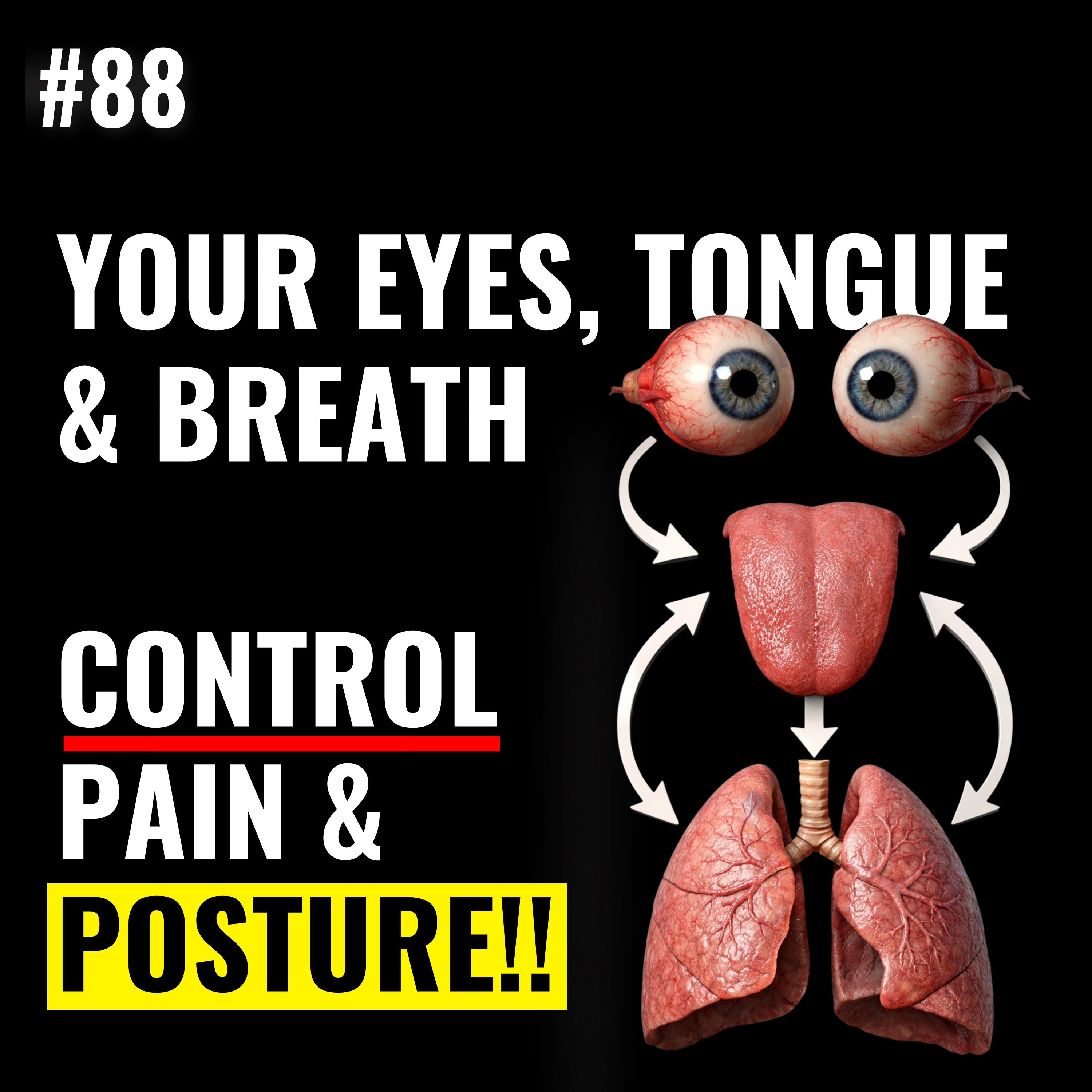
Fix Pain & Posture Fast: Tongue, Eyes & Breath Explained NO Stretching! Eye Exercises, Tongue Posture & Breathwork for Nervous System Regulation, Fascial Health, Mobility & Pain Free Movement
What's This About?
Fixing pain and posture isn’t about stretching or strengthening alone — it’s about your nervous system, breath, and sensory input!
In this episode of the Fitness Wisdom Podcast, Darrell “Daz” Spencer explains how tongue position, eye function, and breathing patterns directly influence posture, movement, and pain.
After recovering from a severe injury using breathwork alone, Daz developed a unique system called “quantum biomechanics” — a model that views the body as an integrated sensory network where the eyes, tongue, diaphragm, and feet work together to regulate alignment and stability.
We explore how breath creates an internal 3D map of the body, how fascia behaves as a dynamic communication system, and why many movement issues originate from poor sensory integration and nervous system dysregulation — not weak muscles.
If you’ve tried stretching, strengthening, or rehab without lasting results, this episode offers a completely new approach to pain relief, posture correction, and movement optimization.
🔥 What You’ll Learn
• How tongue position, eye movement, and breath affect posture and pain
• Why breathwork can accelerate healing and recovery
• The connection between the nervous system and movement patterns
• How fascia functions as a responsive, adaptive system
• Why traditional rehab and stretching often miss the root cause
• The role of early development in posture and dysfunction
• How to improve mobility without stretching or force
• Practical techniques for nervous system regulation and body awareness
🎯 Final Takeaway
Pain and posture aren’t mechanical problems — they’re neurological and sensory.
When you improve breath, awareness, and input, the body reorganizes naturally without force.
⏱ Chapters
00:00 The Journey to Quantum Biomechanics
00:58 Breathwork & Body Awareness
06:43 Healing Injury Through Breath
11:45 Eyes, Tongue & Posture Explained
16:50 Nervous System, Safety & Movement
21:53 Practical Applications & Exercises
27:15 Building an Internal Body Map
31:29 Reprogramming the Nervous System
32:35 Fight or Flight & Chronic Tension
34:43 Breath & Movement Connection
37:06 The Role of the Diaphragm
38:57 Movement Without Movement
40:51 Reconnecting with the Body
41:50 Unlocking Mobility Through Breath
49:33 Practical Posture & Breathing Tips
58:37 Learning to Listen to the Body
-
🌞 Join the Fitness Wisdom Podcast Community HERE:
- ➡️ Get access to Ad Free episodes of the show
- Connect with a like minded Tribe ⚔️
- Submit your burning desired questions to the Guests of the show!
- Exclusive member Blogs
- Get my Health Optimization Protocols + Programs ✅
👉 I look forward to seeing you in there‼️
.
⬇️ Find & Connect with Daz:
🌐 Website
📲 IG
.
Find & Connect with me 👉 HERE
👉🏽 For Discounts & Offers: HERE
.
👉 Find my favorite Blue Light Free Tablet ‼️ at a 15% Discount here, using promo code MOBILITYFITNESS at checkout ✅️ HERE
.
👉 Find the Methylene Blue 💙 that I use HERE:
Use promo code: MOBILITYFITNESS for 15% Discount ✅ *Consult your Doctor before trying this, especially if you are taking SSRI's or other medications*
.
⚡ Find the Best Grounding Mats & Sheets🔋 at a massive Discount using promo code: MOBILITYFITNESS at checkout HERE
.
🧬 Find the SHILAJIT I use & recommend HERE ⚡Use promo code: MOBILITYFITNESS for Discount ✅
.
*None of the content / statements in this Podcast are Medical or Personal Advice & is not intended to cure, treat, prevent or diagnose any medical condition. All my videos are for Educational & Research purposes only. If you decide to try anything discussed in this video, you agree to do so at your own risk & responsibility*
This is the Fitness Wisdom podcast.
Your eyes are meant for seeing, your tongue is meant for eating and speaking. But is that the only thing that they do? Today we've got Daryl Spencer, quantum bio mechanist on the show to enlighten us on the subject of the eyes, the tongue and also the breath. Being responsible for nervous system regulation, pain, mobility, athleticism, and pretty much every area of your life. So thank you for coming on the show, Daz. It's a pleasure to have you. Thank you very much for having me. It's, I know we've had a little bit connecting, but you know, I'm so happy to be here.
Thank you for taking the time to be here. Yeah, I'm so excited to talk with you because we were just talking before we actually started our recording and you were telling me all these things about the breadth and about downloads, and I'm just so excited and fascinated about this stuff. And I'm sure the audience is as well. Do you want to tell me how you actually go into this work that you're doing right now? Because clearly your work is not very conventional. Like how did you actually go down this route?
Completely by accident, when I was 33 years old, I had come back to the United States and I tore my hamstring off and just coming back to the States, we don't have the best healthcare system when it comes to, you know, you returning to the country. So I was left with the choice either go incredibly in debt or figure out how to fix my leg without a hamstring. And I was a corrective exercise specialist for 20 years, so I was already very good at fixing bodies with muscles. But how did I fix a body without muscles?
So my solution was to return to my breath. When I was living in New Zealand, I got introduced to the Wim Hof method, and I don't believe anything's by accident anymore. Everything is on purpose and everything is putting you on a path to exactly where you need to be. So when I was in New Zealand, a friend of mine, she came up to me. She goes, hey, do you want to do this breathing thing with me? And one of my gifts is I say yes. You know what's the worst thing that happens to me? Nothing. OK. Or the best thing that happens to me is I have an experience that I can learn from and build from.
So I laid down with her and two other of my friends that day and we did 3 rounds or 4 rounds of the Wim Hof Method. And I was so blown away by the sensations that I had felt in my body that I bought 3 books, started practicing and you know, the rest was history. As I dove into my my breath work in New Zealand, it started to open up a lot of doors for me. I started being the weird guy breathing and then I decided that I needed to be outside while I was breathing. So then I would go down to the beach and then I was the weird guy breathing on the beach until the first guy asked me what I was doing.
And then before I knew it, I had 25 people sitting around me on the beach, everybody doing breath work. And we would climb up to the top of the remarkable mountains, jump in the glacier pools. It was, it was awesome. So after I tore my my hamstring off, I how am I supposed to stabilize? I don't have a muscle. So I laid down and I breathe and I started under the the precedent that I am connected to me, therefore I should feel all of me. Anything that I don't feel is because I'm stopping myself from feeling it.
So what can I feel? What can't I feel and how do I feel it? And I would lay on the ground for about 3 to 4 hours a day and follow my breath and follow my breath and follow my breath and follow my breath until you start to develop. It's an internal vision, right? You start following the sensory until that sensory will create almost like a 3D imagery behind your eyes. And your, your brain, your brain is taking the sensation and formulating it into a picture. You know, it's not that you're seeing the inside of your body, your brain, your sensory system, your nervous system is taking that sensation and creating an image for you.
And you know, as I worked down my leg, I started finding things like trauma, things like body reactions that I did not tell my body to do. So I had to separate myself into autonomic me and conscious me, right? There was the me that was trying to perform an action, but then there was also the me that was creating reactions. And the more I could dive into the subconscious reactions of my body, right, and take my control out of it, the more I could learn what my body was doing without me. And it turns out it's everything.
95% of our actions, our thoughts, our wants, our needs, our desires. You know, the things that we like, we don't like aren't our thoughts at all. It's our nervous system depicting, is this safe? Is this not safe? And once I can learn that language, I can then have a communication with my body and I don't have to force anymore. I could go through my leg that's not moving and go, hey, why aren't you moving? What's holding you back? And as I let go, guess what, so does it you know, our fascial tissue is alive and it's not figuratively alive.
It's, it's not a fantasy that it's alive. It has its own thoughts. It has its own emotions, its own reactions, its own fear. It's got its own everything. So if I can treat it like the person, the, the living Organism it is, I can start to work with it. And your breath is the communication between this shoe and this shoe. And yeah, that's how I got started on this path. And that's how I started finding the the bread crumbs that led me to all the information I hold now. Guys, if you haven't already, smash that subscribe button and the like button.
Now back to the show. Well, what a mind blowing story. Thank you for sharing that. That's that's truly inspiring. I love these kind of stories which you know, take you down a deep dive. It's most of the times it's due to personal health struggles, right? Why? Most people discover something deeper about health or deeper meaning and purpose in their life and they make it their life mission. And clearly now it's now become your life mission to spreading the awareness of this knowledge and wisdom. So do you want to tell me though, before we move further, did you fix your hamstring?
What happened in the end? No, I can do things with my leg now that people with two good hamstrings can't do. So did they reattach or? So it reactivated the fascial tissue, quite literally reorganized the muscle in my leg to where my leg was now stable. Right when you tear your hamstring, these outside 4 toes stop to grab. Really. These toes, right? These toes affect your breathing. So if your toes start to curl, you're going to struggle to breathe up and back through your sinuses. If your toes are popping up, you're going into your quad, right?
And I'm talking about the knuckle of the toe, not the actual point of the end of the toe where it leaves the base of our foot, because that is what's dictating the message that that's going through my body. And as you start to realize that these things make you breathe, right? Like your hands are like a web. This knuckle, this knuckle. And here, that's the web. I can't open it. When my shoulder goes forward, it closes. When my shoulder goes backwards, it opens, right. But this is what all the old chi masters used to talk about.
Breath is cheap. So when you realize your hands and your feet are that heavily responsible for how you breathe, you start to pay attention to them a lot more. And it took me about seven months of staring at my toe and breathing at my toe before it finally clicked, popped, circled around and extended. But then I could move my toe. So, you know, with me when I'm working with people, the ones that don't have any options are the best clients to work with because they can't lean on old things to to fix new problems, right?
It's it went like people like Sam, right? Sam spines all twisted. He had to sit and listen, right? Either we choose to do it, or one day our body forces us to do it. It's our choice. Wow, absolutely incredible. Well, you just blew my mind there. I'm sure the audience is thinking like, what the hell? Like there's all these connections, there's all these secrets, sorts of like secret, right messaging that exists within the body. The body is giving us the signs and the symptoms like what you just mentioned there about the toes, which I had no awareness about by the way, and you know you have figured this out.
Because you. Yeah, I mean, you have figured this out because you tapped into your breath, which you were talking about at the beginning because you didn't have a choice. You were spending so much time. You became literally a master of your own body. And what really blew my mind is that you said that you were through your breath. You were able to create sorts of this 3D map and system of your body, like where things are flowing and where where things are stagnant and you know, where things are actually like moving well.
And in that way you were able to reconnect and sort of reawaken areas which were not flowing. And therefore you're therefore you're able to restore your, your body. Am I correct? That is absolutely correct. And it sounds really fundamentally, you know, out there when you look at it from our perspective. But when you look at it from the perspective of an infant, this the exact system infants use to develop, right? When you bring a baby home from the hospital, all it can do is look around and breathe.
That's all it can do. And the baby comes hardwired with its tongue already on the roof of its mouth. So as it's looking around in his breathing, it's gaining awareness. And then when we take the baby out of the swaddle, all it does is look at its hands and it breathes. That's it. It's just gaining an awareness of what this thing is. What does this thing do? I've never seen it before. What is it? Its breath is what's attaching its sensory system to the thing that's really far away. And then if you ever watch a baby roll over, their eyes become wide and they look in the direction they're trying to move, and guess what they do?
They breathe right? And as they breathe, their body gets more comfortable, gets more comfortable, gets more comfortable, and then they roll over. Now here's the awesome part. The thing that is building the tensegrity of an infant's spine is their breath. When they're laying on their belly and their head is to the side, they are nasally breathing down their left side of their body all the way back up, creating extension. Then they'll turn their head to the other side and they'll breathe all the way down through their toes, all the way up through their head, creating extension until their chest begins to raise.
That downward motion of their hands as they press into the floor is what's raising their chests, right? Babies don't have these muscles that we do. They have fascial tissue and they have a diaphragm. Everything else is done by them looking and breathing. So being able to restore our vision, not just here, but here and here and here starts to restore our connection to all those places and Meridian lines that we already have stored in our body. It's about re going through those development. There's developmental stages that every time that we have an injury, that we have a stress, we have an anxiety, We have, you know, that fascial tightness, it stops everything that we built breathing as an infant.
MMM imagine a tablet that doesn't blast artificial blue light into your eyes, disrupt your sleep, or sabotage your health, but actually use a sunlight to power the display. If you've been listening to this podcast, you already know how damaging constant artificial blue light can be on your circadian rhythm, your sleep, and your overall health. That's why I love my Paper 7 tablet by Harborino. It's definitely one of the most interesting devices I've used in a while. The paper 7 tablet uses something called an RLCD display, which means there is no backlight and essentially no blue light.
Instead, it reflects ambient light just like paper, so the brighter your environment, the better the screen looks And unlike E Ink devices, which are slow and stuck in black and white, this gives you full color, a smooth 60 Hertz refresh rate and the ability to run all of your favorite apps. It also comes with 8 gigabytes of ram for smooth performance, a 7.8 inch display that's perfect for both reading and productivity. And at only 240 grams, it's easy to carry around anywhere. The battery life holds up really well too.
You're getting around 10 hours of active use and up to 12 days on standby, so you're not constantly thinking about charging it. For me personally, I like to use it a lot for writing, researching, and preparing for my podcasts. Basically all of my administrative work. And the best part is I can do all of that outdoors in natural light, so I can actually support my biology while I work instead of fighting against it. And because the screen gets brighter in brighter environments, it's incredibly easy on the eyes, even in direct sunlight.
I've also noticed that it naturally improves my nighttime habits because indoors, especially at night, the screen isn't overly bright or stimulating since it uses your environment, the power of the display. So it kind of guides you towards better sleep hygiene and healthier circadian rhythms without even trying. At the end of the day, technology isn't going anywhere, so the goal is to find tools that work with our biology, not against it, and this is definitely one of those devices. You definitely want to hurry up and grab yours today as they are extremely popular and run out of stock really fast.
The link will be in the description below alongside with the 15% discount code. Wow. I'm sure that we're going to be getting into some practical. Exercises as well in this episode. So for anybody who is actually listening, there will be video format on Spotify and also on YouTube as well. So we will sprinkle in some practical exercises that I'm sure does is going to share with you for to help you, you know, realign your body and to help adjust your fascia system, get your things, your juices flowing, basically your chi flowing.
And so do you want to maybe just rattle off what are the basic functions on the eyes beyond seeing because I think people that are not really aware. So our eyes are how our body knows where's safe and where's not safe, right as my eyes are tracking and they're going through my nervous system, but there's a blank spot in my body. My eyes will not go there. So there's a drill that I'll have people do where we'll take the eyes up and around and down, and then I call it around the world. And as you're doing that exercise, you will notice places in your line of vision where your eyes will just completely skip.
And in the beginning, you won't notice anything at all. You'll be like what's going on until you start to slow down and you go, wait a minute. My eye doesn't go up and to the left. And wow, when it does go up and to the left, my body starts to tremble, right? It's a neuro tremor. My job is to stay in that blank spot until my body finds that comfort, until it balances right. But your eyes only work with your tongue. Your tongue is what closes the sensory loop. Without my tongue, there's no ground, right?
If I'm here and I can just move my eyes wherever, see how this just moves? But if I ground my tongue and now I do that exercise, it holds me in place, right? I can't move outside of the ground of my tongue. And that's one reason why mouth breathing is so detrimental, right? Finding that suction point of your tongue, you'll start to feel your feet spread because your tongue is facially directly connected to your feet. The wider your eyes become as you breathe out, the wider your hands go, right? If you close your eyes right now and imagine someone who is aware, right?
Someone who's present, you can picture what that guy feel looks like, right? Are his his eyes open or they closed? I'm not sure. What are they and you're they're open, right? They're open. Or is his chest up or is his chest down? Up, right? His chest is up. He's where he's ready. Those are all subconscious reactions to our body. He doesn't need to put his body there to be present. Him being present puts his body there. I was going to say that the, the presence, like just sitting even with the eyes closed.
I feel like even, you know what you said at the beginning, seeing without seeing, I was kind of feeling, feeling like that's also being aware, right? Yeah, yeah. And the, you know, there's, there is. If you take your eyes through your crown, you'll feel a tremble underneath of your skin, right? If your tongue. I mean looking. Rounded and your eyes. Yep, Yep. Just relax your eyes and then look up and you'll start to feel the top of your head tremble. Will start to shake. That's what holds us up all the time.
That little shake. We actually hover. Yeah, it's it's pretty weird when you feel it for the first time. He's like, oh, what is that? But that our head almost feels like it's floating When I'm here, my body, see how it's like a gyroscope. The head stays on the axis. We're kind of like a chicken in that way. But we're so into our throat and our neck muscles that we can't do any of that, right? Our throat, our jaw muscles, they chew, that's it. They chew. Everything aside from chewing that your jaw is doing.
Is your nervous system yelling at you? Oh, wow, this. See that V that sucks down? That's your breath, that's your tongue, That's what holds you from your feet up. And we just kind of forgot that, right? But you want to start with your head down and then suction and then take your eyes up and just follow with a breath through your nose. Yep, right there. So that little V that you had in the beginning there, Yep, Yep, I can see it. That little V right there, Yep, that's showing, that's showing you that vortex, right?
Your diaphragm, it's strong, right? It pulls. That was from my feet, by the way, that was me lifting my feet off the ground. That made that sound, really. But your diaphragm pulls and creates that, that outward pressure. We don't brace, right? We think that we, we push our belly out and we don't, you know it. A exhale is contraction. I can show you a ton of cool tricks with your breath that we don't need all the muscles that we think that we need, right? When if I breathe in and I exhale everything, now I'm just going to let all the air go and I'm going to do a little lion's breath.
But now I don't have to do anything. I can keep that. It stays contracted 100% of the time and my breath is going up and down my tongue in my diaphragm. None of these muscles need to be activated. Yes, I agree on that. Yeah, too many people think that you need to somehow activate your core or something like this. But if you know how to breathe correctly, that's the pressure management system pretty much is the breath itself. And if you learn how to breathe right at the bottom of your lungs, you know, without like, you know, trying to force it, but just allowing the breath to naturally happen through the nose and with the correct tongue posture, then you're able to create the pressure in the midsection without like forcing it, right?
Without effort. Without any effort whatsoever. And you know, the, the deeper I've dove into my breath, you start realizing the fallacies and everything that we're doing now, right? My pelvic floor does not work if my diaphragm is not stacked on top of my pelvic floor. It doesn't matter how many Kegel exercises you do. It doesn't matter how many in and out. It doesn't matter how many flexes. It doesn't matter. You know, under our glute, there's 4 sub muscles. These two down here, tuck your pelvis.
When the majority of people are doing pelvic floor exercises, what they're really contracting is those two sub glute muscles. It just feels like they're pelvic floor. So they think that it's their pelvic floor, but it's not, right? We were talking about fascia before. When your fascia moves, you know what else moves? Your nerves, right. Your nerves sit in your fascial system. So if my fascia moves well, then my perception of where things are is also going to move. And as you start to expand and extend your body, everything down to the sensations that you feel will be completely different.
Wow, wow, incredible. So you were saying earlier about the eyes and the nervous system safety, how they create the safety for the nervous system, right, Or they give the, the input is coming from the environment. I believe it's something like 70% of our proprioception comes from our eyes, right. So it's kind of like important for our nervous nervous system. Yes. And so you were going down this line, you were telling me about the role of the eyes. Is there anything else that the eyes do beyond regulating the nervous system?
You mentioned something about the tongue and the breath. So you're saying that the eyes, the tongue, and the breath are all connected? They are. It's, I call it the, the, the TfL loop, right? It's your eyes, your tongue, and your feet, right? It's your axis of healing, right? My tongue, right. Your taste buds are more than taste buds. When you're putting them on the roof of your mouth, it's sending messaging to your brain. As I'm breathing and I'm walking, my body is picking up sensation from the ground right where I am in space, delivering it to my thalamus, and then my thalamus is distributing it through through my body.
My eyes are dictating my posture. If my head's here, even if my eyes are open, my eyes are still looking down, right? I'm going to be tired, I'm going to be lethargic. When I try to put my eyes up, I'm impinging my occipital nerve here in the back, so that then sends a pain response down. Ah, ah, ah, right. It starts to shorten it. My chest then collapses, but as my eyes widen and I follow them, my chest can begin to raise. My diaphragm can unspasm itself, right? I can start to gain that extension that my body's craving.
Instead of the compression that I keep telling it that it's, I keep giving it the information for right. It's a communication between me and my body, how wide my eyes are. That gaze dictates my posture. When we have our cell phone close, we don't have a gaze. We have a fixed stare. Yeah, right. We're not gazing to anything. We are staring and it's dull and lazy, and there's no reaction of the body to that look. That's why all these things sound so foreign. We've never felt them. Most people chase energy, performance and good cognitive function through stimulants, but that only gets you so far and depletes your system over time as it doesn't address the foundation of cellular energy, which is your mitochondria.
One of my favorite tools to boost cellular energy, mitochondrial function, reduce inflammation, and is also a potent antioxidant that's methylene blue. Methylene blue is a fascinating molecule as it's able to grab onto electrons and donate them anywhere where they are required in the body, making it an awesome antioxidant and restores electron flow in the mitochondria resulting in more cellular energy ATP. I love to use methylene blue, especially in times of high stress. It keeps my brain clear and energy sharp so I can perform my best no matter what life throws at me.
So if you want to explore the methylene blue that I use, head over to the the description below and make sure to use the promo code attached to get a nice discount on your entire order. Yes, yeah, basically. Your eyes. Your eyes. Go ahead. Sorry. Go ahead, Go ahead. I was just gonna say your eyes dictate everything from your posture to your balance to, you know, where my breath actually goes, right? If you can see it, you can feel it. If I want to breathe into my shoulder blade, I am going to literally let my head hang, Take my eyes to my shoulder blade, take my jaw to my shoulder blade.
See how it's rotating Now my chest needs to come up so my eyes will then go up. It looks really weird because your nervous system is what's jerking it back into place, but your eyes are your literal road map when you look at those. The Chinese Meridian maps of the face. When your eyes go into those places of the Meridian map and then you breathe. You breathe down that Meridian line. You will breathe down the entirety of that Meridian line. That's insane. Wow, it is insane. I'm sure we've already, like so many people have already like, being like, OK, like I need to go and study the Chinese meridians now before I continue this, no.
No, you just have to, no, you just have to feel right. And we, we confuse ourselves with information. But if I just look in a direction, ground my tongue and continue to breathe, I will find everything that I'm talking about today. You know, I'd never planned to learn any of this. I found it all right through practice. It, it's taken me two, two years, 2 1/2 years of my breathing practice. But last week, I am now at the point where I can punch, I can kick, I can do all of that stuff with solely my breath, right?
I learned that my breath moves the entirety of my body. So I started to train that. But it takes a while to gain the strength, to gain the awareness, to gain the percept, the, the perception. And because there's a lot of junk between where we are now and where, you know, I'm speaking from. Do you know what I mean? Like I, I have to clear stressors, I have to clear traumas, I have to clear body reactions. So Step 1 is just to learn how to even listen itself, right. What? What can I feel? What can't I feel, and how do I feel it?
Your body speaks to you in only three ways, pressure, stimulus, and emotion. If I can start finding my pressures, like right now when I'm sitting, where is the pressure in my pelvis? Where's the pressure in my feet? Where's the pressure in my forearms? Resting on my thighs. And if you ask them, the majority of people, they'll look at you with a very puzzling look and go, what do you mean? Where's the pressure in my forearms?
But shockingly, you can in fact feel all of that at the same time without any effort. And that's what awareness is. Wow, wow, that's insane. And so basically you're saying that there is like sorts of like a system. What you're saying that you, you press the tongue, you guide the eyes there where you want to emphasize the energy direction. Is that what we're going for? And with the breath you are sort of channeling the the energy in that specific direction where the eyes are going as. Goes. My breath flows.
Oh wow, that's amazing. And so like you just figured this out like when you were doing your breath and then it coincided with all of the knowledge and wisdom that actually exists out there. So yeah, so throughout my practice, I would have experiences, right? I would be going through my body and we were talking about downloads and epiphanies and all of that stuff before, but I would have a just a mind blowing experience. Let's say the first time I hit the brain orgasm, right? That's when you start moving the synovial fluid at the base of your brain stem and your body is flooded with euphoria, dopamine and serotonin, and there's a color explosion behind your eyes.
Imagine finding that for the first time, without ever knowing it existed or knowing what it was. I came out of that breathwork session going what? What was that? And then I would research what I experienced or what I felt or what I found. And it turned out all of the stuff existed far before I ever had found it. I just had to look really far back to find it. And I had to look through a lot of ancient Chinese medicine. I had to look through, you know, you can find all of this stuff in old samurai teachings, right?
When they're hardening their body and their mind, and you know, how to find singular focus, how to lessen the weight that we hold in our life, how to, you know, enlighten yourself of your knowledge of self. And once you start tapping into the knowledge of self, you really start realizing that you have had all the knowledge you have ever needed ever already inside of you. You just didn't wake it up or sit down and ask enough questions. Right? We want now, now, now, now. My my elbow hurts. Fix it yesterday.
My my tooth hurts. Fix it yesterday instead of OK, Why does this tooth hurt? How is Oh, it's a little bit tight over here on this side. Wow. Yeah. This this is getting a you know, this is moving differently than this side, right? We don't do that ever. We never really check in with herself. We talked about being intentful, but what does that word really mean?
So how would you guide somebody? Let's say they came to you and then, you know, let's say they had some issue. Do you have? Sort of like a system or a map that you run through to analyze people's bodies. Yes. So when people come in first, like we'll start with just standing posture, right? Because when you look at someone's posture, it's an expression. You can tell, I would say 95% of what's going on internally in someone's body by watching them stand there, right? Once you realize everything is a subconscious reaction to the chain that came before it.
The body already has a map, so if you can read it, you know what's going on with someone. But then for the the client themself, right, I'll take them through ranges of motion, you know, so we can, we can look at this moves this far, this moves this far. And then I'll give them a practical exercise. Let's say it's like left to right or over the moon, whatever it is. And then you recheck that exact same movement and they'll notice a 10 to 20% increase in their turn side to side and they go, wow, that's amazing.
Or if I have, I have hip pain on my left side and I'll have them take their thumb, thumb bent. My eye is going to track this up my jaw and then I exhale. If I have that, any sort of pain I have going down this right side will just magically disappear. So I think more people out there think I'm this, you know, very crazy shaman type guy rather than, you know, the the exercise specialist. But it's not magic. I'm just manipulating your nervous system response. Yeah, you've learned to identify the map like you said, like so many people to actually realize that there is this sort of inbuilt map within our system.
And you have become so good and identifying just by looking at someone's posture and because you, as we say, like you know, a picture is 1000 words, right? So just by looking at something you can fundamentally understand. OK, what's actually going on? And when you look at enough people over time, coupled with your own personal experiences and you see enough times over and over, you start to notice patterns. And obviously patterns are, you know, often repeated within individuals because all of us now we're living this modern disconnected life from nature, disconnected from ourselves.
And because we are disconnected from nature, we are actually disconnected from ourselves. And what you were saying about the the cell phones is a really, really big issue because you're saying that people are just staring like zombies, you know, just at A at a box in front of them at a little screen. And that's not really, as you mentioned, the fixed focus. There's something very different between between like reading a book and you are actively grabbing the words and you're reading the book, or you're staring into the horizon and you're watching a bird fly and your eyes are doing all that, all of that.
And then your posture is going to be following your eyes. But then when you're staring at a screen, your body is just entering this very, very strange, weird state where I guess it just is so non-native that now your nervous system doesn't know how to respond. And I guess that does that put us automatically in fight and flight? It puts, it puts us into fight or flight because of everything that we're also ingesting off of those screens, right? When we're looking at constant blue screen, it's constant overstimulation.
When I'm looking at a constant, you know, Facebook or, you know, whatever stressor or dopamine gratitude system that's sent into my body, I, I'm, I'm programming it. I'm saying this, you know, think of your nervous system like a dog, right? Dog sit, here's treat good. Now if I tell the dog to sit again, it's probably not going to sit, but if it sees the bag of treats, it's going to sit down. So the more times I do that, then I go Fido sit and it sits and we do that subconsciously we don't know that we're doing that to our nervous system.
So then we have to reprogram it out of that fight or flight. Right now, 78% of people are in fight or flight 100% of the time, 100. So that means our nervous system can't feel any of these things that we just spoke about for the last 40 minutes. It's impossible because if my brain is worried about a fake bear behind a fake Bush, it can't stop to smell the roses. It thinks it's going to die.
And so what's the compensation mechanism then of all of this? Like, you know, I guess people are probably listening to this episode and they're thinking, how does all of this knowledge and wisdom apply to me and my life? Why should I give a shit to like? Why should actually people care? Do you want to feel better or do you want to not feel better? That's kind of why do I care or why do I not care, right? If I want my nervous system to function in me to be a professional functioning adult that can handle my life, my emotions, and all the thing that life throw at me while also attaining my goals and not feeling overwhelmed and also feeling rundown like everything's trying to kill me.
Well then this is something I should probably think about. Because if your wires fry, well, so does your immune system, so does your GI system, so does your neurological system, right? Alzheimer's, things like that. I've beaten my brain down, my filter down South much throughout the life. My brain also then breaks down and I don't want that for me and I don't want that for, you know, anyone else. When I personally started this journey, I was having my son and I was ranked second in the world in powerlifting in 2009.
I had a £700 deadlift, £700 squat, 420 LB bench. I was a professional MMA fighter, I was playing college football. I was an athlete my whole life, and I never wanted my son to tell the story about how great Dad used to be. So for me, that was my wife. That's why I could sit down there and breathe with no real direction, because there was answers that were worth having. And by doing that, I learned that my nervous system was in fact what controls everything. Muscles only do what they're told when they're told to do it.
That's it. Everything else is my fascial tissue. Things like Chi Gong, right? We see Qi Gong. It looks very beautiful. Qi Gong is breath. You don't actually move in Qi Gong, you follow your breath. So if you're not following your breath in Qi Gong, you haven't really figured out Qi Gong yet. You know it's your breath is what is what your body is listening to every second of every day. When we sleep at night, your body is tossing and turning because it's figuring out where it can breathe. It does it subconsciously without you.
You don't choose to grind your teeth at night. Your fascial tissue does that. Every breath you take moves your body, every single one. The fact that people don't feel that is problem #1. Everybody knows about vitamin C, but have you ever heard about vitamin G? I'm talking about grounding. We know that oxygen is important for our survival, but what if I told you that grounding is just as foundational for our health? Your body is literally a battery and needs to be recharged every single day. Modern life, depleted fatigue, insomnia, brain fog, and restlessness.
These all sound like a charge deficiency to me. You see, grounding is not optional, it's foundational. This is why I make sure to get my bare feet on the ground every single day and to ensure that I stay grounded 24/7 like our ancestors did. I use my favorite grounding sheet as I sleep to keep me connected to the earth at all times. Check out my favorite grounding mats and sheets that I use on a daily basis by heading over to the description below and make sure to use the promo code attached to get a massive discount on your entire order.
Wow, yeah. So basically you just highlighted there how important the eyes, the tongue, the posture and all, and the, yeah, the breathing, the pressure management, all of these go together and how they literally influence every single aspect of your life. So This is why people shall actually care. You know, obviously that question is not for me. It's for the audience, for people who are listening and they are probably hearing this information for the first time and they're probably thinking, why should I care about exercising my or moving my eyes in all directions to figure out, you know, if I have something underlying in my system?
It's just that we're living in a world now which is so fast-paced and so over stimulating, right? And no one wants to just sit down for even just 5 minutes a day and just sit down on a mat, you know, with your legs crossed and just do something, you know, go within and just listen to your body, listen to yourself. How am I feeling today? No one asks these questions. And then what the body does, eventually we hit a wall and we either get sick, so we're forced to stop and lay down or we get some kind of like non contact injury or some pain or something.
But then we don't think anything of it. And we think that it came out of nowhere. And most of the aches and pains that people are experiencing are not from direct contact. They're experiencing them from non contact. Which means that your body is literally giving you the sign whether you're lacking oxygen or or blood flow or nutrition or lymph flow, something's not flowing. Your breathing is off. Like your breathing controls all of those things like you mentioned. Without your diaphragm. Without your diaphragm, your lymphatic system doesn't really work.
You're you have what's called your cisterna Kylie that sits right underneath your diaphragm. The pressure that your diaphragm creates is what pumps our lymphatic system. So if I'm not creating diaphragmic pressure passively through my diaphragm, functioning it, I can do all of the lymphatic circles, you know, draining tools I want. I'm going to get the limp, the lymphatic system operating in that moment, but my pump isn't pumping. So then we look at our pool and we go, man, why is my pool green?
I don't understand. I have this awesome filtration system. And then you go, hey, hey, buddy, your, your pump isn't running. So how are you going to filter any of this water? You can't, It's impossible. Wow. Yeah, the, the lymph is, is, is incredible. And I mean, I've had Doctor Perry Nicholson on the show, you know, stop chasing pain. He's he's next level. And I love his work. And he also talks about the importance of the breathing and the diaphragm and, well, basically breathing is moving without moving, isn't it?
It it it is moving without moving. That is that is a beautiful way to put it. You know, it's you don't you know, once I learned that I don't have to move to move, I stopped moving a whole lot more. I'm like, wait a minute, my body can move itself like this is fascinating. How do I follow this more? You know it and it's and when it started the other night doing punches and kicks with it. The punches and kicks are so fast, like the speed and the power that you generate through an inhale and then releasing an exhale.
It makes guys like Bruce Lee and and all of those martial artists that it, that achieve these incredible speeds of power. They all make sense now. I'm like, oh, that's what they were doing. They weren't actually using their muscles, right? They were using their, their actual body, their breath, you know, at the end of a punch. That's why you grab it at the end. Then before that you don't have to do anything. Yes, like a whip, like a whip, because if you if you tense your body before, if you know, if you, if you grip your punch or if you tense your body, you're going to move so slow, right?
But if you if you look at Conor McGregor, for example, he he the way he threw his punches, he was sort of like it was like a whipping motion. And then it was at the very end the, you know, where he would intentionally, you know, close his fists. And so that's actually the way that the body is designed to move effortlessly, right? Because you're moving there with more intention rather than aggression. And Conor McGregor is a fantastic example because what happened after he put on all that muscle?
Yeah, he slowed down. He. Slowed down and broke his leg, right. He lost that whip when he was a young fighter. He would throw that whipping left hand and it was devastating. And then he started getting famous, right? All the stress, all the struggle, you could see him get tighter. He started to look like a balloon. And then when that starts to happen, it's a matter of time before something breaks and it did You know it. My, my, my wife will make fun of me all the time. Or should be like, you don't know this thing's going to happen.
I'm like, no, watch this. This is what will happen to that guy's body. And then lo and behold, it happens to that person's body because his body told me it was doing that way before something ever happened. I can just listen to his body better than he can. Yeah, because you're from the outside. And when someone is under a lot of stress, they can't actually see what's what's going wrong. Exactly what you said previously. When we're stuck in that fighting flight, stay, we can't listen to our body, We can't be in tune with our body.
And I guess our entire discussion today is literally centered around re entering your body, right? Reconnecting with your body, remembering that you only have one, one vessel, you know, one home, which is your body and you need to take care of it. And the more you take care of it, like the more you can connect with it and you can start to understand the mapping system, which you talked about so much today. And one thing I wanted to dive into was mobility, because that's that's an area which I specialize in as well.
And one thing which I say all the time is that mobility is not not earned. It's granted by the nervous system, right? Because as you mentioned previously, that everything that we could ever imagine about the entire universe, we have this knowledge within us if we allow our body, you know, to access that knowledge. And I believe it's the same with strength and the same with mobility. So I want to get your take on that. So your body has locks, right? Say my thumb, for example, if we're talking mobility back up here, if I'm talking mobility, if this is going backwards and I'm turning this out here, that's going to block me, right?
See how this is coming up like a palm down now it's unlocked. See how these are together and my back then rounds now see how my my middle finger has pointed down Yes, now I'm ready to I can just pop on down to the ground, right? But once when all of this stuff is blocking me and stopping me internally, I can't be mobile because I'm fighting against, you know, one of my sub thumb muscles that's running down through my pelvis where if I can just go to the point of where it gets stuck, take a deep breath, you know, shake these out and start aiming myself in the direction I'm going.
Mobility becomes almost instantaneous. Wow, wow. So you're saying that if you work with the sorry, sorry for interrupting. I was just wanted to mention, you're saying that you incorporate the hands and you use the hands sort of like a guidance system, sort of like a compass. Right, so I'm aiming where I'm trying to go. My knuckles have to stay bent because if my knuckles lock, they block, right? If it locks, it blocks. If my elbow is locked out, it blocks. If my shoulder is locked out, it blocks.
If my knee is locked out, it blocks. So I want to make sure everything stays unblocked so I can freely move. And in the beginning of the process, you know, you have to walk people through their blocks because they don't know what's blocking them and what's not blocking them. You know, they'll be doing it. You, I'm sure you've seen it since you do mobility. They'll be trying to move and they're locking their arm in one position. And they're like, I don't understand why I can't move. And you're like, because you're not letting yourself move, you're getting so frustrated in this position that like all you got to do is turn your hand.
And then you tell them to turn their hand and they're like, Oh, I can't turn my hand. I'm like, I know we're frustrated. Take a deep breath. Oh, wow, look at that. Your shoulder like, Oh, I just, I, I laugh with people a lot because I'll, I'll confuse them on purpose, right? I'll give them more things and they know how to control or I'll take their attention elsewhere so they're not thinking about the thing that I'm fixing because then I can just fix it. You know, if I take their attention away from it, it's so much easier to work with.
And if they are focused on it, and when people focus on it with their frontal lobe, you know, if they stop doing breathing, how many clients have you had that have said I forgot to breathe? So man, it's automatic. You can't forget to breathe. It's physically impossible to forget to breathe. You would die and you sleep every night, right? You stopped your breath. We just don't realize that we did it. Based on my research, this is the best shilajit in the world. Here's why you need to know about Shilajit.
Shilajit is a herbal mineral substance made from the decomposition of plants and bacteria. This process taking place over thousands of years. It's harvested from the Altai and the Himalayan mountains. Think of it as a hyper concentrated plant matter that is made by a Mother Nature over thousands of years. In many cultures and traditions. It's known as the destroyer of weakness. Let me tell you why. Jilajit is loaded with ionic minerals which are the most biocompatible with our human body. It also has a very high concentration of folbic acid.
This folbic acid allows those minerals to get into the cell and do their work. Minerals are absolutely essential for all processes of the body. I'm having good energy levels, enhanced cognitive function, hormone optimization, and so much or you name it. This is why I use shilajit on a daily basis because it works on a foundational level, on a mitochondrial level, and we know that we need healthy mitochondria in order to produce cellular energy. Something very important to mention is the quality of shilajit.
The one I use has been tested for heavy metals and impurities, ensuring the highest quality shilajit. So if you want to experience this incredible ancient substance and find the one that I use on a daily basis, head over to the description below and use the promo code attached to get a discount on your entire order. Yes, yes, I, I guess I have so many clients, like, I guess you start to see them go red in the face. I'm saying like, relax, breathe, you know, like take a deep breath. Because many times what I say is because I, I try to help people to breathe like nasally as much as possible, right?
Because I feel like if you're breathing through your nose, your body naturally knows when to breathe in and when to breathe out. Unless you're doing some specific movement, which is very easy to coordinate like A to B, like 1 directional, then it's kind of easy to say, OK, now breathe in here and exhale here. But in multi dimensional movements or movements which require a lot of coordination or more speed, you can't breathe at the same rhythm, you know of the speed or the OR the direction of the movement.
So you've got to allow the breath to naturally flow in and out where it feels most natural, right? Because in that way you can perform the most fluid. But if you try to control your breath, I feel like too much by inhaling the wrong moments, you're just going to brace. That way you shouldn't be bracing. And here's the thing, we this is your body breathes for you. So once I get my breath, it's my hands that are making that happen. I just have to let that happen. So when I'm moving and I'm striking my, my breath is just open.
I don't have to think when to exhale, I just have to miss. Is it literally is that automatic right? Everything that stops me from doing from what I just did of my body's movement itself, breathing and someone struggling to breathe, that's the work they have to do. Wow. Because your body should just breathe. The faster I move, the faster it goes, unless I choose to slow it down. Yep, Yeah, that's, that's so true. It's that it's that feedback loop, right? We have so much autonomy and power over our nervous system state, as we mentioned already throughout this entire podcast episode, through the eyes, the tongue and the breath, like all of these different ways, which are, as you said, it's like a circuit, right?
So would you say that, for example, if someone was doing the eyes without the tongue or the tongue without the eyes and you know all of these pieces separately that it's not fully addressing like the nervous system state, it's not addressing the certain like mapping system? Because I'm struggling to find the words to ask you the right questions because I don't fully understand. The eyes, the tongue, the eyes and the tongue need to be engaged together, right? The step number one is find your tongue.
Step one, find how I ground my tongue. So as an ease as I should say, a simple drill that I do with people is letting the tongue just touch the tip of the the roof of the mouth, shake the jaw and then you begin to inhale through the nose, continuing to shake your jaw. That's hard.
See how my my mouth closes on its own. So then as I continue that, Oh yeah, your, your jaw should shake all the way through an inhale, all the way through an exhale. It is very hard when you start realizing how out of place things are. You're like. Yeah, that's what doesn't move. Like, what the hell? Yeah. So for you right now, it's because your body position, you're looking up at this screen, right? You have to drop it down 1st. Yeah, it's more, it's more relaxing when the when it's down, Yeah.
Right, because that goes again back into that occipital nerve, right? When it's compressing my jaw, racing, it's, it's holding me here, right? And that's the mistake people make in the beginning. They try to put their body where they think it should be, not where their body wants to be, right? They'll fix their position. This is my posture. We'll know you've created compression. Just this is where we start, right? Wherever your body stops itself is where we begin. It's like golf. We we fix the body from where it lies, not from where we want to put it.
Do you want to go with me now, like through some practical tips for the audience, something that they can try at home, you know themselves to start implementing maybe every day or however you think is best for them to to try and implement in order to help their nervous system stay their posture, you know their pain, anything like this. OK, so those are all three different categories, but one and a simple one for posture is just balancing. So your feet go on or on the ground, you want to just gently press your big toe down while picking up your other four toes.
So big standings down, other four. Yeah, you can be sitting. This one I usually do with people lying down, but since we're sitting here on the podcast, I'll do it sitting. So big toe down, other four toes up. And then you want to rotate your knee until the four toes on the outside meet the ground. Let me know when you have that feeling. So now, now let your chest hang down, take your shoulders round them forward. Just let yourself slump like a potato. Let your hands rest on your knees. And now you're going to begin to breathe through the nose with your tongue grounded.
You're going to be balancing the pressure on the floor. So as you breathe in, you're going to pick your knees up to engage. Breathe it in without lifting the head. Lift the chest as high as you can from where? Am I still doing the toes? Am I still doing the toe thing? So you're balancing them, right. Once we find the beginning position, that's our big, I can't really see you. It's dark red on your screen. Let me let me see you really quickly. No, no, you can't see my feet, obviously. Wait. No, I can't see your feet.
But once your feet, your big toe is just pressing. Worry about the big toe pressing, lifting your knees, balancing the pressure on the floor. Right. So my feet are not my feet are not touching the ground at all. Your your feet will be touching. Which is my big toe touching? Is my big toe touching the ground? Yes, I'm going to let me this is easier when I can show you. Can you see my toes? Yes. So when I start, I'm here. These are the ones that don't work by the way. They don't have muscles, see, I just leave them out to the side, right?
So now as I as I breathe in and raise my chest right, lifting my knees, raising my chest. Oh, that's what you mean by lifting the knees? OK, got it. Yeah, it's much easier to show these than it is to verbally take people through them because of, you know, obvious body confusion. Yeah. So as you're breathing in your lifting your chest, you're continuing to balance your feet and what you'll feel over time is them start to spread and they'll start to spread and your pelvis will begin to sit. Then we once you get your feet, you start to balance your hands.
So when my hands are on my lap, as my chest raises, I'm going to spread my hand. I'm making sure there's no press. So I'm here. See how the hand begins to adjust itself to my thumb. So when it comes to your posture in your breath, your shoulders want to be forward, shoulders forward, even if it's here, my chest as it comes through my shoulders, it's what sets them back. So really it's learning your head, chest, knees and toes, head, shoulders, knees and toes. So practice that drill, balancing your feet, pressure, you can start yourself in any position.
As you breathe in, you're lifting your knees until your feet begin to feel balanced on the ground. In the beginning, it's all going to feel very tight. Yeah, but that one I normally do, starting from the ground. I call it 360 degree breath. Then we follow it with your eyes. So you take, you let your head fall down. Your tongue is grounded. Your eyes go down through the pelvis and then up your spine in the back, not up the front, up the back of your spine. So just give it a try, try both different ways.
So let your head hang down. Yes, my tongue is. I want you to. Yep. Good. Now take your eyes all the way down like you're looking at the back of your heel. And I want you to breathe both. I want you to do both ways to feel the difference. I want you to breathe down and then look your eyes up the front of your body and just do a full, slow breath. Take 10 seconds to do a breath. Let your head hang. Let your head hang. Let your chest be the thing that raises hard, isn't it? So that would tell me that you have some thoracic compression, right?
Because that internal, that internal lift of your center isn't allowing. Your head is coming up before your chest. But now try to look down and then look up the back of your spine like you're looking through the back wall. So let your head hang down and take your eyes. Let your head move in a position where your head would physically need to be to look at the back wall. Right now you're looking kind of at the floor at the back corner. Try to look all the way at the back wall. Take your head down more, head down more, head down more.
Just good sensationally. Can you feel the difference? Yeah, I feel the pressure on the front. Big, right, Right. So where your eyes go changes how your body moves. Crazy. When when I'm saying through the back, see where my head is, Yes, I'm looking. Oh I see what you meant. Like looking literally like through the back. Ah, I have the microphone in front of me. Oh, so here I'm breathing my back now I'm looking up. Right. I think I know what you're getting out with this. It's like a slow unraveling, sort of.
We start ironing it out, think about going. Think about going from fetal position out of fetal position. Connect with the like minded community. Get ad free episodes. Submit your burning desire questions to the guests of the show to just topics and guests that you would love to see on the show. Get access to my programs, protocols and blogs as well as exclusive discounts on my one-on-one coaching programs. Get access to the Fitness Wisdom Podcast community starting from just $2.00 a month. The link is in the description.
I look forward to seeing you in there. Yes. Oh my God, that like it's so true that like how we develop, you know, from children and we go into adulthood, like literally we have to return back to what we did as children pretty much like return back to the ground, have that extra proprioception by having all four, you know, paws pretty much on the ground. So we get that more that bigger sensory perception and input, so that we can rewire our nervous system and sort of restore the primal patterns which exist already within us.
Right, 100% right. We had to, we have to return to the things that made us great in the 1st place, you know, and the the very first thing that made us great was our our breath. You know, we're the only animal in the animal Kingdom that can differentiate movement from breath. We just also forgot that our movement regulates breath, right? Our breathing is dictated by our movement. We know that we can do other kinds of breathing. We do it all the time. Like my favorite is people like, am I doing it right?
You're like, why do you care? You've been doing it wrong your whole life, but you haven't asked a single question about that. Is this right? Well, what you've been doing is wrong, so this better. But yeah, once you can remove, once you can remove things like good and bad and right and wrong, and you can just allow practice, then you can really grow. If you restrict yourself through judgment, you know you don't ever express your fascial tissue relies on your ability to express yourself. You know, one of the things that I do, especially in my men's work, like with the roar, right?
That like that deep guttural sound, that sound had a meaning, right? That that sound protected my family. That sound was when arrival came up, they started to measure themselves up against me, right? Are they going to take my things? So when I have people do it in today's world, they have no voice, they have no roar. There is no sound that comes out of them anymore. And then we get into things like vagal toning and the, the meanings of vagal toning and all of that kind of stuff. But all of the stuff matters.
And it is in fact that deep. You know it is, it's our nervous system and learning how to be comfortable and restoring. As you said, you know our curiosity as a child, right? Our play as a child, our our freedom to express ourselves without judgement as a child. Well then I start restoring all the systems of my body. You know, we have 8,000,000 things wrong with us. They all fit into like 3 different boxes. Yeah, exactly. And if I can exactly. But yeah, yeah, yeah, yeah. That's hope. Hopefully I answered all these questions as as well as I I could.
No, that, that was fantastic and and so much more. You took me down many rabbit holes, which I wasn't expecting and that's the best, you know, I love these type of conversations. Is there anything that you we didn't talk about today that you wanted to bring to awareness to the audience and that you wanted to tell me about as well that you would like to share before we close out the show? Did I send you my book? Not yet, no. I don't know if you. No, OK, so I'll send you over my book, but I, I did want to come out here and, you know, say we just released restoration through function, just a book about all the things that we're speaking about now.
It's it's got the, you know, the, the healing axis. It talks the way through all of these things and it gives you, you know, that hard copy because I know it's a lot to wrap your head around when it comes through a podcast. I just release, I'm releasing the Axis of healing online course. There'll be a coaches course coming soon. But yeah, just check us out at Fit to move.net. You also find us on Instagram fit under score to move all of that jazz. Find me in the posture Dojo. But the biggest thing I want to bring people's awareness to is learning how to listen to themselves, right?
Learning how to quiet the noise. You know, we all live in this world that is constantly inundating us with I have to's. And the truth is you don't, right? The only thing you have to do is what's true for you. You know, anything, anything that puts something on your plate that you didn't put there. Any, anything, any feeling that I have of accomplishing this, any push that I have is my own. And if I can put down, you know, these invisible rocks, I can then lead a much more carefree and, and fun existence.
Because the way that we're doing reality now isn't how a human being is supposed to survive. And our bodies are a direct reflection of that. You know, we're dying and we're killing ourselves and we're not asking the questions. We're going through the motions. We're patching with band aids. But there there's real solutions and it's not, you know, this out there concept, it's very real and it's very, very powerful if we let it be powerful. Beautiful message. Thank you so much Tyrell. I, I absolutely enjoy this conversation so much and you literally blew my mind.
So I think we definitely need to do a Round 2 because I'm sure that it's like so much information which you which we didn't managed to like get into today. There's there's so much information and yeah, no, I just want to share it all. I just want to share it all with people. You know, it's the, the human body is a beautiful thing. It's not scary. It's not as complex as we have made it out to be. You don't need to learn every single muscle that that exists. We've, we've got 7 primary fascial slings.
I rotate, I squat, I stand up and I move. I turn and I move everything. Everything else is noise. You know, if I can turn down the noise, I can then not be afraid of my own body. You know, it's we talked about being comfortable in our own skin. You never see it more true than when you have somebody lay down to do a breath work session with you. They'll close their eyes and they'll be open their eyes every 3 1/2 seconds. And it's because they're scared of the inside, right? It's safe out here. It's scary in here, you know?
It is time for everybody to get out of the dark. I love it, I love it. I will make sure to put all of your links in the description below as well. If you guys enjoy the topics and guests I bring on the. Show I would really appreciate if you left me a five star review on Spotify and subscribe to Fitness Wisdom podcast on YouTube as well. This helps to spread the knowledge and wisdom with the world. Until next time.
 Apple Podcasts
 YouTube
 Spotify
 Castbox
 Castro
 Goodpods
 Moon FM
 Overcast
 Pocket Casts
 Podbean
 Podcast Addict
 Podcast Republic