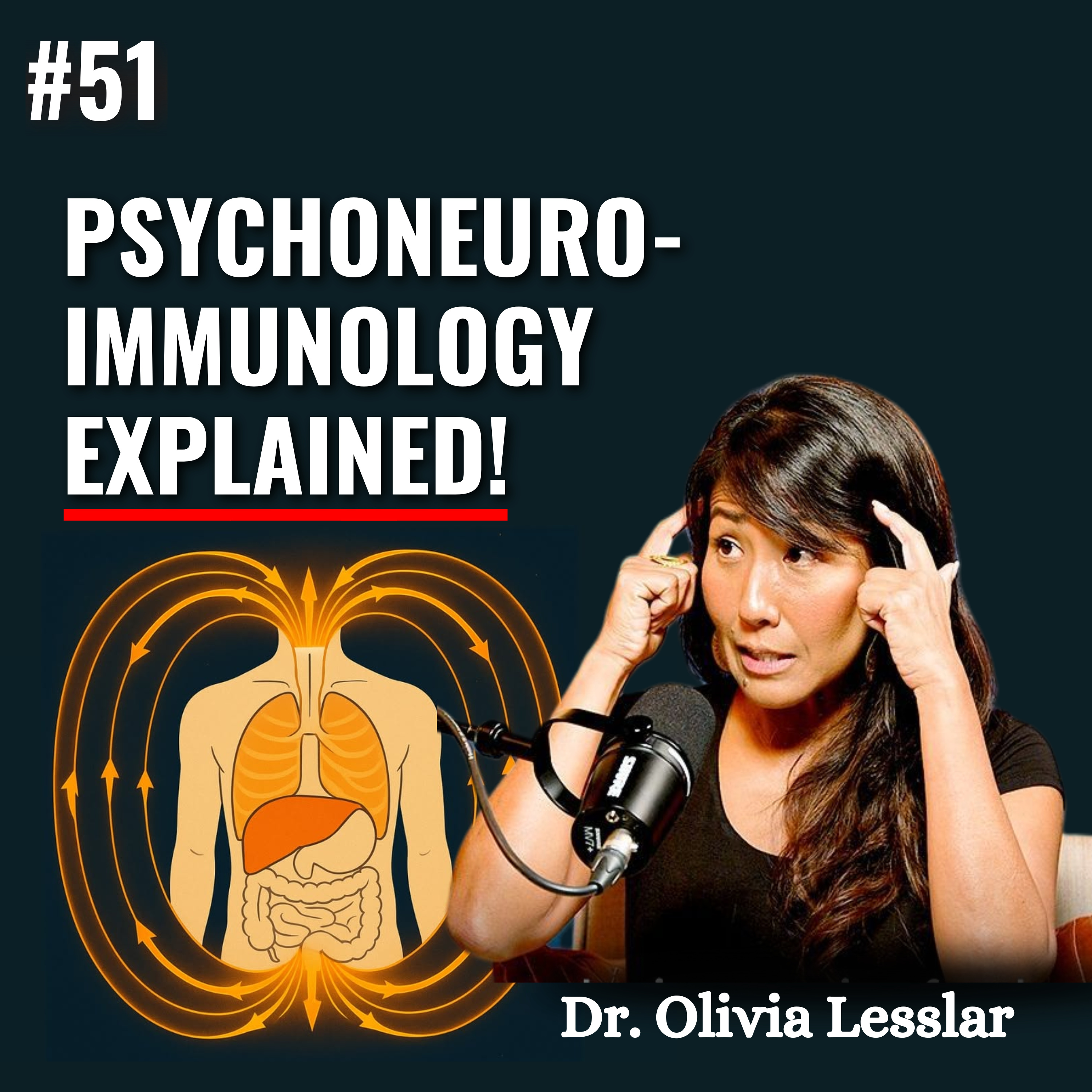
Dr Olivia Lesslar Explains Psychoneuroimmunology | Mind Body Connection, the Science of Energy Healing, Frequency Medicine, How Emotions affect your Health & the Future of Holistic Health
What's This About?
In this episode of the Fitness Wisdom Podcast, Dr. Olivia Lesslar discusses the intricate relationship between the mind and body through the lens of psychoneuroimmunology. She shares her personal journey from conventional medicine to a holistic approach that emphasizes the importance of emotional health, lifestyle choices, and the interconnectedness of various bodily systems. Dr. Lesslar explains how thoughts and emotions can influence cellular health and offers practical techniques for creating safety in the brain and building resilience. The conversation highlights the future of medicine as one that embraces energy and frequency as vital components of healing.
Definitely SAVE & SHARE this episode with a friend, this knowledge is extremely important & potentially life changing!✅
⬇️ Find & Connect with me Here:
https://www.bio.link/move_with_andreas
👇🏽 In this Episode of the Fitness Wisdom Podcast we discussed:🎙️
00:00 The Journey into Psychoneuroimmunology
06:37 Understanding Psychoneuroimmunology
12:21 The Role of Bioenergetics in Health
18:53 The Impact of Emotions on Cellular Health
28:01 Creating Safety in the Brain and Daily Habits
32:18 Understanding Stress Beyond the Obvious
35:17 The Importance of Autonomy in Health Choices
36:38 The Impact of Environment on Health
39:47 Advanced Glycation End Products and Health Risks
42:34 Food Intolerances and Dietary Choices
44:46 The Role of Chemicals and Resilience
50:35 Building Resilience and Safety Signals
59:50 The Interconnectedness of Mind and Body
👇🏽 You can find me on my other platforms as well, as work with me1-on-1 Online World-Wide 🌎
📲 Instagram: https://www.instagram.com/andreas_david_christou/
🎙️ Podcast IG: https://www.instagram.com/fitnesswisdompodcast/
🌐 Website: https://www.mobility-fitness.com/
▶️ https://Youtube.com/@fitnesswisdompodcast/
🐦 Twitter: https://x.com/movementandreas/
⬇️ Find & Connect with Dr. Olivia:
📲 Instagram: https://www.instagram.com/drolivialesslar/
🌐 Website: https://https://www.drolivialesslar.com/
🐦 Twitter: https://x.com/DrOliviaLesslar
🔥 Find the Hume Body Pod HERE Full body analyser I use & recommend to my clients to help them understand their body fat percentage, muscle mass, cellular hydration, visceral fat & more. It comes with over 40+ actionable health metrics! Get it at a great discount with promo code: MOBILITYFITNESS at checkout ✅
💥 OUR FAVOURITE NON-TOXIC AND SUPER EFFECTIVE HAIR WASH! USE THE PROMO CODE: MOBILITYFITNESS FOR A 15% DISCOUNT AS WELL✅
➡️ HTTPS://TRYBLOO.COM/MOBILITYFITNESS
👉🏽 Find the Best UV + Red Light Therapy panels, Blue Light Blocking Glasses & Circadian friendly light bulbs 🚨Use promo code: MOBILITYFITNESS ✅ for 20-30% OFF your entire order 👇🏽
https://www.emr-tek.com?snowball=MOBILITYFITNESS
👇🏽 Here is the Methylene Blue I use 🌀🧠
www.merakimedicinal.com/MOBILITYFITNESS
Use promo code: MOBILITYFITNESS to get 15% Discount on all products ✅🧠
👇🏽 Find the SHILAJIT I use & recommend below ⚡
https://mountaindrop.com/order/?ref=5873
Use promo code: MOBILITYFITNESS for Discount on your entire order ✅🧠
Get yourself a personalised Nutrition, Training & Lifestyle Optimization Plan designed for Your Body & Goals! Let's Transform your Body & Health from the inside-out! ✅
💎 The Link is Below👇🏽
https://bio.link/move_with_andreas
*None of the content / statements in this Podcast are Medical or Personal Advice & is not intended to cure, treat, prevent or diagnose any medical conditions. All my videos are for Educational & Research purposes only. If you decide to try anything discussed in this video, you agree to do so at your own risk & responsibility*
This is the fitness wisdom. Podcast Hello and welcome back to another exciting episode of the Fitness Wisdom Podcast. Today we have a very special guest, Doctor Olivia Leslar. She's an expert in psycho neuro immunology and she also take cares of with people all around the globe for chronic disease and different kind of conditions. So welcome to the show, Doctor Olivia. It's a pleasure to have you. Thank you so much. I'm pleased to be. The reason why I invited you on the show actually is because we connected on Instagram and I was digging through your Instagram page and I found that everything that you were saying on there was super fascinating.
You know, especially about the mind body connection. And you, you're bringing many, many ties that I've never heard about in that way before. But I've always been very interested in how the mind and the body are intertwined as one system. So maybe before we dive into all of that good stuff, I would like love to hear your own personal journey, how you go into this, you know, learning all of this alternative, but not the alternative. But it sounds more alternative than the current medical paradigm, right?
So how did you get into this space in the 1st place? How did it come to your awareness? I would love to hear your story. So I actually grew up in a family who was very open to these sorts of things because my father is a functional medicine veterinarian. So he actually practices as a conventional vet, but also alternative medicine, traditional Chinese medicine, acupuncture. He does hyperbaric oxygen for animals now, red light therapy, pulse electromagnetic field. So I grew up with this sort of mindset and my dad and my mother are very open minded people where they kind of know the traps of conventional inverter commas, wisdoms, right where you have a cabal basically saying do this or else, you know, the science is settles.
No, it never is. It never has been, you know, and anybody who talks like that is. So I already was minded. I went to medical school, and I guess to a certain extent, I was brainwashed too. You know, pharmacology was a big part of my medical degree. And you really kind of started to feel like it was what was going to save your patients. You know, we didn't talk about prevention. I mean, because at that stage, it's like, yeah, it's obvious, obvious. You know, don't get cancer, don't get diabetes. You know, then you don't have to be seen by a doctor.
But we weren't taught about preventative medicine. Yeah. And then look back, you know, we weren't really taught about nutrition, either. We weren't taught about anything else apart from the mainstays of conventional medicine, which as you know are drugs, surgery, radiation, chemotherapy, etcetera. The lightning bulb, the lightning strike moment for me was when I was in hospital and I was filling out a medication chart for an elderly patient and this medication chart just went on and on on. And any reasonable person, medically trained or otherwise, would have looked at this man's medication chart and realized that this is complete bullshit.
He's on half his medications because of the side effects of like the other half of the medications. And there is no way that animal on this planet who has been forged in the evolutionary fires over millions of years needs these many drugs to patch them together so that they can even just walk down the corridor. And that's when I realized, what are we doing? You know, I went into GP training, so general practice, family medicine training, and it was largely uninspiring. However, what I did manage to hone skills on when I was doing GP training is that I was listening to these podcasts, you know, Rhonda Patrick, you know, Peter, whatever.
And I became very interested in these things I'd never heard about before, heat shock proteins with regards to sauna, you know, using a rapamycin for longevity, all these things that you, of course, you're not going to get exposed to in conventional medicine. And in my downtime in the clinic, I started to do more investigation into these things I was listening to. And I started writing what I now know to be white papers. I didn't know they were white papers. And it was just, I liked putting information together and getting pretty pictures and graphs and stuff, you know, and referencing it and all that.
And in deep diving into these things, you know, that's what the practice of medicine is. I have the foundations to be able to dig deep into all these different things and be able to sort out information, what's real, what's not, what needs more evidence, blah, blah, blah. I mean, I'm not saying I'm perfect, but it's a skill you have to practice, right? And so I did a lot of practice and speaking to my patients more and more about lifestyle medicine, about their sleep, their diet, their movement, their mindsets.
And patients really responded and I wound up becoming a very popular GP, registrar GP in training because I had all these patients coming to, to come see me because they were looking for something more, something better, something other than a Doctor Who was just going to prescribe them something. And anyway, story short, I wound up being offered work with a very famous neurologist, psychiatrist in the US. And so I just left my training post and I, I'd left and I decided to forge my own path. For every disease process or for every organ system, there is a bell curve of information.
The meat of the bell curve is where 80% of the population are going to sit, but that's also where 8090% of doctors are going to sit too. And I didn't want to compete with other people because you know what? There are far better doctors than I am, I'm sure of it, right? So I decided to concentrate on the tail end of the bell curve. The little known things, the this, you know, this is what we say about physiotherapy. But is that true? What about other things, you know, neuro kinetic theories or spiral lines or, you know, more autonomic nervous system integrations with the muscles?
Like it didn't matter what it was. It didn't matter if it was cancer or movement or it was psychology or biopsychosocial stuff. I wanted to know about the tail end of the bell clips and that's where I wound up from forming A expertise. And I'm very good at translational stuff, so I take this information. I'm also able to put my own slots on things, you know, like my own frameworks or hypotheses. And so now I educate on the stage as well. I've been using red light therapy for many years now but the only since I started using EMR tech red light therapy panels did I really start to notice the true benefits of red light therapy.
I'm using EMR tech's fire dragon pro and the inferno pro. I know is better recovery from workouts, improved skin health, better energy levels, improved eye health, improved sleep quality, and pain reduction. I can safely say based on my experience that EMR Tech has the highest quality panels on the market from build quality, functionality, and the aesthetics. Don't take my words for it. Grab yourself a panel from emrtech.com and use the promo code Mobility Fitness for a massive 30% discount. Very cool, awesome breakdown.
So basically all begun from your childhood, really like your your parents were sort of like your inspiration at the beginning or they plant, they planted the seed basically, you know, in your mind. And then it was so much easier for you to identify that there was something wrong in the current medical paradigm that you were practicing in or that you were getting trained to, you know, training and to be to practice in. And then basically that allowed you to, you know, visualize and see that you want to do something more with your degree and your knowledge.
You want to actually help people from a preventative aspect rather than just to be patching the symptoms as is currently done now in the conventional medical paradigms. So where does like psycho neuro immunology fit into all of this? You know, where did they all begin? You know, how did it come to your awareness? And also why is it important for us to understand for our health? So. Let's do a definition for psycho neuro immunology is that intersection point between psychology, behaviours, emotions, mindset, nervous system, immunology, endocrinology, pathology, Physiology.
Basically everything is connected to everything. And I came upon PNI, psycho neuro immunology because in practice I was seeing that some of my complex chronic condition patients were getting better because of the change in mindset or because of a change of emotional circumstance and not because of supplements, drugs or a ketogenic diet, I should say. And I had some patients who were on the perfect protocol for them. The perfect protocol, but they weren't getting better because they were orthorexic or they were anxious about their food.
And you know, we've all been with people who are so anxious about eating clean or you know, not no gluten, no dairy, whatever it is that you can see the anxiety coming off them, vibrating off them, that they're vibrating a much different level and it's not healthy. And then once you go down that more spiritual emotional consciousness pathway, you realize how important bio energetics is, electromagnetic fields, the kind of things that emanate from your heart, from the soul in your brain. And then you put it all together.
And I started to get better results with my patients when I was act, when I was acknowledging and accessing these different aspects to the treatment profiles. Not just take this supplement, you know, take this diet and do this exercise. Like it became far more than that. And I remember one day I said to my best friend, I'm like, I feel like I'm doing some sort of, I don't know, like psycho neuroendo, immunology type thing. And then I googled it and there was such a thing. Wow, that's crazy. This yeah, this field has been going on since like the the 1970s, nineteen 60s.
And it's only just getting gaining traction now. And the reason why it didn't gain traction then is because of the way that the different organ systems were siloed and how the different doctors were siloed from each other. So if you have a lung problem, you see a respiratory physician. If you see your, if you have a heart problem, you see your cardiologist. Even though the lungs and the hearts are, are so intertwined, really, you can't be treating one without the other or at least acknowledging the other, right?
That's why in our modern medical paradigm, when we're sending patients to specialists, the specialists aren't speaking to each other. And then before you know it, this patient is on 6 drugs and the the GP who doesn't have time, right? And they're so under stress, they, they, the best they can do is like just repeat the prescriptions by these specialists. And so nobody is taking that, you know, 20 foot look at this patient and seeing how things are connected because you can't give a patient a drug for the insulin resistance.
When you find out that the insulin resistance is because of excessive blue light exposure and poor sleep, sort out the light diet, sort out the sleep, all of a sudden you don't have incident resistance. The patient doesn't need to be on drugs. So this came to it. It was all from experience with patients and the patients taught me, you know, so much. And so now I, I've kind of dedicated my career at the moment in trying to figure, learn more and more about these interactions between these different organ systems between, you know, things that usually aren't the realm of doctors.
So psychology, emotional health, spiritualism, consciousness, because they make a difference. And more importantly, from a non objective perspective, if it makes a difference to the patient, then it makes a difference to me. Yeah, yeah. So basically you're talking about systems instead of body parts, right? You're, you're viewing the the whole body as a as a system, not as you know, separate parts like they are viewing it today. And why I guess this is so important to understand this because the body is an integrated system, even though when we take, let's say, an anatomy of a cadaver or whatever and we, we think that everything, you know, we take these parts out, we think that everything is working separately.
All the same thing. Like when we look at the Fascio system or the different or the musculoskeletal system, we think that this muscle is working separate from this one, but it's all really working together as one unit. And some very important things that you mentioned there about the consciousness, about the energy, about the bioenergetics you, the way that you spoke about it in this paragraph or sentence, you made it sound like it was very factual, very scientific, as I would love for you to get more into that if possible.
Like how, how does our bioenergetic body, because there are many people who are unaware that we have such a thing, you know, or, or these sorts of electric fields or magnetic fields that our body is producing. You know, maybe you can explain to us how this is actually affecting us on a cellular level, because I think it's still not really understood the fact that what are these things, because maybe they are invisible to the make you die. It's hard for us to grasp and understand. Yeah. So I mean, at First off, I'd like to say that this is so complex.
I don't feel that I'm an expert at all. I am good at translational stuff, and so I'm trying to really dig deep so that I'm able to distill enough out of it to be able to make a difference to a patient's life. However, let's see if we can chat about enough that it's going to make sense to the average layperson. And it's this, if you, I guess, if you look at it from a, you know, as above, so below, as below, so above kind of philosophy, then you realize that every electron has a spin, every, every atom has a spin and a spin is going to produce an electromagnetic field.
We, this is basic physics that we all learnt in primary school, secondary school. OK, so you then put a lot of atoms together and then before you know it, you have a, a molecule, right, humming with the spins that it, it's holding, right. And that's why when one molecule comes in contact with another molecule they have, they possibly can have some sort of reaction. And that reaction, whether it's coming together loosely or coming together tightly like a covalent bond or repelling each other, that's all to do with the electromagnetic field that is produced by the spins of the individual electrons and atoms and the atoms, right?
OK. So we kind of understand that. We, we understand the biochemistry of the body very well. We know that things go kaboom or things bind together or whatever it may be, but we don't realize that biochemistry yields and bends to bio energetics. And we still talk about biochemistry as the be all that end all because it's an easier thing to see, to quantify, to qualify. But we have the tech now to see the electromagnetic fields and how those things are affecting each other. Biochemistry tends to be very Newtonian.
So in other words, it's sort of the physics that we're used to, you know, the, the, the biggest stuff like how do things move and how do things progress along a, a ramp up or down and how do things fall and Newtonian physics. So we've all heard of quantum physics and that's what happens at a much more sub cellular, much more lower down area, right? And, and it, it almost plays by slightly different rules, but surely quantum physics, if it does affect the system, it's the only thing that we have to worry about is at the Newtonian level.
OK, I'm going to draw a line in the sand for the moment. I think most people understand that the mitochondria is a very important organelle because it produces energy for the the cell. It does a hell of a lot more than that. But for the moment, just understand if your cell doesn't have energy, it cannot do the things that it needs to do, produce the proteins, clear out the ways, induce apoptosis and cell cell death is if it needs to, et cetera, et cetera. Like you need the energy for the cell to do what it's meant to do, whether it's your brain cell, eye cell, or liver cell.
The mitochondria is a quantum organelle. In the mitochondria, there's something called the electron transport chain. The very fact that that's called the electron transport chain is like, oh, we're talking really tiny bits here. We're talking quantum level bits. OK. The electron transport chain is called that because as the mitochondria is pulling bits and pieces off the substrates of the Krebs cycle, it's quantum tunneling electrons through the electron transport chain. It's quantum tunneling protons or the H plus into the inter membrane space to create that proton gradient so that the H plus the protons can then go through the ATP synthase to make ATP.
Quantum biology, quantum medicine, quantum physics is very relevant to our health and we are so lucky that we are in this era where we now have the assays and the technological capability to quantify and qualify this aspect of things. That is what the explosion of red light, infrared therapy has been about. It's because the protein complexes in the mitochondria are non visual light acceptors. They actually take in light energy. And as you know, you cannot destroy or create energy. It's converted, right?
So you're taking in light energy and it's doing something with that energy to do the things that the organelle needs to do, right? That's quantum as well. So the quantum aspects is very complex. I am. I feel like I have a mountain in front of me. I'm very lucky to be surrounded by people that you know as well who are far more advanced than me. My interest is to come into the space to learn and then to help translate it in a meaningful way for patients. Yeah, that was such a fantastic breakdown and thank you so much because you basically just explain how the biophysics, you know how it's all working, right?
And how this system, this bioenergetic system is influencing the the physics of our biology. And why this is essential to understand is because it ties into this psycho neuro immunology that we're going to dive deeper into today, right. So if for example, by the way, that we are thinking whether that is positive or negative, that can have a specific influence on the type of light that we are producing internally or the type of magnetic field our cells are producing. And that therefore altering our metabolism.
And then that then that therefore influencing our nervous system state. And obviously our nervous system, we know that the state of the nervous system is influencing so many different organs and systems of the body, right? So it all has this, they're all these systems which are all intertwined, which are inseparable. So when you're affecting one, they're all it's like a domino effect. They're all getting effective. So, so may so maybe you could tell us like how, how are people's emotions affecting them?
Like on a cellular level, Let's say that if someone is thinking negatively, do you know what's actually happening on a cellular level? Is something harmful going on? So let's give some concrete examples that conventional medicine knows. And we tell patients about it all the time.
So your thoughts are frequencies, right? Everybody's heard of Alpha, alpha wave, delta wave, Theta wave, gamma, beta. And these are different wavelengths, right? The Hertz, it's an electromagnetic frequency. And you know, Theta waves are what the brain cells are emanating when you are in a meditative state. For example, delta waves are slow waves, right? And it's what happens when you go when you're in deep sleep. Did you know that the delta waves are necessary to actually open up the aquaporin in the brain, which then allows the cerebral spinal fluid to come through and wash out the brain during deep sleep?
It requires that electromagnetic frequency to open up the channel. This happens everywhere in the body, right? So the knock at the door, at the cell, at the receptor, at the ion channel. This is not just a molecule comes along and sits on the receptor. Sometimes it's actually the the charge of the molecule that helps to open up the ion channel. It's actually the electromagnetic spin, the electromagnetic frequency around the molecule that will open up those ion channels and doesn't even have to be a molecule that needs to be there sometimes if you have the right electromagnetic frequency, it does all these things without needing that molecule.
There is a company called Emulate Therapeutics, EM Electromagnetic Emulate Therapeutics in the US and I've been following their work since 2019 when I was at a Northwell Hospital brain tumor Summit. So I'm talking about a conventional hospital brain tumor summit, which I was attending with the neurologist, psychiatrist that I was working with. And the Emulate speaker was talking about how, you know, being at a conference on brain tumors, how drugs with to treat GBMS, you know, bleoblastoma multiforms are really they're ineffective because they can't cross the blood brain barrier.
So what Emulate was going to do was actually pull the electromagnetic signature of the drug and pump out the electromagnetic signature of the drug by giving a coronet to the patient to wear. That's incredible. And I thought at that stage, because I was stupid, I thought this is bullshit. And I'm looking around and all these people are writing notes. I'm like, oh, OK, OK, so I'm starting to write notes. And essentially it's this, he goes every, and, and This is why it's so important to be in different groups of people who know different things to you because you're going to learn something.
And he said, as a matter of fact, and everyone's like, yeah, absolutely every, every molecule, every substance in the universe has its own unique electromagnetic signature. All drugs, this table, my computer, this hair tie has its own electromagnetic signature. And So what Emulate Therapeutics did was these series of experiments which we watched from the audience, right? These videos, these Faraday cages of mice. And they would then pump out an electromagnetic signature of caffeine, tequila, benzodiazepines, you know, whatever.
And you'd actually see the behavior of the mice change because the electromagnetic frequency was affecting the ion channels, the receptors, the, you know, the brain, the immune system, the whatever. It's so complex, but yet simply beautiful. And ever since then I've been like, because they actually finished pilot boat that was 2019. So not long after obviously COVID hit and their research got scuttled for a bit. However, they actually did finish their pilot studies at at universities in Australia because it's cheaper.
They finished their pilot studies at the university in Australia to show that, you know, this is, this is safe. And, and I'm so excited for this company for the next few years. So this is ultra low electromagnetic frequency medicine, tiny bits. And like you said before about the knock on effect, I've gotten more and more used to the idea that I don't need intensity to create an effect because what I'm looking for is enough to start the domino effect. That's why the red light is not as important as I used to think it was.
You just need to get some mitochondria going and then they're going to start producing bio photons which are going to affect the next mitochondria and so on and so forth. Because, you know, everyone's talking about intensity of the red light, and if it's not intense, it's not going to work. And I don't believe that to be true anymore. Anyway, let me get back to emulate because I'm so fascinated by them. So they have a device called a Voyager and it's a little Coronet that you wear for 23 hours a day, little battery pack, and it pumps out the electromagnetic signature of the GBM drug.
That's how it works. Now, is it effective? Is it not effective? I don't know. I'm sure that we're going to get that information in the next few years. However, the very fact that theoretically, and it makes sense theoretically, there are companies actually doing that. And you can imagine how much research and work is happening behind the the the scenes. If you are in 2025 saying that that kind of stuff is bullshit, you're not even looking at it, then you've buried your head in the sand and you're going to miss out on the next wave of medicine, which is coming.
The next wave of medicine is energy. It's light energy, it's sound, it's electromagnetic fields. What was your question? I got so carry on with. That did you know that muscle weighs more than body fat in terms of volume? This is why someone can look like this or like this and be the exact same weight on the scale, making weight tracking not the most reliable metric when it comes to measuring progress. So building muscle while losing body fat can massively influence the number on the scale, leaving you feeling frustrated and discouraged.
This is why I love the Homebody pod and At home full body analyzer. That gives you over 40 actionable health metrics allow you to get true insight into your body composition from body fat percentage, lean muscle mass, cellular hydration, visceral fat, and so much more. So if you're serious about your health and fitness and leveling up your results, definitely need to check it out. The link is in the description below and if you use the promo code Mobility Fitness at checkout, you can get a massive discount on your order as well.
Yes, I was talking about how. How do you think that negative emotions are influencing us on a cellular level? You kind of already elaborated on that a little bit just more generally, which was fantastic. And I absolutely loved your description because it just shows you that how much power as a human being you have. Because if this band that you're talking about that you can put on your head with the frequencies is able to influence yourselves by them thinking that you are. So let me just clarify something.
When they are wearing this band, are they taking the drug at all or is it just emulating the frequency of the drug? OK. So yeah, So basically does that also minimize the side effects of the drug? Exactly. Wow, there are. No, so this that is incredible because I know that there is this one brand, I forget the name now, but it's you put your glass on top of it and it imprints the frequencies within the water and you can you connect it up to your laptop and it plays specific music as well. I think it's called.
It's a again. Is it Lila quantum? No, it's not Lila Quantum. I know that their stuff is really, really great too, but this is more something that you plug into your computer and there are these frequencies set on the computer that you can choose from, like caffeine or psilocybin or whatever kind of mood you want to choose or, or molecule. And you can imprint that into the water. And it also produces different light frequencies as well. And then basically you drink that water and you get the effects without actually ingesting the actual molecule, but just the fact that the frequency has been imprinted into the water and then you're actually drinking.
And that would make sense as well that because our body is primarily made-up of water, right? Our brain, as you mentioned, and as our heart is generally creating these these self generated frequencies that we have so much power and potential over to manipulate really. But there are of course many individuals who think that they can't manipulate the way that they're thinking because they are just stuck in this fight and flight state. But when you come out of that state, you realize that you know, you can't actually alter your reality if you're more in a parasympathetic state.
Now you are responding to your environment. You're not so reactive to your environment. So I think that everything that you so, so powerful and so incredible and it is really true that I believe also the future of medicine is in frequency because that is as you explained on a quantum level is having this domino effect. And you don't need much of it because the quantum is even though it's a small effect, it's extremely powerful because it's working on that, that level which is having that domino effect affecting our biochemistry.
And therefore we are able to see it in a Petri dish in a lab, for example. So. The next thing I would like to love to ask you is that what things are important or what kind of daily life acts, habits and behaviors help to create safety in the brain? Because as you know that now the modern world is filled with a lot of subconscious stressors, right? And many, many people are not aware of these subconscious stressors. And I think it's important for us to become aware of those things. So maybe you can list a few of those if you know what of those stressors are and then give people like solutions to how are they able to bring a sense of safety to their brain and their nervous system.
So. This is an interesting question. Let's break it down a little bit. I think that the interesting thing about people going on holiday is that it is a holiday. It gives them bandwidth and room to breathe and to relax. So if you want to recapitulate all the different things on a holiday, that's going to make you feel different, better and right, presumably then those are the things that you can implement in your life as well. So usually it's going to be a new place or novelty. It's going to be usually sun, let's just say right, or sea.
So more elements hiking in the forest or skiing down a, a, a, a mountain like it's, it's usually nature is involved in it somehow. Usually there's more sex, usually when you go on holiday with your partner, it's better sleep or more sleep. And even those little things about how people take time out of their regular lives to go on holiday in inverted commas to do these things, those things actually can be available to you in your day-to-day life. You just have to make time for it, OK. And there's something to be said about being on holiday and then wanting to go home.
OK, I've had enough. I want to go home. So what is it about home that gives us feelings of safety and home? I'm a digital nomad, so I don't have a home, but I can tell you that home can be a person as well. So it's where you feel like you can you and authentic, right? You don't have to pretend. You don't have to dress up. You don't have to be any of these things. You can just you can just fall into someone and be yourself. So home or that concept can be taken with you on holiday or when you're a digital nomad, right?
So these transferable aspects is important to note because when we tie patients to feeling like you can only feel calm if you learn to breathe, you can only feel this if you do the psilocybin. You can only do this if you exercise. You can only do this if you go on holiday. We keep yoking those things to these other things and then your brain is very good at making associations and then all of a sudden it doesn't allow you to become calm unless you do your breath work. So we need to being patients anyway.
And then the other thing of course about home is that you know where everything is. So you don't have to use bandwidth to try and figure out where the bottle opener is or the this or the that or whatever. You know, like there are so many decisions to be made in a day. Sometimes it's helpful when you take those that off the off the plate Then also your home is where your Biome is or where your microbiome is created, right? We have an energetic microbiome and a physical microbiome and the microbiome feels safe when it is in a place that it was forged in.
What I mean by that is I know plenty of patients who their own home there may not be the cleanest, you know, there's a bit of dust, all the rest of it, but they're fine. Their symptoms are OK when they're at home. And then the minute they go to someone else's house, even if the other person's house is not dusty, sometimes the allergy symptoms can flare up because it's a different type of electromagnetic signature, a different type of microbiome, right? So the reason why people feel safe at home in part is because of of that stress was as you brought up before there, everyone always thinks of the psychological stuff, the fighting, the shouting, the screaming, the crying, the anger, the frustration, the, you know, the traffic jams.
And but you know what the, those are the obvious ones. Let's talk about the not so obvious ones, right? So most of us are exposed to non physiologic palettes of light because we're indoors all the time or most of the time. When I say non physiologic palettes, I mean unopposed blue light or the Spectra is not what you would expect in in in in nature. Windows will filter out certain like wavelengths, right? And so your options, your non visual light acceptors in your skin, for example, or your adoptions, melanopsins in your eyes, these have been evolved over, you know, millennia in response to ambient light from the sun and the moon and fireplaces.
Let's just say all of a sudden these receptors are being asked to accept these weird types of light with these weird Spectra. And it can cause stress at a microscopic level, right at a, at a, at a, at a level that probably doesn't affect most people. If you're well, it's just a paper cut. It makes no difference. But you know, you can bleed out from in paper cuts. And everyone goes, oh, they want to blame the rise of anxiety on one thing, social media, on the news. Yeah. You know, this is it's a complex thing.
And what we need to do is at least have the knowledge and then we can make informed choices. Now, am I going to start? Am I going to get a tent and live out in the garden? I'm not. Absolutely not. Right. Will I buy a pair of blue blockers and use them at night, especially if I'm in an environment where there's a lot of fluorescent lighting or LED? Yes. That's called an informed choice. That's called an informed decision. And I have autonomy and agency over my own body. I don't need you judging me, right about eating processed foods or having a glass of wine or whatever it may be, because autonomy means especially when it's informed.
I know the risks that I'm taking and I'm going to make those decisions for myself, full stop. When we give patients agency, or rather sorry, when we, when we see that patients take agency, when they come up to the helm of the boat and help steer the boat with us. When we are merely guides and information givers and not prescribers necessarily. Patients thrive because the electromagnetic frequency is different. The the, the that, that it's from their brain and their hearts is different. They drop faster into parasympathetic states because they have agency.
It's a big, it's a it's a big deal. Yeah, that's fantastic. Yeah, that's so true because if you're telling someone what to do, they are, you know, doing something more out of fear rather than empowerment. And I guess you know, when, why it's so important for us to have these discussions like this podcast episode that we're doing is to actually inform people about the different information and knowledge that exists out there. And that you do have alternative ways at looking and tackling health, right?
And so then if people now are listening to this and then after they are aware of it, then they know that there are other ways that they can deal with whatever they are dealing with, with their health, or if they are thinking even about health optimization. Whereas if someone is unaware and they're just going down the conventional route, well, then they're just doing what they believe to be right for them. But when they at least have the knowledge and the wisdom, then they can make an informed decision.
OK, I I do have this other option. And if they do decide to go down the conventional route, which may not be the most optimal thing to do, then it's up to them. But at least they are doing it through their own choice. And even in that case, as you're saying, even if they're actually doing it with their own choice, they are is stepping into it with a different energetic feel, the different mindset, so that I actually experienced quicker benefits even for with the conventional tools, for example, just because they actually chose to do that, right?
Yeah, exactly. It's you. Know part of that realm of placebo and nocebo and stuff, you know other stressors that I guess we should touch upon are things like modern architecture, modern interior design it makes a difference to your neuro immune system where you're faced with sharp angles, right angles because we don't get acute angles like this in nature, right in nature everything is mostly curved sorts of things and so when you see these angles now again, these are paper cuts for you and me no difference but for a patient and I have had two patients where this has made a difference One of the patients she was post I think she had like a post COVID vaccine issue and she found that the biggest symptom was that she would walk through an archway of a door for example, right and she dropped.
She she dropped to her knees. And it was completely non volitional. The other thing where she would start to get walk in fall is that if she's walking down like a, a galleyway, like a kitchen and you see the convergence of the, you know, the, the, the two countertops, you know, so it was like an angle like this and I had no idea. So, so looking things up and I came across looming research. Looming research is where you have a mouse in a, you know, in a, in a test area and you have a screen, an LE screen so that you can shine whatever you want on it so that it emits whatever you want, right?
And the screen will be white with a small black dot in one spot. Right now as the dot gets bigger, it looks like it's coming towards you right? Quickly the black dot becomes bigger, or how slowly it becomes bigger would change how the mice reacted. The faster the loom, the quicker the the mice would run back to home. Whereas if the. Boom. So if the black dot got bigger slowly, the mice would stop and stare instead to assess the situation. And this relates to a whole field of study that I'd never heard of before, which is architectural neuro psychology.
How do buildings how do architect interior design? How do angles? How do colours? How does you know details like sealing roses or whatever it is? How does that change your perceptions? How does that make you feel? I mean, we all know that the hospitals and clinics are painted green, right? Because green is meant to be soothing or whatever it is. But the science behind that kind of stuff goes way deeper than that. Fascinating. In other words, when you have a building that isn't built or when you have a interior design that isn't sympathetic to those aspects of your psychology and your emotions, that's a stress.
That's why we like to go to certain places and we don't like to go to other places, right? It's a stress. Thinking of stress is just a fight with your husband. It's more than that. Little things like these is all little paper cuts. And The thing is, if you can avoid as many paper cuts as you can, you're increasing your bandwidth to be able to deal with the true, the real, the hardcore paper cuts when they do happen. Advanced glycation end products. I like speaking about that advanced glycation end products AG ES are where you have a sugar non enzymatically bound to a protein or DNA or fat or something like that.
It's what ultra process very high end, which is why they're so dangerous and advanced glycation end onto the receptor for advanced glycation end products because this is a considered a threat in the body. And when rage is activated, the receptor advanced vacationing products, then you have a whole inflammatory cascade that gets turned on. So when you eat ultra processed foods and processed foods. And I wrote a paper with Professor P. And since then, there has been a more definitive review done like I think it was within the last year, Ultra processed foods, processed foods or rather the burden of advanced location end products absolutely is going to be a massive risk factor for allergy.
Balan like that. Is now in the literature, right? So food allergies are in part due to your your. Body. Thinking that this that's coming through is a threat. So you can eat broccoli with ultra processed food and your body is going to tag everything that came through your mouth at that time because it needs to try and figure out, OK, why did the immune system get turned on? Is it this is it, this is it, this is it? Certainly eat something that's going to turn on your rage along with broccoli, for example.
Your body is going to think that the broccoli was part of the problem and all of a sudden you have a broccoli intolerance. That's what we see in allergy clinic. That's why in, you know, these are of course not Ige driven allergies, right? But when you have these kinds of sensitivities, sensitivities where you'd like, wait, hang on a second, how come one day I can eat tomatoes and another day I can't? How come some days when I eat eggplant aubergine, my mouth gets a little bit itchy and sometimes it's not.
It's because it's thresholds. We all have thresholds for certain foods. When you overdo it on a certain food, right? When you smash, for example, you're drinking 2 liters a day or whatever it is. And this is an actual real life example from when I was at university. You have to be careful because you can induce an intolerance because the body is like, OK, OK enough, enough, and then it will make you stop. That's why you can then go, OK, I'm going to cool it. I'm going to, you know, give my body a bit of a break for, you know, that's what those food intolerance tests can possibly be helpful for this.
I'm a skeptical, but anyway, so then you you go, all right, I'm going to give my body a break from the cashew nuts or from the pineapple or whatever. Give yourself a little bit of a break and then you need to reintroduce because if you do not reintroduce foods, you run the risk of not permanently, but you run the risk of developing a like intolerance that's harder to get rid of. So a lot of these like carnival guys, for example, you know, it's meat, meat, meat, meat, meat plants out to kill you, plants out to get plants that evil.
Just eat meat. They won't eat a carrot or a broccoli for years. And then when they do and then they get bloated and cramping and this and that for them. It's like, you see, I told you the broccoli is out to get you. I told you it was evil. It's like, no dude, it's exactly lost tolerance you. Weren't eating. Physiologic way, like we need to have some flexibility. Does carnivore diet, keto diet or these more slightly extreme diets, do they help? Yes. So many of my autoimmune patients I put on carnivore diet.
So many my neurodegeneration patients aren't ketogenic diet. Absolutely. But you also have to look at it in context of everything, right? So for the patients, severe mental illnesses, bipolar, all the rest of it, you know, should you try to take them off the ketogenic diet and then, you know, widen that if everything is fine and they're happy and healthy then and they don't want to, then yeah, OK, you stay on the ketogenic diet for the rest of your life. That's great. You have that. But for the for the average layperson who's trying to figure out what to eat and what's healthy and listening to these, you know, the thousands of influences and this, that and the other, and then they take themselves off something without appropriate supervision.
They take off all these foods and then they don't reintroduce it in an appropriate period of time. And then they lose tolerance. And then before you know it, they go back into a cycle of anxiety, which leads into more food intolerances. I mean, you can see where that might be a problem. Yeah. Absolutely. That we're seeing in, in society, you know, so I've spoken a bit about architecture, I've spoken a bit about light foods. There are so many different types of stressors in our society. The chemicals, of course, that's in our personal care products is going to be a problem, can be a problem.
The water that we drink, huge, massive problem. You know, it's like fluoride in the water. Look, I. I am now of the opinion that because of psycho neuroimmunology, if you are resilient enough you can almost surmount. Anything. Right.
There is some great. Studies from Alia Crumb. She's, I think she's at Stanford University, maybe Harvard. And basically she showed that if a person thinks so, in this case it was a allergy to peanuts, I think it was. And they got a patient into this clinic, into this room, and then someone comes in and says, Oh my God, I'm so sorry. That powder that's on that table, that's peanut powder. And the person will have an allergic reaction that is no different to an allergic reaction in terms of the molecules that are being released into in terms of the histamine and the Illinois 6 and the tumor necrosis factor alpha and the swelling of the blood vessels.
And what it looks like clinically, it is no different to if they actually had a real peanut because in this scenario that wasn't peanut butter, it was just talcum powder or something like that. But the body is so at knowing how to mount a response, it doesn't actually need the stressor to do it. If you say to it, hey, I need you to. I mean, obviously I'm kind of tongue in cheek here, but can you mount an allergic reaction for me? Because I think that I've just had peanut. It'll go, Yep, no worries.
We've had these reactions before. I know exactly what needs to happen. I can just do it. Don't need the actual receptor to be bound to a peanut. So. You know, I, I, I'm at that mine at that point now where I really do think that people can surmount things that would normally be considered a stress. It's all to do with thresholds. Like, you know, so, so for example, I have a friend who went through a really emotional time with some government stuff with her visa and all the rest of it. And she noticed that after a while, whenever she put makeup on, she would react to the makeup a little bit more, little puffy eyes and something.
So then she stopped wearing makeup and we then trace it back to the fact that when your body and mind are in high alert, everything becomes suspect and your thresholds drop. So before where she could handle the chemicals in the makeup, now she can't when the thing with the visa and all the rest of it was sorted out, she could handle her makeup again. Not that I'm recommending you go out and get rubbish makeup, but what I'm saying is that it's your body is very, your body's incredible. Incredible.
Yeah, if there was 1. Substance that could increase your energy levels, optimize mitochondrial function, boost ATP production, help to optimize your hormones, re mineralize the body with ionic minerals, boost cognitive function, assist detoxification and support your gut health via the microbiome. This substance is Sheila Jit, known as the Destroyer. Shilajit is a herbal mineral substance made from the decomposition of plants and bacteria. This process taking place over thousands of years. It is harvested from high altitude locations, primarily the Altai and Himalayan mountains.
And what makes Shilajit so unique is that it's made by Mother Nature herself. I call it nature's methylene blue. That's all Shilajit that you find on the market is created equally. This is why I only use and trust Mountain Drop Shilajit. They have an extremely high quality shilajit product that has been rigorously tested for heavy metals and impurities. Grab yourself some Shilajit, the Destroyer of Weakness today and head over to mountaindrop.com. Use the promo code MOBILITY FITNESS at checkout for a nice discount as well.
It's insane. Like basically what you're saying is that if the belief is there strong enough, like what you explained there about the peanut butter powder, if you actually are convinced that that is actually a an actual threat or a stressor, your body is going to believe in it. It's going to have this reaction. But it's the same as gratitude, right? You can't just think that you are grateful. You have to feel that you're grateful. Like you have have to truly believe it for it to actually have this very real biophysical response on the body, on the cellular level.
But if you're just saying, oh, I feel grateful and you're just saying it in your head, it's just a word. Yeah. Maybe if you repeat it long enough, maybe you might, you know, believe it, but you definitely have to make it feel throughout every single cell of your body. You know how that feeling when you get goosebumps when you have a really enlightening moment or you hear something that really resonates? Well, clearly something is happening there, right? On an energetic level, because what are even goosebumps?
It's almost like all your cells together are sort of going like a wave and you just feel it all the way up to the the every single hair follicle, you know, it's like every single part of your being is becoming heightened or incoherence, right? With something that is aligning with energetically right? You know the. The interesting thing about what you said there, it's true with gratitude because it is not the words that create, it is the state of being from which it emanates. So you can say I am grateful or I am happy, but those words aren't some magical incantation the state of being from those words emanate from.
If you believe and you embody the gratitude and the joy of whatever it may be, that is when you actually feel that shift right in the energetics We told a lot of people. About a lot of the stressors and we talk. We didn't talk much about how to build resilience, let's say, because of course it's good. It's good that we made people aware about all the different stressors. So now they feel like, OK, now I'm aware about all of these different things. I need to make sure that I eliminate them or minimize them, which is fantastic because that's what I advise people as well.
Instead of trying to patch the problem, it's always good to eliminate the source of the problem to allow healing to take place. But now let's talk about some things that can accelerate people's healing and energy levels and their bioenergetic body. What kind of things can we utilize or even, I don't know, any mantras or different techniques, breathing techniques, these kind of things that people can incorporate into their daily life, which can have a profound impact on every single system of their body.
Yeah, love it. OK. So you already mentioned, so there, there are some ways to go about it. And you mentioned 1 patch, right? So patching is not a bad thing, but of course it's not ideal, but that may be helpful sometimes. So then you patch, you assist and that is going to be like your red light or something like that where you know you need your mitochondria to do XYZ and you just give it a little bit of assistance with the the the energy there. OK, Then you remove triggers as much as you can. So if you live, if your workplace is in a is moldy, then ask to work from home, right?
So you need to try and remove triggers as much as possible. If you eat a lot of ultra processed foods, then put aside an extra half an hour in a day to make food instead. That's that's whole, that's not packaged and so on and so forth. Just just small, small things. OK, so we've got patch assist and we've removed the triggers. The other thing that I like talking about specifically is increasing safety signals. Increasing. Safety signals whilst doing the patching, the assisting and the removing of triggers or the removing of threat is really important because you need your body to know what cellugenesis is.
Pathogenesis is where you go from well to unwell. Cellugenesis is where you learns how to go from unwell to well, because sometimes in you see lots of patients who've been unwell for so long, that's their baseline. So you can't give them the drug and you can't the surgery. You can't give them all these things and leave them without, without the the pathology because they don't know how else to be. So these are the patients who, you know, you remove the tumor or whatever it is and this they don't have as much liberation as they thought that they would have.
They don't have the the joy that they thought they would experience by not being, you know, not being burdened by this illness anymore. And that's because your state of being is multifaceted. It's not just about having this illness or not having this illness. And if you remove the illness is the rest of the state of being able to readjust itself. So we need to learn how to increase safety signals. So I'm going to demonstrate something now that I've actually never fully demonstrated before. Super simple and the.
Reason why I like it is because it's free, it's simple and, you know, anybody can do it. And I also want to stop being part of that machinery which tells patients that they have to buy this or buy that, you know, and patients get FOMO, fear of missing out and no, I let's do this. OK, let me see my hand. Exciting. So let's see if you can see me. All right, so can you hear me? One of the things that I say to patients about increasing safety signals is trying to get into a wide open space. Now any space where you can move your hands is is good enough.
But if you are able to go outdoors into a wide open space, that's ideal. The reason? Behind this is because if you are going into a wide open space, it means that as an animal, you are not afraid of being seen by a Saber toothed tiger, an apex predator from the from the hill around the wide open space. Because you know what your apex, you feel safe. You're going to get your shoes off, right? And you're going to ground your feet into the ground because your feet are always meant to be in contact with the ground from an evolutionary perspective, pretty much.
And now they're all wearing shoe and other sensory deprivation chambers and our brain is just not getting as much information as it would like. So not only are we getting electrons, presumably, let's pretend I'm outdoors you. Not only are you getting electrons from the ground, and remember electrons transfer better in damp so that the the grass should be a little bit damp. That would be ideal. Not only you're getting the electrons, but you're also giving the brain sensory information about the different terrain.
Because when we are constant doors and we're constantly walking on tiles, your brain starts losing information because it wants to feel the the different changes to the terrain, the little different inputs like all these, it's hungry for these signals. OK, my feet are grounded. Now, if you're able to move your joints just a little bit right up and down and your hips, what this is, is a little bit like in tikong, Tai chi or yoga or whatever it is, I'm not stretching. I'm not here to do a stretch stretching.
I'm not here to exercise. I'm here to feed proprioceptive and information to my brain simply because your brain is so starved of information, being indoors all the time, it will take any breadcrumb you give it and it will savor it. So just a little bit. Do whatever you great. And do it slow because your brain is savoring all these little snacks that you're giving in. OK? I would like for you to have your hands in a parasympathetic state. And a parasympathetic state is where your palms are exposed.
This is sympathetic. That is parasympathetic. I need your shoulders to be best to be up. I need your chin to be up because this is a parasympathetic sympathetic state. The parasympathetic state of surrender and surrender when your state of mind is not being coerced into it, means that you feel safe. So we're going to trick your brain into feeling safe. I can surrender because I am safe. When you twit hands this way, your shoulders come in and your chin goes down. Do you know what this is called?
Boxes starts. That's a sympathetic state. You're ready to fight, that's why I need for you to. Be opposite. Of boxes starts OK, when you're now ready, I need you to prove to your body, show off that you can check for threats if you need to. Not that you need to because you're safe, but you could if you wanted to. And you're going to move your entire body and your head and you're going to slowly survey the horizon. Look at me go, I can survey if I needed to. Not that I need to, but I can if I wanted to.
And this is going to counter the fact that most of us when we're sat at a desk looking at our screens, that we don't look behind us. We don't rotate our thoracic, which we normally would on a regular basis when we're from an evolutionary perspective. And when you're staring at your screen, your computer, your phone, your brains going. You haven't looked around for a bit. What if there was a threat? Hello. Are you, Are you sure? I mean, what if I don't know? Maybe I'm just, I don't know. I mean, maybe you know.
And So what we're trying to become, we're countering that. And a lot of the time, just proving to your system that you can survey for threats, that you can move is enough to put it at ease. Most of us, when we're sitting down for 8 hours a day, we don't move. Your body starts to your brain, your mind, your heart starts to wonder, is there something wrong with this animal? Because if there is, I need to, I need to put them in The Cave because that's the safest place for them. And you know what the easiest, best way to put someone in The Cave?
It's to give them depression like symptoms, sickness like behavior. You don't want light, you don't want to socialize and you want to be under the covers. That's The Cave. So we are doing you're also using your eyes to go backwards and forwards, nice and slow to survey the horizon. And in part this is helpful for the hippocampus and the limbic system, which is why EMDR, the eye movement, desensitization and reorientation is it, It goes backwards and forwards, right? Because there's something special about the eyes sweeping the brain.
That's it. The what I say to my patients to do when they can, because now that you know the whys behind it, you can actually buy into it a little bit more, you know, and it's so simple, of course, do a lot more with that, including making sure that you do your breath work with it. But as because you slowly, you tend to breathe slower anyway, because it is one of those things that feedback into each other. That's why when you breathe fast, you actually turn on your sympathetic nervous system, right?
Even if there's nothing to fear, things like wait a minute, everything like that. You only breathe like that if there's something to be worried. Oh my God, I'm going to be worried, you know? So when you move, you're going to breathe slow. And when you breathe low, your heart rate is going to slow down. Your blood pressure just by knock on effects is going to decrease. When all these things are combined, your brain has no choice but to also slow down. So there you go that's, that's psycho neuro immunology in a nutshell, right?
Everything effects everything. So we have lots of lever points. I'm going to pull whatever it is I need to pull to, to make other things be affected because, as I say, not everyone can or wants to change their diet. Not everybody can or wants to stop smoking. Not everybody can or wants to exercise and that's OK that's OK Meet you where you where you are. We try as hard as we can. We, you know, do as little or as much as you want and but we will have domino effects and then eventually we'll get to the thing that, you know, you want to change but can't.
Like the smoking, for example. I would never take away cigarettes from a patient. Patients use that to breathe. Patients use that to relax. Patients use that for the nicotine, for as a nootropic patient, you know, there are all these different things. Shame a patient or you try and take things away from them that they've got a psychological attachment to, you know, you're, you're being a dictator, you know. Anyway, there you go. Wow, that was so. Powerful. Thank you so much for that incredible tip there at the end.
And the fact that you said that everything effects everything. Yeah, it absolutely does. And this was such a beautiful discussion. I really, really enjoyed it. And there is this one really famous quote which goes something like, you know, the way that you think about something or the way that you approach something is like 50% of the battle, right? Just the fact that, you know, if you think about it in your head, like, let's say you want to transform your body, you want to go from fat to fat or from skin into fat or whatever.
And if you are visualizing where you want to be, that's 50% of the work done. Now you have to just simply take action and keep that belief system and that mindset with you along the way. And as you get started to see the results, you are now justifying or rather showing to yourself, proving to yourself that what you're doing and what you're believing is real and it's actually manifesting before your eyes and that you can actually change your reality. And this can be applied as to everything that we talked about today, to your health and to your healing journey, right?
You need to utilize this to your advantage as much as you can. Because as human beings, as we talked about in this discussion, we have so much power to influence our biology just from the power of thought and how we are perceiving and responding to our environment. And also utilizing, as you said, our environment as well to influence our biology and our nervous system stay and therefore every single system of the body. I absolutely love this conversation, Doctor Olivia. I'm sure we're going to do it again in the future for sure, because there's so much more that we didn't talk about and there's also so much that I'm not aware of, right?
So I would love for you to bring it to my awareness. You know, maybe you can send me an e-mail or a message or something. If there's something that you wanted to talk about, let's, you know, write it down and maybe make a Part 2 or something like this. I would absolutely love it. So where can people find find you, connect with you and work with you if they wish to do so? So the best way? To see what I'm up to is actually by Instagram. So I'm at Doctor Olivia, Doctor Olivia LESSLARI am actually about to embark on an Australia wide tour to showcase a framework that I've developed about how to understand the survival brain or the adaptive brain, perceiving modern threats and then kind of what to do with that however I feel.
So I feel so impotent. I don't have a course or a book or anything like that. I just never went down that road. But I that is going to change over the next year or so. I hope that people do follow me on Instagram and then, you know, you'll be able to see what I'm up to, where I'm speaking next and then when I do have a course of book, if you're interested enough. Yeah, I'd love your support 100%. I'll invite you on 100 times before that. This was a really awesome discussion. Yeah, I love this so much and I will make sure to link all of your links in the description below so people can find you easily.
And let's absolutely do it again in the future and thank you so much you're welcome You guys enjoy the topics and guests I bring on the show. I would really appreciate it if you left me a five star review on Spotify and also subscribe to fitness wisdom podcast on YouTube as well as this helps us spread the knowledge and wisdom with the world until next time. This is the. Fitness Wisdom Podcast.
 Apple Podcasts
 YouTube
 Spotify
 Castbox
 Castro
 Goodpods
 Moon FM
 Overcast
 Pocket Casts
 Podbean
 Podcast Addict
 Podcast Republic