Blue Light is Dehydrating your Fascia | Sunlight, Grounding, EZ Water, Breath Charge for Optimal Health & Vitality | Mitochondrial Health, Deuterium Depleted Water, Circadian Rhythm, Quantum Biology
What's This About?
Is artificial blue light draining your energy and dehydrating your fascia? 💡
In this rebroadcast from The MediSun Podcast, Andreas David Christou explores how blue light exposure impacts cellular hydration, fascia health, and mitochondrial function — and why natural tools like sunlight, grounding, EZ water, breathwork, and circadian rhythm alignment are essential for restoring vitality.
You’ll learn:
How artificial blue light affects fascia and energy flow
Why sunlight benefits hydration and cellular function
The role of structured water (EZ water) and fascia hydration
How grounding and breathwork recharge the body
The deeper link between mitochondria, melatonin, and resilience
✨ By understanding the difference between artificial blue light and natural light, you’ll discover practical ways to reclaim hydration, energy, and optimal health.
👉 Perfect for anyone curious about holistic healing, circadian biology, fascia science, and quantum health practices.
Definitely SAVE & SHARE this episode with a friend, this knowledge is extremely important & potentially life changing!✅
⬇️ Find & Connect with me Here:
https://www.bio.link/move_with_andreas
👇🏽 In this Episode of the Fitness Wisdom Podcast we discussed:🎙️
0:00 Introduction: Andreas David Christou on Circadian Rhythms & Quantum Biology
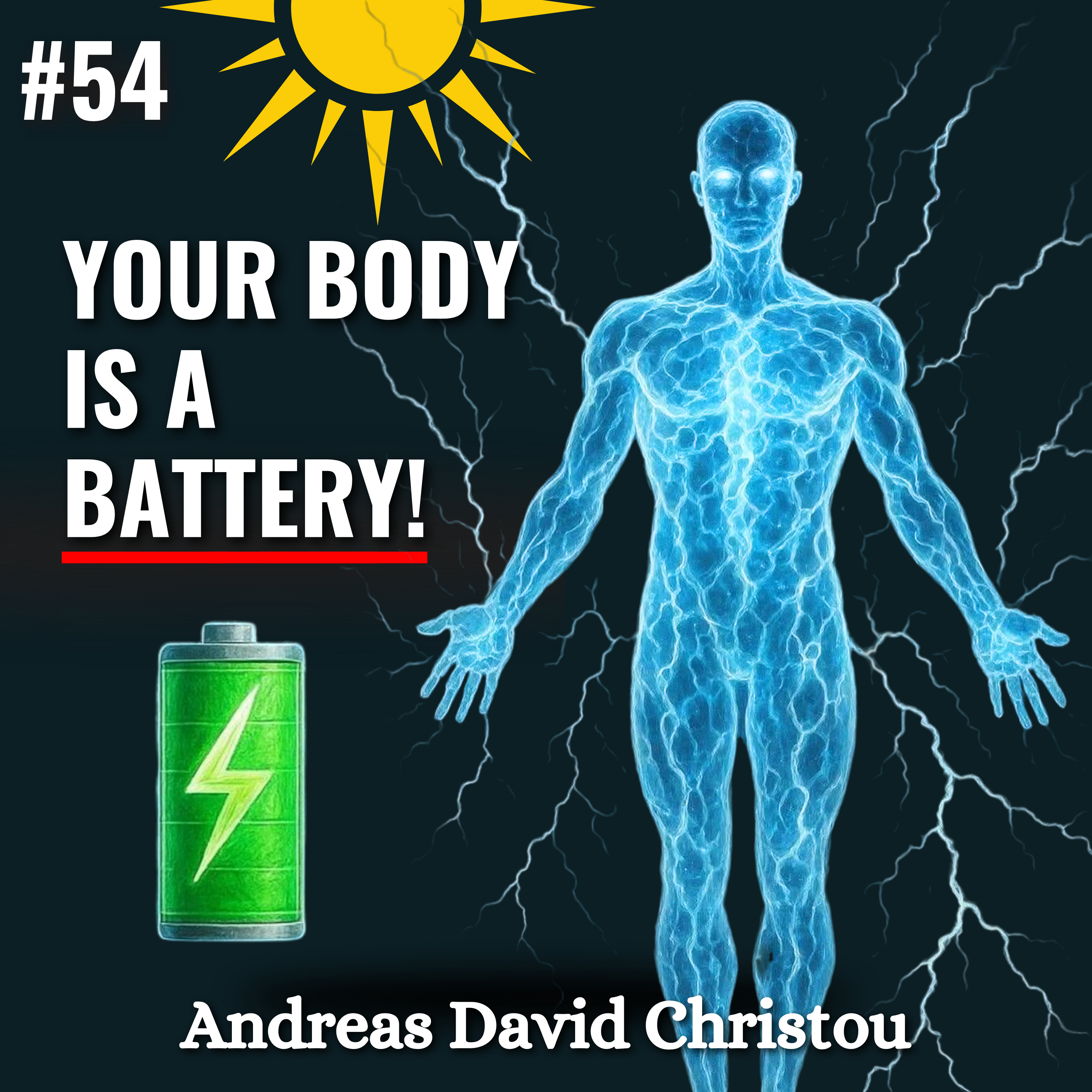
4:30 The Body as a Battery: Water, Sunlight, and Grounding
10:00 How Indoor Living & Artificial Blue Light Rob Life Force Energy
15:30 Exclusion Zone (EZ) Water & Nature Charging the Body
21:00 Sunlight & Grounding for Energy Collection
25:30 Red & Infrared Light and EZ Water
30:00 Sunlight, Deuterium-Depleted Water, and Mitochondrial Health
35:30 Effects of Blue Light on Mitochondria
40:00 Blue Light Dehydrates Cells & Fascia
45:00 Non-Contact Sports Injuries & Blue Light
49:30 Cellular vs Pineal Melatonin
53:00 Infrared Light & Cellular Melatonin Production
56:00 Circadian Rhythm Disruption
58:00 Best Hydration Foods & Seasonal Eating
1:01:30 Quantum Sensing & Piezoelectricity Explained
1:04:00 Melanin, DHA, and Key Roles in Optimal Health
1:06:00 Conclusion & Key Takeaways
👇🏽 Find & Connect with MediSun Podcast below 💎
📲 Instagram: https://www.instagram.com/realmedisun/
▶️ Youtube: https://www.youtube.com/@themedisunpodcast
🎧 Spotify: https://open.spotify.com/show/3UYqtRgIbtAUWw0evx9zJC
🔥 Find the Hume Body Pod HERE Full body analyser I use & recommend to my clients to help them understand their body fat percentage, muscle mass, cellular hydration, visceral fat & more. It comes with over 40+ actionable health metrics! Get it at a great discount with promo code: MOBILITYFITNESS at checkout ✅
👉🏽 Find the Best UV + Red Light Therapy panels, Blue Light Blocking Glasses & Circadian friendly light bulbs 🚨Use promo code: MOBILITYFITNESS ✅ for 20-30% OFF your entire order 👇🏽
https://www.emr-tek.com?snowball=MOBILITYFITNESS
👇🏽 Here is the Methylene Blue I use 🌀🧠
www.merakimedicinal.com/MOBILITYFITNESS
Use promo code: MOBILITYFITNESS to get 15% Discount on all products ✅🧠
👇🏽 Find the SHILAJIT I use & recommend below ⚡
https://mountaindrop.com/order/?ref=5873
Use promo code: MOBILITYFITNESS for Discount on your entire order ✅🧠
Get yourself a personalised Nutrition, Training & Lifestyle Optimization Plan designed for Your Body & Goals! Let's Transform your Body & Health from the inside-out! ✅
💎 The Link is Below👇🏽
https://bio.link/move_with_andreas
*None of the content / statements in this Podcast are Medical or Personal Advice & is not intended to cure, treat, prevent or diagnose any medical conditions. All my videos are for Educational & Research purposes only. If you decide to try anything discussed in this video, you agree to do so at your own risk & responsibility*
This is the Fitness Wisdom Podcast.
This is a rebroadcast episode from the Medicine Podcast. Enjoy the show. OK, welcome to the Medicine Podcast. Today I'm joined by Andreas Cristo. Andreas is a circadian health coach, movement specialist, and overall just great resource when it comes to quantum health, quantum biology and fascia movement. Everything, all things hopefully we'll cover today. Andreas, thank you for so much, so much for coming on. Thank you so much, Brett, for inviting me on your podcast. It's a, it's going to be a very exciting conversation, especially because you are also very interested in the field of circadian quantum biology.
And I feel that this is such an important, you know, topic to address from many different aspects, right? Especially when it comes to fitness. Awesome. Super excited. So how did you? We'll just start with how you started on your journey and how you got into the world of circadian health and movement. Yeah, great question. I guess everybody gets into circadian and quantum biology because they face some form of personal struggle or health issue, right? Because most of the times you have tried everything else, you know, you've fixed your exercise, you fixed your nutrition, you fixed your sleep and many different areas or aspects of your health.
And then you're wondering, why am I still not getting better? Why am I not improving? Why are my energy levels sucking, you know, or why is my performance declining even though I'm doing all the things? And then you discover the world of circadian and quantum biology and you realize that that is the foundation for everything else to be built upon. And that is the realization that I came to and the message that which I am spreading with the world. And so how I actually got into movement was because I was always into training and lifting from a very young age.
I was an obese child going up until 14 years old and that is when I decided to make a change for myself. So I joined the gym. You know, I started training, I managed to lose a a bunch of weight, build muscle, transform my physique. But I wasn't so much interested in health when I started. You know, my fitness journey, just like most people are, you know, they're interested on the outlook, not so much about the internal environment. But now I have come to realize after so many years of being in this field of fitness and health, like 14 years at least, that basically health and fitness is built from the inside out.
You know, if you try to build it from the outside in, eventually the house is going to collapse. You know, you're going to burn out or you're going to going to hit some roadblocks that you're not going to be able to understand why you're not able to break a certain plateau or why you're having certain difficulties in your life or energy management. But once you start to understand that health is an inside job, it's also like a, you know, a mindset as well, you're able to really reap the benefits of vitality and performance.
Absolutely. I think a lot of people get stuck at that level of going to the gym and you know, even just even eating like high protein diet, they get stuck at that level and they don't necessarily get the health results they want internally because they're just, they think that's all it is. You know, they think they go to the gym and it's going to solve all their problems. So, and I've heard you speak a lot about building that foundation, which is kind of born in the, in the world of redox, right?
And so how, how do you achieve that foundation, build that redox to then build outwards from there? Great question. I think it would be really good to give the analogy of the body as being a battery, right, which is basically made-up of water. And we have the problem with the modern world that we are facing right now is that we have an indoor environment which is robbing us of our precious resources and energy, you know, from the inside, which is also going to reflect on the outside. And This is why we're having so much obesity and diabetes and all kinds of other issues as well.
It's an energetic issue on a cellular level, on a mitochondrial level. And so basically if the body is a is a battery made-up of water, we need to think, OK, so that water, what is it actually doing inside of the body? The the water is actually acting as a holder of charge. So it's doing many, many different things, but that is one of its roles in the bodies to hold on to charge. And how do we go about building that charge or collecting that charge? Well, we need to connect with nature and that is what we did as human beings for thousands of years before we lived in an indoor environment.
And we need to think of the outdoor environment as an electron rich or any energy rich environment which is constantly replenishing our cellular battery, basically our mitochondria and our whole system and building this water which is going to hold on to that charge, which for our body needs to produce the ATP, the cellular energy. And so when we're in an indoor environment, the our cellular batteries are becoming depleted and also the water as well is losing its form. This specific type of form, what we call exclusion zone water.
And exclusion zone water is basically the fourth phase of water based on Gerald Pollock's work and Carrie Bennett, they explain it extremely well how that this type of water is nothing like the water that we drink. It is like a gel in a gel like state. And this is what gives it these unique properties. It's negatively charged. And so that means that anything that else that is negatively charged is going to repel, you know. And so This is why grounding is so powerful for your red blood cells, for example, for anticoagulation and for increasing your redox potential, gathering charge from the earth and as well as giving you the ability to harness more photonic energy from the sun as well.
So I just mentioned a couple of things there. So it's the light environment, and then you've got the electromagnetism from the earth, but you've also got the negative charge of the earth, which is, you know, restoring your electrical potential within your body, and it's also discharging any excess voltage that you've accumulated from modern living. And so we'll just focus on the light portion of that. What does someone need to do to to maximize making that exclusion zone water in terms of their light environment?
So basically the the red and infrared light specifically is known for maximizing exclusion zone water within the body. Especially like when they have studied this, but the UV light, it actually charges the water. So basically the red and infrared, it expands the exclusion zone. So it makes your battery of your body bigger, meaning that you have more of this exclusion zone. So your back, your what's the battery, your capacity to hold on to more charge increases. And so when you are in sunlight, you get the full spectrum, right?
And so especially if you're outside the whole day, you're getting all the different times of the day, the morning light, the midday sun, and also the evening light. You're getting different spectrums of light, which is going to impact your biology and your mitochondria in a positive way so that you can produce deuterium depleted water, which then becomes this exclusion zone water in the body, which allows you to hold on to that charge from sunlight and grounding. It's really interesting, like I think people are missing the boat on this and it's a reason why everyone is so energy depleted.
And the blue light plays a huge factor in this as well. So what? What's the blue light doing to drain that battery? Basically the blue light specifically in the absence of red and infrared light, it actually inhibit cytochrome C oxidase within the mitochondria. And so the cytochrome C oxidase is a key enzymatic step in the formation of ATP production, which is our cellular energy, right. And so at that specific step within the mitochondria, that is the step in which we actually are producing the mitochondrial water, which is the deuterium depleted water.
And so when we have this, when we don't have the deuterium depleted water, you can imagine now the cells are becoming more dehydrated, especially because we don't have the red and the infrared. If we're getting the blue light in the presence of red and infrared, the body is able to continue to make this deuterium depleted water. And this is the beauty of full spectrum sunlight. Whereas when you're indoors, you're getting the isolated blue light, which is inhibiting this key step. And this is dehydrating tissues on a cellular level.
So no matter how much water you are drinking, you are never going to solve this problem unless you fix your light environment. And this is a forgotten source of hydration for the body, right? Which is the form of light that we are receiving or dehydration you could call it when it comes to blue light. And still you can imagine what this is also doing to the fascio system, right? Because obviously the fascio system is primarily made-up of water. Most, most organs and systems of the body are primarily made-up of water.
And so when they are not hydrated, their electrical charge is not able to be conducted throughout the body at the speed of light as it should. And so we start to encounter all kinds of problems. That's, that's a great point and it's something that I, I have experienced personally before I knew any of the, any of this, the circadian health side and exclusions on water. I, I was, I played basketball in university and I would always have to stretch for like 30 minutes before playing. I was tight all the time.
And it's something that I wish I knew as an athlete because it would have made everything work better, would have been my recovery would have been much faster. And I think it's a big problem today. Do you do you think that is a problem that can be attributed to a lot of these athletes with ACL tears, Achilles tears? I mean, you see in the NBA like it's it's happening almost on a weekly basis in the NBA. Do you think that lack of exclusions on water is contributing to these injuries? Thank you for going in that direction because this is an area which I'm very passionate about and I do fundamentally believe that this is one of the primary issues that why athletes are facing non contact injuries, right which is happening out of the blue.
Of course, there is also maybe different contributors as well such as like overtraining, lack of sleep, lack of certain nutrients, all these other kinds of things are interplaying here which we are not aware of. But for sure one very massive contributor is, is their light environment and that where they are spending the majority of their time. It's not so much about when we think about training and exercise. It's not so much about one hour of our day being problematic. Being exposed to artificial blue light, blue light at any artificial blue light, isolated blue light at any time of the day is problematic.
But if you think if you take it in context, right, and you take one hour out of the day and that is only one hour where you are spending an artificial blue light in 23 hours you are in natural sunlight, you're getting grounded. You're doing all the things that we talked about. I don't think it's so much of a problem unless you're somebody who is needing to heal something. You're trying to, you know, recover, then you need to have, you know, your 100% focus on, on getting better and optimizing your environment.
But definitely if you, if athletes are spending the majority of their time indoors, they're not aware of their light environment. They're exposed to artificial blue light at night, specifically disrupting their circadian rhythms in their, in their melatonin production, which is responsible for the repair and the regeneration and the healing. Because we cannot repair, heal and regenerate if we do not get this massive dose of melatonin in the evening time, which is coming from the pineal gland. However, the body also produces cellular melatonin in the daytime in the presence of red and infrared light.
So what does that tell you? It tells you that the body is meant to have melatonin 24/7. But it with our modern living, if you are indoors and you're exposed to artificial blue light and absence of of red and infrared, you are now going to inhibit melatonin production on a cellular level as well as pineal melatonin, especially if you're exposed to artificial blue light after sunset. And so therefore you're missing out on the healing and the regeneration that is supposed to happen every single night.
And so if healing and regeneration is not occurring, then when is it occurring? It's not right. So you are digging a hole which you cannot get out of. And eventually you're going to manifest some form of problem, whether that is a non contact injury, whether that is some kind of autoimmune condition, whether is any kind of issue you can imagine you can manifest due to the lack of circadian rhythm disruption and just the bombarding of the artificial blue light. And what that's actually doing to your nervous system state as well.
Constantly activating your sympathetic nervous system, putting you in a state of fight and flight, chronically contracting your muscles in a subtle way which you cannot tell what is stiffening your fascia system, which is already dehydrated due to not having the red and infrared. So Add all of those things together, now you can imagine why there is an increased risk of non contact injuries. That was that was a great explanation and something I've thought a lot about with I'll just, I mean, I'm not picking on the NBA, but NBA players are getting a lot of injuries.
And if you think about a day-to-day, they're in a gym, terrible artificial blue light. They're watching film on an iPad. They're taking flights all the time. They're changing time zones. They're staying in high rise hotels with 5G antennas on on the top of them and they're just being bombarded. And the way I've kind of pictured it is that it's almost making your tendons joints more brittle, right? Because they're, they're so dehydrated. Is that the correct way to think about it? That's 1000% what's happening.
I mean, on a cellular level, they're becoming dehydrated. So no matter how many electrolytes they drink, no matter how much water they drink or biohacks they do, if they don't return to nature, if they don't ground to read the to restore the electrical potential because that also helps us to build exclusions and water in the body as well grounding. That's. And so if we ground on a daily basis, if we're getting the sunlight, we're constantly able to regenerate the exclusion zone water, which we are breaking down when our body is stressed.
Also, when we are receiving things like glyphosate in our system, that also breaks down the exclusion zone water in our body. When we're exposed to non-native electromagnetic fields like you mentioned, these cell towers, phones, laptops, microwaves, anything that is emitting basically, and the radiation is going to impact the cellular water of our body and that is going to have these negative consequences for sure. And So what I know diet is like down the road, but what type of diet would you do you recommend to clients and things like that to to aid in this process of, of rehydrating ourselves?
OK, so this is very context specific and it depends also where you live. So this is also really important to mention because when people talk about diet, they never talk about location or seasonality. And your body is a quantum sensor and what this means, it's constantly trying to sense what's going on in the environment and everything is literally happening on energetic level. Like food is a form of energy, right? It's an electromagnetic barcode which your mitochondria and your cells, they scan of it that tells it basically what is the season and what is the location.
But if you are giving it mixed signals, then you are going to impair your mitochondria to produce energy and therefore impair your ability to make this cellular water, because cellular water is produced when you make cellular energy, ATP. And so the cool thing is about not eating. By being exposed to sunlight, you actually make ATP without eating food. And that is one really cool thing because you actually decrease the amount of reactive oxygen species that you produce. So that means the amount of stress on your system is decreased because you are receiving a form of energy which does not need to be broken down.
It's direct, right? You're receiving this photonic energy. You are your melanin is capturing the photons. It's able to convert that energy into hydrogen, oxygen and electrons. And now basically those electrons can go anywhere in the body where extra energy is required for healing, regeneration and repair. So This is why it's so important to be exposed to the light and receiving nutrition from sunlight. But talking about actual food, if you're living in an environment where you are at a high latitude and you don't have access to vegetables or fruits most of the year round, then obviously your diet should be primarily composed of ketogenic style foods.
So like high fat, high protein, Well, moderate protein, more higher fat, because the fat is actually what increases your mitochondrial ability to generate more of this cellular water. It actually makes 50% more water compared to carbohydrates. Interestingly, I don't know why this specifically is. This could be due to the fact that 1g of fat contains 9 calories right? And 1g of carbohydrate contains 4 calories. That could actually be the reason because it's actually more energy dense. So that could be the reason why it's actually making more mitochondrial water.
I could be wrong, so if somebody knows they can comment below and educate us on this. And also, if you are living in a latitude which is closer to the equator and you have an abundant fruits and vegetables in your environment, you want to be consuming more of those because those are giving your body what you need. You are going to be sweating more, so you're going to require more minerals because when you sweat, you lose a lot of minerals, right? And you need minerals for the electrical conductivity within the body, which is basically how the electricity, the bioelectricity is traveling throughout your system and communicating with each other.
And so when you're eating these fresh fruits and vegetables, which are local to your environment, organic, ideally, then you're able to nourish your body with, with nutrition and hydration, which is nothing like the water that you drink. Because the water which is found within fruits specifically is the is found in this exclusion zone type state, which so basically when you eat watermelon, for example, you're eating exclusion zone water. And that's what's so cool about it. But that doesn't mean that if you live, you know, in a Nordic country on the 55th latitudes that you should be eating watermelons.
It just means that you need to eat whatever's local to your environment. So if you only have blueberries, for example, like in Finland, then you eat blueberries. You know, if you you're like in like me in Cyprus, where we have a ton of watermelons and melons, then I eat watermelons. I don't eat blueberries because that was going to confuse my body and my mitochondria about where I am located. So now the processes are going to work better when I eat in alignment with my location and also the season.
So this is the way that you need to approach hydration, right? Restoring the hydration within the system. And of course, it makes total sense that when you live on the equator, you need to be more hydrated because you're receiving more sunlight, you are sweating more, and a hydrated system. Is more electrically, electrically conductive, but it's also able to work better. So melanin, which is basically this pigment which is found under the skin, but also in our brain, in our heart, in most of our tissues of our body is works better when it's hydrated.
When it's dehydrated, it doesn't work so well. So we cannot capture so much photonic energy. But one other very important thing which I forgot to mention was eating fish. And so why do we actually want to eat fish, especially if we are living in a Nordic country or living up high? The reason is because the light environment there is so much more scarce and we're getting way more, less UV light. And the UV light is so important for so many of our cellular processes and especially harnessing that free photonic energy that I talked about through our melanin, through the photoelectric effect.
And so basically, when we don't have so much light, we need to be able to absorb more light. That's why people in Nordic countries have white skin and blue eyes because that allows you, when you have less melanin on your surface, that allows you to absorb more light compared to someone who has more melanin. And so basically by eating fish, that makes you a superconductor to light and allows you to absorb more light through your skin and more light through your eyes and is able to allow you to harvest more of that photonic energy which you will be receiving if you are outside.
Now if you are in indoors, well, it's still beneficial to eat the fish, but it's not obviously going to benefit you as much as if you were outdoors. That's really interesting. That's a a really good breakdown. The, the fish piece is something that I've added in more recently and it's, I noticed a huge difference like when I, when I eat fish and then get sun, I, I just feel like it's like supercharged. And I think yes, a lot of people too, even like down in Florida, it's, it's a good latitude, great UV, but people just live inside all day.
So it doesn't even matter that you're, you have a good UV environment because they're they're stuck inside and then you still see the same diseases manifest as you would up up north. Exactly. They are living in, they are living a high latitude lifestyle as a as a lower latitude. Yeah, and, and people just get so used to being comfortable. They they're in air conditioning or heat if they're in the up, up, up north and they always are at like a really comfortable temperature and never sweating, never exerting themselves or being outside.
And I, I really think that's why a huge piece of why people are getting so many of these chronic health conditions. 100% yeah, for sure. And you touched on melanin there and I'm glad you did. So it's, and I know you've had a bunch of people come on your podcast and talk about melanin. Just wanted, I wanted you to start off and give kind of a baseline description of why melanin so important and what it's actually doing not only on the surface of our skin but within the body. OK, so melanin is a very complicated topic, so I'll describe it to the best of my ability.
So basically melanin is not just a pigment that you see on the skin. It's just not it's not just the color of your skin. It has many incredible and critical roles within the body and it's actually there before life even begins. So basically on the tip of the sperm you have melanin and that is when the egg and the sperm are making the first contact, melanin is there acting as a transfer or a transformer of energy. So it's creating that spark which is actually allowing the egg and the, and the embryo, basically all the, yeah, the egg and the sperm to merge to create the embryo.
So it's even there before life even begins. So if it's even there before life even begins, it just actually shows you its critical importance in creating in the formation of life, right? And we see melanin not only within the body, we see it in the Galaxy, we see it in the soil, we see it in plants. So it's been playing many, many critical roles in being able to sequester, for example, heavy metals from the body. It's able to transform energy, it's able to protect your body, it's able to transform energy.
So it has so all of these critical roles, which are, which is energy harvesting, transforming and sending. So it's, it's doing so many, many, many different things in the body. So it's always found in the areas where you where energy transfer is required the most. So your eyes, your ears, all of your five senses really. So, and it's even found in the fascial system as well. This is what actually allows you to perceive the environment because think of melanin as this thing, they actually, this compound, they actually decodes information.
So for example, pressure is a form of information for the body, right? But how can the body even perceive pressure in the 1st place with melanin? Melanin is able to transform the information for the brain so it can actually understand what's actually going on. And that's happening on the different areas of the body in the in the vision, for example, it's transforming light into an image, It's transforming sound into something that you can actually understand. So it's it's has so many incredible roles in the body and it is not a sign of skin damage.
Wow, that's a great explanation. And so basically, Melanin's creating the world around us pretty much through our sensory systems. You notice in autistic children they have a lack of melanin in their ears or in certain areas where they are having their senses and This is why they are having such a hard time to understand what's going on, you know. And so there is because there is a lack of melanin in there. Wow, that's, that's a really interesting thing to think about. Yeah. So the the pressure you're talking about does that in within the melanin within the fascia.
Does that have anything to do with the piezoelectric ability of the fascia? I believe so. All tissue in the body is pretty much piezoelectric because we have this crystalline exclusion zone water which is lining the is sort of think about the fascile system like a web. And within the web we have all of these microtubules which are transferring this exclusion zone water throughout the body. And the charge which we talked about, this free energy that we can gather from our environment actually can attach itself onto this exclusion zone water within the fascile system.
And that is the way that it's able to transfer itself throughout the body at the speed of light through the fascile system. And so This is why the fascile system so important because it starts from the exterior and goes all the way to the mitochondria within the cell. And so the the faster is not just basically what you see is that it's a quantum communication highway throughout the body. So it's critically important basically for everything. So if you have a dehydrated the facial system, it can impair cellular communication and things begin to break down there.
It's not actually impacting only your ability to move well, but also your cellular functioning as well. So when when two things are striking each other or when 2 crystalline structures strike each other, this is basically when we are able to generate electrons, we're able to generate free energy that can be used anywhere in the body. And the cool thing is that This is why movement as well is an incredible form of gathering charge and building that redox potential. When you move your body, you are creating infrared light and heat.
So you are basically creating more of this exclusion zone water within the body. But you are also creating this piezo electricity because every time when you have friction and the tissues are gliding, that is basically when piezo electricity is created. So it's almost like a self propelling system which is all constantly creating energy. So when you are sitting down a lot and you are stagnant, you are constantly losing energy and especially if you're doing it in an indoor environment behind glass with artificial blue light, non-native DMS Add all those things together.
Imagine now a battery which is in the red zone which is basically crying for help and a battery which is crying for help or a body which is crying for help does not care about thriving or fat loss or muscle building or performance. All it cares about is survival. So that means now you're stuck in fight and flight. You're in a heightened immune system response and your body's trying to get away from that invisible threat which you have created because now your cellular state is so low. But when you return to nature, you're able to reverse all of that which I just mentioned.
What type of movement is going to facilitate healthy fascia and create the most energy? Like how what what movement's going to? I know people think like I go to the gym and lift weights, but I know you have a little bit of a different philosophy on that. So what do? What do you recommend movement wise? Well, first I would like to start off by saying that I'm not necessarily opposed to lifting weights or machine training, bodybuilding training. That's how I started off myself when I started my fitness journey.
And I'm, I'm deeply passionate about that and I fell in love with that at the beginning. That is what actually got me to transform my body. So I'm a true believer in that, that you can actually do that even if you don't take care of your light environment and your and your redox and all that kind of stuff. But that doesn't mean that you're healthy. I just need to, you know, make that clear. You look good on the outside, but that doesn't mean that you're healthy on the inside. This is why you see so many bodybuilders dying, unfortunately, because they are enlarging their muscles, they are hypertrophying their tissues, they are creating more mitochondria.
And So what do mitochondria need? They need more energy, right? So if you are constantly creating a demand for energy, so you're increasing your metabolic rate, but you are not feeding your metabolic rate with the not only through food, but actually the forgotten sources of nutrition, which is the electrons from the earth and also the electrons from the sun through the photoelectric effect, then obviously your battery is going to become more and more depleted. And as I mentioned this, that even that just not getting those sources of energy is bad enough.
But then if you add the indoor environment of the blue light and the EMF, which is going to deplete you even more of your vital life force energy and use these electrons towards fight and flight, towards sympathetic activity, you are now wasting a lot of energy that you don't need to be wasting. And so therefore, now you are more prone to experiencing things like, well, I don't want to mention, but anyway, you can, you know, increase your risk of just dying, you know, sooner younger in your life.
But yeah, so when we come to when it comes to different forms of movement, you can even do obviously resistance training outdoors, right? You don't need to do it in an indoor environment. You just need to know what you're doing. And This is why I actually help people with, I help people to do circadian fitness, outdoor training or utilizing their body weight as a form of training and resistance. So as long as you're pushing your body to failure, you're able to increase your muscle size, you're able to lose body fat effectively, you're able to get an incredible workout.
You just need to know what you're doing and have maybe a couple of tools with you that you can use in your park. For example, in calisthenic type of training, some rings, some bands, maybe some club bells, some kettle bells, and also your body weight as well. Like in yoga style movements, animal flow, primal movement. There are so many ways to actually move your body that you don't even realize, especially if you've been stuck in the gym environment for many years. Because if you're in a gym environment, you don't see people so much doing this form of training unless you go to a more unconventional training gym where they do do this type of stuff.
But this type of stuff, you can easily take it outdoors. So there's no need to go to an indoor environment, especially when you can build a home gym where you can control your lighting as well, you know, with infrared light bulbs or something like that and UVA light bulbs. If you have to be indoors and optimize your indoor environment, you know and have some incredible tools which you can transform your body and plus save your your budget as well. You know, save your wallet from all of these gym memberships that you are spending on.
But for when it comes to facial health, I think movements which are very holistic, which are taking the body through their full range of motion, lengthening and strengthening the tissues like you do in calisthenic type of exercises. For example, if you take gymnastic rings and you look at some of the athletes which are doing this exercises like on the rings and you see them lengthening their tissues under tension. What they are doing, they are they are basing putting a tremendous amount of stress on the muscle and the facial system while they are lengthening the tissues.
There is no healthier way to train your body than that because what you are actually teaching and programming the brain is that this long state that I'm programming my muscles through the training, this is the state I want you to retain at rest. When you are constantly just pumping your muscles and you're doing a lot of isolation work and you're not taking care of your mobility, you're not doing any form of dynamic stretching or walking or moving in general. What's going to happen is the tissues get tighter and tighter and tighter and you're also creating a lot of adhesions within the fossil system.
But you're also easily overtraining the joints as well. And so basically, you're going to run into a whole host of issues, which is going to definitely present themselves down the line. This is why you see a lot of bodybuilders, they have like surgeries on their knees, their hips, their shoulders. And then they also wear these like knee wraps or wrist wraps in the gym because their body is literally falling apart because they're not willing to accept that what they're doing is actually harmful for them.
But some people, you know, they also acknowledge that what they're doing is not optimal for themselves, but they love it so much that they're willing to die for it. You know, and This is why you see a lot of bodybuilders, they die because they actually love what they do. This is they're, they're willing to take it to the NTH degree. They are the most extreme form of, you know, taking your body to the extreme in terms of fitness and muscle size and and dieting and all of that. Yeah, and I, I try and tell people all the time, especially like older women, like a lot of these things are pretty simple to do.
Body weight is going to get you huge results. Absolutely. You just focus on longevity and just being a functional human. I think you remove a lot of those bodybuilders and put them in the in the natural world. And they're they're pretty limited. And I've spoken to Irwin the core about this and he's just, he has a huge emphasis on being capable. And I think it's a big problem playing a lot of people as they're just, if they were to be, I don't know if they're in a situation where they need to Sprint right away they they physically can't because they're just simply training incorrectly.
And you know that actually explosive type of movements, plyometric type of movements such as printing, which thank you for mentioning because that's something that I also do in my routine as well. And I recommend my clients too, because it's actually so powerful in generating that piezoelectricity throughout the body. So as I mentioned, it is mainly through aggressive contact with the ground. Every time when your bones strike the ground, you are creating this electrical potential throughout your whole body.
Your, your think of your bones. They are literally meant to be an antenna for the divine. They are meant to attune you to your environment. Haven't you ever felt like when you go for a really long walk in nature and you just keep walking and walking and walking and you're either wearing barefoot shoes or no shoes and you're constantly striking the ground. Eventually you hit this flow state, this rhythm, and now your heart and your brain and everything is working in coherence with the earth, which is the 7.83 Hertz, right?
And this is literally now your body's being programmed and you're tuning like a tuning fork. And this is actually what's happening on a cellular level. It's a, it's a biophysical thing. This is not some wool kind of stuff. This is literally happening on a biophysical level. So it's actually happening first in the physics and it's impacting our biochemistry thereafter. Wow. Yeah. And I think people, a lot of people too are they're like, oh, I'll go up for a jog and they don't really get that much out of it.
Whereas I'll be I advise people just go for either a long walk or high intensity sprinting and you'll get a lot more out of it with a lot, a lot less energy spent. Yep, and actually one of the benefits, huge benefits of sprinting is the fact that you can get rid of so much visceral fat from inside of your body. This is based on Doctor Shawn Omara's work. I had him on my on my podcast as well, and he's a huge advocate for eating primarily like a meat based diet with some fermented vegetables for the gut microbiome and also sprinting.
And he's seen incredible results utilizing this approach with his his clients. And not only that, but you know when you are sprinting, you're doing exactly what I mentioned previously. Every single tissue in your body is not actually contracted in a shortened state is contracted in a lengthened state. So you are teaching your body to be programmed to be in this very good mobility type state when you are in in when you're supposed to be in rest and digest in like in a parasympathetic state. So when you're relaxed, your muscles are supposed to be nice and long and fluid, but when if you are actually just dumping your muscles all the time, you're not taking care of your mobility, you're an indoor environment.
Now your muscles are constantly constricted, which are restricting blood flow. So that means oxygen and nutrients to the tissues. So they're not able to recover as well. You're getting so much more of that muscle soreness that you're experiencing. So when you're trained outside, you actually experience less muscle soreness because your body is able to be more in a parasympathetic state even in between of your sets that you're doing in the training. This is something that people don't consider is that training itself to is should not be so stressful on the body.
If you leave the workout feeling smashed and totally tired, that means that it's fundamentally something wrong. And I personally noticed an experience that when I train outside and I train equally as hard if not harder, I don't feel smashed at all. I actually feel more relaxed and rejuvenated after I finish the workout, which is actually telling me that my body's actually constantly being recharged from the environment. But I'm also tapping into parasympathetic activity between every single sympathetic set that I'm doing.
You know, because exercise is obviously a sympathetic activity. And Speaking of parasympathetic sympathetic, how do you use breath work, if you do at all? I'm just curious of your opinion. Yeah. What do you do? Breath work not only just at a resting state, but while you're training. That's a really good question and and that's actually one of the most important things before you even start training, to be honest. They like think about the breath as the foundation of movement and exercise and the same thing as you know, circadian and quantum biology as the foundation of your entire health, which everything else is built upon like exercise, nutrition, a lifestyle, relationships.
If you get your circadian and quantum biology right. Why everything else works so much better. It's the same thing with breath and exercise. So when you're actually breathing through your nose, as you should be, because your nose is meant for breathing and your mouth is meant for eating. So you should be keeping your mouth closed and so the tongue should be on the roof of your mouth at all times. Now, this takes time to train, especially for people who are not experienced to breathing through the nose because you literally accumulate crap in your nose which is stuck there because you haven't breathed through your nose efficiently for years, right?
So it's the most stupidest thing for you to listen to this podcast and go out and start running through your nose because you actually haven't trained it. So what I actually want people to do is actually to learn how to breathe through their nose throughout their daily life without even training at all, just sitting down. Just breathe through your nose as much as you can, nice and relaxed. Don't try and force the breath in and out. Allow the body, the autonomic nervous system, to regulate the breath as it desires.
This is the number one way to reach perfect or good nervous system regulation is when you're when you're in a coherent environment. So for example, if you're outside and you are grounded, your breath rate automatically drops and you're able to be in a more balanced state. You don't even need to try and lower your breath rate when you're in an indoor environment under artificial blue light because it spikes cortisol. So it puts you in that fight and flight state. Your heart rate increases and therefore your breath rate increases as well.
So your performance is actually diminished in an indoor environment, plus your blood pressure increases too. When you're outside, you have UVA, you have red and infrared light, right? So you're actually having nitric oxide production, you're having vasodilation, which is actually decreasing your blood pressure. And it's actually doing all the things that I mentioned, decreasing your heart rate, decreasing your breath rate. So obviously when your breath rate is lower, that means now you're not creating so much metabolic waste.
And so the higher your breath rate, they're all the more metabolic waste you create, you create a more CO2. So it's a, it's a perpetual cycle. The faster you breathe, the more CO2 you create. And therefore you need, you feel the need to constantly keep on blowing out. But if you actually regulate your breath through your nose and you slow down your breathing, now your metabolism is working a bit more relaxed, right? And you're able to also build your CO2 tolerance because the amount of air that is escaping through your nostrils is significantly less compared to you breathing out through your mouth.
So is there any context which I believe that you should breathe through your mouth? No, no, I don't believe there is any context in fact, that you should actually build your capacity so that when you exercise, you stop when you feel like you need to open your mouth big. And I tell you why, because the breath is a safety system for the nervous system. As soon as you open the mouth, you're now going into sympathetic OverDrive. That means that you are pushing your body beyond its abilities, beyond its limits.
And so that means that when you do that, now you are creating a bigger deficit for the body, right? So you are stealing energy from the system, potentially from vital organs as well. Whereas if you stop at the point where you are feeling comfortable or you know, struggling through the nose, then you're able to recover faster between of the sets and you're not going to feel so smashed after the training. So your ability to absorb oxygen really depends on the amount of carbon dioxide that you have within the system.
And so if you are excreting more carbon dioxide then there is in the body, now there the oxygen cannot get released from the red blood cell. So no, even if you are inhaling air, you're actually not extracting the oxygen basically, or you're not able to release the the oxygen from the red blood cells. So you're actually becoming hypoxic on a cellular level, which actually makes you want to breathe harder because, you know, your body is constantly asking for that oxygen, right? But until you actually get in control, the breath will continuously control you.
So you need to learn how to control your breath. So personally, I like to do a lot of breath holding. I go to the sea a lot. I do breath holding in the sea. You know, I go deep down, I hold my breath for as long as possible. And the reason why I do this is because I like to build up this CO2 in my body, which is actually allowing me to become more efficient with every single breath that I take. So that means I need to now take less breaths to get more oxygen. So I'm becoming very efficient when I'm outside of the water as well.
So this is something really, really important for people to understand is that you need to just breathe through your nose. And just by breathing through your nose, you increase the carbon dioxide in your body even when you don't exercise, which is actually going to make you better at utilizing oxygen and increasing your CO2 tolerance. Now, if you want to get better at increasing your CO2 tolerance in exercise even faster, I would. What I like to do is I like to jump on a bike or I like to go for a walk or a run.
And I like to, you know, push myself to the limit as much as I can and be on the threshold where I feel like I want to open my mouth. But then I back off just a little bit so I don't need to open my mouth. And this way I become an extremely good nasal breather. Now my my nasal cavities are able to dilate more. They're able to get bigger during exercise, I'm able to take in more air and I'm able to extract the oxygen as well from the red blood cell. Well, that's a really interesting point that I have never really thought of because I've I'll train hard and I will be breathing out of my mouth.
But so you're, that's a, a good way to think about it where you exercise hard enough just to the point where you, you're kind of your brains telling you to breathe out of your mouth and then bring it back a little bit and then push it back up to that point and you know, you'll gain a bigger. Tone 100 percent 100% and I think that why it's so important, especially during exercise is because you become hypoxic when you are excreting too much CO2. This is why you see a lot of people faint when they are hyperventilating during exercise, when they are breathing a lot, like really, really heavy.
And then all of a sudden they get off the treadmill or the, OR the bike. And then they faint when they get off or, or when someone is doing a really like heavy lift or whatever, you know, and then their bodies literally running out of oxygen. And so when you're, when you run out of the oxygen, you become hypoxic. This is an extremely dangerous state for your body, right? And then this is what leads to the, the potential fainting as well. But not only that, if your cells are in a hypoxic state, they are ringing the alarm bells and now you're shifting more into an anaerobic metabolism.
Even even if you're doing an anaerobic activity, for example, such as running or cycling or swimming, you shouldn't be in an anaerobic, you know, metabolism if you are doing an aerobic activity, because what determines what fuel source you use is the presence or the absence of oxygen. And so if you are using oxygen at a greater rate that you are taking in, obviously you start tapping into anaerobic metabolism. That's why when you Sprint long enough and you go hard enough, you start to feel all the muscles in your body burn and it, and it hurts like hell because now you are depriving the body of the oxygen and you're starting to produce lactate because you are now changing, you're shifting the metabolism.
This is why the beginning of the Sprint doesn't hurt hurts because you are primarily an aerobic metabolism. So the same thing happens with the resistance training too. Resistance training is an anaerobic environment for your muscle. So it's not so hard on the cardiovascular system, but it's very hard for the muscle. So the muscles are going into, you know, an anaerobic environment. You feel the burn, basically. That makes absolutely perfect sense. And it kind of makes me think too of a little bit different, but like sleep apnea and how what the body's really doing there, it's trying to stop excess oxygen because your cells can't really handle it.
And I wanted to jump into sleep a little bit with you and what you. So I mean, we'll just start from like the basics of what you do to facilitate a healthy sleeping environment and what you do during the day to help your sleep at night.
That's, that's a really good, great point and a great question. I think it's so important to understand this. Sleep hygiene begins in the morning time because the morning light is actually what helps to entrain our circadian rhythms was the light through the entire day is important for entraining the circadian mechanism. But getting that morning light in the morning is able to tell your brain, you know, 12 hours after or whatever you need to start producing melatonin. So it's sort of a synchronizing your clock with the environment, right?
So if you actually want to be able to rise with the sun and you know, fall asleep easily after the sun has set, you need to be in synchronicity with the sun, which makes total sense, right? But if you are in out of synchronization and you are switching your artificial blue lights on in the morning, you're telling your body that it's midday, you're spiking cortisol, you are shifting all of your hormones, you are doing that as well after sunset and you're blocking melatonin production or release. Then of course, you're shifting your entire circadian rhythm, which makes you wake up later.
And then the cycle keeps on perpetuating itself. So I can tell you a little bit about my routine and how I go about it, optimizing my sleep and my sleep hygiene routine. So obviously, I wake up with the sunrise every morning. I go outside, I get crowded, I make sure that I eat my breakfast within 30 to 60 minutes of sunrise. Now, the reason why I eat within 30 to 60 minutes of sunrise is because your gut also needs to be entrained, right? Because it's a little bit harder for the guts to receive light.
So the grey cue, circadian cue you can give to your gut or to all of the systems basically of your body is food. And so when you put food in the system, now you're telling the body, hey, now it's daytime start to time to start. You know, all these vital functions that you need to do. And so I try to spend as much time outdoors as possible throughout the day because I am an entrepreneur. So I can control my environment that where I spent my time during the day. So I try to spend my time outdoors in direct light if possible.
But people don't necessarily need to be in direct light to get the benefits, but they can, you know, of course, when you're in dialect, like you get even more benefits. And I like to use my phone or my laptop or whatever always when I'm outdoors because this minimizes the strain on my body and my eyes. And also, you know, it's just so much better for your circadian rhythms. And you. I'm getting, I'm getting that parasympathetica activity because of the sun, you know, the red and the infrared light, the UV light.
I'm gathering energy as I'm losing energy from the technology. So the consequences are not as bad when I'm doing it outdoors, especially if the feet are grounded. Then it's an absolute game changer because as I am gathering this stray voltage from non-native Emfs into my system causing dysregulation, I'm able to discharge that through my feet into the ground and to restore my electrical potential through the grounding. So grounding, even though it's so simple, it's so, so powerful. I think it's one of the most powerful things in regulating the nervous system in combination with sunlight.
But even grounding alone is absolutely incredible. And grounding mats and, and you know, sheets and all this stuff are good, but it's very context dependent, you know, So they're not as good as being in a body of water, obviously, like in the sea, in a lake, on grass, you know, getting the real deal is always the best idea, right? But having like grounding sheets or grounding mats are good if your environment is not filled with dirty electricity, if you don't have a lot of non-native electromagnetic fields, because the mat itself is acting like an antenna, right?
Because it's, it's a grounding mat. So it's literally like ever, all of those things are seeking to go to the ground. And so basically that's where the electrons are going to flow because electrons flow from a point of high concentration to a point of low concentration. So electricity does the same thing when there is a like a high voltage, it's always going to seek grounding, right? And if you are, if you are part of that grounding system, imagine you are going to be bombarded by this dirty electricity and these non-native BMS.
So you need to be careful when you are playing around with these things and just try and get as much natural grounding as you can throughout the day. Now midday sun is also very important because you're you know, you're getting that * blue light, which is entraining the circadian mechanism is telling the body that this is the middle of the day, right? And it's keeping you awake and alert and it's keeping you in this more heightened state because you are meant to be able to hunt and gather your food.
This is This is why you're supposed to be in this heightened state. And obviously as the blue light decreases throughout the day, now your body is shifting more into this more parasympathic state, which is this more relaxed and regenerative state, right? And this is you observe this when you look at the light throughout the day. So the spectrum of light changes. It starts off by more red and blue in the morning, then it goes towards very blue in the middle of the day. Really, really sharp and intense with the with UV light as well and hotter.
And then you are going again back into this more red and blue and even more red in the evening. So that is the last light that your eye is meant to see biologically or as all living beings on the planet are only designed to see the red light, you know, the last thing before it actually becomes dark. Now we have these receptors in the eyes, I think they are called is it melanopsin? If I'm not mistaken, melanopsin is a blue light detector in the eye. And so if you have a blue light detector in the eye and then it's night time and you're not meant to be exposed to blue light after that after sunset for optimal hormone production and melatonin release.
Well, obviously if your melanopsin is perceiving any kind of blue light in your environment, it's going to trigger, you know, the alert response within your brain and say, hey, it's not night time yet. It's still daytime. Don't go into partisan politics state, don't relax. Don't produce melatonin because we still need to find and hunt and gather our food, you know? And so, yeah, This is why it's so important to be exposed to enough brightness and light throughout the day to allow you to produce enough serotonin in your gut, which is actually going to be converted to melatonin in the evening.
And it's actually going to travel via your vagus nerve all the way up to the pineal gland. And this is the way in which it actually makes the pineal melatonin. It's super powerful. And This is why sunlight on your belly as well is super powerful because it also manipulates and programs your microbiome as well, independent of food, which is actually super powerful. And we know that the microbiome is so important for so many things, right? Which is like your immune system, like basically everything, your brain health, your gut's health, like every system of your body.
And you're making so many compounds in there. So basically after sunset, what I do, I always make sure that all of my lights in my house are red because obviously we're not meant to be exposed to blue light after sunset. And I make sure that they are also pretty dim as well because the light intensity also informs your brain pain in your body, what time of day it is. This is why when you are outside, you are receiving a massive amount of light intensity in your eyes. And your body knows, OK, this is daytime.
But as soon as you go into a dark environment, your body all of a sudden starts to feel more sleepy, more drowsy, more relaxed because it starts to release melatonin. And so yeah, the brightness that you are exposed to is also super powerful. So if you aren't spending all day indoors and you are getting very little brightness, right? So, and then all of a sudden the brightest thing you are exposed to is this night time artificial blue light. So now your body thinks that is the sun. Well, obviously you're going to mess up your entire circadian rhythm, which is going to impact every single cell and system of the body because the circadian mechanism controls every single cell and system of the body, like everything is under circadian control.
And when things don't happen at the right time, problems begin to occur and things begin to break down. And that is how we have the manifestation of things growing in the body that we do not want to be there. We do not have this regeneration, this autophagy, this apoptosis. We do not have these vital functions that are supposed to happen due to melatonin in the night time, right? So we want to be minimizing artificial blue light as much as possible after sunset because this is what allows us to release melatonin, but also have an environment which is dim to allow the melatonin to be released to the fullest.
And you don't want to be going to bed too late after sunset. You want to be going, you know, for example, in the summertime, if it sets at 8 O clock, the sun, you want to go to bed around 10. If it's, you know, in the winter time, if it sets A5, you want to go to bed around 7-8 because your body's actually designed to get more melatonin in the winter time. And This is why we have seasonality. We have cycles. We need to honor those cycles because different things are supposed to occur in different seasons, right?
So in the summertime, we our bodies under more stress because we're getting more light. In the winter time, our body has less stressed because there's less light, but we're meant to be harnessing more of the cold to make light inside of us, you know, through bio photon emission. And we're also meant to be having more melatonin production. So to assist that healing that and that regeneration and repair to prepare us for the next summer. That was a great explanation. I think brightness is something a lot of people kind of miss the boat on there.
And I use the Sarah Kleiner's My Circadian app to measure. And I think everyone should to measure the lux in their environment because it's like you don't really think about it when you're inside, but it's even, it's just really dim if you're inside like all day. And then most pretty much first of all, where I am, everyone wears sunglasses. Like basically every single person I see is wearing sunglasses. So they have dim days, bright nights and yeah, their their Physiology is just crumbling. Absolutely.
I mean these, it's so important what you said there about the the brighter days and darker nights. This is such an underrated topic. And even if people were still exposed to blue light, but it was more dim blue light in the evening and they got light during the day, they will still get a massive benefit because their body is like seeing the contrast, OK, in the daytime we have this massive lux, we have this massive amount of blue light. In the night time we have way less. Of course it's not going to be optimal.
You know, it's more ideal if you switch your light bulbs to incandescents, orange or amber or red. But you know, if people that you know want to start straight away, start dimming your lights as much as possible in the evening. Yeah, I think that that's a huge hack that not a lot of people are utilizing. And in terms of, I wanted to ask you about this when you sleep on because I've heard a few people say you want to sleep on a harder surface. And it's better for recovery in in your fascia, is that, is that true?
Gosh, that's such a tough question because you know, I think it really depends. It's really context specific. Yes, probably for the fascia system it is very beneficial because you know, it's sort of like a self myofascia release, right? You know, if you're on a foam roller and it hurts or if you're on a hard surface and you're moving and you're, you're constantly moving your body and rolling your body. You're not staying stagnated in one's position the whole night. You're actually, you know, shuffling and moving around so your tissues don't get so tight.
But if you are, you know, on a bed, which is super soft, it's going to allow you to sleep like without moving the entire night. And then maybe you wake up and you feel super stiff and like, you know, like a teen man. Yeah, that's, I mean, I've noticed that the the softer bed I sleep on, I kind of wake up feeling less energized. But yeah, so I, I think, I mean, you've done a great job here explaining basically everything from head to head to toe. I think if you just some closing statements, you would have of low hanging fruit what you would implement someone starting from, from zero, they've never heard any of this.
Where would you have someone start to to try and regain their their health back? Well, the greatest hack is always nature, right? But if we're going to talk about, you know, some bio hacks that we can utilize, if people are not willing to, you know, get into nature or they don't feel that they don't have the time to go into nature, everybody has the time. But let's say that they don't have the time. You the one of the number one most powerful things you can do is start by blocking the artificial blue light at night.
That is the number one thing. If you change that, that is going to change so much about your life. You know, the next day, the morning time, your energy levels, everything, your recovery. So that means you need to invest in some a pair of red lens blue light blocking lasters. And then you don't necessarily need to change all of the light bulbs in your house straight away. You, you obviously need to do that at some point because your skin has photoreceptors as well and it's ideal when you don't need to wear glasses in the house anyway.
It's so much more comfortable. I, I personally like it more when I don't need to constantly keep protecting my eyes. But if you do have to look at screens after sunsets, you know, be watch TV or something like this, try and change your, you know, your phone to red. But of course, that's not going to minimize the impact of blue light. The the screen is still blue lit, right? So you obviously want to make it red. You want to make your TV red. If you can wear your red blue light blocking glasses, that is like one of the lowest hanging fruits that people can start from.
Of course, the next step would be for people to change their light bulbs or have some of their light bulbs at least in their house, which are red and specifically low down. That's one thing I forgot to mention was the positioning of the lights. So if you think about the last light that your eye is meant to see is on the horizon, which is red light. And so it should not be above your head because above your head would stimulate, you know, sympathetic activity, even if it's red light and even if it's dim.
So it's more ideal for it to be lower down. So, so having lights next to your bed, for example, like it's like a perfect thing, you know, red lights at least optimize your sleeping environment, make your sleeping environment as optimal as possible. Use blackout curtains if you can, if you live in a light polluted area, so you don't get any blue light in your in your room. Make sure that you put tape over anything which is emitting blue lights in your room, like your your TV or your clocks or anything like this.
Make sure to turn your Wi-Fi off at night or put it as far away from you as possible, especially your phones as well. And never keep your phone next to your bed, even if it's on flight mode. Put it as far away from your head as possible. You want your bedroom to be a sleeping sanctuary because this is the time where your body is healing, repairing, and you're regenerating. Sleep is not just so you don't feel tired. Sleep is a vital biological function in order for your system to work well the next day.
It's literally the reset button on your body. So if you're not resetting your body every single day, you're going to wake up feeling like crap, you're not going to have energy, and you're not going to perform well in any area of life, cognitively or physically. So if you want to feel good, have more energy, have better hormones, have everything better, you need to optimize your sleep. And it starts by optimizing your light environment. But of course, always returning to nature, getting grounded every day, getting that natural light throughout the day is one of the most powerful things you can do, alongside blocking the blue light.
Amazing. I've learned a ton so far. I've talked to you. This has been awesome. So where can people find you if they they want to dive deeper into your topics? Thank you for having me on. It was a really great and fun discussion. These are all things that I'm really passionate about talking about, as you can tell, because they're all interconnected, right? The body's a holistic system. People like to separate the body in into separate parts and study different parts. But in reality, everything always works together.
You cannot fix one thing you know and without affecting another thing. So for example, when you fix your nutrition, it's not only going to impact your metabolism, it's going to impact your energy levels. It's your cognition, your sleep, your performance, it's going to impact everything. So just by changing little small things, it's like health is basically like a pyramid. You need to stack all the pieces of the pyramid together to have complete health. But if you have only one piece of the puzzle, that's not complete health and nutrition and exercise alone is not complete health.
And I hope that this is what people have understood from this podcast episode that we just shared today. And so people can find me on social media on Instagram, Andreas under score, David under score Crystal. I have my I have my podcast on YouTube and Spotify, which is Fitness Wisdom podcasts and also my website where you can find all of my services and all of my coaching packages is Mobility Dash fitness.com. Thank you so much, Brett. It was a pleasure. Awesome. Thank you, Andreas. I really appreciate.
You guys enjoy the topics and guests I bring on the show. I would really appreciate it if you left me a five star review on Spotify and also subscribe to Fitness Wisdom podcast on YouTube as well as this helps to spread the knowledge and wisdom with the world. Until next time, this is the Fitness Wisdom Podcast.
 Apple Podcasts
 YouTube
 Spotify
 Castbox
 Castro
 Goodpods
 Moon FM
 Overcast
 Pocket Casts
 Podbean
 Podcast Addict
 Podcast Republic