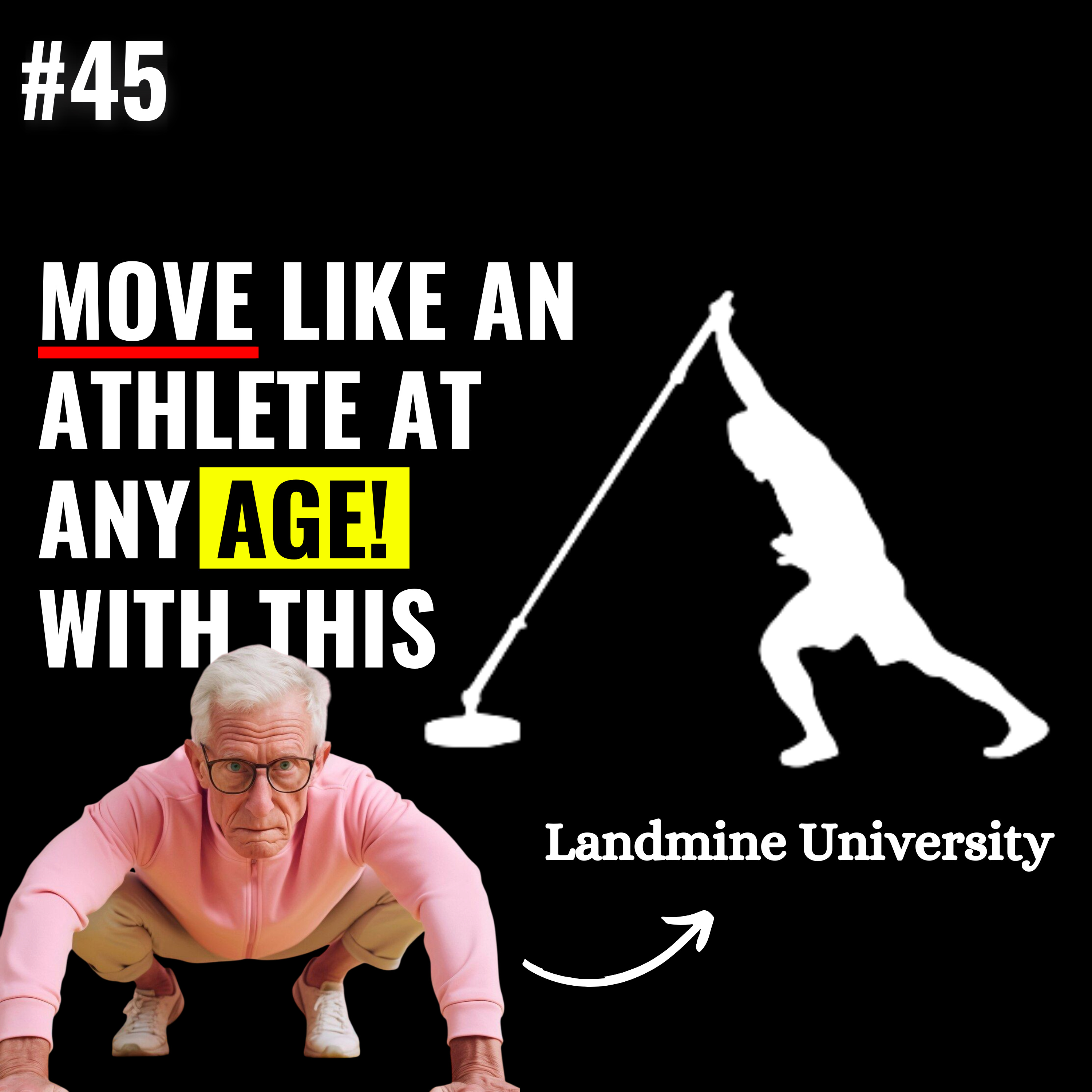
How to Move & Train like an Athlete at any Age! Landmine Training for Athleticism, Mobility & Pain Free Living | Functional Training with Alex Kanellis - Landmine University | Explosiveness Training
What's This About?
How to Move & Train like an Athlete at any Age! True Functional Training with Landmine University - In this episode of the Fitness Wisdom Podcast, we discuss how to use Landmine training to develop physical freedom, athleticism, mobility and pain free movement at any age! Alex founder of Landmine University shares his journey into strength training, the benefits of landmine training, and the importance of rotational movement and spinal engine theory in athletic performance. Alex shares his five key principles of landmine training, emphasizing the significance of forward intent, core-driven movement, and the importance of loading functional movement patterns. The conversation highlights how landmine training can enhance athletic performance and improve overall movement quality at all stages of life!
Definitely SAVE & SHARE this episode with a friend, this knowledge is extremely important & potentially life changing!✅
⬇️ Find & Connect with me Here:
https://www.bio.link/move_with_andreas
👇🏽 In this Episode of the Fitness Wisdom Podcast we discussed:🎙️
00:00 Alex's Journey to Founding Landmine University
03:33 Understanding Landmine Training
07:28 The Importance of Ownership in Movement
11:10 Exploring Spinal Engine Theory
14:42 Multi-Planar Movement in Sports
18:36 The Role of Rotation in Athletic Performance
22:13 The Benefits of Landmine Training for Everyday Life
33:16 The Five Principles of Landmine Training
42:03 The Importance of Breaks in Training
50:33 Final Thoughts on Landmine Training and Integration
👇🏽 You can find me on my other platforms as well, as work with me1-on-1 Online World-Wide 🌎
📲 Instagram: https://www.instagram.com/andreas_david_christou/
🎙️ Podcast IG: https://www.instagram.com/fitnesswisdompodcast/
🌐 Website: https://www.mobility-fitness.com/
▶️ https://Youtube.com/@fitnesswisdompodcast/
🐦 Twitter: https://x.com/movementandreas/
⬇️ Find & Connect with Alex Kanellis:
📲 Instagram: https://www.instagram.com/landmineuniversity/
🌐 Website: https://www.landmineuniversity.com
💥 OUR FAVOURITE NON-TOXIC AND SUPER EFFECTIVE HAIR WASH! USE THE PROMO CODE: MOBILITYFITNESS FOR A 15% DISCOUNT AS WELL✅
➡️ HTTPS://TRYBLOO.COM/MOBILITYFITNESS
👉🏽 Find the Best UV + Red Light Therapy panels, Blue Light Blocking Glasses & Circadian friendly light bulbs 🚨Use promo code: MOBILITYFITNESS ✅ for 20-30% OFF your entire order 👇🏽
https://www.emr-tek.com?snowball=MOBILITYFITNESS
👇🏽 Here is the Methylene Blue I use 🌀🧠
merakimedicinal.com/MOBILITYFITNESS
Use promo code: MOBILITYFITNESS to get 15% Discount on all products ✅🧠
👇🏽 Find the SHILAJIT I use & recommend below ⚡
https://mountaindrop.com/order/?ref=5873
Use promo code: MOBILITYFITNESS for Discount on your entire order ✅🧠
Get yourself a personalised Nutrition, Training & Lifestyle Optimization Plan designed for Your Body & Goals! Work with us 1-on-1 ✅ and let's Transform your Body & Health from the inside-out! 💎 The Link is Below👇🏽
https://www.mobility-fitness.com/product-page/1-on-1-online-coaching
*None of the content / statements in this Podcast are Medical or Personal Advice & is not intended to cure, treat, prevent or diagnose any medical conditions. All my videos are for Educational & Research purposes only. If you decide to try anything discussed in this video, you agree to do so at your own risk & responsibility*
This is the Fitness Wisdom Podcast.
Hello and welcome back to another exciting episode of the Fitness Wisdom Podcast. Today I'm joined by Alex Kanellis, founder of Landmine University. Welcome to the show, Alex. It's a pleasure to have you. Yes. Sir, thanks for having me excited to talk a little bit. Yeah, the reason why I invited you on the show is because so many people are not aware about this form of training. And I feel that this is it's going to be such a great service towards athletes and coaches and anybody around the globe who actually has an interest in becoming an athletic mover.
So if you just want to be able to move well, have good mobility, explosive power and strength, this is definitely the podcast for you. So, but before we dive into all of that good stuff, I would love to hear your personal journey to founding Landmine University. I would love to know, maybe tell the audience who you are and what you do and how you came about to founding my university. Yeah, sure. I grew up in Iowa City in the, in the United States, of course, Iowa City, IA and you know, sports was always just kind of the thing to do.
It was the main thing that I occupied my free time with my whole life, pretty much. I ended up playing football here at the University of Iowa American Football. And as soon as I got done, I knew that I wanted to be in the weight room because I just, I had built so many great relationships with my strength coaches and it was always something that I really enjoyed. And so as soon as I got done competing, I got into the coaching world, fell in love with it, worked as a strength and conditioning coach at at multiple levels, you know, for 10 years before being exposed to spinal engine theory, some of these concepts about some of David Weck's concepts.
And really, and he was one of my mentors, as I, as I said, I had been working as a strength coach for 10 years. But when he exposed me to some of the coiled positions and some of the rotational principles, I realized that I really had just been missing a lot in terms of my strength training. And that became the quest to sort of find the best tool for me to be able to share, you know, this new information, this new knowledge with people that were in my community, which is, you know, strength coaches.
It's something that you see, you know, I, I still would love to see this system, this style of training. You don't live more abundantly in like the college football weight room and then. Always getting there, that's. Getting there. But that's, you know, for me, it was that I ended up going to San Diego and working with David very closely and helping him teach his certification classes and just being, you know, daily working with him. And I got to the point where I just became obsessed with the landmine because to me, it just seemed like the fastest tool for teaching some of these coiled positions in a way that, you know, allows forward more effectively.
Then on top of that, for me, it was really just a marriage of the fact that I still love lifting weights. I've always loved weight lifting. I love being a strength coach. I loved being a strength coach before I got into these methods as well. So one of the special things about the landmine and, and one of the things that we prioritize in my system is that you can load it. You can load it easy and safely, and you can set personal records and you can really sort of measure the strength that you've built through these explosive rotational patterns.
That's amazing. What a great breakdown. I'm sorry, yeah, I started, I started Landmine University, you know, during COVID. It was something that I had used with all the athletes that I'd worked with and I'd worked with a wide variety of athletes. But when Kovid came and I had all this extra free time, which I put in quotations, but I that was when I was finally able to sort of package it and think about the most effective way to share it with with other coaches. And that's where the the certification program really blossomed.
Methylene blue, an incredibly powerful substance that has an affinity for the mitochondria. Discovered in 1876, at first as a textile dye, it didn't take long before it was noticed for its unusual biological effects. Here is a list of all the things that methylene blue is known for. My personal favorites it is effects that it has on the mitochondria. Methylene blue acts as a redox agent. What this means is that it has the ability to grab onto electrons, donate and transfer them anywhere where energy is required in the body.
And we know that most Neolithic diseases these days are due to a lack of cellular energy, ATP. The more electrons we can get through successfully along the electron transport chain in the mitochondria, the more deuterium depleted water we can make, as well as the end of energy production, which is ATP, the energy that we need to power all our cellular processes come from. So it only makes sense the more we take care of our mitochondria and our energy production, more energy we have for our overall health, well-being and vitality.
If you wish to explore the methylene blue that I use, head over to maragimedicinal.com/mobility Fitness and use the promo code Mobility Fitness at checkout for 15% of your entire order. Well, it's such a brilliant concept for sure because it's centered around this one piece of equipment and you can do so much with it, right? And you can just really unlock your body's potential, and that's what I love about it. Maybe you can tell the audience, especially for people who don't know, who have never seen a landmine before, what is a landmine and what is landmine training?
Sure. Yeah. And the landmine is just, it's a bar that's put into a pivot point. So one end of the bar is anchored to the ground or close to the ground, and it's essentially as if you were lifting one side of a log and, you know, to try to get it to stand straight up. So it changes some things. The reason that I love it is that it really allows you to get into some super athletic positions. That's reason number one reason is that the bars in front of you, which allows us to train with aggressive angles.
So we can put our body in a position where we are really in a position to move forward, that our knee is over our tone, our chest is out over our knee. And now we can actually do resistance training with those angles. And that's really a powerful thing as opposed to just working against gravity constantly and lifting things straight up and down. So that's the IT allows for some really free, it allows for a lot of different athletic positions. It also allows you to train through the balls of your feet, which is something that I feel is really, really important for athletic transfer.
Instead of constantly driving our heels into the ground and then going out to play our sport on the ball of our foot. It's nice to have something that connects the dots there so we can do some actual resistance training on the balls of the feet. I don't know if that explains. Yeah, most landmine is, but it's, you know, one corner. No, no, that, that was fantastic. You put one corner, you know, one side into the corner of the room and then grab the other side. Yeah. And lift it, yeah. But a lot of people who do landmine training, they're still not exposed to your concept though.
For example, they may do a lot of rigid stuff, you know, a lot of anti rotation stuff with the landmine, whereas your concept is a little bit more on the opposite direction. You're allowing the body to go where it wants to go in the fullest position, right? So when you go into the maximum positions, you can't go any further than that. So that means the only possibility is the opposite direction. And so if people think of the body sort of like an elastic band, if you stretch it maximally, you're going to have the biggest amount of you're going to be able to explode the most.
But if you go halfway, well, you're going to open yourself more towards injury, right? Because you have slack in the system. Maybe you can tell people why it's important to not have slack when we do exercises in general. I feel like this is a key concept that should be transferred in all forms of training, don't you think? I think so. I mean, I think, you know, one of the cool things about this style of training and one of the reasons why I definitely recommend it to, you know, anyone who's interested in performance.
And really I, I tend to gravitate towards working with competitive athletes, but I feel like regardless, part of this, of the population that you're working with, this can be really beneficial. And it's really just, you know, the, the verbiage I like to use is just ownership. You take ownership of some of those positions. We get into some positions that when you're first being exposed to the training, they might not be super comfortable. You know, we, we talk a lot about the short side and the long side of your core, which is something that we try to establish and, and just getting, you know, your lat and oblique to contract together in some of those positions.
Sometimes it's such a deep contraction compared to what people are, are used to that they'll experience cramps and some severe soreness. And then once they get used to it and they, they really claim ownership of that position, they know how to get to that position quickly. They know how to get out of that position to get to it on the other side. For me, it just makes it so that they can now be comfortable in those positions because those positions happen in sport, they happen unexpectedly in all different types of movement.
You've been exposed to them enough and you know where to go and how to get out of them and how to turn them into a powerful advantage. I think that's, I think that's huge. So it's, you know, the big thing I was, I was an anti rotation guy before I found all this stuff. But the big question when you're training specifically for anti rotation is OK, what happens when I rotate? What, what am I? What are the answers? Exactly. What have I taught myself to do if if I'm a boxer and I have to roll with a punch and someone's going to make contact and I need to roll, I need to rotate and I've been constantly training anti rotation, What's going to happen?
I'm probably going to brace because every time that I challenge my nervous system, my brace and that's get knocked out. That's when you get injured Similar, you know, just on field sports in terms of like if you find a real rotated position and you need to make a cut or you need to recover, you know, what does that really look like? And are you really addressing it in the weight room? Not to say that the weight room is going to make you a better soccer player or fighter, but if you're doing it anyway, then I think it makes sense to have some of the same patterns.
So, you know, the anti rotation stuff in my eyes is kind of dying out. I don't, I actually don't see as many people doing it, even people that aren't into my system and see getting away from the anti rotation because it really is just the least athletic possible way to train is fine. And what you're doing is, you know, getting a ton of slack out, like you say in the middle. And then as soon as you get out of that position, you know, if your training is going properly and you're really, you're really creating the, you know, a big stimulus in your training, Then as soon as you get out of that neutral position, your body's going to try to get back to neutral, which is it?
Again, half range of motion. It's not balanced when you're on one leg and it can lead to some, some I think less than optimal outcome. So I don't know if that answers your question, but that's like that's sort of how I like to think about it is just let's really take ownership of these rotated positions and let's go ahead and load it. Let's measure it and let's see if we can get stronger going from East side to that side as opposed to spending all of our time in the weight room right in the middle and then going out to the field and and spending very little time in the middle.
Yeah. Maybe let's explain to the audience what spinal engine theory is so they can really understand. Because I think it's important for people to understand what their bodies is supposed to do. Because actually a lot of people actually don't know, especially people who do not have a movement practice or they are not connected or aware with the body, right? And I'm trying to reach the broadest audience possible from people who do not exercise at all to people who are at the highest level. So let's try and break it down for the audience.
Yeah, I'm with you there. I mean, my big thing is just trying to make things as simple as possible and to try to take take out of these concepts what I'd feel like is of value. The spinal engine, yes, theory is that, you know, spinal Engine is a textbook by a biomechanist named Serge Grecovetsky. It was published, I believe in like 1980, So relatively new in the grand scheme of things, but the the concept is essentially that the spine is the primary engine for locomotion. So that movement in the spine, you know, movement in the frontal and transverse plane is part of gait.
So when we walk, you know, and you start by looking at the animal Kingdom or just like babies in general crawling, and then you just look at are they braced in neutral or are they rotating through the spine? And it's pretty clear when you start to look that everybody moves the spine when they move if if, if the spine wasn't part of locomotion, my conjecture is that it would just be one bone. So all the potential for that's true that we have in the spine is there for a reason. And really the primary function of this machine is locomotion.
So when we talk spinal engine theory, we're really talking locomotion. We're talking about forward movement, walking, running, jogging. And the theory or the concept is that the spine powers that and powers locomotion. That I could cut your legs off and that you could walk around on your occipital or whatever that would be called. And you could do it with just the same patterns that you use when you walk regularly. That the legs are an improvement to the machine. They're not the whole thing. Now, this is counter to what you would call the pedestrian theory, which really has been the most popular approach since I was educated.
And really that concept there is that the main function of your core and your spine is to resist rotation, and it is to brace and keep things neutral so that your hips and legs can power locomotion. And that's, you know, that's the concept is that what you're doing with your trunk is just constantly trying to make sure that you don't fall while your hips and legs generate all the power for movement.
Now, there are still people that are, you know, diehard into that theory, into those concepts. One of the main goals for my system is to try to find really straightforward and simple ways to teach you how to run the patterns that you're going to run through your trunk, through your core and to use them to your advantage when you perform full body movements. Things like a rotational split, jerk, clean snatch, those are all things that involve all planes of motion. They do involve the hips, the legs, the shoulders, but we're also generating a lot of force by rotating and side bending and moving the trunk, moving through the spine.
So I think as we, as we get further into this next, you know, century or this next phase of strength and movement, you're going to see more and more coaches trying to get as much movement as possible through the trunk in more of their methods, more of their exercises as opposed to let's try to get as little movement as possible. The other great thing about spinal engine is that it's, it's really, it's really about multiplaner movement. And this is something I just mentioned in a post the other day.
But I think the, the tendency is as movement coaches or strength coaches is that as soon as you learn the different planes of motion, be it transverse, rotating, frontal, side bending, sagittal, you know, hinging or, or squatting or whatever, we instantly try to isolate them. And it's something that like I went through myself, it's OK, now I know all these planes of motion and for me to create the ultimate athlete, he needs to be good and every plane. So I'm going to do some rotational training and make sure they don't side bend when they're rotating.
Then I'm going to do some side bend training, but make sure they don't rotate. And then we'll do our sagittal plane. And what you end up with is just like athletes that look like robots, these movements look robotic. They don't look like sport. And what you realize as soon as you watch any important moment in their sport is that the most important actions are multiplaner. You're side bending and rotating and moving in the sagittal plane at the same time. And it's OK to combine behind those things getting into some of David's stuff, spinal engine theory concepts.
And it's it's what it really is going to do is it's going to open a lot of coaches eyes to like what is the fundamental pattern? And it's these figure eights, It's these multi planer circular patterns. And and then it's not let's try to rotate without side bending. It's let's do both together with a clear goal, you know, to we're not just doing it Willy nilly. We have a purpose and we have a direction that we're moving. So yeah, that's, I don't even know what I was rambling about, but you know, when I start rambling, that's how I that's how I go on these podcasts.
I love it. I love it when you keep on going. It's good. Yeah, I know. It's just the concept that your, your, your spine powers locomotion. I try to simplify it even more down to the fact that like, hey, it's part of gait. Movement through the spine is part of the gait cycle. It starts when we are crawling and it doesn't go away. It continues into old age. And if you hurt your back and have to fuse your spine, you will locomote less efficient, not more efficiently. Some of the stuff. Exactly that's.
Proof. Yeah, Some of it really just comes from weightlifting and the influence that weightlifting coaches had on strength and conditioning and performance training from the beginning. Because when athletes started hiring strength coaches, they hired weightlifters to help them get stronger. And weightlifting is its own sport that requires you to be really strong with anti rotation and it requires a really strong neutral base. I love weightlifting. I think it's awesome and beautiful. But when you hire weightlifters to teach soccer players how to get stronger, you have to understand that these sports could not be more different.
And that right. And, and it's some of the principles, some of the things they teach are going to be super helpful, but some of the stuff that they say might not be applicable. And when it comes to actually hanging the trunk, I think that's one place where we've just been a little bit too influenced by the weightlifting world when it comes to sports performance. Because they are. If you just look at what's happening with the spine, they're doing something totally different than what, say, a baseball player or a fighter is going to have to do.
Light influences every single system of your body from mood, skin health, cognition, energy levels, gut health, sexual function, training, performance, recovery, wound healing, body composition, and so much more. This is why I make sure to block the harmful artificial blue light and expose myself to the beneficial wavelengths of light. Optimized my biology. Upgrade your biology today by upgrading your light environment. Head over to emrtech.com/mobility Fitness and use the promo code Mobility Fitness for a massive 20% discounted.
Check out for the best red light therapy panels on the market and the best blue light blocking glasses. Yeah, because most sports basically or all sports involve some form of rotation, right? And as you mentioned, it's so important to unify all those planes of motion together because you never see like in baseball, for example, like that's the perfect example or gulf. You see that how all the planes in motion are working together towards 1 intention, you know, 1 intent. We're channeling the power.
But if you think about it, if you're training in the gym and you're training just straight up and down or left and right, how is that going to transfer to something that's supposed to be fluid, you know, and it's supposed to flow like an underhand sneak. It doesn't. It's just going to be really, really stiff. I'll say this too, I think one of the one of the reasons why it was so sort of life changing for me to discover the spinal engine theory in these concepts is that if you subscribe to that theory is spinal engine theory, then every step you take is rotational.
So it's no longer, this is a rotational sport, this isn't a rotational sport. If the sport involves running at all, then it's rotational. And so like track and field now becomes a super rotational sport. The other thing that, you know, I think David is one of the first, maybe not one of the first, but he's definitely been a pioneer of is just studying track and field mechanics from the front. And you know, David talks about the head over foot. He's seen how the fastest runners are honestly usually moving the most in the spine And that, you know, as we get old and slow, we don't rotate as we move.
And, and I love watching who's the guy that some guy in a suit and tie for the NFL combine. He always goes out there and runs his 40s. I think it's Rich Eisen and they'll, they'll play a video of him next to the, you know, real athletes. And it's just supposed to be funny showing how much faster these guys are than a regular person. We also start to look at the mechanics and it's like, man, look at these, these guys run and walk with a lot of swagger and a lot of movement through the spine that your average 4 year old office worker has probably lost.
And it's actually one of the main things we lose. And I think it leads to stiffness. I think it leads to back pain. I think it leads to injuries. That's another reason why I say just understanding that regardless of who your demographic is, whether you're working with competitive athletes or regular people, I think it's worth learning about this stuff. Because if you're going to combat the effect sitting at a desk all day with your core in neutral, maybe it makes sense then when you go to combat the effects of doing that all day for you to do something besides brace your core neutral for an hour, right.
So it's really just looking at structure of the spine and and you know, let's let's use it the way it's meant to be used. My big thing is let's try to then, you know, layer on some weight lifting and that's where the landmine system sort of comes into play. Yeah, when I, when I've been spending a lot of time sitting down, the first thing that I want to do is to just really like, you know, bend side to side and rotate because that feels amazing on my lower back, right, and my entire body and my core.
And I feel like my organs get that fresh blood in there as well. Because you're not just moving your muscles, you're moving all of your organs. You're able to breathe better, you're opening your body up. But if you're just, you know, imagine if you're sitting down all day and as you mentioned, you go to the gym and you're just training that brace stiff position through anti rotation training because that's what you believe. That's what you need to get rid of your back pain. Because that's what a lot of physios and people are teaching is that, you know, try and keep your spine as stiff as you can.
Yes, maybe in a certain situation to not irritate you might need that at some point. But to get out of it, to solve the problem in the 1st place, to never experience it again, you need to get good at being able to bend and rotate. And if you're not able to bend and rotate, basically your fascial system is going to be all jacked up. And that's basically what you're training, right? You're not only training your muscles when you're training the landmine, you're training your facial system. And obviously life and sports is basically all facial involvement.
And if you don't utilize that, you're leaving a lot of untapped potential on the table. Yeah, absolutely. And I and I really don't think, yeah, no, continue. Now I was just going to say maybe you can tell people why it's important to have that forward intent when we're training the landmine. And you know, why do you think it's important to be on the ball of the foot in in contrast to training with a flat feet in training? Sure. And I, and I'll tell you, I mean, I'm one of these guys. I'm, you'll find people in this sort of area who are much more dogmatic than I am.
I, I, I tried my hardest not to bash on any specific type of training. I love all kinds of training. I love strength training. And I'm not really trying to say that there's anything inherently bad with doing some strength training on the on your heel or on your entire foot. But I think there are some really interesting and cool adaptations that come with doing some resistance training on the balls of your feet. And it's really also one of the things I try to get into is the term functional, because it's something that is clearly powerful, but I think it gets bastardized a lot.
And I think a lot of people throw that word around without actually even making an effort to define it. So one of the things like the exercises as I was building the way mine system was to really try to come up with the definition that people could understand functional training. The way I see it is training that relates to the primary function of the machine. I like to use the analogy of a car where I could I could add new spinners, I could get tinted windows, I could get a new paint job. These could all be improvements for my car, but they're not functional improvements because they don't make it drive better.
Whereas if I got new tires or upgrade my engine, those would be more functional improvements to the car are now I believe that we're built the way that we're built. This machines primary function is forward locomotion. You could argue through our species survival of you know, throwing and swinging and all kinds of other things. We're also a reason for our, you know, evolution to evolve this way. But if you had to pick one primary function, my argument would be that it would be forward locomotion.
You have to be able to move through space to do any of those other beautiful things. So when I look at training, I try to find ways for it to relate to gate. That becomes the gold standard. Can I run the same patterns at the same angles that I'm going to need to actually locomote to move forward? So when it's time for our athletes to move forward through space in their, in their sport, they're not driving their heels into the ground. They're on the balls of their feet, their knees are over their toes and they're leading with their chest.
So theoretically, right. And it is like this, these are impossible things to measure. But if I want more transfer from my explosive weightlifting to my sprinting and running, then I think it makes sense to train at the same angle to maintain forward intent. And what we really use it for is, like you said, to get the slack out of the system so that we always know what direction we're trying to go. And that's a big advantage of the landmine. You don't feel any slack because, you know, even in the space between positions, as you transition, as you're halfway into your pole on the cleaning, you know that that the one of your goals is to maintain forward pressure to keep moving forward, to keep jamming that bar into the landmine.
And that really creates this really interesting effect where there is no slack. If you do high Rep rounds of like land university movements, you will be exhausted because there's no break. Oh yeah, you're constantly applying forward intent. So it is our principle number one. I've got 5 principles that I use as like a measuring stick to see how good is this exercise. And principle number one for us is forward intent. And it's something that's really unique with the landmine because it's one of the only tools that as it goes up, it does move forward and it is in front of you and it allows you to not only apply forward intent, but for that to actually be an advantage.
So it's going to help you lift more weights if you're ready for that bar to move not just up, but up and forward. And so for me, it's important. It's an important part of the landmine training. It's also something that I think there are certain things we do where you just can't apply that same level of forward intent. You can do lunges on the ball of your foot with the kettlebell and you can do it with your knee over your toe and you can claim say you're applying forward intent. But if you're not like moving forward or being stopped from moving forward, then I don't know that you can actually make that argument.
The nice thing with the landmine is that if the bar disappeared, if I'm in my landmine new position and you got rid of the bar and it disappeared, I would move forward. I am trying to move forward. The bar is stopping me and that's a pretty powerful stimulus for a lot of the things that we do. So maybe we can explain to people what those positions that you do look like. So they found positions because I think if they don't know, maybe try and be as descriptive as you can, because if people who are not watching, maybe they can try and understand what your body position is and what it looks like so that they can truly understand what you're trying to say here.
Yeah, I'll try to do it without even demonstrating so I will just use words but. You can demonstrate there's going to be a video format as well. OK, cool. One of the things that we use to really fast track learning and to make sure that we get into as coiled of positions as possible is something called the landmark. Landmark is a very specific position. We connect our elbow and hip on the same side of our body and we try to get it in the same spot every single time and create pressure there. Now for me, for our system, we always do it on the front foot side.
So you see us with a lot of different stagger. We stagger our feet. If my right foot is in front of my left foot, then I know that my right elbow is going to be jammed into my right hip. My right hip is also hiking into the elbow and now we have created tension so that my right lat and oblique are as short as they possibly can be. Now our whole system, and again, we've tried to make this simple, is based on three positions, a hang position, a blade position, and a lockout position. You can really equate it to Olympic lifting because what we do, you know, what I do really is I, I provide alternatives for the Olympic lifts.
So we do rotational cleans, rotational jerks, and rotational snatches with the landmine. Those are the gold standard moves. Those are the moves that we work up to and then we end up using as alternatives to the Olympic lifts. So in our hang position, the bars down on the floor are my feet are staggered. I have my landmarks on my elbow jammed into my hip on the front foot side. The other side, the long side is the arm that I'm going to reach down with for the bar. It's internally rotated so the pinky is forward and my chest is rotated also towards my front foot.
So if my left foot's in front, my right hand's on the bar, my chest is rotated towards the left. I'm also using that landmark to make sure I'm into the frontal plane too. I am side bending and rotating towards the front foot. Now I can go from that hang position to a clean on the other side. And when I hit that clean, my feet switch, my landmark switches and I rotate explosively to the other side. Now I have the bar, my right hand, my right foot forward. And again, now my right elbow and hip are connected in that landmark.
And you see, as people ask all the time what we're doing with that other elbow. My other elbow is pushing forward so that I can now stretch the lat and oblique as much as possible on the other side. That's going to help me get shorter into that lat. I'm rotated towards the right and now when I go to hit, my jerk switches again, my chest rotates, my feet switch, I hit my landmark on the opposite side, and I'm in a fully congested. What you see is just this constant. How tight can I get the muscles on one side of my body and how long can I get them on the other?
And then can I reverse it explosively? Can I reverse it again? Can I reverse it again so that we're constantly using our trunk to create the long side by the short side. We're trying to get as much rotation and side bend as possible with the constraint of good weight lifting posture. And it's really just those three positions. And you know, you see us do a lot of fancy stuff, a lot of crazy stuff, but they it's all those three positions. We really don't mix it up too much because in my experience, those are the three best positions for, for feeling what I want you to feel, which is core driven movement comes, you know, through the same patterns as, as your, as your spinal engine.
Yeah, what a fantastic breakdown. That was really great. The snatch is just all the way up in one motion. So for the snatch, we have to switch hands. We don't switch hands just to be fancy, but we switch hands on the bar because as we are long through that high pole on one side, we want to get as short as possible. And so we have to switch hands to make that switch. But yeah, those are the main three positions, and the clean jerk and snatch are really the main 3 movements. I mean, I think I've created it in a way where you could just scroll through my Instagram and get a decent idea of what it is that we're doing and copy it and hopefully, you know, enjoy it and start to include it.
But if you really want to get deep into it, I definitely recommend, you know, a little bit more formal education, especially if you're going to try to teach it, because we've got some. Yes, exactly. Really great shortcuts in terms of getting a big group of guys, you know, up to speed and making sure that they get as much out of this stuff as they as they can. I would love to join one of your certifications when they look super fun. Yeah, And you know, I've got it set in a way where I make myself available to coaches that do it online.
But I had the class itself is 100% on demand, so you can sort of work through it at your own pace and have lifetime access. I did it that way so people could go back. Oh, nice. And revisit the lessons, you know, there's quizzes that are made mainly principal based, and then you get to send me videos and set up a meeting with me. But it's, you know, ultimately, if you can understand the concepts and pass those tests and you get your certification, you can run your own workshops and, you know, at least just be an expert with with the tool, with the system.
So that's how I've done that. But yeah, absolutely, man. Let me know, I'll hit you. That's amazing. I'll shoot you a code after this and we'll we'll get you into that. If there was 1 substance that could increase your energy levels, optimize mitochondrial function, boost ATP production, help to optimize your hormones, re mineralize the body with ionic minerals whose cognitive function assist detoxification and support your gut health via the microbiome. This substance is shilajit, known as the destroyer of weakness.
Shilajit is a herbal mineral substance made from the decomposition of plants and bacteria. This process taking place over thousands of years. It is harvested from high altitude locations, primarily the outside and Himalayan mountains. And what makes Shilajit so unique is that it's made by Mother Nature herself. I call it nature's methylene blue. That's all Shilajit that you find on the market is created equally. This is why I only use and trust Mountain Drop Shilajit. They have an extremely high quality shilajit product that has been rigorously tested for heavy metals and impurities.
Grab yourself some Sheilajit, the destroyer of weakness today and head over to mountaindrop.com. Use the promo code mobility fitness at checkout for a nice discount as well. Thank you so much, brother. Yeah, so why I love this concept so much is because it relates so much, as you said, to gate. And basically life is walking and moving, right? And this is an incredible tool for people to get out of pain and to be able to move better. And this is as one thing I say all the time is that life is a sport and everybody's an athlete.
And if you're not aiming to move better, like, what are what are you doing? You know, when you go to the gym, you can do your conventional lifts. Like you said, I don't have anything wrong with people doing conventional lifts. It's just that why don't you marry that with some real functional training, as you call it, as it relates to the function of the human body, right. You said before that you have these five key principles. You only covered one of them. Would you like to go into the other four as well?
Sure. Yeah, we can definitely talk through the principles. Principle one as I, as I said was Ford intent principle number 2 is core driven movement. And that principle really falls into the spinal engine theory that I want my trunk to be generating force to be contributing to the movement. So as that weight goes up, I want my core to be driving some of it. I want to be able to create some force through my core. So core driven movement that really that one really just is the spinal engine is just like, OK, well are we generating force with our core?
How can we do it? One of the ways to do that is, is through use of the landmark be in terms of coaching. There's some really simple cues that we use with that landmark just to ensure that you're not just falling into these positions, you have ownership of them and you are making those contractions, your fascia muscle, everything's working together and it's not an accident that you're landing, you know, rotated on the other side. You made that happen. And so core driven movements, principle #2 principle #3 is rotational intent.
And this is really just an answer to the anti rotation movement is like and, and, and I'm not going to, again, I try not to bash even on anti rotation. Maybe there's a time and a place for it. But when we say rotational intent, we're talking about rotating as much as possible. So instead of, you know, trying to stay in the middle and stay neutral, our goal through our movements is actually to skip the middle and to rotate as much and as explosively as possible. So that's principle #3 rotational intent.
You see a lot of people how they basically when they do like who don't know your system, right? They may stand there like super stiff and neutral and they'll do like a shoulder press, right? And it's it just looks like it looks OK, but it could be so much better. I mean, it's, it's, I think the other thing that we see, you know, in this industry is like a huge trickle down from bodybuilding as well, because bodybuilding is another one. Yes. You know, that's one of the reasons why the fitness industry blew up.
It was through the the popularity of bodybuilding. Now, if if you are a bodybuilder and you are training a lot and you have time to isolate one muscle at a time and you're doing a landmine press because just because you want to build your deltoid or your, you know, chest or whatever that is. I'm just saying there's situations where maybe that makes sense, right? Maybe it's good. Maybe that's a more isolating movement. The the problem with that is that, you know, muscle hypertrophy is actually like, especially for beginners or for people who haven't been in it, that's like the easiest goal to accomplish.
So, you know, it's like you said, if you're going to be in there, especially someone that's not very experienced or someone, you know, most people who are working with a trainer who have hired someone to help them in the gym, most of those people are going to put on muscle. That's not the hard part of training. So why not do so, you know, in a more athletic pattern or in a way that involves more muscles, the proximal.
But yeah, that's it is something you see. And you know, I digress, But principle #3. So functional muscle. Functional muscle basically, because the idea is that in the past I didn't used to do so much functional training myself. And I used to be very stiff because I never did any kind of rotational stuff. I only did bodybuilding when I got into training when I was 14 years old. And I did that for seven years before I met my partner Tina, and she was more into this functional training and yoga and endurance training.
She opened my eyes to another world that I didn't know existed. You know, I didn't even know that functional training was a thing because in Cyprus here where I live, they don't really even have any functional training areas, just all machines and weights, right? And so basically your tool allows you to basically do that even in a bodybuilding gym because it doesn't even need much space to be done, which is super cool. Yeah, for sure. OK, Now principle #4 is positions before transitions. This is really a teaching principle, but it is a powerful one, especially with the landmine.
What it's really alluding to is that we use a lot of isometric training to teach the system. So positions before transitions really means that we want to own every single position before we start jumping in and out of them. It is essentially the use of isometrics. One of the cool things about the landmine is that you can layer these intent, this layer this intent into your isometric. So I can be in my blade position where the bars under my chin and I'm coiled. I can actively Dr. forward. I'm actively trying to rotate the bar.
It is an isometric exercise, but I am applying real force. Not so you can't do that with other tools, but the distillation of the forward intent and the rotation that comes with the landmine is really powerful. And again, that's more of a teaching principle. I, I, I use that principle on everything I do, whether it's coaching, football, wrestling, you know what, whatever it is we're working with, I think that it's unfair to ask anyone to be explosive or do anything dynamic that involves a position that they aren't comfortable in or that they can't even reach.
So if say you're working with a young football player and he has a terrible stance, then he's not going to be able to take a good first step because he doesn't have a good stance. You have to invest time in his stance first. You have to learn the positions 1st, and then when you're really comfortable in those positions, now we can start snapping in and out of them. And you know that intent, You know what it's supposed to feel like. You know what you're supposed to be thinking once it comes, because when it comes, it's going to come fast.
So that's principle four. And then principle 5 is progressive overload. So principle 5 is really just like the oldest principle in strength training in general. This came from a place of like, I went to San Diego, you know, probably similar to your experience where you, you're first exposed to these people that are getting into a new styles of movement. Guys are rolling ropes, guys are swinging maces, guys are doing some really interesting stuff. And I, and I see that this is all great. This is all good stuff, maybe even better than what I was doing before.
It's just strictly weightlifting. My issue with it was that I looked around and when I got too deep into that rabbit hole, I felt like no one was lifting weights and I missed it. I missed the personal records and getting stronger with weightlifting. And what I really wanted was I really wanted to marry the 2, so I didn't have to do OK, now I'm going to do my functional work and I'm going to roll a rope and swing a kettlebell around. OK, now I'm going to do my strength work. And for my strength work, by course, brace to neutral again for every single thing that I'm going to add weight to and Max out.
I had issues with that because that was my favorite type of training. So I wanted the lamb on university system, something where we could take all these functional principles and then marry him to, hey, progressive overload. Now we can measure. You can add 5 lbs to your landmine snatch and you know, you've built explosive strength through that rotational pattern and that rotational pattern is going to help you move forward, you know, more efficiently. So progressive overload is the last principle, and it's really just an attempt to marry everything I love about spinal engine theory and functional movement with traditional weightlifting, which is still my passion.
And that's it. Very good. Yeah. And that progressive. Sorry, go ahead. No, that's I said that's those are the five principles that we try to just use as like a measuring stick and and it and it helped me really build the program. Oh yeah, very important principles for sure. And especially like the progressive overall that I feel like I so much forgot. And even today, imagine people who are doing bodybuilding or anybody who is trying to transform their body in the gym to lose body fat and just change their body composition.
You have to meet your body where it's at #1 and that's the cool thing about the landmine, because you can start with an empty bar, you know? And you can basically start off even with 0 weight. And even if you have any issues, you can just slowly get comfortable with getting comfortable in these awkward positions, right? Until they become normal because you need to normalize something that you haven't been doing. If all you've been doing is this brace stiff and neutral, and that's what you've been taught or you've never trained in your life before, you most likely will be very tense and stiff.
And when you try to get into those position and lift your elbow as high as you can, you probably won't be able to open the side of your body as as much as you want at the beginning. Do you see that a lot when people come to your certifications? For sure. Yeah, it's, you know, there's a it's it's running the classes. The in person classes is always interesting because there's always a couple people who have never trained like this before. And then there's also obviously a few people who have been doing it and you can tell, right?
I mean, like, OK, yeah, you've done all of this before. Good for you. And so you, it's fun to see the contrast and, and I think it's also that's helpful for the people that haven't done it very, you know, in the past to see what this can turn into when you get these guys that clearly have been doing it for a while. They're always good athletes and they always look explosive and and awesome. And so when you put them right next to the guy that's never done this before, I love that because he sees what it's going to look like.
He sees the end, yes, but OK, I want to move like that. I want to be able to move like that. Here's a super simple blueprint, things that I can practice so that I will be able to move like that and I'm going to get stronger at the same time. But yeah, no, it's definitely about meeting people where they're at. The other thing is like one of the things that we do at the certification class is a heavy loading in quotes, heavy loading segment. So when everyone has first learned how to do these movements the right way, I let them add a little bit of load to the bar because most of verification class is done with an unloaded bar.
So I wanted to add a little bit of weight just so that they can be exposed to what that's going to feel like. And what's really interesting is that some guys will work up to a weight in the class that feels quite heavy. But when they leave the class and they go home and play with it, the improvement is so fast because you know, a they're exhausted at the cert, right? That's part of it. But also that first exposure is where you're going to make your biggest improvement. So it's been really fun to see people take it and, you know, apply a little bit of progressive overload.
And it's crazy how it's like, you know, I'll tell you, it's just crazy. I'm doing the same thing. It feels, it feels the same as it did with the bar, but now I'm up to a 45 LB around there and I'm just keeping it snappy. So, you know, that's the progressive overload is is definitely important for me. You know, what I noticed is that when I take a good break in between learning a new skill, especially when I started doing rope flow at the beginning, I noticed that, yeah, my, my brain was like a like a Mashed potato, right?
Everything was like a mush when I was learning at the beginning because I felt like I was overloaded, overwhelmed. But after a while, when I took a couple of days break even and in even in the bed, when I was laying in bed, I felt my muscles twitching in weird ways. It was almost like my brain was rewiring and repatterning the way that my muscles were working. It's exactly what you mentioned earlier about building that muscle in a functional way, which is actually not only becoming functional and strong, but it's getting bigger by doing those ranges of motion.
So you're actually teaching your muscle how to fire correctly and in the fullest expression, which is actually what allows you to have the full potential. And so how, how important do you think it actually is for people to take a break in between of the sessions? Because I feel like your body has more time to integrate that way because integration time it must be quite important too. For sure. I mean, gosh, I, I, you know, that's, that's, it's a great question and it's an interesting question and one that you can really just like talk and experiment with for a long time.
But my experience is if you really want to learn something and get good at it, learn hard and then get away from it and then do it again. It's something that I even see with my young boy now. Just I think that's just the way that human beings work. You know, in a situation like a certification class or like you diving into rope flow and getting very into it. It's like you, I and it's definitely how my brain works. But when you find something that engages, you dive in and let it engage you over engage.
You get to the point where you feel like mashed potatoes where you're, you know, overexposed and then get away from it right and then come back. And I think that's something that often times happens naturally. It's something to keep in mind if you're like a coach who's prescribing any type of new training or trying to facilitate learning. But like, you will always make your biggest gains and improvements on those breaks. I, I believe, I think that that's something that you can always see. It's like, it's like when you're a kid and everyone leaves for summer vacation and then comes back the next year and they all look totally different.
It's like, oh geez, like this kid grew 5 inches over the summer. Why? Well, because he was sleeping and he wasn't overwhelmed with a bunch of, you know, overstimulated. So I do think that the breaks are important. It's like one of those things where I also believe that, you know, in a little bit of, you know, autonomy in terms of if it, if you are still engaged and I'm sure this is you'd agree with this, but if you're engaged, then then go for it, right? Stay on it. Learn if that yeah, if that phase lasts longer than you can anticipate maybe a longer break as well.
But it's definitely something that it's important and it's it's it's like the the certification classes for me are such a hardcore in your face exposure that I anticipate people taking a week off afterwards in terms of just yeah, yeah, a lot of people don't. A lot of people get into it and just, you know, they want to get right back home and try to, you know, Max out their clean and jerk. And that's awesome too. So. Nice, That's amazing. Yeah. Yeah. So what I meant was really by the rest was maybe like one or two days or something like that.
Nothing like crazy because I just feel like you're. But if you do it every day, sometimes your body can just get like overused in certain patterns and positions. And especially if you're really sore, it would make sense to allow the tissues to fully heal. Because when I started doing some landmine training and trying some of your methods out, I remember that my fascia here on the side felt super torn. You know, it was, I actually literally felt like it was torn and maybe even it was, I don't know.
But then after, you know, when I did it again and I took enough breaks, then it was totally fine. It was more bulletproof and I never got sore again. So it's just like that initial exposure was super like a new stimulus to me. And it was especially if you try to load the as well. You know, if you if you think that you can load it and it feels fine when you're doing it, but clearly it's too much for the body, like too soon. Yeah, for sure. It's extreme. They're extreme ranges. And it's like that's the tough thing about this type of this type of approach is that sometimes people, it is weightlifting.
So we have to take the same sort of, you know, cautionary measures that we take for any weight lifting as you would for Olympic weight lifting. But sometimes when people discover it, they just want to do it more. And so it's like, you know, all right, you can do with an unloaded bar, right? You can practice your techniques, get snappier in your transitions, but you don't necessarily need to be lifting heavy every day because if you're not used to those ranges of motion, like, yeah, you're lat, you're oblique or you know, or you know, your fascial system, you're going to be sore.
You're right. I mean, like brutally so. Yes, definitely. I guess this is also a great testimony as well to your system, the fact that you can actually lift so much weight even though you know you were doing it the first time. Because normally when you're getting into weightlifting or doing any kind of bodybuilding, if you can't move the weight, you can't move the weight, right? It doesn't move. But this, because you're actually utilizing your entire body as it was intended to move, it allows you to lift so much more load than you possibly thought.
And I guess that is the thing that allows you to exceed your expectations. I think that's part of it. Yeah, I do. I mean, it's just it is a true full body movement. And when you learn how to organize your whole body into this effort, yes, and surprise yourself with, you know how strong you really are. Yeah, and that's what I love about the system, is that you're actually teaching people how to utilize their body in a way where they didn't know it was possible to generate so much power and force.
It's a full body integration. So you're teaching how to unify the upper body and the lower body together and to transfer that power through the core as well. So I think that was absolutely incredible. This has been a really great discussion, Alex. Is there any last words of wisdom like to leave the audience with? I would guess my last thing would be I would encourage you guys to, if you do get into the landmine training to make sure that you find ways to add band tension to the bar to add elastic, something we didn't get into, but one of the, you know, the one downside of the landmine is the strength curve.
As the bar goes up, it gets lighter, which is, you know, counter productive because the joint angles get more advantageous. So I think it's actually there's pros and cons there. If you do it without the band, it's going to teach you how to move really explosively. That's one of the benefits. But once you've got your movements down and you're comfortable in those positions, add some band tension and watch yourself really, really take off with the strength gains. That's it, yeah. And then you're taking, you're taking even more slack out of the system as well by doing that.
Absolutely. Yeah, yeah, absolutely. I mean, that's been a big game changer for me and and my athletes anytime that I even smell a plateau coming, which we add more band tension, so. Nice, amazing. Well, thank you so much for coming on Alex. It was an absolute pleasure to talk with you and this is going to be a great message for the audience and coaches and athletes all around the world. And this is going to be like an awesome episodes for people to come back to and learn about your method and your system.
So where can people find you, connect with you, work with you, and find your certifications? You can always check out my Instagram, which is just Landmine University. You can head to landmineuniversity.com and check out the virtual classes. And then I don't know the next time that I'm going to be traveling for an in person class, I'm taking a little bit of time off there. But the virtual class is always my recommendation because it's so in depth. And like I, like I alluded to, it's lifetime access.
So head over there, check it out nice. And never, you know, never hesitate to reach out to me. I'm usually pretty easy to get a hold of just through Instagram. Awesome. And if you have some new revelation in terms of new methods of movement training, I would love to do it again in the future. The podcast. Absolutely my man for. Sure you guys enjoy the topics and guests I bring on the show. I would really appreciate it if you left me a five star review on Spotify and also subscribe to Fitness Wisdom Podcast on YouTube as well as this helps to spread the knowledge wisdom with the world.
Until next time, this is the Fitness Wisdom Podcast.
 Apple Podcasts
 YouTube
 Spotify
 Castbox
 Castro
 Goodpods
 Moon FM
 Overcast
 Pocket Casts
 Podbean
 Podcast Addict
 Podcast Republic