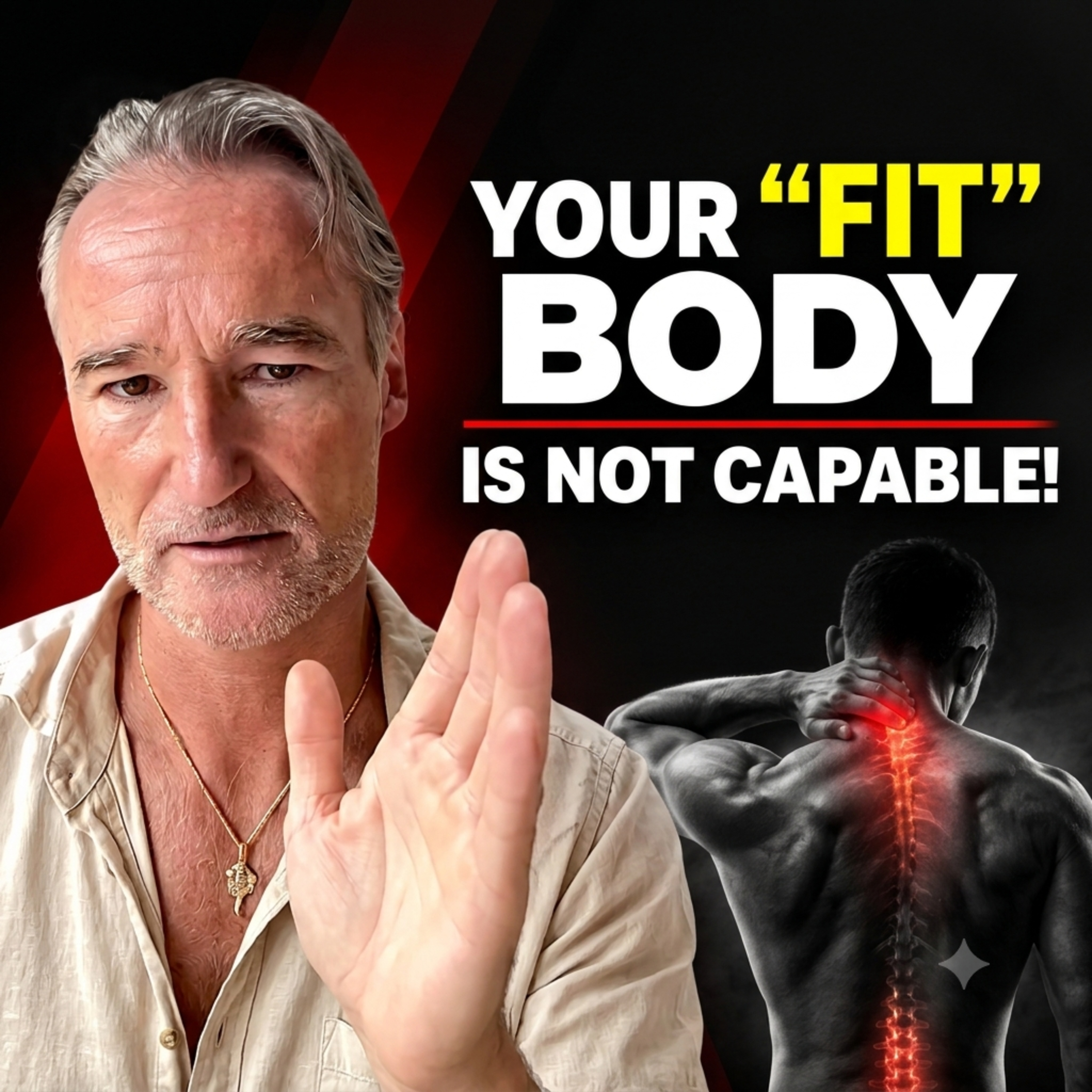
Erwan Le Corre Explains Natural Movement & Breath Holding | MovNat, Rewilding, Functional Fitness & Nervous System Regulation | Breathwork, Mindset & Stress Management
What's This About?
What happens when modern convenience makes movement optional?
In this episode, Erwan Le Corre, founder of MovNat and a three-time US national breath-hold champion, explains natural movement, breath holding, physical resilience, and nervous system regulation.
Erwan explores how modern lifestyles can create “movement poverty” by reducing the frequency, variety, duration, and intensity of everyday movement. He explains why looking fit isn't the same as being physically capable—and why crawling, climbing, running, jumping, carrying, throwing, and adapting to natural terrain are fundamental human skills.
The conversation explores natural movement and functional movement training, breath holding as mental training, nervous system regulation, stress resilience, mindset, natural light, environment, sleep, and the philosophy of rewilding the human body.
What if health isn't just about exercise—but about recovering the movement, resilience, and physical capabilities modern life has taken away?
Discover how natural movement, movement diversity, breath control, and a more resilient nervous system can become part of everyday life.
🔑 Key Topics
• Natural movement & MovNat
• Movement poverty
• Functional movement & physical capability
• Crawling, climbing, running & jumping
• Real-world strength & resilience
• Breath holding & mental control
• Nervous system regulation
• Stress resilience & mindset
• Natural light & environment
• Childhood movement instincts
• Rewilding the human body
• Movement diversity & frequency
• Modern convenience & physical fragility
🎯 Takeaway
Health and physical fitness aren't only about structured workouts—they're also about maintaining the movement diversity, adaptability, resilience, and capabilities humans evolved to use. Erwan Le Corre's approach challenges us to move more naturally, develop real-world physical skills, train our relationship with discomfort through practices like breath holding, and reconnect movement with our environment.
⏱️ Chapters
00:00 Erwan Le Corre & MovNat
00:58 Modern Convenience & Movement Poverty
04:51 Fundamental Human Movement
19:48 Losing Natural Movement
22:47 Movement Diversity & Frequency
27:27 Real-World Physical Skills
32:47 Environment & Physical Resilience
37:46 Artificial Lifestyles & Fragility
42:14 Resilience vs Fragility
45:13 Natural Light, Environment & Movement
50:24 Natural Movement for Real Life
56:24 Functional Movement Training
01:04:41 Breath Holding & Nervous System
01:11:19 Breath Holding & Mental Resilience
01:17:45 Rewilding & Final Thoughts
-
⤵️ Show Sponsors & Listener Discounts:
.
👉 Best 3 in 1 Blue Light Blocking Glasses Use code: MOBILITYFITNESS for Discount ✅ HERE
.
🫀 Elonga HRV Use promo code: MOBILITYFITNESS for Discount ✅ HERE
.
🔆 Best Full Spectrum Light Panel: Use code: FITNESSWISDOM for Discount ✅️HERE
.
👣 Leather Barefoot Grounding Shoes! Use code: FITNESSWISDOM for Discount ✅️HERE
.
👉 Find my favorite Blue Light Free Tablet ‼️ at a Discount HERE using promo code: MOBILITYFITNESS at checkout ✅
.
🧠 Vagus Nerve Stimulator: Use code: MOBILITYFITNESS for Discount ✅ HERE
.
⬇️ Find & Connect with Erwan Le Corre:
Website
.
🌞 Find & Connect with me 👉 HERE
👉🏽 For Discounts & Offers: HERE
.
*None of the content / statements in this Podcast are Medical or Personal Advice & is not intended to cure, treat, prevent or diagnose any medical condition. All my videos are for Educational & Research purposes only. If you decide to try anything discussed in this video, you agree to do so at your own risk & responsibility*
This is the Fitness Wisdom podcast.
Today I have the privilege and the honor to welcome Irwin Lacour on the Fitness Wisdom podcast. He's the founder of Move Nuts, which is basically a movement philosophy and method which teaches people how to rewild themselves to reconnect with their bodies and with their environment. But also he's a three time breath hold national champion, U.S. National champion, and we're going to be diving into all of that today. These are really some of my favorite topics, movement, mobility, rewilding, breath holding, resilience, self-control, discipline and all of that good stuff.
So thank you for coming on the show, brother. Well, thank you for having me. It's a, it's a true honor. And I know that you're such a wealth of knowledge when it comes to these subjects. And maybe let's start off with a, an issue that we are facing today, right? Humans seems to have lost their capability, their capacity to be in connection with themselves and with their environment. How do you think the modern world has shaped human movement? Through convenience, through convenience everywhere, through the lack of necessity.
It's it's that simple. Because you you do things that you are either interested in, that are rewarding or that are necessary. In the past, movement was way more necessary than it is today. Therefore today it's way more optional than it ever was. And because it is optional, there is the possibility of not doing it much, if at all, which explains why people spend a lot of time sitting. And then the fact is that movement is very rewarding in the sense it's very pleasurable in the sense of, yeah, it's satisfactory.
It's a it's a great satisfaction when you're a kid, when you're a kid. Kids are very instinctive. And so they, they are naturally driven to move, to move all the time, to move a lot until they're so exhausted that they fall asleep and then they wake up and do it again. And they do all kinds of movement. And they don't have a program and they don't need equipment. They don't need to know what's a bicep squirrel. They don't need to know what are the glutes. They don't care and they shouldn't. They just move.
So that's what I call natural movement. It's a, it's an innate, instinctive, therefore evolutionary program. And we are all born with it. And as children, we all went through that program before we even were able to really talk or commit, indicate or understand language much what we understood is the what's called the language of movement. OK? So once we understand that, we understand that natural movement is our universal birthright. And something happened along the way that takes that that pleasure, that that satisfaction out of our body, out of our mind, out out of our horizon, out of our mindset.
Can we blame the modern world for it? Probably since wherever people still live a more natural lifestyle, which is a more less technological lifestyle, less a lifestyle where there are less conveniences. Well, they have to walk more typically they have to walk. They have the garden, they carry things, they move their body to just for food or to for work. So they don't have an option of not moving, but we do. And when we do have adoption, we tend to not really want to do it. So we've lost the satisfaction, we've lost the memory of how rewarding movement is.
And then that's when we have the the possibility of choosing one physical activity optionally. So it's typically very specialized. It's either go to the gym, do those specific exercise for those specific muscles, or do running, but only do running, nothing else, and only do running, this kind of running. So that's a speciality of running within the specialized physical activity which is running. Whereas we know that human beings are of course able of running, but they are also able of many more movement, which is the whole scope of natural movements, which we were all doing, exploring and learning as children.
So yeah, something is something is off in the modern world because there's a price to pay for that lack of natural movement behavior. Wow, that was fantastic. And so many questions came there. I don't even know where to start. I think let's start off maybe with what is, what are the human, the fundamental human movements? What are the human functions that we have lost that we are, we are? Which are we are supposed to have as human beings? Again, all you have to do is to remember what movement was, what were you playing with when you were a child?
Everybody can do that. Think of when you were two years old, three years old, four years old, five years old, six years old. Hopefully you weren't raised because now we have literally the new generations. All right, so I'm, I'm going to be 55, so I'm over half a century old. Things have changed a lot in 50 years. A lot. I was blessed that I was that as a little as a young child. I lived more on the countryside and the woods were right nearby, so I had heels with big boulders. A little like the infamous world known French bouldering site called Fountain Blow.
It was like a mini fountain blow that not only my parents let me go when whenever I want it unsupervised. I could go alone, but they literally encouraged me to go if I was watching TV. There was not much TV by the way back then, very few TV programs. But let's say on maybe on Saturdays or Sundays, there would be more. But then it would be, let's say if it was the summer and sunny, they would tell me to school, go outside. But I was not doing that reluctantly. I'm like, OK, sure. And then I would go.
And if I didn't have a sibling or a friend at that moment, I would just go on my own. And I would hike and I would be in the woods for four hours and I would be scaling those rocks and going up and down the hills, sprinting and doing all kind of things like that in my head with adventures in my head of being a pirate or whatever I was. So I was, I believe I had a healthy instinct of not just exploring, not just enjoying, but also somehow training, training those abilities. I wanted to become better.
And I believe that it, it used to be, and in the right context, it still is for young, healthy young children. A an instinct, the instinct of becoming physically capable to do again, do again, do again until you manage to to become good at a given movement, a jump, balancing, hanging and climbing on top of something, whatever it is. So when you observe children, back to your question and rest. When you observe children, you will see again universally the same patterns. It doesn't matter what is in what country, that is, what ethnicity, the background and all kind of identity details, their details, their behavior is all the same, exactly the same.
They they learn to crawl, they start climbing up the stairs or whatever is climbable even before they can stand and walk. Then they start standing. That's a big achievement to become bipedal instead of just being on all floors. And then they start walking, then they start running, then they start jumping and landing and but they keep crawling too. Kids can hang before they can even stand on their two feet. They can hang like they have crazy grip strength. All right. So all these movements, if we were to categorize them, they are mostly locomotive movements.
So they are about moving from point A to point B Very important, obviously, because originally we lived in nature. So the more children have access to nature, the more inclined they are to move naturally. But at the same time, if you keep them in an apartment, they still will use your table as some form of obstacle and your couch and whatever. They will climb the fridge if they can. Whatever they they will just not care about it, will not care if the environment is appropriate for their instinct.
They'll just be behaving instinctively with these natural movements. So that's the, the biggest observation here, how instinctive it is. So the locomotive movements and then you have the manipulative movements, which is the ability to to move objects, to lift them, to carry them, to throw them and then layer on to catch them, which is a little more, which is the the most complex of all these manipulative movements. And then also, let's say if you had two while you also they also explore fighting a bit, even if it's typically playful, but they will they will wrestle at some point.
They will also like hit each other or kick each other. Those are realities of human nature, even when you're a kid. So kids can also become aggressive and fight. OK, So we call those abilities. They are not necessarily skills yet to become skills you need to train them more over time and more consistently. But there are natural abilities, which means that with an instruction, without any verbal instruction, all kids will have those basic abilities. They will come to them naturally. The same way if you had like a baby, baby elephant, baby horse, baby, whatever, baby animals, they do exactly the same.
They play a lot, they move a lot. Why? Because they need to learn the movements, the natural movement that be specific to their species. So the, the, the baby birds, the baby eagle will start to walk and stand on their feet and walk and then start to move their, their, their wings. There's a reason for that. They're aren't trying to crawl or they're aren't trying to their movements that don't belong to their species, right? Dolphins are going to be very bad at climbing trees and Guinea pigs are going to be very inefficient at diving and holding their breath and traveling through the oceans.
All right, because natural movement, yes, but for, for who? For what species? So when it comes to human beings and when you look at any human group anywhere on the planet, those natural movements are the same. You don't go to Africa and be like, whoa, Africans are amazing because they have this extra movement ability that Asians and Europeans don't have. Like that makes no sense. Nobody has an extra ability or, or, or, or a missing ability in the scope of their human natural movement. It really belongs to all of us human beings on this planet.
That's why you know, it's natural movement. So the locomotion, that's obviously we want to say walking and running for instance, but it actually starts with everything on the ground, on the floor, everything called quadrupedal, but not necessarily. By the way, you can move on your own on your back. You can crawl in your back, you can roll on your back. There are many, many techniques, not just bear crawl And that's it. That's the movement. All for is bear crawl. Well, First off, we're not bears, so we're not imitating bears when we're moving that way.
We're moving in a way, but it's very human. It's just that it's forgotten or, or it's misused or disused. Mostly disused, since we don't really need to move on all fours anymore. Except. Except when there is a dramatic event where survival is at stake. And then we may have to move on all fours. We may have to run fast, we may have to keep hanging and climb something for survival. That's also when you know. But oh, that's a natural movement. Why? Because you never hear do yoga for your life. You will hear run for your life.
You don't hear play tennis for your life, but you may have to throw something or to catch something in a survival situation. And why why am I saying that? Because when you play tennis, what you need to to realize what we need to realize is that it's obviously a a codified specialized sport. But what are what are the natural movements specifically in tennis? And we could do the little game with other sports. You run, you walk, you mostly run, sometimes jump a little, but most importantly, you, you throw and you catch with a piece of gear called a racket.
But what the movement you're doing is to throw the ball and to catch the ball as you also throw it back at the same time. So those are natural movements. Originally it was used to do. You would do that with a stone or the spear, or you would throw and catch a fruit or something, a piece of whatever, some food. That's the reason why humans develop that ability. They realize, wait a minute, I have hands. I can grasp things now. I can make those objects travel through space, Not a lot of space, but some space.
And that can be useful for defense or for helping somebody else or for being helped by somebody else. OK. So all the modern sports that we know, if we look at the natural movements in them, we can we can understand that natural movement. Those abilities precede every sport, every physical discipline, all of them. It's really evolutionary. So, and if you don't know if or what is a natural movement, if you're not sure, just ask yourself, would I need to do this? If there was, if it wasn't in a vital situation, a situation where I got I've got to survive.
And I, I, I dare you to find a situation where you would do some kind of a calisthenics, not to say anything wrong about calisthenics. You know, it's like, it's great, but or yoga, like a yoga pause. You're not going to do yoga pause when you need to survive. You want or chicken or or what, what, what not again, because every time I say that people are well, you're talking bad about those disciplines that are amazing and they made me feel great and they help me with my pains and my energy and absolutely this is great.
There's no, no, no doubt about it there. This is not to say that any of those that those practices do not have value and benefits. This is not the point. The point is, they are not useful directly, Maybe indirectly because they caused you or they made you be more in shape, more and more, you know, more physically active instead of doing nothing. But they are not going to help you in a direct way to be helpful to yourself or to others. When there is a again, a dramatic situation where maybe all you need to do is a run with that stopping for 20 kilometers or Sprint fast enough for 200 meters.
But if you are two seconds late, it's too late. You're done. Yes, or hold your breath or swim or lift and carry somebody, right? Those are real situations. So when you think mindset, the mindset of real world, the real world, the real life, you want to acquire what I call the real world physical capability. You want to become capable so that any of these situations happen. You are not helpless to yourself 1st and you become also potentially helpful to others, people you know, people you don't know, people that need help.
Not because you're a trained professional, which you could become, but because you are just a human being who has developed and then maintain the whole scope of real world physical capabilities that can be useful at any time in any place, in any moment when as we say, shit hits the fan. So that's the mentality because you said move. That is a philosophy. Yes, we could say to philosophy, well, it doesn't have to be something very sophisticated. We could call that also just a mindset. And if we replace philosophy by mindset, and that's the mindset, the mindset is how capable are you in useful ways, in intangible useful ways, things you can do with your body, a capable body to to get out of trouble, to help people, to be out of trouble when needed.
Is your body capable? Is it competent? Means are you first train on how to move efficiently with a courtesy that's competency. And then are you fit enough? Do you have enough strength or power or endurance? And and all these other physiological adaptations that enable you not just to do the movement wells the the, the, the, the movement efficiency efficiently, but also to do them repeatedly if needed or with enough speed or enough power. It's obviously very different than what the modern mindset of going to the gym to get more, you know, more biceps, bigger muscles and for the looks, you know, like these people don't and that's whatever is whatever's choice, but don't really care for function for for application.
They care for looks. They want the image of fitness, not the actual fitness, the fitness that can do things for reals. And how do I know? Well, how do they know? They don't know what it is that they can do with their body except for what they do in the inside the gym, because they never take that body outside of a gym to test it out, to test what it is that it can do. So you ask them to run and it's hard for them to run. You ask them to jump over an obstacle, they can't do that. They're afraid they're going to get hurt, things like that.
So it's basically a trophy body. It's not a capable body. Different mindset. It is what it is. Everybody you know has a choice. You'll probably be shocked to hear that as a fitness professional, I don't think nutrition and exercise are the most important things when it comes to health, but light is. Light controls everything in our body from our energy levels, sleep, hormones, metabolism and more. Each wavelength of light has a critical function for the human body. Our body evolved to receive full spectrum light from the sun.
Indoor lighting strips away all the beneficial wavelengths of light and leaves us with the high energy blue, which is very draining. So being outdoors is a the non negotiable, but if you can't be outside, it's very important that you optimize the light environment inside your home. And This is why I love the Solar X Panel by Mitolux. It provides my body with all the wavelengths it needs to keep on functioning optimally. It comes with 10 wavelengths and 11 different modes to cover my body's needs and requirements for all times of the day.
Light is not optional but is a foundational piece to being healthy and vital. You can find the Solar X Panel by Mitolux by heading over to mitolux.com/fitness Wisdom and if you use the code, Fitness Wisdom at. Check out, you will get a nice discount on your entire order. The links will be in the pinned comments as well as in the description below. Thank you MiTo Lux for sponsoring the show. True. That's true. That was fantastic. Yeah. I mean, there's so many consequences to losing our human capabilities.
I'm sure that you're aware of and that you are seeing constantly, all the time, people are in so much pain in their body, whether that is like because their body is asking them for change. Because something that Doctor Perry Nicholson talks about a lot is that pain is a request for change by the body. So when it senses stagnation, it sends you signals of alertness in some areas of your body to kind of pay attention or move, especially since if you're not hit or you have some acute accidents somewhere in some specific location.
Most people with chronic pain have issues or they just wake up 1 morning and they have all these aches and pains because they've lost the very function which makes them human. So now they cannot locomote, they cannot lift stuff over their head, they cannot pick up their heavy groceries off the floor without hurting their back or something like that. And I feel a lot of that is because just as you mentioned at the beginning, a lot of the convenience has dissociated us, dissociated us from our environment.
So now we are become more fragile. And I feel like the environment that we place our body in can either make us weak or resilient. And I think that as you mentioned at the beginning that you were, you know, as a child, you were exploring time in nature, you're climbing rocks and you are spending a lot of time in nature. That makes you very resilient because you are experiencing so much different terrain compared to our modern world right now where everything is flat, everything is air conditioned, everything is regulated, controlled, and unfortunately control makes us more weak because it's predictable.
And I can assume that what you mentioned previously about children exploring their environment, even if they are living in, let's say in an apartment building, I would assume that the reason that they would want to do that, as you mentioned, because that is a human desire, like innately the body wants to do that. I would assume it's because the brain is trying to develop itself. So it's trying to get a sense of its environment, of how it should function in that environment. So we are always trying to use our environment as much as possible to guide us towards better.
But then because the modern environment is so convenient now and as an adult, you know how we all have free will, we can decide whether we move or not. Whereas children innately do it. Whereas as adults, because we have, you know, grown up to a level where we can make conscious choices and decisions, we allow our conscious or unconscious decisions to take over our mind and then to do things which actually sabotage ourselves because the environment is not supportive of our health. Because I'm sure you're aware that if you try and sit in nature, you cannot sit comfortably, you know, for a long period of time because nothing is even in nature.
Everything is up and down sharp, you know, smooth. And it makes it very uncomfortable. And I think that's what keeps you in this in this ready state, in this alertness. It keeps the blood flowing. It keeps your brain sharp. You have the natural light, you have the oxygen from the environment. And I think my next question to you would be, since we are talking a lot about movement, many people love to separate all of the different training modalities. So I'm going to do stretching here and I'm going to do strength training there and I'm going to do aerobic training there.
And people think, for example, if they exercise one hour a day, it counteracts the 23 hours of not doing anything. But you're basically saying the humans move are designed to move all the time, and they're meant to do all of those functions all at once. By design, we are meant to move, maybe not all the time, but way more frequently than we are. And in, in all ethnic groups, including those who live still very close to nature, they're not moving all the time. They love to rest, love to sit or lay down.
You know, if, let's say, if it's in, in a country where because in Europe it's a little different because then the, the winter comes and then it gets really cold and it freezes. And you'd better have a man made environment where you can be cozy and semi hibernate before, you know, during long winters it it's not the case anymore. Because now we with LEDs and electricity and everything, we can make it look like we still live in the tropics even when it's the winter in the northern hemisphere. However, yeah, in in places where they don't have such harsh winters, you see people outside just sitting, sitting a lot, taking naps.
They're not always moving. They love to, to rest whenever possible to and which is important, by the way, for, for health and for survival is to regenerate. We're not supposed to be busy and active all the time like most people are today in the modern world, thinking that if they take a break for a moment, something wrong is going to happen. Like, like they're basically in danger. They take a moment to do nothing. I'm not saying that's everybody who thinks that way, but still there's that what's called the the chronic sympathetic dominance, where people's nervous system is always on edge.
But it it doesn't have to do with movement. It has to do more with the the idea of being busy and being productive, as if not being occupied was a liability would actually be the threat, the danger. But otherwise we are meant to move frequently and children move way more and also they they move way more in way more diverse ways because it's the playful time. And what's interesting is that if you observe in all animal species tend to be the same adult members of whatever species are less playful movement wise, older monkeys, older apes, older elephants, whatever older humans, that's it.
They've they've done the training normally if it was done, if it was done healthily and without interruption like it like it's unfortunately happening in our human societies. The physical development is full is, is completed and after that people or animals are less explorative, less playful movement was they can't serve their energy. And sometimes they play a little typically because either it's like in the mating phase or because they have children. The children want to, they have babies and babies want to play like kitties or, you know, Cubs or or puppies.
And then sometimes like the, the parents will play a little bit. Typically they are the adults, so they don't play, but then they start showing what to do. They start showing examples. When the kids have developed their movement well enough, then they can start to be trained. And that's when you start observing that either the mother or the father or both start to show like the hunting behaviors or the the the prey behaviors, how to conceal, how to freeze, how to hide and things like that. Guaranteed that it used to be the case in humans too.
And it's still to a degree the case in some individuals. So yeah, that's the way that's the way it's done. And I actually lost the thread of what was the original question. No, no, the question was about Bush. I lost my train of thought as well. Don't worry, it'll come back to me. We can, we can, we can move on from here. Actually, I had a great thought where you were talking previously about function. Sorry. Did you want to continue? Yeah, I remember now you're talking about why is it that it's that we're not moving that much and should we should be moving way more or more often?
We should be moving all the time And I was saying not necessarily all the time, but frequently enough. And what would be frequently, it's certainly not 3 * 1 hour gym session per week. That's nothing. If our wake time is, let's say 16 hours on average, 16 hours of wake time. And if we were to exercise three times a week and when we exercise an hour, we're not actually exercising an hour. Because if you look at people who train at the gym within an hour, if you look at the amount of movement, that's maybe 20 minutes, OK, 20 minutes, three times in a week, that's one hour in a week.
But if you in a week, if you're awake 16 hours a day times 7, that's more than 100 hours of wake time in a week. And then 1%, one hour, 1% of our time is actually exercise. That's absurd. That makes no sense. That's like nothing at all. So the, the, the antidote to that. Well, fortunately there's still some movement in modern life, but it's very poor. I call that movement poverty because it's poor in many ways, in many variables of poverty. It's poor in frequency, it's poor in duration, it's poor in variety, it's poor in intensity.
So if you look at the behavior of the physical behavior of a regular person at what's called normal and have them move in a day from morning to evening, well, they're probably waking up standing up, moving a few steps. Maybe they go in the shower, they stand. Maybe they go sit and have a cup of coffee or something. They sit and the whole day is going to be standing up and moving a few steps to go to the next sit to sit. What if your healthy habits and routines are quietly sabotaging your health and actually creating more stress on your nervous system?
The truth is, your body is constantly giving you feedback, but most people are not paying attention to it. One of the best ways to really understand what's happening inside of your body is through heart rate variability, also known as HRV. The problem is, many HRV devices just give you a single number, a high score, or a low score without telling you what's actually driving the results. This is why I use a longer HRV measuring device. Elonga doesn't just measure your HRV, it analyzes the components behind that number, giving you real insight into the balance between stress and recovery and really helps you understand what state your nervous system is actually in.
In just a few minutes every morning, Elonga gives you objective feedback on how your sleep training habits and lifestyle choices are influencing your body. HRV is one of the most unbiased ways to see how your daily decisions are influencing your nervous system. It shows you whether the things that you're doing are truly supporting your health or creating more stress than you realize. Instead of guessing, you can measure, learn, and make smarter decisions about your health, performance, and recovery.
So if you want to find my favorite HRV measuring device, head over to the description and make sure to use the promo code MOBILITY FITNESS at checkout to get a nice discount on your entire order. That's it. All right. So this is extremely poor in, in variety, no intensity, no variety, some frequency, but but not that much. So you bet that then those bodies are physiologically deficient. They shrink day by day over the course of years and and decades. That's why I've always liked to say that normalcy, what we call the normal lifestyle, normalcy is a silent killer.
And it's not just movement. Of course, you know, I'm friend with Jack Crews. He's just doing a fantastic job educating people to the importance of circadian rhythms and biology, importance of natural light and grounding. Which by the way, back in the days when when I start to show my work in 2009, 2008, 2009, there was already a video of me training shirtless, barefoot in the sun in nature, doing all these natural movements. But corrounding, no shoes, no sunglasses, shirtless. So talk about the original gangster.
So, you know, I've never talked about quantum biology or medicine or anything like that, but it was there. It's been there all along by instinct. And that's what I've been wanting to show. So it's not just movement, but if people wanted to be healthy again, they would start early in the day outside take of their shoes. And it's not always possible or or easy for people, especially people who live in big cities, they don't have access to nature or more restricted access to nature. And then also in the Northern hemisphere in the winter, it's hard, like you don't really get a lot of sun or it's, it's hard to, but it's still possible.
It's still possible. There still are sunny days. There may be cold, but they're sunny. You can go to the park, you can get moving, move on all fours, start jogging, grab a tree branch, start hanging and pulling and climbing. Take off your shirt, be in the sun, be barefoot. You can absolutely train for that. And even though you may not be able to do that perfectly or in the sense of every day, there's going to be in every winter, there's going to be very nice days where you should be spending most of the day outside.
And yes, there are plenty of obstacles to to that ideal healthy lifestyle. But obstacles are just that, obstacles. It doesn't mean there are you cannot surmount them doesn't mean that you cannot do anything about that. If you want to do something, you find a way. If you don't want to do something, then you find an excuse. If you don't want to change anything, then don't keep, don't change your bulbs at home. Keep going to bed late and wake up late or, or keep having all these electronics and, and, and Wi-Fi and in your environment and all of that and all these chemicals everywhere, in your shampoos, in your toothpaste, in your, in your house cleaning products and perfumes.
Take your medications, do all these things, take all these things. Keep going, doing that and you'll get the same results. If you are interested in this conversation, in the conversation we're having now in the conversation you had with Jack Crews and other people who are doing this kind of work, it's because you are already into the alternative. The alternative to the centralized lifestyle, in the centralized lifestyle is, is honest, is not really a good way to live. And so you may not change everything overnight.
You may start changing one thing and stick to that and see already how it makes you feel normally should whatever that is that you're going to change more movement. You start with more movement or you start with changing your food or removing chemicals or or circadian rhythm, ETC. You start with one, it makes you feel good. Then you start to unravel the whole thing like, wow, that really worked for me. What else can I do? And and then before you know it, you've managed to change a number of aspects of your, of the way you live.
And the proof is in the pudding. You just feel better. You can see it. Some of your conditions go away, your pain goes away. That's it. The slower works, but there's no, I mean, we can look at the world and how messed up it is in so many ways, all the horrible things that are taking place. And then we can also look at the way most people live their lives. And it's really damaging to themselves. But at the same time, there's very little that we can control. We're not meant to control anybody. We're not meant to decide how they should live, even if we wanted.
You know what? What can you control in your life to begin with? You know, you cannot control the weather. You cannot control the world. Some people can barely control the thoughts. Some people can barely control the body. Bodies are clumsy, they're untrained. The mind is untrained. So what do you control? What's your apartment or your house looks like? You know where is where you place that decorative thing and it's there instead of there. And that's it. You have a sense of control that everything is in order.
Maybe the inside of your car, maybe the inside of your purse. But some people you know, their, their homes are messy, their purse is messy, their backpack, whatever their, their car is messy and their minds are messy and their lives are messy. You can't. That's, that's it's, it's obvious that if you want to live more healthily in this time and place, in this era, there are so many possibilities to do that. There's so much more. You have so much more freedom and possibilities to actually achieve a healthy lifestyle today than before.
And you may say, no, that's not true because before there was no pollution, no, no EMF, no TV's and all that. The pollution in the food, yeah, it's true. Everything was seasonal and organic. Yeah, but you had to work in the fields and or maybe in factories back then. And it was very hard. Very, very hard. But people were healthy in many other ways. They sung together, they danced together. They talked way more than they than people talk to each other today. And they talked in person, looking at people in the eye, not on some online chat thing.
And all get anyways we can, we could compare the pros and cons and how it was back then, how it is now. But the question is there's only now. And if you want to live more healthily, you need to organize. So it can't be messy, but it also cannot be controlled in a way that's centralized in a way that's conventional, Right. Because some people, everything is clean. The way they they dress, their house, their car, everything is spotless. Yes, it's spotless, but it's centralized. It's the artificial light is spotless.
It's LED everywhere. The everything smells good. Yeah, great. But it smells like chemicals. In fact, chemicals that smell good, but they're toxic nonetheless, etcetera. You know what I mean? Yes, you have like super high Wi-Fi, ultra fast Internet, yeah, 24/7 in your face, in your brain, et cetera. So it, it's nothing is linear in this reality. And well, the principles that make up reality are very linear. But otherwise, the way we go through life and the way we navigate through life, it's not linear, but you start somewhere.
If you're not already on your way to to change your life, to have a healthier life, you start somewhere. You don't have to change everything and it doesn't necessarily have to be overnight. You don't have to cold Turkey everything. Sometimes you cold Turkey sometimes take your time. Over the course of a month, you progressively decrease something, progressively increase its opposite, ETC. There are plenty of strategies. Also depends on how your mind works. For some people it has to be cold Turkey, for some people it has to be progressive.
We have to understand individualities as as well. The individuality of the of the psyche, of the mindset, of how people respond to change what we know. Like you said, when people experience pain, it's typically because it's a message from body to change something. But you know, it's also pain. Pain in the mind, pain in the, the heart, pain in the the spirit. It's also an indication that something about one's life has to change. And it may not be material or or or biological, even though that could be, but it it may have to do with being more oneself, giving oneself more permission to be free to explore.
For some people who work too much is give yourself permission to just relax, take a break. For people who are tend to be don't like effort, don't like doing anything. It could be an invitation to be, you know, what you need to wake up and get your thing together. You know, get your act together and start to discipline yourself and start to get some discipline, some work, different conditions and different medicines different, you know, so it depends on the individual. I want to say. I wanted to say that because typically it's like people show up and be like, well, that's a solution.
This is the one thing that's making everybody suffer. And like if you change this, then your whole lot and that's all there is. Like funnel vision. It happens in the health. It's the circuit and rhythm. Just change that. It's like, yeah, it's definitely important that others are right. It's food. It's just food, you know, and others like it's movement. It's only movement. No, it's all of it. It's all of it because we're not compartmentalized and the laws of nature are not they can, they can be described very specifically.
Jack is phenomenal at that from the science perspective. But in the end, everything has to work together. But it's the idea that the prescription should be the same for everybody in the No, it's eventually, yes, eventually you end up with a lifestyle that's pretty much what's healthy is is the same for everybody. But coming from the the place of having a centralized lifestyle, which is normalcy, right? What we call normal unexamined people who don't even they're like, oh, this is bad for you. Like artificial is bad for you.
Like, yeah. And like, electromagnetic frequencies are bad for you. Like. Well, those kinds are, yes. And like, not moving. Like, I actually don't move enough. But I do, like, gym, like, maybe once or twice a week. That's not good. That's like, not really. No. Not good. And like, eating that is not good, like, now. And like, it's like they're ignorant of everything. And some people are doing quite OK, actually, even in those, like, super toxic environments. It's crazy, right? Some people are very resilient and they're still happy.
They still have energy and they still have like a but the truth is for most people, most people are suffering. Most people are are on some form of medication plus drugs plus, you know, like whatever substances to numb themselves. And then they watch TV like they whatever, they have to numb themselves all the time because they actually they are both very bored and very, very self abused by by by all these super aggressive variables of a centralized lifestyle. And but the way out may not be exactly the same for everybody.
That's my point. Yes, yes. And take. Take your time. Take your time because you're not going to reverse the, the, the deeply ingrained mindset that you've been having since you were born. Like literally you were born in it, in the centralized mindset. You were raised in it. You, you believed you've been a follower follower of it your whole life. The thing you're going to change your thing overnight. No, it can be actually counterproductive because you're trying to change too much too soon. Vagus nerve stimulation is one of my favorite ways to shift my body from a stress state to a parasympathetic state.
When our body is in a parasympathetic state, it can put its focus on rest, recovery, digestion, and other restorative processes that otherwise do not take place. If we are stuck in a state of fight and flight in the modern world, our attention and energy is pulled in all different directions, keeping us stuck in a state of fight and flight. Over the years, I've tried many different ways to shift my body into a parasympathetic state, including breathing exercises and meditation. And while those practices are incredibly effective, I find myself taking at least 20 to 30 minutes before I shift into a parasympathetic state.
And This is why I love The Vagus Nerve Stimulator by Xena Well. For me personally, it's a really convenient way to shift my body into a state of rest and digest not in hours, but minutes. So whenever I feel that my nervous system is on the edge, I just hit a vagus nerve stimulation session and I start to feel calm within minutes. With Lunar Plus, you can also log your sessions in through the Xena Well app and also get AI powered insights to help you decide which most is best suited for your situation.
Whether that is relaxation, sleep relief, focus, mood, or digestion. It takes your vagus nerve stimulation to the next level by making the experience more personalized to your body goals and needs. You can find my favorite vagus nerve stimulator by heading over to Zeno Well dot AI forward slash mobility fitness and if you use the code Mobility fitness at checkout, you will get a nice discount on your entire order. Thank you Zeno Well for sponsoring the show. You know, like one of my beliefs that completely got destroyed like over the last maybe 5-6 years is that the weather, you know, the weather is not what I thought it was like my entire childhood was a lie.
So, you know, because I feel like once you realize that the weather can be manipulated, whether it can be very hot on purpose or very cold or cloudy or make it rain or make it snow, then you realize that wow, like am I even experiencing the reality as it is? Or is my reality being created for me? And it's just crazy. Because once you realize that if you can go to that level and accept that weather can be manipulated, you start to question everything because the weather is one of the hardest subjects I have found to speak with people about because it's such a hard thing to grasp that somebody could do that to you.
Like literally alter your behavior of whether you're outside or inside by changing the temperature, by making it cloudy, by making you more dopamine dependent on your screen, by making you spend more time indoors, for example, because it's cloudy outside and it's, oh, I don't feel like going out because it's cold today. So all of this, it feels like it's by design. But then once you open your eyes up to that, you realize there is so much deception and reality is altered in the modern world that we are living in right now and what you mentioned before about how humans have these specific needs and we all end up going back to the same things in the end.
So, you know, we all need movement, we all need light, we all need sleep, we all need connection, we all need food. But because we have this disassociated ourselves from everything which is real, the natural environment, we are experiencing so much dysfunction. And we are having this discussion because now we are living in a technologically advanced and modern world where everything is done for us and we don't need to do anything. So before we used to have to run, climb, throw, you know, hunt and gather our food.
That was our way to move our bodies, to exercise our bodies. Now we think that going to the gym compensates or mimics the hunting and gathering scenario. But like what you're saying is that, you know, human beings have been moving all the time. When I say all the time, I don't mean the entire day, but I mean frequently, meaning whether that is fidgeting or shuffling or active, resting, squatting down and resting. You know, chilling in the chilling is not passive. It's never passive. Anything in nature is not passive.
Everything is active. When you look at an animal which is laying down, for example, a cat which is sleeping, they always have their eyes slightly open. They're watching you. They're you know, their, their spider senses are on in case they need to be alert, in case you're a threat. As human beings, we used to be the same and now we've lost that. We've dissociated ourselves from nature and now we are so numb to our environment. So even if something is coming at us from the side, it would just hit us on the head because where our reflexes are gone and that goes back to the function.
And now I remembered one question which I wanted to ask you was, you know, so many people think that with their gym training, their training for functionality, you know, you see, you see that we're thrown around all the time. What does functionality mean to you? Not much to be honest. Function. Function is it's like, OK, can you can you bend your your arm? Can you bend your elbow? OK, well, let's see. It's functional. That's it. Yeah, yeah. Movement is not functional or not functional. No, the body or joints are functional or not functional.
Movement is either useful, practical or it's not. That's it. So you have creative movements like dancing, they have traditional movements like yoga is like transition. It's not that much movement. It's more like positions. Move a little to another position. Hold the position in the gym, conventional gym like body bodybuilding, the movements are very limited in scope, in range of motion. And they are very, I like to say the machine dictates the movement because if you use an exercise machine, you can only do the movement that the machine allows, not the other ones.
And even if you use barbells, you're like, well, no, not with barbells. Well, but you're going to then follow very precise movement patterns because it is said that the such and such muscles are best worked out if you do move the movement exactly like that. So if there may not be a machine, but you're behaving like 1 because you're not doing whatever with the with the barbells man. Like people go to the gym hate when I say that, but it's just a reality. You're not free. You're just following protocol.
And So what it is to be free? Well, freedom could be just be moving randomly means doing whatever like doing like if you're crazy or something, there would be no real. It will be maybe good for the nervous system for people who need who need to let go. That can be great. It can be creative in the form of dancing. But typically when you dance, you are not that creative because you're either following a choreography or you are not following a choreography, but you're still rehearsing specific moves that you have learned before.
And and again, what I'm saying are just observations. It is not to say anything bad or negative about dancing, which is beautiful thing, or any traditional discipline or practice or even going to the gym. Some people go to the gym, they're really happy with it makes them feel great. You know what I mean? It's it's very important to acknowledge that. But if you want to think what's functional movement in natural movement, the movements we talked about, the movements you used to do as a kid, the movement you still can do as an adult that are going to be great for you.
And then you still can, by the way, make more and more efficient, make very technical, just like in martial arts, right? Martial arts, what is it? Martial art?
It's fighting, basically. It's fighting with efficiency. So everybody has some fighting ability without any instruction. Everybody like kids that just hit each other and kick each other and bite each other and do all kind of nasty things, or they wrestle, they try to strangle each other. I don't know, it can be mean and brutal, but they're they're doing that instinctively. There's no technique to it. Natural movement is the same. You can run, you can jump and land, but you don't necessarily have a technique because you're not really paying attention to how you do it and finding ways to rehearse until, Oh my landing is way lighter and it's more stable and it's more accurate.
Well, if you train mindfully, you become good like that. So that's when you turn and a basic instinctive ability into a skill that you've mastered. And you can do that with all the natural movements. But what's the point? The point is not functionality. The point is not to be functional. Give a shit about function. Function is just what you possess in your body. If you're healthy, you're functional. All kids are naturally functional. Being. Human, right, adults, if they were to keep moving like they used to move in nature or as children, climbing things, jumping, landing, crawling and running, etcetera, they would keep doing that.
But instead of looking like kids that are trying things out and exploring, now they look like they are amazing movers, very capable as adult human beings. And now they can apply that. They can apply those those skills not to some functional exercise like what the what no, but to some whatever practical applications. So the problem is that we are reinventing functional movements because the way what happens is that from the stage of natural movement, which is inherently 100% functional, like everybody's functional, the bodies are functional.
It's it's exploration through play. It's not just playful by the way, because kids, they hurt themselves, they take a risk, they scare themselves trying to do things. It's not just haha, we're playing, we're having fun. Not at all. They push their themselves, they push their limits. So it's real serious training. They're not doing functional training. They have a functional body and they're training natural movement. And what is natural movement is the full scope of movements that the human species possess.
Just like the same way wild horses, bears, wolves, all the other animals have their own natural movement and they need to trend these movements early on to be good at them, to be recapable, so that they don't get eaten by praise by by predators, or that they that they are able to catch the praise and not starve to death. Or if they're not left behind by the herd, is it belong to 1? Because they're too weak and they are not trained. They need to keep up because otherwise they're going to be isolated.
And I mean, everybody knows that when you're a kid, if you're really clumsy with your body, if you're not strong at all, other kids are going to bully you. They're going to mock you. I'm going to tell you lame. Oh, it's not nice to say that and everything. Oh no, kids don't do, don't be mean. But there's a reason why kids behave like that. And the reason is not to be mean for the sake of being mean. It's an invitation to the less capable element to wake up and do more and push themselves so that they can keep up with the rest.
Because if everybody starts to be like that, then everybody, the whole group is going to be weak. And if the group is weak, then it's vulnerable. And that does not need to survive. So these are instincts and then we replace that with some pseudo morality. That's complete bullshit. The point is to be strong and not strong just by having big muscles that are useless, but strong by being capable physically and yes, also mentally strong and emotionally resilient. Because in the end, you're going to be an adult and you'll need to to help with a group.
You'll be part of the human community or a human community. You'll be, you'll need to carry things. You need to maybe carry children. You need to defend your, your, your, your family and things like that. And you can't do that if you're weak mentally and starting with physically and mentally, you can't because back in the days the, there wasn't like phones and you call the police, like, excuse me, look, somebody's mean to us. Like did not exist. You took your axe and you went to war. Somebody messed with you, you split their head.
Well, you can't think like that. Well, those are realities of the world still today. Look at what's happening when when you have a number of people who don't want to respect those principles of goodness, then you have savages in the wrong sense of the term. But once you re understand that, what do you give a fuck about functional movement and playing with some little ball and like making sure that you're moving the thing like on the all the good planes and the sagittal plane or like, what, what is that?
What kind of nerdy thing is that? That's like for people who are not even that fleet. They're for people who are pretending. And then the problem. And here, like, right now, I'm being judgmental sometimes because I realized, wait a minute, how long can you afford to entertain such weakness? What are you doing in the gym that you think is so special that I'm moving from the left to the right? And like, because twisting is important and bodybuilding, you don't twist. So we need to bring back the twisting.
OK, great. And yeah. Because then you can play golf better. Oh, OK, Bravo. You know what I mean? It's like, who cares about functional movement? Think about a functional body that can move naturally and become recapable in the real world so that it can do real stuff. Practical actions lift and carry that load of that person Sprint. On whatever terrain, jump from that obstacle, or over that obstacle, through under that obstacle, crawl, et cetera. Like be able to move from one type of movement to the next just like that without hurting yourself, without slowing down, etcetera, etcetera.
So you go in nature, you get in the woods, that's going to be the test. But in a gym that it is a bodybuilding type of gym or functional type of gym, you can pretend all day long. So is it better to do functional movement than bodybuilding? It can be if strength is more involved and there are now people who are, there's a not a brand, but a trend in people who are training in more and more smart ways with loaded movements in all kind of ranges of motion. Or it's start to resemble some some very efficient natural movement training.
But you still need to do the actual the actual training. I'll give you another example. If all you do is to jump up and down the box box and you call that a box jumping, a box jump. So if you replace the box by a rock, you're going to call that a rock jump. Now does that make any sense? If you replace the box by a wall, are you going to call that a wall jump? The jump is not where you jump. The jump is. The pattern is and it's the technique. So if you do that jump 1000 times or 100 times, you know that's good for stamina and there's some ploy metrics to it, whatever.
It's very functional and that's all you do when it it comes to having some jumping elements in your physical training. That's all you do is you box jump. Does that mean that you're ready for jumping over any obstacle outside in in in nature or in a city? Not at all, because there's going to be way such diversity of things to jump over or from or onto or through complete different jumping patterns. Also different landings because jumping on top of the box, but also like jumping over it or from it and maybe with some running steps and momentum.
Everything changes. And depending on where you're going to land, there's going to be also a lot of diverse techniques involved. And also you need to train them because if you don't train them, it doesn't matter. Well, but I have this functional training and I have this general preparation. Therefore I'm ready for anything. No, you're not. No, you are not. And that's if you start to understand that, then you start to understand what real world physical capability is, what it means to be ready. And it cannot be encapsulated and shrunk to a set of eight exercises that they're functional or not or whatever.
There are way more. There's so much more to try. And if you just do pull ups, that's good, but that doesn't mean that you know how to climb a tree or rocks. That just means that you have the upper strength to do this. What happens if the bar is not like a nice pull up bar? What happens if it's like a big limb like that and your hands are like that and you don't have the strength to just hold that because you don't actually have the, the physiological adaptation or specific strength to maintain that grip, then you're not strong because you're, you have a weakness right there.
And so if you start to spot all of your weaknesses, that so, so many weaknesses. And typically when I have this kind of discourse, people hate it because then they're like, yeah, actually if I go that route, I'm going to realize all my deficiencies. And I don't want that because it feels that I'm, you know, I'm good at the gym, I'm good in my functional training, I'm good in my whatever routine. And that should be enough for it. OK, well, there's more to it. Yeah. Most people focus on nutrition and exercise when it comes to health, and that's cool.
But if you're sitting under artificial lights all day, that's quietly sabotaging your health. That's not going to get you very far. As an educator, podcaster, and fitness professional, I care about recovery as much as I do performance. The biggest secret to recovery isn't supplements. It's light. The light that hits your eyes is literally the instruction manual for your body. It says your sleep energy metabolism and your hormones. The problem is the modern indoor lighting is sending that signal at the wrong times of the day from morning to midnight, so your body never gets the message the day is over.
Now if you already own a pair of blue light blocking glasses, hear me on this. Not all blue light blockers are equal. Viva Rays use a three in one light balancing system, Magnetic day, sunset orange and nighttime red lenses you swap to actually match the time of day. So you get energized in blue in the morning without the eye strain and protect your sleep at night. One pair dials you in for the entire day. That's the difference between just blocking light and actually syncing with it. Since wearing Viva Rays blue light blocking glasses, my sleep is deeper, my recovery is fantastic, and most importantly, my energy and cognitive function are through the roof.
If you're ready to experience the difference for yourself, head over to vivarays.com/mobility Fitness and make sure to use my code Mobility Fitness at checkout to get a nice discount on your entire order. The link will be in the description as well as in the pinned comments. Huge thank you to VRAS for sponsoring the show. It goes back to programming and beliefs as well. People just want to look good. They want to like feel like they are capable of doing something, but they are not applying that capability into the real world.
And when they are faced with the real world, they cannot mimic or function as they thought that they could. So for example, instead of chopping wood, they would like hit the tire in the gym, for example, with a hammer and they think it's the same thing. But then when you go to chop wood, you realize you can't chop the wood or you're not able to actually do the actual function. So what you're basically saying is that it's better to train your muscles and your body in a way that you are building your body, your functionality and your muscles by real world capability.
That is actually going to translate to something meaningful, like saving somebody, for example, from an extreme situation, saving yourself, managing to hunt and gather your foods. Even working, working, working at the farm or doing some firefighter things that were where the firefighters are exposed to all kind of crazy situations where, for instance, they need to to pull somebody while they're on the floor crawl, you know, moving all fours and, and things like that. And the more specifically you train the the the the better.
So that's why, for instance, form work in especially more traditional form of farming, it would destroy any bodybuilder very quickly because all these muscles are not put to work in the same way. So they're the the muscles of the bodybuilder are put to work in a bodybuilding way, but not in other ways that are different than are actually really practical, not functional, just practical. But same with the functional movements. You do those movements, but that doesn't mean that because you do this functional movement, you're ready for any sports any no, because specificity.
So if you want to be good at any sport, you need to practice that sport. Now, if you think of if you want to be good at or decently trained and prepared at situations of the real life that could happen where all of a sudden and again, you need to run, you need to climb, you need to jump over an obstacle, you need to get out of something or to crawl through something. All the situations that may occur, then you need to train that. You need to train those movements specifically. Otherwise you're not ready and you don't don't even know if you're going to be able to do them or not or well or not or for how long.
So you put some people on the ground, you have them crawl on the back and within a few meters they are exhausted. Exhausted because they've never done that. Whatever. But if you're trying, you can keep going. You're going to do 100 yards, 200 yards, 300 yards, just like that. And then after that you go running and then you jump a few obstacles and and you keep going. But if you never train like that, it doesn't matter that you train at the gym or that you do functional training. After a few meters, you're done or there's that obstacle.
You need to jump on the other side and land on that Little Rock there, a small rock and all. And you're not even going to do it once because you're afraid or you're going to try and then you're going to hurt your ankles because they're not ready. Either they cannot sustain that type of effort or because you, you were not accurate, you missed and now you've somehow sprained your ankle. Something happens like that. So you're fragile, you're inept. You don't know how to move. You're not trying for that.
You're not competent. You don't have the skills, you don't have the movement skills. You don't have a specific physical preparation, physiological adaptations for these types of movements. You're not ready. You're not ready for the real world. You're ready for the gym, you're ready for functional training, you're ready for gym training, you're ready for biceps, girls and things like that. You're not ready for the rest. Don't go outside, you're going to hurt yourself. Don't go in the real world. It's bad for you.
I want to be respectful of your time. Are we OK for time? Do you have a bit more time on? Your a little, just a little bit. OK, so I want to ask you some questions related to breathing because that's something that really interests me and also my audience as well. What is the secret to holding our breath as long as. Obviously the first word that would come to mind is would be adaptation. But if I say that, then people are going to think, Oh yeah, physiological adaptation. So I just need to hold my breath like a training all the time and and then I'm going to adapt.
Yeah, that can work that way, but that's not the best way to do it. So adaptation is more an adaptation of the mind and nervous system more than it is about oxygen diffusion and things like that. But if I was to summarize with one word completely different, I would say it's about trust. Because by default, if you hold your breath, you're overriding your autonomic nervous system. So it triggers a response, an alarm in your autonomic nervous system that is saying we're all going to die in there within minutes unless something is done.
So we are breathing all the time, 24/7 since we're born. You can make the decision, conscious decision. To hold your breath means to override that autonomic function for some time. And that's something you want to do rationally. That's a deliberate decision and action. But the autonomic nurse system that has made sure to keep you brief 24/7 for decades of your life is like, excuse me, what? What are you doing? Like he does not understand. He cannot understand because it doesn't have reasoning. It's not meant to think, it just senses and then it starts to trigger emotional responses.
And the reason is to agitate you because the threat is not outside, it's inside, it's internal. But you still need to activate the fight or flight response. So you need to activate the the the, the flight response, which is agitation. Why agitation? Because agitation is the beginning of movement, and movement is how you create a distance between the perceived threat and you. But how can you create a distance between a perceived threat and you when the threat is internal? There's no distance to be created.
So the autonomic nerve system does not really know how to respond to that because it's not trained to have a response to that. But it still wants to agitate you because the hope is that if you get agitated early enough and strong enough, at some point it's going to unstuck the, the ventilation. It's going to make the ventilation resume again. The autonomic nervous system does not that does not think, but it's meant to protect your life to keep you alive. Fortunately, does not think because if it could think, then you could have a conversation between your rational mind and your autonomic nervous system.
And your rational mind will try to bamboozle the autonomic nervous system into like, you know what, it's really good for you. Let's keep doing that until, until you die, you know, So you have plenty of very important survival mechanisms in place so that you never reach such a such an extent. So agitation and unpleasantness. Remember we were saying pain in the body is a sign that, well, it's not always that, by the way, but it can be often a sign that you need to change something in your life. Basically, your body is not happy, but your body cannot have a conversation with you.
So he needs to use its own ways to make you understand. So that's going to be unpleasantness and pain. You're not going to feel good in your body. Same with breath folding. So there's a lot of basically mind training that is important. That's what I teach, by the way, most importantly, and I call that a meditation, an active meditation. So why a meditation? Because if you don't meditate,
the autonomic in our system is just going to do what it does, which is alarm you and in your head it's going to go all over the place. I have to start doing this and it's too hard and everything at the same time. How can you meditate when everybody knows that it's already very hard to meditate? For most people, it's very hard to meditate. Secondly, you are exposed to a stress, obviously. Whereas when normally when you meditate, there's no stress. You just sit and everything is quiet. There's maybe a nice ambient music, a little incense, all is good, you know, dim the light and you're going to do slow breathing to help with shifting in the parasympathetic nervous system, etcetera.
Whereas here you hold your breath, there's a stress, that stress doesn't go away, actually keeps increasing. And not only that, you cannot do slow breathing to mitigate that stress. How could you even meditate in those circumstances? And precisely?
It is entirely possible. It's trainable, you can learn it, and in the end you realize that it had nothing to do with breath. It's not the breathing that is making you stay composed. It's all in the mind. But you need to train the mind. But when you hold your breath, the first response of an untrained mind is to be afraid, scared, agitated, impatient, confused, or weak. Just oh, I said I was going to hold my breath for one minute, and then after 15 seconds, you're already breathing again, right? So it's a skill.
But what you want to understand is that it's the the skill is the mind. You train your mind like a skill. So you have to train what the mind does in that situation, which is a different way to to respond to that internal threat. Imagine a tablet that doesn't blast artificial blue light into your eyes, disrupt your sleep, or sabotage your health, but actually use the sunlight to power the display. If you've been listening to this podcast, you already know how damaging constant artificial blue light can be on your circadian rhythm, your sleep, and your overall health.
That's why I love my Paper 7 tablet by Harborino. It's definitely one of the the most interesting devices I've used in a while. The Paper 7 tablet uses something called an RLCD display, which means there is no backlight and essentially no blue light. Instead, it reflects ambient light just like paper. So the brighter your environment, the better the screen looks. And unlike E Ink devices, which are slow and stuck in black and white, this gives you full color, a smooth 60 Hertz refresh rate, and the ability to run all of your favorite apps.
It also comes with 8 gigabytes of RAM for smooth performance. A7 .8 inch display that's perfect for both reading and productivity, and at only 240 grams, it's easy to carry around anywhere. The battery life holds up really well too. You're getting around 10 hours of active use and up to 12 days on standby, so you're not constantly thinking about charging it. For me personally, I like to use it a lot for writing, researching and preparing for my podcasts. Basically all of my administrative work. And the best part is I can do all of that outdoors in natural light so I can actually support my biology while I work instead of fighting against it.
And because the screen gets brighter in brighter environments, it's incredibly easy on the eyes, even in direct sunlight. I've also noticed that it naturally improves my nighttime habits because indoors, especially at night, the screen isn't overly bright or stimulating since it uses your environment to the power of the display, so it kind of guides you towards better sleep hygiene and healthier circadian rhythms without even trying. At the end of the day, technology isn't going anywhere, so the goal is to find tools that work with our biology, not against it, and this is definitely one of those devices.
You definitely want to hurry up and grab yours today as they are extremely popular and run out of stock really fast. The link will be in the description below alongside with the 15% discount code. Wow, so that that just shows you that actually the mindset is so really important when it comes to controlling yourself. And it's about this self-control really. And that why I love breath practices in general, specifically breath holding, diving in the sea and holding the breath, is because it teaches you so many aspects in so many different areas of life.
It trains you to become more self disciplined. You know, you learn to calm your mind down in stressful and threatening situations where you feel like you're potentially going to die, especially if you're underwater. And then that translates to other areas of. Europe, Yes, exactly. That's exactly the point. That's why I say because in the breath word, they talk a lot about nervous system regulation
and nervous system regulation matters a lot. But you're, as we say, you're leaving a lot of money on the table if you don't do nervous system recalibration. That means that your nervous system, the baseline of your nervous system over time should shift. It should become better and better if all you do is to wait that you have this nervous breakdown or moment where you don't feel good, you have anxiety or you feel overwhelmed to do some breath work. And hopefully it's not going to give you even more anxiety because a lot of there's so much that's it's like breath work.
You get to know who needs what at what moment, not a one-size-fits-all type of exercise where everybody does the same at the same time for the same duration, the same way in the same group, regardless of who they are, regardless of what they need. And then you have them do something else. That is antagonist means some exercise that up you, some exercise that slow you down some exercise. It's like that's a rag bag. That's like basically you try to do as many exercises as you can. Hopefully it's suppose all of them are supposed to be good, you know, like no.
It's not that some exist breathing exercise should be bad. What could be bad is to give the wrong exercise to a person at the wrong time because you have not asked them. How do you feel? What is it that you need? But that's a different question. But ultimately, if you train regular, regularly, consistently your nervous system to calm down under pressure, you will even, you don't have to wait that you feel a certain way, an unpleasant way to do your practice. Ultimately your nervous system becomes very strong, very good at handling the stress.
So your baseline shifts. And that's what I call a recalibration. It's not just a regulation in the moment, it's a recalibration. The recalibration happens over time, not in one session, and then it is going to convey to other areas of life because it's the same nervous system. Basically, we don't have a nervous system, we are one. So once that nervous system has been trained, it's stronger, it's more robust, it's more stable, it's more resilient. You will feel better in stressful situations of your life.
You will do better. And how do you know that you are doing better in three different ways? Because no breath work, no meditation, and no nothing is going to make you perfect, impeccable or immune to any event of your life that's going to be stressful where you don't feel good. Nobody, everybody will have their moments, moments where you are maybe unhappy, disgruntled, whatever that happens to everyone. Some people are confused, some people are depressed, some people there are all kinds of elements of the psyche.
But when you start to recalibrate, not just regulate, OK, regulation means this. You're having that moment. You do whatever regulation. That can be breathing, that can be a cold shower or it can be going in a run. That could be doing yoga, that could be watching a show, that could be having a massage. That could be red light therapy, It could be whatever. Take a pill. You're going to feel the effect, you're going to feel better, but it's going to wane. You just regulate it. You manage the moment.
That's all it is. You have not acquired a skill, therefore you will still, you deal with those bouts of unpleasant, of an unpleasant state of your mind with the same frequency, same intensity and same duration. If it happens to you five times a day, it will still happen to you five times a day. If it's very intense, it will still be very intense. And if it lasts a whole hour, it still will last a whole hour because you've regulated but you're not recalibrated. If you recalibrate, you will notice that those bouts that are unpleasant, that need regulation, happens less frequently with less intensity and less less time, until sometimes they almost disappear.
But again, nobody's immune to life into some of these challenges. So moments will still happen, but again, much less frequently with much less intensity, and they won't last very long, not as long as they used to. That's it. Those are the signs that the nervous system has been recalibrated, but you need a consistent practice for that. That's what I teach through breath folding, but it's not. The point is not to hold your breath a long time. The holding your breath a long time is the cherry on the cake.
It's it's, it's more an indication that indeed your never system has improved.
It's not the finality. The finality is like, look, I can hold my breath for three minutes, 4 minutes, 5 minutes, 6 minutes. That's cool. But if you're still not feeling good in your life and still very vulnerable mentally and stable emotionally and all, it doesn't matter. But you can hold your breath for a very long time because you have not recalibrated anything. I love that. I love that so much. So many great words of wisdom there and it's resilience over fragility. This has been a fantastic discussion.
I really, really enjoyed it and I'm sure my audience is absolutely going to devour the. And so any last words of wisdom before we close out the. No, I wish everybody, I wish everybody a a good life, as pleasant as possible. This is the moment, right? This is it. This is here now. This is the moment. There's no there's, there's maybe a later. This is maybe a future. Maybe there isn't. So if if you feel that you need change in your life, make it happen. Believe in it. You know what we are, we are.
I believe all of us is in itself, in in themselves a self fulfilling prophecy. So pay attention to what you believe in, to what you choose to believe in and what you want to experience. Choose what you want to experience and how it is that you want to experience who you are and and believe in that. Believe that you can do that and do that. That's it. It's the generation after generation that's the that's the opportunity of being alive to be a spirit is that opportunity. So let's make the best of it.
I love that, I love that. Where can people find you and connect with you? For the movement method, it's called move Nat MOVNAT, so MOV nat.com, movenat.com. And for the, the, the breath work breath, it's breath hold work. So breath hold work.com. And I've got a master class which is 10 hours of video. It's very, very detailed and you can learn a lot and you will learn breathing control and breathing power. You will learn how to regulate and recalibrate your nervous system. And to all the meditation techniques, the visualization techniques, whatever you want to call that, all the work of the mind that you want to do, especially practice of the inner speech, which is very important.
So it has nothing to do with, by the way, a conventional meditation where you just sit and you're told to observe your thoughts, because observing your thoughts is just an assessment. It's not going to change anything. What changes how you think and what how you behave in your mind is to actually change it means to work on it. So I, I'll teach you that. That's what I teach people. And most people have an untrained mind. Just when it comes to the training of the mind, typically everybody has been told just meditate and then everybody has tried meditation.
And most people who've trained or who've tried stop doing it because it doesn't work for them. And the truth is that it doesn't work for most people. So what does that say either? You say that, you know, how can you blame everybody? Is that when somebody doesn't work for most people? But instead of thinking, wait, maybe there's another way to do it. No, you're saying, well, basically you've already failed at meditation because they suck. It's like what is that makes no sense. So it's time to think of meditation in a different way.
And the paying attention to thoughts alone is just the warm up. That's just the assessment. Once you realize your patterns and the way you think, which for most people is either too fast, too negative, too random, intrusive, like weird thoughts, depressed thoughts, redundant thoughts like rumination, etcetera. There's all this kind of pattern. Some people have one, some people have all of them. If you just try to observe your thoughts and you realize, OK, I have that, that, that, that, that, and then what?
What do you do? If you're going to keep observing, it's not going to change anything. You need to get to work. So that's what I teach. Fantastic. I will make sure to put all of your links in the description below so people can connect with you and find you on all your websites and your social media platforms as well. And please stay on the line when I am there. Sure. Thanks. If you guys enjoy the topics and guests I bring on the show, I would really appreciate if you left me a five star review on Spotify and subscribe to Fitness Wisdom Podcast on YouTube as well.
This helps us spread the knowledge and wisdom with the world. Until next time.
 Apple Podcasts
 YouTube
 Spotify
 Castbox
 Castro
 Goodpods
 Moon FM
 Overcast
 Pocket Casts
 Podbean
 Podcast Addict
 Podcast Republic