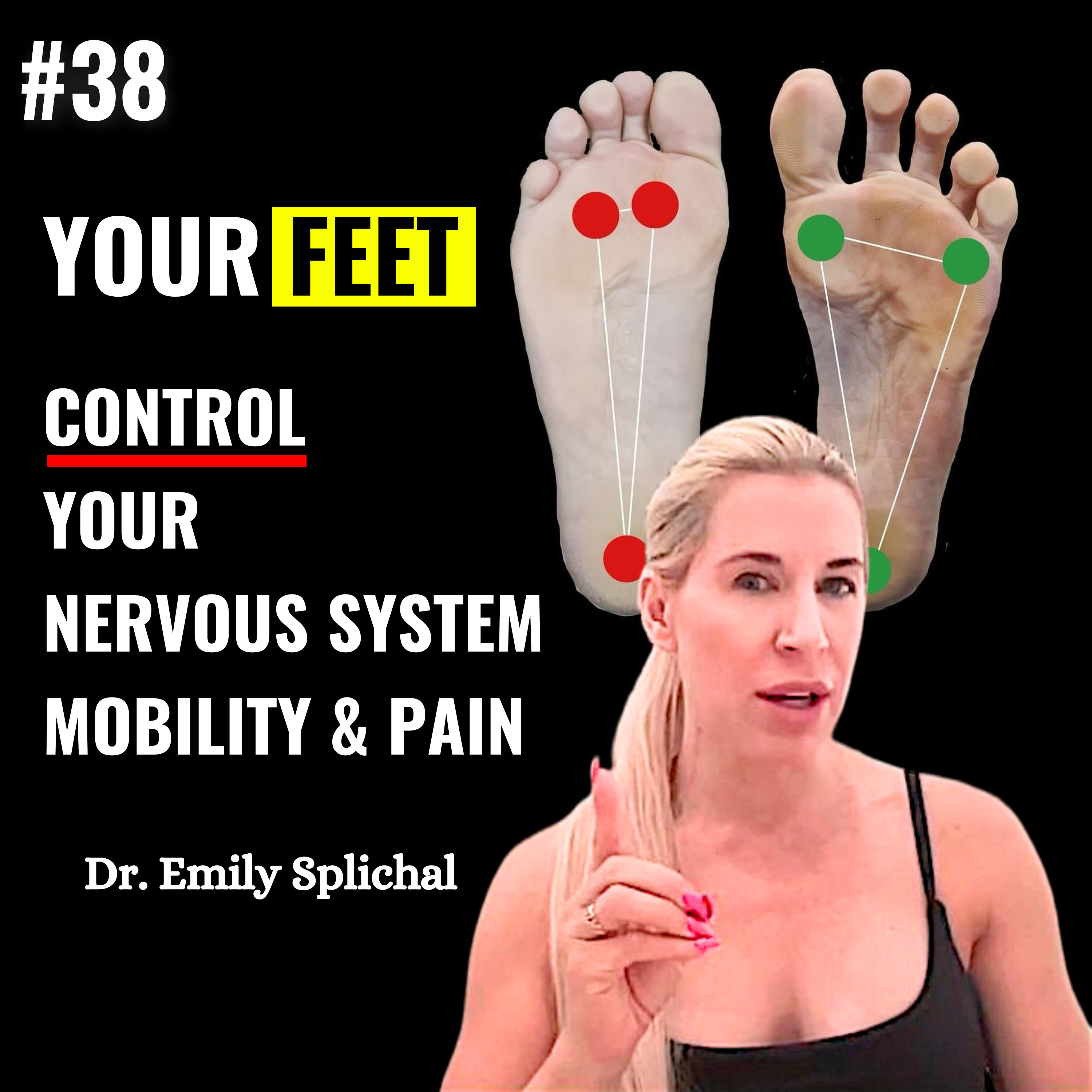
Dr. Emily Splichal Explains How Foot Health controls your Nervous System, Mobility & Pain Management | NABOSO Technology, Neuro Ball | Healthy Feet, Back Pain, Knee Pain, Plantar Fasciitis, Barefoot
What's This About?
Dr. Emily Splichal | Functional Podiatrist & Human Movement Specialist - Enlightens us on the importance of having Healthy Feet and what that means from a practical sense. We dive into the critical role feet have on regulating our nervous system state, mobility (range of motion), athleticism & most importantly pain free living! Towards the end of the episode we empower you with daily practical tools NABOSO technology & tips!
Definitely SAVE & SHARE this episode with a friend, this knowledge is extremely important & potentially life changing!✅
🔱 Eliminate Stagnation & Stiffness, Restore your Mobility & Function, Improve Blood Flow and take Care of your Fascial System with our Dynamic Stretching Routine Program! Only for limited time, you can get it at a 50% OFF ✅ with the code: GET50 at checkout 👇🏽https://www.mobility-fitness.com/dynamic-stretching-routine
👇🏽 In this Episode of the Fitness Wisdom Podcast we discussed:🎙️
• Dr. Emily shares her personal journey
• Why is barefoot living important?
• What does having "Healthy Feet" mean?
• Why are the feet often overlooked when it comes to whole-body health and movement?
• The corruption in the Footwear industry!
• What is Proprioception & why is it important?
• The connection between the feet & nervous system
• Organ stimulation through the Feet?!
• How does our Foot Health influence our stress levels and emotional state?
• How do dysfunctional feet influence mobility & range of motion?
• Common structural foot patterns / deformities that restrict the body's natural function
• The role of foot health in Athletic Performance
• How poor Foot function can lead to Knee, Hip & Lower back pain?
• Body symptoms signalling poor Foot function even if the feet don't hurt?!
• Everyday practices or tools people can use to start improving their foot health?
• NABOSO technology
👇🏽 You can find me on my other platforms as well, as work with me1-on-1 Online World-Wide 🌎
📲 Instagram: https://www.instagram.com/andreas_david_christou/
🎙️ Podcast IG: https://www.instagram.com/fitnesswisdompodcast/
🌐 Website: https://www.mobility-fitness.com/
▶️ https://Youtube.com/@fitnesswisdompodcast/
🐦 Twitter: https://x.com/movementandreas/
👇🏽 Find & Connect with Dr. Emily Splichal💎📲 Instagram: https://www.instagram.com/dremilydpm🌐 Website: https://www.dremilysplichal.com/▶️ https://www.youtube.com/@nabosotechnology👇🏽 Find the NABOSO technology we discussed about in the show through the link below: Use promo code: MOBILITYFITNESS for Discount as well ✅https://www.naboso.com/?rfsn=8680632.b2eb6a0&utm_source=refersion&utm_medium=affiliate&utm_campaign=8680632.b2eb6a0
👉🏽 Find the Best UV + Red Light Therapy panels, Blue Light Blocking Glasses & Circadian friendly light bulbs 🚨Use promo code: MOBILITYFITNESS ✅ for 20-30% OFF your entire order 👇🏽
https://www.emr-tek.com?snowball=MOBILITYFITNESS
👇🏽 Here is the Methylene Blue I use 🌀🧠
merakimedicinal.com/MOBILITYFITNESS
Use promo code: MOBILITYFITNESS to get 15% Discount on all products ✅🧠
👇🏽 Find the SHILAJIT I use & recommend below ⚡
https://mountaindrop.com/order/?ref=5873
Use promo code: MOBILITYFITNESS for Discount on your entire order ✅🧠
👇🏽 Find our favourite Functional Mushroom 🍄 Extracts Belowhttps://www.kaapamushrooms.com/MOBILITYFITNESS Use promo code: MOBILITYFITNESS for Discount on your entire order ✅
Get yourself a personalised Nutrition, Training & Lifestyle Optimization Plan designed for Your Body & Goals! Work with us 1-on-1 ✅ and let's Transform your Body & Health from the inside-out! 💎 The Link is Below👇🏽
https://www.mobility-fitness.com/product-page/1-on-1-online-coaching
*None of the content / statements in this Podcast are Medical or Personal Advice & is not intended to cure, treat, prevent or diagnose any medical conditions. All my videos are for Educational & Research purposes only. If you decide to try anything discussed in this video, you agree to do so at your own risk & responsibility*
This is the fitness wisdom. Podcast.
Hello, and welcome back to another exciting episode of the Fitness Wisdom Podcast. Today I'm joined by Doctor Emily Spitzel. She's a functional podiatrist, human movement specialist, and she's going to enlighten us today on the importance of having healthy feet and what that means from a practical sense. We're going to be diving into the critical role of the feet on regulating the nervous system, our mobility, range of motion, athleticism and most importantly, having a pain free life. So welcome to the show, Doctor Emily.
It's an absolute pleasure to have you. Thank you. I'm excited. I'm also very excited because I've been looking for an expert to have on the show when it comes to the feed because the feed have such a critical role in so many aspects of our being, right as I just mentioned there in the introduction. So I would like for you to dive into, you know, your own personal journey, how you got interested to studying fee in the 1st place. You're a doctor in Podiatry. So clearly there must have been some trigger or interest in your past that led you down this road.
And also you're not, let's say, a conventional podiatrist, right? You see things a little bit more holistically, if I'm correct. So if you can just dive into your story that I think the audience would find that fascinating. Yeah, absolutely. So my story is a little bit of a zigging and zagging and where I did not know that I wanted to focus on barefoot science, functional Podiatry. Real quick, a little bit on my back background is that I was a gymnast for 13 years. So that is a barefoot sport. At that time, I did not know that I was going to use that knowledge into my career.
And then I got into the fitness industry in my early 20s. And it's important to note that I was such a competitive athlete when I was younger because then when I started getting into fitness and teaching classes, my body was already used very heavily. So I was starting to get injured as a group exercise instructor and I I realized that I wanted to stay in fitness, but my body as a tool did not have good longevity in it. So I had to look at graduate schools, and I was living in New York City at this time, which is another important part of it, because one of my requirements when I was looking at Graduate School is that I had to be able to still do fitness and stay in New York City.
And there was one option, and that was poetry. So I became the diatrix partly because it checked those two boxes. Then I started to realize that there was a lot of opportunity in this profession that what was being taught very narrow, that I was not getting fed all of the information of how you could really look at the foot to the rest of the body. I do think that's because stayed within fitness the entire time. So then when I finished dietary school, I actually paused. I didn't go directly into residency, went back to school, got my master's movement, and then I went back to residency, get license.
So I kind of went back, needed more information to really connect the practice that I wanted, and then I went forward. I do, I think another really important part of this is that I've always been fascinated in longevity medicine or anti aging medicine it used called, but this deeper level of health and that we hold the control of our health and our own hands, that we have to be our own advocates. That's just something that I believe just deeper in my course wanted to push that into my practice. And I also guess I'm just a little bit of a black sheep.
No, that's wonderful. Yeah. And people like you are so important in this world, right? Because they are the ones who are changing the game when it comes to, you know, incredible tools and inventions. And you're the founder and CEO of Naboso Technology. Do you know, tell us a little bit about that, Like what it's about? What does the technology do for the health of the food? Light influences every single system of your body from mood, skin health, cognition, energy levels, gut health, sexual function, training, performance, recovery, wound healing, body composition, and so much more.
This is why I make sure to block the harmful artificial blue light and expose myself to the beneficial wavelengths of light. Optimized my biology? Upgrade your biology today by upgrading your light environment. Head over to emrtech.com/mobility Fitness and use the promo code Mobility FITNESS for a massive 20% discounted checkout for the best red light therapy panels on the market and the best blue light blocking glasses. Absolutely. So I have one of our products here. This is our one of our hand kit.
But all of our products show this. And if people are not watching video, I have a product that has all of these tiny little pyramids on them. And what that's doing is that is stimulating the nerves in the bottom of the feet and technically the palm of the hand. And those nerves, there's thousands of nerves, is an important part of how your feet read the ground, how your feet control posture, how it feeds into how you load and unload energy. So balance, posture, functional movement, athletic performance, injury prevention, all of this relates to our ability to feel our feet fast and then to stabilize our foot through center system very quickly and then to release power.
Everything, everything literally starts with your feet. And I try to tap into it through a sensory based approach and part of that is by using the Niboso product. And so for example, by using your tool, what would be the difference compared to, let's say, wearing barefoot shoes and sensing the ground and then utilizing a tool like yours? What does that do to the feet or to the nervous system to to change the body in a healthy way? Yeah. So a lot of people will wear minimal shoes or barefoot shoes, which is incredible.
That is an awesome first step. So you are wearing a shoe that is free of restriction, it is free of cushion. So you're getting a lot of movement of the foot, you are getting sensory stimulation to the foot, but it is still a barrier between the foot and the ground. It's still a barrier, a small barrier, but it's still a barrier. So using products like Naboso, either you could use our textured insole in the minimal shoe and it's a very thin textured layer that you just add to the minimal shoe. You wake up your foot even more or a lot of people like our products after they use the shoe.
So it's something that is done to reset and recover the feet. Even though you're wearing minimal shoes, you still have to recover your feet. It's something that you're doing after to be just an important part of your healthy foot regimen. So when you say that, what does a healthy foot mean to you? Like from your perspective. Yeah. So a healthy foot is sensorily stimulated. You can feel it, you can connect to it. You have very good mind body perception, which means you know where your foot is without actually looking at your foot.
When you walk. You are going up the stairs, down the stairs, jumping, changing direction, and you never have to look at the ground once because you have such a tuned in where your foot is in space. It's very, very important. 2 is that you have a strong foot, but a strong foot has to be connected to your center of mass or your core. So strong feet are are connected strong core muscles. That's very important. Also, the power of the foot or the strength of the foot actually lies within your toes. So you need to access your toe strength to really harness the strength of the foot.
Third one, really, really good station. So you have to have very healthy nerves with good circulation. Circulation is a really, really important part of a healthy foot. When I talk about circulation and feet, it's actually micro circulation. So it's the itty bitty blood vessels going to the skin, to the fascia, to the nerves, and that's an important part of how we keep a healthy foot and then just a recovery component. That's so cool. Yeah. All of these things that you just touched upon, basically on about healthy feet, we should definitely, towards the end of the episode, give the audience some practical tools and tips that they can do so they can restore their feet, you know, and gain that strength and function back and that sensation that you're talking about, that blood flow and all that good stuff.
Because I think it's so important to leave the audience with an empowering message so that they can start straight away. Because I feel like it's so simple, you know, but we have just over complicated as human beings. We have put our feet in these food coffins. And maybe you can talk a little bit about the corruption in the food industry if you feel comfortable about that. Because I feel that there are so many brands out there that are selling supposingly, you know, sports, athletic shoes, right?
And I feel like they're doing such a disservice to the modern human and especially to the the athletes who are performing at the highest level. Because if you think about it, most shoes are cushioned and they are a narrow tore toolbox and they are with a heel elevation. So that's basically decreasing our proprioceptive input to the brain and that's increasing our risk of non contact injuries. So why do you think that it's so prevalent, you know, this way of making the shoe? Why has the shoe industry not still changed their trajectory when it comes to making healthy shoes?
Yeah. So I've actually done consulting for some of the top companies. Nike is 1 helped or consulted with the Nike Innovation Kitchen for several years. This is back in 2000, 10/12/14, kind of around those years. And an important part of it is they, their role, and I understand this from an innovation perspective, is to try to push and defy what the shoe could unlock in the foot, in human performance, meaning that they believe that shoe is the technology. The technology I see. Yeah, So what there is a lot of innovation in cushion materials, right.
So think of all of the Super shoes. So the Super shoes was a demonstration of we can take this high level athlete and they can break their personal record by using our shoe, right. So that's and again, it's just the mindset of the footwear companies. Unfortunately, when you where all you're doing is unlocking your foot's natural technology, which is what minimal shoes do you kind of stop at that point, right. There's no to new journey evolution. You know, a lot of these footwear companies are also kind of fashion.
So there's a little bit of a trend that in it, it is the reality of the footwear industry. Footwear is part of the fashion industry. And I think if we and I'm huge advocate of of natural footwear and functional Podiatry and all of that. But if we understand and just create the space that it is and will always be a component of fashion and trends and just like, OK, it's just another trend and then you stay consistent footwear that falls into your core beliefs of optimizing natural foot function, which is of course the more minimal.
Yeah, and I love it. Now these days there are so many brands and companies coming out there all the time, minimalist, you know, shoe wear and barefoot shoes, and they are doing a really great job with the, the fashion side of things. I feel like, you know, there's so many more fashionable shoes these days. When it comes to barefoot shoes, in the past, maybe just even five years ago, it was you were very limited and they looked quite ugly. You know, and they're especially when you think about the most extreme case, which is the five finger, you know, toe shoes, right?
But I, I don't think they look ugly, right, because I've used them myself. And when you wear them all the time, you get used to how they look. And to me, they look normal. When I see someone wear them, they look normal. But someone who hasn't seen them before, they think that you look like a frog. Yes. So why do you think that the feeds are such an overlooked part of the human body? Why have they been, you know, just ignored so much compared to other areas of the body when it comes to health and overall well-being?
Yeah. So I would say partly because they are just in your shoes that they're very far away. See, yeah, you know, the hand is super important too. And it's very rare to have a hand specialist, right? When you think of like orthopedics and, and things like that, the foot is very complicated. I've spoken to many medical doctors here in the US, like friends and colleagues and, and things like that. And they'll say that as soon as a patient brings up something with their foot, they're like too complicated.
They're like, the foot is just so complicated. And then they're like, we're going to refer that one. So it's, it's just really understanding and kind of coming at it with a fascination. I don't know, I love it. I don't know why it is under focused, especially in the medical space. Do you want to give us some facts about the foot? I feel like the, the foot is so interesting, right? So for example, it has, it has so many bones in the human body, right? Isn't it the majority of the bones in one place or something like that are in the foot and you know about the muscles and all that good stuff.
Do you want to go into that bit? Yeah. So you have quarter of your bones in your feet. This is in both feet. So you have over 50 bones in your feet. You have 26 muscles in the bottom of each foot. So small muscles, there's 26 muscles on this foot, 26 small muscles on the bottom of this foot. The foot is when a baby is born. The foot is almost entirely cartilage. So you actually don't see a lot of the foot bones when a baby is born. A baby does not achieve a adult gate until about 3 or 4 years old.
So as far as the mechanics and the gate, we do not develop our art until around age 7. So it's another fun fact. There's over 100 ligaments in your feet. So on the top of your feet there's over 100 ligaments. So when women are pregnant and they increase relaxing the hormones to their pelvis can widen, foot also widen. So this is where when women are pregnant, especially multiple pregnancies, their feet, they say their feet grow, but it's actually not the foot is actually just dropping and widening because of those ligaments loosening.
So that is a fun fact I. Feel and I jump in there, I feel like the reason why the body does that right is to increase our base of support. Do you think that, you know, because I feel like the body never does anything by mistake, right? Everything in nature has a reasoning behind its doing so. I feel like that would give us a bigger base of support underneath the body, especially when we're carrying something in front of our body like a child. Yes. The only downside is though, if you when you give birth and you go back to your original weight and you're like, my feet are still wider, but I hope.
I see they don't go back. Yeah, then they don't go back. OK, well, interesting, I didn't know that. Yeah, yeah, they did not go back. But that's an important thing for women to know that oh, your feet can actually widen and it's the relaxing hormone to the 100 ligaments. Another fact, as far as the nerves on our feet, 70% of the nerves on your feet are sensitive to vibration and vibration are ground reaction forces. So ground reaction forces is one of the most important stimuli that you can bring into your feet.
So that's movement, right? Movement on the ground. The nerves in the bottom of your feet, their peak sensitivity is age 40, and then by the time you are 70, you need twice the stimulation to feel or to create that response. So that is another important fun fact about that. Yeah, I would say those are probably my big ones. I could talk about how much sweat you have and how many gallons of sweat in a day. I don't know some stuff like that if you want, but we'll keep it to those, no. No, that's, that's cool.
Yeah, I think that that is very interesting actually about the sweat glands, because I'm not sure if you're aware of Doctor Jack Cruz. He's a neuro scientists and I'm sorry, a neurosurgeon, retired neurosurgeon. And he's the, he's like the godfather in circadian and quantum biology. So I'd highly recommend that you check him out if you don't know him. And he talks about how the sweat glands are essential for absorbing the free electrons that we gather when we do grounding on the earth. And that's basically how we're able to harvest the electrons.
So that's super, super fascinating. I find this topic, you know, the quantum health area, like super fascinating and the feet and the hands and everything. We are literally quantum beings, right? We're not just this physical vessel that we see, but we, our body just extends beyond ourselves. So would you agree? Yep, Yep, Yep, Yep. And I'm very, I'm very into vibration and vibrational energy. I mean, people speak about vibration for like emotion and vibration. And you know, your state is either high vibrational, low vibration.
Our cells communicate through vibration. Yes.
So I'm very into that, that type of energy. Yeah. And light. I'm into vibration and light. Yeah, it's beautiful because when you realize that everything is happening on such a because chemistry is not running the show in our body, right? We have something else bigger that is governing our biochemistry because biochemistry is too slow. And so we need something greater, which is the electromagnetism, the electricity in our body, which is governing our basically our biochemistry. And this is what you're talking about.
It's that vibration, it's that light communication, communicating at the speed of light. And that's the beauty of the, the fascio system as well, which is also, you know, so much, you know, everywhere all over the body. And again, that's how the feet can communicate as well with the with the rest of the body as well. OK, so I've got a little bit of track. Sorry about that. About the sensation that you said about the decrease in the sensation, how it goes down by 50% after age 40. Why do you think that happens so?
That's that's demonstrated through studying people who chronically use shoes. If we wear shoes, you know, a majority of our day from the age of, I don't know, 5, something like that. For some people even younger all the way to 708090. You are creating a continuous sensory disconnect and then your body just starts to move with not all of the information. I understand. So how does the nervous system and the feet like? What is the relationship between the two and why is it is so important to understand?
Yes. So when it comes to our feet, there are, I mean that's your peripheral nervous systems. You have your central nervous system and then your peripheral nervous system, your peripheral nervous system is somatic, has a somatic function, somatosensory function. That is how we control our movement, our relation to our body in relation to other objects. And then, and we use that for navigating movement. That's the first part. But your autonomic nervous system is also connected through your feet, your lower extremity, your entire body.
So there's a big interplay between perceiving your feet, how it affects posture and balance, perceiving your feet or the nervous system, right, The awareness of your feet, stimulation of your feet and movement efficiency, energy transfer, loading responses. So that's again, movement, but then you have the side that, yeah, it's important in how you regulate. Am I safe or not safe? So kind of your survival response is very much connected to feeling grounded, right? We feel our base, we feel our foundation.
You know, I, I work with a lot of cranial sacral therapists that will use the feet to help the person use it as an anchor. So it could be an emotional anchor, right? I'm here, I'm safe, literally grounded or planted on this planet. I'm stable, I'm safe, right? And how you create nation as well. So I think that there's a there's a lot of power and interplay between. I often say memory, mood, and movement, so those are the three things that I think about. The foot sensorily activates or optimizes has a role in optimizing mood, optimizing memory, and optimizing movement.
Wow, so you think as well that the the feet, the health of the foot can impact our emotional state as well? 100% right. We have to to be emotionally regulated. You have to have a connection to your body, to your physical body. You have to know where it is in space. This is when you look act like proprioception, mechanoception, the sensory science of children or adults that have a hard time processing sensory stimulation. It's sensory seeking, right? Some people are sensory seeking and when they're sensory seeking, they're dysregulated and there's like an anxiety state.
There's kind of a a fear response that is and by re anchoring, connecting, turning up the volume, bringing the awareness that yes, I can feel my body in space. It then will down regulate some of that anxious or fear in these individuals. And that's an important part of my book, which is called sensory Sapiens is that's a lot about what I speak about is that I feel that technology has moved us away from how we connect to our body, right. If kids are not playing the same way and things like that, then a lot of that is them learning to connect to their body and space.
They understand these different positions. They stimulate the brain in different positions, they feel, you know, the body moving and they connect to that movement in a very subconscious or unconscious way that they don't understand that it has that it's really important. I often actually believe that why they recommend that someone that has some sort of mental health issue, but there's anxiety, depression, PTSD, whatever it is, is that exercise, working out movement, right. So they say this is good for you.
You should go to the gym every day or go for a run or a walk, etcetera. And a lot of people will will associate that the endorphin release, I think that that is a small fragment of it. But what I actually is more is that you are contracting your muscles. And when you contract your muscles by going to the gym, doing a workout, your muscles are surrounded by millions of nerves through the fascia. And your fascia has is the spider web of tissue that wraps around the muscles and the fibers and the fascicles of your muscles that you can't contract your muscles without stimulating your fascia.
And your fascia has over 100 million sensory nerves, which then talks back to your brain. You feel your body. So that's really why I think there's a benefit to movement to people for mental health reasons. Yes, Wow. Yeah, Because we tend to think of mental health separate from the body, right? We think it's something that lives in our head. And I tell people all the time that I believe that mental health is a physiological result, basically, whether that is a positive or a negative outcome. So how you feel, if you're happy or if you're depressed, if you're anxious, it's just because the majority of the time is that there's some imbalance inside of your body.
And we don't know what that imbalance is, but there is 1000 reasons that could contribute to that imbalance. And one of those could be what you just mentioned, that it's the lack of information that the body is receiving from the environment. And therefore it's feeling under threat to like there is an imaginary stressor or a threat in the environment which we are not aware of. And it's impacting us on a subconscious level. And this is what you're saying that that's why it's so important to feel our feet more.
Because another thing which I tell like my clients is that, you know, the feet are the only thing in contact with the ground right when you're standing. So if the feet are the only thing in contact with the ground, they must be kind of important to the brain. And that's where we're receiving the majority of the information from about how we should, you know, regulate our our posture and our balance and all that good stuff, how our muscles should basically fire and wire. And so the eyes have a critical role in our proprioception as well, the eye healthy.
So if our eyes are not healthy, then that can throw off our balance as well and make us feel threatened or put us in that fight and flight state. What do you think about stimulating the feet to stimulate the organs? Do you know much about the meridians in the body and how how the feet are connected with the meridians? Yeah, so I have as of late. It's so funny. Every podcast that I'm on is asking me that question. Really it's a sign from the I'm supposed to go study reflexology. So I'm not trained in reflexology, but I am a big believer in these different philosophies and the role that they collectively play.
So again, not not trained in it. I do refer patients to reflexologists, especially for more complex presentations where they're not responding. And I'm really trying to think outside of the box on what can help this patient. And so I have referred patients to reflexology. Very, very cool. Yeah. I mean I've noticed myself that sometimes when I'm doing some self myofascial release on the feet or anywhere on my body or if I'm using a spike mat or I'm going to be also receiving your technology soon to try as well.
So I'm very excited about that to see how I feel, you know, in the rest of my body because I, I just don't think so much about my feet with when I'm taking care of my feet. But I think about how my feet is going to influence the rest of my body because the majority of the time I noticed that it's my feet never really hurts. But once I take care of my feet, I noticed this. Wow, like this big relief in different areas of the body where I maybe had tension or I feel that I'm releasing some sort of emotion through my body because I've mobilized, you know, I've broken some adhesions or, you know, released some tension or some stuck emotions that were there.
So I think that's really, really cool. So maybe now we can move into how like the our feet is that the mechanism of how our feet is influencing our mobility and our range of motion. If there was 1 substance that could increase your energy levels, optimize mitochondrial function, boost ATP production, help to optimize your hormones, re mineralize the body with ionic minerals, boost cognitive function, assist detoxification and support your gut health via the microbiome. This substance is she legit known as the destroyer of weakness.
Shilajit is a herbal mineral substance made from the decomposition of plants and bacteria. This process taking place over thousands of years. It is harvested from high altitude locations, primarily the outside and Himalayan mountains. And what makes shilajit so unique is that it's made by Mother Nature herself. I call it nature's methylene blue. That's all shilajit that you find on the market is created equally. This is why I only use and trust Mountain Drop Shilajit. They have an extremely high quality shilajit product that has been rigorously tested for heavy metals and impurities.
Grab yourself some Shilajit, that destroyer of weakness today and head over to Mountain Drop Com Use the promo code MOBILITY FITNESS at checkout for a nice discount as well. Yes. So when you ask that question, my mind goes towards walking and how does it affect our overall movement, mobility, range of motion, things like that. When we think about walking, walking is a critical part of our longevity story. Like we have to be able to walk. We have to be able to walk the right way. And when I say that, I mean fast enough.
So walking speed is a correlator to longevity and it's very important to walk fast, walk fast. You have to be able to take long steps. Now, in order to take long steps, you have to be able to balance on one leg. So that's important. But you also have to have range of motion in your big toe, which is an important one don't think about. So if you lose range of motion, flexibility, etcetera in your big toe and you cannot extend it up, then when you walk you are going to compensate somehow. You literally cannot take a long step if you cannot move your big toe.
So you will then shorten your steps. You will most likely turn your feet out like a duck. Some people start to shuffle, a lot of people will March. And what happens is that when you change your step length, you take away reciprocal swinging. And the reciprocal swing between let's say your right leg stepping forward and your left arm swinging forward is that your pelvis is going in One Direction. And then your upper body, your T spine isn't going the opposite. So you have this counter rotation that is happening through the body.
That counter rotation is critical to facial health, to circulation, to joint health, to balance, to energy transfer. Like everything is literally linked to this ability. Take long steps and create counter rotations from your foot all the way to your head. So that then blocks and restricts the way that someone is moving. It becomes a very highly work. So they have to work to walk and when and people have to work to walk, people don't walk because there's that why energy expenditure, right? Most people don't want to expend that extra energy.
And this is a part of the sedentary issue and how sedentary feeds, you know, morbidity and mortality and things like that because it's changing how walk. So part of what I look at when I work with patients is I'm of course assessing all joints in the foot. What is the range of motion? But I want to look very specifically at the big toe, all the digits, but really it's the big toe. How much ankle plantar flexion do they have? So that's the downward motion. We need that to push off. So think of if you're doing a calf raise, right, your ankle has to be able to go into a plantar flex position, but then also dorsiflex.
So what's that mobility when we dorsiflex our ankle? That's how you potentiate the Achilles tendon. So that's how you store energy in that tendon. If you do not store energy tendons, then you do not have any elastic energy return when you move. That again becomes very exhausting to move. If you're not using your tendons to move, you are using your muscles to move. That's very exhausting. So people will stop moving, but what that that's kind of a start that hopefully gets the listeners to think about how powerful the foot is in movement in walking and how walking is not just passive subconscious movement that you get from point A to point B. It's a very, very important part of the longevity story is walking.
Yeah, yeah, it's a critical tool. I tell people to walk all the time because I feel like there's so many benefits beyond what people think, which is just burning extra energy, right? I feel like inner like exercise should never be used to burn energy, but it should be used to yield change within the body. And I feel like it depends what you're using exercise for, right? When you talk about resistance training, for example, for building muscle, people shouldn't be focusing on burning calories within the workout.
They should be focusing on trying to transform their body, like breaking down their body so it can rebuild itself and come back bigger and stronger. So you increase your resting metabolic rate and you do not need to do so much excessive cardiovascular type of activities to reach your goal. But I feel like walking is a fundamental human movement that we should be doing on a daily basis, despite whatever our goals are, because it just gives the body what you said, that information from the ground.
You know you're gaining that mobility. But as well, if you're not walking in perfect balance, meaning like your toes are not working as they should or your foot's not working as it should, I assume that can cause some downstream consequences too, right, If the foot is not working as it should? Yeah, absolutely. So wait, you can if your foot is not working the way that it should. I mean, this translates into foot pain, knee pain, back pain, shoulder pain, wrist pain, headaches, you know, fear of falling, lack of movement, confidence.
That's a huge, huge thing when you think about the aging population is the less that they're connected to your foot in the way that the foot connects to the ground and the strength and the awareness and that whole story. It really contributes to a fear of movement. And if someone is very hesitant in their movement, that creates overcorrection. And it's the overcorrection that creates the injury, right? This is anything athletic is that if an athlete overcorrect, I mean, that's, that's typically where the injuries happen, right?
Because you contracted too much, you shifted too hard, right? We need to everything is about subtle dances in and out of positions or in and out of Corrections. We have to anticipate perturbations. So a perturbation is a shift to your perception of balance, since that's what perturbation is, right? We have to be anticipating the perturbations. This is a big reason why I like barefoot training, because if an athlete or an individual does balance work or instability training or agility training or whatever it is barefoot, they will actually start to perceive the perturbation faster, and then it starts to become anticipatory.
And that anticipatory is really what looking for. Yeah, yeah, That's so important. And what kind of other food deformities do you notice when looking at people's feet, which are also leading to all of these problems? So for example, what are some common structural issues that you see in your practice? Yep. There are bunions, of course. Bunions hammer toes, so some sort of misalignment into the toes. I'm often where I think that when someone has hammer toes, cracks of the toes are a bunion. So it's a deviation of the big toe.
They have lost their stability or their anchor when they are in a push off position. It also decreases balance when you're just standing on one legs. Mid stance is when we stand on one leg. Push off is when you're in that calf raise and you're about to release energy. Both of those need a lot of proper toe alignment proper to string some other things you can see of course all in arches, right? I have a lot of lectures on how I look at in classify flat feet. Not all flat feet are weak feet. Meaning it's a muscle issue.
That's not flat. Feet are ligament laxity, and ligament laxity cannot be addressed through just strengthening the muscles. You cannot strengthen a muscle sufficiently to replace a ligament. A ligament is considered mechanical stability. Muscles are neuromuscular stability, and they they have different layers in which they create stability around a joint body part. I also talk about what's called a pancake foot. A pancake foot is a flat foot, but it doesn't have the rotational component of pronation.
Pronation is actually a rotational imbalance or collapse of the foot, where a pancake foot is literally just no arch. But they don't have the tibial rotation that is creating stress into the knees, hips, and lower back. So it's a subtle difference, which is important. High arches, super high arches can cause a lot of rigidity and movement. It can cause top of foot pain, stress fractures. Our foot mirrors hip. So if your foot is unstable times the hip and the pelvis will be unstable and the high arches are more rigid.
So that's going to mirror more stiff hips. So like a locked pelvis, you will typically see an association like that as well.
So which kind of talked at the beginning of what your definition of a healthy foot looks like, could you kind of visually describe it with your hands as well, like for the audience what how the foot should actually look like for with with your hands, Yeah. So a healthy foot were really you can put any foot into this position. You can put a majority of feet into this position if they have the flexibility. But the first one is I always start people by finding their foot tripod. So they would lift their toes and then find their tripod.
So underneath the first metatarsal head, 5th metatarsal head, heel, spread the toes as wide as you can and then place them back down onto the floor. So part of that is tripod, long, straight, flat, wide toes, those two things really, really important. Then you want to be able to create a slight lift to your medial arch. So the inside arch that is done through your hips. So if you slightly externally rotate your hip, it's oftentimes what happens when people squeeze their butt. So just squeeze your glutes and your hips should slightly externally rotate.
Do that movement and when you slightly externally rotate your hips, you should see that your arch lifts slightly. And that's what we're trying to create. The final part of what I do to establish a stable base or a healthy foot is going to be, it's called toe purchase. Toe purchase is when your toes are connecting to the ground, so you feel the ground or you grip the ground. Hey, I teach this what's called a forward lean. A forward lean is where you stand nice and tall. Your arms are by your side.
You imagine you're stiff as a board, stay stiff as a board and you're going to slightly lean your body forward slightly and then you go back vertical, slightly lean forward, go vertical, and every time you slightly lean forward, you should feel your toes gripping the ground. That gripping, anchoring, flexing, purchase use a word that you would like. That activation is a reflex because your body does not want to fall on its face. So it's activating this intrinsic or this innate reflex within your nervous system to pull your toes down.
And that's an important part. So that sensation of what your toes are doing is what I want people to understand. Can you now do this contraction, this gripping of the ground without leaning forward? So can you stand nice and tall, spread your toes wide, feel that tripod again slightly externally rotate into the hips and without leaning forward, can you push your toes into the ground? Can you grip the ground? And then you would just relax. And I take them through that a few times. It's a really good postural wake up.
Your toes connect to your pelvic floor. So every time you push your toes into the ground, you are technically waking up your center of gravity or your pelvic floor. I call it saying hello. So we're just saying hello to our posture, hello to our feet, hello to our pelvic floor. Do some deep breaths. You're ready to go. And that's that's an easy way to reconnect to your foundation. Oh, that was wonderful. Great tip for the audience. That was awesome. Yeah. I mean, I've never heard it so well explained before because you put in a nice structure for people.
So that's that's really nice. I'm going to try after the podcast episode. Definitely good. So how does how does foot health relate to our pain tolerance? I mean, so pain, pain is a state of your nervous system, right? So if you are in a more heightened state, an elevated state, you could say anxious, you could call it survival, fight or flight, something like that. You will have a more Alladenia based response. Alladenia means what should not be a painful stimulus is perceived as painful. So it's Alladenia calm in the nervous system, feeling grounded, feeling anchored, connecting to your breath, feeling your feet.
And then of course there's the conversation in the head has an analgesic effect that is keeping you in more of a parasympathetic state or a relaxed restoration state. And there are research studies showing that if a individual is in a sympathetic fight or flight elevated state and you give them an injection, they will feel it more than if they. They are cool, calm, parasympathetic, grounded, anchored. They won't perceive the stimuli so that that is really again that continuous interplay of sensory awareness, grounded anchoring emotion autonomic states that a parasympathetic and then yes, here you're trying to apply it to pain in our perception of pain and and pain is a very hard one because pain is highly subjective.
I can't, and I, I learned this as a clinician that I cannot discredit your experience of pain because I don't really know what you're going through. Have I experienced pain in my life? Absolutely. Physical and emotional, right. So that's where I try to create empathy for the patient and compassion, never judgment. Understand that they're having this current relationship to pain, their pain presentation and how can I obviously help them, but how can I guide them and educate them? How a connection to their peripheral nervous system could possibly down regulate that awareness of that sensation for them?
It could change their relationship to that awareness. I love it that you broke that down because I feel like so many people are experiencing pain which is not due to contact injuries, right? They're just experiencing some pain somewhere in the body. They don't know why it manifested. They just have it there and they, it just came out of nowhere. Just one day they woke up and they have pain somewhere in their body, right? And they, the last place that they would think about would be their foot and their whole body connection.
And I feel like this is exactly why it's so important to have this discussion because there is so much pain in the world. You know, there are so many people experiencing pain unnecessarily where they don't need to especially as well individuals who are athletes who don't need to be experiencing any pain, even though they're experiencing pain because they have a true disconnect with their like with their foot and maybe their body. Maybe they're trained, they're really good with the rest of their body, but they haven't unlocked their foot potential.
So now I would absolutely love to go into, you know, giving the audience some practical tools and tips and maybe talking about the Naboso technology as well, how we can incorporate all of that to help people improve. You know, they're grounding, they're anchoring the foot mobility and, you know, the range of motion of the foot, the foot function and also give the nervous system that feedback that we are well regulated and that we are safe. So yeah. When you're ready. So some of my tips are one, I would definitely recommend earthing.
So if you had your podcast on earthing grounding, people should listen to that. I'm a huge believer in the power of grounding and grounding in all different ways. PMF and different modalities like that. I'm a huge proponent of for your feet. Would I recommend for people every day starting their day is to release their feet. And this I will show the neural ball. So the neural ball from Nabo. So it's a ball that splits into two pieces. So you have two domes that is covered in the texture. So it's a little tiny pyramids across it.
You would leave this in front of your bathroom sink and just leave it there. Don't worry about moving it. If you need one somewhere else, get another one. But leave this in your bathroom so that you will use it every morning and every evening. But to go back to our routine, wake up when you're brushing your teeth. I like people to release their feet. We teach them how to do a 5 point foot release. You do a pinpoint pressure, five points on the foot, 20 seconds per point. You're just standing there.
We're not rolling as a ball. We are standing on the domes. You are allowing the pinpoint pressure, the texture to increase circulation, wake up the nerves, wake up the muscles. So we're doing that. That is great. We are then stepping off of the neural ball domes and we are finding that stable base that I spoke about earlier. So you're lifting your toes, you're spreading the toes as wide as you can. You find your tripod, rotate a little bit, do 5 to 8 forward, leans right. You're just subtly rocking.
And it doesn't have to be this dramatic, A dramatic sharp movement. I'll tell people just think that you're like a tree blowing in the wind and we're just kind of rocking back and forth and then that's it. That's all you're doing. Nice. As you do it right, you're waking up the fascial slings in the body and these partial responses in the body. Great. After you do 5 to 8, you're going to stand nice and tall and you're going to activate just a couple of them without leaning. But this time, every time you grip the ground with your toes, I want you to intentionally exhale.
So you're going to exhale 5 to 10 seconds. You could do it in several different ways, but you'll inhale, and then as you exhale, you will grip the ground. Exhale in the entire time. Relax your toes, inhale, push your toes down, exhale for the entire time, 5 to 8 seconds. We'll do that three times. Great. Now we are going to progress to single leg stances. You're going to grip the ground, shift your weight to one side, lift and you are in a full single leg balance for 10 seconds. Other leg goes down, grip the ground, balance for 10 seconds.
You're doing that three times per side. There's one more thing you're doing. You're going to take the ball, close it, put it between your heels, and then you're going to do 10 calf raises while squeezing the ball between your heels. That is your morning, morning foot routine that I would like people to do every single day. That's will. So what that is focusing on the nervous system waking up your nervous system. It's working on the fascial systems in the postural slings. It's focusing on circular because texture increases circulation.
It's focusing on the muscles of the feet, it's connecting your feet to your pelvic floor and your diaphragm, and then it's waking up your ability to stand on one leg. So to me that checks the most number of boxes and that should take you 6 minutes to do that routine. Something like that. It's, it's pretty simple and pretty fast when it comes to taking care of the body. I think it's so important that you came on the show today to give the audience these essential like tools and tips and to bring forth your technology as well.
So everybody can find a link to the Naboso technology in the description below as well with the discount code if they're interested in checking your technology out, I highly recommend it. So what would you say like that there is a difference between a spike mat standing on a spike mat versus standing on the Nabosu technology because I believe your technology is specifically designed to help, you know, the the food because maybe the spike is too intense, Maybe is it putting the body too much in a fight and flight?
What do you think? Yep. Absolutely. So they are complementary of each other. I have a acupressure mat. So the plastic spikes, that's pressure that is designed to of course, wake foot, increase circulation, stimulate the muscles. So the same thing, but it is more noxious, it's more painful, which means there has to be this emotional conversation override. So that falls under a little bit more autonomic. OK. I also use nail boards, so I don't know if any of the listeners have seen nail boards. I will use nail boards.
And really the science behind the nail board is autonomic. So it is trying to teach you to find stillness and calmness while being on metal nails. Standing also is mechanoceptive, subtle. You definitely feel it, but it's subtle. It's not noxious. It is supposed to be in the background to increase the awareness. So when people use our socks or our insoles in their shoes, you could walk around, you could exercise on our mats. You're not going to do deadlifts on acupressure mat or a nail board, right?
That's that is not, that is not the intent of those products. It is the intent of the Boso products though, where it's trying to heal your feet in a somatosensory movement muscle perspective. The acupressure on nail boards is autonomic, which is a different strategy to the nervous system, right? All all complementary. I love all methods that stimulate and bring in awareness to your feet. So I encourage people to look at acupuncture mats. If people want to look at nail boards, they could look at those, but understand the role of what they have in the in the toolbox, I guess you could say.
So basically the role of the Naboso technology really is to provide an environment for the foot as if it would mimic an outdoor environment like we would live in the past without shoes, completely hunting and gathering our food in nature where we're fully sensing and immersing the foot with the ground, with the different textures and temperatures. And this is all happening on a subconscious level and that's literally altering our postural alignment, you know, muscle toe, nervous system state and all that good stuff compared to the other tools, which are, as you said, they're complementary, but they're working on a different level.
And I understand that when you create pain in the body, like let's say if the spike might is too painful at the beginning, before you're used to it, you sort of create this bracing effect or this tension in the body, right? So you're not able to fully relax immediately. Whereas with your technology, it's something that you can utilize throughout the entire day. So your body is able to just, you know, the the foot is able to receive the information, the stimulus that it needs that is missing from basically wearing shoes or even even minimalist shoes.
Yep, Yep, that was a perfect recap. Thank you, Doctor Emily, it was an absolute pleasure to talk with you today. I really appreciate your coming on the show. Where can people connect with you and find you and work with you if they wish to do so? Yeah, thank you. Thank you so much. If anyone is interested in learning more about my work, definitely on Instagram, my handle is Dr. Emily, DPM, my Podiatry website. So I do see virtual patients all around the world. It is the functionalfootdoc.com. All of the Naboso products would be naboso.com, naboso.com.
We do ship globally. We have European distributors, US, Asia all around the world. And then Naboso's Instagram is Naboso under score technology. That's fantastic, Doctor Emily. I would love to do it again in the future as well. I'm sure that my brain will come up with some more questions. It would be great to connect again. Yeah, that would be wonderful. And there is so much more that we could talk about on this topic, so I would be honored. This is the Fitness Wisdom podcast.
 Apple Podcasts
 YouTube
 Spotify
 Castbox
 Castro
 Goodpods
 Moon FM
 Overcast
 Pocket Casts
 Podbean
 Podcast Addict
 Podcast Republic