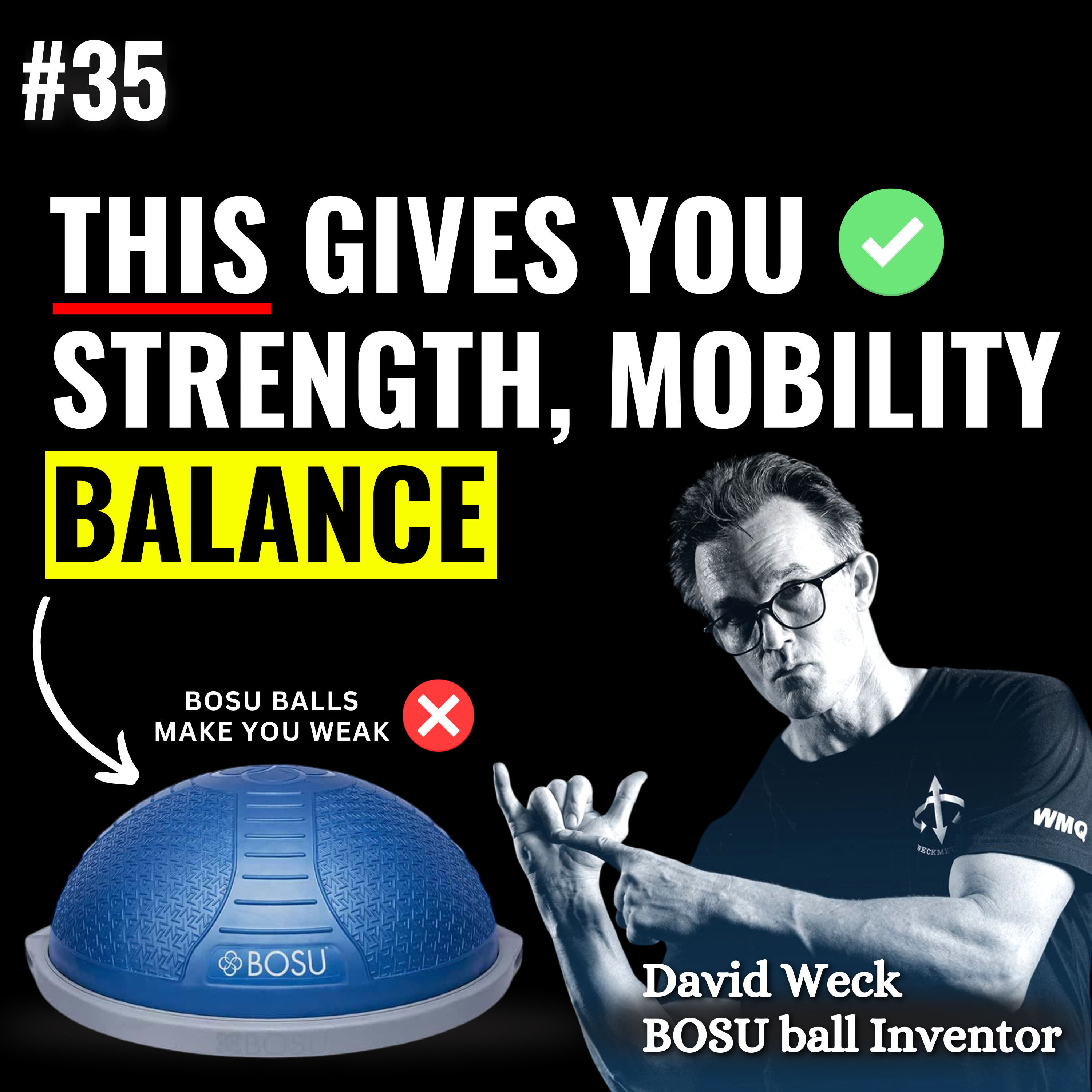
David Weck | BOSU ball Inventor Explains Balance, Pain Free Movement, Nervous System States, How to Walk, Move & Run with Perfect Balance | Head Over Foot | Weck Method | Functional Training Rope Flow
What's This About?
👇🏽 David Weck is the foremost Expert on the subject of Balance! He is famously known for inventing the BOSU ball and many other incredible training tools such as the propulse speed trainers, rope flow... for optimizing human performance, efficiency and balance of course! His mission is to help the world move efficiently, through perfectly balanced locomotion allowing you to take Every Step Stronger
Definitely SAVE & SHARE this episode with a friend, this knowledge is extremely important & potentially life changing!✅
🔱 Eliminate Stagnation & Stiffness, Restore your Mobility & Function, Improve Blood Flow and take Care of your Fascial System with our Dynamic Stretching Routine Program! Only for limited time, you can get it at a 50% OFF ✅ with the code: GET50 at checkout 👇🏽https://www.mobility-fitness.com/dynamic-stretching-routine
👇🏽 In this Episode of the Fitness Wisdom Podcast we discussed:🎙️
• David Weck shares his inspiring Story to inventing the BOSU ball
• Weck Method - Both Sides Utilized philosophy
• The importance of Feet for Balance, Pain free living, Performance & efficient movement!
• Head Over Foot
• Understanding Proprioception & Pain
• The need for Perfectly Balanced Locomotion!
• The flaw in the Science (to bend or not to bend the spine?)
• Rope Flow Benefits
• Fascial & Rotational Movement Training
• End point of Rotation?
• What is the Core Fist and how it influences the Fascial System?
• Structural Integrity - Bone Orientation
• Nervous System States dictate movement outcomes
• The many uses of the BOSU ball from Nervous System Regulation to athletic efficiency & strength output!
👇🏽 You can find me on my other platforms as well, as work with me1-on-1 Online World-Wide 🌎
📲 Instagram: https://www.instagram.com/andreas_david_christou/
🎙️ Podcast IG: https://www.instagram.com/fitnesswisdompodcast/
🌐 Website: https://www.mobility-fitness.com/
▶️ https://Youtube.com/@fitnesswisdompodcast/
🐦 Twitter: https://x.com/movementandreas/
👇🏽 Find & Connect with David Weck 💎
📲 Instagram: https://www.instagram.com/thedavidweck/
🌐 Website: https://www.weckmethod.com/
▶️ https://www.youtube.com/@weckmethod/
🐦 Twitter: https://x.com/thedavidweck/
👉🏽 Find the Best UV + Red Light Therapy panels, Blue Light Blocking Glasses & Circadian friendly light bulbs 🚨Use promo code: MOBILITYFITNESS ✅ for 20-30% OFF your entire order 👇🏽
https://www.emr-tek.com?snowball=MOBILITYFITNESS
👇🏽 Here is the Methylene Blue I use 🌀🧠
merakimedicinal.com/MOBILITYFITNESS
Use promo code: MOBILITYFITNESS to get 15% Discount on all products ✅🧠
👇🏽 Find the SHILAJIT I use & recommend below ⚡
https://mountaindrop.com/order/?ref=5873
Use promo code: MOBILITYFITNESS for Discount on your entire order ✅🧠
Get yourself a personalised Nutrition, Training & Lifestyle Optimization Plan designed for Your Body & Goals! Work with us 1-on-1 ✅ and let's Transform your Body & Health from the inside-out! 💎 The Link is Below👇🏽
https://www.mobility-fitness.com/product-page/1-on-1-online-coaching
*None of the content / statements in this Podcast are Medical or Personal Advice & is not intended to cure, treat, prevent or diagnose any medical conditions. All my videos are for Educational & Research purposes only. If you decide to try anything discussed in this video, you agree to do so at your own risk & responsibility*
This is the fitness wisdom. Podcast Hello and welcome everyone to another episode of the Fitness Wisdom podcast. Today my guest, the David Woke is the foremost expert on the subject of balance. He's famously known for inventing the Bosu ball and many other incredible tools and products such as the proposed speed trainers and also Rd. flow. And his mission is to help everybody to become pain free through balanced locomotion and athletic efficiency to take every single step stronger. So welcome to the show, David.
It's an absolute pleasure to have you. Well, thank you so much Andreas. This is a great opportunity to share the message and make every step stronger for everyone, and we're talking billions and that's very exciting. Yeah, and I feel that it's super important to share your message with the world because, you know, I'm pretty sure that every single individual has seen the Bozo Ball in pretty much any single gym that you walk into. You know, everyone has seen this Half Dome blue ball. And basically David Weck is the inventor of that, and he's going to share his personal journey to the invention of the Bosu ball from the very beginning.
And I feel that that that story super, super inspiring. I've heard it before on other podcast conversations. So I'm sure the audience would absolutely love to hear your journey to the invention of the Bosu Ball. OK, well, I was the first born of four children in my family. And so the 1st 19 months of my life, I was just showered with affection and, you know, nothing was wrong. So life and the life revolved around me. I was the center of the universe as far as my cognition and emotions felt. When I was six years old, I lost a foot race to two other boys and it sort of was this like, like, wait, how did I lose?
Like I don't lose I'm the best I also during six years old. What it says we can't access your video. Riverside is having trouble getting a sick up. We're back. OK, you're good. You're good. It's OK. It just has a little bit of a delay in the speech. It's OK, OK. OK, yeah. So, so when I was six years old, I also fell asleep standing up. And I think that imprinted an efficiency experience in my nervous system that I've been longing to discover and and ride ever since. So that that sort of set the stage.
And what I would say is I'm AB plus level athlete with a plus level competitive drive. I can't get paid to play a sport, but I'm a good enough athlete to know what is real worth your time and effort because I'm a good enough athlete, but I'm not a great athlete. If I were a great athlete, I wouldn't share any of this with anyone until I had exploited it for my career and then I would share it. But since I can't get paid to play, it's in my better interest to share it with everyone. And so it's it's it's a it's a bigger win than I would have imagined.
I'm very just fulfilled. My soul is fulfilled. SOLESOLESOUL to be at the forefront pioneering a you know, just better information to orchestrate, you know, just beautiful poetry in motion when you when you walk and you're going to walk anyway. Anyway, I went to Williams college. I played football at Williams College. Then I was going to go work on Wall Street and make a lot of money, like most of the kids there. And I sort of had this crisis of like, Oh my gosh, like that's going to be my life is like taking the train to New York City every day and like that.
So I just said, no, I can't do that. And I, I went into acting and as an actor, I was a personal trainer to make my money, but I was pursuing acting and I didn't care about personal training. I, I care about acting. And then I injured my back, dropped a motorcycle, injured my back, and it just led to chronic pain every day for more than a year. And in the process of trying to solve that problem, you know, blindfolded because I didn't know what I know now. If it happened now, would it be better inside of a week?
But then it was just stuck forever. Yeah, just through information, knowledge. So anyway, one night I was standing on the stability ball, big stability ball, and I was doing this minimalistic exercise where I was closing my eyes and just being really soft and gentle. And I did this and I fell instantly. I bounced off the ball, did a backflip landed across the room, kick my feet to make sure that I could still kick my feet because I land on my neck. And and and so that night I thought, what if I cut the ball in half and I just jumped out of bed?
I was like, whoa, I've never seen that. Like, wow, that Oh my gosh, whoa. And I was like, OK, I quit acting in that moment. I'm like, I'm taking this one. This is the big opportunity. I can hit, you know, a home run with an invention that you live the American dream where you know, you make money when you're doing nothing. So anyway, I worked real hard to get that off the ground. And then as it was sort of at that lift off stage, I made the decision to license the Bosu ball to a bigger company where they did the work.
I helped with the programming and product development, but it gave me all of my time to study movement. And so I'm obsessive and extreme. And I used those hours invested in trying to discover and, you know, understand what is the essence, what is the foundation of movement. And the answer, the only answer that it can be is locomotion, because that's the thing that bridges every other function. So if I want to get to the swimming pool, I'm going to walk to go swim, right? I'm going to go do gymnastics, but I got to walk from here to there.
So you're going to take a huge number of steps in your lifetime. And one of the reasons why I think you had such a successful pain remediation where you know, you felt stiff and your back hurt and now you don't, your back doesn't hurt. You feel more fluid. I think it's sort of A2 fold approach because you're getting the biomechanical sort of, you know, movements in the rope is the teacher, right? We're the coach and the teacher is the rope because they they can internalize and feel what they're doing and we can see what they're doing via the rope.
Rope will never lie if it's true. So you OK, you do it. If you do it enough reps, it's muscle memory and you don't need a rope anymore. You're wireless, but you're integrated, and you would not have integrated to that extent had you not availed yourself the opportunity to learn 4 patterns with the rope that you're not jumping through. Couldn't be simpler, right? So yeah. And then I've, I'm just in, I'm always searching, I'm always fiddling. I'm always trying to figure it out. Like literally figure it with my body so that I can have perfect balance.
And I discovered it and, you know, cute it. So it just head over foot. That's your first rule and it's the most important rule. And if you do that rule, you'll walk in balance. If you don't do that rule, well, then you won't walk in balance. All right, which is better? And So what what was interesting about this whole journey is the Bosu ball was accepted relatively well because the timing was right when it arrived. The stability ball was very, very famous and it sold really well. But then in 2007, science, exercise science suddenly said that it made healthy athletes weaker based on a study that didn't use BOSU balls in the study.
So there's a a lot of corruption in the science and this sort of agenda driven like we start with a hypothesis that we've already said as a theory. Now we're going to go prove it with the science. And then they're looking through a, you know, a little tube like this and they missed the forest through the trees. And the consequences to human beings is is, you know, catastrophic Because if I'm interrupting or messing up or glitching your survival reflect flexes, I'm talking about like reflexes that are faster than thought.
And if my first response is this, that was that was the wrong direction. And now I'm helpless. I'm I'm freaking out and freeze while I could have boom fight flight drop into and athletes don't fall. We drop into balance. We arranged the upper body so that when we drop it's perfect balance and it requires that we fluid. So I think in terms of, you know, your success with this, you're going through the bio mechanics that are true to locomotion. That's the underhand rope, right? That is locomotion.
If you're good at that, then you're good at locomotion. But then I think there's also like a deep psychological level where you you start to instill a deeper confidence because now the force transmission is clean. So you're getting the biomechanical thing, but you're not putting that little irritant into every other step that you take because you achieved perfect balance X on the map. So now whatever progress you make in helping yourself biomechanically and structurally, physically, you know, remodeling tissue, clean forces that are not being restricted with uprooting tension.
And you found it and suddenly everything was better and and it's a sustainable better because you've removed the thorn from the paw like you're in balance. And imagine if you did all this progress, but then you took a million steps out of balance. You sort of, you know, it's like climbing up a sandhill. Like you take a step, but you just keep going down. And so this is this is unequivocally true. It's, it's obvious if somebody's honest right now, the exercise sciences in the state of just absolute terror and fear because deep down they know that they're wrong.
And so now what it is, this is the last days. You know, it's sort of like, you know, you could make it analogous to what's happening politically. You know, heads are going to start to roll when we start to get the correct information about who did what and what was for and what actually happened. The difference is there's a lot of money involved in the politics. So it attracts truly evil people. But exercise science, there's no money in it, and it does not attract evil people. It attracts people.
Who? Methylene blue, an incredibly powerful substance that has an affinity for the mitochondria. Discovered in 1876, at first as a textile dye, it didn't take long before it was noticed for its unusual biological effects. Here is a list of all the things that methylene blue is known for. My personal favorites it is effects that it has on the mitochondria. Methylene blue acts as a redox agent. What this means is that it has the ability to grab onto electrons, donate and transfer them anywhere where energy is required in the body.
And we know that most Neolithic diseases these days are due to a lack of cellular energy, ATP. The more electrons we can get through successfully along the electron transport chain in the mitochondria, the more deuterium depleted water we can make as well as the end of energy production, which is ATP. The energy that we need to power all our cellular processes come from electrons. So it only makes sense. The more we take care of our mitochondria and our energy production, the more energy we have for our overall health, well-being and vitality.
If you wish to explore the methylene blue that I use, head over to maragimedicinal.com/mobility Fitness and use the promo code ABILITY FITNESS at checkout for 15% of your entire order. Have an ego to be right intellectually. That is the most important thing to them. Scientists, if you went to a convention of scientists, every scientist there wants every other scientist to be wrong so that they are right. And then they're Einstein, they're Tesla, right? You know, they're famous. They're, you know, they're successful and people, you know, live better lives because of their intellect.
And that's what happens in exercise science. And they think that they got to the top of the mountain, but they, you know, failed to fortify the foundation. So everything they do is now kilter because they're not aiming at the correct target. And intent is everything. If you're going to train, you have to have the correct intent. So it's the blind leading the sighted and the good athletes will do it naturally because it's natural to move in perfect balance and not natural. It's in build. Natural to what it's it's a modern contrivance of technology and convenience that robbed humanity of the need for physical and efficiency.
And if you don't need to do it as human being, odds are you're not going to do it If you don't need to do it. But as soon as you need to do it, well, OK, you're going to get really good at it because you need to. And so without my technology and convenience, you got to go get dinner. And that means that air breathing is the most important thing you got. But locomotion, swinging, throwing, catching, carrying, those are more important than water and food, because you cannot have water and food unless you locomote Bah, Bah, Bah, Bah, Bah.
So what we're doing is it's almost like our ancestors operated their lives from the locomotion one point O, where it was perfect balance, but it wasn't enhanced with modern technology. So locomotion we have locomotion we don't know is exercise science where they took us off course. And then I'm introducing what I call locomotion 2 point O, which is the best of one point O, everything perfect balance, but with the assistance and the capacity to make it even better than it was through the technology.
So we should make progress as we go forward. We should not, you know, just fall off a Cliff, especially for something as important as physical education. Like that's where you live. You don't live in your live in your body. So if your body is stiff and your personal trainer is making it stiffer, well, you know they're, they're not, they're not helping you the way they could be helping if they just taught you correct intent. And so many people are unaware, though as well. So many personal trainers and, you know, scientists are still so much more behind, like your work.
They're unaware of your work. They're either ignorant to it or, or they just, you know, don't want to pay attention because they've heard, you know, oh, bosu balls make you weak. You know, when you stand on a bosu ball, you know, it's, it's causing you to fall off and therefore it's making you weak. But they don't understand that the foundation that your feet is where you get your proprioception from like so much of the information that you feed to your brain to be able to produce more force output comes from your proprioception because sensory drives motor.
And that's what a lot of your tools are doing right, which is the bozo ball, the rope, the pro pulsers. They're giving you that feedback. Yep. What what we're doing is we're giving you up down all around so that you have timing, you have positions, you have transitions. So if you know the fullest capacity on your right foot to be longest and strongest right to the to end, the intent never stop. So even when the range of motion ends, excuse me, so even when the range of motion has reached its limit, the intent keeps going.
And when you have, when you own that you're not getting tired, you're poised to pounce. You don't have to warm up, right? It's just you're ready and you can bang. And now you learn that on your left side, now you got the leeway that anywhere in between, you know how to like drop it into maximum. And then it becomes, oh, every single step that I take can reinforce that capacity to move with better balance. Pretty soon that just becomes the new normal and you don't have to think about it. And that I think the thing that's frustrating is that what I'm saying is so obviously true if you just step back and use common sense.
And what science has done is it is literally neutered the intellects and the courage of people. So if you go that route into science, they're going to bludgeon you with what exists in the peer review. And the only thing that you can do as a researchers, you have to review all of the peer review and you have to ignore anything from the outside world that hasn't been, you know, blessed with the holy water of peer review. So you're not even taking into account things in the real world like the Fosbury Flop and high jump.
That is the essential, necessary technique because biomechanically it's superior. Yet it was denied for eight years by the experts when it arrived. So we have this phenomenon of willful ignorance because of fear loathing. And you know, they're afraid that they're going to lose relevance, which they are, and that's it. And they're not playing the hand right because the way you play the hand right when you've lost is you fold and you deal out another one with the benefit of having played the hand before.
And that's where if I've said pal off press is the foundation of exercise, which is what the expert said, you just say, oh, I was wrong. I was wrong, but now I'm right. And I do this. I do my programming sequencing, I do my, you know, intervals and stuff. I'm the best coach. And now I'm operating with the right information. And then you've got the list. You've got the name. That's going to be better than trying to hide in the hole and deny, deny, deny. Because then it's going to come and go and you're still like this, you know, like, oh, it's stiff.
It's oh, no. And it's their ego, especially that the OSU guy is the guy that's now humiliating them. Because it's a bully culture and bullies will not stop bullying. If you ask them nicely or if you yell at them, they will still take your lunch money and punch you in the nose. So your only choice with a bully is to beat the bully up in front of everyone. Right after school, we'll meet, you know, in the middle of the playground. And we're going to fight, and I'm going to kick your ass. And everybody gets to see you lose.
And now you have mud on your face. And now you can adjust your ego to be the good person that you actually are that was encumbered by the culture and the bucket of crabs around you. And I want to put an end to bullying. I hate bullying, OK? The righteous indignation that I feel when I see someone, you know, strong, picking on somebody weak that that no, that will not stand. That will not stand. Are you in high school? I used to Jack guys up. A guy was captain a football team out pretty strong and like I remember they were picking on this, you know, transfer student from Vietnam who didn't speak English had a little mental problem and these kids are picking on them.
I remember taking a kid and just like jacking on the locker, I'm like, you ever pick on him again? I will destroy you. Are you get that through your head that you ever to pick on him ever again. So I've had this throughout my entire life, this sense of righteousness that boys don't beat up girls, right? I don't care that you're competitive and you suck amongst the guys and so you're going to go with the girls and break records. They'll never be beaten by a girl just because you're competitive. And so you dress up like a girl.
A society that condones that and celebrates that is a society on the decline because it violates natural law. Don't beat up girls. That's not what you do, right? You don't do it. And a society that we're in right now, that we have lost touch with morality and reality. We've lost touch and one of the ways that you can fortify yourself, your body, your mind, and your spirit is to start with the body where it's accountable and it's real. And now you master body. And guess what? Brain and body, it's the same thing.
Everything. Your body is a root system for your brain and your mind. Your mind derives from that entirety. It's not just in the head where where it is, it's systemic. It's in your gut, right? You have a good feeling, right? We are energetic beings. We're spiritual beings. And if you walk out of balance and your exercise is reinforcing walking out of balance, well, then you're doing something that that will create more damage in terms of unfulfilled potential than you can even imagine by simply making the adjustment walking with balance.
So tell us a little bit about your philosophy about the BOSU. Bosu stands for both sides utilized, correct? So tell us a little bit about that. Like how, how is that like the, the most important thing that people need to understand in terms of, you know, athleticism and any kind of subject of movement if they want to improve? I feel like you because you, as you mentioned, you found X on the map. And I feel that that's so true because you start with the locomotion. And when you look at so many things like throwing, running, sprinting, even swimming, it's basically the same motion, right?
It's like opposite hand to opposite leg. And so you're doing this like spiral Figure 8 motion. And when you look at lizards and snakes, they all move in this Figure 8 motion but on the ground. But we're just like walking lizards, right? We're just dropping it back down and forward. And that beautiful motion that happens is, is also like an internal massage to the organs as well. So it's not just about moving right, but it just stimulates every aspect of your being. Yes. And and if you if you think about the capacity of the body, the more integrated the body and the less restrictive tension rising up, the more freedom of the being to resonate with a root and a foundation that is the bedrock.
So you instill a a profound deep confidence that can't be faked because if you don't have the root, you don't have the presence, you're nervous, you're you're rising up, right. So by investing in the capacity to be perfect in timing, perfect in timing. Now the body, it's like a bell like it's you tap it, it's going to resonate this beautiful harmony. Whereas if you're not, if you're forced transmission is impaired through uprising tension, well then you're forced transmission cannot be correct. And if you're forced transmission is not correct, the force magnitude could create a problem because it's not being delivered and and sent and delivered with with a clean efficient, you know, engram.
And so they're the I. Love it how you, how you talk about the nervous system and how like, you know, when you move efficiently and how we're supposed to, you know, with perfectly balanced locomotion as our ancestors did. And you're, you talk a lot about how they didn't have a choice but to walk and move efficiently because calories were scarce, right? And now we're living in a calorie abundant world with, you know, well, the calories are basically empty, you know, but the nutrient deficient. But basically, we have so much access to food these days that we do not need to be efficient movers anymore to be able to hunt and gather and provide, you know, for our families.
So I just love it how you always also connect to that aspect. I feel that that's so, so true. And also it makes so much sense and also the fact that you where you mentioned how you train your body, If you're training your body to be uprooted and stiff by trying to constantly brace your core and be, you know, like upright during, you know, pile of presses and different movements that are, you know, forcing you to keep your spine super stiff, which is never happening in any other situation but in maybe squats or deadlifts.
And maybe we, you know, you could even argue that as well, like in other than that, you know, outside of the gym, it has no applicability like at all. So it just, you know, what you're saying is wiring your nervous system to be more in this sympathetically dominant state because it it doesn't have the capacity. Well, I think what it is is if you're not operating with perfectly balanced locomotion, then I think that that puts I, I, I was just about, I had a thought on how I could express that, but it's, it's just escaped me.
Don't worry about it. You just said again. No, I was just saying that basically you know about the nervous system and how that you know when you're doing this bracing type of work. Go ahead. Yeah, I got it. So, so basically, to the extent that your nervous system has to protect you with compensatory restrictive tension, right? To the extent that, that, that that is happening, your, your nervous system and the N grams, right, the coding that the networks that you're myelinating and making permanent, right?
Practice makes permanent. You're, you're now ingraining this, this response, a reaction to threaten opportunity where you, your nervous system is too nervous. And what we're doing is we're making the nervous system relax and be cool. And so what's so important for energy preservation and efficiency? And it gives us the capacity to operate in a manner that's parasympathetic, and it can drop into sympathetic at any instant and then get out of sympathetic in an instant because you're there so you can catch the food, so you can bring it back and the family can eat tonight.
That is the number one objective. And you don't fulfill the objective, well, then your family lineage, it ends. OK. There's no points for being a good person when you know you can't get food, right? So the nervous system cannot be nervous because then you're operating with a degree of sympathetic. And you're never truly parasympathetic. Never because, because the nervous system is nervous, because it has to be nervous, because you can't orchestrate perfectly balanced locomotion. You're, you got a monkey on your back the rest of your life, every single step you take.
And it's just a little bit. It's not enough to notice now, but it's the accumulation of the bend, the volume and just the, the tonnage. If you think about, you know, OK, you weigh 150 lbs, you're going to walk, it's going to spike a little higher than 150, and now you're going to do that a million times. But that's more weight than you're going to lift. You know, on a bar or dumbbell. You're just taking so many steps. You're taking so many steps. And again, that the harm is not noticeable in the now, which makes it that all the more insidious because you're chipping away and you're not even aware that you're being chipped away, right?
You, you don't even have a clue. And then if your personal trainer is telling you to be stiff and you're investing in that and you don't have the natural athletic intelligence, so you follow the instruction, well now, OK, well, that trainer's chiropractor and his networks, you don't get some business all right, 'cause you're going to be working them out and they're going to be stiff. They're not going to feel that good. And, you know, and then they got to go get an adjustment every week and everybody's happy because they don't know.
And the ignorance is bliss until it's not. You know, I think it's so important that we talk about this because, you know, I've talked with many other guests over, you know, over time on the podcast about the nervous system and regulating the nervous system state and how important it is to be in the majority of the time in our day in a parasympathetic state. Because that is when our body is able to heal, to regenerate, you know, to toxify and to to improve, right? And to come back stronger than before.
Because during the sympathetic activity, when we break down basically our body, that is not when we are building. And I think, and it's so fascinating to hear it from a movement perspective because I've never heard it from anyone else before talked about in this way. But what you're saying makes absolute sense. And that so many people just by the way that they are inefficient through their movement, they are automatically placing their body in a sympathetically dominant state without even trying because their body is not moving as it should, you know, with perfect balance.
And so they're experiencing pain and obviously pain is igniting that sympathetic activity. And it's like this constant loop that's going around. But as soon as they experience balance in their body and their tissues and and structural integrity starts to align and they become more efficient. That's when they're able to now able to come more into a parasympathetic state. Of course, there are so many other things that influence your nervous system state. Like light influences every single system of your body from mood, skin health, cognition, energy levels, gut health, sexual function, training, performance, recovery, wound healing, body composition, and so much more.
This is why I make sure to block the harmful artificial blue light and expose myself to the beneficial wavelengths of light. Optimized my biology? Upgrade your biology today by upgrading your light environment. Head over to emrtech.com/mobility Fitness and use the promo code Mobility FITNESS for a massive 20% discounted. Check out for the best red light therapy panels on the market. And the best blue light blocking glasses you're breathing the type of light that you're exposed to, you know, sunlight or artificial blue light.
Your relationships, whether you sleep good or not, you're the food that you eat. If you drink a lot of like coffee or if you don't like, if you drink alcohol, like all these things are influencing your, your nervous system state, right? So if you are also doing the movement side of things wrong as well, even if you're unaware, that's even worse, right? Because it's on a subconscious level and it's happening all the time. And then people are going with this level of dysfunctional foundation to the gym and then they're applying load onto that dysfunctional foundation.
And then that's what leads to, you know, pain, discomfort, injuries. And then they think that, you know, that specific exercise like the squat or the deadlift or whatever is not good for them. When in reality, it's just that they haven't built that foundation outside of the training on the 23 hours that what are they doing? How are they moving? How are they operating? And then, you know, that's basically resulting in how they're feeling in their in their body and in their mind if. If if you think about structure and function, the structure will dictate the function in the now, and the function will transform the structure over time.
So your body is always remodeling itself. So seven years from now, every cell in your body is a new cell, you know, blah, blah, blah. So it's always remodeling itself and the structure will model itself according to the forces acting through that structure. So when those forces are aberrant and not clean, now the, the manner in which the fascia and the muscles, the way it's going to lay down the, you know, the structure is going to take into account that, you know, the, the impairment of force transmission where it gets stuck.
And now you have a knotty dub like, you know, fatal thing that'll never stretch, right? Because it remodeled according to like static. It's like trying to record the radio show when you don't have the signal, it just keeps going in and out, whereas you got to tune the dial. So that OK, yeah, we got, we got a clean signal because then we're going to remodel this. I had my hip replaced and I literally jogged off the recovery table. I wake up, I get up, I'm like, watch this, Bing, Bing, Bing, Bing, Bing.
Because you have the foundation down. I got the foundation, I got the basics. I know how to breathe and I know how to balance, right? I mean those are the basics, breathing and balance. You know how to use all your body to move your legs, not just your legs to move your body. That's right. And you're moving without moving. So I can be here and here and my center doesn't have to change, which means that, you know, balance is in the air and it's the upper body first. Because if the upper body is like not in a position, well, then the feet can't do anything anyway.
So all right, you know, the feet are not as important as the head. You can cut off your feet and cut off your legs, but you can't cut off your trunk and your head, right? These are obviously more important. And what am I trying to move there? I'm trying to move my brain so that I can feed my mouth. And like, this is what has to get there, right? This can figure it out, you know, cut off the hands. Okay, well, I'll make a gun, whatever, you know what I mean. So I'll make a trap and then I can catch them when I and I just wait, you know, so we have an ingenuity about us that our upright bipedal strategy for movement, which takes a lot of sort of, you know, the engine is always idling because you have the burden of of the balance, right?
Whereas A4 legged creature, they get to rest and their belly is horizontal. So all the organs get to rest and we pay a price in terms of the squishing down of our organs cuz we're upright all day, right? So we have the gravity bringing us down and prolapsing us, right? So our job is to be able to raise up and send down and raise up and send down. And if you can't do that, you've broken the cycle that is the nutritive generative movement that is sustainably strong. You're not going to go wrong when balance is the foundation and relate to gait.
That is the the mandate. That's great. I love it. It rhymes. You got the mandate is relate to gait with your exercise. And if you're not relating to gait and you're making gait worse, all you need is a good reason. That's all. OK, that guy wants to squat, you know, 1000 lbs OK, well, maybe he's not going to move quite as well when he's bulked up to 350 and he sort of waddles around. But he did what he wanted to do. So there's no hard and fast rule that says anyone has to do anything. But if we don't present the option and we don't give them the information and the knowledge, well, then you're going to make poor choices just through ignorance.
They don't know and they don't have the time to figure it out. Even people who are at that level who want to squat 1000 lbs and they're pretty big in their body, they can become so much more athletically efficient by incorporating some of your work. It's not that bodybuilders, for example, can't move with the rope and all this kind of stuff. When you see them move and they start to get better at it, everything you get that hand eye coordination, the feet going, that pivoting of the feet, you know, and the ankles and you see that beautiful motion going.
Then you start to realize, wow, you can be big and you can be also athletic and functional, right? Yes. Well, and I'm going to say boldly because I know it's true, is that our unique approach to training where we go all the way on the side and all the way on the side. If you don't go all the way to each side, you'll never master bilateral as deep as you could when you've gone to side where you get so much deeper. So I will make you, I will make you stronger at squatting whilst we're making you more fluid and athletic.
So I'm giving you stronger too. And I've got world record squad holders who credit me as a significant piece of the puzzle to help him break 6 world records in a row where the first world record was harder than the six world record, where it went up remarkably easy. All right. And it's boiling the core. And Joe, even Joe Sullivan is the guy I'm talking about. And even he he says it is in your best interest as a power lifter, anyone to side and to side and to center. And what happens today, especially for those competing in center is they never do side.
The idea of side would be like a one arm dumbbell row with, without any coiling intent. So you're, you're, you're missing the opportunity to get the most out of that energy and time just because you don't know that side. Side center is the approach to optimize center because without the sides, you know what I'm saying? So it's very important. It's very important that we all recognize stronger is better. And I mean, if all things are equal, This is why boys shouldn't, you know, box against girls because stronger is better.
And his bone structure is stronger. So it's not just his muscles when he hits those bones are those bones are heavier. OK? They can send a lot more force than a girl. And the girl's center of mass is a lot lower than his center of mass, right? She's hourglass. And there's a lot of weight down low. The guy's AV, the weight's up top. He has more vertical potential to move better. I mean, and these are just physiological facts, you know, never mind the chemistry, never mind the chemistry, you just like look at the, you know, just just look at the capacity and you're like, OK, that's multi factor.
You know what you said before about going to the extremes on the left and the right side? I always tell people that if you never go to both extremes, you never find the center, you know, and I feel that that's so true because how can you know where the center is if you don't go to the both extremes? I'm this kind of person who is, you know, over the years I've been an all or nothing kind of person. And I feel that for me has been a blessing in disguise because it helps me figure out pretty quickly what works and what doesn't work.
And then I, I like to always overdo things and then back off because then, OK, I know that this is like the perfect amount for me, right? And then exactly what you're saying with this, you know, balanced locomotion and finding the center line of your body, which is this perfect, you know, balance, you know, between the left and the right side can only be discovered if you exaggerate. You over exaggerate the left and the right side motion so that you can actually understand where center is. It's the same thing when you think about the pelvis, when you tell people to practice a pelvic, you know, tilt, you know, backwards and forwards.
If they never do that, they don't know where their pelvis is actually sitting, you know, if it's actually in the center or if it's posteriorly or anteriorly rotated. So I think that this, what you're saying is so, so important. So maybe you can give us some examples of how, how would people go about utilizing the Bosu ball for, let's say for preparing for a big lift? Yep. OK, So before we talk about the BOSU ball is a, is a PAP device, a post activation potentiation device. It's perhaps its greatest value is in what I call reset threat.
Everybody has the threat of falling that the nervous system is 100% to make sure you're not going to fall, right. So that's just baseline. The nervous system is occupied in keeping you here, right. And like I said, the upright bipedal strategy costs a lot of brain to orchestrate that balance as opposed to something that is easy structurally easier to balance. Like a table is easier to balance than just, you know, a table with two legs, you need a third leg, right? So the beginning with the end in mind is how you make all your effort get you to the end that you're after.
And. You have to aim at X on the map, otherwise you're off the mark and you're teaching intent That is incorrect. It's wrong strong, and it'll last a long time if you do wrong strong training a lot. Yeah. And because because the narrative right now is, you know, you have to keep your spine stiff, keep your arms 9090 cheek to cheek, right? That's just wrong. It's never been correct. It's been said from the beginning, and I'm the first person to say no, it's the side. It's the side. We're playing catch with the right, playing catch with the left.
It's got to be clean, nice throws so you can get the double play. Like you can't throw a wild one where the guy runs the first base and he's safe. You know, this is, this is and, and it's, you know, it's the vessel for your being is your body and it, you know, even if you don't eat right, at least move right, you know what I mean? Like moving right is so easy. Eating right, that's hard, you know what I mean? Because the ice cream and Oh well, it's, you know, it's the birthday. I got to have a piece, you know what I mean?
All of pizza, you know, beer, those things are hard to not do. People fall off the diet wagon all the time. But there is no reason why you should ever take a single step out of balance. Yes, exactly. I mean, it doesn't cost you anything. In fact, it makes you so much more. It makes your life so much better in every single aspect. That's what I've noticed. You know, every single time I go for a walk, I find it like an opportunity to just improve my athletic efficiency for my training as well. And through life, the way that I move, I can just be more efficient and just spend way less energy when I walk and I'm just less tired.
And plus at the same time, I feel like I'm doing something so good for my body, right? I'm not not actually causing harm because as you mentioned, if you're walking upright, rooted and stiff and your joints are not moving as they should and you're constantly applying those thousands and thousands of reps on the joints on a structure which is not aligned as it should be, eventually it's going to deteriorate. And then that's where issues, pain, discomfort, inflammation starts to come in. And. And, and the the first step is addressing the survival reflexes and patterning it, patterning the response correctly to threat and opportunity that you get to seize like now, otherwise it goes away.
So the reset threat, the Bosu ball when the Dome is up gives you this magical experience where it's extremely difficult to get hurt when the Dome is up. Yeah, the correct way. Use it the correct way. Well, but also there's utility on the other side too. But what makes it special is this. You can lose your balance without damage. And what you do on a bosu ball is you do a minimalist approach where you you can put your hands on your hips, you can just hang your arm, hang your arms down to your side.
And your job is to create the perturbations with your vestibular and your ocular. That's going to make you lose your balance. And what you do is strategically, don't try to save yourself by doing this counterweight. Just chill out with your upper body and figure out down low, right? And so if you go, if you go through that process, your reaction time or your reaction response will improve. So the reaction time is the reaction time. And whether you do this or whether you do this, that's the same time.
But this response gives you productivity in the time where you're seeking solutions, where is this is just protective and you're just, you know, there's no solution except for oh, please, I hope I don't get hurt. So that's the first thing with the BOSU ball. Now for a post activation potentiation, what it is, it's in the category of how you use a BOSU ball called limit force elastics. So with elastic force, there is an urgency that can't be replicated with any other stimulus. So 100 lbs of pole on an elastic band is fast like a slingshot where is 100 lbs of mass is 9.8 meters per second squared.
So the same force coefficient can be like charged or just, you know, heavy. And so we use the charge and elastic bands. What you do is you stretch them to limit and then with the Bosu ball, you compress it to limit and it works through the hands and through the feet that you're getting this center line strength and you're training the adductors to both flex and extend because it's torsion and it's not flexion because figure eights through the hip. It's not sewing it back and forth like this. There's this cycle, right?
So it keeps on going. If I have to start and stop all the time, that's not efficient, but I can keep it flowing. Well, that's the way God intent, right? That's the way He made us. So what we do with the limit force elastics is, let's say you took an elastic band and you wrap it under the bosu ball. So your feet are on the bosu ball and you're grabbing hold of an elastic band here and you squat up halfway so you can still send force and you're not squeezing the adductors, you're routing the adductors through the skeleton.
And you hop off and you have, you know, a momentary sort of excitation that will lead to a better performance on that particular lift from that potentiate. And it's literally just a 123 done, you know, and you can, you can train it to fortify those positions under the load, not urgent load by holding it for time, right? If you hold it for time, you're not going to deadlift more. But if you're prime, you will likely improve your deadlift. So that that's that's how you would use it as a post activation potentiation.
But I think the first thing, and it's not sexy and it's not really appreciated. But now because all the other stuff is so sexy, because it's the best form of fundamental physical education ever taught, head over foot, it's simple, right side, side center, move without moving. Just all these simple, simple principles that we put into practice. And we're essentially doing the same thing over and over and over with different tools in different ways. But it always comes to we weck methodize everything that we do.
So we get more from it and, you know, and, and, and it did just the social proof is already manifesting. Like people get faster and stronger with us, you know, after they've spent their entire time with someone else. OK, no, they didn't teach you perfect balance. And so everything they taught you was, you know, had a little glitch in it somewhere, a little hot spot. It didn't make the force flow. It sort of caught the force and kept it inside you and then you collapse with a non contact injury, which is like common and typical these days is the kids literally are dropping like flies and there's nothing that happened.
Like nobody else like knocked into them. They just ran and collapsed and now they need surgery. I would argue that if your nervous system's glitchy, the likelihood that you're going to have a problem on the field goes way up. Way up. You know, I loved it that you broke the BOSU ball down South nicely because now it helps people understand like the how much important function it actually has. Even if you're not actually a person who trains, even if you just simply have it in your home and you stand on it every single day, how much more resilient your nervous system can be because once you're off the BOSU ball, you can now relax.
That's what I noticed when I stand on a BOSU ball, I just simply stand there and I'm just chill out on it in the gym and I come off, I feel like my whole body just won't the melt like my foot melts on the ground. It's sort of like it does what it should be doing than than before I stepped on it, you know, and now I feel like, OK, now I feel like more ready because I'm more smooth and you know, smooth is fast. And then when you're, when you're smoother, you're more efficient, right? So you're doing things with more intention like you mentioned.
But when you're working or from that fight and flight state, you're not smooth. You know, you're stiff and you're braced and your, your, your joints are not moving as they should. Then I guess now would be a really great point to talk about your core fist and the different the core the hand course that you teach and how the fascia of our body is so important for athletic efficiency. And basically everything that you're doing and teaching with all of your incredible tools is always incorporating the facial system that is the energy transmission system throughout the entire body.
So maybe you can go into that. So basically, if the bone structure is not correct, meaning optimal for forced transmission, then the fascia can't solve the problem, right? So the fascia and the skeleton become the two things. Like the skeleton is enveloped by everything else, but it's fascia that's enveloping everything else. So when we put this and it's not stacking bones, we're not like, you know, Ding Ding, Ding. It's this complex spiraling thing that don't even think about how complex it is.
Just focus on what works and pattern that X on the map, right? So as long as I'm getting that X on the map and the Bosu ball, what's so special about it is it introduces upsetting balance without threat. So your nervous system feels safe. So you actually have a chance at re patterning your response to threat and opportunity. Your fight flight drops into effective behavior right now before you could even think. And you're either this or you're this and it's one or the other and it's never nothing.
It's either this or it's this, and we want this, we don't want this. And so tell us a little bit about the importance of how you arrange your hands, you know, when you're doing different type of activities because I've noticed massive benefit when I, when I configurate my hands like this, I find that, you know, I'm more efficient when I'm moving. Yes. So you have a huge percentage of your skeletal structure in the hands and the feet in terms of the number of bones that are, you know, sort of arranging, excuse me, think I'm fighting off a cold, say, what was the question?
Yeah, about the orientation of the bones. Yes, OK. So because we have so many bones in the hand, we have an opportunity to create architecture with a structural integrity where force goes through the bones. So what happens is when we arrange it like this, we have somewhere that there is no end. You can keep compressing this and it doesn't get hurt. Whereas if I do this, this is for the purposes of holding something, it's not for the purposes of punch, right? A long time ago, if you didn't show up to the fight without a weapon, well, you'd lost.
I mean, empty handed combat is a modern phenomenon that, you know, maybe the tribe had little contests who could wrestle who they probably did. But you know, you had to get good with a weapon back then. And the interesting thing is, the better you are with a weapon, the better you are without a weapon because the hands have so much intelligence. So by structurally arranging the hands into fundamental positions of strength through the skeleton, because like I said from the beginning, if the bones are not correct, well then nothing can be correct because the bones are the strong part of your body, right?
I mean, your bone is stronger than your your muscle, right? Your bone is the most dense thing in you, right? And it's the architecture. So even the the modeling of the chalogen crystalline matrix of the bone structure, if the force is clean, you're getting very clean, beautiful bones. But again, if it's a force is all out of balance and this muscles tugging on that and that's tugging on that and the bone ain't getting that nice fluid thing. And that means that the bone itself doesn't have a beautiful matrix.
The bone itself has modeled itself to deal with the fact that you got this as your foundation. Wow, yeah, it's incredible. You know, like what you can do with your body just alone without any tools at all. I tell people all the time that your body is the perfect gym. You don't need to. You don't need to have like any tools to be able to have an incredible workout or to be able to move your body efficiently. All you need to do is to know how to position and transition like you, like you say, you know your body in an effective and efficient way, which is not going to hurt you, and that you can feel, you know, alive.
And that's the whole purpose. And it always goes back to what you were mentioning about, you know, our ancestors and, you know, our ability to hunt and gather our food and survive and to be able to, you know, hold things and grab things, throw things, carry things. If we're not moving in the way that our ancestors moved, you know, causing a lot of problems and dysfunction. And I feel like This is why it's so important for us to have this conversation. If I'm going to carry something, I'm going to carry it on the high side, Yeah, and I'm going to walk with a same side stride like this.
I'm not going to queue up a Part 2 if you want. 100%, yeah. I had like maybe 10 more questions. All right, so let's let's queue up a Part 2 and then we'll go through those 10 more questions. 100%, yeah. Thank you so much, David. It was an absolute pleasure today for sharing this very important and valuable information. I felt that, I felt that we gave already the audience so many incredible facts. Where can people find you, connect with you, and, you know, reach out to you if they wish to do so?
Yeah, WEC method.com is where we have, you know, everything on the website and then the David Weck, THE David Weck on Instagram and X, those are the social ones that I personally use. Awesome. I look forward to do it again in the future. David, thank you so much. This is the Fitness Wisdom podcast.
 Apple Podcasts
 YouTube
 Spotify
 Castbox
 Castro
 Goodpods
 Moon FM
 Overcast
 Pocket Casts
 Podbean
 Podcast Addict
 Podcast Republic