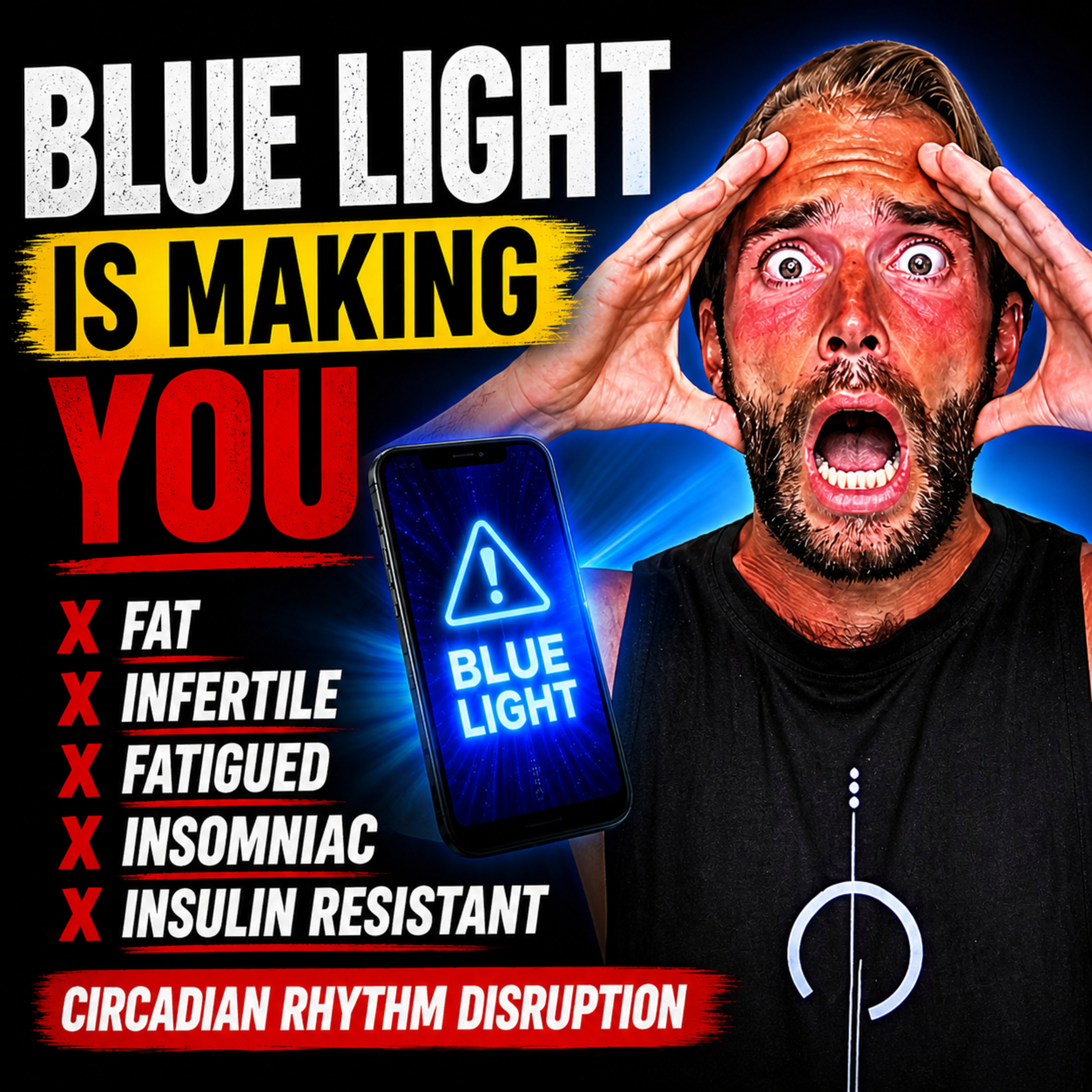
Blue Light Is Making You Fat & Insulin Resistant | Circadian Rhythm, Sleep Hygiene, Metabolism, Hormones: Melatonin, Cortisol & Energy Explained | Red Light Therapy Benefits - Circadian Light Bulb
What's This About?
Artificial Blue Light is disrupting your sleep, metabolism, and hormones more than you think!
In this episode, we break down how blue light and modern indoor lighting affect circadian rhythm, leading to fat gain, low energy, poor sleep, and insulin resistance.
Learn how light influences your biology and how simple changes to your light environment and sunlight exposure can improve energy, sleep, and metabolic health.
💡 What You’ll Learn
• How blue light disrupts circadian rhythm and sleep
• The link between artificial light and insulin resistance
• Why modern lighting contributes to fat gain and fatigue
• The importance of red and infrared light
• Differences between sunlight and indoor lighting
• How light impacts hormones, metabolism, and energy
• Practical ways to optimize your light environment
🎯 Final Takeaway
Light is one of the most powerful drivers of your biology.
Fix your light environment, and your sleep, energy, and metabolism can improve dramatically.
⏱ Chapters
00:00 The Lighting Crisis & Health
01:10 Evolution & Light Exposure
04:16 Circadian Rhythm Explained
07:07 Modern vs Natural Lighting
09:49 Full-Spectrum Light Importance
12:58 Red & Infrared Light Benefits
15:49 Why Dynamic Lighting Matters
19:02 Blue Light in Daily Life
21:55 Optimizing Indoor Lighting
24:48 Sunlight & Health
27:35 Future of Lighting
40:33 Artificial Light & Behavior
45:03 Technology & Health
48:33 Coherence & Biology
51:51 Practical Light Strategies
57:51 Lighting Innovations
01:11:22 Building a Better Light Environment
-
🌞 Join the Fitness Wisdom Podcast Community HERE:
- ➡️ Get access to Ad Free episodes of the show
- Connect with a like minded Tribe ⚔️
- Submit your burning desired questions to the Guests of the show!
- Exclusive member Blogs
- Get my Health Optimization Protocols + Programs ✅
👉 I look forward to seeing you in there‼️
.
⬇️ Find & Connect with Jai & Dan:
.
🌞 Find & Connect with me 👉 HERE
👉🏽 For Discounts & Offers: HERE
.
👉 In Rhythm Sleep Better Bulb💡 Circadian Healthy Lighting at a Discount with promo code: MOBILITYFITNESS HERE
.
👉 Find my favorite Blue Light Free Tablet ‼️ at a 15% Discount here, using promo code MOBILITYFITNESS at checkout ✅️ HERE
.
👉 Best 3 in 1 Blue Light Blocking Glasses Use promo code: MOBILITYFITNESS for Discount ✅ HERE
.
👉 Find the Methylene Blue 💙 that I use HERE:
Use promo code: MOBILITYFITNESS for 15% Discount ✅ *Consult your Doctor before trying this, especially if you are taking SSRI's or other medications*
.
⚡ Find the Best Grounding Mats & Sheets🔋 at a massive Discount using promo code: MOBILITYFITNESS at checkout HERE
.
🧬 Find the SHILAJIT I use & recommend HERE ⚡Use promo code: MOBILITYFITNESS for Discount ✅
.
🚨 My favourite Red Light Therapy Mat ⚡Use promo code: MOBILITYFITNESS for Discount 👉 HERE
.
*None of the content / statements in this Podcast are Medical or Personal Advice & is not intended to cure, treat, prevent or diagnose any medical condition. All my videos are for Educational & Research purposes only. If you decide to try anything discussed in this video, you agree to do so at your own risk & responsibility*
This is the Fitness Wisdom podcast.
Imagine intentionally giving yourself a headache, sabotaging your sleep, tanking your hormones and your. Sex drive and putting yourself in a bad mood. That's what most people are doing to themselves these days, and we have a hidden culprit which is not. So hidden, but it's actually quite obvious. And that is the lighting crisis. And we've got Jay and Dan on the show from In Rhythm today. Thank you for coming guys. Thank you so much for having us, Andreas. So great to be here. Awesome. So let's dive down this rabbit hole.
I feel like we have this massive elephant in the room, right? And still the majority of the individuals around the world are unaware about the impact of the that light has on our biology. Everyone knows that sunlight sunlight is good, but they think that sunlight equals vitamin D, right? They are very unaware about all of the other incredible benefits that comes with sunlight. But when we go to the other end of the spectrum and we think about indoor lighting, people just think again, light bulb equals brightness, but it doesn't mean that it's actually doing anything to our biology.
So does anyone of you, Dan or Jay, want to go down the rabbit hole of explaining how does light actually influence our biology? What is it actually doing to our body? Yeah. So perhaps I'll start off by saying it's, you know, this crisis is is kind of hiding in plain sight and maybe excuse the pun, because we're talking about light and things that we can see here. I think, you know, we need to understand and appreciate that evolutionarily, it's really a grain of sand on the beach of our evolutionary history and our development that we've now lived in these indoor modern lit environments and where we've been out of touch with, you know, ancestrally what our genes and our our DNA expect us to be around in terms of the environment.
Right. And you, you alluded to this idea of sunlight. You know, there's more nuance to it certainly than that based on, you know, our haplotype or our mitochondrial haplotype, you know, where our ancestors were from around the world, the latitude at which we lived, the amount of sunlight that we got. But one thing is really, really clear, you know, human beings have never lived inside of these artificially, predominantly, you know, blue lit environment. And this is what's causing us, you know, so many problems.
I mean, you alluded to Andreas to the, the full spectrum of light. You know, what is like people think about light is this thing that we can see, right? It's what gives us illumination. It allows us to to do things at night. It's fantastic. It's wonderful, you know, instead of the sun setting and us having to go to bed, now we can pot around and do our chores and entertain ourselves and these sorts of things. But people until more recently, I believe, have really failed to appreciate the impact that the different wavelengths, you know, that's something that people may or not have heard of before, the different colours of light, which, you know, packaged in sunlight, we're all together in this kind of harmonious equilibrium.
And, but now that we've begin to isolate them and eat these artificial forms of light, at least the majority of the kind of cooler white traditional LED's and the fluorescence and things like that, which have become so popular in the last couple of decades, you know, having a, having a huge impact on everything, as you alluded to, from hormonal health to mental health, to libido, to reproduction, to sleep qualities, stress in the nervous system. There's really no area of life that is, is untouched by this kind of phenomenon.
And, and you know, something that the Jay and I are very passionate about in in rhythm and to educating, making people more aware and offering solutions that can help us to really, you know, make simple changes that have such wide systemic effects on ourselves, our families, our societies. Guys, if you haven't already, smash that subscribe button and the like button. Now back to the show. And do you think that we are having all of these consequences because we just don't have like a good enough awareness around the lighting perspective in general?
So going back to the introduction of the light bulb in general, I think that it you can really notice that some diseases begin to manifest. Jay, do you feel comfortable in talking about the manifestation of different diseases since the introduction of the light bulb in general, which was, you know, more incandescent? Yeah, absolutely. And look, one thing I'd like to start with when we talk about the impact of light is looking at this evolutionary story that that Dan just outlined. But you know, why is it that light and the interplay between light and dark became important evolutionarily?
And really the insight here is that over the course of millions, 10s of millions, hundreds of millions of years of evolution, life organizers around on those things that are most consistent and predictable in the environment, because those form the foundation words for how evolution is going to develop. And if you look at the most consistent and most obvious cycle here, we're talking about the interplay of light and dark, which has happened every single day on this earth, as you know, since, since its initial, initial formation.
So it forms this very important pillar. And an analogy that I, I really like to go to around, you know, articulating why circadian health is so important. And particularly why circadian health is not, shouldn't be put in the same category as other health fads or trends or things like that. Because it relates to a very fundamental way that the human body works. And at the very foundational layer, it's really about your body's concept of time. OK, because every process in your body runs in cycles.
Your body is not always doing the same things all the time. It's a very intelligent system. And so every process follows cyclical patterns, and time is the critical variable that underpins how these cyclical processes can happen. And if you've ever asked yourself, how does your body know what time it is, right? Because 3:00, four o'clock 5:00, these are made-up concepts, right? But your body does have a sense of time. And it gets that sense of time from natural sunlight because natural sunlight changes predictably throughout the day.
And yeah, your body's not going to say, oh, it's 6:00 PM. But your, your eyes are going to register the different wavelengths in sunset light and basically infer the time of day. And so let's say, you know, you're, you're in Cyprus, I think, let's say you, you take a flight to India, let's say, and your objective for your week in India is I'm going to have the most productive week of meetings for my business. Now you you land in India and you've got to change your watch. Because if you don't change your watch and you do not bring your sense of time in line with the natural order, you've got absolutely no hope of having a productive time.
You're not going to be on any, you're not going to be on time for any of your meetings. Now, setting that clock is a necessary condition for you to even be at the meeting, but it doesn't by itself imply that you're going to have a productive meeting, right? So this is the key for me for circadian, circadian rhythm, circadian principles, it actually behaves more like the body's infrastructure, a necessary infrastructure that you need to have. And being aligned is not sufficient for optimal health.
Let's be very clear about that. But it is necessary, OK. And you asked a specific question about the evolution of, of disease with related to, you know, modern lighting. Don made the point that we're talking about a grain of sand in the evolutionary timeline. When, you know, the, the incandescent bulb was, was developed in the late, you know, 19th century, kept talking like 200 years ago. That is nothing in the, in the timeline of evolution. The human body does not adapt that quickly. And so it's sort of from this point where we start to see the advent of different types of disease that we never saw before, right?
We, we as a society, we solved our problem or somewhat solved the problem of acute illnesses with antibiotics and things like that. But over the course of the last 100 or so years, we've seen the emergence of chronic illnesses. And that's really what people die of these days, right? You don't really die of infections. Of course you can generally if you're older and infirm. But it's chronic illnesses that that have really taken center stage, whether they're neurodegenerative disease, cardiovascular diseases, and a lot of them have upstream, well downstream consequences when the upstream mechanism of timing is is not correct.
Wow. I absolutely love that breakdown. That was fantastic. Go ahead. Go ahead, Dan. Yeah. I'd love to add to that, that, you know, one of these large parts of timing in the circadian mechanism is the ability to repair and regenerate. And so like what we're doing with the introduction of, you know, especially more recently, more harmful forms of lighting or more disrupting or just regulating forms of lighting is we're actually putting the brake on the ability to restore and repair. And so when Jay, you know, alludes to this idea of chronic disease, you know, chronic disease doesn't manifest in a day.
It doesn't manifest in a week, it doesn't manifest in a month, you know, maybe even for the majority of people, a year. We're talking about like, you know, decades and decades and decades of us being out of sync or out of rhythm with the conditions in the environment, which, you know, lead this upstream infrastructure, which is healing, repairing and regenerating to become dysfunctional. And so, you know, I always get very excited talking about this because I think it, you know, such a simple thing to fix, but the implications of that fix are so wide and systemic for the whole body.
And, you know, I'm sure we'll talk more about, you know, the implications of that has for society, it has, you know, financially on the world. It has in terms of like mental health, in terms of community and like all of these sorts of things, you know, can be so readily improved through our light environment. And thankfully, you know, the evolutionary history is there, right? You know, it's not like we have to start from a scratch and trying to understand like how are we programmed to to exist in these environments?
It doesn't take very much, especially with the latest science catching up. Imagine spiking your blood sugar without eating cake, elevating cortisol, your stress hormone without being stressed, and suppressing your body's most powerful sleep. Antioxidant and regeneration hormone, which is your melatonin. This is why I make sure to wear my yellow daytime blue light blocking glasses every time where I spend time indoors, under artificial lights and in front of screens to protect my eyes from oxidative stress and my entire body.
And if I'm going to be exposed to artificial blue light, especially after sunset, I'm going to wear my red lens blue light blocking glasses to support my. Melatonin production and. Release So if you want to protect your energy levels, sleep, and biology from artificial blue light, head over to the description and you will find all of the links with a massive discount on my favorite blue light blocking glasses. Oh yeah, 100%. And and what you said there, Jay, about like anchoring, like the rhythm that really resonated with me and how it's like such a foundational thing that has built with our biology for thousands of years.
Like that was that was truly mind blowing. And the fact that people need to realize that the concept of light in general is something very new to our biology specifically, you know, from a light bulb, of course, fire light, we may have had that like way, way longer, but the lighting is something so new. And so do you guys, maybe I want to explain how the difference between the incandescent bulb that we started with versus the modern lights that we have now and why actually even the incandescent bulb was actually problematic for our biology?
Because it was, it's disrupting this rhythm that you dis that you discussed about and this anchoring of this, you know, night and dark cycles and honoring the seasons in general. So are we actually seeing now even more accelerated disease due to the removal of specific wavelengths from our indoor lighting as well? I think it's, it's really interesting in how the narrative and the science has even been evolving over the last, you know, 5 to 10 years looking at light bulbs, looking at things like incandescence versus fluorescence versus the more traditional modern LED's.
So if you go back, you know, Jay alluded to the end of the 18th century, Thomas Edison or, you know, whoever entered the, the light bulb when we were first using incandescence, you know, they weren't widespread. They weren't in every street, they weren't in every home. It was, you know, if you were lucky and you can afford it, you might have had one or two incandescents in your home that might have allowed you to cook a little bit later, to clean a little bit later, to sit up as you would have done, you know, by candlelight, to write your memoirs or do whatever you needed to do.
So it wasn't hugely disrupted. It wasn't really until the electrical grid, you know, became available that we started to illuminate entire homes, entire towns, entire cities. And this is where we really broke from the order, right? Because if we were to look at an incandescent, I mean, to give a kind of a TLDR as they say these days and all forms of natural light, be that sunlight, you know, even deflected moonlight, firelight, their their full spectrum. OK, So they include, you know, invisible and visible light.
Now sunlight includes more of the, the UV, the ultraviolet light. We won't necessarily talk about that here because it's not something that we're putting necessarily in indoor lighting these days. But what we know from sunlight and firelight is it contains the full spectrum of visible all the way from, you know, the indigos and the Blues all the way through to the Reds. And then also this very broad band of infrared light, which goes from near into far infrared. OK. And so in the last kind of couple of decades, we've begun to to learn and understand that all of these different wavelengths have different roles to play within the body.
And so incandescent bulbs, for example, are coming back into favor now. And what is that? But we know that sunlight and firelight, large proportion of sunlight and firelight, something like 50 plus percent of that light was actually invisible in the form of infrared light. And we know that infrared light penetrates very deep into tissues. The work of Doctor Jen Goffley for Glenn Jeffrey, for example, is, is really profound in this way, demonstrating that has, you know, very beneficial effects on the mitochondria, such as, you know, up regulation of endogenous melatonin production, for example, which is an antioxidant, you know, a free free radical scavenger within cells.
So it's about, you know, healthy aging and and support on a mitochondrial level. And the problem now is that we're coming to understand that those longer wavelengths, those infrared wavelengths, whilst those are more soothing down the other end of the spectrum where we go towards Violet, ultraviolet, I should say indigo, we've got this, what we call HEVL, this high energy visible light and blue light, this is more chaotic or it's more stressful, it's more stimulating to the system. And in nature those were always counterbalanced, you know, the stressful and the soothing, if you'd like to simplify it in that way into the light spectrum.
So firelight, yes, contained a small amount of blue light that was abundant in infrared. Blue light, yes, depending on the time of day there was more or less blue light which controlled functions in the body allowing us to wake up, feel motivated or energized or begin to wind down as it disappeared in the day. But we always had infrared light present to to counterbalance some of the more cellularly stressing effects of this kind of higher energy, shorter wavelength visible light. And so whilst incandescent certainly have been disruptive from the point of view of circadian timing, they were most certainly a more health protective form of lighting than a lot of the more modern fluorescence and LED's.
Although I would argue now that some of the latest developments and, and maybe we'll talk about this later on in the podcast are allowing us to kind of come full circle back to a healthy alternative with some of these new technologies. But you know, as we broke out from incandescents, which was largely as a result of a need for more energy efficiency, you know, that's a whole topic you could discuss within itself. I mean, you know, I don't know how energy efficient it is to keep LED lights on all day and all night as they do in entire cities when there's absolutely no need for it whatsoever.
But you know, the argument was, well, an incandescent bulb which is heated from a tungsten filament and creates this lovely fire like spectrum. It's not energy efficient. It uses a lot of energy. OK, So what are we going to do now? We explore this idea of fluorescent lighting and then eventually LED lighting. But the the spectral distribution of these types of light becomes very, very chaotic. So instead of a smooth kind of black body curve like you have with fire light, like you have with sunlight, what you have, it is kind of a sporadic, you know, high amounts of blue wavelengths, maybe some green wavelengths and largely devoid of the red and the infrared, which is like this counterbalancing effect, right?
And so it's really about understanding it in the context of it. You know, what did nature expect and what are the healthiest options that we have these days in terms of lighting? Because, you know, we're not going to move to a cave in the Himalayas. We're not going to turn all the lights out every night. You know, I would love to use candles around my home every evening, but if I put candles everywhere, my daughter would only come and knock on over and I wouldn't be here very long and neither achieve that happened.
So it really it's about understanding, you know, like where have we gone wrong and, and where can we move forward from this now to create better solutions for humanity? Oh, I love that breakdown. Do you have something to add, Jay? Yeah, I mean, so, you know, Dan did a great job of, of summarizing and I think, you know, it's, it's, it's important to focus on the, the color spectrum in and of itself, but it's also very important to call out the the lack of, of dynamism, right. An incandescent bulb, whilst it's, you know, it, it is a great tool that we, we have the light spectrum does not change.
The most that you can do to an incandescent bulb is very recurrent and dim it so you can reduce the locks and yes, that will change the color a bit. But fundamentally, even if you have an incandescent bulb that is stuck on the same setting all day, it means a clock is stuck, right? It means a watch isn't running and your watch stuck it, you know, 4 PM, 5:00 PM, you know, whatever the relevant time is. And so when it comes to a game, this fundamental concept of time, we're still not there with with the incandescent bump.
Imagine a tablet that doesn't blast artificial blue light into your eyes, disrupt your sleep, or sabotage your health, but actually use the sunlight to power the display. If you've been listening to this podcast, you already know how damaging constant artificial blue light can be on your circadian rhythm, your sleep, and your overall health. That's why I love my Paper 7 tablet by Arborino. It's definitely one of the most interesting devices I've used in a while. The Paper 7 tablet uses something called an RLCD display, which means there is no backlight and essentially no blue light.
Instead, it reflects ambient light just like paper. So the brighter your environment, the better the screen looks. And unlike E Ink devices, which are slow and stuck in black and white, this gives you full color, a smooth 60 Hertz refresh rate, and the ability to run all of your favorite apps. It also comes with 8 gigabytes of RAM for smooth performance, a 7.8 inch display that's perfect for both reading and productivity, and at only 240 grams, it's easy to carry around anywhere. The battery life holds up really well too.
You're getting around 10 hours of active use and up to 12 days on standby, so you're not constantly thinking about charging it. For me personally, I like to use it a lot for writing, researching, and preparing for my podcasts, basically all of my administrative work. And the best part is I can do all of that outdoors in natural light so I can actually support my biology while I work instead of fighting against it. And because the screen gets brighter in brighter environments, it's incredibly easy on the eyes, even in direct sunlight.
I've also noticed that it naturally improves my nighttime habits because indoors, especially at night, the screen isn't overly bright or stimulating since it uses your environment, the power of the display, so it kind of guides you towards better sleep hygiene and healthier circadian rhythms without even trying. At the end of the day, technology isn't going anywhere, so the goal is to find tools that work with our biology, not against it, and this is definitely one of those devices. You definitely want to hurry up and grab yours today as they are extremely popular and run out of stock really fast.
The link will be in the description below alongside with a 15% discount code yes. And so now that we have these modern leads and I think a lot of people who. More health conscious are switching to more incandescence. I personally prefer like red light bulbs in my home to be honest, like after sunset, I prefer them to be completely devoid of blue light because I know that incandescent does have some blue light in it. So I'm just a little bit of a maniac like that in a way that I want to make sure that am I dressing or preserving my melatonin at all costs, My melatonin production and release, making sure that my lights are dim enough and at a low angle and that they're also the correct light spectrum.
But I think most individuals are still unaware and they are having their, their TV on their LED lights overhead on. And then now we've gone from a nice relaxing environments in our homes to very like cold and clinical when I visit, like some of my friends here in Cyprus who are very unaware about their lighting. And even though I tell them all the time, they still don't make any change to their lighting, right. And then I go in there and it feels extremely stressful, even with my blue light blockers on my red ones.
I it's just. Still entering from the top of my blue light blockers and it feels so pervasive. It's like just, it's so threatening, right? It's coming from every single angle and it's just threatening my existence. That's how I personally feel. Do you guys want to explain to the audience, like, what is actually the problem with the fact that we are missing the red and the infrared from, you know, most modern LED's? And what kind of health consequences does that have? It doesn't have to be, OK, You could say that mood and you know, behavior is part of health too, right?
But what kind of health consequences are we seeing today due to the fact that we are devoid of this red and infrared from our lighting? Yeah, I think I'd love to jump on that question for a second because you've identified a really big thing and I think this is catching on in the zeitgeist now is like blue light, right? You know, blue light is the boogeyman. We need to remove blue light from our bulbs. And so now there's this huge proliferation, and I've used them for many years. You're alluding to using them.
Jay's using them and like red LED's or and their LEDs, but these can be, and I'm trying not to get too technical with the language here, these can be quite what we call monochromatic. So they only are a very short band of wavelengths that give us one color. And so there's some problems with that I think that we'll explore, but I think there's like a hierarchy, right? Or there's like, yeah, a hierarchy of issues. And, and certainly for me, the the three biggest issues are an abundance of a very short wavelength high energy visible light, which is, as you said, available in most LED's, phone screens, laptops, television, St. lights.
You know, you're going around to your, your friends places, you're being exposed to a lot of that. And above a certain wavelength that is suppressing melatonin at night time, right. So that's putting all of this restoration and then and regeneration processes on the back burner basically. And and there are other problems as well. I mean we're talking about lux or illuminance, so brightness of light. So it's not only the the colour or the spectral distribution that changes out in nature every day, but it also gets dimmer towards light time, right.
So whilst many of us may have our homes filled with red bulbs and we think we're doing a great job there and and we are, we're certainly taking a step in the right direction. I want to make that really clear. And when we have types of bulbs which, which don't get dimmer or that we can't kind of manually orchestrate to, to create a dimmer environment in the evening, our body can still think it's, it's, you know, earlier in the day than it is. And when we talk about this in the scientific way, we're discussing melanopic illuminants, right?
So we're talking about the brightness and we're also talking about the wavelengths and how those correlate to suppression of melatonin in the brain, at least the pineal gland at night time. And So what we want is that absence of blue light and but we also want things to be dimmer. And then there's a third factor. And I really think that this factor doesn't get enough attention and I think there's not enough awareness of it. There's not enough science behind it currently. And, and that's the flicker effect of a lot of these bulbs, right?
And, and bulbs flicker. The majority of bulbs, especially the leads, the LED's that that flicker, it's actually a driver choice by engineers when they create the product. OK, so it's kind of like a shortcut, but these bulbs can be flickering anywhere up to, you know, 50 or 60 Hertz per second, right? So literally without of our conscious awareness bulbs are flickering so fast that our brain sub perceptually is taking this as a stress signal. It's affecting cognition, it's affecting the nervous system.
A good way to kind of give the audience an example of this is if sometimes if you, if you take your mobile phone, if you like film a television screen, or you take a film in a public place with a lot of bright LED lights. Then you look back at the film, you know, they're like, why does it look like the screen is, is tearing up? You know, like, why does it look like the, I didn't see that, you know, in person, but I can see that on the screen and that is the, the flicker effect at play. So there's these kind of 3/3 dynamic things which are, which are major.
And you mentioned the idea of the, the red and infrared. You know, I think whilst the majority of us are doing a great job approaching this idea of like circadian lighting or blue free lighting. And obviously, you know, there are wonderful companies all over the world that are providing, you know, these, these more innovative solutions that are certainly supporting people's health. I think there's this lack of recognition that actually we, we can do a bit better than just a red or an amber light bulb.
You know, we can create forms of light which are more, which are more full spectrum, right? They still have little or no blue light in them. And, and in being full spectrum, they have what we call it a higher or more optimal colour rendering. So you can see things more naturally, You know, when you're around the campsite fire or when you're outside in the sun, you see colour for what it is, right? As you mentioned, it's getting very sterile these days when we're underneath these cool white LED lights.
Sometimes what we call the colour rendering index of these lights can be below 8080% and, and in sunlight and firelight, it's 100%. And so we're losing a substantial amount of our colour differentiation as well, which actually can make people look quite, I'll can make them look quite sick. It can make them look quite, you know, clinical. And, and we have the same problem with these, these red and these amber LEDs as well, because they are so monochromatic. You know, you see everything is red, you see everything is amber.
And I think the truth be told that, you know, and this is something we're discovering as we begin to like push the frontier in, in what's possible with LED technology and things like that. Is it? It doesn't have to be that way. And it's really exciting to know that, you know, we can now develop types of lighting which not only have, you know, shifting spectrum across the day, OK, to have higher or lower blue light content depending on when you want that clock to be set. The time at which you want your body to know it is different levels of brightness, which aren't necessarily controlled through functions in the bulb, which increase the flicker effect, which is a problem with dimmers.
So even though incandescent bulbs are a lot healthier than these, if you have it on a dimmer switch, it will still flicker, which isn't something that our brains really evolved to experience. And, but also that the colour rendering and also the, the addition of infrared into that bulb can help to create a more evolutionary appropriate form of lighting. And, and I've really become obsessed with this idea and I know that Jay has as well. And, and maybe he can speak to this and that, you know, we're not just talking about sleep here.
We're not just talking about melatonin. We're fundamentally talking about the nervous system, the entire, you know, environment in which we live now be that psychological, social stresses, electromagnetic stresses, light stresses, all of these things are taxing our nervous systems. And that's our nervous systems, which are governing our state of recovery. And it's our state of recovery, which is essentially governing our risk for chronic disease and things like that. So I love to broaden up the, the conversation and talk about like all of these different aspects and factors when it comes to light.
And I know it's a lot to get your head around. You know, the concept of blue light is very simple. There's not so much nuance to that, but there really is a lot to know and understand and explore. And it's not a case of like, you need to, you know, take a degree in science to understand it. But it's interesting to know that, you know, some people that don't respond well to like the red LEDs, for example, or can't have their, you know, homes full of candlelight at night, that there are alternatives, which I hope you know, will spread across society and begin to provide not only more health benefits, but just also more enjoyment of our, of our evening light environments in particular.
You can jump in then Jay if you want to add something to that. Yeah. Look, I mean, I think, I think Dan did a did a fantastic job at summarizing it. I think the only thing that I'll add is that, you know, one of the real big losses as Dan's alluded to in transitioning from incandescence to LED's is this loss of red light, of course, but also infrared light, right. And the more that we're learning over time is really the importance of infrared light in the body and in particular the way it, you know, it, it modulates the function of DNA and the production, the, you know, the production of energy and the, and the functioning of, of your mitochondria.
And your mitochondria are the energetic powerhouses that govern your health, energy levels and well-being. You know, they work like little miniature factories and they require certain conditions and inputs to work properly so they're not spewing out lots of, you know, toxic byproducts that wreak havoc on your health. And you know, we're, we're learning more and more how important infrared light is to, in, in modulating and optimizing that process. And stripping that completely out of indoor environments, which is where people spend 95% of their time, is a serious, serious issue.
And in my mind, you know one of the largest issues of our generation when it comes to health. Yeah. And I would just finally add to that so that people understand it a little bit. You know, in nature, all of the green vegetation that we surround ourselves with and with which we evolved is reflective of red and infrared light, right? So if you touch a leaf, for example, a leaf is not hot, a leaf will not be hot in the sun. That's because it reflects the infrared light, which is heat, OK. So whether we were out in direct sunlight when we were under the canopy, you know, whether we were sat in the shade, we were always getting a high stimulus of this like picking near but also far infrared exposure.
And now we have obviously invented, invented, for example, glass. You know, we have these of these window glasses in our homes, our hotels, our schools, our offices and everywhere. And but this is filtering a majority of that infrared light out. So, you know, go back a couple of 100 years when we were using things like quartz glass in churches, it wasn't having such an impact on like filtering those beneficial wavelengths. But now not only are we not going outside to get that light, but we're also sitting in the homes which are actively blocking that light or filtering that light out.
And then as I said, you know, we're underneath these kind of very high energy, short wavelength and blue lights. So what's exciting? And I think Doctor Glenn Jeffrey and colleagues did a, a recent study looking at the impact of even just putting like an incandescent bowl back into like an indoor daytime environment focused cognition and supplementing the light environment as such. I'm not saying that that is, you know, necessarily the best solution long term or like the most energy efficient or things like that.
But it's, you know, it's profound how even small, simple changes like this can begin to just see a change in the way that our health functions on the day-to-day basis. Are you interested in smoother skin, better recovery from workouts, improved energy levels, and an overall feeling of vitality? Listen up. You've probably heard about the benefits of red and infrared light, and This is why I love to use my red light therapy mat every single day. And the reason why red and infrared light is so powerful for our health is because it targets the mitochondria, which is the foundation of cellular energy.
When our body is able to produce energy efficiently on A to control level, we have better energy levels, better cognitive function, better hormones, better sleep, basically every aspect of our life is improved. Red and infrared light is not something optional, it's foundational and it's something that we are meant to get in our lives every single day. Sunlight contains red and infrared light at all times of the year. Unfortunately, most people are not getting outside and This is why it is essential for red and infrared light to be supplemented back into our lives because it's not something nice to do.
In my opinion, it's a biological necessity. Think of light as an an instruction manual for your metabolism. Without that light, your body starts to fall apart. So if you want to check out the Red Light Therapy mat, which I love to use on a daily basis, head over to the description below and make sure to use the promo code attached for a nice discount on your entire order. So what I understood from what you guys just said? There is the fact that blue light itself, yes, it's a problem, but the fact that we are lacking this red and infrared from our environment, you are saying to me that red and infrared is actually a biological necessity.
It's something that we must must have on a daily basis and if we don't have it, we start to manifest all kinds of issues, whether that is metabolic issues, whether that is skin issues, whether that is accelerated aging, energy issues, hormonal issues. All of these things are tied to the fact that we are actually deficient. If we start to view the sunlight and full spectrum light like different nutrients, we are devoid of certain essential light nutrients that our body is actually needing to operate correctly on a daily basis.
We know that blue light is essential for setting the circadian rhythm and keeping us on track. And then the absence of it helps us, you know, to go, go to sleep and to release that melatonin. But we don't, I think talk enough about the importance of red and infrared and the UV and all the other colors of the spectrum that we probably haven't, you know, discovered yet through science about their impact that it has that we if we are deficient, for example, in green light. I know that what you Professor Thomas Seger, for example, he has the the migraine lamp, right?
And he talks about how it can help to alleviate headaches and migraines. And again, he, he mentions how in a forest, the, the majority of the spectrum there is green and red and infrared light. So it's those two specific spectrums of light which are very calming and soothing to our biology. And it just feels like our indoor lighting is doing as a huge disservice. And again, I think what's very important for us to mention to the audience is that, OK, yes, it's important to optimize our lighting, our lighting, but how can we welcome the full spectrum back into our homes, right?
Should we like consider maybe opening our windows? Should we maybe take light breaks and go outdoors? Should we actually still try and get the OG full spectrum sunlight? Because of course we do want to have good lighting in our homes 100% since we are spending the majority of our time indoors. But we also must reconnect back to the original blueprint or the original environment our body evolved in. Otherwise, even if we spend 100% of our time indoors under these newer versions of light, we can still encounter issues because we are not getting the maximum light intensity, the fresh air, the energy in the environment, the electromagnetic spectrum of the earth.
Do you guys want to add anything to this? Absolutely. Look, I'd, I'd love to jump in there. You made a lot of really good points, Andreas. And look, I want to start by saying that, you know, blue light in and of itself is not bad, right? It it, it's, it's sort of developed this narrative that it is the boogeyman. But blue light appears in nature, right? It appears in sunlight, in luck, significant quantities, as you say, it's really important for your circadian signaling umm, you know, in the beginning of the day.
And the lack of it is also important for your circadian signaling, umm, in the evening. So what we're really trying to do here is bring environments and, you know, the exposure that the body gets back in line with those proportions of light that it's used to evolutionarily. I'll give you an analogy, right? You, you, you, you. You made the point of thinking about wavelengths of light like nutrition, like food. And that's a really fantastic comparison to make. One analogy I'll give you is, you know, sugar and and blood sugar levels.
If you eat an orange, right? A natural orange, which has within it natural sugars but also lots of fiber in a in natural proportions, the impact on your blood sugar is not that dramatic. OK. If you drink a glass of orange juice where the fiber has been stripped out and a glass of orange juice probably contains like 6 to 8 oranges, which is which you would never normally eat, suddenly your blood sugar that goes berserk, right? And so this context is very important because you know, we fundamentally believe that nature does not make mistakes, right?
That orange is perfectly crafted to give you the nutrition you need without damaging you. It's when we start stripping out what Nate, how nature built these things because we want better juices and we want it faster and we want it more energy efficient. That's when we that's when we start to start to have problems. And then you, you know, you made another excellent point around, you know, do we need to make sure we get out in nature and sunlight every day and the ABS? The answer is an absolute resounding yes, right?
Nothing that we do in this space or in rhythm will substitute you getting outside, getting your skin and your eyes in that sunlight, putting your feet on the ground, right? There is absolutely nothing that is going to replace that. Our mission in in our business with what we do is is to acknowledge that you may not always be able to do that, right? To acknowledge the fact that you still spend 95% of your time inside because you've got to work in an office and you've got to live in a home, right?
And so, you know, our our products and our vision are to support people, really meet them where they are, right, as opposed to where you're hoping that they should be. And it's also why, you know, education, education is such a big thing for us because really you got a couple these new full spectrum technologies with the right information that that shows people the importance of of being out in nature and actually how to get the most out of these new products and ecosystems that that have been created.
Yeah, I really want to jump in there. I love talking second to you guys because I got so much juice to squeeze. Sorry to get back to the analogy, but yeah, talking about this idea of malillumination, right, which is a concept coined by the the late doctor John or you know, one of the first people to be seriously studying light. I won't go too much into his work, but people can look him up. He published 2 very prestigious books, one called Health and Light, I forget the name of right now, but this is something like in the 50s or 60s and he was a time lapse photographer studying the impacts of different types of light on the growth of plants and such like that.
To get back to that analogy of like the the orange, it's like, well, if we were to only eat oranges all day, every day, we would become like, you know, we'd have malnutrition. We wouldn't be getting enough nutrition because we're not eating enough breath of, you know, different nutrients that evolutionary we're expected to do. And in the same way, if we're only getting this very, you know, short wavelength blue light all of the time, we're not getting enough of those other spectrums and we become mild as such.
And I just wanted to pick up on Jay's point because it's really interesting. Now we're beginning to learn like even more nuance in this discussion around blue light, right? Because previously we've been there like, OK, blue light, blue light sets the circadian rhythm and blue light is bad at night time. OK, So that was like the conversation, like we'll put it there. And now we've begun to understand that actually within that blue light spectrum you have shorter wavelengths and longer wavelengths.
You have some wavelengths such as the roughly the 418 nanometers, which are more melanotropic, so that wake us up more, that have more of a cicadian stimulus, right, for alertness, for increasing cortisol, for setting that scadian timing. But then you have this HEVL, which is a little bit of a more difficult idea to get your head around. But it's the shorter wavelength blue light, which you know in nature was always counterbalanced by that infrared light. But when it's devoid of that is actually causing a lot of damage and it's causing a lot of like approaching a lot of reactive oxygen species and oxidative stress in cells.
And so it's interesting to know, understand that like, you know, not all blue light is created equally, for example, but that even, you know, a lot of the more modern, healthier forms of lighting, fuller spectrum forms of lighting still have a lot of this very high energy visible light that the shorter end of the blue spectrum without the infrared. So even some of this full spectrum visible light that we're using in our homes, it certainly is a lot better. It's causing us a lot less problems, especially from a circadian timing standpoint.
If you know, the removal of blue light is is done correctly, but it is doesn't mean that it's not causing stress for the the biology still. And and so to kind of talk about that idea of going out and getting light breaks. You know, fundamentally, yes, you know, there are key times of the day. And my favorite one big shout out to Sarah Kleiner, her app that my my circadian app. I don't know, Andreas, maybe you have a personal code or something that you can put in the show notes to that I use that, you know, every day and I have done for years and my clients and it it shows us, you know, key solar events throughout the day, You know, sunrise, the introduction of UVA, the introduction of UVB, if you're lucky enough to have it where you are at this time of the time of the year.
And then, you know, the the removal of that UVB, removal of the UVA and then the sunset again. So we begin to understand the properties of sunlight over the course of the day. And we can use an app such as that to set reminders to go outside at those key times and absorb those key light nutrients so that we're not Mal illuminated. And that's fantastic. But fundamentally, if you're coming back indoors and you're sitting in the environment again. You know where you're under this very high energy visible light, which is to avoid an infrared light, you're kind of taking 2 steps forward and one step back because you're going outdoors into an environment which is putting you in rhythm and is making you feel complete and relaxed and restored and on a cellular level, safe.
There's less chaos, right? And less chaos in our lives, but then you're coming back indoors into environment, which is putting you back into a cellular stress response. And you know, you're wearing your daytime blue light blocking glasses there and dress. Jayce has got his nighttime ones on. He's in an area of the world where it's a bit darker right now. I've got my daytime ones on in here. You know, I've got a couple of I'm in a typical environment for me. So I don't have control of the lighting here.
And there are a few of these brighter LE DS that I want to use to, you know, increase illumination while we're on the podcast. But I'm using these, these glasses, these particular blue light blocking lenses in order to reduce the harshness and the stress associated with that. Of course, of course, it is much better that we're going outside every day. In fact, it's fundamental that we're going outside every day to get these key like hues. But the, the missing part of the conversation is where we spend 95% of our time indoors, right?
Because you can go outside and get your 5% of sunlight at the right times a day. But if you're in a toxic environment, 95% of the time for some people that is going to override or, you know, is going to kind of net negative the benefits of, of them of going out, you know, because different people have a different nervous system, like a different state to their nervous system. You may be somebody who's more or less prone to stress. Maybe you have more or less trauma that you've experienced in your lives.
Maybe you have more or less, you know, symptoms and, and disease risk and things like that. And so not everybody is going to react to these types of cool white LEDs in the same way. Some people may say, I, I never noticed, you know, I don't get headaches and migraines. Like, what are you on about? You know, I sleep fine every single night, but there are some of us, you know, I'll raise my hand and say me here, who are far more sensitive to these forms of light. I think, you know, for me, like the idea would be a world in which our indoor lighting environments are OK or where we understand the impact that that light is having on our bodies every step of the way.
And unfortunately, you kind of do have to have a degree to understand it in its fullest these days, you know, unless you're a very strong citizen scientist. So, you know, something that we're very passionate about in rhythm is kind kind of in the most positive and empowering and autonomous way possible, actually taking the choice out of the way for people so that they don't have to try to figure out what types of lights do I want? My, my stress profile is there. So I should have this or that. If we were able to invent lighting, which is more neutral and biologically supportive for more people, then, you know, cost of health care premiums and all these sorts of things would be down, you know, rates of happiness, levels of consciousness amongst us all on the planet and all outcomes you can imagine would be improved.
And so I'm very passionate about this indoor lighting piece. And I've seen it affect myself personally over the years, you know, symptoms of things like ADHD and stress and burnout. When I began to change my indoor light environment, as well as, you know, connecting outdoor with nature's rhythms, that's really where I've seen the biggest improvements in my health. When people think about energy, sleep and hormones, I think in terms of fats and carbs, but your metabolism does that run on macros. Minerals are the foundation for your metabolism and a healthy and well functioning metabolism starts from your mitochondria.
Every single biological process inside your body requires minerals. When your body is lacking the minerals to run your cellular metabolism, guess how that is going to show up in your body? I'll let you figure that one out. One of my favorite ways to ensure that I get all the minerals that I need on a daily basis is through Shilajit, A herbal mineral substance which is made from the decomposition of plants and bacteria. This process taking place over thousands of years. It is primarily Marley harvested from the Altai and the Himalayan mountains, some of the most pristine locations on the planet.
The beautiful thing about shilajit, it comes with high concentrations of fulvic acid. This molecule actually drives the minerals into the cells where they can do their work. So basically the minerals come in the most bioavailable form for your body to be able to use. Unlike most supplements which become expensive urine, this one actually does something without the hype. It's not man made, it's produced by Mother Nature herself. Now, something very important to mention is the quality of shilajit.
Not all shilajit on the market is created equally. The one that I use has been tested for heavy metals and impurities ensuring that you are getting the highest quality shilajit. So if you want to explore the shilajit that I use on a daily basis, make sure that you visit the description below and make sure to use. The promo code attached for a nice discount on your entire order, that was fantastic. And just a couple of things to mention there. To recap that what you mentioned, I think what was very important that you said there is about the Circadian app, how actually people understanding the importance of the change of light throughout the day, how sunlight is not the same throughout all times of the day.
And this is something very hard for people to grasp their head around, especially people who are afraid of sunlight and afraid of getting skin cancer and stuff like that because they believe that the sun causes skin cancer, right? And they will start applying sunscreens on from the morning and not acknowledging that the sun spectrum changes like an orchestra that's playing a song and the melody changes throughout the entire day, right? So the type of ratio of colors is changing throughout the entire day and the intensity of those colors and it kind of starts dim and it gets bright and it gets dim again like it does the reverse.
And that's basically what Don was saying is that we're trying to like mimic with our indoor environment, this external environment, if we actually can't get outside because our biology has evolved to be outside 24/7. But now that we are the majority of the time indoors, we still need to match what the sun is actually doing. Obviously, nothing will ever beat the power of the sun or the benefits that the sun has to offer. But in order for us to not have these hormonal consequences, like Don mentioned, which I loved it, the way you said hormonal neutral, that was a really nice phrase, is that you are not psychologically manipulated into a specific state of being.
You could almost say that the blue light was intentionally designed to put us in a specific state of fight and flight and buy, buy, buy, purchase, purchase, purchase quick. Dopamine put us in this state of constant fight and flight because that is where we can't think clearly and we're most easily vulnerable and manipulated when we are introduced to information from our screens or our environment and so on. And yeah, so I think it's so important that we actually reclaim our health and that we actually reconnect with nature.
And as Dan mentioned, what was very powerful there, the combination of nature with the introduction of healthier alternatives of our indoor lighting is where the magic is found. Because I think what's very important to say is that people's stress tolerance and nervous system resilience lies in your daily acts, habits and behaviors. And when our daily acts, habits and behaviors are in alignment with nature, getting cold every day, getting in the sea, you know, getting grounded if we can, if we can get in the sea, getting in sunlight, doing a hard workout, basically doing the hard things and having enough time to adapt to those hard things makes us a Baras and makes us more resilient and stronger.
And it makes us have a bigger stress tolerance and stress bucket, right? Which is basically now can have more room to fill if we are exposed to that damaging artificial blue light, for example, indoors or we need to go or we would love to go out to a party to a rave all night, you know, with these flickering blasting lights and loud music. But but then again, you try to enjoy the experience and it allows you to get away with certain things. If your biology is, you know, you're doing things and habits on a daily basis, which is taking you towards that, towards resilience.
But if you're constantly breaking your body down, like training for example, every single day without giving enough adaptation in between, how can you come back stronger, better and bigger than before? If you are digging your hole all the time but you're never refilling it. Do you guys have anything to add to I just said there? Yeah, it's, look, I think it's, it's, it's all super, super important, valid. And, and, you know, you, you mentioned that, you know, increasing the amount of blue lights and LEDs does, you know, mess with people's dopamine and has, you know, different, you know, physiological and psychological impacts for sure.
I often find actually that, you know, this biohacking space and I, I really don't like the word biohacking because it sort of implies that there's some sort of brute force you need to, you know, force through and, and force your system to be in a state that it's not. But the reason I raised this is because I, I, I, I, I sort of see this creeping into the biohacking world as well, right where there's this big emphasis on doing more. I must do more and I must peak my performance and I must live forever and I must take all the supplements and, and yes, I think, I think that there are, you know, roles for all these things.
But the beauty of, you know, what I refer to as natural intelligence. What does natural intelligence means, right? Or how, how does it contrast, let's say to artificial intelligence, right, Which is on everyone's minds right now. Artificial intelligence, which is my, my professional ground. You can define it as a created or a designed intelligence that focuses itself or focuses on some external goal, right? Normally some kind of optimization problem. Natural intelligence is the inherent intelligence that emerges from the interplay of life, right?
It is not designed by a human being. And so why why I raised this point is because you mentioned the certain behaviours and actions that people need to do in order to, you know, get into circadian alignment. But really what's happening when people take these measures is they're actually. Getting out of the way, OK. This is a really subtle thing for people to understand because in taking these, let's say, you know, daily circadian interventions, you're actually getting out of the way and you're allowing the natural intelligence of nature to work within your body and for your body to come into alignment and order.
And importantly, it's not just static order, it's order through time. And order through time is ultimately the definition of coherence, right? And coherence is really what we're striving for. And so, yeah, I really love the way that you worded all that. Perfectly said. So I really, really love that. And one point I just wanted to circle back around to and I think, you know, look in the world in which we live now, who knows the the true reason for many of the things that are happening in the world.
And it's easy to point fingers and talk about conspiracy theories and things like that. I think, you know, ultimately what we come to understand from the science in perhaps quite a a narrow view, is that we know that that blue wavelength of light, this short wavelength light is very stimulating. And many people, I think maybe it's a result of the sickness of our society, want productivity at all costs. More productivity, more alertness, more focused, more. But what's happening with a lot of these studies and these research projects is they're not looking at like the hormonal implications of this light.
They're looking at subjective outcomes or they're looking at objective outcomes like that, your focus, your concentration, your, your performance on cognitive tests and things like that. But they're not looking, you know, later done in the day at like how burnt out is this person's mitochondrial redox? How, you know, high as their cortisol level was in relation to, like Jay said, that that coherence that we should have across a day and night in terms of the diurnal fluctuations between cortisol and melatonium, for example.
So I don't think it's necessarily that this is like a really nefarious thing. I think we've just gone too far in the wrong direction. And now we're really beginning to see like some of the impacts of that. And I think what's what's so exciting about this point? I mean, it's inevitable, right? You go too far in the wrong direction, you eventually find out. And so now it's about steering the ship back in a direction of like, yeah, like I say, an equilibrium coherence. Because. And ultimately, so many of the problems that we we have in the in the world, there is a lack of coherence between US and nature, between each other, between, you know, societies, between countries, you know, between families, all, all of these challenges.
And, you know, for me, the world has a lot of challenges. I as an individual have a lot of challenges, right? You know, whether they're psychosomatic, whether they're emotional and these sorts of things. And, and I can do my own work, you could say to unearth those and to make strides in my own life. But if something as simple as like changing a light bulb and even support me to move towards more of a state of equilibrium and tranquility as such, to maybe have more personal insights or actually have more focus, more creativity to be able to really connect with like my intuition, for example, things like that.
I mean, the amount of people that we used to interview back in, back in times when we were running like global educational challenges. And we say to people, what was the biggest thing you noticed when you got your circadian rhythm in order? And they say, like, I felt like my, my spirituality came back online. I felt like I had a soul again. I felt like I was motivated. I felt like I had a purpose. I felt connected to nature. I felt connected to other people. I, I can't imagine how I was living prior to that.
But as you alluded to, the truth is that the short wavelength light, nefarious or not, does drive us into this sympathetic state, into this stress response, into a disruption, a dysregulation of things like dopamine and cortisol and adrenaline. And as a result, we cannot think collectively. We can only think individually because what is stress? Stress is survival, OK? And you know, yes, you can be altruistic and help other people to survive, but ultimately it's about like survival of the Organism.
And so if we're stuck in that constant state, be that because of blue light at night, be that because of a lack of sunlight and grounding, or, you know, the the new issue that we're really trying to solve here, be that because of the constant, you know, incorrect light stimulus in an indoor environment, we're just making our lives harder than they have to be. You know, they're already tough enough. So let's do what we can to at least, you know, infrastructurally think about how humanity can move in a different direction when it comes to the lighting.
Everybody knows about vitamin C, but have you ever heard about vitamin G? I'm talking about grounding. We know that oxygen is important for our survival, but what if I told you that grounding is just as foundational for our health? Your body is literally a battery and needs to be recharged every single day. Modern life, depleted fatigue, insomnia, brain fog and restlessness. These all sound like a charge deficiency to me. You see, grounding is not optional, it's foundational. This is why I make sure to get my bare feet on the ground every single day and to ensure that I stay grounded 47 like our ancestors did.
I use my favorite grounding sheet as I sleep to keep me connected to the earth at all times. Check out my favorite grounding mats and sheets that I use on a daily basis by heading over to the description below and make sure to use the promo code attached to get a massive discount on your entire order. Absolutely. Yeah. That's such an important discussion, actually. How the whole world needs to take an entire shift. But as you mentioned, the consequences and the implications there that it has on a societal, like on a mass world level, basically how it's affecting our consciousness and how we are treating each other.
I think what's very important to mention is like self ownership and responsibility. And it all starts with with self. And you can't pour from an empty cup, right? And once your cup is overflowing, you feel like it's very nice to give because you feel like you have in abundance, right? You have this abundance mindset, You're more optimistic about life, you're happier, you're more joyous automatically, not because there has to be a specific reason to be happy, but just because as human beings, I fundamentally believe we are happy.
Enjoy, enjoy us living organisms, you know, like we were, we're kind of playful in a way. We're designed to kind of have fun and be creative and, and create things together. Whereas like when we are, as you mentioned in survival, all we care about is just surviving. So we become very irritable and angry and miserable to the to ourselves and to everybody else around us because how we treat ourselves, it's basically how we treat everybody else, right. And another good analogy, which I would like to give with that you mentioned about the lighting at the beginning, how we, we have pushed it too far and we have, you know, used it for productivity and focus and all this.
But many times in the day when I'm drinking coffee, if I was to have a second or third coffee, I would notice that it has diminishing effects. So instead of actually feeling more energized, I actually feel I want to go to bed after drinking the coffee. And I know a lot of people, like in places like Brazil or other places of the world, they might drink an espresso right before bed, right? And they'll, and they'll just go to sleep just fine. But it just depends if you fried your system so much much that, you know, drinking that coffee throws you completely like over the edge.
And now you just go into this dorsal shutdown state because your your body just cannot go anymore. It cannot function right. And so I think it's so important to be for people to realize, mitigate as much as you can the stressors in your life, control your control controllables and discard the rest. So what can you control? You can control your lighting as much as you can, whether that's your indoor lighting and if you're outdoors, you can get in the sunlight. Of course, we've got the chemtrails these days, but it's still worth, worth it.
You get outdoors, right? They're trying to manipulate us on every single level. And we must do everything that we can to take control back of our biology. So our breathing, right, our, our grounding, how many hours we're sleeping, our nutrition, our, our thoughts, our acts, habits and behaviors to ourself and to the people around us, that's going to influence us on a massive level. And if we can take control as many of those things as we can, our stress bucket is not going to be overflowing. And inevitably, we can be better human beings towards one another.
I'd like to move into a few practical tips now and solutions since we talked a lot about the downsides of, you know, the modern lighting, Let's let's discuss a little bit for the audience how to take self responsibility and ownership of their situation when it comes to their own lighting. So let's start off by, you know, discussing how can they actually apply in their lives in a very real way. Do you want to go ahead, Jay? Yeah, absolutely. I mean, look, we, we pair all of our products with education.
We've run education programs, you know, independently of product in the past. And, and really we, we advocate, we created quite a simple tool for people to, to kind of try and remember all, all the steps to, to, to take in the day. And we've sort of made them spell the word lighter, right, as an, as an acronym. And, and we, we find that, you know, there's, there's a few steps in there, but an acronym kind of just helps people anchor it. So let's work through the acronym. The L to start with is light first thing in the morning, right Soon as you wake up in the morning, it's very important that the first light signal that goes in your eye is a natural light signal from being outside.
So when you wake up, don't turn on any lights, don't look at your phone, you know, stay away from any artificial light source. Get yourself outside, spend some time outside. If it's, you know, if it's a sunny day, you know, 10-15 minutes is great. If it's not a sunny day, might need a bit longer than that, but light first thing in the morning, you know, best possible way to start your day the eye is include UVA. OK, so we haven't really talked much about UV light so far, but UV light also gets a bad Rep, but actually is critically important for the the functioning of of human Physiology, right?
And the first wavelength of UV light that emerges later in the morning is UVA, right? Really, really important wavelength of light to get the G in lighter is then gather UV B, right, which is the second wavelength of UV light that comes out, you know, towards the afternoon, critical for vitamin D production, amongst amongst other things. So we've had LIG, the H is harness evening light. So the same practice that you did in the mornings, you do in the evening around the time of sunset, you get sunset light, which is rich in red and infrared into your eyes.
This is why watching a sunset is never going to get boring, right? Because you are wired to do that and it's wired, you're wired to feel relaxed when you do it. OK, So make sure you get out there and you get your sunset light. That's the H. Timmy is turn off Alan. OK, who's Alan? Alan's are not very good friend, but it's artificial light at night. So sorry, Alan, you've got to go. And this includes, you know, once you come back from your, from your sunset light, you've got to dim the lights in your environment.
You've got a, if you have access to, you know, something like the better sleep bulb or, or some kind of dynamically changing full spectrum, you know, circadian bulb. These are the, the amber and red settings that you're going to use in the evening. And you're going to make sure that your screens and devices are, are filtered like mine is right now, that's your T The E is earthing or grounding, which we're familiar with, which means making sure that you get your, your body on natural ground or swim in the sea, you know, these 20-30 minutes every day.
And then the R is regular earlier meal timings, because meal timings sometimes don't often get talked about in the circadian protocol. But the timing of your meals is a, is a very significant timing queue for your body, right. And So what we, what we advocate here is sometimes referred to as intermittent fasting, but it effectively means eating within, you know, a regular predefined window, right about, let's say, you know, 10 hours or so and ensuring that your body actually gets a fast every day.
Because, again, our ancestors wouldn't have been eating three times a day and snacking, you know, all day. They just didn't have that kind of access to food. They didn't have fridges. And so, you know, allowing your digestion time to rest is really important. And so that's the lighter protocol, right? So hopefully we're trying here to distill something that might seem a bit complex, but actually really isn't complex. And you can stack these habits, right? It doesn't necessarily mean that you need to take specific time for all of them.
You can't stack them, right? You can ground while you're getting your morning light or your UVA. So really, you know, we're really talking, you know, an hour, maybe even less of your day, right? That needs to be, that needs to be dedicated to this kind of thing. So it's, it's super manageable. And so, you know, this is what we, we advocate to people, but equally, you know, we, we appreciate that behavior change is hard, right? Everyone in the world knows that they need, they should eat healthy, right?
But very few people actually do. And this is just one of the problems, not a problem. It's just a facet of of human nature. And so really it's about progress and not perfection. And I think we have a problem these days where people get too obsessed with I must do all the things that I must be very healthy, right? And particularly this is exacerbated by the amount of information there is now on health protocols. But really it's progress, not perfection. It's about not being hard on yourself. It's a marathon, not a Sprint.
And hopefully the the lighter acronym is a is a good way, way to to kind of anchor, anchor the principles in your mind. Everything that you shared there, Jane, and just again, to reiterate, you know, that the ability to stack habits is so important because I think when you first begin to learn about this stuff, it's like, I've got to find how much time to do all these things. 15 minutes, 15 enough. Should I do 16 minutes or 17 minutes or? But the reality is, you know, eat your breakfast outside, take your kids outside first thing in the morning, have your lunch outside with your shoes off on the earth.
Guess what? Tick, tick, tick. You've just, you know, hit half the lighter protocol right there. And a big onus though, on that, that last piece, you know, the, the artificial light at night. And maybe we can segue into the kind of idea of these more efficient and more health centric or solutogenic health enhancing forms of artificial like, like the, the better sleep bulb that, that we've been bringing to the market recently. And because ultimately, you know, you can do all the things that you, you need to do in the daytime from getting that morning light and the UVA and the UVB and the evening light.
But if you're not fundamentally working with your evening light environment, this is one of the most important things. And and we see time and time again, you know, if a client said to me, look down so overwhelmed and my kids are screaming at me, I can't get outside, you know, I can't take all this time. What is the one thing that I should do? And we say, you know, it's really about your artificial light at night. OK. And these, you know, beginning with a pair of blue light blocking glasses. If you can't control the lights in your environment or far, far, far better looking at, you know, integrating some of this full spectrum lighting, which has a spectral distribution or color composition that is conducive to what's going on outside in the environment with, you know, as little flicker and as much infrared as possible.
You know, in, in the absence of the wrong types of light, it shouldn't even be need to be a step in your lighter. It's not even something you need to think about, you know, putting on a pair of blue light gluten glasses or filtering screens, because if the light in your environment is already conducive to what's going on outside, then it's taken care of. But as Jay alluded to, the reality is, you know, I, I still use screens at night time. You know, Jay's on a screen right now performing this interview, so we need to be able to work with some of these modern interventions like, you know, the screen filters, the flux or iris, these programs, and you know, the plethora of blue light blocking glasses and things that are out there to support as well.
Connect with the like minded community. Get ad free episodes. Submit your burning desire questions to the guests of the show to just topics and guests that you would love to see on the show. Get access to my programs, protocols and blogs as well as exclusive discounts on my one-on-one coaching programs. Get access to the Fitness Wisdom Podcast community starting from just $2.00 a month. The link is in the. Description I look forward to seeing you in there. Yeah, yeah, that's, that's a fantastic addition.
I actually wanted to ask you guys specifically about your sleep better bulb because it is a great like invention and idea that you're bringing to the market because I, as I told you, I use red light bulbs, right? But I, I wish that my light bulbs actually produce that infrared because I know about all the incredible benefits that infrared light has to offer and just the fact that we can supplement that infrared back into our lives. It doesn't need to be like hitting us directly, but but just by having it simply in our environment, our mitochondria can sync and communicate to one another mother and have this knock on effect and build this coherence inside of the system instead of this cellular chaos and this communication or lack of communication or decoherence as Doctor Catherine Clinton talks about.
So I actually absolutely love your idea. Do you want to go a little bit more deeper into that, like why your bulb is actually superior to most blue like free light bulbs on the market? Yeah, sure. I'd love to dive into that because I've been doing so much over the the technical specs of this as a as a product as we've been launching here. The first thing I want to say is, you know, yeah, the word superior, I mean, it's, it's more biologically compatible is what I want to say. You know, and that's not to say we're not here to say that many companies out there producing amber bulbs or red bulbs or things like that are bad or, you know, that they're not doing a service to humanity or that you've been lied to or anything like that.
That's just not the reality of it. You know, most people are taking steps in the right direction by using what we've had available to us in the last decade or two, which has been, you know, these like more monochromatic red bulbs and the bulbs and things like that. But as we've kind of like spoke about over the the course of the interview, you know, at times just separately, maybe bring it all together now, there is a lot of things that we should consider for the optimal light source, right? So the first is like the spectral distribution, so to speak, to our bulb.
It has three different settings and those settings are obtained or they're cycled through by turning the bulb on and off. Simple as that. You turn the bulb on and off quickly goes from a warm white incandescent, rich broad full spectrum light with no flicker and a lot of infrared, which allows enough visual kind of stimulation to see during the daytime and off clarity. You can see color perfectly, but it's hormonally neutral, so it doesn't have a lot of that high energy visible light or a lot of blue light to stimulate you.
That's the first setting. And then when you turn the bulb on and off at the switch, it comes over to this beautiful golden amber sunset, which is reducing the blue light output to almost nothing while still maintaining a full broad spectrum of yellows, of Reds, and of infrareds. And then when you do it again, it turns onto our firelight mode. And the great thing about these three modes is that they not only change in terms of their color temperature or what we call their spectral distribution, but it's also the brightness or the illuminance.
And we spoke about how how important that is because during the day, any time you want bright light, OK, it's not only blue light, it's also that bright aspect which stimulates the metabolism and the brain and nervous system. But at night time, you need to be decreasing that illuminance or that lux or that brightness. And so as we cycle through our day mode into our evening mode, into our night mode, from warm white into golden amber, into a deep fire light red, the bulb actually decreases brightness.
But it does that without a type of LED driver that causes flicker. So it's not like when you turn, you know, a dimmer switch in your home and it turns the light down. Unfortunately, it's doing that and through doing that is causing a lot of invisible flicker that, as I said, are causing a lot of like neurological stresses. So our bulb is completely flicker free in its operation and it has no kind of Bluetooth or online networking. So the electromagnetic frequencies or emissions are very, very, very low as well.
As I said, every mode has got near infrared up to 1000 nanometers. And the majority of the research that we're seeing about infrared now is really looking at this 750-2000 nanometer range length. So it's really in alignment with the latest science around that. And specifically as actually had the the higher energy visible light or the shorter wavelength part of the blue spectrum, that more stressful part of the the spectrum is had that reduced. Because again, as Jay alluded to, this is not a replacement for sunlight.
We do not expect you to use this bulb in the absence of going outside. But what we wanted to do was produce a visually acute but hormonally neutral daytime light source. And so that's what we've done. Final thing to say about it, I would we say that the the color rendering is superior to anything that I've seen before. And that's my favorite thing. It looks so beautiful. I've had people message me and say, you know what, your your fire like red mode, your night time mode. It's not as red as, you know, the bulb that I bought from this place or that place.
And I'm used to that. I'm used to a very red. But something about your bulb feels more natural. And that's because with this better color rendering index, you can actually see things. You see human skin, the color of human skin there, for example, you know, the plants in your home, all of these things that previously would have had the color stripped from them because of the monochromatic nature of those, like isolated red and amber wavelengths and things like that, and has now been restored. So not only does it feel great, it looks great.
And there's something about it which is just like a return to nature. You know, the brains not guessing here. The brain is getting something that is really, you know, close to what it expects in the outdoor environment from afternoon sunlight, from sunset light and from fire light. And so, yeah, we're really proud to have brought this to the market so far. And, you know, we've been producing it and distributing it for the last couple of months. I know that you've either received yours, Andreas, or they're on the way to you.
And, and yeah, just the feedback that we've had so far is that not only are people sleeping well, but it's just that they're feeling so relaxed. And whether, as I said, whether that's the lack of flicker, whether that's the optimal color rendering, whether it's a reduction in that high energy visible light, or whether it is, you know, the optimal color spectrum from day to night. And I think to be honest, it's a combination of all of them. And that's why we went to, you know, addressing all of these factors in this bulb.
And I think that, you know, it's, it's probably the best sleep bulb in the world right now. Nice. Do you have anything to add, Jay? I think Dan absolutely did a killer job at that, that pitch. You just made me look up and admire mine even more that they're burning that kind of light right now. No, thank you. That was that was excellent. Fantastic. Yeah, I actually wanted to add there that could people actually use it to complement the light spectrum inside of their home? Because I'm just thinking right now for myself, I have like my windows here, but if they are closed, my windows, let's say super cold outside and I and I'm blocking the infrared light through my windows because that's how, you know, energy efficient glass works these days.
For example, am I able to turn it on next to my laptop while it's blasting me with the blue light as I'm working? Can I use it on the fire light mode for example, to actually complement that spectrum and make it a bit more full, like, you know, full spectrum? Yeah. So you could actually use any three of the modes because as I mentioned, they're all like rather hormonally neutral. So depending on what time of day, you know, if you're, if you're moving from sort of the late afternoon sun towards sunset, you'll begin to want to use the evening or the night time mode.
But during the daytime, you could use a daytime bulb close to you and it would supplement infrared in your environment, similar to how you would supplement with an incandescent. But there's a few nuances here. Incandescents because of like dimming and flicker effects, they can actually produce quite a lot of dirty electricity. This can be an issue from an electromagnetic perspective. Incandescent is also much less energy efficient, right? So as it goes, you know, you could have incandescent lights everywhere around you all the time.
That's fantastic. But then what are you going to do in the night time? You know, we wanted to invent a bulb that you could shift between so you could get the benefits of a daytime incandescent or very close to, but also within the same bulb without having to have your house Kick It Out with tons of different bulbs and different circuits for different times a day. Just that one application could shift through those three. But yeah, to more specifically answer your question, you absolutely could do that.
And you know, I'd recommend having that source of infrared close to you. I mean, there's a reason that photobiomodulation has gotten so big these days, you know, this idea of red and infrared light, you know, see, even FDA approved now as a treatment, right? And think I'm wrong. This is not a medical device. Our bulb is not a medical device. It is a general illumination product. But, you know, we'll let the let the audience kind of discern, you know, from the research and the composition of the bulb whether that might have some beneficial properties.
And the FDA would have me say for their well-being.
So I was just thinking there that what you mentioned there about the different light bulbs around the home. For me personally, like I don't have any blue lights in my home. I've just swapped out all of the light bulbs, the red light bulbs and I just don't use any in the daytime at all. I just try to get it all from an open window or even with my windows closed and just don't have anyone in the daytime. And obviously if it's like if you're someone who has a super dark home, obviously you will need or if you need live in a Nordic country like in Finland or UK, you will probably need lighting indoors in the daytime.
So the daytime time mode is super duper useful, especially having something that's more full spectrum because as we mentioned previously in our episode that you don't want it to fry your nervous system and your energy levels, you know, because you're just getting the isolated blue light. So getting that full spectrum is held, allowing your biology to just not get triggered so much on a nervous system level. And what you said there done about, you know, whether there is like some benefits or not to the light.
I mean, people, all they need to do is just witness the incredible benefits of sunlight, right? And of course, the the light indoors, if it's, if it's mimicking that, obviously it's going to be less disruptive, as you said, hormonally neutral. So people are just going to carry on feeling OK and well, also indoors instead of feeling drained, tired, fatigued and all of this. I mean, people for sure can say that's about the modern leads and the fluorescence that we have everywhere in gyms and in hospitals and in airports, unfortunately.
Do you want to tell maybe people where they actually can find the light bulb? Yeah. So I believe you're going to have a link in your show notes. I mean, thank you so much. You know, one of our first supporters, one of our first affiliates, you know, who signed up for the program and we know that you, as I said, have been such a big support to it. So the Andreas has his own personal link which will put in the show notes. And I believe you got a code as well to offer a discount to to listeners, which is Mobility fitness.
So between visiting via that link and using the codes, you know, your audience will be able to get a healthy discount on that bulb. At the moment. You know, this emerging technology, it's certainly more expensive than than traditional bulbs, but we've already been able to do, you know, a great job of refining our manufacturing processes to begin to bring the price of the bulb down already. And another thing to add is that, you know, versus an incandescent, I mean, our bulb has a 30,000 hour lifetime, OK, which is, you know, something like 1010 times the the lifespan of an incandescent.
So not only is it kind of more efficient in being able to flip through different color settings, not only has it got those night modes which an incandescent doesn't, but it's also saving more energy and lasting longer. So I'd like to think that we're heading in the right direction. And of course, there will be future products to come from us. As you alluded to, there are certain stances where people can't get outdoors. And so we're currently ideating over a a hormonally supportive bulb or setting within a bulb that could help to provide more stimulation as opposed to just, you know, clear visual illumination and one that is is less stressful for the system.
But of course, you know, we want to design from first principles and really that's for us is about making sure that the products that we're bringing to market are beneficial for people and that we're not generating contraindications, you know, for certain subsets of the population. You know, there's no point in creating something saying, oh, this supports everybody when 20% of people are actually maybe going to feel a negative effect from it. So we're really, really proud of this first product. Better, better sleep bulb.
As I said, Mobility Fitness is is your discount code and you'll be able to check it out in the show notes. That's fantastic. And where are you guys heading now in the future? What's your vision for In Rhythm? Are you looking to expand worldwide and impact schools, hospitals, airports? Is that like your next goal? Because I feel like the disruption doesn't end on a human level. We are actually impacting wildlife as well with this all, all this terrible artificial blue light that we have on the streets 24/7 now with the, you know, lit up with solar panels.
What's your mission and vision from now here? I'll let Jay answer this one because he articulates it's so beautiful. Yeah. Look, we're, this is something we're really, really passionate about and we've spent a long, you know, a long, a long time, you know, ideating and developing the direction of the business. And really we're, we're thinking about this quite differently, right? Because generally lighting light bulbs, they've been considered consumer products, OK? We don't think about them like consumer products.
We think about them like infrastructure. And that, that sounds like a subtle nuanced mindset shift, but it's actually very significant, right? Because when do societies build infrastructure? A society will build infrastructure When some kind of shared environmental stressor causes some kind of bottleneck to that society, OK, So if you take cholera, right, or waterborne diseases, we didn't really solve those diseases with better meds. Obviously the meds helped. How we solve those diseases was by implementing infrastructure in the form of sanitation, OK.
And that the decision, that sanitation decision is effectively taken away from a from a consumer because it's not a consumer choice, right? There is a sense of biological right and wrong. Now we'll ignore, you know, impacts of like chlorination and all kind of all that kind of thing. But the, you know, the fundamental principle is that infrastructure emerges to solve a common environmental stressor. And now after decades of research and, you know, more sort of mainstream awakening of this topic, we can, you know, very concretely argue that the wrong lighting is a shared environmental stressor and it is causing havoc when it comes to health conditions.
And, you know, across the world, particularly United States, healthcare spending is going up and up and up and healthcare outcomes are going further down. So there is a, there is a fundamental problem in how we've been thinking about health and how we've been thinking about life. And So what we're really, you know, our company mission is to effortlessly reconnect human biology with the natural rhythms of the earth. And the keyword there for, for, for me is effortless. OK, because infrastructure is very quiet.
It's very continuous. It happens very silently in the background. It's we're not playing in the realm of more apps and more features and more choice and, and, and all of this that sounds and feels very sexy infrastructure, sometimes not the sexiest, right? But it's important. And So what we're really doing here is we're developing the next layer of civilizational infrastructure and that is biologically aligned, biologically coherent environments that are supportive to health both in personal applications like B to C in your in your home and in commercial applications.
You've already named many of them that have really terrible lighting environments, particularly hospitals, right, which is really crazy to think of how, how those environments are lit. But airports, you know, supermarkets, shopping malls, all this kind of thing. We're building infrastructure. We, you know, we're, we're hoping to scale it globally and we're hoping to inspire and ignite other companies and other organizations and other grassroots movements to, to do the same. Because this is a global problem, right?
And it's going to take global coordination to, to solve it. But we have a, we have a lot of hope and it's fantastic to see the, the rapidly increasing awareness and support for, for these kind of technologies. And we truly believe that this can become a foundational pillar of a, of a, of a healthier and more responsible society going forward. You want? Do you have anything to add then? There's nothing I can say that my wonderful Co founder has not already articulated, so thank you and good night.
That was fantastic. Thank you so much for that elaboration. So are you guys thinking of building something like fluorescence light bulb, but a version like which is healthy, for example, like these kind of things? Because you see that this is the type of lighting that companies and big industries and corporations and places like you mentioned in societies are utilizing everywhere, right? This is the type of, it's not like just a regular screwing bulb. Are you thinking of putting the technology that you currently have into something more industrial?
Yeah, we're, we're in, we're investigating, you know all the possible routes and all the possible avenues in which in which lighting is used, particularly at scale. A lot of our focus at the moment is actually a bit more upstream of, of the, the kind of the product side, which is really the kind of the infrastructure of the lighting itself, how that lighting actually works, the settings that are used. And, you know, building up a biological data set and really measuring physiological outcomes from, you know, the, the, the light settings that we currently have.
And also, you know, ways in which those light settings can be made better. So I think proliferation across different, let's call them product segments is definitely going to come a little bit further down the line. But we're at the moment focusing a little bit more upstream at the, you know, the fundamental building blocks of this technology because if we can get those right, and I think scaling it across, you know, product sets across geographies and applications will become become a lot, you know, a lot more profound.
I hope that you guys managed to achieve your mission and you managed to impact specifically hospitals, places where people spend a lot of their time, like the gym, for example, supermarkets, airports as well, which, you know, a lot. You have to spend many hours and hours in there. It's very circadian disrupting in that kind of environment. Very, very stressful for the nervous system, not inviting at all. So it would be nice to have a more biologically compatible environment wherever we go, or at least, as Dan says, hormonally neutral.
I absolutely love that word, by the way. So yeah, like I think it's just so important that we actually honor and respect our biology and we can't, you know, talk about this subject enough. Even though all of us guys here acknowledge the impact of artificial blue light and the importance of full spectrum sunlight, I feel like the majority of the population still doesn't fully grasp the understanding. So I feel, I hope that this episode and this discussion reaches many, many people who are totally unaware about the impact of of light on their biology and so they can start making better choices and decisions.
And as I mentioned, it's all about taking self ownership and responsibility. You can hear this podcast today and do nothing, you know, actionable in your life, or you can take everything that you heard and start implementing taking little tiny action steps every single day by changing one thing at a time and then start habit stacking and start to notice the benefits that you feel and that will motivate you and drive you towards better and make you more resilient human being. So thank you so much guys, and I'd love to have you on again in the future when you have created some new innovations and we have made some, you know, global scale improvements.
Thank you so much, Andreas. Thank you, Andreas, absolutely loved it. Thank you so much. If you guys enjoy the topics and guests I bring on the show, I would really appreciate if you left me a five star review on Spotify and subscribe to Fitness Wisdom Podcast on YouTube as well. This helps to spread the knowledge and wisdom with the world. Until next time.
 Apple Podcasts
 YouTube
 Spotify
 Castbox
 Castro
 Goodpods
 Moon FM
 Overcast
 Pocket Casts
 Podbean
 Podcast Addict
 Podcast Republic